
Unlocking Automotive Excellence: A Deep Dive into High-Quality 3D Car Models for All Applications

Unlocking Automotive Excellence: A Deep Dive into High-Quality 3D Car Models for All Applications
In the rapidly evolving landscape of 3D visualization, the demand for exceptionally detailed and versatile 3D car models has never been higher. From breathtaking automotive marketing renders to immersive game environments, cutting-edge AR/VR experiences, and even precise 3D prints, high-quality vehicle assets are the cornerstone of successful projects. However, creating or acquiring these assets involves navigating a complex world of technical specifications, artistic nuances, and optimization strategies. It’s not just about a pretty model; it’s about clean topology, efficient UVs, physically accurate materials, and seamless integration into diverse pipelines.
This comprehensive guide delves into the intricate processes behind crafting, optimizing, and deploying professional 3D car models. We’ll explore the critical aspects of modeling, texturing, rendering, and performance optimization, equipping you with the knowledge to make informed decisions whether you’re building a virtual showroom, developing a next-gen racing game, or simply seeking the perfect asset for your next visualization project. By understanding the underlying principles and best practices, you’ll be better positioned to leverage the power of platforms like 88cars3d.com, which provide meticulously crafted models ready for immediate use across various professional applications. Join us as we unlock the secrets to achieving automotive excellence in 3D.
The Foundation: Mastering 3D Car Model Topology and Edge Flow
The quality of a 3D car model begins long before textures or renders – it starts with its topology. Topology, the arrangement of polygons (usually quads) that define the mesh surface, is paramount for realism, deformation, and overall usability. For automotive models, clean, quad-based topology with intelligent edge flow is crucial for capturing the smooth, reflective surfaces and sharp panel lines characteristic of vehicles. Poor topology can lead to pinching, artifacting, and issues with subdivision surfaces, making the model unsuitable for high-quality rendering or animation.
A professional approach to car modeling emphasizes efficient polygon distribution, focusing detail where it’s needed (e.g., around headlights, grilles, and complex curves) and maintaining broader, simpler surfaces elsewhere. This balance helps keep polygon counts manageable while preserving visual fidelity. For a high-fidelity rendering asset, polygon counts can range from 150,000 to 500,000 triangles or more, while a game-ready model might target 30,000 to 80,000 triangles, relying more heavily on normal maps for surface detail. The goal is always to achieve the desired visual quality with the fewest possible polygons, ensuring optimal performance without sacrificing detail.
Quad-Centric Modeling and Panel Gap Techniques
The golden rule for professional automotive 3D modeling is almost universally to use quadrilaterals (quads) over triangles or N-gons. Quads behave predictably under subdivision surface modifiers (like TurboSmooth in 3ds Max or Subdivision Surface in Blender), ensuring smooth, uniform results. For car bodies, specific edge loops are essential: two or three supporting loops around hard edges and panel gaps help maintain sharpness when subdivided. Techniques like “crease sets” or “support loops” are applied strategically to define the precise curvature and separation of body panels, creating realistic shut lines without adding unnecessary geometry to flat surfaces. Modeling panel gaps involves creating subtle offsets and additional edge loops that allow light to catch the edges realistically, mimicking the intricate engineering of a real car. This attention to detail is what distinguishes a truly professional model from a basic one, especially when viewed up close in a high-resolution render.
Optimizing for Deformation and Smoothness
Beyond static appearance, proper edge flow is vital for any potential deformation or animation, even subtle ones like suspension compression or door opening. Edge loops should follow the natural contours and directional flow of the car’s surfaces. For example, loops should run along the length of the hood, around wheel arches, and along the door frames. This ensures that when the mesh is manipulated or subdivided, it deforms gracefully without unwanted pinches or stretching. Smoothness is also greatly enhanced by maintaining consistent polygon distribution across surfaces, avoiding areas with extremely dense or sparse polygons adjacent to each other. Tools like the “Retopology” tools in Blender or ZBrush, or manual retopology techniques in Maya or 3ds Max, are often employed to refine messy CAD data or sculpts into clean, animatable quad meshes, ready for sophisticated automotive rendering or integration into complex game engines.
Bringing Surfaces to Life: Advanced UV Mapping and PBR Materials
Once the topology is solid, the next crucial step is to prepare the model for texturing through meticulous UV mapping and then develop realistic Physically Based Rendering (PBR) materials. UV mapping is the process of flattening the 3D surface of a model into a 2D space, allowing a 2D image (texture) to be wrapped around it. Without proper UVs, textures will appear stretched, distorted, or misaligned, ruining the realism of even the best-modeled car. PBR materials, on the other hand, define how light interacts with the model’s surface, leveraging a standardized set of maps to achieve unparalleled realism across different lighting conditions and rendering engines.
The combination of well-executed UVs and accurately calibrated PBR materials is what truly makes a 3D car model shine. It allows for the intricate details of paint reflectivity, tire rubber grip, glass transparency, and metal sheen to be accurately represented. These elements are non-negotiable for achieving high-fidelity visualizations, whether for a commercial advertisement or an immersive virtual experience. When you acquire models from marketplaces like 88cars3d.com, you expect, and should receive, assets with production-ready UVs and PBR texture sets.
Strategic UV Layout for Automotive Assets
Effective UV mapping for a car model involves several strategic considerations. The primary goal is to minimize distortion, prevent overlaps, and make efficient use of the 0-1 UV space. For cars, distinct parts are often unwrapped separately: the main body, wheels, interior, glass, and smaller details. Seams are carefully placed in less visible areas, such as along panel lines or under the chassis, to hide their visual impact. It’s common practice to use multiple UV sets: one for unique, high-resolution textures (e.g., body paint, interior details) and another for tiled textures or decals. Ensuring consistent texel density across the model is also vital; this means that texture pixels are roughly the same size regardless of where they are on the model, preventing some areas from looking blurry while others are sharp. For performance-critical applications like games, UV atlasing (combining multiple smaller textures into one large texture map) is frequently used to reduce draw calls and optimize memory usage, bundling all body parts onto a single UV sheet, or grouping all interior elements, for instance.
Crafting Realistic PBR Shaders
PBR materials rely on a set of standardized texture maps to simulate real-world surface properties. The core maps include:
- Albedo/Base Color: Defines the diffuse color of the surface without lighting information.
- Normal Map: Adds fine surface detail (like scratches or panel lines) without adding geometry.
- Roughness Map: Controls the microscopic surface irregularities, dictating how light scatters (from glossy to matte).
- Metallic Map: Differentiates between metallic and non-metallic surfaces, crucial for car paint and chrome.
- Ambient Occlusion (AO) Map: Simulates soft shadows where surfaces are close together.
- Displacement/Height Map: (Less common for car bodies, more for tire treads or certain interior fabrics) Modifies actual geometry for pronounced detail.
Each material (e.g., car paint, tire rubber, window glass, chrome, plastic trim) requires its own PBR setup. Car paint often involves complex shader networks to simulate clear coat reflections, metallic flakes, and subsurface scattering effects. Software like Substance Painter is widely used for generating these texture sets, while engines like Corona Renderer, V-Ray, Cycles, Arnold, Unity, and Unreal Engine provide robust PBR shader implementations. The key is to calibrate these maps accurately based on real-world reference, ensuring consistent physical properties across all elements of the car for ultimate realism in any rendering environment.
Cinematic Visions: Professional Automotive Rendering Workflows
Once a 3D car model is meticulously crafted with clean topology and stunning PBR materials, the final step for visualization is professional rendering. This is where the model transcends its digital form and becomes a photorealistic image or animation. Automotive rendering is an art form itself, requiring a keen eye for composition, an understanding of lighting principles, and technical proficiency with advanced rendering software. The goal is to create compelling visuals that evoke emotion, highlight design features, and accurately represent the vehicle’s aesthetics.
Leading renderers like Chaos Group’s V-Ray and Corona Renderer (for 3ds Max/Cinema 4D), Autodesk’s Arnold (for Maya/3ds Max), and Blender’s Cycles are industry standards, each offering powerful tools for global illumination, ray tracing, and material simulation. The workflow typically involves setting up a virtual studio, positioning cameras, artfully lighting the scene, and meticulously configuring render settings to achieve the desired look while managing render times. Post-processing is then used to add the final polish, enhancing color, contrast, and overall mood, transforming a raw render into a high-impact visual.
Lighting and Environment Setup for Realism
Effective lighting is the single most critical factor in achieving realistic automotive rendering. A common approach involves using High Dynamic Range Images (HDRIs) for environment lighting, which provide realistic ambient light and reflections derived from real-world scenes. These are often supplemented with physical lights (area lights, spot lights) to sculpt the car’s form, emphasize reflections along curves, and create dramatic highlights. A typical studio setup might involve a large, soft area light for the main illumination, one or two smaller lights for accentuating body lines, and perhaps a rim light to separate the car from the background. For exterior shots, dynamic lighting setups can simulate different times of day or weather conditions. In Corona Renderer or V-Ray, HDRI maps are easily integrated into the scene’s environment slot, while physical lights are placed and adjusted with real-world units, allowing artists to intuitively mimic photographic studio techniques. Careful consideration of light color, intensity, and position is paramount to make the car feel grounded and integrated into its surroundings.
Render Settings and Post-Processing for Impact
Optimizing render settings is a balance between quality and speed. Key parameters include sampling rates (for anti-aliasing and noise reduction), global illumination settings (e.g., brute force, irradiance cache, light cache), and depth of field. For high-resolution stills, higher samples and more accurate GI methods are used, while for animations, slightly lower settings might be chosen to keep render times manageable. Rendering in passes (diffuse, reflection, raw lighting, Z-depth, object ID, etc.) is a professional workflow that provides maximum flexibility in post-production. Software like Adobe Photoshop or Blackmagic Fusion is then used for compositing. Post-processing steps typically include color grading to set the mood, adjusting exposure and contrast, adding bloom or glare for highlights, vignette for focus, and correcting any minor imperfections. Atmospheric effects like mist or subtle dust can further enhance realism. Techniques such as adding chromatic aberration or subtle lens distortion can mimic real camera imperfections, adding another layer of authenticity to the final visualization. It’s in this final stage that the technical render transforms into a captivating image worthy of an automotive campaign.
Performance Power-Up: Optimizing 3D Car Models for Game Engines and Real-Time Applications
While cinematic renders prioritize absolute visual fidelity, game engines and real-time applications like AR/VR demand a delicate balance between visual quality and performance. An overly complex 3D car model that renders beautifully in a static scene can cripple frame rates in a dynamic, interactive environment. Optimization is not just a suggestion; it’s a necessity. This involves a suite of techniques aimed at reducing polygon count, optimizing texture memory, minimizing draw calls, and ensuring the asset runs smoothly on a variety of hardware platforms. Game developers, simulation engineers, and AR/VR content creators rely on these methods to deliver immersive and responsive experiences.
The core principle is efficiency: achieve the maximum possible visual impact with the minimum computational cost. This means carefully managing every aspect of the asset, from its geometry to its materials and animations. Platforms like Unity and Unreal Engine provide powerful tools and frameworks for asset optimization, but the initial groundwork must be laid in the 3D modeling and texturing phases. Understanding these optimization strategies is crucial for anyone creating or integrating game assets or real-time AR/VR content, ensuring that their 3D car models contribute positively to the overall application’s performance.
Level of Detail (LOD) and Draw Call Management
One of the most effective optimization techniques is Level of Detail (LOD). This involves creating multiple versions of the same 3D car model, each with a progressively lower polygon count. The highest detail (LOD0) is used when the car is close to the camera, while lower detail versions (LOD1, LOD2, etc.) are swapped in as the car moves further away. For example, a high-detail car might have 150,000 triangles for LOD0, 50,000 for LOD1, and 15,000 for LOD2. This dramatically reduces the number of polygons the GPU needs to render for distant objects, boosting frame rates. Game engines like Unity and Unreal Engine have built-in LOD systems that automate this swapping based on screen percentage. Alongside LODs, minimizing draw calls is paramount. A draw call is a command from the CPU to the GPU to draw an object. Each unique material, mesh, or texture can generate a separate draw call, which can quickly overwhelm the CPU. Combining meshes (mesh instancing), using texture atlases, and reducing the number of unique materials are common strategies to keep draw call counts low, ensuring smooth performance even with many vehicles on screen.
Texture Atlasing and Material Instancing
Texture atlasing involves combining multiple smaller textures into one larger texture map. Instead of having separate textures for the car body, wheels, and interior, they can all be packed into a single 4K or 8K atlas. This reduces the number of texture lookups and material swaps required by the GPU, directly impacting performance. When combined with a single material, a texture atlas drastically cuts down draw calls. For example, a single car could have a body atlas, an interior atlas, and a wheel atlas, reducing its texture overhead significantly. Material instancing is another powerful optimization. Instead of having entirely separate materials for slightly different variations (e.g., red paint vs. blue paint), a base material is created, and instances of it are made. These instances can then have parameters (like color or roughness values) changed without creating a completely new shader, further reducing draw calls and memory footprint. This is particularly useful for environments with many car variations, where each car can share the same base shader logic, only differing in a few material parameters, allowing for efficient rendering of a diverse fleet of game assets.
Beyond Screens: 3D Car Models for AR/VR and 3D Printing
The utility of high-quality 3D car models extends far beyond traditional screens and cinematic renders. The burgeoning fields of Augmented Reality (AR) and Virtual Reality (VR) demand models optimized for real-time, immersive experiences, often on mobile hardware. Simultaneously, advancements in 3D printing technology have opened up possibilities for transforming digital car designs into tangible, physical objects. Each of these applications presents unique challenges and requirements for 3D assets, necessitating specific preparation and optimization techniques. A model designed for a high-end renderer won’t necessarily be suitable for a mobile AR app or a consumer-grade 3D printer without careful modification.
Understanding these distinct needs allows artists and designers to leverage their 3D car models across an even broader spectrum of use cases. Whether showcasing a new vehicle in an interactive AR configurator, providing a virtual test drive in VR, or producing scale prototypes and collectibles, the underlying 3D data must be robust, clean, and appropriately optimized. This adaptability is a hallmark of truly professional 3D assets, underscoring the value of acquiring versatile models, perhaps from a curated source like 88cars3d.com, that can be prepped for multiple outputs.
Specific Optimization for Immersive Experiences (AR/VR)
AR/VR applications, especially on mobile devices, are extremely sensitive to performance. The goal is to maintain a high, stable frame rate (e.g., 60-90 FPS per eye) to prevent motion sickness and ensure a comfortable experience. For AR/VR optimization, all the techniques for game engines (LODs, texture atlasing, draw call reduction) become even more critical. Additionally:
- Reduced Polygon Count: Target even lower polygon counts than typical PC games, often below 50,000 triangles for a full car model, with aggressive LODs.
- Simplified Materials: Use fewer, simpler PBR materials. Avoid complex shader networks, parallax occlusion mapping, or excessive transparency if not essential.
- Baked Lighting: Wherever possible, bake static lighting information into lightmaps or vertex colors. Real-time dynamic lights are expensive.
- Culling: Implement occlusion culling and frustum culling to avoid rendering objects not visible to the user.
- Optimized Textures: Use compressed texture formats (e.g., ASTC for mobile, BC7 for desktop VR) and lower resolutions (e.g., 2K or even 1K for less critical parts).
- Single-Pass Stereo Rendering: Utilize rendering techniques that draw both eyes’ views in a single pass to save GPU cycles.
For AR, especially on mobile, consider the scale and orientation challenges. Models must be scaled correctly and have their pivot points accurately placed to interact naturally with the real world.
Preparing Automotive Meshes for Physical Output (3D Printing)
3D printing requires a completely different set of considerations for 3D car models. Unlike rendering, which relies on visual representation, 3D printing needs a mathematically “manifold” mesh – meaning it must be a completely watertight, solid object with no holes, inverted normals, or self-intersecting geometry. Key preparation steps include:
- Mesh Repair: Tools like Blender’s 3D Print Toolbox, MeshMixer, or Netfabb are used to identify and fix common 3D printing errors, such as non-manifold edges, open boundaries, and intersecting faces.
- Wall Thickness: Ensure all parts of the model have sufficient wall thickness (e.g., minimum 0.8mm-2mm depending on material and printer) to prevent breakage during printing and post-processing. Thin details might need to be thickened or simplified.
- Boolean Operations: If combining parts, use precise boolean operations to ensure a clean, unified mesh.
- Internal Structures: Remove any unnecessary internal geometry that won’t be visible but adds to print time and material usage.
- Scale and Orientation: Accurately scale the model to the desired physical dimensions and orient it to minimize support structures and maximize print quality.
- Part Separation: Complex car models are often split into smaller, interlocking parts (e.g., body, chassis, wheels, interior) for easier printing and assembly, especially for FDM printers.
The output typically needs to be in an STL (Stereolithography) or OBJ format, which are widely supported by 3D printing slicer software. Preparing a 3D car model for printing is a meticulous process, bridging the gap between digital design and physical reality, requiring a deep understanding of both 3D geometry and additive manufacturing principles.
The Ecosystem of Assets: File Formats and Cross-Platform Compatibility
In the interconnected world of 3D, a single 3D car model often needs to traverse multiple software applications, rendering engines, and real-time platforms. This necessitates a thorough understanding of various file formats and their capabilities, as well as strategies for ensuring seamless cross-platform compatibility. The choice of format can impact everything from material fidelity and animation support to file size and ease of integration. For professionals, the ability to effortlessly move assets between 3ds Max, Blender, Maya, Unity, Unreal Engine, and even web-based viewers is not just convenient—it’s essential for efficient workflows and maximizing asset utility.
Different file formats are optimized for different purposes, carrying varying levels of data complexity, from simple geometry to full scenes with animation, rigging, and complex shader graphs. Navigating this ecosystem requires knowing which format best suits a particular need and understanding the potential pitfalls during conversion. High-quality asset providers, such as 88cars3d.com, typically offer models in multiple industry-standard formats, ensuring broad compatibility and ease of use for their diverse clientele of artists, developers, and designers.
Understanding Key File Formats (FBX, OBJ, GLB, USDZ)
Several file formats dominate the 3D industry, each with its strengths:
- FBX (Filmbox): Developed by Autodesk, FBX is the de facto standard for exchanging 3D data between different software applications. It supports geometry, materials (with some limitations), textures, animations, rigging, cameras, and lights. It’s excellent for complex scene transfers but can sometimes have compatibility quirks between different software versions or if custom shaders are involved.
- OBJ (Wavefront OBJ): A simpler, widely supported format primarily for geometry (vertices, normals, UVs). It can reference external .MTL (material) files for basic material properties and texture paths. OBJ is robust for static meshes but doesn’t support animation or advanced material definitions, making it ideal for pure mesh transfer.
- GLB (Binary GL Transmission Format): An efficient, compact, single-file format that bundles geometry, PBR materials, textures, and animation into one package. It’s the standard for web-based 3D, AR, and VR applications due to its small size and ease of loading. GLB is often generated from GLTF, which is a JSON-based text format.
- USDZ (Universal Scene Description Zip): Developed by Pixar and adopted by Apple, USDZ is an augmented reality-centric format that bundles geometry, PBR materials, and animations into a single, optimized file. It’s specifically designed for viewing 3D content on Apple devices and is crucial for ARKit applications.
- Other notable formats: Alembic (.ABC) is excellent for cached animation data, while .BLEND (Blender), .MAX (3ds Max), and .MA/.MB (Maya) are native software formats for their respective applications, offering full scene fidelity within those programs.
Seamless Integration Across Software and Platforms
Achieving seamless integration often involves a multi-step workflow. For instance, a 3D car model might be created in 3ds Max, exported as FBX to preserve its hierarchy and basic materials, then imported into Substance Painter for advanced PBR texturing. The resulting textures are then exported and re-linked within the target engine (e.g., Unity or Unreal Engine) or renderer (e.g., Corona, V-Ray, Arnold). When preparing for web or AR/VR, the model might then be exported from the game engine or 3D software as GLB or USDZ, ensuring all textures are correctly embedded and optimized. For maximum compatibility, it’s best practice to keep material definitions relatively standard (e.g., using a metallic/roughness PBR workflow) to ensure consistency across different renderers and engines. Always double-check imported models in the target software for scale, orientation, material assignment, and texture paths, as minor discrepancies can occur. Utilizing platforms that provide models with clear documentation and multiple format options, like 88cars3d.com, significantly streamlines this process, allowing artists to focus on creative execution rather than troubleshooting format conversions.
Conclusion: Driving Forward with Professional 3D Car Models
The journey of a 3D car model from concept to compelling visual or interactive experience is a testament to the blend of artistic skill and technical expertise. We’ve explored the foundational importance of clean topology and smart edge flow, essential for capturing the sleek lines and complex surfaces of modern vehicles. We’ve delved into the intricacies of UV mapping and PBR material creation, which imbue models with photorealistic textures and surface properties, from the sheen of metallic paint to the subtle grain of interior leather.
Furthermore, we’ve navigated the diverse landscapes of application, understanding the specific demands of cinematic automotive rendering, performance-critical game assets, immersive AR/VR experiences, and the unique requirements for 3D printing physical prototypes. The role of intelligent optimization strategies, such as LODs, texture atlasing, and material instancing, cannot be overstated in ensuring seamless integration and fluid performance across various platforms. Finally, we’ve examined the ecosystem of file formats, crucial for maintaining cross-platform compatibility and enabling efficient workflows.
Mastering these aspects empowers 3D artists, game developers, automotive designers, and visualization professionals to truly harness the potential of 3D technology. Whether you’re building from scratch or sourcing assets, a deep understanding of these technical considerations will elevate the quality and versatility of your projects. For those seeking to accelerate their workflow with production-ready assets, platforms like 88cars3d.com offer a curated selection of high-quality 3D car models, meticulously prepared for a wide range of applications, saving valuable time and ensuring professional results. Continue to innovate, experiment, and push the boundaries of what’s possible with high-fidelity 3D automotive assets.
Featured 3D Car Models

Nissan Fuga 2003 3D Model
Texture: Yes
Material: Yes
Download the Nissan Fuga 2003 3D Model featuring clean geometry, realistic detailing, and a fully modeled interior. Includes .blend, .fbx, .obj, .glb, .stl, .ply, .unreal, and .max formats for rendering, simulation, and game development.
Price: $4.99
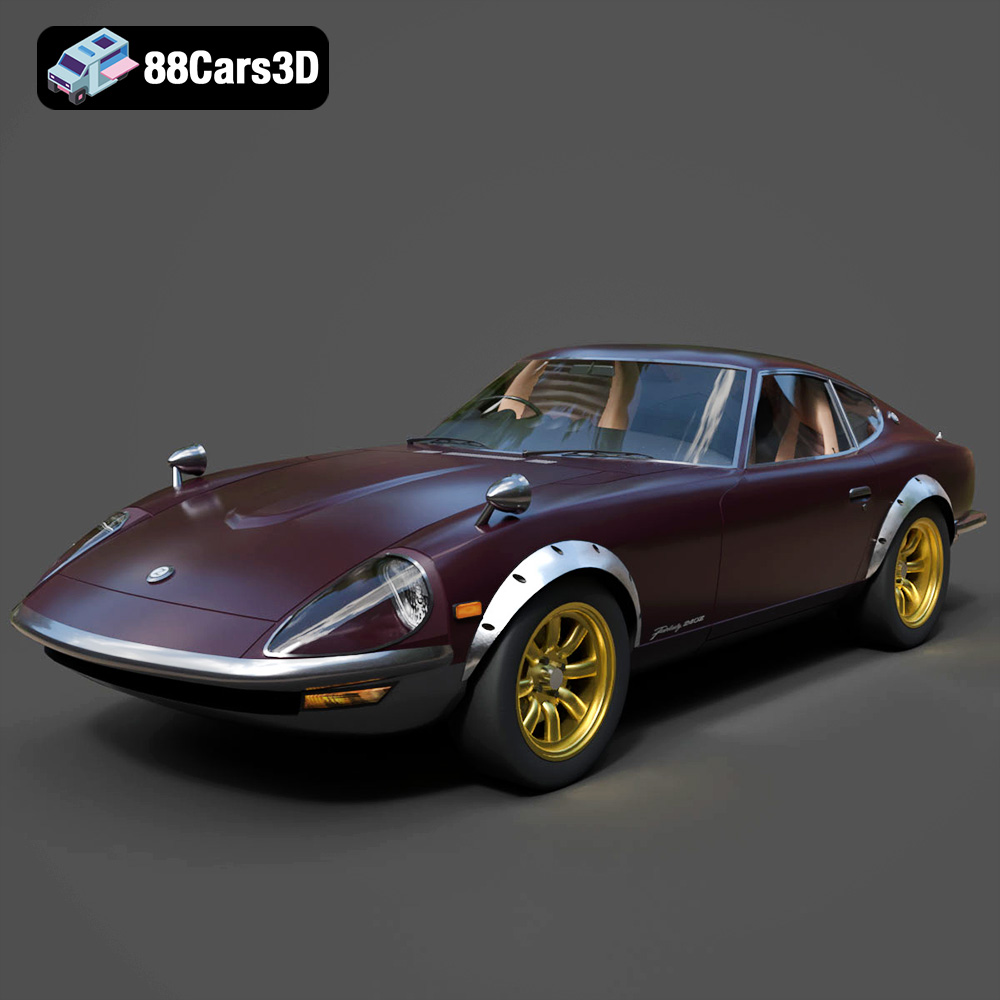
Nissan FairLady 240ZG 3D Model
Texture: Yes
Material: Yes
Download the Nissan FairLady 240ZG 3D Model featuring clean geometry, realistic detailing, and a fully modeled interior. Includes .blend, .fbx, .obj, .glb, .stl, .ply, .unreal, and .max formats for rendering, simulation, and game development.
Price: $4.99
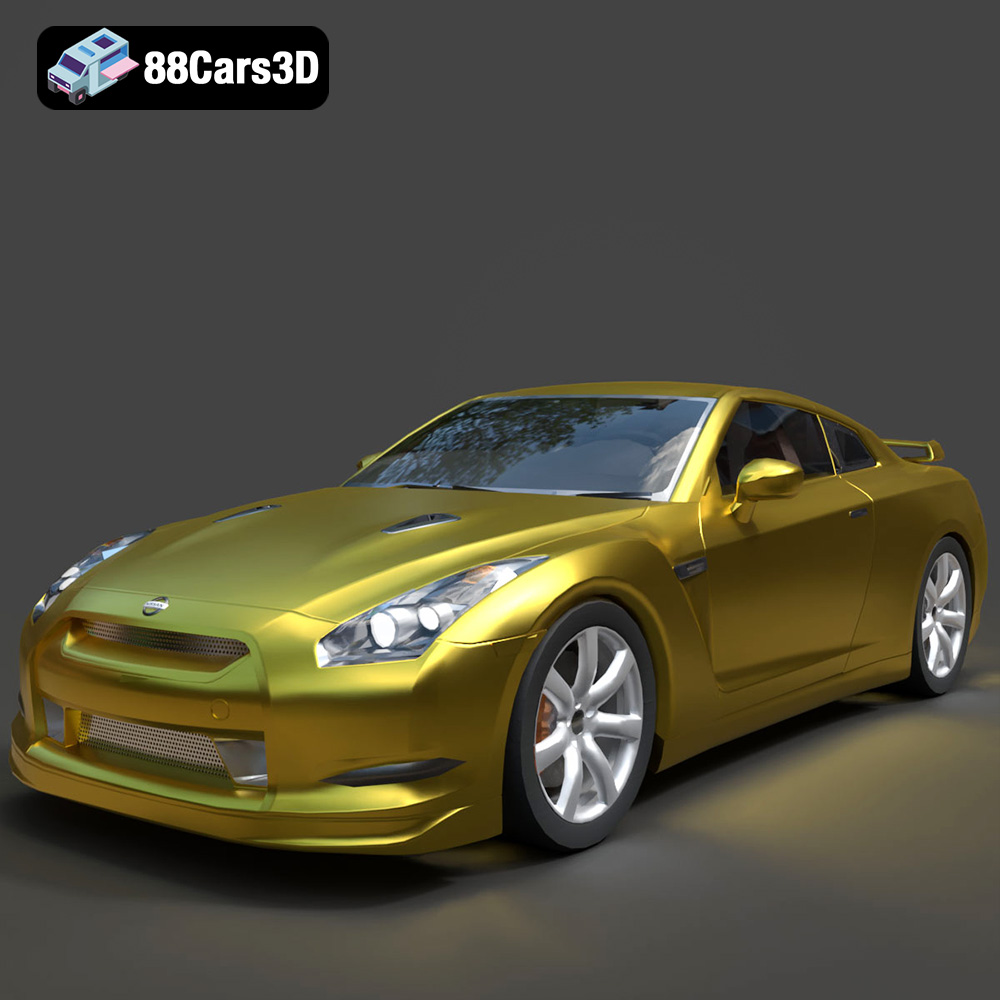
Nissan GT-R 2008 3D Model
Texture: Yes
Material: Yes
Download the Nissan GT-R 2008 3D Model featuring clean geometry, realistic detailing, and a fully modeled interior. Includes .blend, .fbx, .obj, .glb, .stl, .ply, .unreal, and .max formats for rendering, simulation, and game development.
Price: $4.99

Nissan Cube 3D Model
Texture: Yes
Material: Yes
Download the Nissan Cube 3D Model featuring clean geometry, realistic detailing, and a fully modeled interior. Includes .blend, .fbx, .obj, .glb, .stl, .ply, .unreal, and .max formats for rendering, simulation, and game development.
Price: $4.99

Nissan Cedric Y32 3D Model
Texture: Yes
Material: Yes
Download the Nissan Cedric Y32 3D Model featuring clean geometry, realistic detailing, and a fully modeled interior. Includes .blend, .fbx, .obj, .glb, .stl, .ply, .unreal, and .max formats for rendering, simulation, and game development.
Price: $4.99

Nissan Cima Infiniti Q45 2007 3D Model
Texture: Yes
Material: Yes
Download the Nissan Cima Infiniti Q45 2007 3D Model featuring clean geometry, realistic detailing, and a fully modeled interior. Includes .blend, .fbx, .obj, .glb, .stl, .ply, .unreal, and .max formats for rendering, simulation, and game development.
Price: $4.99

Nissan Juke 2025 3D Model
Texture: Yes
Material: Yes
Download the Nissan Juke 2025 3D Model featuring clean geometry, realistic detailing, and a fully modeled interior. Includes .blend, .fbx, .obj, .glb, .stl, .ply, .unreal, and .max formats for rendering, simulation, and game development.
Price: $4.99
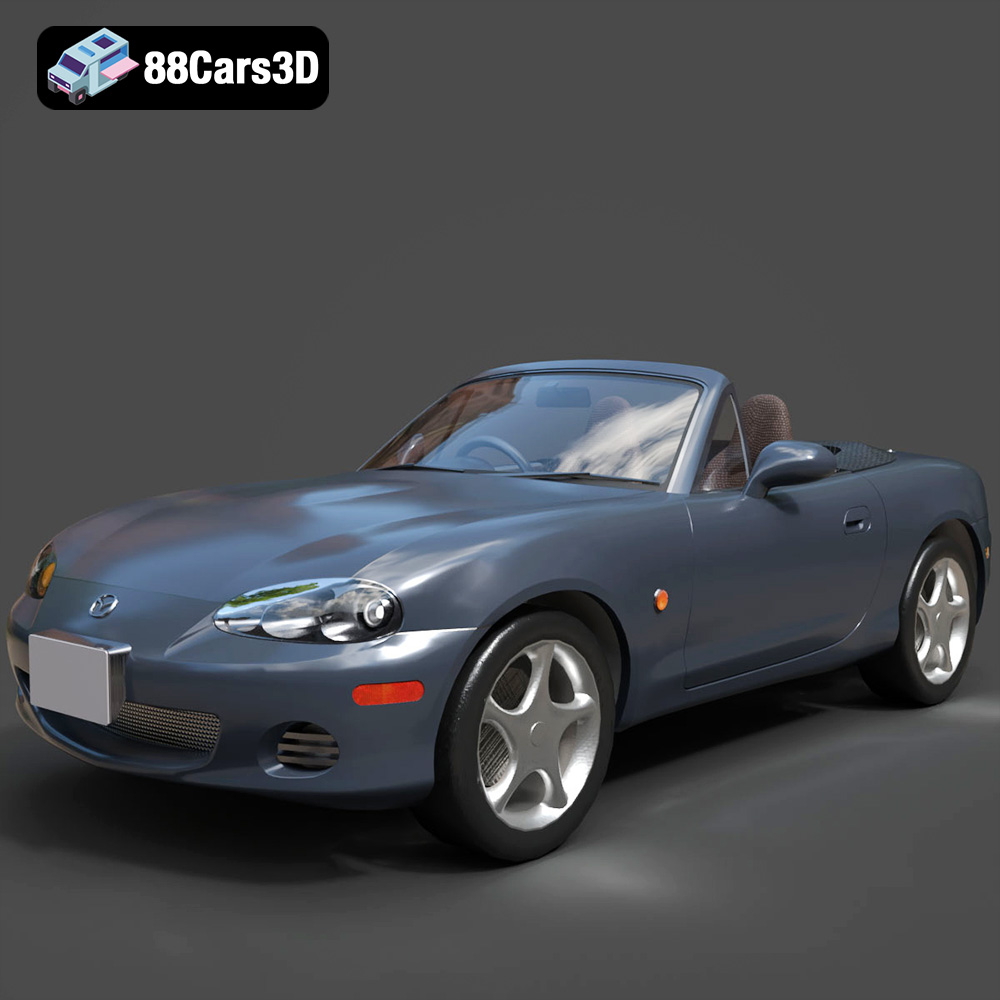
Mazda MX-5 2025 3D Model
Texture: Yes
Material: Yes
Download the Mazda MX-5 2025 3D Model featuring clean geometry, realistic detailing, and a fully modeled interior. Includes .blend, .fbx, .obj, .glb, .stl, .ply, .unreal, and .max formats for rendering, simulation, and game development.
Price: $4.99

Nissan Maxima 2009 3D Model
Texture: Yes
Material: Yes
Download the Nissan Maxima 2009 3D Model featuring clean geometry, realistic detailing, and a fully modeled interior. Includes .blend, .fbx, .obj, .glb, .stl, .ply, .unreal, and .max formats for rendering, simulation, and game development.
Price: $4.99
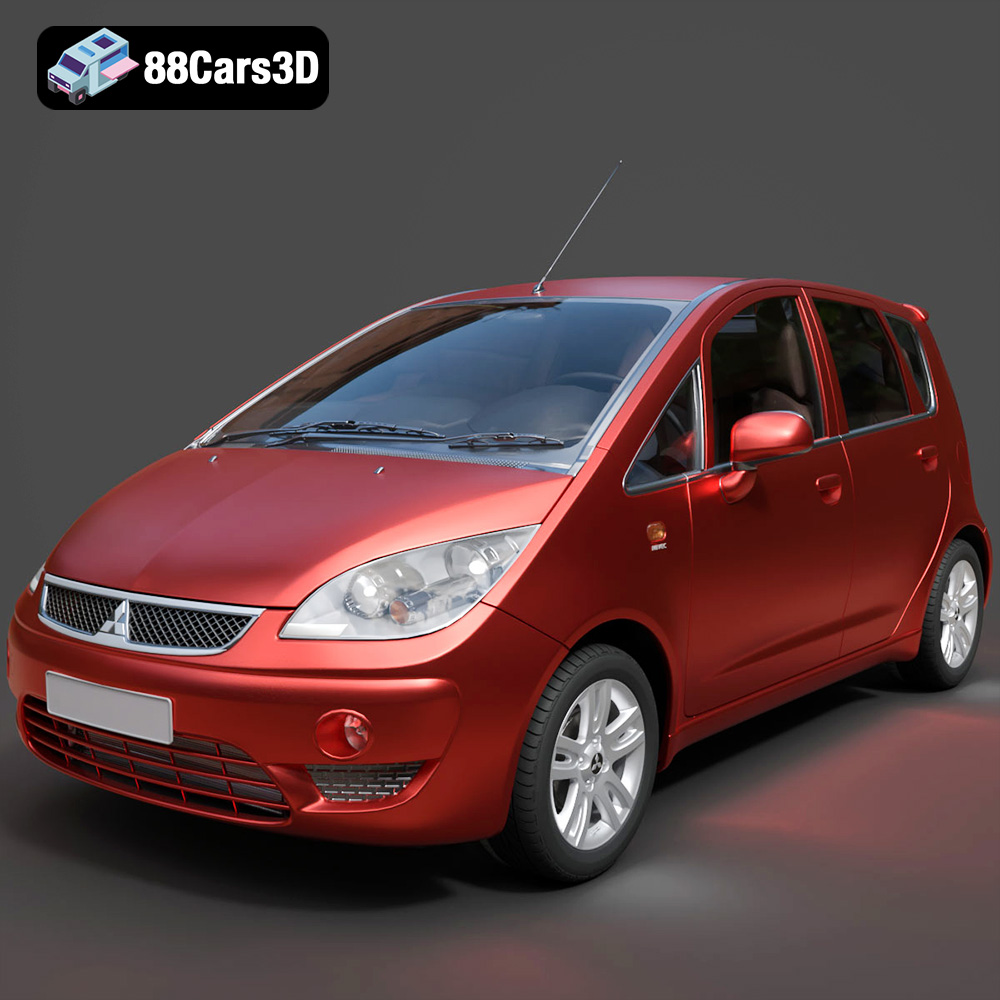
Mitsubishi Colt 2025 3D Model
Texture: Yes
Material: Yes
Download the Mitsubishi Colt 2025 3D Model featuring clean geometry, realistic detailing, and a fully modeled interior. Includes .blend, .fbx, .obj, .glb, .stl, .ply, .unreal, and .max formats for rendering, simulation, and game development.
Price: $4.99
