
The Ultimate Guide to Using 3D Car Models: From Photorealistic Rendering to Real-Time Applications

“`html
The Ultimate Guide to Using 3D Car Models: From Photorealistic Rendering to Real-Time Applications
In the world of digital creation, few assets are as versatile and visually compelling as a high-quality 3D car model. From stunning automotive renderings that grace magazine covers to interactive game assets that power immersive racing simulators, these digital vehicles are the cornerstone of countless projects. But acquiring a detailed model is only the first step. The true magic lies in knowing how to prepare, optimize, and deploy it effectively across different pipelines, whether for cinematic visuals, real-time applications, AR/VR experiences, or even physical 3D printing. This guide is your definitive roadmap to unlocking the full potential of your 3D car models.
We will dive deep into the technical intricacies that separate amateur results from professional-grade output. You will learn the critical importance of clean topology and strategic UV mapping, master the art of creating realistic PBR materials for car paint and chrome, and explore advanced rendering workflows in industry-standard software. Furthermore, we’ll dissect the essential optimization techniques required for game engines like Unity and Unreal Engine, demystify the complex world of file formats, and provide actionable steps for preparing models for the emerging frontiers of AR/VR and 3D printing. This comprehensive journey will equip you with the skills and knowledge to transform any 3D car model into a stunning final product.
The Foundation: Understanding High-Quality 3D Car Model Anatomy
Before you can render, animate, or optimize, you must understand the fundamental structure of a professional 3D car model. The quality of this underlying foundation dictates the potential of your final output. Sourcing a well-constructed asset from a reputable marketplace like 88cars3d.com is a crucial first step, as it provides a solid base built on industry best practices. A great model isn’t just about looking good at a glance; it’s about the precision of its construction, from the flow of its polygons to the organization of its components.
Topology and Edge Flow: The Blueprint of a Perfect Model
Topology refers to the arrangement of vertices, edges, and polygons that form the model’s mesh. For automotive models, which rely on smooth, flowing surfaces and precise reflections, good topology is non-negotiable. The industry standard is a quad-based mesh, meaning the model is constructed primarily from four-sided polygons. This is critical because quads subdivide cleanly and predictably when using modifiers like 3ds Max’s TurboSmooth or Blender’s Subdivision Surface, allowing you to create high-resolution renders without pinching or artifacts. Triangles and n-gons (polygons with more than four sides) can disrupt this flow, causing shading errors and visible seams on reflective surfaces. The edge flow should follow the natural contours of the car’s body panels, defining sharp creases and soft curves organically. A typical high-poly model for rendering might range from 500,000 to over 2 million polygons, while a real-time game asset might be optimized down to 50,000-150,000 triangles.
Clean UV Mapping: The Canvas for Your Textures
If topology is the skeleton, UV mapping is the skin. UV mapping is the process of unwrapping the 3D mesh into a 2D space so that textures can be applied correctly. For a complex object like a car, this is a meticulous task. Key considerations for professional UVs include:
- Minimal Distortion: The UV shells should be relaxed to prevent textures from stretching or compressing on the model’s surface.
- Strategic Seams: UV seams (where the mesh is “cut”) should be placed in inconspicuous areas, such as along panel gaps, on the underside of the car, or on sharp edges where they are less noticeable.
- Consistent Texel Density: This ensures that the texture resolution is uniform across the entire model. You wouldn’t want a high-resolution headlight next to a blurry door panel. Tools and scripts can help automate maintaining consistent density.
- UDIM Workflows: For ultra-high-resolution assets used in film or advertising, artists often use a UDIM (U-Dimension) workflow, which allows a single model to use multiple UV texture maps, enabling incredible detail (e.g., 8K textures for the main body, 4K for the wheels, etc.).
Model Organization and Hierarchy
A professional model is not a single, monolithic mesh. It’s a logically organized collection of distinct parts. Proper hierarchy and naming conventions are essential for an efficient workflow. A well-structured model will have components named descriptively (e.g., `wheel_front_left`, `door_driver`, `brake_caliper_FR`) and grouped logically. Furthermore, the pivot points of each object should be correctly placed to allow for realistic animation and interaction. The pivot for a door should be at its hinge, and the pivot for a wheel should be at its center axis for proper rotation. This organization is vital for animators, riggers, and game developers who need to manipulate individual parts of the vehicle.
Mastering Materials and Textures for Automotive Realism
The realism of a 3D car is ultimately judged by how its surfaces react to light. This is governed by its materials and textures. Modern real-time and offline rendering pipelines are built around the Physically Based Rendering (PBR) methodology, which simulates the flow of light in a physically plausible way. Crafting convincing PBR materials for the diverse surfaces of a car—from multi-layered paint to textured rubber and refractive glass—is an art form in itself.
The PBR Workflow: A Deep Dive
The PBR workflow simplifies material creation by using a set of intuitive texture maps that correspond to real-world physical properties. The most common PBR workflow is Metallic/Roughness. Its core components are:
- Base Color (Albedo): Defines the diffuse color of the surface. For a red car, this is the red paint. For a metal like chrome, it’s often near-black or a dark tint, as its appearance is dominated by reflections.
- Metallic: A grayscale map that determines if a surface is a metal (dielectric) or non-metal (insulator). Values are typically 0 (non-metal) or 1 (metal). For a car, the body paint is non-metal (0), while chrome trim is metal (1).
- Roughness: Perhaps the most important map for realism, this grayscale map controls how rough or smooth a surface is, which dictates how sharp or blurry its reflections are. A polished clear coat has a very low roughness value (e.g., 0.05), while a rubber tire has a high value (e.g., 0.8).
- Normal Map: Adds fine surface detail (like leather grain, tire treads, or small bumps) without adding extra polygons. It fakes the way light interacts with these small details.
Creating Complex Car Paint Shaders
A simple red material won’t cut it for car paint. Real automotive paint is a multi-layered material. In a 3D application like 3ds Max with Corona Renderer or Blender with Cycles, you can replicate this with a layered shader network:
- Base Layer: This is the paint color itself. It has its own Base Color and a moderate Roughness value.
- Flake Layer (Optional): For metallic paints, a “flake” layer is added. This is often simulated with a procedural noise texture (like Voronoi) that drives a secondary Normal map and influences the color or roughness slightly to create that sparkling effect under light.
- Clear Coat Layer: This is the most crucial part. A top layer with a low Roughness (e.g., 0.0 to 0.1) and a high Index of Refraction (IOR) of around 1.5-1.6 is added on top of the base layers. This clear coat is what gives car paint its deep, glossy reflections. Most modern render engines have a dedicated “Clearcoat” parameter in their primary PBR shader.
Texturing for Wear and Tear
No car is perfectly clean. Adding subtle imperfections is key to breaking the “perfect CG” look and achieving photorealism. This can be done by layering textures. For example, you can use procedural masks based on ambient occlusion or curvature to add a light layer of dust in crevices or subtle scratches on exposed edges. Tire sidewalls can be enhanced with a dirt map blended in, and brake discs can have heat tint and grime textures applied. These details, even when barely visible, collectively contribute to a much more believable final image.
Photorealistic Automotive Rendering Workflows
Creating jaw-dropping, photorealistic automotive renders is a common goal for visualizers, designers, and advertisers. This process combines the high-quality model and materials with sophisticated lighting, camera work, and post-processing. The choice of render engine and the techniques used can dramatically alter the final result.
Choosing Your Render Engine: Corona vs. V-Ray vs. Cycles
While many render engines can produce great results, a few stand out in the automotive visualization space:
- Corona Renderer: Known for its ease of use, speed, and photorealistic results with minimal tweaking. Its interactive light mixing and material library make it a favorite for studio shots and architectural visualization.
- V-Ray: A production-proven powerhouse used extensively in VFX and high-end automotive advertising. It offers immense control over every aspect of the rendering process, though it has a steeper learning curve than Corona.
- Blender Cycles: A powerful, free, and open-source path-tracing engine built directly into Blender. With recent advancements, its quality rivals that of its commercial counterparts, making it an excellent choice for artists of all levels.
Lighting Setups for Studio and Environment Renders
Lighting is everything in rendering. For classic studio shots, a three-point lighting setup (Key, Fill, and Rim lights) is a great starting point, but automotive lighting is often more complex. Many artists use large area lights or softboxes to create broad, soft reflections that accentuate the car’s curves. An even more powerful technique is Image-Based Lighting (IBL) using a High Dynamic Range Image (HDRI). An HDRI map of a real-world location (a desert road, a modern city, a photography studio) is wrapped around the scene, providing both realistic lighting and detailed reflections on the car’s surface. This is the fastest way to ground your model in a believable environment.
Camera and Post-Processing Techniques
Treat your 3D camera like a real-world DSLR. Use realistic camera properties like a focal length between 50mm and 85mm to avoid distortion. Use a low F-Stop (aperture) value like f/2.8 to create a shallow depth of field, which helps to focus the viewer’s attention and add a cinematic quality. After rendering, the image is taken into a post-processing application like Adobe Photoshop or DaVinci Resolve. Here, you can perform:
- Color Grading: Adjusting contrast, saturation, and color balance to achieve a specific mood.
- Effects: Adding subtle bloom and glare to highlights for extra realism.
- Compositing: Integrating the rendered car with a photographic backplate for a seamless final image.
Optimizing 3D Car Models for Game Engines and Real-Time Applications
The requirements for a real-time game asset are fundamentally different from a high-poly rendering model. In gaming, performance is paramount. Every polygon and texture must be justified to maintain a smooth frame rate (e.g., 60 FPS). This requires a dedicated optimization process to make the model “game-ready.”
The Art of Polygon Reduction and LODs
A 2-million-polygon model would bring any game engine to its knees. The first step is polygon reduction, often through manual retopology, where an artist builds a new, low-poly mesh over the high-poly source. The detail from the high-poly model is then “baked” into Normal maps for the low-poly version. More importantly, professional game assets use Levels of Detail (LODs). This involves creating multiple versions of the model at decreasing levels of complexity:
- LOD0: The highest quality version (e.g., 80,000 triangles), seen when the player is close.
- LOD1: A reduced version (e.g., 40,000 triangles), swapped in when the car is at a medium distance.
- LOD2: A heavily simplified version (e.g., 10,000 triangles) for distant viewing.
- LOD3: A very basic “impostor” or billboard for when the car is a speck on the horizon.
The game engine automatically switches between these LODs based on the car’s distance from the camera, drastically improving performance.
Texture Optimization: Atlasing and Mipmapping
High-resolution 4K or 8K textures are overkill for most game assets and consume precious video memory (VRAM). Game textures are often downsized to 2K (2048×2048) or 1K (1024×1024). Two key techniques are used:
- Texture Atlasing: Instead of having separate small textures for the headlights, badges, grille, and taillights, their UVs are arranged to fit onto a single, larger texture sheet (an “atlas”). This is a huge performance win.
- Mipmapping: The engine automatically generates a series of pre-filtered, lower-resolution versions of a texture. When an object is far away, the engine uses a smaller mipmap, which improves performance and reduces shimmering artifacts.
Textures are also compressed into formats like DXT or BC to reduce file size and VRAM usage.
Mastering Draw Calls and Material Instancing
A draw call is a command from the CPU to the GPU to draw an object on the screen. Too many draw calls can create a CPU bottleneck and lower frame rates. Each unique material applied to an object in the scene typically results in one draw call. A car with 20 different materials would generate 20 draw calls. By using texture atlasing to combine multiple parts into a single material, you can significantly reduce this number. In engines like Unreal Engine, Material Instancing allows you to create variations of a master material (e.g., different paint colors) very efficiently, without creating entirely new materials and adding to the draw call count.
Preparing Car Models for AR, VR, and 3D Printing
Beyond traditional rendering and gaming, 3D car models are increasingly used in augmented reality, virtual reality, and for creating physical replicas via 3D printing. Each of these applications has its own unique set of technical requirements and preparation steps.
AR/VR Specifics: Performance is King
Augmented Reality (AR) on mobile devices and Virtual Reality (VR) headsets have even stricter performance budgets than traditional PC or console games. For a smooth AR experience, a car model should be heavily optimized, often below 100,000 triangles, with only a few materials using 1K or 2K textures. The key is to find a balance between visual fidelity and performance. File formats are also crucial. The GLB format is the standard for web-based AR and most Android applications, as it packages the model, textures, and other data into a single compact file. For Apple’s ecosystem (iOS, iPadOS), the USDZ format is the native standard. High-quality asset providers, including platforms like 88cars3d.com, often provide these optimized, ready-to-use formats alongside the high-poly source files.
From Digital to Physical: 3D Printing Preparation
To turn a digital model into a physical object, the mesh must be prepared for the 3D printer’s slicer software. The primary requirement is that the model must be “watertight” or manifold. This means it must be a single, continuous, closed volume with no holes. You can use tools like Blender’s 3D-Print Toolbox or standalone software like Meshmixer to check for and repair issues like non-manifold edges or inverted normals. You also need to consider the physical constraints of printing:
- Wall Thickness: Parts must have sufficient thickness to be printed without breaking.
- Separated Parts: It’s often easier to print a car model as separate components (body, wheels, axles) and assemble them later.
- Detail Level: Extremely fine details may not be reproducible on standard FDM or SLA printers and may need to be exaggerated or removed.
File Formats and Pipeline Integration
Integrating a 3D car model into your specific workflow requires an understanding of the various file formats and how they transfer data between different software applications. Choosing the right format can save hours of rework and prevent compatibility headaches.
Navigating the Alphabet Soup: FBX, OBJ, GLB, and USDZ
While dozens of formats exist, a few are dominant in the industry:
- FBX (.fbx): The industry workhorse. Developed by Autodesk, it’s the best format for transferring complex scene data, including geometry, UVs, materials, lights, cameras, and animations, between applications like 3ds Max, Maya, Blender, Unity, and Unreal Engine.
- OBJ (.obj): An older but still widely supported format. It’s excellent for transferring simple static geometry and UV data but has limited support for complex materials or animations.
- GLB (.glb): A binary version of the glTF format, designed as the “JPEG of 3D.” It’s the standard for web and AR applications, efficiently packing all model data and textures into a single file for fast loading.
- USDZ (.usdz): Developed by Apple and Pixar, this format is built for AR. It’s the standard for displaying 3D content on Apple devices and is optimized for mobile performance.
Building a Non-Destructive Workflow
A professional best practice is to always maintain a high-resolution, non-destructive source file of your model (e.g., a `.max` file with an intact modifier stack or a `.blend` file). From this master file, you can then export various derivative versions tailored to specific needs: a high-poly version for rendering, a game-ready FBX with LODs, a GLB for a web viewer, etc. This approach ensures that you can always go back to the source to make changes or export for a new purpose without having to start from scratch. It provides maximum flexibility and future-proofs your asset for any pipeline.
Conclusion: Your Journey Starts Now
We’ve traveled from the microscopic level of polygon edge flow to the broad strokes of cinematic lighting and the demanding constraints of real-time performance. It’s clear that a 3D car model is not just a static object but a versatile digital asset with boundless potential. The key to success is understanding its fundamental structure and knowing how to adapt it to the unique demands of your chosen application. Whether you are an automotive designer creating a stunning portfolio, a game developer building the next great racing title, or an AR creator bringing virtual showrooms to life, these principles are your guide to achieving professional, high-quality results.
The journey from a raw model to a polished final product is a rewarding one that blends technical skill with artistic vision. The next step is to put this knowledge into practice. Start with a high-quality, well-constructed model from a source you can trust, and begin applying these techniques to your own projects. Experiment with different rendering setups, push the limits of optimization, and explore new applications. By mastering these workflows, you can ensure that every 3D car model you work with realizes its full, spectacular potential.
“`
Featured 3D Car Models

Mercedes-Benz SLK 350 2005 3D Model
Texture: Yes
Material: Yes
Download the Mercedes-Benz SLK 350 2005 3D Model featuring clean geometry, realistic detailing, and a fully modeled interior. Includes .blend, .fbx, .obj, .glb, .stl, .ply, .unreal, and .max formats for rendering, simulation, and game development.
Price: $9.99

Mercedes-Benz SL 65 AMG 3D Model
Texture: Yes
Material: Yes
Download the Mercedes-Benz SL 65 AMG 3D Model featuring clean geometry, realistic detailing, and a fully modeled interior. Includes .blend, .fbx, .obj, .glb, .stl, .ply, .unreal, and .max formats for rendering, simulation, and game development.
Price: $9.99

Mercedes-Benz S500 3D Model
Texture: Yes
Material: Yes
Download the Mercedes-Benz S500 3D Model featuring clean geometry, realistic detailing, and a fully modeled interior. Includes .blend, .fbx, .obj, .glb, .stl, .ply, .unreal, and .max formats for rendering, simulation, and game development.
Price: $9.99

Mercedes-Benz S55 W220 AMG 1999 3D Model
Texture: Yes
Material: Yes
Download the Mercedes-Benz S55 W220 AMG 1999 3D Model featuring clean geometry, realistic detailing, and a fully modeled interior. Includes .blend, .fbx, .obj, .glb, .stl, .ply, .unreal, and .max formats for rendering, simulation, and game development.
Price: $9.99

Mercedes-Benz CLA45 AMG 2017 3D Model
Texture: Yes
Material: Yes
Download the Mercedes-Benz CLA45 AMG 2017 3D Model featuring clean geometry, realistic detailing, and a fully modeled interior. Includes .blend, .fbx, .obj, .glb, .stl, .ply, .unreal, and .max formats for rendering, simulation, and game development.
Price: $29.99

Mercedes-Benz CL65 C215 AMG 3D Model
Texture: Yes
Material: Yes
Download the Mercedes-Benz CL65 C215 AMG 3D Model featuring clean geometry, realistic detailing, and a fully modeled interior. Includes .blend, .fbx, .obj, .glb, .stl, .ply, .unreal, and .max formats for rendering, simulation, and game development.
Price: $9.99

Mercedes-Benz A45 2021 3D Model
Texture: Yes
Material: Yes
Download the Mercedes-Benz A45 2021 3D Model featuring clean geometry, realistic detailing, and a fully modeled interior. Includes .blend, .fbx, .obj, .glb, .stl, .ply, .unreal, and .max formats for rendering, simulation, and game development.
Price: $9.99

Mercedes-Benz 300SL 1955 3D Model
Texture: Yes
Material: Yes
Download the Mercedes-Benz 300SL 1955 3D Model featuring clean geometry, realistic detailing, and a fully modeled interior. Includes .blend, .fbx, .obj, .glb, .stl, .ply, .unreal, and .max formats for rendering, simulation, and game development.
Price: $9.99

Mercedes-Benz 190SL 1955 3D Model
Texture: Yes
Material: Yes
Download the Mercedes-Benz 190SL 1955 3D Model featuring clean geometry, realistic detailing, and a fully modeled interior. Includes .blend, .fbx, .obj, .glb, .stl, .ply, .unreal, and .max formats for rendering, simulation, and game development.
Price: $9.99
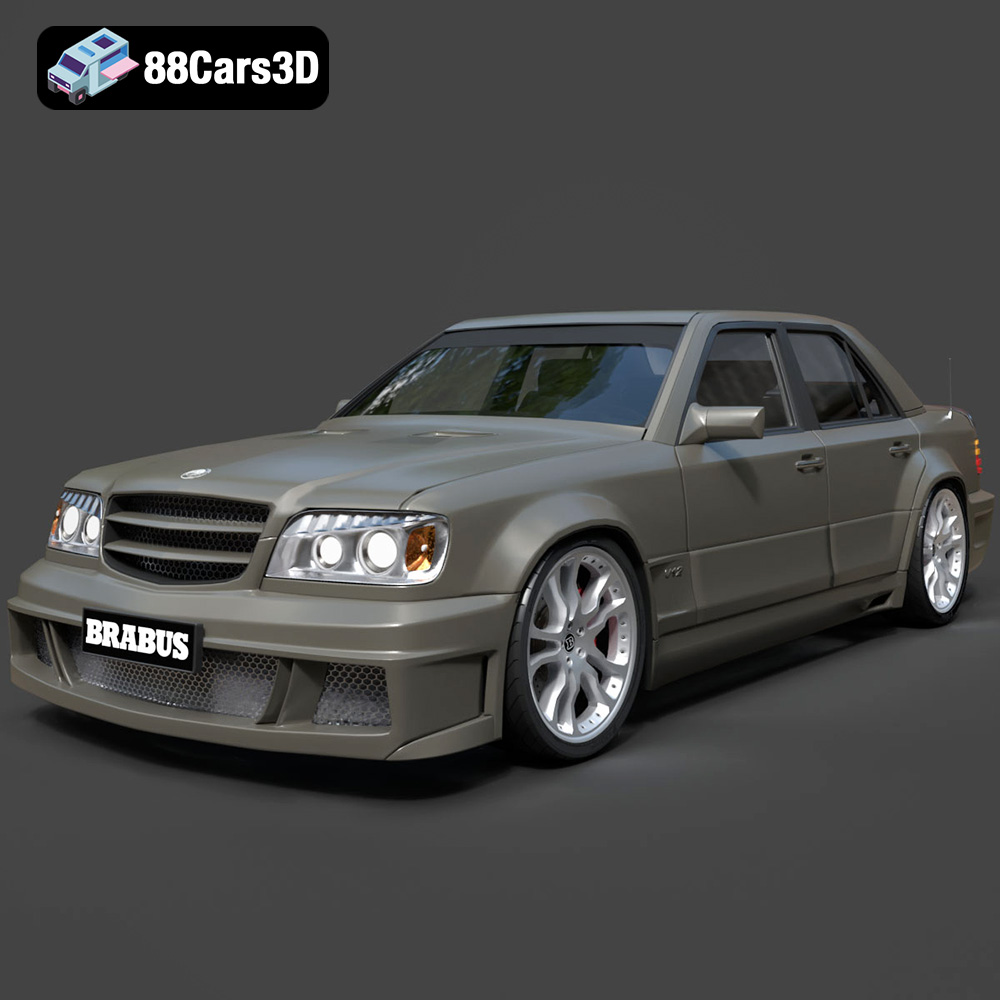
Mercedes-Benz W124 Brabus V12 3D Model
Texture: Yes
Material: Yes
Download the Mercedes-Benz W124 Brabus V12 3D Model featuring clean geometry, realistic detailing, and a fully modeled interior. Includes .blend, .fbx, .obj, .glb, .stl, .ply, .unreal, and .max formats for rendering, simulation, and game development.
Price: $9.99