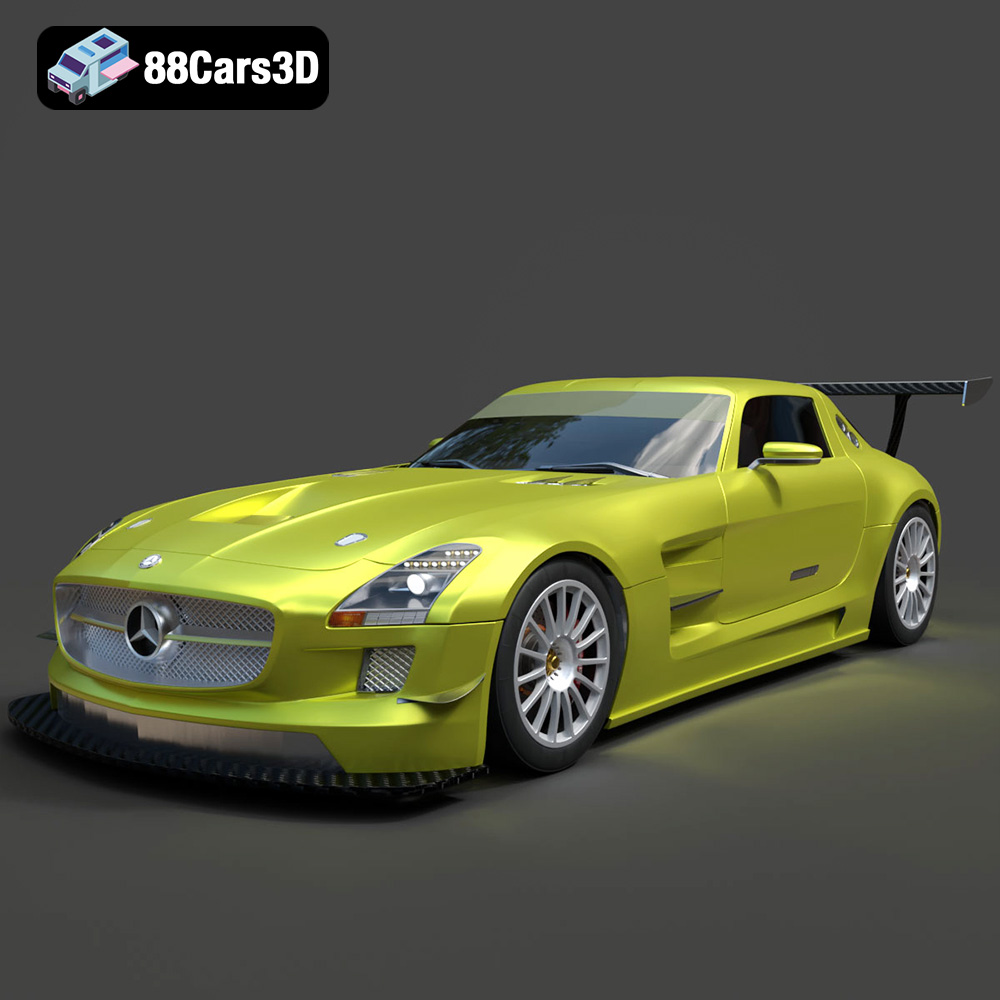
From Showroom to Screen: A Technical Guide to Using 3D Car Models for Photorealistic Renders and Real-Time Applications

From Showroom to Screen: A Technical Guide to Using 3D Car Models for Photorealistic Renders and Real-Time Applications
There’s an undeniable magic to a beautifully rendered car. Whether it’s a hyper-realistic sports car gleaming under studio lights in a commercial, a battle-scarred vehicle tearing through a dystopian landscape in a video game, or an interactive configurator that lets you customize your dream ride in real-time, digital vehicles captivate us. But behind every stunning image or immersive experience lies a complex and fascinating technical pipeline. The foundation of that pipeline is the 3D car model itself—a digital asset whose quality and preparation dictate the success of the entire project.
This comprehensive guide will take you under the hood, exploring the essential workflows for two primary use cases: high-fidelity offline rendering for advertising and cinematics, and optimized real-time applications for games and interactive experiences. We’ll break down the technical specifications, software-specific techniques, and best practices that transform a collection of polygons into a photorealistic digital masterpiece. Understanding these principles is crucial whether you are creating assets from scratch or selecting production-ready models for your next project.
The Anatomy of a Production-Ready 3D Car Model
Before you can even think about lighting or rendering, you must start with a superior asset. Not all 3D models are created equal, and the differences become glaringly obvious under the scrutiny of a rendering engine. A professional-grade 3D car model is a symphony of carefully considered components.
Topology, Poly Count, and Subdivision
Topology refers to the flow and structure of polygons (quads, ideally) across the model’s surface. Good topology is clean, follows the natural curves and panel lines of the vehicle, and deforms predictably. This is crucial for achieving smooth, accurate reflections.
- High-Polygon Models: Used for offline automotive rendering where detail is paramount. These models can range from 500,000 to several million polygons. They are often “subdivision-ready,” meaning they are modeled with a lower-poly base cage that can be smoothed algorithmically (like with 3ds Max’s TurboSmooth or Blender’s Subdivision Surface modifier) to create perfectly smooth surfaces without any faceting.
- Low-Polygon Models (Game Assets): Built for performance in real-time engines. Poly count is a critical budget. A hero vehicle in a modern AAA game might be between 80,000 and 200,000 polygons. These models rely heavily on Normal maps to fake high-frequency detail. They often include Levels of Detail (LODs)—progressively lower-poly versions of the model that are swapped in as the car gets further from the camera.
UV Unwrapping and PBR Texturing
UV unwrapping is the process of flattening the 3D model’s surface into a 2D map so textures can be applied correctly. For a complex object like a car, this is a meticulous process.
- Clean UVs: A professional model will have non-overlapping UV islands, minimal distortion, and efficiently packed UV shells to maximize texture resolution. Separate materials for different parts (body, wheels, glass, interior) are standard.
- PBR Textures: Physically Based Rendering (PBR) is the industry standard for creating realistic materials. A good model will come with a set of PBR textures, typically including: Albedo (base color), Roughness (controls how diffuse or glossy reflections are), Metallic (defines which parts are metal), and a Normal map (adds surface detail like bumps and dents without adding polygons).
Hierarchy and File Formats
A well-structured model is easy to work with. The object hierarchy should be logically named and grouped (e.g., all wheel components parented to an empty at the wheel’s pivot point). This is essential for animation and rigging.
- .MAX / .BLEND: Native files for 3ds Max and Blender, often containing pre-configured materials and render setups.
- .FBX: The industry standard for transferring assets between applications. It preserves hierarchy, materials, textures, and even animation data. This is the preferred format for game engines.
- .OBJ: An older but still widely supported format. It’s great for static models but is less sophisticated than FBX, often losing complex material and hierarchy information.
The Offline Rendering Workflow: Achieving Photorealism
When your goal is a single, breathtaking image or a cinematic sequence for an advertisement, performance takes a back seat to pure visual fidelity. Here, we use powerful offline renderers like V-Ray, Corona, or Arnold to simulate light with incredible accuracy.
Scene and Lighting Setup in 3ds Max + V-Ray
Let’s walk through a typical studio shot workflow. After importing a high-quality model, the first step is creating a believable environment.
- Environment: Start with a simple cyclorama or ground plane with curved edges to create a seamless background.
- Lighting with HDRI: The fastest way to achieve realistic lighting and reflections is with a High Dynamic Range Image (HDRI). Use a V-Ray Dome Light and load a high-resolution HDRI of a studio environment. This single light source provides soft, nuanced global illumination.
- Key and Fill Lights: Supplement the HDRI with V-Ray Plane Lights (area lights) to act as key lights, creating specular highlights that define the car’s shape. Use large, soft lights to mimic softboxes and smaller, more intense lights to create sharp “ping” reflections along body lines.
- Camera: Always use a physical camera (V-Ray Physical Camera). This gives you real-world controls like F-stop (for depth of field), shutter speed, and ISO, allowing for intuitive and realistic results.
Crafting Advanced Car Paint Materials
A convincing car paint material is layered and complex. Most renderers have a dedicated Car Paint shader, but building one manually provides maximum control. In V-Ray, you can use a VRayBlendMtl to layer materials:
- Base Layer (VRayMtl): This is the diffuse color of the paint.
- Flake Layer (VRayMtl): For metallic paints, this layer uses a noise or flake map in the reflection color slot to simulate metallic flakes. The flakes should have very sharp, high-gloss reflections. You can control the flake color to create different effects.
- Coat Layer (VRayMtl): This is the clear coat. It’s a fully transparent material with a high Index of Refraction (around 1.5-1.6) and highly reflective properties. The key is to give it a slightly imperfect glossiness using a subtle noise or smudge map in the reflection glossiness slot to break up the “perfect CG” look.
Layering these with V-Ray’s blend material allows the clear coat to sit on top of the base and flake layers, creating a realistic sense of depth just like real car paint.
Post-Production and Compositing
No render is truly finished straight out of the engine. The final 10% of polish happens in post-production using tools like Adobe Photoshop or After Effects. Render out multiple passes (Render Elements in V-Ray) like VrayReflection, VraySpecular, Z-Depth (for fog or depth of field effects), and Ambient Occlusion. Compositing these passes gives you granular control over the final image, allowing you to tweak reflections, enhance shadows, and color grade the shot to perfection without needing to re-render everything.
The Real-Time Workflow: Performance and Interactivity
When developing for games, VR, or AR, the goal shifts from absolute realism to the best possible realism that can be rendered 60 times per second or more. This is a world of budgets, optimization, and clever shader tricks.
Asset Preparation for Unreal Engine 5
Getting a 3D car model ready for a game engine like Unreal Engine 5 requires careful preparation. You’ll want a model that is already optimized, often referred to as a “game-ready” asset. Using a high-quality base from a marketplace like 88cars3d.com can save hundreds of hours of manual optimization and cleanup.
- LOD Generation: If the model doesn’t come with LODs, you’ll need to create them. LOD0 is the highest quality model. LOD1 might be 50% of the polygons, LOD2 25%, and so on. This can be done manually or with tools like InstaLOD.
- Collision Mesh: A simple, invisible mesh (or series of convex hulls) is created to represent the car’s physical shape for collision detection. This is much more performant than using the detailed visual mesh for physics calculations.
- FBX Export: Export the visual meshes, LODs, and collision meshes in a single FBX file from your 3D application with the correct naming conventions for Unreal to automatically recognize them.
Material and Shader Setup in UE5
Unreal Engine’s material editor is incredibly powerful. The goal is to create a flexible “Master Material” for the car paint that can be instanced and customized.
- Master Material: Create a new material and set up nodes for your PBR textures (Albedo, Normal, and a packed “ORM” texture for Occlusion, Roughness, Metallic). Expose parameters for things you want to change later, such as Base Color, Roughness intensity, and metallic flake tiling.
- Material Instances: From the Master Material, you can create Material Instances. These are lightweight “children” of the master where you can change the exposed parameters without recompiling the shader. This allows you to create dozens of color variations (red, blue, black, etc.) for the car incredibly efficiently.
- Glass and Lights: Transparent materials for glass and emissive materials for headlights and taillights are created separately. Unreal’s advanced shaders can create highly realistic glass with refraction and specular highlights.
Rigging for Drivable Vehicles with Chaos
To make the car drivable, it needs a skeleton (a rig) and a physics setup. Unreal Engine 5’s Chaos Vehicle system is the standard for this.
- Skeletal Rig: In your 3D software, create a simple skeleton. You need a root bone for the car body, and then four bones for the wheels, placed exactly at their pivot points. Skin the car body to the root bone and each wheel to its corresponding bone.
- Physics Asset: Once imported into Unreal, a Physics Asset is generated. Here you’ll configure the collision bodies for the chassis and wheels.
- Vehicle Blueprint: The logic is handled in a Blueprint. You’ll use a Vehicle Movement Component, where you define engine parameters (torque curves), transmission settings, and assign the wheel bones. With the inputs configured, this Blueprint makes the game asset come to life as a fully drivable vehicle.
Real-World Applications and Case Studies
Let’s see how these workflows apply in practice.
Case Study 1: High-End Automotive Advertisement
Scenario: An advertising agency needs a hero shot of a luxury sedan for a magazine cover. The deadline is tight.
Workflow: Instead of spending weeks modeling from scratch, the team licenses a production-ready, high-polygon model from a trusted source. The model is imported into 3ds Max. They use a V-Ray Dome Light with a “golden hour” HDRI to establish the mood. Three additional V-Ray Plane Lights are strategically placed to trace the elegant curves of the car’s body with specular highlights. The layered V-Ray car paint material is tweaked to a custom deep metallic red. The final image is rendered at 8K resolution with multiple render passes, which are then composited in Photoshop for final color grading and polish.
Case Study 2: Hero Car for an Indie Racing Game
Scenario: An indie game studio is developing a racing game in Unreal Engine 5 and needs a customizable hero car.
Workflow: The team acquires a game-ready 3D car model that already includes LODs and is fully UV unwrapped for PBR texturing. The model is imported into UE5. A Master Car Paint Material is created with parameters for base color, metallic flake intensity, and a “dirt” mask that can be procedurally layered on top. Using Material Instances, they create 20 different paint jobs in under an hour. The pre-rigged skeleton is configured using the Chaos Vehicle system, and a Blueprint is scripted to handle the driving physics and player controls. The result is a high-performance, visually stunning, and fully customizable game asset ready for the racetrack.
Conclusion: The Asset is Your Starting Line
Whether you’re chasing the last degree of photorealism in an offline render or balancing fidelity and performance for a real-time application, the journey always begins with the 3D car model. A well-constructed asset with clean topology, meticulous UVs, and high-quality textures is not a shortcut; it’s a professional foundation that enables creativity and technical excellence.
Understanding the distinct workflows for offline automotive rendering and real-time game assets allows you to make informed decisions and tackle any project with confidence. By leveraging the power of modern software and starting with best-in-class assets, such as those found on marketplaces like 88cars3d.com, you can focus less on technical problem-solving and more on what truly matters: creating breathtaking digital automotive experiences that leave a lasting impression.
Featured 3D Car Models