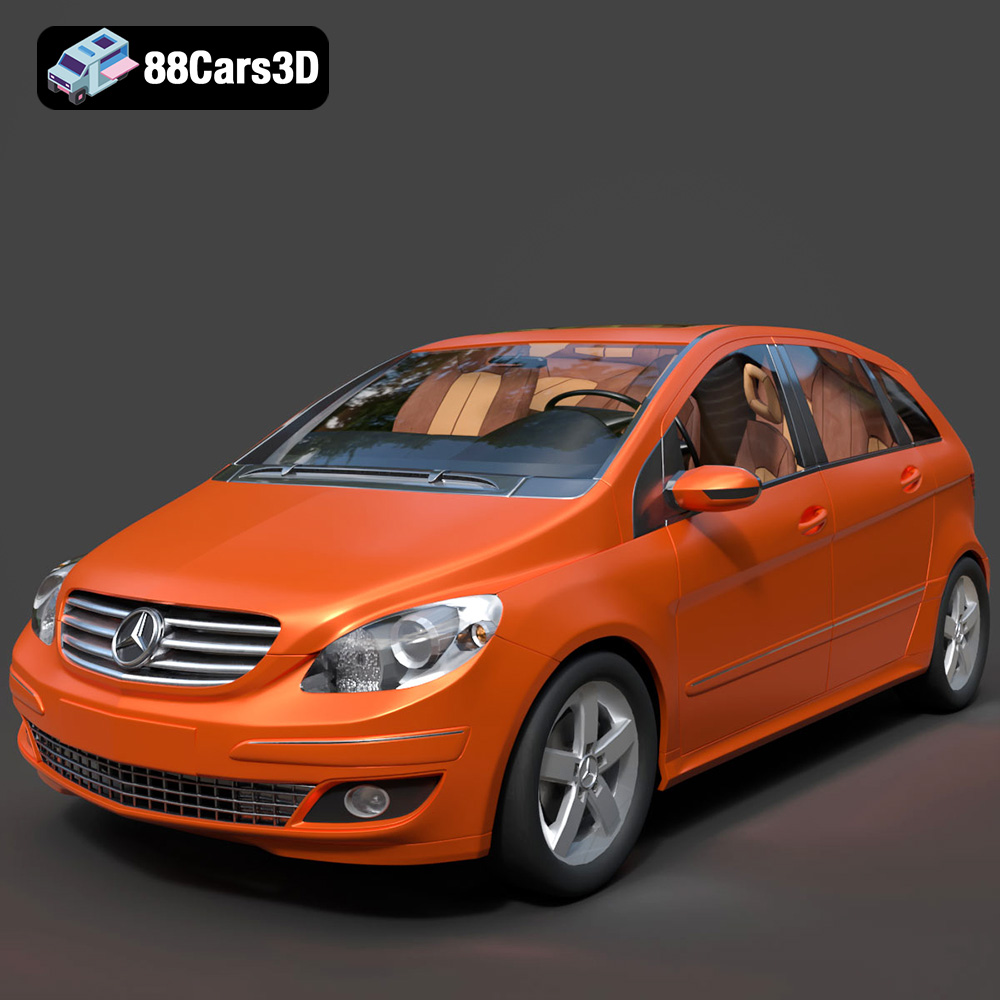
From Showroom to Screen: The Ultimate Guide to Using 3D Car Models for Professional Renders and Games

From Showroom to Screen: The Ultimate Guide to Using 3D Car Models for Professional Renders and Games
The glint of light across a perfectly curved fender, the intricate detail of a leather-stitched interior, the aggressive stance of a supercar ready to pounce. Capturing the essence of automotive design in the digital realm is one of the most challenging yet rewarding tasks for any 3D artist. Creating a photorealistic car from scratch is a monumental undertaking, often requiring hundreds of hours of meticulous modeling, texturing, and shading. This is where high-quality, professionally crafted 3D car models become an indispensable asset for artists, designers, and developers alike.
This comprehensive guide will take you deep into the technical workflows for transforming a premium 3D car model into a stunning piece of portfolio-worthy automotive rendering or a high-performance, interactive game asset. We’ll move beyond the basics and explore the specific considerations, software techniques, and optimization strategies that separate amateur results from professional-grade output. Whether you’re an architectural visualizer needing a hero car for your scene, a game developer building a racing simulator, or a filmmaker creating the next big chase sequence, mastering these techniques is crucial.
The Anatomy of a Production-Ready 3D Car Model
Not all 3D models are created equal. Before you even import a model into your software of choice, understanding its core components is vital. A production-ready asset is built with precision and foresight, ensuring it’s versatile enough for both ultra-realistic renders and real-time applications.
Topology and Polygon Count: The Foundation of Form
The underlying mesh structure, or topology, dictates how a model will look, deform, and catch light. For automotive models, look for clean, quad-based topology. Quads (four-sided polygons) subdivide predictably, which is essential for creating smooth, artifact-free surfaces required for close-up renders. Avoid models with excessive triangles or complex n-gons, especially on visible body panels, as these can cause pinching and shading errors.
Polygon count is a balancing act. For high-end automotive rendering, a model with 500,000 to 2 million polygons provides the necessary detail for headlights, grilles, and interior components. For game assets, this high-poly version serves as the source for baking details onto a much lower-poly model (often 50,000 to 150,000 polygons).
UV Unwrapping and Texture Fidelity
A model’s UV map is like a flattened-out blueprint of its surface, dictating how 2D textures are applied to the 3D object. A professional model will have non-overlapping, efficiently laid-out UVs. For hyper-realism, look for models that support UDIMs (U-Dimension), a workflow that allows a single object to use multiple, high-resolution texture maps. This is key for capturing minute details like paint flakes, brake caliper text, and dashboard icons without sacrificing quality.
Textures themselves should be high-resolution (4K or 8K) and based on a Physically Based Rendering (PBR) workflow, typically using Metalness/Roughness or Specular/Glossiness maps to accurately simulate how light interacts with different materials.
Model Hierarchy and Preparation
A great 3D car model is more than just a static shell. It should be logically organized. This means a proper hierarchy with components correctly named and grouped (e.g., all left-front wheel components parented to a single null object). Doors, wheels, the steering wheel, and wipers should be separate objects with their pivot points correctly placed for easy animation and interaction. This preparation saves countless hours of cleanup work down the line.
Workflow for Photorealistic Automotive Rendering
Once you have a quality model, the next step is to place it in a virtual studio and bring it to life. The goal here is photorealism, where every reflection and shadow feels authentic.
Studio Setup in 3ds Max with V-Ray/Corona
This combination is an industry standard for automotive visualization. The workflow is methodical:
- Import and Scene Setup: Import your FBX or OBJ model. The first step is crucial: check your scene units (e.g., set to centimeters) and ensure the model has been imported to the correct real-world scale. An incorrectly scaled car will react to light and camera depth-of-field unnaturally.
- Lighting: Start with an HDRI (High Dynamic Range Image) loaded into a V-Ray Dome Light or Corona Sky. Choose an HDRI of a professional photo studio or a clean outdoor environment. This provides realistic global illumination and reflections. Augment this by adding large, soft area lights to create key, fill, and rim lighting that sculpts the car’s form and creates appealing specular highlights.
- Camera: Use a physical camera. A focal length between 50mm and 85mm is ideal for avoiding distortion and creating natural-looking “portrait” shots of the car. Enable depth of field with a low F-stop (e.g., f/2.8 to f/5.6) to create a beautifully blurred background that draws focus to your subject.
Achieving Believability in Blender with Cycles
Blender’s Cycles engine is a powerful, path-tracing renderer capable of incredible realism. The principles are similar to 3ds Max, but the tools differ slightly.
- Shader Verification: After importing, go through the key materials. The model should use Blender’s Principled BSDF shader. Verify that the correct textures are plugged into the right inputs (e.g., Roughness map into the Roughness slot, Normal map through a Normal Map node).
- World and Lighting: In the World Properties tab, add an Environment Texture and load your HDRI. This will provide your base lighting. As with 3ds Max, add large Area Lamps to shape the light and create those signature long, soft reflections that define automotive photography.
- Render Settings: For final renders in Cycles, use a sufficient number of samples (e.g., 1024-4096) to get a clean image. Enable Blender’s powerful denoising options (OptiX or OpenImageDenoise) to cut down on render times while maintaining quality.
Material Mastery: The Secrets to Realistic Surfaces
The final 10% of realism comes from perfecting the materials. A high-quality asset from a marketplace like 88cars3d.com will come with excellent base materials, but you can elevate them further.
- Car Paint: The most complex material. A proper car paint shader has at least three layers: a base coat for color, a metallic/pearl flake layer for sparkle, and a top clear coat layer with its own reflection and roughness properties. V-Ray and Corona have dedicated car paint materials, while in Cycles, you can build this by layering shaders with a Mix Shader node.
- Glass and Chrome: For glass, ensure it’s modeled with thickness for proper light refraction. The Index of Refraction (IOR) should be around 1.52. For chrome and metals, the look is almost entirely driven by the Roughness map. A perfectly smooth, black-and-white map will give a mirror finish, while a map with subtle smudges and scratches will sell the realism.
Optimizing 3D Car Models for Real-Time Game Engines
The requirements for game assets are fundamentally different from rendering assets. Performance is king. The goal is to preserve maximum visual fidelity while ensuring the game runs at a smooth framerate.
The Art of Polygon Reduction and LODs
You cannot simply drop a 1-million-polygon model into a game engine. It must be optimized. This starts with creating a low-polygon version.
The standard workflow involves using the original high-poly model as a reference and creating a new, clean, low-poly mesh over it. However, many models can be optimized using tools like 3ds Max’s ProOptimizer or Blender’s Decimate modifier, followed by a manual cleanup pass to fix any errors and improve edge flow.
Crucially, you must create Levels of Detail (LODs). These are a series of progressively lower-polygon versions of the model. LOD0 is the highest quality, visible when the player is close. As the car gets further away, the engine swaps to LOD1, LOD2, and so on, saving performance. A typical setup might be:
- LOD0: 100,000 polygons
- LOD1: 50,000 polygons
- LOD2: 20,000 polygons
- LOD3: 5,000 polygons
Baking Maps: Transferring Detail
How does a low-poly model look detailed? Through baked texture maps. The process involves “projecting” the surface detail from the high-poly model onto the UVs of the low-poly model. The most important baked map is the Normal Map, which simulates the high-poly surface detail, creating the illusion of complexity without adding any actual geometry. Other common baked maps include Ambient Occlusion (for soft contact shadows) and Curvature (to create procedural edge wear in the texturing phase).
Case Study: Unreal Engine 5 Integration
Let’s walk through integrating an optimized sports car into Unreal Engine 5.
- Import: Import the low-poly FBX file. During import, UE5 will ask if you want to generate collision meshes. It’s better to create custom, simplified collision shapes in your 3D software for better performance and accuracy.
- Material Setup: Unreal uses a PBR material system. Create a new material and plug in your baked maps: Base Color, a packed “ORM” map (Ambient Occlusion, Roughness, Metallic in the R, G, and B channels respectively), and the Normal map.
- Vehicle Blueprint: To make the car drivable, use Unreal’s Chaos Vehicle system. You’ll create a Vehicle Blueprint, assign your car’s skeletal mesh (with bones for each wheel), and configure the Vehicle Movement Component. This involves setting up engine torque curves, transmission settings, and defining the physical properties of each wheel (e.g., friction, suspension travel). This is where a well-prepared model with correctly placed wheel pivots becomes a massive time-saver.
Advanced Use Cases and Workflows
High-quality 3D car models are not just for static images and games. Their utility extends into interactive experiences and high-end visual effects.
Building Automotive Configurators
Because professional models have separated parts, they are perfect for creating real-time configurators in engines like Unreal Engine or Unity. By using simple scripting, you can allow users to swap out materials for the car paint, change the wheel models, switch interior leather colors, and even trigger animations to open doors and hoods. This provides an immersive, interactive showroom experience.
AR/VR Showrooms and Virtual Test Drives
For Augmented Reality and Virtual Reality, performance is even more critical. Models must be heavily optimized, as the application needs to render the scene twice (once for each eye) at a high framerate (typically 90fps) to avoid motion sickness. This means relying on efficient models, low-resolution textures, and smart use of LODs. The payoff is an unparalleled sense of presence, allowing a user to walk around a virtual car or even “sit” inside it.
Conclusion: Start with a Superior Asset
The journey from a digital file to a breathtaking automotive image or an exhilarating in-game experience is a complex, multi-stage process. Every step, from initial lighting setup to final optimization, builds upon the last. However, the entire process hinges on the quality of the foundational asset.
Starting with a meticulously crafted, technically sound 3D car model is the single most effective way to elevate your final product and streamline your production pipeline. By investing in a high-quality model, you bypass the most time-intensive part of the process and can immediately focus on what truly matters: your creative vision. Whether you’re setting up a dramatic render, building an interactive configurator, or developing the next great racing game, the quality of your source model will define the quality of your result. Sourcing your assets from specialized marketplaces like 88cars3d.com ensures you’re working with a base that’s built for the demanding workflows of both cinematic rendering and real-time development, empowering you to create without compromise.
Featured 3D Car Models