⚡ FLASH SALE: Get 60% OFF All Premium 3D & STL Models! ⚡

“`html
Welcome to the exciting world of 3D printing, where digital designs leap off the screen and into tangible reality! If you’re an enthusiast, a hobbyist, or even a professional looking to bring intricate automotive designs to life, you’ve undoubtedly encountered the STL file format. It’s the ubiquitous language of 3D printing, the bedrock upon which countless creations are built. But why is this seemingly simple format so dominant in a field that thrives on complexity and detail? This article will dive deep into the technical underpinnings of the STL format, explore its advantages and limitations, and demonstrate how it remains the go-to choice for everything from rapid prototyping to detailed hobbyist models, including the stunning printable car models you find on platforms like 88cars3d.com. Get ready to understand why mastering STL is key to unlocking the full potential of your 3D printer.
At its core, the Stereolithography (STL) file format is a way to represent a 3D object’s surface geometry. Developed by 3D Systems in the 1980s for their stereolithography printers, its simplicity and effectiveness have ensured its longevity. Unlike complex CAD formats that store intricate design data like colors, textures, and material properties, STL focuses solely on the shape of the object. It achieves this by approximating the object’s surface as a collection of connected triangles. These triangles, also known as facets, are defined by their three vertices (corner points) and a normal vector, which indicates the direction the triangle is facing. This “mesh” of triangles effectively outlines the boundaries of the 3D object, creating a closed volume – a requirement for successful 3D printing.
An STL file can be stored in two primary formats: ASCII and Binary. The ASCII format is human-readable, making it useful for debugging and understanding the file’s content. Each triangle is defined by a ‘facet normal’ and three ‘vertex’ coordinates. For example, a typical ASCII facet might look like this:
facet normal 0.0 0.0 1.0
  outer loop
    vertex 0.0 0.0 0.0
    vertex 1.0 0.0 0.0
    vertex 0.0 1.0 0.0
  endloop
endfacet
The ‘normal vector’ is crucial. It always points outwards from the solid object, ensuring that the slicer software knows which side of the triangle is the exterior surface. This is fundamental for creating a watertight model. The ‘vertices’ define the corners of each triangle in 3D space (X, Y, Z coordinates). The Binary format, on the other hand, is much more compact and efficient. It stores the same information but in a more condensed, machine-readable format, significantly reducing file sizes, which is particularly beneficial for large and complex models.
The choice of triangles as the basic building block is a key reason for STL’s success. Triangles are the simplest polygon that can form a flat surface. Any complex curve or surface in a 3D model can be approximated by a sufficient number of small triangles. The more triangles used, the smoother and more detailed the approximation. This triangulation process allows for the representation of virtually any shape, from simple cubes to intricate automotive bodies. While this approximation can sometimes lead to a loss of true curvature, modern software and high-density meshes largely mitigate this issue, especially when preparing models for printing.
The journey of a 3D printable object typically begins in Computer-Aided Design (CAD) software or 3D modeling applications. Once a design is finalized, it needs to be converted into a format that a 3D printer can understand. This is where the STL export function comes into play. Most 3D modeling software, whether it’s professional CAD packages like SolidWorks or Blender, or even specialized platforms selling 3D printable car models, offers an ‘Export as STL’ option. This process converts the model’s geometry into the mesh of triangles that the STL format requires.
When exporting an STL file, several settings can significantly impact the quality of the resulting mesh. These often include options for ‘resolution’ or ‘tolerance.’ A lower tolerance (or higher resolution) means more triangles will be used to approximate curves, resulting in a smoother surface and better detail, but also a larger file size. Conversely, a higher tolerance uses fewer triangles, creating a coarser mesh and a smaller file, which might be acceptable for very simple parts but can lead to visible facets on curved surfaces, especially noticeable on smooth body panels of car models. For high-detail models, such as those found on 88cars3d.com, aiming for a relatively fine mesh is crucial for preserving the intended aesthetic and accuracy.
Once you have your STL file, the next critical step is ‘slicing.’ This is where specialized software, such as Cura, PrusaSlicer, or Simplify3D, takes the 3D model and divides it into hundreds or thousands of thin horizontal layers. The slicer then generates the specific G-code instructions that your 3D printer follows to build the object layer by layer. The STL file provides the 2D outline of each layer, and the slicer determines how to fill these outlines, add supports, and manage print settings.
The emphasis on clean geometry and proper wall thickness in STL files is paramount. A “watertight” or “manifold” mesh is essential – meaning the mesh forms a single, closed volume without holes, internal faces, or edges connected to more than two facets. If the mesh isn’t manifold, the slicer may interpret it incorrectly, leading to printing errors like gaps in the model or failed extrusion. Services that offer print-ready STL files ensure these issues are resolved beforehand, saving users significant time and frustration. Mesh repair tools like Meshmixer or Netfabb can be used to fix common problems if an STL file isn’t perfectly formed.
The enduring popularity of the STL format isn’t accidental. It boasts several key advantages that make it the de facto standard for additive manufacturing, especially for hobbyists and professionals alike who download printable car models and other complex designs.
The biggest strength of STL is its straightforward approach. By relying solely on triangular facets to describe surface geometry, it strips away all non-essential data. This simplicity makes it incredibly easy for virtually any 3D modeling software to export to and any slicing software to import. This universal compatibility ensures that a model designed on one computer can be printed on almost any 3D printer worldwide, regardless of the specific CAD software used in the design process. This broad accessibility is a significant factor in its widespread adoption.
Unlike complex CAD formats that are designed for engineering and manufacturing workflows involving assembly, analysis, and modification, STL is purely about the shape of the final object. This focus is exactly what a 3D printer and its slicing software need. The printer doesn’t need to know the material, color, or intended function; it only needs the surface definition to build the physical part. This geometric focus makes the translation from digital design to physical object as direct as possible.
For the vast majority of 3D printing applications, especially in the realm of hobbyist models, prototypes, and decorative items, the level of detail captured by a well-generated STL file is more than sufficient. The ability to approximate complex curves with a sufficient number of triangles means that detailed objects, like the intricate lines of a classic sports car or the fine details of a modern supercar available from 88cars3d.com, can be represented with excellent fidelity. The limitations of STL are often more apparent in high-precision engineering applications where exact mathematical surfaces are critical, but for visual and physical representation, it excels.
Because STL has been the standard for so long, virtually every piece of 3D printing software, from slicers to slicers and even some printer firmware, has robust support for it. Similarly, most 3D modeling and CAD software include STL export options. This widespread, deeply ingrained support means there’s rarely a need to look for alternative formats unless specific advanced features are required. This inertia is a powerful force in maintaining STL’s position.
Despite its dominance, the STL format is not without its drawbacks. Understanding these limitations is key to troubleshooting and achieving the best possible print results.
As mentioned, STL approximates curved surfaces with flat triangles. This means that true mathematical curves are converted into a series of straight lines. While increasing the number of triangles (reducing tolerance during export) can minimize this effect, it’s an approximation nonetheless. For extremely smooth or highly curved surfaces, especially at low resolutions, you might notice a “faceted” appearance, like looking at a low-polygon model in a video game. This is a trade-off for simplicity and compatibility.
An STL file only defines geometry. It contains no information about color, texture, material properties, or internal structure. If you want to print a multi-color object, you’ll typically need to either paint it post-processing, or use a slicer feature that allows for color changes at specific layer heights (if your printer supports it), which then requires careful alignment of separate parts or manual intervention. Similarly, material properties are defined by the filament or resin you choose and the 3D printer settings you use in your slicer, not by the STL file itself.
The triangulation process can sometimes result in errors within the mesh. Common issues include holes (non-manifold edges), inverted normals (facets pointing inward), or overlapping triangles. These “non-manifold” conditions can cause significant problems during slicing, leading to incorrect toolpaths, missing sections, or failed prints. While tools exist to repair these errors, it adds an extra step to the workflow. Furthermore, very high-resolution STL files, especially for complex models like detailed car bodies, can become extremely large, sometimes making them difficult to manage or process by older slicing software.
Recognizing STL’s limitations, newer file formats have emerged. For instance, the 3MF (3D Manufacturing Format) Consortium developed the 3MF format, which is designed to be an extensible, XML-based format capable of storing much richer information, including color, materials, metadata, and even print settings. OBJ and FBX are also common in 3D modeling and can sometimes be used, though they are not as universally adopted by slicers for direct printing as STL. However, despite these advancements, STL’s entrenched position, its simplicity, and the sheer volume of existing models and software support mean it remains the most widely used format for 3D printing today. For many users, the advantages of STL’s universality outweigh the benefits of newer, more complex formats, especially when downloading models from marketplaces such as 88cars3d.com.
To get the best results from your STL files, particularly for detailed objects like printable car models, a bit of preparation and understanding of the file’s structure is essential. This involves ensuring the file is “watertight,” optimizing its resolution, and understanding how it will interact with your slicing software.
A manifold mesh is the cornerstone of a successful 3D print. It’s a continuous surface that can hold water – meaning there are no holes, gaps, or non-physical connections. Common issues arise from:
Software like Meshmixer, Blender (with its 3D-Print Toolbox add-on), or Netfabb (now part of Autodesk Fusion 360) are invaluable for checking and repairing these issues. Typically, you’ll load your STL, run an analysis, and the software will highlight problematic areas, offering automated or manual repair options.
When exporting from your modeling software, pay close attention to the STL export settings, specifically ‘tolerance’ or ‘chord height.’ A smaller tolerance value leads to a denser mesh with more triangles, better capturing curves and details but increasing file size. A larger tolerance value results in a coarser mesh and a smaller file. For intricate models like cars, finding a balance is key. Too coarse, and you’ll see blocky surfaces. Too fine, and you might create an unnecessarily large file that taxes your slicer. A good starting point for detailed models is often a tolerance between 0.01mm and 0.05mm. Experimentation is often necessary depending on the model’s complexity and your printer’s resolution capabilities.
Before slicing, it’s also wise to consider the physical limitations of your 3D printer. Extremely thin walls or delicate features in your STL file might not print reliably. Most FDM printers have a nozzle diameter of 0.4mm, meaning features smaller than this can be problematic. Ensuring that walls in your car models are at least two extrusion widths thick (e.g., 0.8mm for a 0.4mm nozzle) is a good practice. Similarly, be mindful of overhangs. While slicers can generate supports, severe overhangs (typically exceeding 45-60 degrees) can lead to printing failures or require extensive support material that’s difficult to remove cleanly, impacting the final finish of your collectible models.
The slicing software is where the STL file truly comes to life. The settings you choose here directly translate into the quality, strength, and print time of your object. For complex STL models, especially those with fine details, thoughtful slicing is critical.
Layer height is one of the most impactful settings. A lower layer height (e.g., 0.1mm or 0.12mm) will produce smoother surfaces with less visible layer lines, ideal for achieving a high-quality finish on car models. However, printing at lower layer heights significantly increases print time as the printer has many more layers to lay down. Conversely, a higher layer height (e.g., 0.2mm or 0.3mm) speeds up printing considerably but results in more pronounced layer lines. For many functional parts or prototypes, 0.2mm is a good compromise. For display models, especially those downloaded from sites like 88cars3d.com, it’s often worth the extra time to use a 0.1mm or 0.15mm layer height.
Complex geometries, particularly those with overhangs and bridges, require support structures to prevent layers from collapsing during printing. Slicers offer various support options: standard, tree (or organic), and custom supports. Tree supports, available in software like Cura and PrusaSlicer, are often excellent for intricate models like cars as they use less material and are typically easier to remove than standard supports, minimizing damage to delicate details. Experimenting with support density, pattern, and interface settings can greatly improve the ease of removal and the quality of the supported surfaces.
Infill determines the internal structure of the print. For display models, a low infill density (5-15%) is often sufficient, saving material and print time. Patterns like ‘gyroid’ or ‘cubic’ offer good strength in multiple directions. For functional parts that need to withstand stress, higher infill densities (30-60% or more) and stronger infill patterns (like rectilinear or honeycomb) might be necessary. When printing car models for collection or display, prioritize surface quality and ease of post-processing over extreme internal strength.
How you orient your STL model on the build plate can dramatically affect print quality, strength, and the amount of support material needed. For car models, consider these points:
The journey doesn’t end when the print is complete. Post-processing is crucial for achieving a professional finish, especially for detailed models like those you might download from 88cars3d.com.
Careful removal of support structures is vital. Use flush cutters, needle-nose pliers, and hobby knives to gently break away support material. For resin prints, supports are often removed after washing and curing, and care must be taken not to damage delicate features. For FDM prints, sometimes scoring the base of the support structure can help it detach more cleanly. If supports leave marks or scars, gentle sanding or careful application of filler can help.
Most FDM prints will exhibit visible layer lines. Sanding is the primary method for smoothing these out. Start with a coarser grit sandpaper (e.g., 120-220 grit) to remove major imperfections and supports, then progressively move to finer grits (400, 800, 1200, and even higher) for a smooth finish. For larger gaps or imperfections, automotive body filler or 3D print-specific fillers can be applied. Once sanded smooth, applying a primer coat helps to reveal any remaining imperfections and provides an even surface for painting.
Painting is where your 3D printed car model truly comes to life. Acrylic paints, spray paints, and airbrushing are common methods. For automotive models, detailing is key: painting headlights, taillights, windows, grills, and wheels. Small detail brushes are essential for precision work. Clear coats can then be applied to protect the paint job and provide a glossy or matte finish, mimicking real car finishes.
The STL file format, born from the early days of stereolithography, remains the undisputed champion of 3D printing file formats due to its profound simplicity, universal compatibility, and singular focus on geometric representation. While newer formats like 3MF offer richer data capabilities, the sheer pervasiveness of STL in design software, slicing utilities, and the vast library of printable models, including the high-quality printable car models available on 88cars3d.com, ensures its continued relevance. Understanding how STL files are structured, how to ensure they are properly formed (“watertight”), and how to optimize them through careful slicing is fundamental for anyone serious about achieving excellent results with their 3D printer. By mastering these technical aspects – from file export settings and mesh repair to advanced slicing strategies and meticulous post-processing – you unlock the full potential of additive manufacturing, turning digital designs into stunning physical objects. Embrace the STL, learn its nuances, and happy printing!
“`

Texture: Yes
Material: Yes
Download the BMW 760Li E66 2005 3D Model featuring a detailed exterior, refined interior, and robust chassis. Includes .blend, .fbx, .obj, .glb, .stl, .ply, .unreal, and .max formats for rendering, simulation, and game development.
Price: $10.79

Texture: Yes
Material: Yes
Download the BMW 6 Series 3D Model featuring precisely modeled body panels, detailed interior, and authentic wheels. Includes .blend, .fbx, .obj, .glb, .stl, .ply, .unreal, and .max formats for rendering, simulation, and game development.
Price: $10.79

Texture: Yes
Material: Yes
Download the BMW M6 Coupe (F12) 3D Model featuring its iconic sporty design and luxurious details. Includes .blend, .fbx, .obj, .glb, .stl, .ply, .unreal, and .max formats for rendering, simulation, and game development.
Price: $10.79

Texture: Yes
Material: Yes
Download the BMW M5 F10 3D Model featuring high-performance luxury sedan design, detailed interior, and realistic PBR textures. Includes .blend, .fbx, .obj, .glb, .stl, .ply, .unreal, and .max formats for rendering, simulation, and game development.
Price: $10.79

Texture: Yes
Material: Yes
Download the BMW M3 Coupe E92-002 3D Model featuring authentic styling, detailed exterior, and a faithful interior. Includes .blend, .fbx, .obj, .glb, .stl, .ply, .unreal, and .max formats for rendering, simulation, and game development.
Price: $10.79

Texture: Yes
Material: Yes
Download the BMW 6 Series Gran Coupe 2013 3D Model featuring a sophisticated design, detailed exterior, and well-appointed interior. Includes .blend, .fbx, .obj, .glb, .stl, .ply, .unreal, and .max formats for rendering, simulation, and game development.
Price: $20.79

Texture: Yes
Material: Yes
Download the BMW 7 Series 750 F01 3D Model featuring a detailed exterior and a luxurious interior. Includes .blend, .fbx, .obj, .glb, .stl, .ply, .unreal, and .max formats for rendering, simulation, and game development.
Price: $10.79

Texture: Yes
Material: Yes
Download the Buick Skylark Convertible 1953 3D Model featuring iconic 1950s styling, a detailed exterior with chrome accents, and an accurately modeled interior. Includes .blend, .fbx, .obj, .glb, .stl, .ply, .unreal, and .max formats for rendering, simulation, and game development.
Price: $10.79

Texture: Yes
Material: Yes
Download the Buick Roadmaster Hardtop Coupe 1957 3D Model featuring a classic American design with detailed exterior and interior. Includes .blend, .fbx, .obj, .glb, .stl, .ply, .unreal, and .max formats for rendering, simulation, and game development.
Price: $10.79
Texture: Yes
Material: Yes
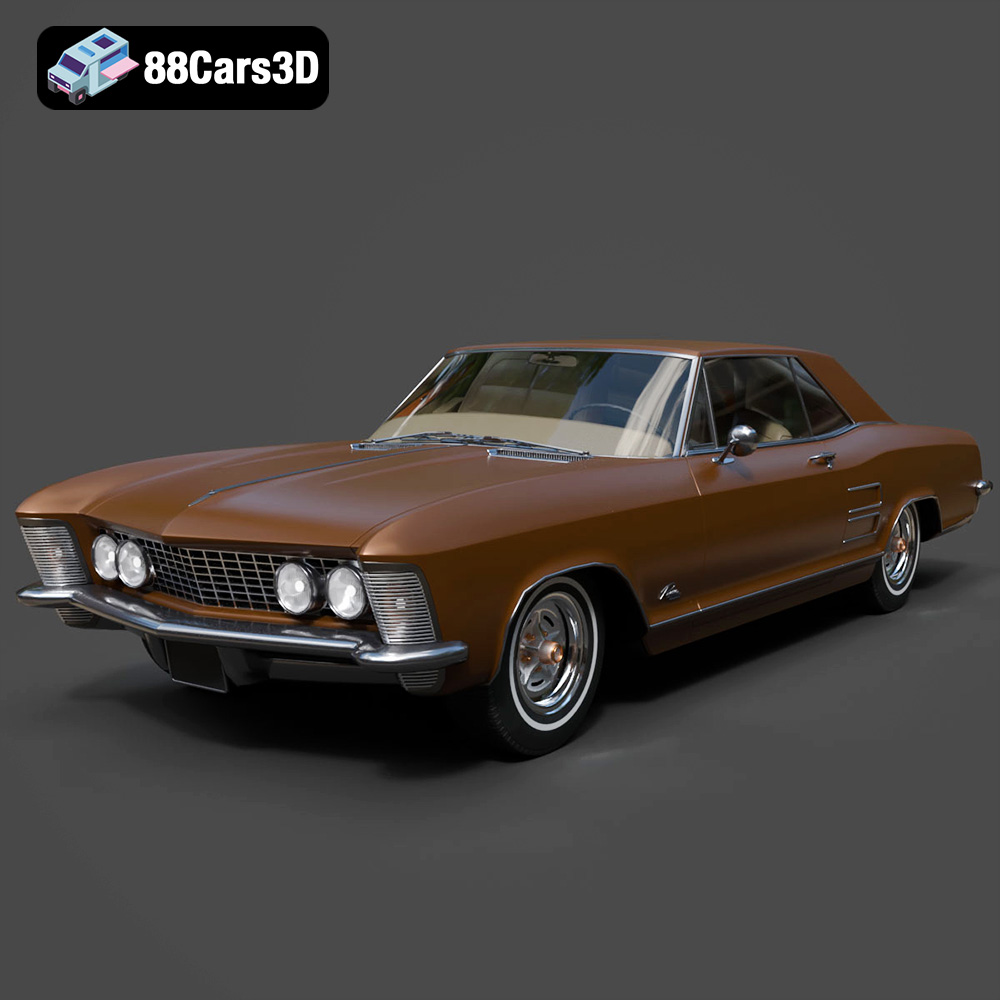
Download the Buick Riviera 1963 3D Model featuring classic American muscle car design and iconic styling. Includes .blend, .fbx, .obj, .glb, .stl, .ply, .unreal, and .max formats for rendering, simulation, and game development.
Price: $10.79

