Mastering Your 3D Prints: A Deep Dive into STL File Preparation with Blender
The world of 3D printing is an exhilarating journey from digital design to tangible reality. At the heart of this process lies the STL file – the universal language that bridges your 3D model with your 3D printer. However, not all STL files are created equal. A beautifully designed model can falter if its underlying digital mesh is riddled with errors, imperfections, or inefficient geometry. This is where the crucial step of STL file preparation comes into play. For enthusiasts aiming to produce flawless prints of intricate automotive models, such as those found on 88cars3d.com, understanding how to clean and optimize your STL files is paramount. This comprehensive guide will walk you through the essential techniques for preparing your STL files for printing, focusing on the powerful and accessible open-source software, Blender. We’ll cover everything from understanding mesh topology and identifying common STL errors to implementing precise repair strategies and optimizing your files for the best possible print outcomes, ensuring your next 3D printed car is a masterpiece.
Understanding the Anatomy of an STL File
Before we dive into the repair process, it’s essential to grasp what an STL file actually represents. STL, which stands for Stereolithography or Standard Tessellation Language, is a simple file format that describes a three-dimensional surface geometry using a collection of triangular facets. Each triangle is defined by the coordinates of its three vertices and a normal vector, which indicates the outward-facing direction of the surface. This collection of triangles essentially “tessellates” or tiles the surface of the 3D object.
Key Concepts:
- Mesh Topology: This refers to how the vertices, edges, and faces of a 3D model are connected. A “watertight” or “manifold” mesh is crucial for 3D printing. This means the mesh forms a continuous, closed surface with no holes, internal faces, or edges shared by more than two faces. Think of it like a balloon – it has a distinct inside and outside and no gaps.
- Vertices, Edges, and Faces: Vertices are the points in 3D space that define the corners of your triangles. Edges are the lines connecting two vertices, forming the sides of the triangles. Faces (or triangles) are the planar surfaces that make up the object’s geometry.
- Normals: These vectors are perpendicular to the surface of each triangle and point outwards. They tell the slicing software which side is “inside” and which is “outside,” which is vital for defining solid objects. Incorrectly oriented normals are a common cause of printing failures.
Common STL File Issues:
- Non-Manifold Geometry: This includes issues like internal faces, edges shared by more than two faces (creating T-junctions or “hanging faces”), and vertices shared by multiple disconnected faces. These create ambiguity for the slicer.
- Holes (Gaps): Missing triangles or edges that aren’t connected create holes in the mesh, making it “leaky” and not watertight.
- Inverted Normals: If a normal vector points inwards instead of outwards, the slicing software might interpret the surface as being inside-out, leading to hollow prints or complete failure.
- Intersecting Faces: When two or more faces of the mesh pass through each other, it creates complex, unprintable geometry.
- Degenerate Faces: These are triangles with zero area, often caused by vertices collapsing onto each other or edges having the same start and end point.
- Floating Vertices/Edges: Stray points or lines that are not connected to the main mesh structure.
Understanding these fundamental concepts will make the process of identifying and fixing errors in Blender much more straightforward. For high-quality printable car models from sources like 88cars3d.com, the STL files are typically well-formed, but errors can still occur during export from modeling software or through accidental manipulation.
Leveraging Blender for STL File Repair
Blender is a free, open-source, and incredibly powerful 3D creation suite that also excels at mesh editing and repair. While it might seem daunting at first, its intuitive interface and robust tools make it an ideal candidate for cleaning up STL files, especially for detailed models like those found on 88cars3d.com. We’ll focus on the Edit Mode and specific tools within Blender that are most relevant for STL repair.
Getting Started in Blender:
- Importing the STL: Open Blender, go to File > Import > STL (.stl). Navigate to your downloaded STL file and import it.
- Basic Navigation: Familiarize yourself with orbiting (middle mouse button), panning (Shift + middle mouse button), and zooming (mouse wheel).
- Edit Mode: Select your imported model in the 3D Viewport and press the Tab key to enter Edit Mode. Here, you can manipulate individual vertices, edges, and faces. Use the icons in the top-left corner of the 3D Viewport to switch between Vertex Select, Edge Select, and Face Select modes.
Essential Tools for Repair:
- Mesh > Clean Up: This is your primary toolkit for automated repairs. Within this menu, you’ll find options like:
- “Delete Loose”: Removes any stray vertices or edges not connected to the main mesh. This is excellent for cleaning up floating artifacts.
- “Make Manifold”: Attempts to automatically fix non-manifold edges and vertices, closing small holes and resolving some internal geometry issues. It’s a good first step but often requires manual refinement.
- “Fill Holes”: Automatically attempts to fill any gaps or holes in the mesh.
- Select Menu: Use Select > Select All by Trait to quickly find specific types of geometry issues. Options like “Non Manifold” and “Interior Faces” are invaluable for identifying problem areas.
- Mesh Tools:
- Merge Vertices (M): Useful for combining duplicate vertices that might be causing issues. Select the vertices you want to merge and press ‘M’, then choose an option like “By Distance” (to merge vertices that are very close together) or “At Center.”
- Extrude (E): Can be used to manually bridge gaps or extrude faces to fix holes, although this is more of a manual, precise fix.
- Fill (F): After selecting boundary edges of a hole, pressing ‘F’ can create a new face to close it.
- Modifier Stack: While not strictly for repair, modifiers like “Decimate” can reduce the polygon count of overly dense meshes, potentially improving performance and reducing file size without sacrificing too much detail. However, use with caution on models requiring high fidelity.
The key is to start with automated tools like “Make Manifold” and “Fill Holes” and then use manual selection and editing tools to address any remaining issues. Patience and a methodical approach are crucial, especially when dealing with complex models.
Step-by-Step STL File Preparation Workflow in Blender
Let’s outline a practical workflow for cleaning an STL file of a car model in Blender. This process emphasizes efficiency and effectiveness, ensuring your models are ready for slicing and printing.
1. Import and Initial Inspection:
- Import your STL file into Blender (File > Import > STL).
- Switch to Edit Mode (Tab).
- Use the Select > Select All by Trait > Non Manifold option. This will highlight all edges that are not part of a clean, manifold mesh. These are your primary problem areas.
- Visually inspect the highlighted areas. Look for:
- Edges connected to more than two faces.
- Holes (often indicated by edges that don’t connect to anything).
- Internal faces.
2. Automated Repair Pass:
- In Edit Mode, select all geometry (press ‘A’).
- Go to Mesh > Clean Up and experiment with the following:
- “Delete Loose”: Click this first to remove any stray vertices or edges.
- “Make Manifold”: This is a powerful tool that attempts to fix many non-manifold issues automatically. It might resolve some holes and internal geometry problems.
- “Fill Holes”: If “Make Manifold” didn’t close all gaps, run “Fill Holes.” You can adjust the “Grease Pencil” fill threshold if needed, though default is often sufficient.
- After running these, re-select non-manifold geometry (Select > Select All by Trait > Non Manifold) to see what remains. Often, complex intersections or specific types of non-manifold edges require manual attention.
3. Manual Repair of Stubborn Issues:
- Addressing Holes: If “Fill Holes” didn’t work, manually select the boundary edges of a hole (in Edge Select mode) and press ‘F’ to create a new face. For complex holes, you might need to create multiple faces.
- Resolving Non-Manifold Edges:
- Merging Vertices: If you find duplicate vertices creating issues, select them and press ‘M’ > “By Distance.” Adjust the merge distance carefully.
- Deleting Internal Faces: Select internal faces (in Face Select mode) and press ‘X’ > “Faces” to delete them. Ensure this doesn’t create new holes.
- Cleaning up T-junctions: Sometimes, you might need to dissolve edges (Edge > Dissolve Edges) or manually reposition vertices to create a cleaner mesh topology.
- Checking Normals: While in Edit Mode, enable “Face Orientation” overlay (Viewport Overlays menu > Geometry > Face Orientation). Blue faces are correctly oriented (outward), while red faces are inverted (inward). Select red faces, press ‘Shift + N’ to recalculate normals outwards, or ‘Alt + N’ for more options.
4. Final Verification and Export:
- After manual repairs, re-run Select > Select All by Trait > Non Manifold and visually inspect for any remaining issues. Ensure there are no red faces visible with “Face Orientation” enabled.
- Check Wall Thickness: While Blender doesn’t have a built-in, dedicated “wall thickness analysis” tool like some professional CAD software, you can visually inspect thin areas. Use the “3D-Print Toolbox” add-on (enable in Preferences > Add-ons) which includes a “Check All Walls” function. If parts are too thin, you might need to scale them up slightly or manually thicken them in Edit Mode.
- Exporting the Cleaned STL: Go to File > Export > Stl (.stl). In the export options, ensure “Selection Only” is checked if you only want to export the repaired model. Choose “Binary” for smaller file sizes.
This methodical approach, combining automated tools with careful manual correction, ensures that your STL files are watertight, manifold, and ready for the slicing stage.
Optimizing Slicing Parameters for High-Fidelity Car Models
Once your STL file is cleaned and verified, the next critical step is slicing – the process of converting the 3D model into layer-by-layer instructions (G-code) for your 3D printer. The parameters you choose in your slicer software (like Cura, PrusaSlicer, or Simplify3D) have a profound impact on the quality, detail, and print time of your automotive models. Platforms offering high-quality printable car models often provide recommended slicer settings, but understanding the fundamentals allows for fine-tuning.
Layer Height: The Detail vs. Time Tradeoff
- Lower Layer Heights (e.g., 0.05mm – 0.1mm): These produce incredibly fine details, smooth curves, and reduce visible layer lines. For intricate car models with sharp body lines, delicate spoilers, or textured interiors, a lower layer height is essential for capturing all the nuance. The downside is significantly increased print time. A model that takes 10 hours at 0.2mm might take 40+ hours at 0.1mm.
- Higher Layer Heights (e.g., 0.2mm – 0.3mm): These print much faster and are more forgiving of minor imperfections. They are suitable for larger, less detailed parts or prototypes. For collectible car models, this is generally too coarse to achieve acceptable detail.
- Recommendation: For most 1:24 or 1:18 scale car models from 88cars3d.com, aim for layer heights between 0.08mm and 0.15mm on FDM printers. Resin printers inherently offer much finer detail, often using layer heights of 0.025mm to 0.05mm.
Infill: Strength and Material Efficiency
- Density: For display models, high infill density is usually unnecessary. An infill density of 10-20% is typically sufficient to provide internal support for the outer walls and top layers. For models that might be handled frequently or require some structural integrity, 20-30% might be better.
- Pattern: While ‘Grid’ or ‘Cubic’ are common, consider patterns like ‘Gyroid’ for good strength in all directions with less material, or ‘Lightning’ infill (available in some slicers) which provides support only where needed, drastically reducing print time and material usage for non-structural parts. For display car models, the visual quality of the outer shell is paramount, so infill rarely affects this directly unless the outer walls are exceptionally thin.
Print Speed: Balancing Speed and Quality
- Outer Walls/Perimeters: Print these slowly (e.g., 25-40 mm/s) to ensure excellent surface finish and detail capture.
- Inner Walls: Can be printed slightly faster (e.g., 40-60 mm/s).
- Infill Speed: Can be the fastest (e.g., 60-100 mm/s), as infill is internal and less critical for surface aesthetics.
- Travel Speed: A higher travel speed (e.g., 120-150 mm/s) reduces stringing and overall print time by moving the nozzle quickly between printed sections.
- First Layer Speed: Crucial for adhesion. Keep this very slow (e.g., 15-20 mm/s) with slightly increased extrusion.
Supports: Enabling Complex Geometries
- Support Type: For car models with overhangs (like spoilers, undercarriage details, or wheel wells), supports are essential. ‘Tree’ supports (in Cura) or ‘Organic’ supports (in PrusaSlicer) are often preferred for complex models as they use less material, are easier to remove, and minimize surface scarring compared to standard ‘Normal’ supports.
- Support Placement: Choose ‘Touching Buildplate’ if overhangs are only on the bottom, or ‘Everywhere’ if internal structures also need support.
- Support Overhang Angle: A common starting point is 45-55 degrees. Increase this if you’re getting supports where they aren’t needed, or decrease if overhangs are failing.
- Support Interface Layers: Enabling ‘Support Roof’ and ‘Support Floor’ with a few dedicated interface layers can create a smoother surface finish where the support meets the model, making removal cleaner and post-processing easier.
- Support Z Distance: This controls the gap between the support and the model. A value of 0.1mm – 0.2mm is common. A slightly larger gap makes removal easier, but too large can lead to sagging.
Experimentation is key. Start with the recommended settings for your printer and material, then adjust layer height, speed, and support settings based on the specific model and your desired outcome.
Advanced Techniques: Mesh Repair Beyond Blender and File Format Nuances
While Blender is a powerful tool for manual STL repair, other software and techniques can complement your workflow, especially for extremely complex models or when dealing with specific file formats. Understanding these nuances can elevate your printing results.
Specialized Mesh Repair Software:
- Netfabb (Autodesk): This is a professional-grade software specifically designed for 3D print preparation. It offers highly advanced automated repair algorithms that can tackle even the most corrupted meshes. Features like automatic hole filling, manifold repair, wall thickness analysis, and simplification are exceptionally robust. While it has a cost, its power is undeniable for mission-critical projects or very difficult files.
- Meshmixer (Autodesk – Free): Meshmixer offers a good balance of features for mesh editing and repair. It excels at sculpting, smoothing, and boolean operations. Its “Inspector” tool is excellent for finding and automatically repairing common mesh errors like holes, non-manifolds, and reversed faces. It also has useful tools for adding custom supports and hollowing models.
- Microsoft 3D Builder (Free): Included with Windows, this surprisingly capable tool offers straightforward automated repair functions. Simply import your STL, select “Edit” > “Fix,” and let it work. It’s a quick way to get a baseline repair on many files before moving to more detailed work in Blender or Meshmixer.
File Format Considerations (STL vs. OBJ vs. 3MF):
- STL (.stl): The most common format, but it only stores surface geometry (triangles). It lacks color, material, or unit information, which can sometimes lead to scaling issues. It can also result in large file sizes for complex models due to the sheer number of triangles.
- OBJ (.obj): More versatile than STL, OBJ can store color and texture information (though not typically used for standard 3D printing) and often includes vertex normal data, which can sometimes lead to smoother shading. It’s generally considered a good format for interchange between different 3D modeling applications.
- 3MF (.3mf): A modern, XML-based format designed specifically for additive manufacturing. It can store far more information than STL, including units, color, materials, precise geometry, and even print settings. Slicers that support 3MF can interpret these files more accurately, reducing potential errors and improving workflow. Many modern slicers like Cura and PrusaSlicer have excellent 3MF support.
- Recommendation: Whenever possible, try to work with and export your final models in the 3MF format if your slicer supports it. If not, a clean binary STL is the standard. Avoid ASCII STL if possible, as it generates much larger files.
Working with High-Polygon Models:
- Extremely detailed models, especially those sourced from 3D scans, can have millions of triangles. This can bog down Blender and slicer software.
- Decimation: Use Blender’s “Decimate” modifier (in Object Mode, add modifier) or Meshmixer’s “Reduce” tool to intelligently reduce the polygon count. Start with a low percentage (e.g., 0.5 for 50% reduction) and check the visual quality. The goal is to reduce polygons without losing significant detail. Aim for a poly count that your slicer can handle comfortably – typically under 1 million faces for smooth slicing.
- Simplify Data: If exporting from Blender, choose the “Binary STL” option for the most compact file size.
By understanding these advanced tools and file format nuances, you can tackle even the most challenging STL files and ensure your printed automotive models achieve the highest level of fidelity.
Material Selection and Printer Calibration for Optimal Results
The journey from a clean STL file to a stunning 3D printed car model doesn’t end with slicing. The materials you use and the calibration of your 3D printer play equally vital roles. Choosing the right filament or resin and ensuring your printer is performing optimally will significantly impact the final print quality, durability, and aesthetics.
Material Choices for Automotive Models:
- PLA (Polylactic Acid): The most common and beginner-friendly FDM filament. It’s easy to print, has low warping, comes in many colors (including metallic finishes that look great on cars), and is rigid. Its main drawback is low heat resistance, making it unsuitable for applications involving high temperatures. For display models, PLA is an excellent choice.
- PETG (Polyethylene Terephthalate Glycol): Offers a good balance between PLA’s ease of printing and ABS’s strength and temperature resistance. It’s more durable and less brittle than PLA, with better layer adhesion and higher heat resistance. It can be slightly stringier than PLA, requiring minor tuning of retraction settings. A great option for models that might see more handling.
- ABS (Acrylonitrile Butadiene Styrene): Known for its strength, toughness, and high-temperature resistance (similar to Lego bricks). However, ABS is notoriously difficult to print due to significant warping and the need for an enclosed printer and heated bed. It also releases fumes that require good ventilation. Generally overkill for display car models unless extreme durability is needed.
- Resin (SLA/DLP/MSLA): For FDM printers, PLA and PETG are top choices. However, if you have access to a resin printer, this is where the highest level of detail is achieved. Standard resins offer excellent detail but can be brittle. Tough or ABS-like resins offer increased durability. Many specialty resins mimic the look of painted plastic or even metal. Layer heights of 0.025mm to 0.05mm are standard, producing incredibly smooth surfaces and sharp edges perfect for intricate car models.
Printer Calibration Essentials:
A well-calibrated printer is the foundation of successful 3D printing. Even the cleanest STL file and perfect slicer settings will yield poor results on an uncalibrated machine.
- Bed Leveling: This is the most critical step. Whether manual or automatic, ensure your print bed is perfectly level and the nozzle is at the correct distance (Z-offset) from the bed for the first layer. A good first layer is crucial for adhesion and overall print success. Print a first-layer calibration test pattern – you want a smooth, uniform surface with lines that are nicely “squished” together without being translucent or ripped.
- E-Steps Calibration: This ensures your extruder is pushing the correct amount of filament. You can find numerous guides online for calibrating E-steps.
- Temperature Tuning (PID Autotune): Ensure your hotend and heated bed maintain stable temperatures throughout the print. Most printers have a PID autotune function that should be run periodically.
- Flow Rate/Extrusion Multiplier: After E-steps are calibrated, fine-tune the flow rate (often called Extrusion Multiplier in slicers) to prevent over- or under-extrusion. Print a single-wall cube or calibration model and adjust the flow until wall thickness is accurate and there are no gaps or excessive material buildup. A setting of 95-105% is typical.
- Retraction Settings: Crucial for minimizing stringing and blobs, especially with materials like PETG or certain PLA blends. Tune retraction distance and speed using retraction test models.
- Resin Printer Specifics: For resin printers, calibration involves ensuring correct exposure times (using a calibration print like the Cones of Calibration or AmeraLabs Town) and proper Z-axis lift speeds. Ensure the build plate is clean and the FEP/PFA film is in good condition.
Regularly performing these calibration steps will save you countless failed prints and ensure that the high-quality STL files you download from marketplaces like 88cars3d.com translate into the detailed, professional-looking models you envision.
Conclusion: From Clean Mesh to Masterpiece Model
The path to a flawless 3D printed car model is paved with meticulous preparation. Understanding the structure of STL files, identifying common mesh errors, and knowing how to leverage tools like Blender for repair are fundamental skills for any serious 3D printing enthusiast. We’ve journeyed through the essential steps: dissecting the STL format, exploring Blender’s powerful repair capabilities, establishing a robust cleaning workflow, optimizing critical slicer settings like layer height and supports, and considering advanced tools and material choices.
By mastering these techniques, you empower yourself to take even complex digital designs, such as the detailed automotive models available on 88cars3d.com, and transform them into tangible realities with exceptional fidelity. Remember that STL file repair is often an iterative process; don’t be discouraged if the first attempt doesn’t yield perfect results. Patience, a methodical approach, and a willingness to learn your software and hardware are your greatest assets.
Your Action Plan:
- Download a sample STL file from 88cars3d.com or another source.
- Import it into Blender and practice using the “Select All by Trait > Non Manifold” tool.
- Experiment with Blender’s “Mesh > Clean Up” options.
- Try manually fixing a small hole or removing an internal face.
- Export the cleaned file and import it into your preferred slicer.
- Adjust layer height and support settings for a complex overhang.
- Print a small test section or the entire model and evaluate the results.
By consistently applying these principles, you’ll not only improve the quality of your 3D prints but also gain a deeper appreciation for the intricate digital craftsmanship involved in creating these collectible models. Happy printing!
Featured 3D Car Models

Texture: Yes
Material: Yes
Download the BMW 3 F30 3D Model featuring a detailed exterior, realistic interior, and optimized mesh. Includes .blend, .fbx, .obj, .glb, .stl, .ply, .unreal, and .max formats for rendering, simulation, and game development.
Price: $10.79
View Product

Texture: Yes
Material: Yes
Download the BMW Z4 Roadster E89 3D Model featuring clean geometry, realistic detailing, and a fully modeled interior. Includes .blend, .fbx, .obj, .glb, .stl, .ply, .unreal, and .max formats for rendering, simulation, and game development.
Price: $13.99
View Product

Texture: Yes
Material: Yes
Download the BMW Z4 E85 3D Model featuring clean geometry, realistic detailing, and a fully modeled interior. Includes .blend, .fbx, .obj, .glb, .stl, .ply, .unreal, and .max formats for rendering, simulation, and game development.
Price: $13.99
View Product

Texture: Yes
Material: Yes
Download the BMW M3 2024 3D Model featuring clean geometry, realistic detailing, and a fully modeled interior. Includes .blend, .fbx, .obj, .glb, .stl, .ply, .unreal, and .max formats for rendering, simulation, and game development.
Price: $13.99
View Product
Texture: Yes
Material: Yes
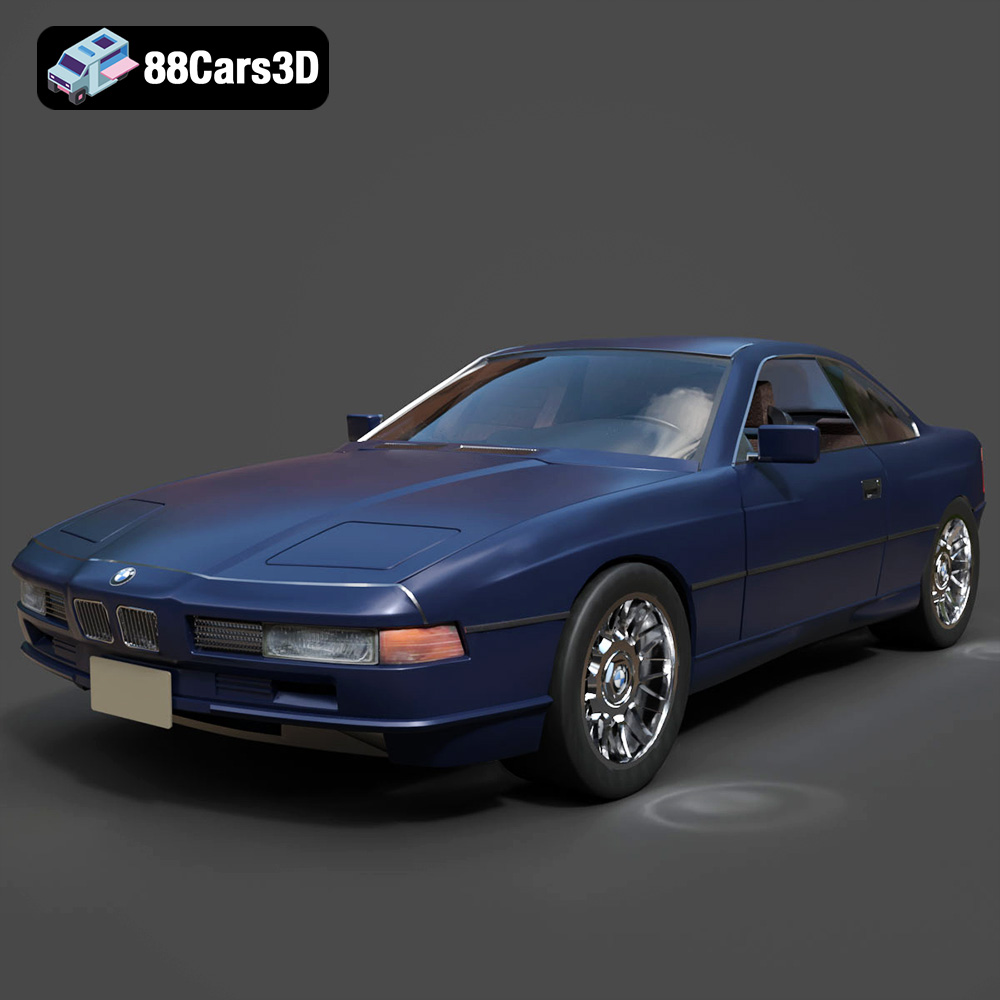
Download the BMW 850i Coupe 1990 3D Model featuring clean geometry, realistic detailing, and a fully modeled interior. Includes .blend, .fbx, .obj, .glb, .stl, .ply, .unreal, and .max formats for rendering, simulation, and game development.
Price: $13.99
View Product
Texture: Yes
Material: Yes
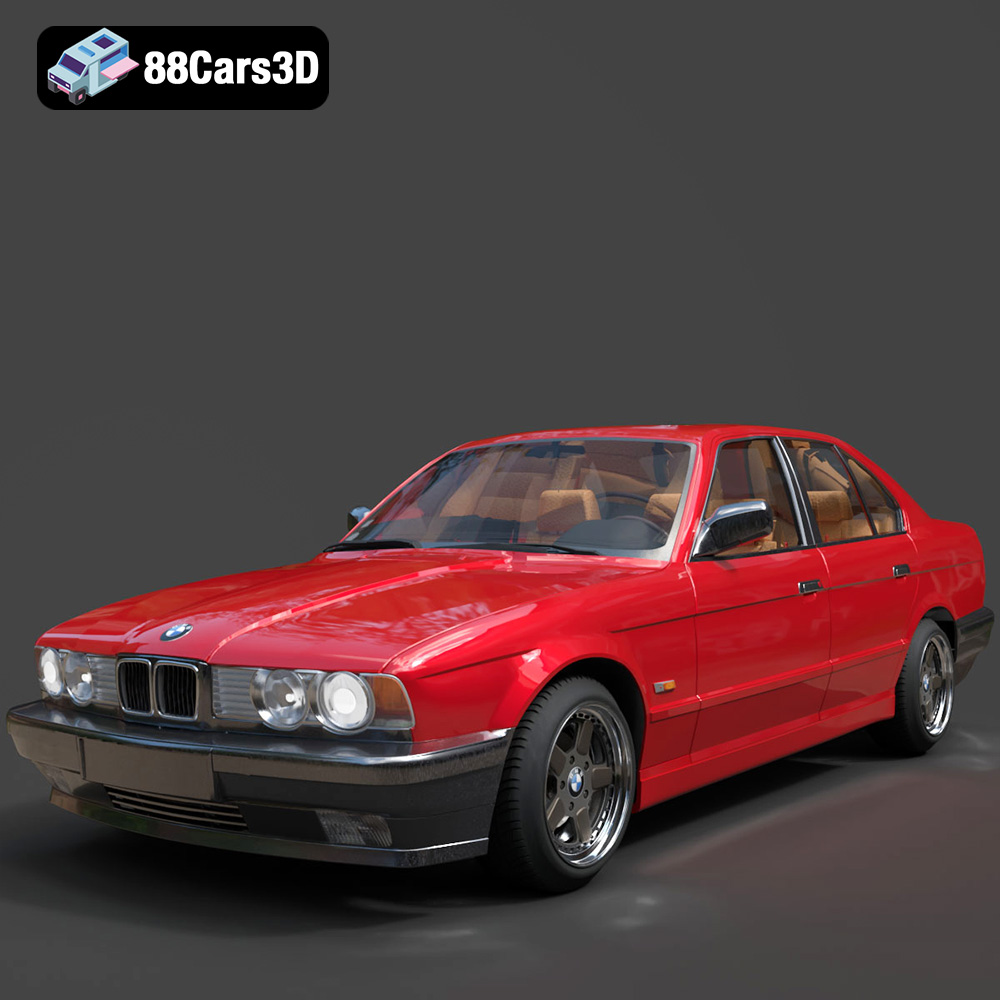
Download the BMW 525i E34 1993 3D Model featuring clean geometry, realistic detailing, and a fully modeled interior. Includes .blend, .fbx, .obj, .glb, .stl, .ply, .unreal, and .max formats for rendering, simulation, and game development.
Price: $12.99
View Product

Texture: Yes
Material: Yes
Download the BMW 7 Series 2016 3D Model featuring luxurious design, detailed interior, and accurate exterior. Includes .blend, .fbx, .obj, .glb, .stl, .ply, .unreal, and .max formats for rendering, simulation, and game development.
Price: $10.79
View Product
Texture: Yes
Material: Yes
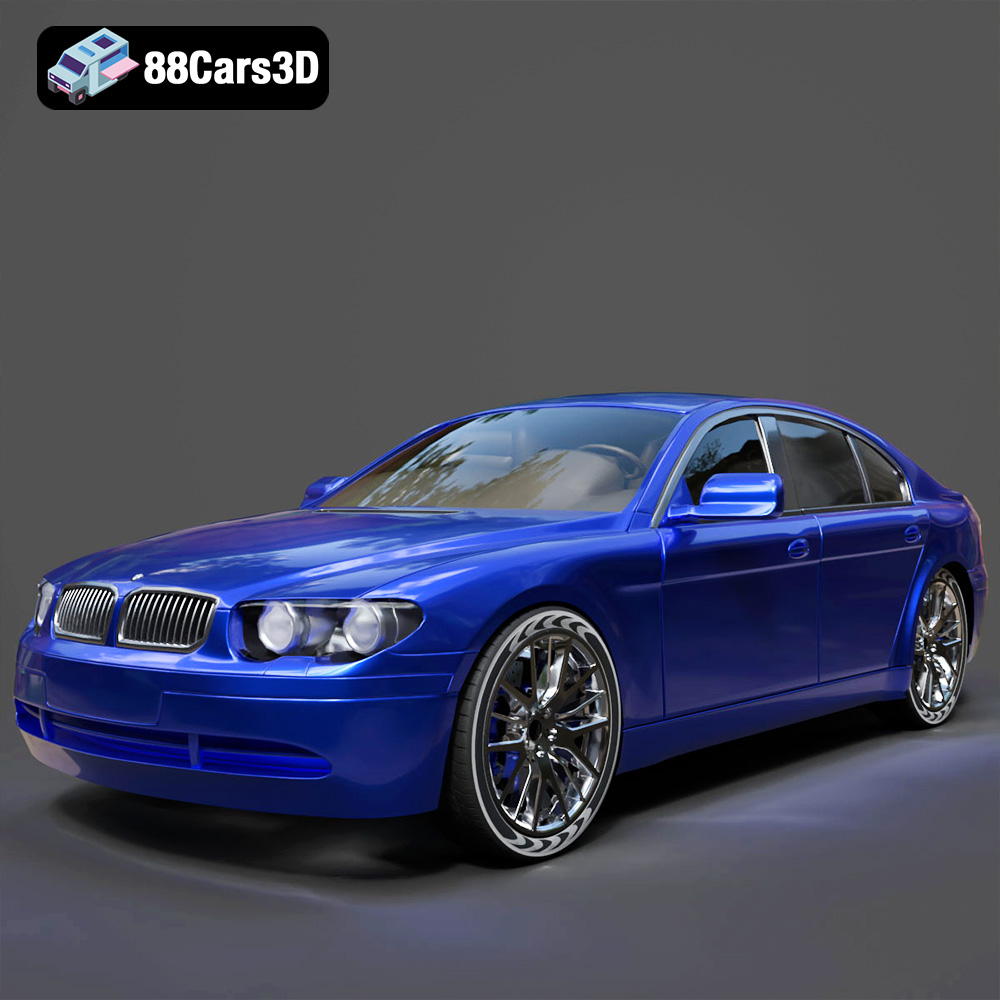
Download the BMW 7 Series 30th Anniversary 3D Model featuring a meticulously crafted exterior, detailed interior, and realistic wheels. Includes .blend, .fbx, .obj, .glb, .stl, .ply, .unreal, and .max formats for rendering, simulation, and game development.
Price: $35.79
View Product

Texture: Yes
Material: Yes
Download the BMW 7-Series F02 3D Model featuring a detailed exterior and interior, optimized for rendering and animation. Includes .blend, .fbx, .obj, .glb, .stl, .ply, .unreal, and .max formats for rendering, simulation, and game development.
Price: $10.79
View Product
Texture: Yes
Material: Yes
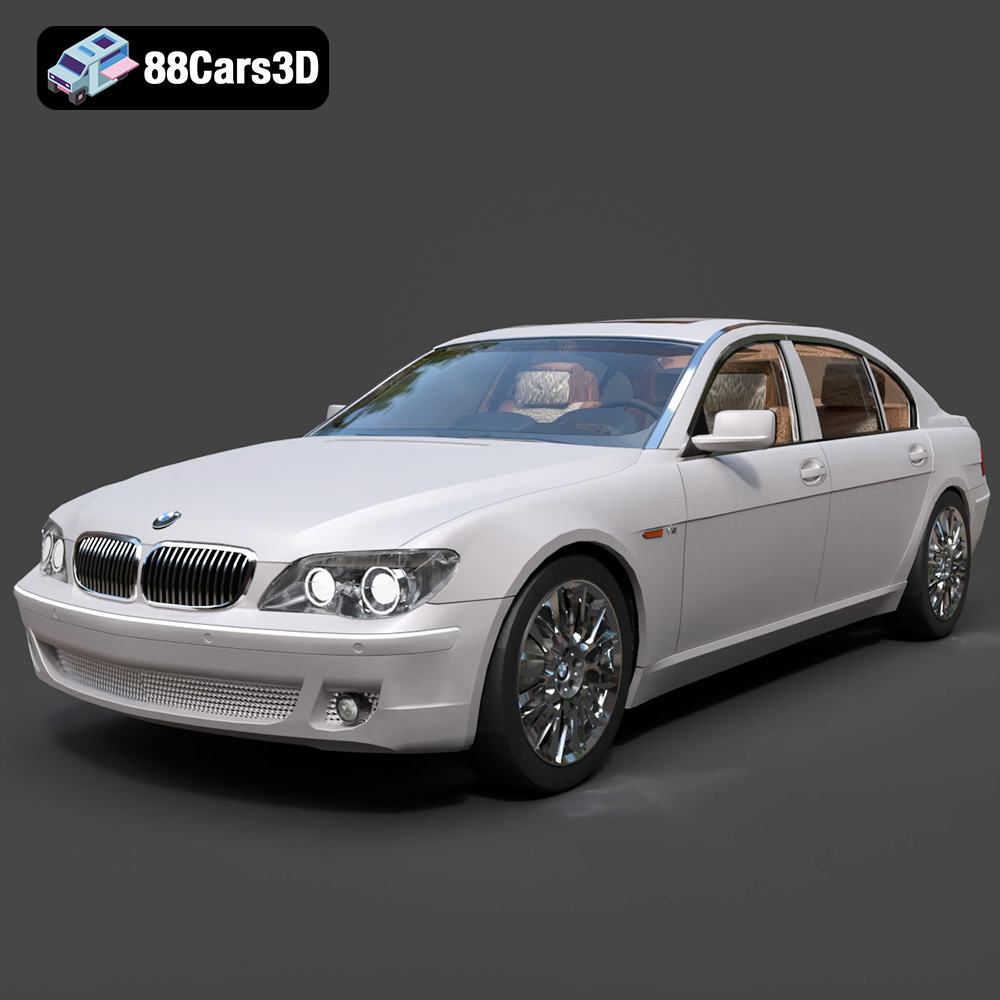
Download the BMW 760Li E66 2005 3D Model featuring a detailed exterior, refined interior, and robust chassis. Includes .blend, .fbx, .obj, .glb, .stl, .ply, .unreal, and .max formats for rendering, simulation, and game development.
Price: $10.79
View Product


