In the demanding world of 3D automotive rendering and visualization, capturing the intricate details of a vehicle is paramount. From the sleek curves of the body to the nuanced reflections on its windows and chrome accents, every surface contributes to the overall realism and immersion. Among the most challenging yet rewarding materials to perfect are glass and chrome. These elements, with their unique interactions with light—refraction, reflection, and specular highlights—can either elevate a 3D car model to photorealistic perfection or expose it as merely a digital imitation.
For 3D artists, game developers, and automotive designers, mastering the creation of realistic glass and chrome is a critical skill. It’s not just about applying a preset; it’s about understanding the underlying physics of light and material interaction, and then translating that knowledge into your chosen 3D software. This comprehensive guide will delve deep into the technical workflows, PBR principles, and software-specific techniques needed to craft stunningly realistic glass and chrome materials for your 3D car models. Whether your goal is a high-fidelity render for an architectural visualization or an optimized asset for AR/VR, the principles we discuss here will be invaluable. Platforms like 88cars3d.com provide excellent starting points with high-quality base meshes, but the final polish often comes down to your material artistry.
The Science Behind Realistic Materials: PBR Fundamentals for Automotive
Achieving photorealistic results in 3D rendering hinges on a solid understanding and application of Physically Based Rendering (PBR) principles. PBR materials are designed to react to light in a way that mimics real-world physics, making them inherently more consistent and realistic across different lighting conditions. For automotive models, this consistency is vital for materials like car paint, rubber, and especially glass and chrome. Unlike older, artistic workflows that relied on subjective tweaks, PBR provides a standardized approach based on measurable physical properties.
At its core, PBR relies on several key maps and parameters to define a material’s appearance. The Base Color (or Albedo) map defines the fundamental color of the surface without any lighting information. For metals like chrome, this color is typically a desaturated grey, almost white, as metals absorb very little color information. The Metallic map differentiates between dielectric (non-metal) and metallic surfaces; a value of 0 indicates a dielectric, while 1 indicates a metal. Chrome, being a pure metal, would have a Metallic value of 1.0. The Roughness map (sometimes called Glossiness, but inverted) dictates the microscopic surface imperfections that scatter light, influencing how sharp or blurry reflections and highlights appear. A low roughness value (close to 0) results in a highly polished, mirror-like surface, essential for chrome and clear glass. Conversely, a higher roughness value would create a matte or frosted appearance. Normal and Displacement maps simulate surface detail without adding actual geometry, crucial for intricate details like brushed metal textures or subtle glass imperfections without increasing polygon counts excessively. Understanding these maps is the foundation for creating any convincing PBR material.
Light Interaction and the Fresnel Effect
The way light interacts with a surface is critical for defining its material properties. For highly reflective and refractive materials like chrome and glass, the Fresnel effect plays a pivotal role. The Fresnel effect describes how the reflectivity of a surface changes depending on the viewing angle. When looking at a surface straight on (at a normal angle), its reflectivity is at its lowest. However, as the viewing angle becomes more glancing or oblique, the reflectivity dramatically increases. Think of looking at a puddle: when you look down into it, you see the bottom (transmission), but when you look across it, it acts like a mirror (reflection).
For chrome, the Fresnel effect means that reflections will be almost uniformly strong, but slightly more intense at glancing angles. For glass, it’s even more pronounced: clear glass is mostly transparent when viewed directly, but becomes highly reflective at sharp angles, such as the edge of a car’s windshield. Most modern PBR shaders, including the Principled BSDF in Blender, automatically calculate the Fresnel effect based on the material’s IOR and roughness values, simplifying the workflow for artists. However, understanding this physical phenomenon allows for more informed material adjustments and troubleshooting. Improper Fresnel curves can quickly break the illusion of realism, making chrome look dull or glass appear flat and unconvincing.
Energy Conservation in PBR
Energy conservation is another cornerstone of PBR. It dictates that a surface cannot reflect or transmit more light than it receives. In simpler terms, if a material is highly reflective, it will reflect more light, leaving less light to be absorbed or transmitted. Conversely, if a material transmits a lot of light (like clear glass), it will reflect very little. This principle prevents materials from looking unnaturally bright or “magical.”
Modern PBR shaders inherently manage energy conservation. For example, when you increase the ‘Metallic’ value of a Principled BSDF shader, the ‘Diffuse’ component is automatically reduced, ensuring that the material doesn’t incorrectly reflect light while also displaying a strong base color. Similarly, with glass, increasing ‘Transmission’ will naturally reduce the reflected light at direct angles. Adhering to energy conservation guarantees that your materials respond predictably and realistically to varying lighting conditions, a crucial factor in achieving believable 3D car models. When working with complex shader networks, it’s essential to keep this principle in mind to avoid creating materials that appear to glow or absorb too much light, leading to an unrealistic final render.
Crafting Realistic Glass Materials for Automotive Models
Car windows, headlights, and taillights are defining features that demand meticulous attention to detail. Realistic glass isn’t just about transparency; it’s about subtle reflections, accurate refractions, and often, a delicate interplay of dirt, condensation, or subtle tints. Mastering glass materials will significantly enhance the visual fidelity of your 3D car models.
Core Glass Shader Principles
The foundation of any realistic glass material lies in correctly configuring its fundamental properties:
- Transparency and Refraction: True transparency means light passes directly through the object. Refraction, on the other hand, is the bending of light as it passes through different mediums. The degree of this bending is controlled by the Index of Refraction (IOR). For standard glass, a common IOR value is around 1.52. Water is typically 1.33, and diamonds are much higher at 2.417. Correct IOR values are critical for convincing light distortion through car windows, especially at oblique angles.
- Absorption and Color Tint: Real glass isn’t perfectly transparent; it absorbs some light, giving it a subtle color, especially with increased thickness. Car windows often have a slight green or blue tint. In your shader, you’ll typically control this with an absorption color and distance parameter. The thicker the glass, the more pronounced the color absorption will be.
- Roughness: While clear glass aims for minimal roughness (values very close to 0.0), a perfectly smooth surface is rarely seen in reality. Adding a minuscule amount of roughness (e.g., 0.005-0.01) can break up perfect reflections and prevent a sterile, CG look. For frosted or dirty glass, you would significantly increase this value, often using a texture map to control the roughness variations.
Software-Specific Workflows: Glass
Here’s how you’d set up a basic, realistic glass material in popular 3D software:
Blender (Cycles/Eevee)
In Blender, the Principled BSDF shader is incredibly versatile. For clear glass:
- Select your glass object and create a new material.
- In the Shader Editor, select the Principled BSDF node.
- Set Transmission to 1.0 (fully transparent).
- Set Roughness to a very low value, such as 0.0 or 0.005.
- Adjust the IOR (Index of Refraction) to around 1.52.
- For subtle tint, you can either adjust the Base Color slightly (though Transmission color is often more accurate for absorption) or, for more physical accuracy, utilize the Volume Absorption node. To use Volume Absorption, go to the Material Properties tab, scroll down to “Settings” (for Cycles) or “Surface” (for Eevee), and under “Volume,” select “Principled Volume” or a custom volume shader. A simple way to add tint is to connect a ‘Glass BSDF’ node (set IOR to 1.52 and desired color) to a ‘Mix Shader’ with the Principled BSDF, using a ‘Light Path’ node’s ‘Is Camera Ray’ to control the mix for reflections/refractions separately, or simply use the Principled BSDF’s built-in transmission controls for basic tints. For more advanced absorption, a dedicated Volume Absorption shader is ideal, connected to the Volume output of the Material Output node.
3ds Max (Corona/V-Ray)
Corona Render:
With a Corona Physical Material:
- Set the Base Color to black or a very dark grey.
- Under “Refraction,” set the Color to white (or a very subtle tint like R:255, G:255, B:250) and IOR to 1.52.
- Ensure “Refraction Glossiness” is 1.0 (perfectly clear).
- For absorption, enable “Volumetrics” and set an “Absorption Color” (e.g., light blue/green) and a suitable “Distance” (e.g., 10 cm or 5 inches). This simulates the tint based on the thickness of the mesh.
V-Ray:
With a V-Ray Material:
- Set Diffuse Color to black.
- Set Reflect Color to white and Refract Color to white.
- Set IOR to 1.52.
- Set Refract Glossiness to 1.0.
- For color absorption, enable “Fog Color” and set the desired tint, along with a “Fog Multiplier” to control its intensity over distance.
Advanced Glass Techniques
- Layered Glass: For extremely realistic windshields, some artists model multiple thin layers of glass with a slight air gap or an internal laminate layer. This approach, while more computationally intensive, can yield incredibly complex and accurate refractions and reflections, especially at grazing angles.
- Imperfections: No real-world glass is perfectly clean. Use subtle grunge maps (grayscale textures) connected to the roughness input to simulate dust, smudges, or rain streaks. A very subtle normal map can add micro-scratches. These details should be barely noticeable but cumulatively enhance realism.
- Headlight/Taillight Glass: These often require a combination of materials. The outer lens might be clear or tinted glass, while the internal reflectors are typically a chrome or highly reflective plastic material, along with the light source itself. Ensure proper modeling and material assignment for each component.
Mastering Photorealistic Chrome for Automotive Detailing
Chrome is the jewel of automotive design, catching and reflecting its environment with dazzling clarity. From grilles and badges to wheel rims and trim, perfectly rendered chrome instantly communicates luxury and precision. However, it’s also one of the most unforgiving materials to get right; any inaccuracy in its reflection or roughness will immediately stand out.
The Nature of Chrome
To render chrome convincingly, we must understand its core physical properties:
- High Reflectivity: Chrome is a highly reflective metal. This means it reflects almost 100% of the light that hits it, with very little light being absorbed or diffused. The environment itself will be the primary visual contributor to chrome’s appearance.
- No Diffuse Component: For pure, unpainted chrome, there is virtually no diffuse color. Its appearance is almost entirely determined by its reflections. Therefore, in a PBR workflow, the Base Color will typically be a very light grey or white, allowing reflections to dominate.
- Metallic Workflow: Chrome is, by definition, a metal. In a PBR metallic workflow, its ‘Metallic’ parameter should be set to its maximum value, typically 1.0.
- Roughness: This is where the subtle variations in chrome come into play. Polished chrome has an extremely low roughness value (e.g., 0.01-0.03), resulting in sharp, mirror-like reflections. Brushed chrome, on the other hand, will have a higher roughness value, often controlled by a texture map, leading to blurred or anisotropic reflections.
Software-Specific Workflows: Chrome
Here’s how to create convincing chrome in popular 3D rendering software:
Blender (Cycles/Eevee)
The Principled BSDF shader is ideal for chrome in Blender:
- Select your chrome object and create a new material.
- In the Shader Editor, select the Principled BSDF node.
- Set Metallic to 1.0.
- Set Base Color to pure white (RGB 1,1,1 or Hex #FFFFFF). This allows the environment’s reflections to entirely define the color.
- Set Roughness to a very low value, typically between 0.01 and 0.03 for highly polished chrome. Increase this slightly for a less perfect, more worn look.
- Optionally, increase Clearcoat and Clearcoat Roughness slightly (e.g., 0.0-0.03) to simulate an additional clear protective layer over the metal, which can add a subtle extra layer of reflectivity, often present on actual chrome finishes.
3ds Max (Corona/V-Ray)
Corona Render:
Using a Corona Physical Material:
- Set Base Color to white.
- Set Metalness to 1.0.
- Set Roughness to a very low value, typically around 0.01-0.03.
- Ensure IOR is set to 999 or ‘metallic’ for physically accurate metal reflection.
V-Ray:
Using a V-Ray Material:
- Set Diffuse Color to black.
- Set Reflect Color to white.
- Set Reflect Glossiness to a high value (e.g., 0.97-0.99) for polished chrome.
- Set BRDF to ‘Microfaset GTR (GGX)’ for a modern PBR reflection model.
- Set Metalness to 1.0 if using a V-Ray PBR material. If using older V-Ray setups, rely on Reflect Color and Reflect Glossiness, potentially adjusting the ‘Fresnel IOR’ (often set very high, like 25-100, or a specific metallic IOR).
Adding Surface Imperfections and Anisotropy
- Grunge and Scratches: Just like with glass, absolute perfection can look artificial. Apply subtle grayscale grunge maps to the Roughness input to create variations in reflectivity, simulating fingerprints, dust, or smudges. For fine scratches, a very subtle normal map can be effective. These should be barely visible but break up the uniform reflection.
- Anisotropy for Brushed Metals: For components like brushed aluminum trim or specific chrome parts with a directional grain, you’ll need to enable anisotropy. This property causes reflections to stretch in a particular direction, mimicking microscopic grooves on the surface. In the Principled BSDF shader in Blender, you’ll find ‘Anisotropic’ and ‘Anisotropic Rotation’ controls. You’ll typically use a tangent map to control the direction of the anisotropy across the surface, ensuring the brushed effect follows the flow of the geometry. This is particularly important for realistic detailing on high-quality 3D car models.
Lighting and Environment for Optimal Realism
The best materials in the world will fall flat without proper lighting. For highly reflective and refractive surfaces like glass and chrome on a 3D car model, the lighting setup and environment play an even more critical role than usual. They dictate what the materials reflect and how light passes through or bounces off them.
Importance of HDRI
High Dynamic Range Images (HDRIs) are indispensable for achieving realistic lighting and reflections, especially for automotive rendering. An HDRI is a panoramic image that captures a full 360-degree view of a real-world environment, including accurate light information from direct sunlight to subtle ambient occlusion in shadowed areas. When used as an environment map in your 3D scene, it provides:
- Realistic Reflections: Chrome surfaces will perfectly mirror the environment captured in the HDRI, showcasing realistic skies, buildings, and landscapes. This is crucial as chrome’s appearance is almost entirely defined by its reflections.
- Accurate Lighting: The HDRI illuminates your scene with light sampled directly from the real world, producing natural shadows, color bounced light, and realistic intensities. This avoids the flat or artificial look that can result from simple three-point lighting setups.
- Global Illumination Contribution: Most modern renderers use HDRIs to contribute to global illumination, further enhancing the realism by distributing light naturally throughout the scene.
When selecting an HDRI for your 3D car models, consider the mood and location you want to convey. A bright outdoor studio HDRI will give crisp, controlled reflections, while a cloudy outdoor HDRI will produce softer, more diffused reflections. Always ensure the HDRI has sufficient dynamic range to provide both bright highlights and deep shadows. In Blender, you can easily load an HDRI into the World Shader nodes as an Environment Texture.
Studio vs. Outdoor Lighting
The choice of lighting setup significantly impacts how your glass and chrome materials are perceived:
- Studio Lighting: Often characterized by controlled light sources (area lights, softboxes, spotlights) and a neutral environment (e.g., seamless white backdrop, infinite plane).
- Benefits: Offers precise control over reflections and highlights. Ideal for showcasing intricate details of a 3D car model without environmental clutter. Glass often appears cleaner, and chrome shows crisp, defined highlights.
- Setup: Typically involves key lights, fill lights, and rim lights to define the car’s contours. Softboxes are excellent for creating elongated, elegant reflections on car surfaces.
- Outdoor / Environmental Lighting: Uses an HDRI as the primary light source, often supplemented by targeted area lights to enhance specific details or add fill.
- Benefits: Provides immediate photorealism and immerses the car in a believable environment. Chrome and glass react naturally to atmospheric conditions, showing reflections of trees, buildings, or skies.
- Setup: Start with a high-quality HDRI. You might add a subtle sun lamp to simulate direct sunlight from the HDRI for sharper shadows and brighter highlights, or use small, strategically placed area lights to pick out details like chrome trim or headlight reflections.
Shadows and Caustics
Accurate shadows are fundamental to ground your 3D car models in the scene. Without them, even perfect materials will look like they are floating. Ensure your light sources are correctly positioned to cast realistic, subtle shadows that define the shape and contact points of the car. The softness of shadows should correspond to the size and distance of the light source.
Caustics refer to the patterns of light concentrated by reflections or refractions, such as the bright patterns cast by light passing through a glass of water. For car glass, especially headlights and taillights with complex internal optics, caustics can add a significant layer of realism. However, rendering accurate caustics is notoriously difficult and computationally expensive, often requiring advanced path-traced renderers like Cycles, V-Ray, or Corona. Real-time engines typically don’t render true caustics and rely on baked textures or approximations. If you’re aiming for absolute realism in a static render, enabling caustics (if your renderer supports them efficiently) for glass elements can be a game-changer, but be prepared for increased render times.
Performance Optimization for Game Assets and Real-time
While photorealism is the ultimate goal for high-end renders, when developing 3D car models for real-time applications like game engines (Unity, Unreal Engine) or AR/VR experiences, performance optimization becomes equally crucial. Highly complex materials can quickly bog down frame rates. Striking a balance between visual quality and efficiency is key.
Material Instancing
One of the most effective optimization strategies is material instancing. Instead of creating a unique material for every piece of chrome or glass on a car, you create a single “master” material (or a few variations) and then create instances of that material. Each instance can have different parameter values (like a slightly different roughness map for a specific part, or a unique tint for different windows), but they all share the same underlying shader code and textures where possible. This significantly reduces:
- Draw Calls: A draw call is a command sent from the CPU to the GPU to render an object. Fewer unique materials mean fewer draw calls, which translates to better performance.
- Memory Usage: Sharing texture maps and shader data across instances reduces the overall memory footprint.
For example, you might have one “Car_Glass_Master” material. Instances of this material could be “Windshield_Glass” (very clean, low roughness), “Side_Window_Glass” (slightly more roughness, minor tint), and “Headlight_Glass” (unique normal map for detail, but same base properties). When sourcing models from marketplaces such as 88cars3d.com, often the provided models are already structured with efficient material setups in mind, which can save considerable time during optimization.
Texture Resolution and Atlasing
Textures are often the heaviest assets in terms of memory. Careful management of texture resolution is vital:
- Appropriate Resolution: Don’t use 8K textures for small, distant details. Use resolutions that are proportional to the object’s screen size and its importance. For primary car body, 4K or even 2K might suffice, while smaller details like badges or specific chrome trims might only need 1K or 512×512 maps.
- Texture Atlasing: This technique combines multiple smaller textures into one larger texture sheet (an atlas). For example, all chrome parts’ roughness maps, normal maps, and metallic maps could be packed into a single atlas.
- Benefits: Reduces the number of texture lookups by the GPU, improves cache locality, and minimizes draw calls by allowing multiple objects to share the same material and texture data. This is particularly useful for game assets where many small chrome or glass pieces are present.
- Workflow: Requires careful UV mapping to ensure each component uses the correct section of the atlas. Many game engine tools and 3D software have features to assist with texture atlasing.
LODs for Complex Materials
Level of Detail (LOD) is a technique used in real-time rendering to reduce the complexity of 3D models as they move further away from the camera. This principle can also be applied to materials, especially for reflective and refractive surfaces:
- Geometry Simplification: At lower LODs, the mesh for complex chrome or glass elements can be simplified, reducing polygon count.
- Material Simplification: For instance, at close distances, glass might use full refraction and detailed normal maps. At medium distances, it might switch to a simpler shader with less complex refraction or even just a transparent shader with a cubemap reflection. At far distances, it could become a simple transparent-colored material. For chrome, high-detail roughness maps can be replaced with simpler, uniform roughness values at lower LODs.
- Seamless Transitions: Ensure smooth transitions between LOD levels to avoid distracting visual pops.
Baking Reflections/Refractions for AR/VR
For highly constrained real-time environments like AR/VR, where complex real-time reflections and refractions are too performance-heavy, baking is a common solution:
- Cubemap Baking: Environmental reflections for chrome and glass can be baked into cubemap textures. These cubemaps can then be applied to the material, providing static but convincing reflections without the cost of real-time ray tracing.
- Workflow: Place a probe camera (cubemap renderer) in your scene, render the environment from that point, and then apply the generated cubemap to your material. This is common in Unity and Unreal Engine.
- Limitations: Baked cubemaps are static. If the car or environment moves significantly, the reflections will appear incorrect. Multiple cubemap probes can be used to mitigate this in larger scenes.
- Reflection Probes: Modern game engines offer “Reflection Probes” which are dynamic or static cubemaps that capture the environment and apply it to nearby reflective surfaces. These are an excellent compromise between full real-time reflections and static cubemaps, often providing good visual quality with manageable performance.
By implementing these optimization strategies, you can ensure that your realistic glass and chrome materials not only look stunning but also perform efficiently across various real-time platforms.
Common Challenges and Troubleshooting Realistic Materials
Even with a strong grasp of PBR principles and software workflows, creating perfectly realistic glass and chrome materials can present unique challenges. Troubleshooting is an essential skill for any 3D artist aiming for photorealistic 3D car models.
“Black Glass” or “Flat Chrome”
One of the most common complaints, especially from beginners, is that their glass appears black or their chrome looks dull and grey, rather than shiny and reflective. This usually stems from an inadequate lighting and environment setup.
- Lack of Environment: For reflective (chrome) and refractive (glass) materials, there needs to be something in the environment for them to reflect or refract. A blank, dark environment will result in black reflections and uninteresting glass.
- Solution: Always use a High Dynamic Range Image (HDRI) for environment lighting. HDRIs provide rich environmental detail and accurate light sources for reflections. Even in a studio setup, use studio HDRIs or large area lights that the materials can reflect.
- Incorrect Material Settings:
- Glass: If your glass is black, check if ‘Transmission’ is set to 1.0 (or full transparency/refraction). Also, ensure that your renderer is set to allow sufficient light bounces through transparent objects. In Cycles, check the ‘Light Paths’ settings for ‘Transmission’ and ‘Volume’ bounces. If the glass has volume, ensure volume settings are correct.
- Chrome: If chrome is flat, ensure ‘Metallic’ is 1.0 and ‘Roughness’ is very low. Its ‘Base Color’ should be white. If it’s still dull, it might be reflecting a dark environment.
Noise in Refractions and Reflections
Complex glass (especially with thickness and absorption) and highly reflective chrome can introduce significant noise into your renders, particularly in path-tracing renderers like Cycles, V-Ray, or Corona. This appears as speckled artifacts in reflective or refractive areas.
- Insufficient Samples: The most common cause of noise. Path-traced renderers work by simulating light rays. More samples mean more rays, leading to smoother results.
- Solution: Increase the render samples in your renderer settings. For Cycles in Blender, navigate to Render Properties > Sampling > Render and increase the ‘Max Samples’. Start with a moderate increase (e.g., from 128 to 256 or 512) and evaluate.
- Light Path Bounces: For glass, insufficient ‘Transmission’ or ‘Volume’ light bounces in your render settings can cause dark artifacts or black areas where light should pass through.
- Solution: In Cycles (Render Properties > Light Paths), increase the ‘Transmission’ and ‘Total’ bounces. For complex glass objects, especially those with multiple layers, you might need 8-12+ transmission bounces.
- Caustics (especially for glass): Rendering accurate caustics can be very noisy and computationally expensive. If not crucial for your scene, you might choose to disable them or use approximations. Some renderers have specific caustic toggles.
- Denoising: Modern renderers offer built-in denoising solutions (e.g., OptiX, OIDN in Blender Cycles). These can effectively remove noise in post-processing, dramatically reducing required render samples and times, especially for high-quality automotive rendering.
Scale Issues Affecting Material Appearance
The scale of your 3D car model can surprisingly affect material appearance, particularly with procedural textures, displacement maps, and even absorption in glass.
- Procedural Textures: Textures like Noise, Voronoi, or procedural grunge maps often have scale parameters. If your model is imported at a massive or tiny scale, these textures might appear stretched, compressed, or simply incorrect without adjustment.
- Solution: Ensure your model’s scale is applied (e.g., Ctrl+A > Scale in Blender). Adjust the scale parameters within your procedural texture nodes (e.g., ‘Mapping’ node in Blender’s Shader Editor) to match your scene’s scale.
- Absorption in Glass: Absorption in glass materials is often distance-based. If your glass is modeled as extremely thin, the absorption effect might be negligible. If it’s too thick, the tint might be overly dark.
- Solution: Model glass with realistic thickness. Adjust the ‘Absorption Distance’ or ‘Density’ parameters in your glass material to achieve the desired tint based on the object’s actual thickness.
Troubleshooting UV Mapping for Materials
While glass and chrome can often rely on tri-planar projection or generated coordinates for basic reflections, any texture-based imperfections (like smudges, scratches, or anisotropic brushed patterns) require proper UV mapping.
- Stretched or Distorted Textures: If your grunge maps or normal maps on glass or chrome appear stretched or have seams, it’s a UV mapping issue.
- Solution: Ensure all relevant parts of your 3D car model have clean, non-overlapping UVs. Use appropriate unwrapping methods (e.g., Smart UV Project, Cube Projection, or manually placed seams) in your 3D software. Check your UV maps in the UV Editor for distortions.
- Inconsistent Detail: If parts of your chrome have high-resolution scratches and others are smooth when they shouldn’t be, verify that your texture maps are applied consistently and at appropriate resolutions across the UV layout.
By systematically addressing these common challenges, you can refine your glass and chrome materials, pushing your 3D automotive rendering to the next level of realism.
Conclusion
Creating truly realistic glass and chrome materials for 3D car models is a nuanced art that combines technical knowledge with a keen eye for observation. We’ve journeyed through the critical elements of PBR, from the interplay of metallic and roughness values to the subtleties of IOR and absorption in glass. We’ve explored the essential role of HDRIs in providing compelling reflections and lighting, and discussed how to optimize these demanding materials for real-time applications like game development and AR/VR.
The key takeaways are clear:
- PBR is Your Foundation: Always adhere to physically based rendering principles. Metals are metallic (1.0), and dielectrics (glass) are not (0.0). Roughness is paramount for controlling reflectivity.
- IOR Defines Glass: The Index of Refraction is crucial for believable light bending through transparent surfaces.
- Environment is Everything: Good lighting, especially with HDRIs, is indispensable for vibrant reflections on chrome and natural refractions through glass.
- Embrace Imperfection: Real-world materials are rarely pristine. Subtle grunge, dust, and micro-scratches enhance realism significantly.
- Optimize for Performance: For real-time applications, employ techniques like material instancing, texture atlasing, and LODs to maintain visual quality without sacrificing frame rate.
- Troubleshoot Systematically: Don’t be discouraged by initial imperfections. Issues like “black glass” or noise often have straightforward solutions related to lighting, samples, or material settings.
The pursuit of photorealism is an ongoing journey of learning and refinement. By applying the techniques outlined in this guide, you will undoubtedly elevate the quality of your 3D car models. Remember, platforms like 88cars3d.com provide exceptional base assets, but it’s your mastery of materials that transforms them into breathtaking visualizations. Experiment, observe the real world, and continuously push the boundaries of what’s possible in your renders. Happy rendering!
Featured 3D Car Models
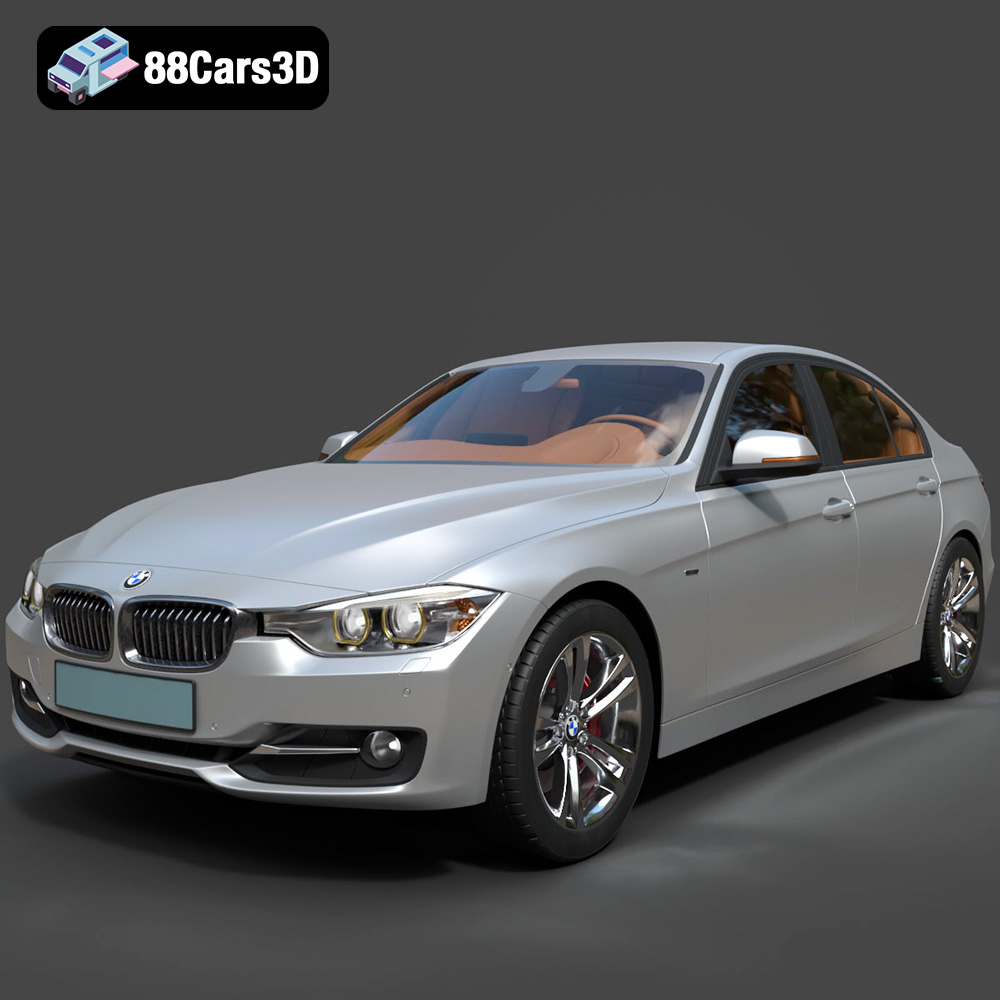
Texture: Yes
Material: Yes
Download the BMW 3 F30 3D Model featuring a detailed exterior, realistic interior, and optimized mesh. Includes .blend, .fbx, .obj, .glb, .stl, .ply, .unreal, and .max formats for rendering, simulation, and game development.
Price: $10.79
View Product
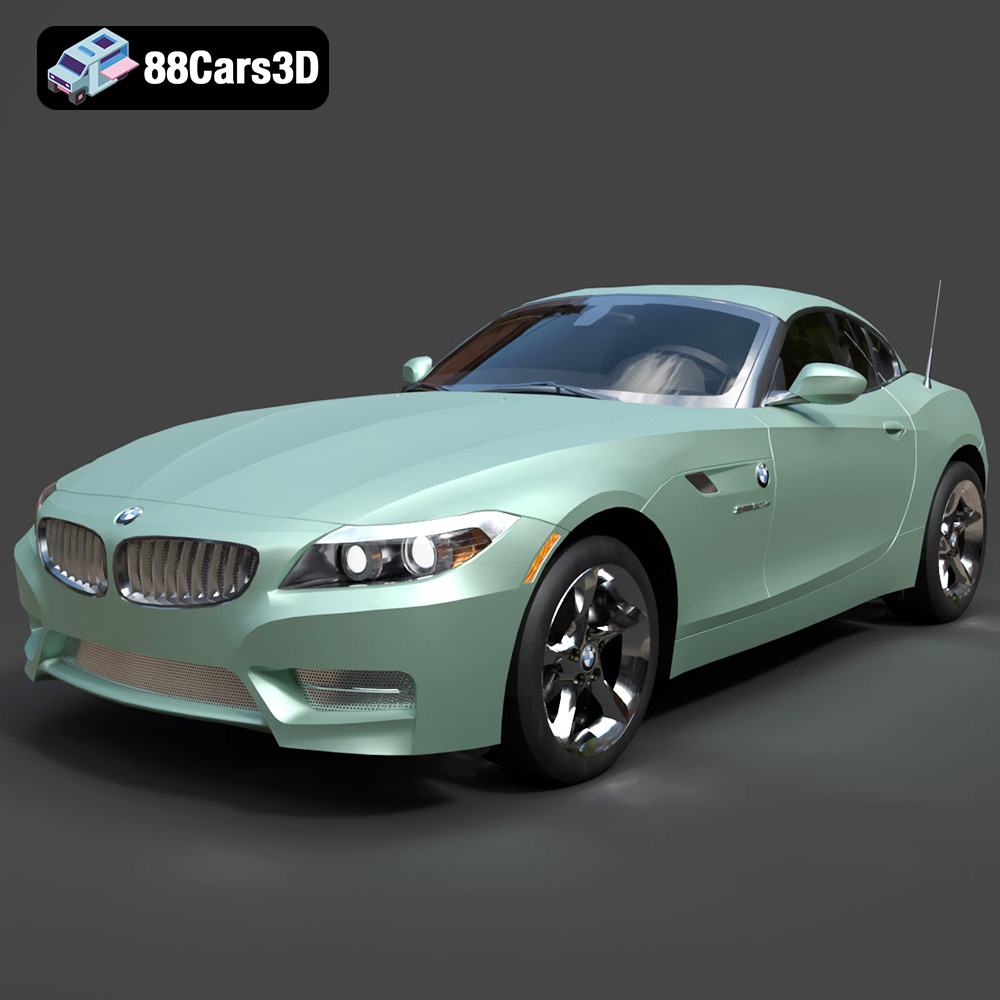
Texture: Yes
Material: Yes
Download the BMW Z4 Roadster E89 3D Model featuring clean geometry, realistic detailing, and a fully modeled interior. Includes .blend, .fbx, .obj, .glb, .stl, .ply, .unreal, and .max formats for rendering, simulation, and game development.
Price: $13.99
View Product

Texture: Yes
Material: Yes
Download the BMW Z4 E85 3D Model featuring clean geometry, realistic detailing, and a fully modeled interior. Includes .blend, .fbx, .obj, .glb, .stl, .ply, .unreal, and .max formats for rendering, simulation, and game development.
Price: $13.99
View Product

Texture: Yes
Material: Yes
Download the BMW M3 2024 3D Model featuring clean geometry, realistic detailing, and a fully modeled interior. Includes .blend, .fbx, .obj, .glb, .stl, .ply, .unreal, and .max formats for rendering, simulation, and game development.
Price: $13.99
View Product
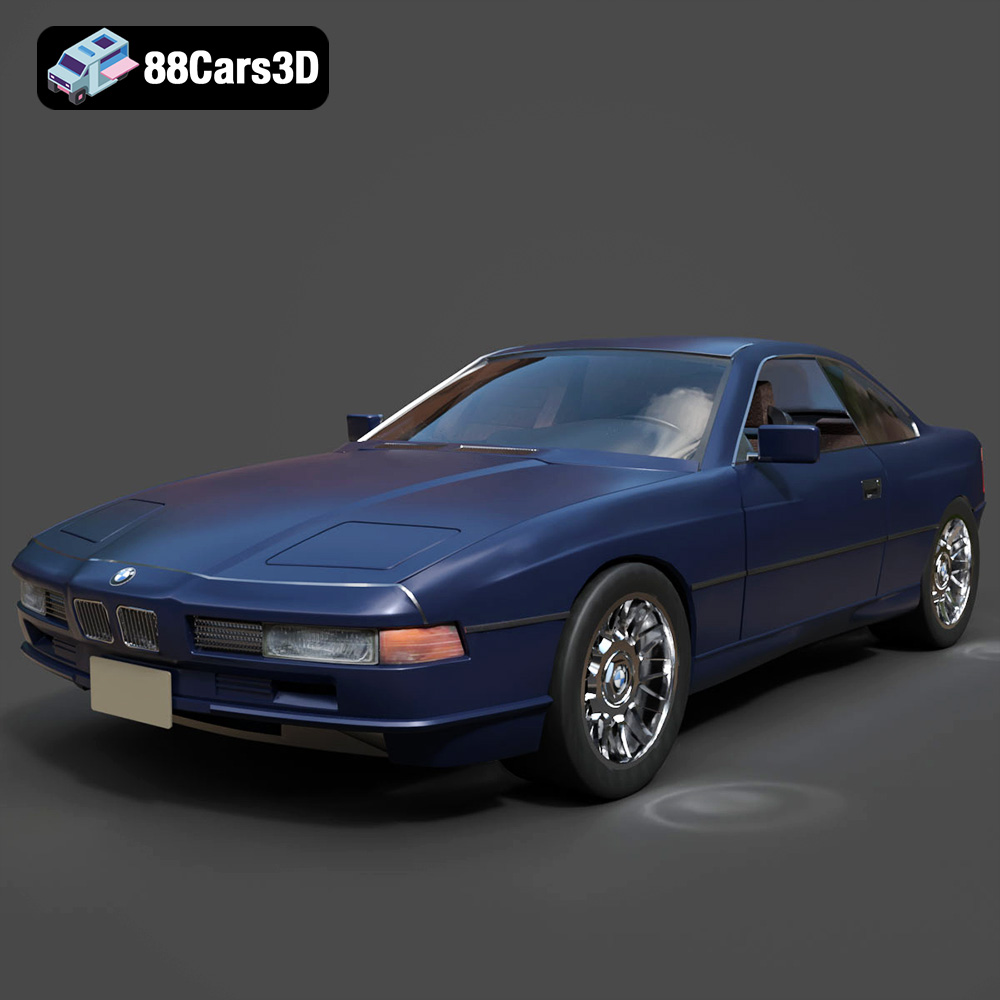
Texture: Yes
Material: Yes
Download the BMW 850i Coupe 1990 3D Model featuring clean geometry, realistic detailing, and a fully modeled interior. Includes .blend, .fbx, .obj, .glb, .stl, .ply, .unreal, and .max formats for rendering, simulation, and game development.
Price: $13.99
View Product
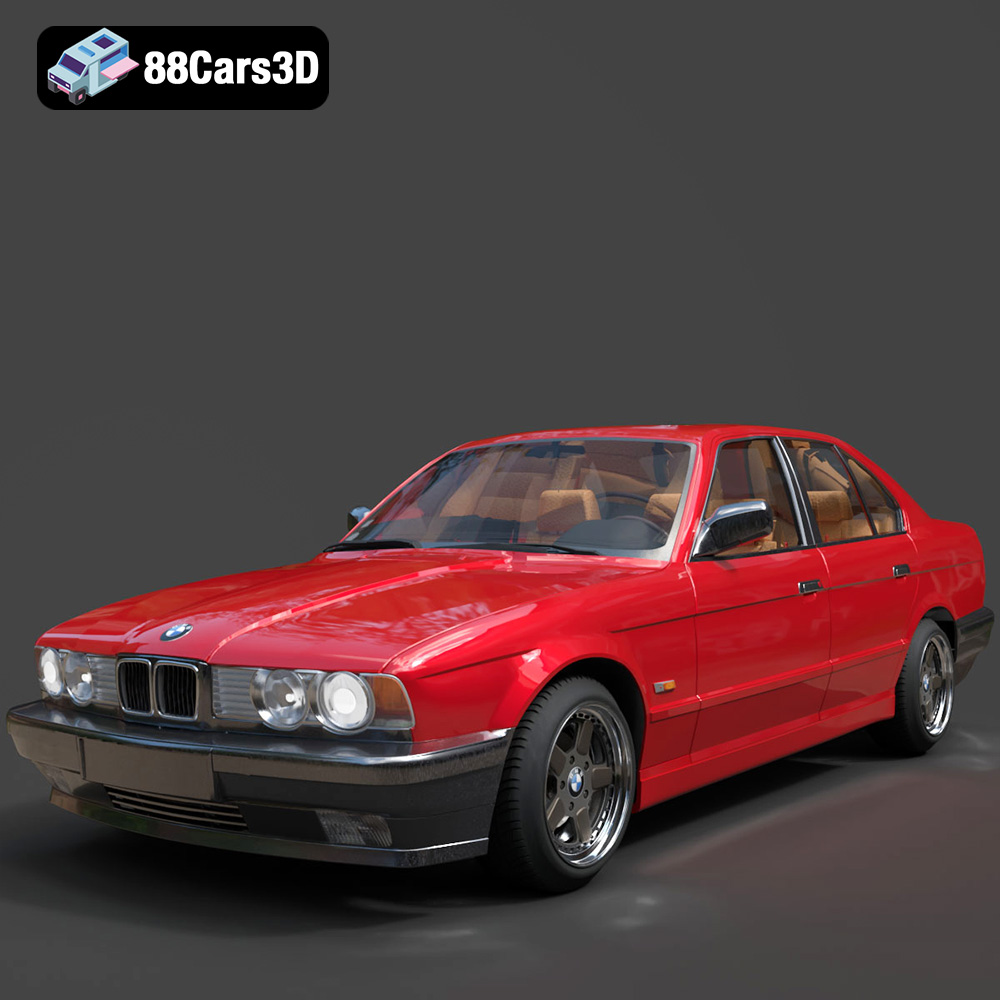
Texture: Yes
Material: Yes
Download the BMW 525i E34 1993 3D Model featuring clean geometry, realistic detailing, and a fully modeled interior. Includes .blend, .fbx, .obj, .glb, .stl, .ply, .unreal, and .max formats for rendering, simulation, and game development.
Price: $12.99
View Product

Texture: Yes
Material: Yes
Download the BMW 7 Series 2016 3D Model featuring luxurious design, detailed interior, and accurate exterior. Includes .blend, .fbx, .obj, .glb, .stl, .ply, .unreal, and .max formats for rendering, simulation, and game development.
Price: $10.79
View Product
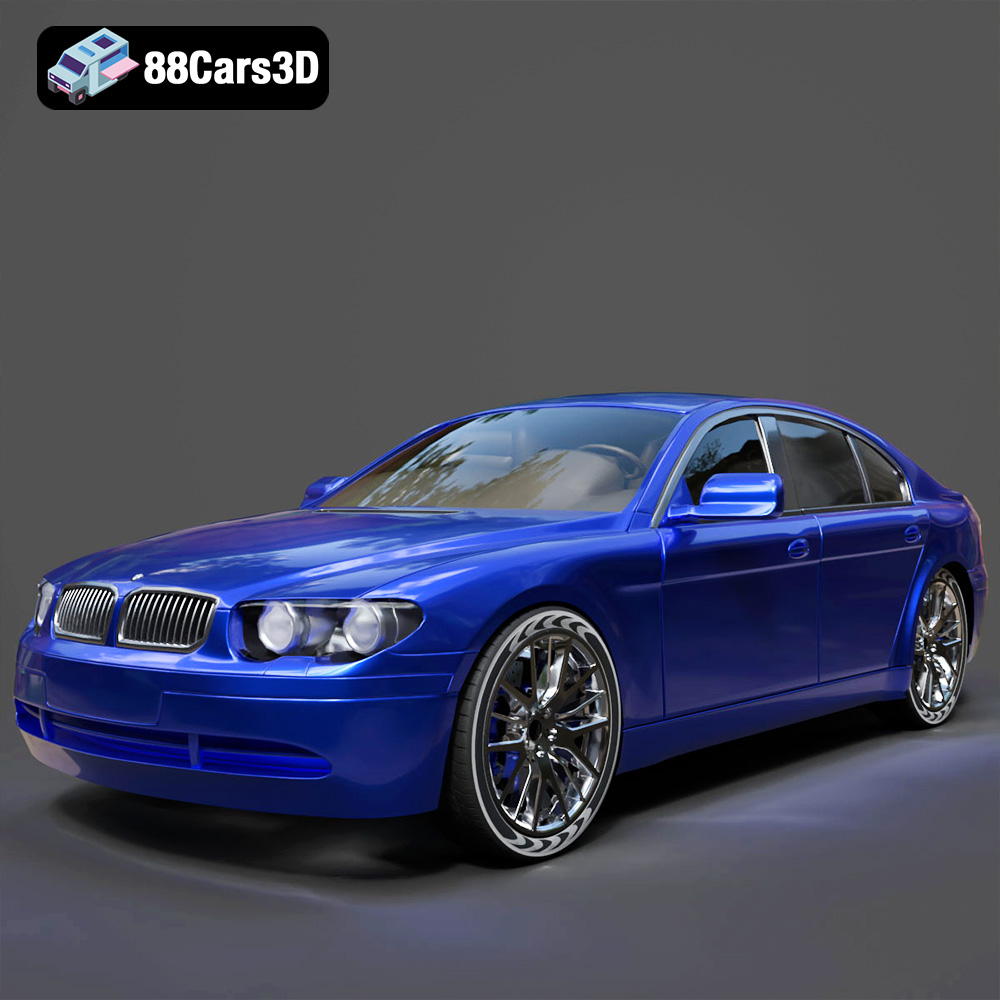
Texture: Yes
Material: Yes
Download the BMW 7 Series 30th Anniversary 3D Model featuring a meticulously crafted exterior, detailed interior, and realistic wheels. Includes .blend, .fbx, .obj, .glb, .stl, .ply, .unreal, and .max formats for rendering, simulation, and game development.
Price: $35.79
View Product

Texture: Yes
Material: Yes
Download the BMW 7-Series F02 3D Model featuring a detailed exterior and interior, optimized for rendering and animation. Includes .blend, .fbx, .obj, .glb, .stl, .ply, .unreal, and .max formats for rendering, simulation, and game development.
Price: $10.79
View Product
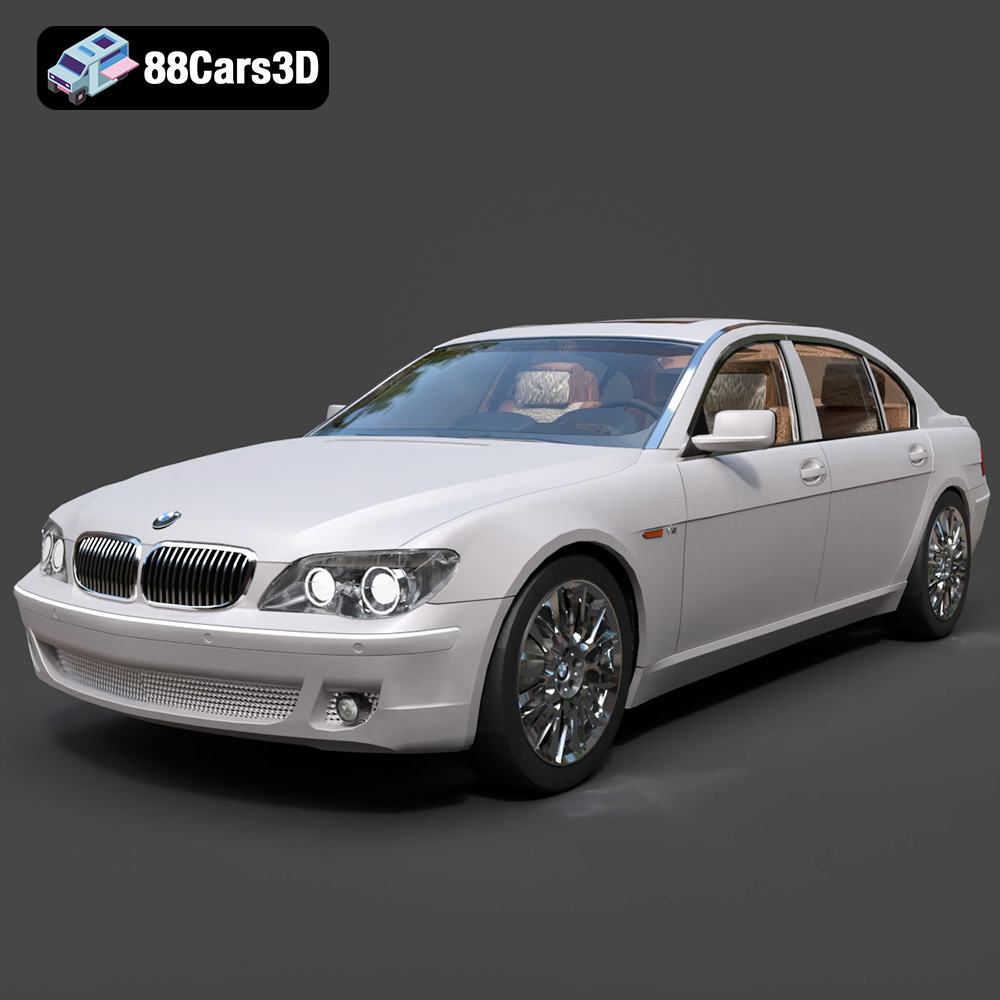
Texture: Yes
Material: Yes
Download the BMW 760Li E66 2005 3D Model featuring a detailed exterior, refined interior, and robust chassis. Includes .blend, .fbx, .obj, .glb, .stl, .ply, .unreal, and .max formats for rendering, simulation, and game development.
Price: $10.79
View Product


