⚡ FLASH SALE: Get 60% OFF All Premium 3D & STL Models! ⚡

The quest for photorealism in real-time rendering has long driven innovation in computer graphics. For automotive visualization, where every reflection, subtle shadow, and material nuance matters, achieving true-to-life fidelity is paramount. Enter Real-Time Ray Tracing in Unreal Engine – a transformative technology that has redefined what’s possible, allowing artists and developers to render stunningly realistic scenes with unprecedented accuracy, directly within the engine.
Gone are the days when such visual quality was exclusively reserved for offline renderers. With Unreal Engine, real-time ray tracing brings cinematic-grade lighting, reflections, shadows, and global illumination to interactive experiences, virtual production, and high-fidelity renders. This guide will delve deep into setting up and mastering real-time ray tracing for your automotive projects, leveraging the power of Unreal Engine to bring your 3D car models to life. We’ll explore everything from initial project configuration and material optimization to advanced lighting techniques and performance considerations, ensuring your automotive visualizations stand out with unparalleled realism. If you’re an Unreal Engine developer, a 3D artist, or a visualization professional looking to push the boundaries of visual fidelity, this comprehensive guide is for you.
Real-Time Ray Tracing (RTR) represents a fundamental shift in how computer graphics simulate light. Unlike traditional rasterization, which approximates light interactions using techniques like shadow maps and screen-space reflections, ray tracing directly simulates the physical behavior of light rays. When a ray tracing-enabled scene is rendered, light rays are traced from the camera (or light source) into the scene, bouncing off surfaces, picking up color and intensity, and interacting with materials in a physically accurate manner. This process inherently delivers hyper-realistic reflections, refractions, global illumination, and shadows.
Unreal Engine has embraced ray tracing with robust support, allowing developers to integrate these high-fidelity effects into their projects. This capability is particularly impactful for automotive visualization, where the accurate representation of highly reflective surfaces like car paint, chrome, and glass is critical. The subtle interplay of light and shadow, the way environments reflect in polished surfaces, and the realistic illumination from headlights all benefit immensely from ray tracing, elevating the visual quality of 3D car models to a new level of immersion and authenticity. When working with high-quality assets, such as those found on 88cars3d.com, real-time ray tracing unlocks their full visual potential.
The core difference between ray tracing and rasterization lies in their approach to rendering. Rasterization works by projecting 3D models onto a 2D screen, then coloring the pixels. This is fast and efficient but relies heavily on approximations and ‘hacks’ (like cube maps for reflections or shadow maps for shadows) to simulate complex light interactions. While incredibly optimized over decades, these approximations can sometimes break down, leading to visual inconsistencies or a less convincing sense of depth and realism.
Ray tracing, conversely, calculates light paths. When a pixel on the screen needs to be colored, a ray is cast from the camera through that pixel into the scene. If it hits an object, new rays might be cast from that hit point – for reflections, refractions, or to sample light sources for shadows and global illumination. This process, while computationally intensive, results in physically accurate effects by design. Unreal Engine leverages hardware-accelerated ray tracing (primarily from NVIDIA RTX and AMD RDNA2 GPUs) to make these complex calculations feasible in real-time, bridging the gap between offline rendering and interactive experiences. For detailed information on Unreal Engine’s rendering features, consult the official Unreal Engine documentation.
Unreal Engine’s real-time ray tracing implementation provides a suite of features that can be enabled independently or in combination:
Before diving into the visual enhancements, it’s essential to properly configure your Unreal Engine project and development environment for real-time ray tracing. This involves specific hardware requirements, project settings, and ensuring your assets are ready to take advantage of this powerful technology. A solid foundation is key to unlocking the full potential of ray tracing in your automotive visualizations.
Real-time ray tracing is computationally demanding and requires specific hardware. Here’s what you’ll need:
Once your system meets the prerequisites, enabling ray tracing in your Unreal Engine project is a straightforward process:
Edit > Project Settings > Platforms > Windows > Default RHI and set it to DirectX 12. This is a fundamental requirement for ray tracing. You will need to restart the editor after changing this setting.Edit > Project Settings > Engine > Rendering > Ray Tracing, tick the checkbox for Ray Tracing. This will expose a series of individual ray tracing features you can enable or disable, such as Ray Traced Reflections, Ray Traced Shadows, Ray Traced Global Illumination, etc. Enable the ones you intend to use. Again, a restart of the editor might be required.It’s a good practice to start with a minimal set of ray tracing features enabled and progressively add more as needed, monitoring performance at each step. This allows for better control and optimization.
Unreal Engine offers extensive control over ray tracing via console variables. These can be typed directly into the console (accessed with `~` in the editor) or configured in a DefaultEngine.ini file for persistent settings. Some essential variables include:
r.RayTracing.ForceAllRayTracingEffects: A master switch (0 or 1) to quickly disable or enable all ray tracing effects for debugging or performance testing.r.RayTracing.Culling: Controls the culling of objects for ray tracing, which can impact performance.r.RayTracing.Reflections.MaxBounces: Adjusts the number of times a reflection ray can bounce. Higher values mean more accurate reflections but increased cost.r.RayTracing.GlobalIllumination.MaxBounces: Similar to reflections, controls the bounce count for global illumination rays.r.RayTracing.Shadows.SamplesPerPixel: Determines the quality of ray traced shadows. Higher values reduce noise but increase cost.r.RayTracing.Denoiser: Controls the ray tracing denoiser (0=off, 1=on). Denoisers are critical for reducing noise artifacts, especially with lower sample counts, making ray tracing more feasible in real-time.Experimenting with these variables allows you to strike a balance between visual quality and performance for your specific automotive visualization needs. Remember to monitor your GPU performance (e.g., using stat gpu in the console) as you adjust these settings.
While ray tracing provides incredible visual fidelity, the quality of your 3D assets remains paramount. High-quality 3D car models, such as those available on platforms like 88cars3d.com, are typically designed with clean topology, proper UV mapping, and PBR-ready textures, which are ideal foundations for ray tracing. However, some specific considerations and optimizations can further enhance their appearance and performance when rendered with ray tracing in Unreal Engine.
For ray tracing, the geometric accuracy of your models directly impacts the realism of reflections, shadows, and global illumination. Models with clean, optimized topology are always preferred. While Nanite in Unreal Engine 5 handles incredibly high polygon counts efficiently for rasterization, ray tracing can still benefit from well-structured geometry.
When importing FBX or USD files, ensure all meshes are properly scaled and pivoted, as inconsistencies can lead to issues with lighting and reflection probes.
Physically Based Rendering (PBR) materials are the cornerstone of realism in modern engines, and they truly shine with ray tracing. Ray tracing algorithms naturally interpret PBR properties (albedo, roughness, metallic, normal) to simulate light interactions accurately.
Unreal Engine provides additional material settings specifically for ray tracing that can further optimize or enhance visual quality:
Support Ray Traced Translucency in the material properties and adjust the Refraction Index for physical accuracy.Careful attention to these details will ensure your 3D car models look their absolute best under ray traced lighting, maximizing the visual impact of your automotive scenes.
Once your project is configured and your assets are optimized, it’s time to leverage the core strength of real-time ray tracing: producing incredibly realistic lighting, reflections, and global illumination. These features are critical for achieving cinematic quality in automotive visualization, where the interaction of light with various surfaces defines the overall aesthetic.
Ray Traced Reflections are perhaps the most visually striking feature for automotive rendering. They provide accurate, dynamic reflections that capture the entire scene, including objects off-screen, unlike screen-space reflections which are limited to what’s visible to the camera.
Max Roughness (determines how rough a surface can be while still showing ray traced reflections; important for paint finishes), Max Bounces (higher values mean reflections of reflections, increasing realism but also cost), and Samples Per Pixel (determines reflection quality, higher means less noise but more cost).Max Roughness (clamping very rough surfaces to use less expensive reflection methods) and Max Bounces. Denoisers (controlled by r.RayTracing.Denoiser) are crucial here to mitigate noise.RTGI simulates bounced light, meaning light doesn’t just travel directly from a source to a surface, but also bounces off surfaces, indirectly illuminating other parts of the scene. This creates incredibly natural and soft ambient lighting, filling in shadows and adding a realistic sense of depth and atmosphere.
Global Illumination Method to Ray Tracing. Adjust parameters like Max Bounces, Samples Per Pixel, and Irradiance Cache Resolution. Higher bounces and samples yield better quality but increase rendering cost.RTS provides physically accurate soft shadows with correct penumbra (the blurry edge) and umbra (the dark core), unlike traditional shadow maps which often produce aliased or hard-edged shadows.
Ray Traced Shadow section. Key parameters include Samples Per Pixel (determines shadow quality and softness), Soft Shadow Angle (controls the spread of the shadow, simulating light source size), and Contact Shadows (a cost-effective way to add crisp detail where objects meet surfaces).Samples Per Pixel leads to smoother, less noisy shadows but comes with a performance hit. For a realistic cinematic look, adjust the Soft Shadow Angle to match real-world light source sizes. For instance, a small, distant sun will produce sharper shadows than a large, close studio softbox.Max Trace Distance for shadows to cull distant shadow calculations. For dynamic objects like cars, RTS is invaluable. For static background elements, consider if traditional cascaded shadow maps or baked shadows might be more performant, depending on the scene’s requirements. Leveraging r.RayTracing.Shadows.Denoiser can also significantly improve shadow quality with fewer samples.By carefully configuring these advanced ray tracing features, you can achieve an unparalleled level of realism in your automotive visualizations, making every rendered frame a work of art.
While real-time ray tracing offers stunning visual fidelity, it comes with a significant computational cost. Achieving high frame rates for interactive experiences or acceptable render times for cinematics requires a strategic approach to performance optimization. This involves balancing visual quality with system resources, particularly for demanding applications like automotive configurators or virtual production.
The first step in optimization is always to understand where performance is being lost. Unreal Engine provides powerful profiling tools:
stat gpu: This console command displays detailed GPU statistics, including time spent on various rendering passes. Look for high timings in ray tracing specific passes like ‘RTGI’, ‘RTReflections’, ‘RTShadows’.stat dumperaytracing: Provides a breakdown of ray tracing costs per feature, helping pinpoint which effect is the most expensive.stat unit: Shows overall frame time, allowing you to quickly see if you’re GPU or CPU bound. Ray tracing is almost always GPU bound.By identifying the most expensive ray tracing components, you can focus your optimization efforts where they will have the greatest impact. For further insights into profiling, Epic Games’ documentation provides excellent guides.
Unreal Engine’s scalability settings are crucial for adapting ray tracing quality to different hardware or performance targets. These settings are found in Editor Preferences > General > Scalability or can be adjusted at runtime via blueprint or console commands.
r.RayTracing.Denoiser only for debugging or if you’re deliberately trying to achieve a specific noisy aesthetic.r.RayTracing.Reflections.MaxBounces, r.RayTracing.GlobalIllumination.MaxBounces, r.RayTracing.Shadows.SamplesPerPixel to control the maximum quality globally or within your Post Process Volume.The complexity of your scene’s geometry and materials directly affects ray tracing performance.
r.RayTracing.Culling console variable.By implementing these strategies, you can maintain high visual fidelity while achieving the necessary performance targets for your real-time ray traced automotive projects. Understanding the interplay between these settings and your hardware is key to unlocking the full potential of Unreal Engine’s ray tracing capabilities.
The automotive industry is a prime beneficiary of real-time ray tracing in Unreal Engine. From marketing and design reviews to virtual production and interactive experiences, ray tracing elevates the visual quality of 3D car models to new heights of realism. This translates into more compelling presentations, faster design iterations, and engaging consumer interactions.
For high-impact marketing materials, car commercials, or product reveals, ray tracing in Unreal Engine with Sequencer is a game-changer. The ability to render physically accurate reflections on car paint, realistic soft shadows, and dynamic global illumination in real-time or near-real-time significantly reduces production cycles compared to traditional offline renderers.
Consumers increasingly expect immersive and interactive experiences when exploring new vehicles. Real-time ray tracing enhances automotive configurators, allowing users to customize a car’s color, materials, wheels, and accessories while seeing the changes rendered with stunning realism.
Virtual production, especially using large LED walls, is revolutionizing filmmaking. Real-time ray tracing plays a crucial role in enhancing the realism of virtual backgrounds projected onto these walls.
These applications demonstrate how real-time ray tracing in Unreal Engine isn’t just a technical marvel but a practical tool that delivers tangible benefits for professionals across the automotive visualization spectrum.
While real-time ray tracing brings incredible benefits, it’s a complex technology that can sometimes present challenges. Understanding common issues and their solutions is crucial for a smooth workflow and achieving the desired visual quality in Unreal Engine.
One of the most frequent issues encountered with ray tracing, especially at lower sample counts, is visual noise. This appears as flickering pixels or grainy surfaces.
r.RayTracing.Denoiser 1) are essential. They use temporal and spatial filtering to clean up noise with minimal performance impact.r.RayTracing.Reflections.SamplesPerPixel, r.RayTracing.Shadows.SamplesPerPixel), increase the sample count. This directly reduces noise but increases GPU cost. Use sparingly and find a balance with denoisers.Max Bounces can sometimes reduce noise in complex light paths, but also increases cost.Ray tracing is demanding, and performance can quickly become an issue if not managed correctly.
stat gpu and stat dumperaytracing to identify the most expensive ray tracing features or passes.r.ScreenPercentage) or console variable r.PrimaryScreenPercentage to render the scene at a lower resolution and then upscale, providing a significant performance boost.Occasionally, ray tracing might produce unexpected visual artifacts or incorrect lighting.
Soft Shadow Angle is appropriate. For point/spot lights, check radius settings.r.RayTracing.Culling or small bias values for shadows can resolve certain artifacts, but use with caution.By systematically approaching these common issues, you can troubleshoot effectively and harness the full power of real-time ray tracing for your automotive visualization projects in Unreal Engine.
Real-time ray tracing in Unreal Engine is no longer a futuristic concept; it’s a powerful and accessible tool that is revolutionizing automotive visualization. By accurately simulating the physics of light, it empowers artists and developers to achieve unprecedented levels of realism in reflections, global illumination, and shadows, bringing 3D car models to life with breathtaking fidelity. From cinematic marketing content to interactive configurators and cutting-edge virtual production workflows, the capabilities unlocked by ray tracing are transforming how we design, showcase, and experience vehicles.
Mastering this technology requires a foundational understanding of its principles, diligent project setup, meticulous asset optimization, and strategic performance management. By following the best practices outlined in this guide – from enabling DirectX 12 and configuring project settings, to fine-tuning PBR materials and leveraging features like Nanite and Lumen in conjunction with ray tracing – you can confidently push the visual boundaries of your Unreal Engine projects. Remember to continuously profile your scenes, experiment with scalability settings, and rely on the robust denoising capabilities to strike the perfect balance between visual quality and real-time performance.
The journey into real-time ray tracing is an exciting one, opening doors to a new era of photorealistic rendering. With high-quality, optimized 3D car models readily available from platforms like 88cars3d.com, you have the ideal foundation to start creating truly immersive and visually stunning automotive experiences. Embrace the power of Unreal Engine and ray tracing to bring your automotive visions to life with unparalleled realism and impact.
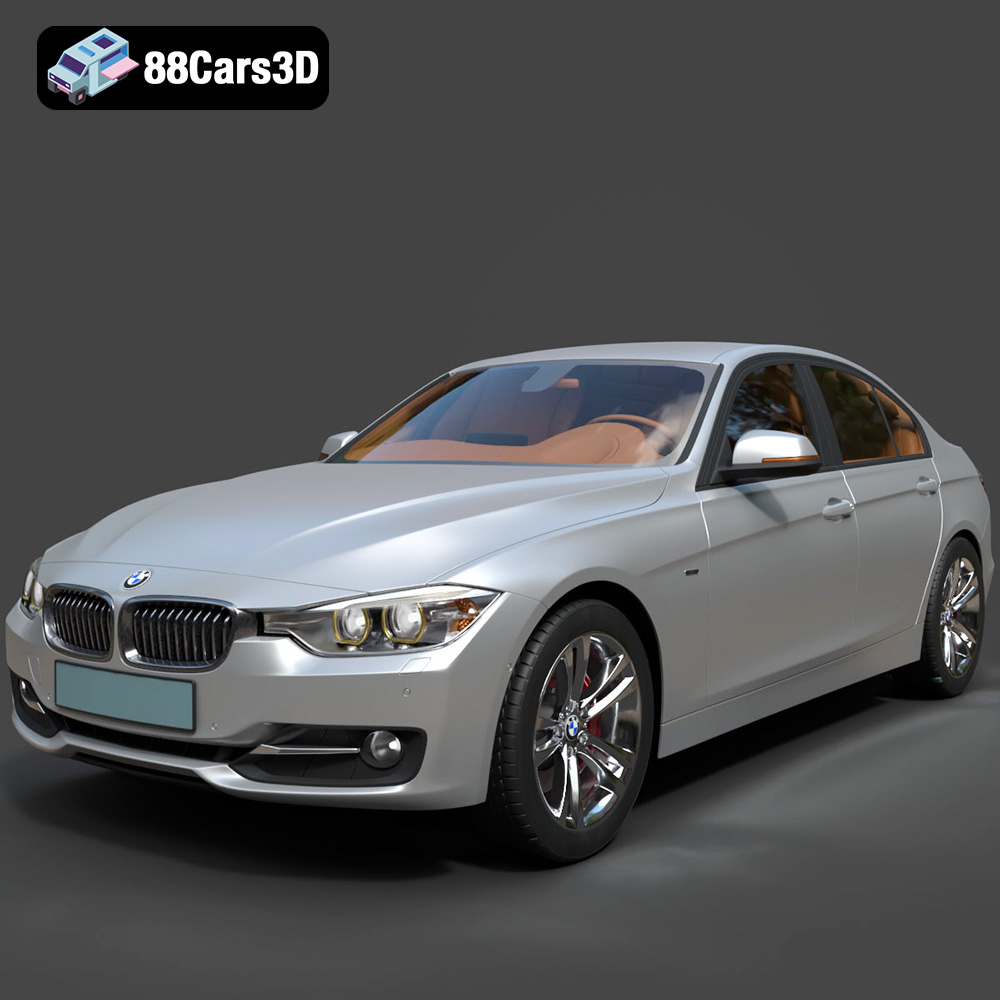
Texture: Yes
Material: Yes
Download the BMW 3 F30 3D Model featuring a detailed exterior, realistic interior, and optimized mesh. Includes .blend, .fbx, .obj, .glb, .stl, .ply, .unreal, and .max formats for rendering, simulation, and game development.
Price: $10.79
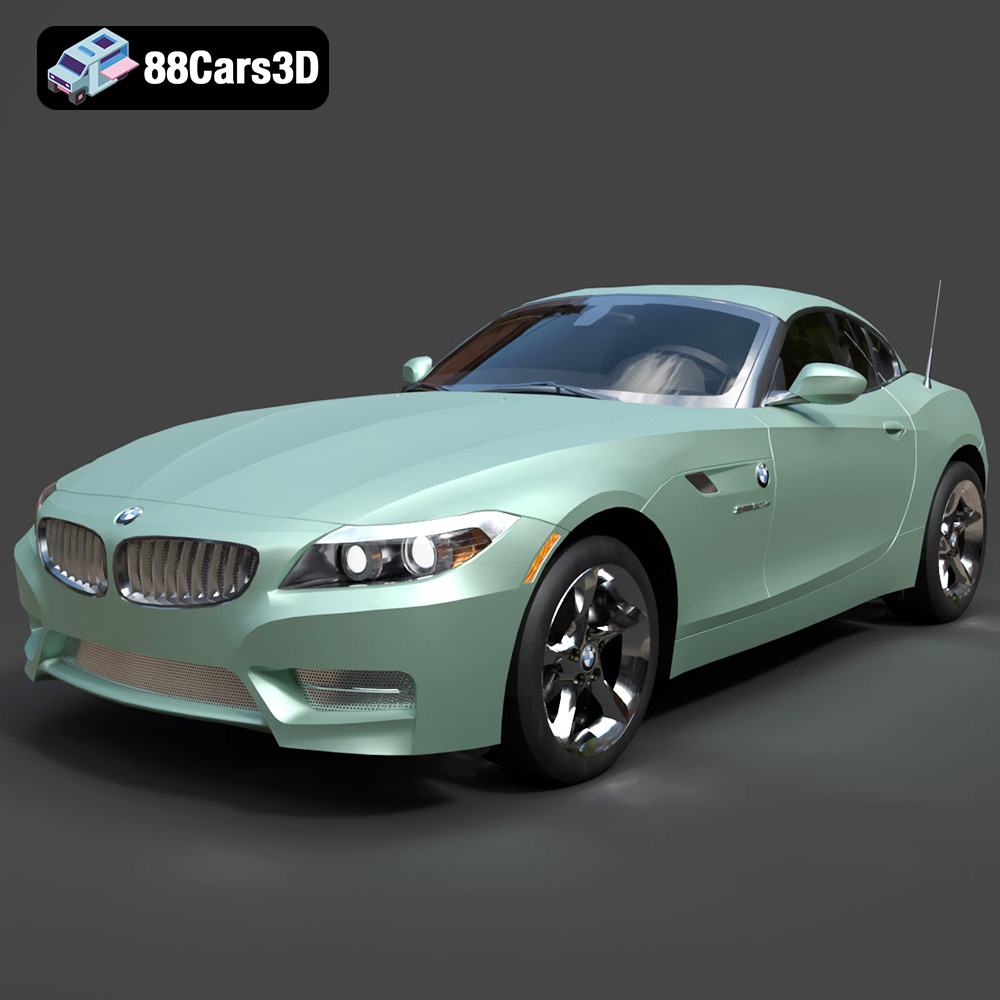
Texture: Yes
Material: Yes
Download the BMW Z4 Roadster E89 3D Model featuring clean geometry, realistic detailing, and a fully modeled interior. Includes .blend, .fbx, .obj, .glb, .stl, .ply, .unreal, and .max formats for rendering, simulation, and game development.
Price: $13.99

Texture: Yes
Material: Yes
Download the BMW Z4 E85 3D Model featuring clean geometry, realistic detailing, and a fully modeled interior. Includes .blend, .fbx, .obj, .glb, .stl, .ply, .unreal, and .max formats for rendering, simulation, and game development.
Price: $13.99

Texture: Yes
Material: Yes
Download the BMW M3 2024 3D Model featuring clean geometry, realistic detailing, and a fully modeled interior. Includes .blend, .fbx, .obj, .glb, .stl, .ply, .unreal, and .max formats for rendering, simulation, and game development.
Price: $13.99
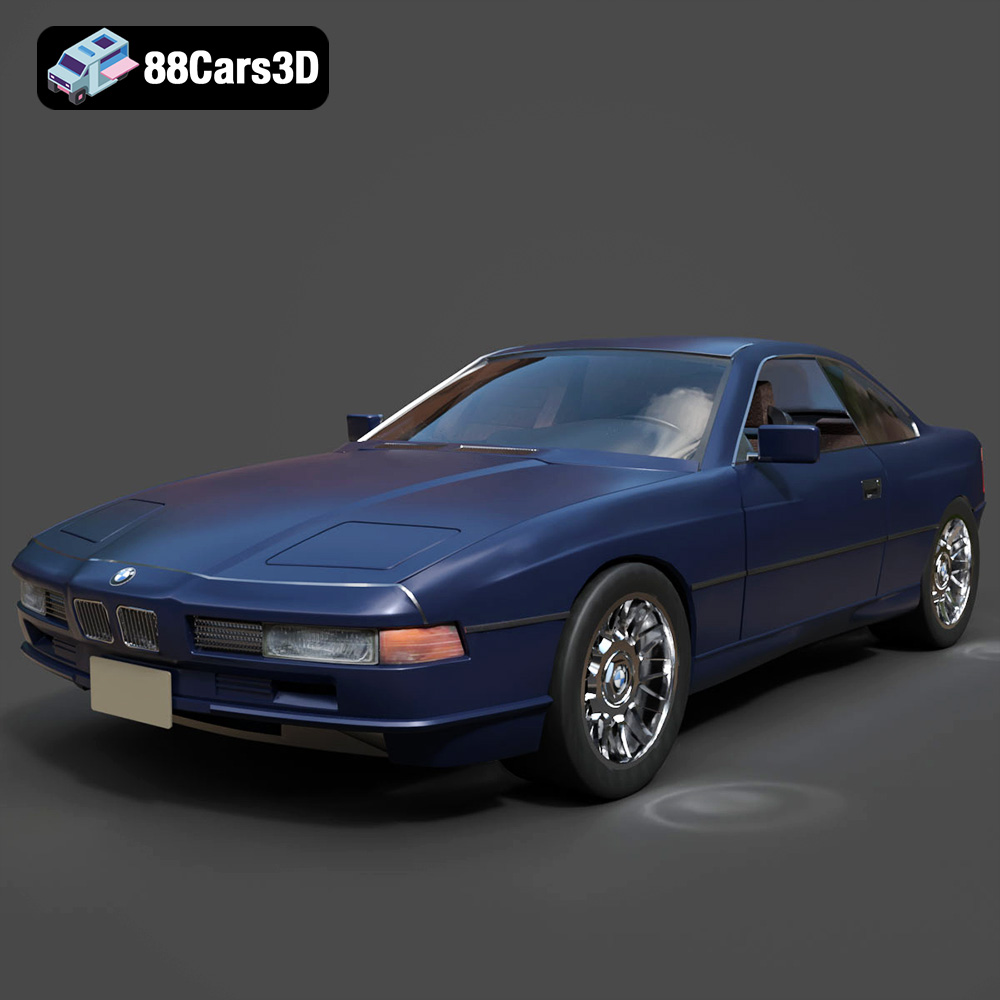
Texture: Yes
Material: Yes
Download the BMW 850i Coupe 1990 3D Model featuring clean geometry, realistic detailing, and a fully modeled interior. Includes .blend, .fbx, .obj, .glb, .stl, .ply, .unreal, and .max formats for rendering, simulation, and game development.
Price: $13.99
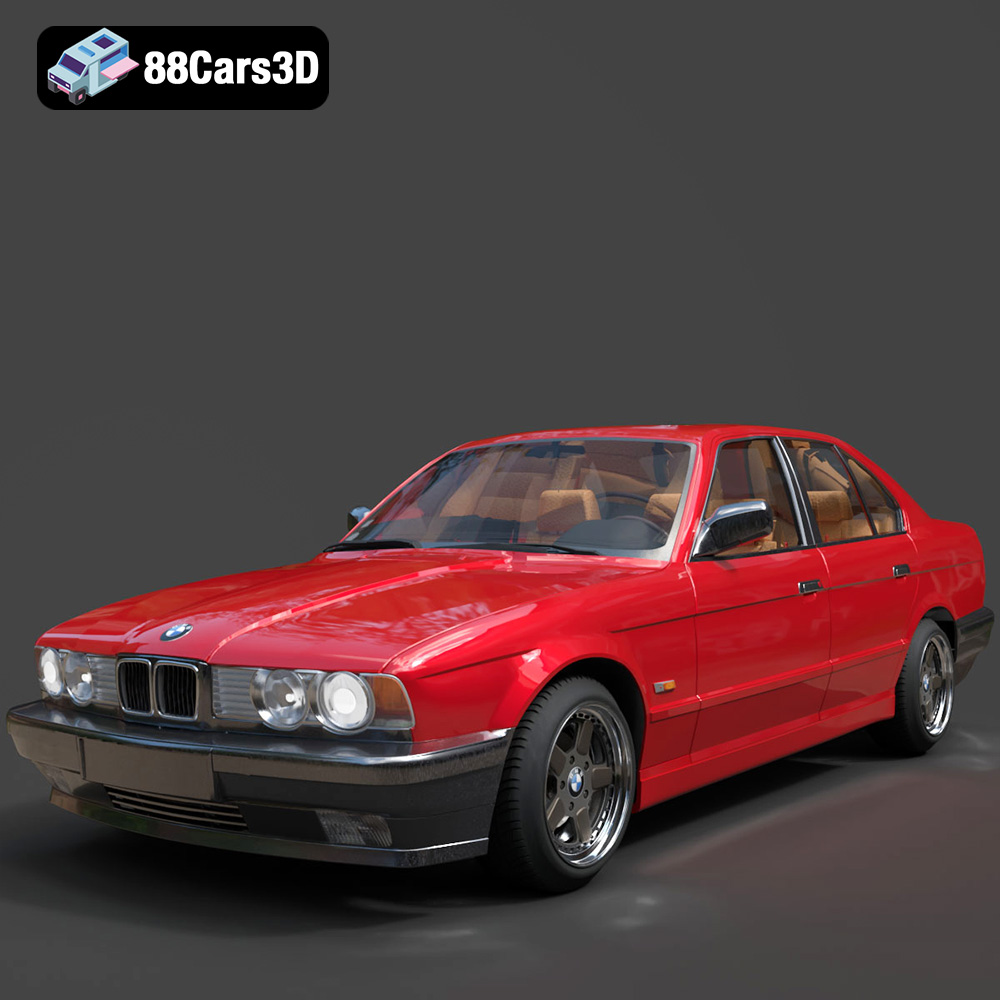
Texture: Yes
Material: Yes
Download the BMW 525i E34 1993 3D Model featuring clean geometry, realistic detailing, and a fully modeled interior. Includes .blend, .fbx, .obj, .glb, .stl, .ply, .unreal, and .max formats for rendering, simulation, and game development.
Price: $12.99

Texture: Yes
Material: Yes
Download the BMW 7 Series 2016 3D Model featuring luxurious design, detailed interior, and accurate exterior. Includes .blend, .fbx, .obj, .glb, .stl, .ply, .unreal, and .max formats for rendering, simulation, and game development.
Price: $10.79
Texture: Yes
Material: Yes
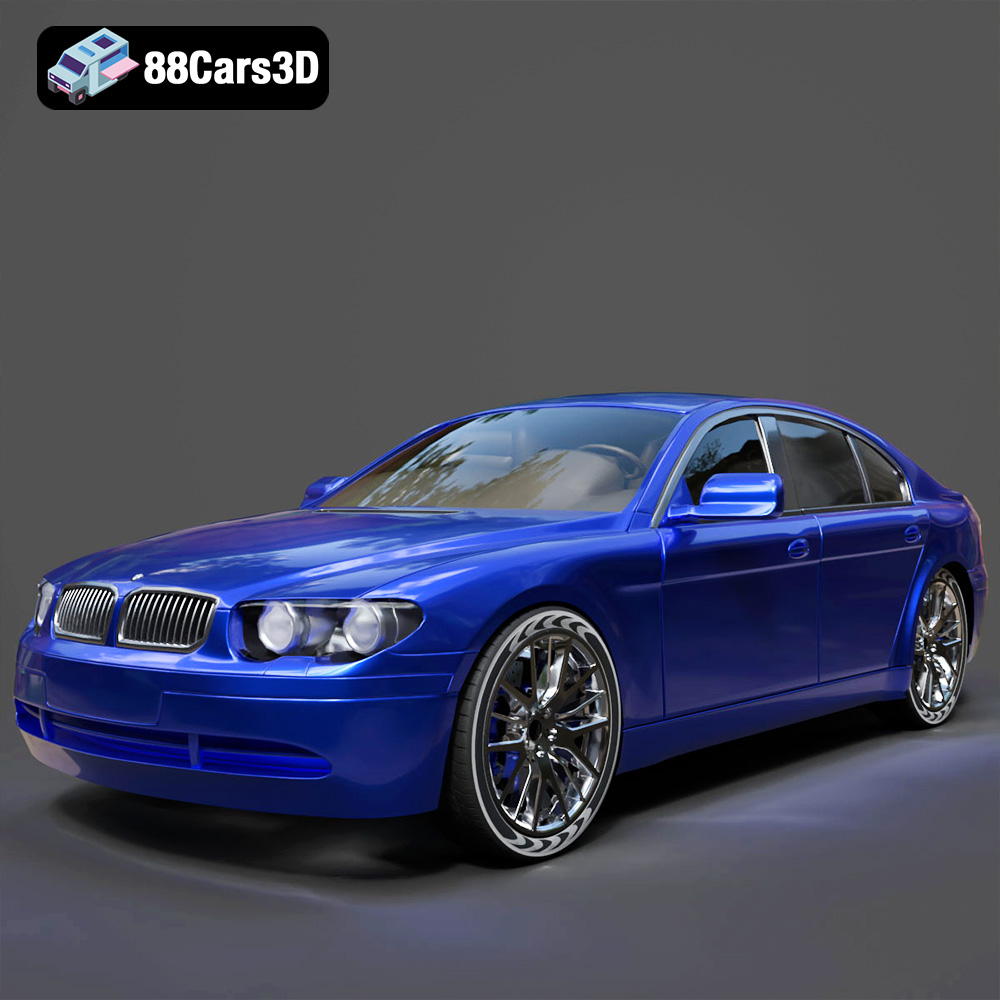
Download the BMW 7 Series 30th Anniversary 3D Model featuring a meticulously crafted exterior, detailed interior, and realistic wheels. Includes .blend, .fbx, .obj, .glb, .stl, .ply, .unreal, and .max formats for rendering, simulation, and game development.
Price: $35.79

Texture: Yes
Material: Yes
Download the BMW 7-Series F02 3D Model featuring a detailed exterior and interior, optimized for rendering and animation. Includes .blend, .fbx, .obj, .glb, .stl, .ply, .unreal, and .max formats for rendering, simulation, and game development.
Price: $10.79
Texture: Yes
Material: Yes
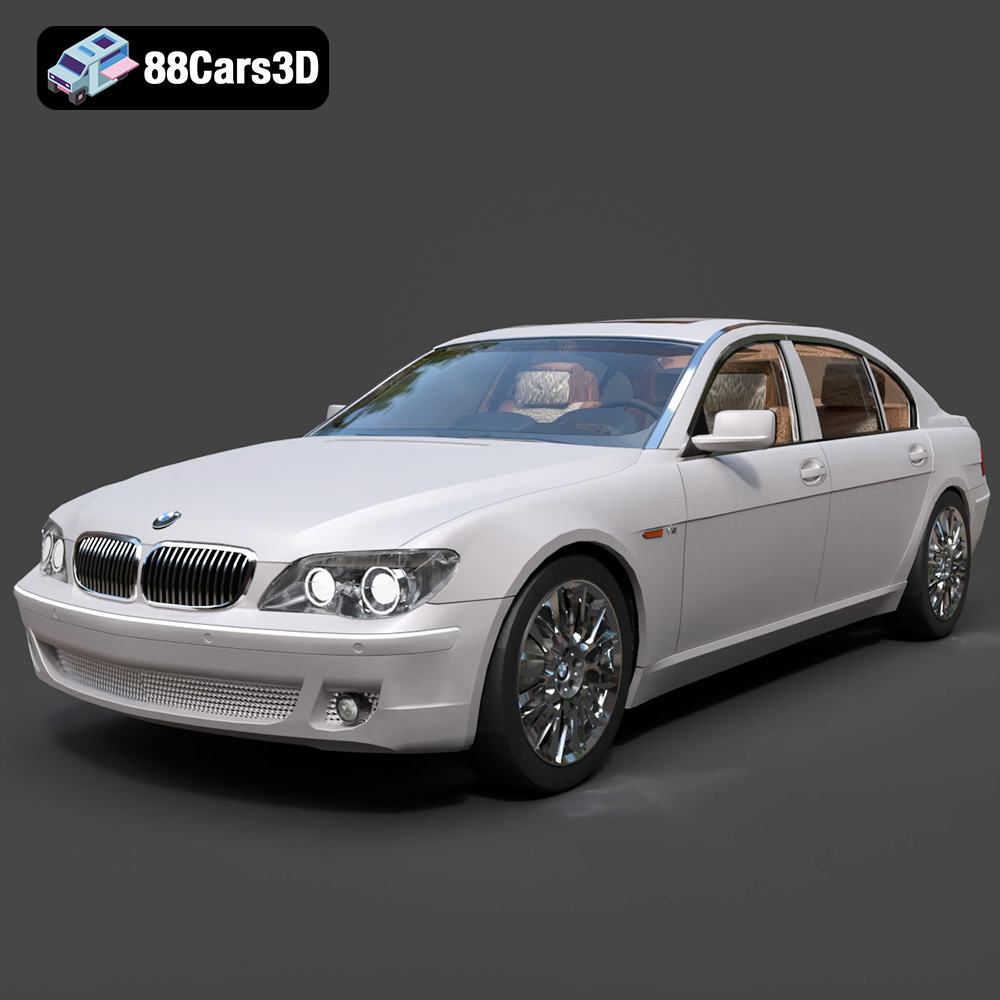
Download the BMW 760Li E66 2005 3D Model featuring a detailed exterior, refined interior, and robust chassis. Includes .blend, .fbx, .obj, .glb, .stl, .ply, .unreal, and .max formats for rendering, simulation, and game development.
Price: $10.79

