“`html
Mastering Your 3D Printable Car Models: Essential Software for STL File Editing
The world of 3D printing, especially for intricate models like those found on 88cars3d.com, is a blend of artistry and engineering. While a high-quality printable car model in STL format is the perfect starting point, sometimes it needs a little refinement. Whether you’re looking to adapt a model for a specific printer, correct minor imperfections, or even add your personal touch, understanding how to edit STL files is a crucial skill. This comprehensive guide will delve into the best free and paid software solutions available, empowering you to take your 3D printing projects from excellent to exceptional. We’ll cover everything from basic mesh repair to advanced modification techniques, ensuring you have the knowledge to confidently tackle any STL file challenge.
In this article, you’ll learn about:
- The fundamental characteristics of STL files and why they sometimes require editing.
- Top-tier free software options for mesh repair and basic modifications.
- Powerful paid software for advanced editing, customization, and preparation for printing.
- Specific workflows and techniques for optimizing STL files for FDM and resin printing.
- How to leverage these tools to troubleshoot common printing issues before they arise.
Understanding the STL File Format: The Foundation of 3D Printing
Before diving into software, it’s vital to understand the STL (STereoLithography) file format itself. Developed by 3D Systems, STL is the de facto standard for 3D printing. However, it’s a relatively simple format that describes only the surface geometry of a 3D object. It does this by approximating the surface with a mesh of triangular facets. Each triangle is defined by the X, Y, and Z coordinates of its three vertices and a normal vector, indicating which side of the triangle is “outside” the object.
This simplicity, while efficient for data transfer and slicing, can lead to several issues that necessitate editing. For instance, STL files don’t contain information about color, texture, or material properties. More critically, the triangulation process can sometimes result in errors:
- Non-Manifold Geometry: This refers to edges shared by more than two faces, or vertices connecting an arbitrary number of faces, creating inconsistencies that slicers cannot interpret correctly. Imagine an edge where three faces meet – this is non-manifold and will cause printing errors.
- Holes: Gaps in the mesh where triangles are missing or incorrectly oriented. These can lead to print failures, with material escaping during the printing process.
- Intersecting Faces: Triangles that overlap each other, confusing the slicing software.
- Flipped Normals: Normal vectors that point inwards instead of outwards, essentially inverting parts of the model’s surface.
- Zero-Area Triangles or Duplicate Vertices: These are artifacts that can cause issues during slicing.
For highly detailed models like those found on 88cars3d.com, ensuring the STL is “watertight” – meaning it has no holes and is a closed volume – is paramount for successful 3D printing. Editing software is your primary tool for diagnosing and fixing these problems, ensuring a smooth transition from digital model to physical object.
Mesh Topology and Its Importance
The “topology” of a 3D mesh refers to how its vertices, edges, and faces are connected. A “clean” topology, often referred to as manifold geometry, is essential for 3D printing. In a manifold mesh, every edge is shared by exactly two faces. This ensures that the surface represents a solid, closed volume. Non-manifold edges or vertices are like errors in the blueprint of your model, leading to unpredictable behavior in slicers and printers. Understanding basic mesh topology helps you identify problem areas quickly within editing software.
Why Edit STL Files? Common Use Cases
Beyond fixing errors, editing STL files serves numerous practical purposes:
- Scaling: Adjusting the overall size of a model to fit your build volume or project requirements.
- Hollowing: Removing interior material to save filament and reduce print time, especially for larger FDM prints.
- Adding Features: Incorporating mounting points, text, logos, or custom elements onto an existing model.
- Splitting Models: Dividing large or complex models into smaller, more manageable parts for easier printing and assembly, particularly useful for large-scale automotive models.
- Simplifying Meshes: Reducing the polygon count of a model to speed up slicing or reduce file size, though this must be done carefully to preserve detail.
- Orientation Optimization: Modifying the model to achieve the best print orientation for strength, detail, and minimal support material.
The Best Free STL Editing Software: Powerful Tools for Every Maker
The good news is that you don’t need to break the bank to get started with STL file editing. Several powerful and free software options are available, offering robust features for mesh repair and basic modifications. These tools are often sufficient for many common tasks, making them indispensable for hobbyists and makers.
Meshmixer: The Go-To for Mesh Repair and Preparation
Autodesk Meshmixer, while no longer actively developed by Autodesk, remains an incredibly powerful and popular free tool for 3D mesh manipulation. It excels at repairing STL files, simplifying meshes, adding features, and preparing models for 3D printing. Its intuitive interface, combined with a vast array of tools, makes it a favorite among 3D printing enthusiasts.
- Key Features:
- Inspector Tool: Automatically detects and often fixes common mesh errors like holes, non-manifold edges, and flipped normals.
- Sculpting Tools: Basic sculpting capabilities to smooth surfaces or add subtle details.
- Hollowing and Shell: Easily hollow out models to save material and print time, with options to control wall thickness and add drainage holes.
- Plane Cut and Slice: Cut models into separate parts or create flat bases.
- Import/Export: Supports STL, OBJ, and other common 3D file formats.
- Workflow Example: Repairing a Downloaded Car Model
- Import the STL file from 88cars3d.com into Meshmixer.
- Navigate to ‘Analysis’ > ‘Inspector’.
- Click ‘Auto Repair All’. Meshmixer will attempt to fix detected errors. Review the results and manually address any remaining issues using tools like ‘Hole Fill’.
- Use ‘Sculpt’ tools for minor smoothing if needed.
- If the model is too large, use ‘Edit’ > ‘Transform’ to scale it.
- For large FDM prints, use ‘Edit’ > ‘Hollow’ to reduce material. Ensure you add drainage holes.
- Export the repaired model as an STL file.
- Pros: Extremely powerful for mesh repair, versatile toolset, relatively easy to learn for basic tasks, free.
- Cons: No longer actively updated, interface can be a bit dated, advanced sculpting is limited.
Blender: The Versatile 3D Suite
Blender is a professional, open-source 3D creation suite that extends far beyond basic STL editing. While it has a steeper learning curve than Meshmixer, its capabilities are nearly limitless. It’s an excellent choice for users who want to perform complex modifications, sculpt intricate details, or even create models from scratch.
- Key Features:
- Robust Modeling Tools: Edit vertices, edges, and faces with precision using a comprehensive set of modeling tools.
- Sculpting Mode: Advanced digital sculpting brushes for fine-tuning details or adding custom elements.
- Boolean Operations: Combine, subtract, or intersect objects – invaluable for adding or removing complex shapes.
- Add-ons: A vast ecosystem of community-developed add-ons can extend Blender’s functionality further, including specific tools for 3D printing preparation.
- Mesh Analysis: Tools like ‘3D-Print Toolbox’ (an add-on) help identify and fix non-manifold geometry, check wall thickness, and analyze overhangs.
- Workflow Example: Adding a Custom Spoiler to a Car Model
- Import the STL from 88cars3d.com into Blender.
- Enable the ‘3D-Print Toolbox’ add-on (Preferences > Add-ons).
- Use the ‘3D-Print Toolbox’ to check for and fix manifold errors.
- Model the custom spoiler as a separate object.
- Position the spoiler where you want it on the car body.
- Use the ‘Boolean’ modifier to join the spoiler to the car body. Ensure the operation is set to ‘Union’. Apply the modifier.
- Perform a final mesh check with the ‘3D-Print Toolbox’ to ensure the combined mesh is watertight.
- Export the final model as an STL.
- Pros: Incredibly powerful and versatile, professional-grade tools, constantly updated, large community support, free.
- Cons: Steep learning curve, can be overkill for simple repairs, interface requires time to master.
FreeCAD: Parametric CAD for Precision
For those who prefer a more engineering-focused approach, FreeCAD offers parametric modeling capabilities. While not primarily a mesh editor, it can import and convert STL files into its native boundary representation (BREP) format, allowing for precise modifications using CAD tools. It’s particularly useful if you need to integrate 3D printed parts into a larger mechanical design.
- Key Features:
- Parametric Modeling: Changes made to initial sketches or operations propagate throughout the model.
- Workbench System: Different workbenches (e.g., Part, PartDesign) provide specialized tools for various tasks, including mesh import and manipulation.
- Boolean Operations: Similar to Blender, FreeCAD offers robust tools for combining and subtracting shapes.
- Workflow Example: Adjusting Wheel Arch Dimensions
- Import the STL car model into FreeCAD.
- Convert the mesh object to a solid using the ‘Part’ workbench. This can sometimes be challenging with complex meshes.
- If conversion is successful, use ‘PartDesign’ tools to sketch modifications (e.g., a new shape for the wheel arch) and use extrusion or revolution to alter the geometry.
- Alternatively, use the ‘Boolean’ tools to subtract or add shapes precisely.
- Export the modified model as an STL.
- Pros: Precise, parametric control, good for integrating with mechanical designs, free and open-source.
- Cons: Can struggle with complex, organic meshes; the conversion process from STL to BREP isn’t always perfect; learning curve can be significant.
Paid Software: Advanced Features for Professional Results
While free software can handle many tasks, professional workflows often benefit from the advanced features, speed, and dedicated support offered by paid solutions. These programs are designed for specific use cases, from high-end model modification to industrial-level preparation.
Autodesk Fusion 360: Integrated CAD/CAM/CAE
Fusion 360 is a powerful cloud-based platform that combines CAD, CAM, and CAE tools. It offers a hybrid approach, allowing users to work with both solid modeling and direct mesh editing. Its subscription model makes it accessible to hobbyists, startups, and professionals alike. For users who also design their own parts or need to integrate 3D printed components into assemblies, Fusion 360 is an excellent choice.
- Key Features:
- Direct Mesh Editing: Tools specifically designed to manipulate STL and other mesh file formats without needing to convert them to parametric solids first.
- Parametric Modeling: Create precise, editable models based on sketches and features.
- Sculpt Environment (T-Splines): Advanced freeform sculpting capabilities for organic shapes and intricate details.
- Assembly Modeling: Design and simulate how multiple parts fit together.
- Integrated CAM: Generate toolpaths for CNC machining alongside 3D printing preparation.
- Simulation Tools: Analyze stress, strain, and thermal properties.
- Workflow Example: Refining a Model for Multi-Part FDM Printing
- Import the STL car model into Fusion 360.
- Use the ‘Mesh Utility’ tools to inspect and repair the mesh.
- If necessary, use the ‘Sculpt’ environment to smooth rough areas or add subtle bodywork changes.
- Use the ‘Split Body’ command or ‘Slice’ tool to divide the car into logical parts (e.g., body, wheels, chassis) for easier printing and assembly. Ensure cuts are clean and provide surfaces for joining.
- Add registration keys or interlocking features using standard modeling tools to aid alignment during assembly.
- Export each part as a separate STL file, optimizing orientation and considering support structures within the slicer software.
- Pros: Powerful hybrid modeling approach, excellent for design and integration, robust mesh editing tools, affordable subscription, cloud-based collaboration.
- Cons: Requires an internet connection for most operations, can be resource-intensive, subscription-based.
ZBrush: The Standard for Digital Sculpting
ZBrush is the industry-standard software for digital sculpting, renowned for its ability to handle extremely high-polygon models with ease. While primarily used for character modeling and concept art, it’s also a fantastic tool for adding intricate details, textures, and modifications to printable car models, especially for creating highly realistic display pieces.
- Key Features:
- Advanced Sculpting Brushes: A vast array of brushes for creating highly detailed surfaces, panel lines, and textures.
- Dynamesh and ZRemesher: Tools to dynamically add or retopologize geometry, allowing for detailed sculpting on a manageable mesh.
- 3D Print Exporter: Dedicated tools to prepare models for 3D printing, including mesh checking, hole filling, and decimation.
- Subdivision Surface Modeling: Create smooth, organic forms.
- Workflow Example: Adding Realistic Panel Gaps and Vents
- Import the STL car model into ZBrush.
- Use ZRemesher to create a cleaner, more manageable mesh topology if the original STL is overly dense or problematic.
- Employ sculpting brushes (e.g., DamStandard, TrimDynamic) to carve out precise panel gaps.
- Use insert brushes or manual sculpting to create intricate details like grilles, vents, or louvers.
- Utilize the ‘3D Print Hub’ exporter to check for manifold errors and decimate the mesh to a suitable polygon count for slicing.
- Export the highly detailed model as an STL.
- Pros: Unmatched sculpting capabilities, handles extremely high polygon counts, industry-standard for detail work.
- Cons: Expensive, steep learning curve, focused primarily on sculpting rather than precise CAD manipulation.
Netfabb: Industrial-Grade Print Preparation
Autodesk Netfabb is a professional software package specifically designed for additive manufacturing process preparation. It goes beyond basic mesh repair, offering advanced simulation, optimization, and build preparation tools used in industrial settings. While overkill for many hobbyists, it’s the ultimate solution for complex projects requiring maximum reliability and efficiency.
- Key Features:
- Advanced Mesh Repair: Comprehensive tools for automatic and manual repair of complex mesh errors.
- Support Generation: Sophisticated algorithms for generating robust and efficient support structures, crucial for intricate parts.
- Build Simulation: Predict potential printing issues like warping or distortion before printing.
- Nesting and Packing: Optimize the layout of multiple parts on the build plate.
- Part Evaluation: Analyze wall thickness, overhangs, and other critical parameters.
- Workflow Example: Ensuring a Flawless Print of a Complex Engine Bay Model
- Import the complex STL engine bay model into Netfabb.
- Utilize Netfabb’s automated repair functions to create a watertight, manifold mesh.
- Employ the advanced support generation tools, customizing density, connection points, and branch patterns for optimal support with minimal surface scarring.
- Use build simulation features to identify potential stresses or areas prone to failure.
- If needed, use slicing and cut tools to divide the model into printable sections and add interlocking features.
- Export the prepared model and support structures (if applicable) for slicing.
- Pros: The gold standard for industrial print preparation, highly advanced repair and simulation tools, powerful support generation.
- Cons: Very expensive, significant learning curve, generally targeted at professional/industrial users.
Choosing the Right Software for Your Needs
The best software for you depends entirely on your goals, budget, and technical proficiency:
- For Beginners and Basic Repairs: Start with Meshmixer. It’s free, powerful for its purpose, and relatively easy to learn for fixing holes, scaling, and hollowing models downloaded from places like 88cars3d.com.
- For More Advanced Customization and Learning: Blender is an excellent free option if you’re willing to invest time in learning its interface. It offers limitless possibilities for modification and creative additions.
- For Engineering Integration and Hybrid Workflows: Fusion 360 provides a compelling balance of parametric CAD, direct mesh editing, and sculpting at an accessible price point.
- For High-Detail Sculpting and Artistic Flair: ZBrush is the ultimate tool for adding intricate surface details and textures, though it comes with a professional price tag.
- For Industrial Reliability and Complex Builds: Netfabb offers unparalleled features for ensuring successful prints of the most challenging models, but it’s an investment for serious professionals.
Often, a combination of tools works best. You might use Meshmixer for initial repairs and basic hollowing, then import the model into Blender for adding custom elements, and finally export it for slicing.
Conclusion: Empowering Your 3D Printing Journey
Editing STL files is an essential skill for unlocking the full potential of 3D printable models. Whether you’re downloading exquisitely detailed car models from 88cars3d.com or creating your own, the ability to repair, modify, and optimize your files can significantly enhance your printing success rate and the final quality of your prints. From the accessible power of free tools like Meshmixer and Blender to the professional capabilities of Fusion 360, ZBrush, and Netfabb, there’s a software solution for every need and budget.
By understanding the nuances of the STL format and mastering the features of these software packages, you can confidently tackle common printing issues, customize models to your exact specifications, and bring your automotive creations to life with precision and flair. Invest the time to explore these tools; the ability to troubleshoot and refine your digital models before they hit the print bed will undoubtedly elevate your 3D printing hobby or professional work. Happy printing!
“`
Featured 3D Car Models

Texture: Yes
Material: Yes
Download the BMW 7 Series E38 3D Model featuring its iconic luxury sedan design and classic aesthetics. Includes .blend, .fbx, .obj, .glb, .stl, .ply, .unreal, and .max formats for rendering, simulation, and game development.
Price: $10.79
View Product

Texture: Yes
Material: Yes
Download the BMW 6 Series 640i F12 3D Model featuring a sleek design and detailed interior. Includes .blend, .fbx, .obj, .glb, .stl, .ply, .unreal, and .max formats for rendering, simulation, and game development.
Price: $10.79
View Product

Texture: Yes
Material: Yes
Download the BMW 6 Coupe E63 3D Model featuring a sleek design, detailed interior, and realistic exterior. Includes .blend, .fbx, .obj, .glb, .stl, .ply, .unreal, and .max formats for rendering, simulation, and game development.
Price: $10.79
View Product

Texture: Yes
Material: Yes
Download the BMW 5 Series Touring F11-007 3D Model featuring a detailed exterior and interior. Includes .blend, .fbx, .obj, .glb, .stl, .ply, .unreal, and .max formats for rendering, simulation, and game development.
Price: $10.79
View Product

Texture: Yes
Material: Yes
Download the BMW 5 Series Gran Turismo F07-003 3D Model featuring a detailed exterior and interior. Includes .blend, .fbx, .obj, .glb, .stl, .ply, .unreal, and .max formats for rendering, simulation, and game development.
Price: $10.79
View Product
Texture: Yes
Material: Yes
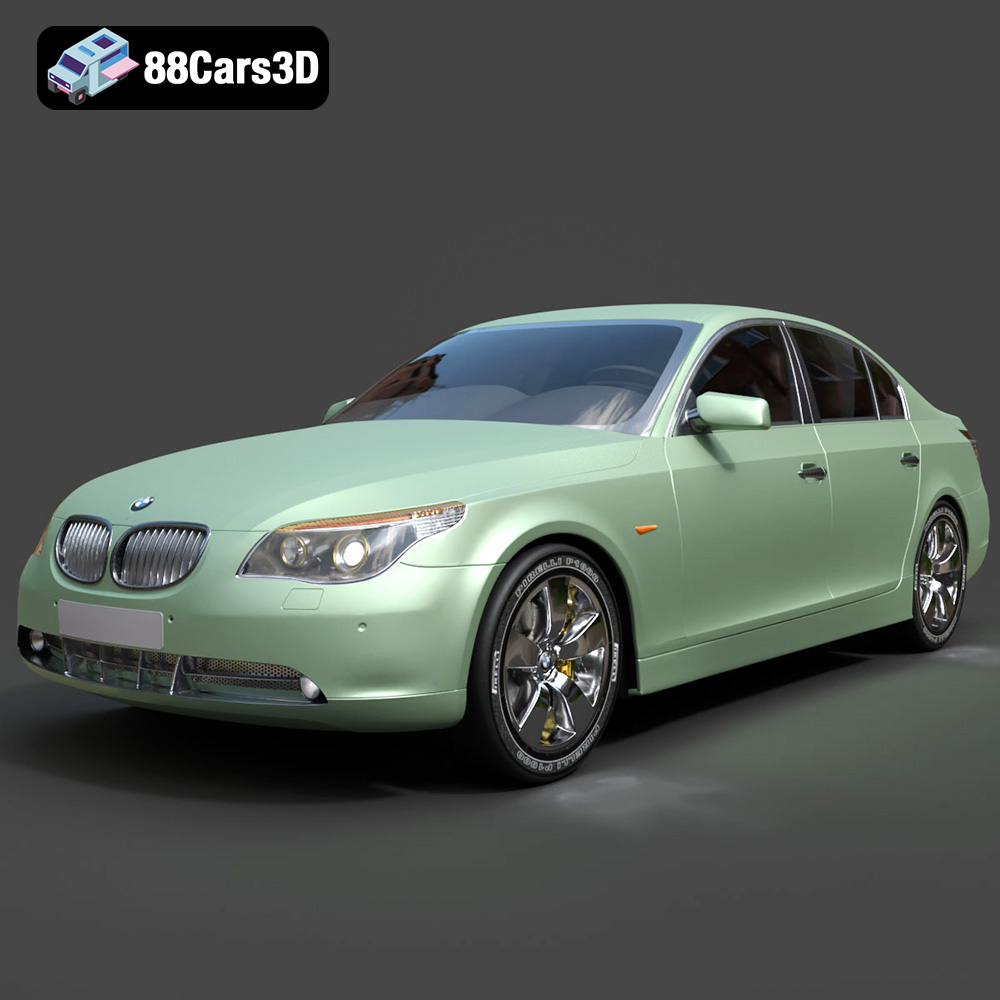
Download the BMW 5 Series E60 3D Model featuring its iconic sedan design, detailed exterior, and interior. Includes .blend, .fbx, .obj, .glb, .stl, .ply, .unreal, and .max formats for rendering, simulation, and game development.
Price: $10.79
View Product

Texture: Yes
Material: Yes
Download the BMW 5 E34-535i 3D Model featuring an iconic design, detailed exterior and interior, and accurate representation. Includes .blend, .fbx, .obj, .glb, .stl, .ply, .unreal, and .max formats for rendering, simulation, and game development.
Price: $10.79
View Product
Texture: Yes
Material: Yes
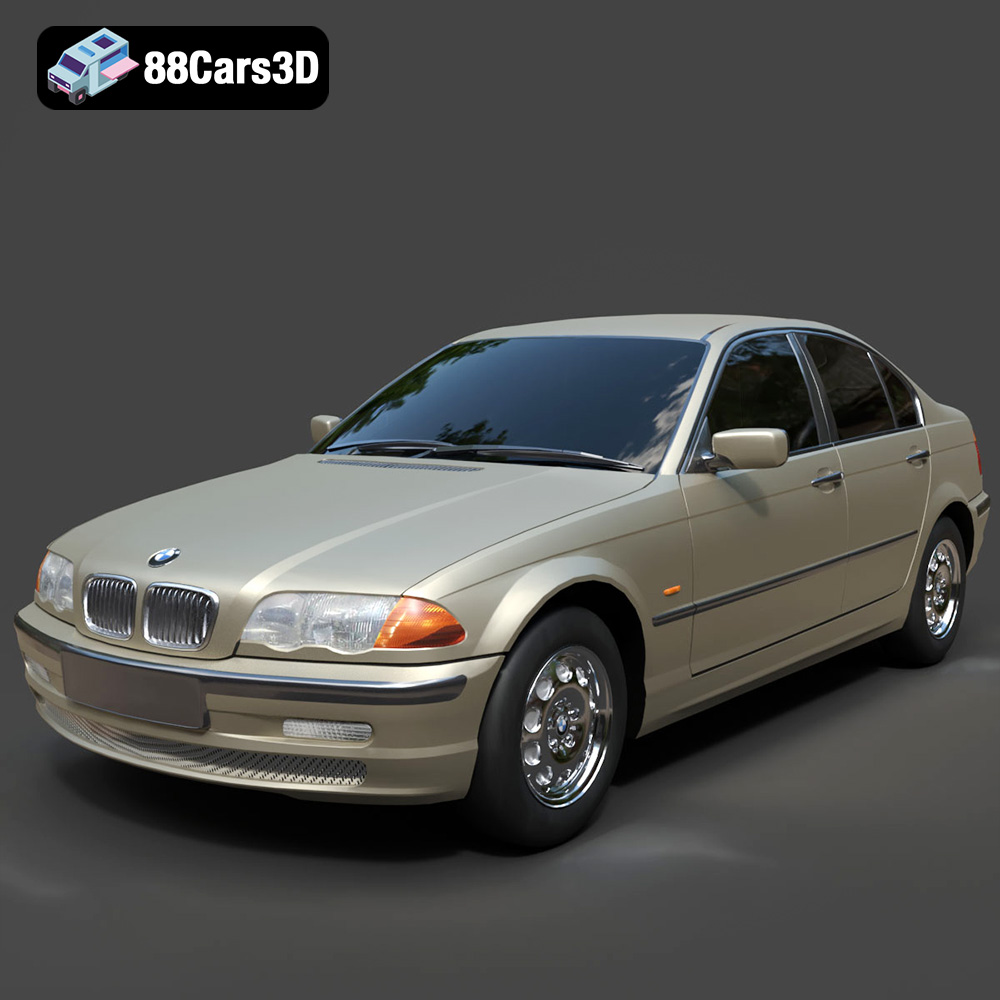
Download the BMW 3 Series E46 3D Model featuring authentic exterior lines, a detailed interior, and separated components for animation. Includes .blend, .fbx, .obj, .glb, .stl, .ply, .unreal, and .max formats for rendering, simulation, and game development.
Price: $10.79
View Product
Texture: Yes
Material: Yes
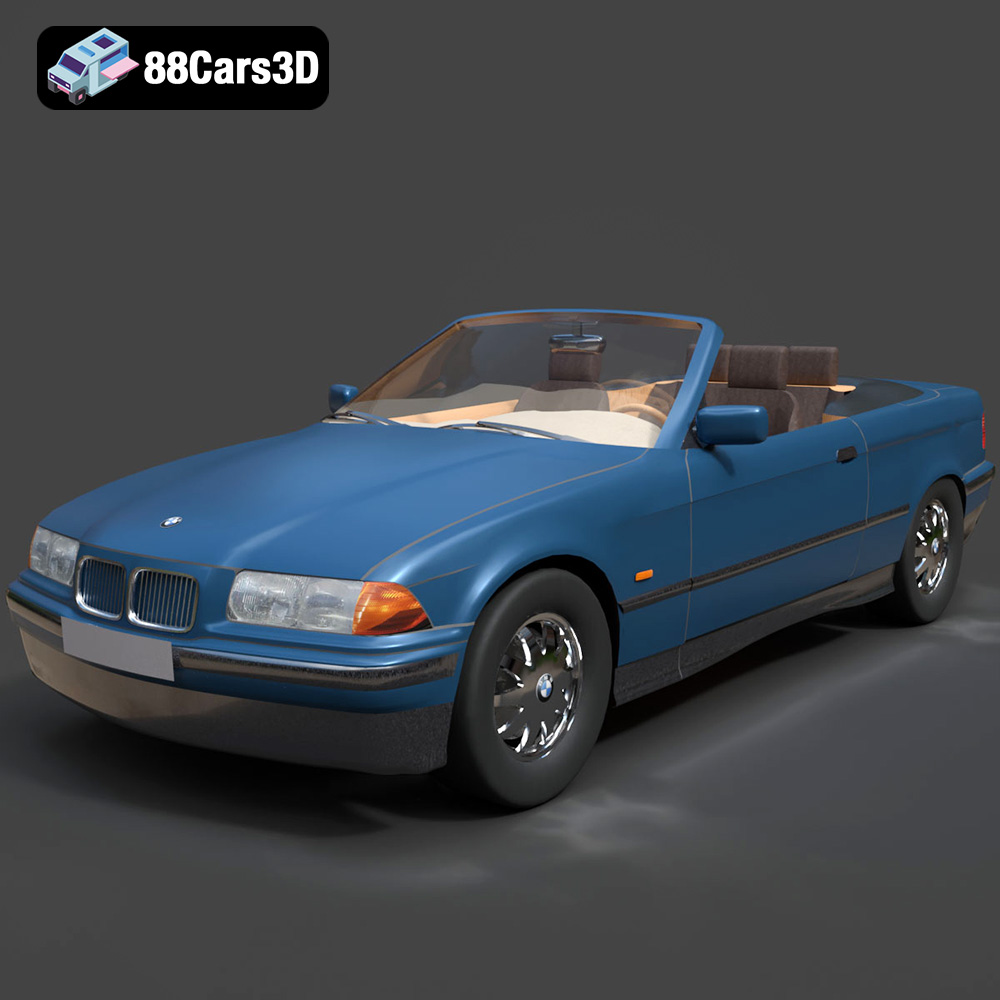
Download the BMW 3 Series E36 Cabrio 325i 1998 3D Model featuring a classic convertible design and detailed interior. Includes .blend, .fbx, .obj, .glb, .stl, .ply, .unreal, and .max formats for rendering, simulation, and game development.
Price: $10.79
View Product

Texture: Yes
Material: Yes
Download the BMW 3 F30 3D Model featuring a detailed exterior, realistic interior, and optimized mesh. Includes .blend, .fbx, .obj, .glb, .stl, .ply, .unreal, and .max formats for rendering, simulation, and game development.
Price: $10.79
View Product


