⚡ FLASH SALE: Get 60% OFF All Premium 3D & STL Models! ⚡

In the dynamic world of digital content creation, the demand for high-fidelity 3D assets continues to escalate. From breathtaking cinematic sequences and immersive game environments to critical training simulations and precise architectural visualizations, realism is paramount. At the heart of many of these endeavors lies the need for accurately modeled vehicles. Generic assets often fall short, failing to convey the intricate details and authentic presence that professional projects demand. This is particularly true for specialized vehicles, where functionality and design merge to create an instantly recognizable form. Imagine a bustling city scene, a high-stakes emergency simulation, or an architectural render of a hospital – each scenario is significantly elevated by the inclusion of a meticulously crafted emergency vehicle.
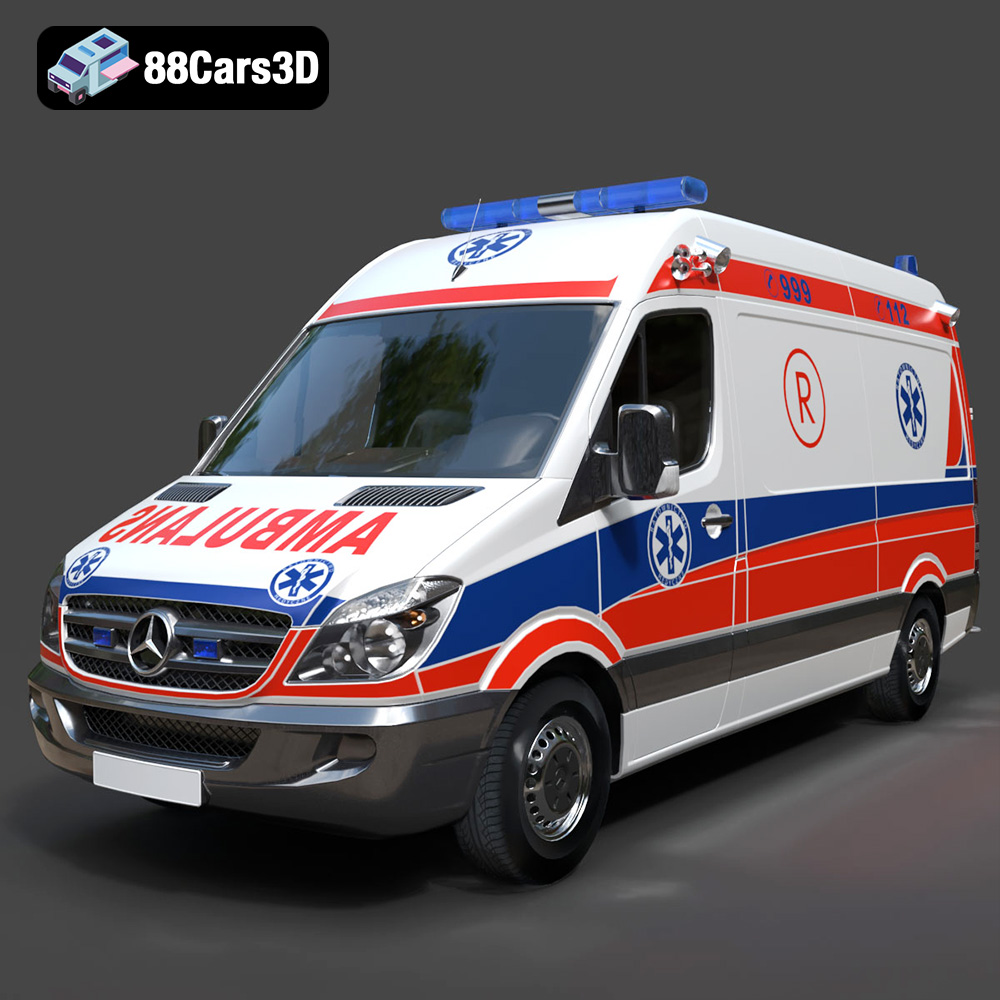
Today, we’re diving deep into the technical prowess and versatile applications of such an asset: the Mercedes-Benz Sprinter Ambulance 3D model. This exceptional offering from 88cars3d.com stands as a testament to the level of detail and optimization required for modern digital pipelines. It’s not just a model; it’s a foundation for creating compelling visual narratives, interactive experiences, and accurate simulations across a multitude of industries.
The journey of a 3D model from conception to integration into a project is heavily influenced by its file format. Each format serves a distinct purpose, optimized for specific workflows, software, or end-use scenarios. Understanding these differences is crucial for anyone working with 3D car models or any complex asset, ensuring compatibility, preserving data integrity, and maximizing efficiency. The Mercedes-Benz Sprinter Ambulance 3D model, for instance, comes equipped with a comprehensive suite of formats, catering to virtually every professional need.
The .blend format is Blender’s native file type, offering a complete and editable scene. This includes not just the mesh data, but also materials, textures, lighting, cameras, animations, rigging information, and even physics simulations. For Blender artists, this is the most direct and powerful way to work with the model. It guarantees that all aspects of the original setup are preserved, making it ideal for customization, re-lighting, or further animation development within Blender’s robust environment.
.fbx (Filmbox) is arguably the most widely adopted interchange format in the 3D industry. Developed by Autodesk, it excels at transferring complex scene data between different software applications, including 3ds Max, Maya, Cinema 4D, and critically, game engines like Unreal Engine and Unity. An FBX file can encapsulate geometry, materials, textures, animations, rigging, and even basic lighting. Its strength lies in its ability to maintain hierarchical structures and animation data, making it the go-to format for exporting game assets or animated sequences for automotive rendering.
The .obj (Wavefront OBJ) format is a cornerstone of 3D asset transfer due to its universal compatibility. Almost every 3D software application can import and export OBJ files. While it primarily handles geometry (vertices, faces, normals, UV coordinates) and can reference external .mtl (material) files, it does not support animation, rigging, or complex scene data. Its simplicity makes it highly reliable for transferring static meshes when clean geometry is the priority, ensuring broad cross-software compatibility for the Mercedes-Benz Sprinter Ambulance 3D model.
.glb (GL Transmission Format Binary) is an increasingly vital format, particularly for augmented reality (AR), virtual reality (VR), and web-based applications. It’s a binary version of the glTF format, designed for efficient transmission and loading of 3D scenes and models. A GLB file bundles all necessary assets – geometry, materials, textures, and animations – into a single, compact file, making it perfect for rapid deployment on websites, mobile devices, and immersive platforms without requiring external dependencies. This streamlined approach makes the Sprinter Ambulance ideal for interactive product showcases or AR experiences.
The .stl (Stereolithography) format is the ubiquitous standard for 3D printing. It represents a 3D model as a series of connected triangles, defining only the surface geometry of an object. STL files do not contain color, texture, or material information, focusing purely on the physical form. For the Mercedes-Benz Sprinter Ambulance 3D model, an STL export allows users to generate a physical prototype or a scale model, making it valuable for architectural models, product design reviews, or even collectible creation. Ensuring a watertight, manifold mesh is crucial for successful STL output.
.ply (Polygon File Format, or Stanford Triangle Format) is often used for storing 3D data from 3D scanners, CAD software, and scientific applications. It supports both triangular and polygonal meshes and can store additional properties like color, transparency, normals, texture coordinates, and even reliability information. While less common for general animation or rendering compared to FBX or OBJ, PLY files are invaluable when precision mesh data is required for engineering analysis, reverse engineering, or integrating into specialized CAD workflows.
The .unreal designation implies a pre-configured asset or project setup specifically optimized for Unreal Engine. This typically means the model has been imported, materials are set up with appropriate shaders, textures are linked, collision meshes generated, and potentially even LODs (Levels of Detail) are implemented. This format significantly accelerates the integration process for game developers and simulation creators, offering a direct, engine-ready solution that bypasses much of the initial setup work. The Mercedes-Benz Sprinter Ambulance 3D model in this format is truly a plug-and-play solution for Unreal users.
Similar to .blend for Blender, the .max format is Autodesk 3ds Max’s native project file. It contains the entire scene, including geometry, modifiers, materials, textures, lighting, cameras, animation, and rigging. For users entrenched in the 3ds Max ecosystem, this file provides the fullest control over the model. It allows for advanced customization, integration into complex rendering pipelines with V-Ray or Corona, and extensive animation work for high-end cinematic sequences or detailed automotive rendering.
Achieving photorealistic results and seamless integration into complex projects isn’t just about having a pretty model; it’s about the technical foundation it’s built upon. The Mercedes-Benz Sprinter Ambulance 3D model from 88cars3d.com exemplifies this principle, showcasing meticulous craftsmanship that meets the stringent demands of professional production pipelines.
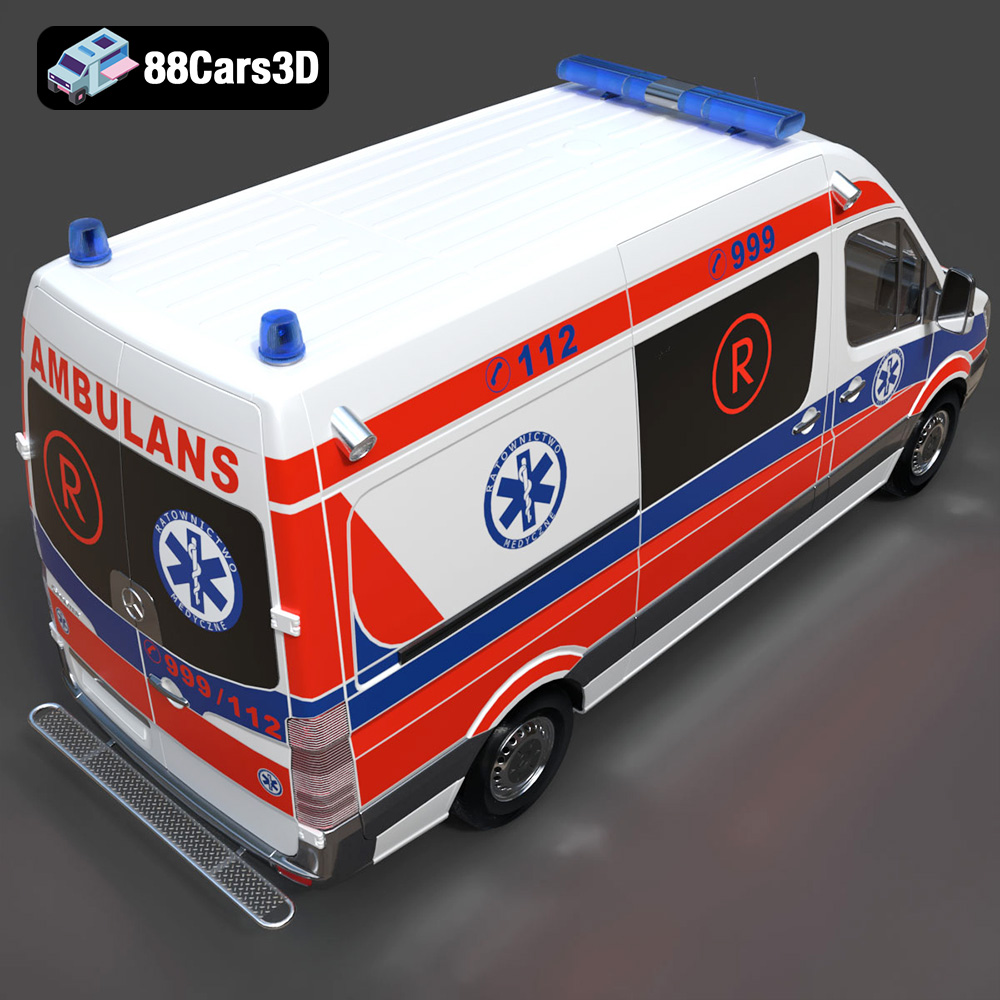
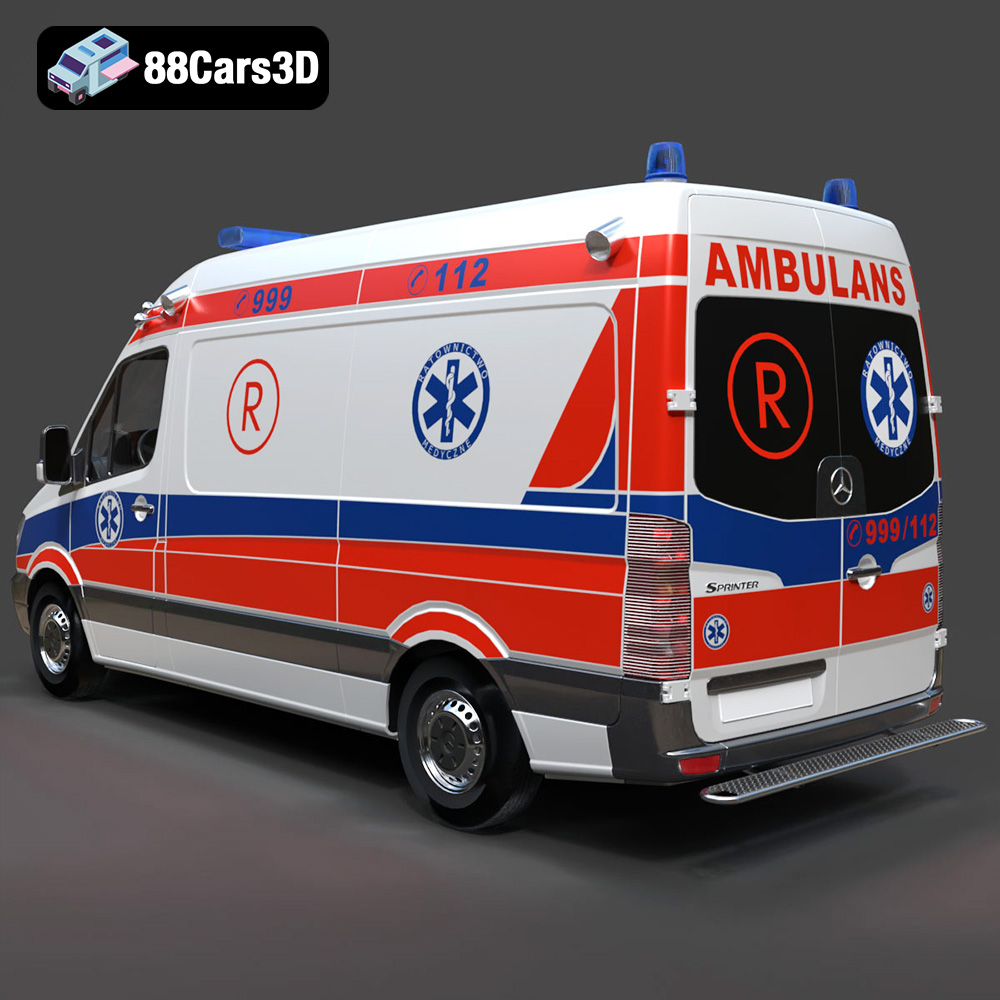
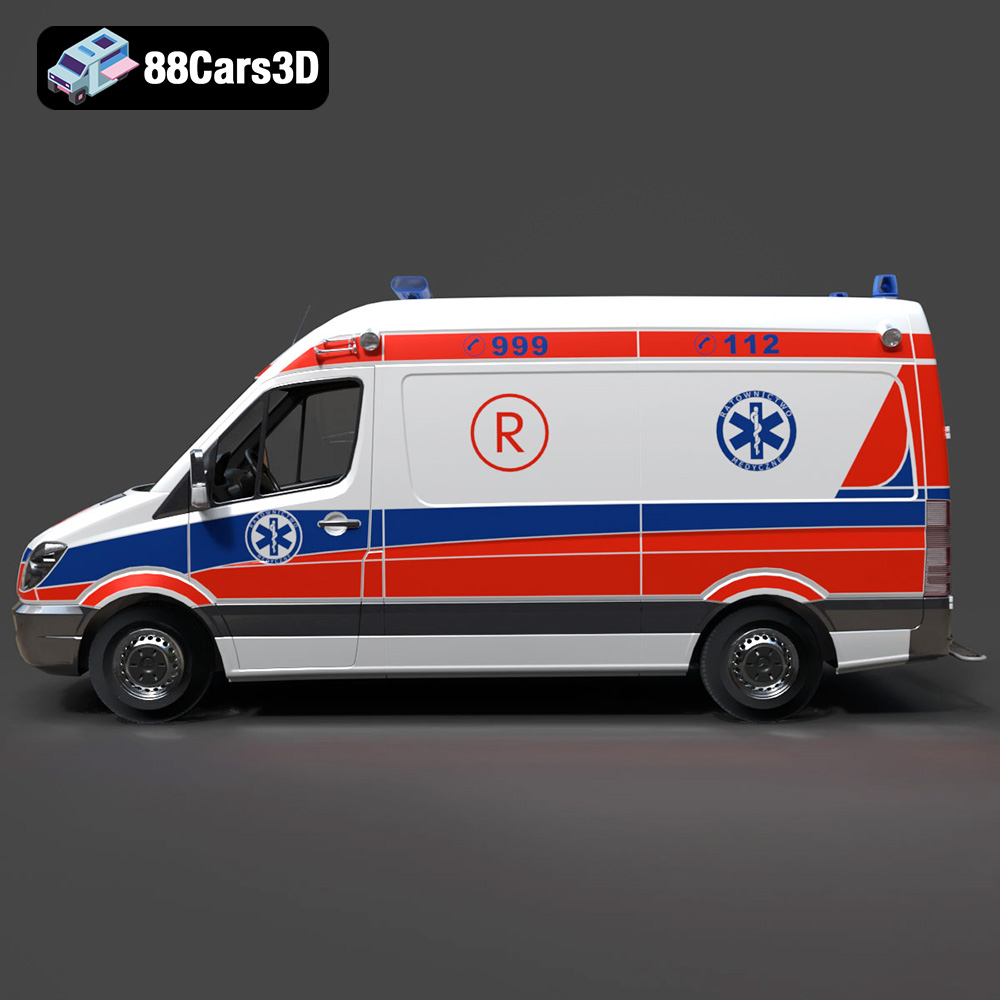
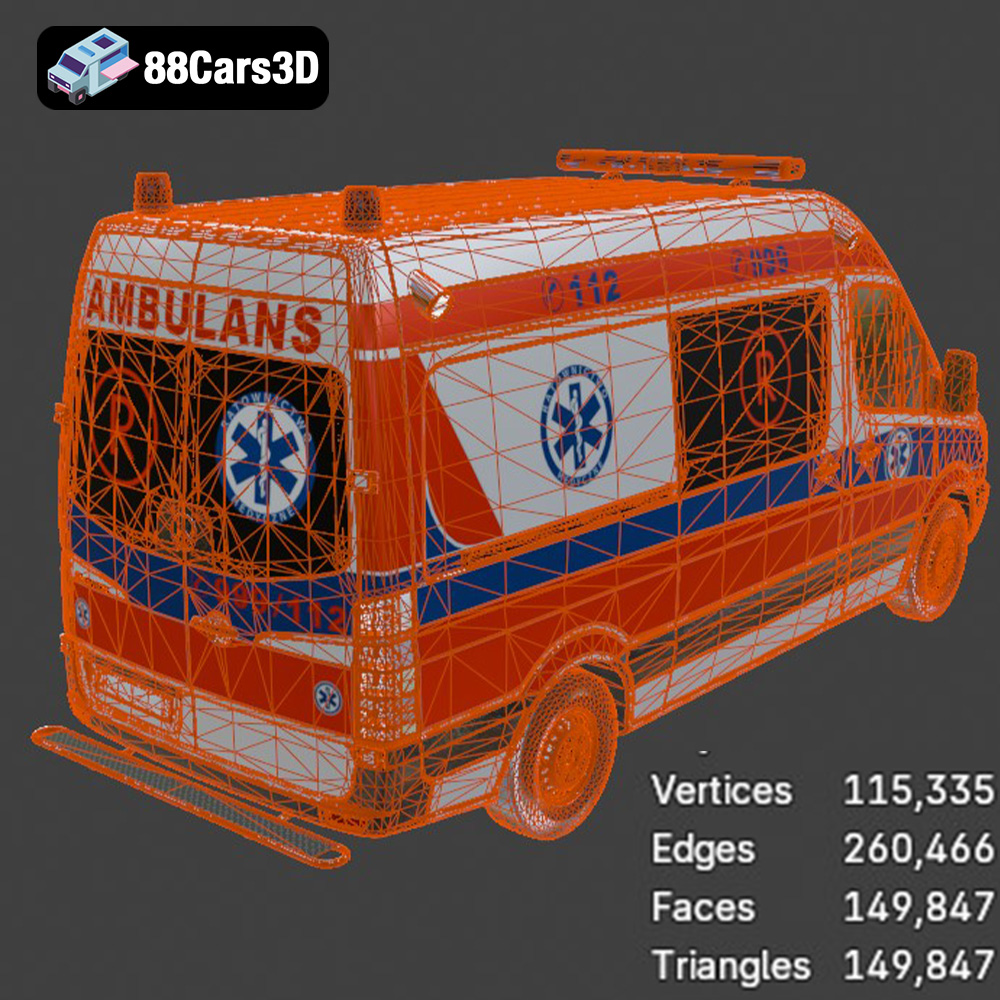
The exterior of the Sprinter Ambulance is a masterclass in balanced detailing. Every curve of the authentic Mercedes-Benz Sprinter body panels and chassis has been faithfully reproduced, ensuring the model’s silhouette is instantly recognizable and accurate to its real-world counterpart. This attention extends to the realistic emergency light bars – roof-mounted, front, and rear – which feature transparent materials ready for dynamic lighting effects. Detailed siren speakers, floodlights, and custom ambulance livery with crisp decals further enhance its authenticity. Crucially for animators, doors and compartments are separated and properly pivoted, enabling smooth opening and closing sequences. This foresight allows for complex scenarios, from paramedics rapidly accessing equipment to a patient being loaded, without the need for extensive rigging work.
Beyond the exterior, the model offers a comprehensive interior, a feature often overlooked in less professional assets. The driver’s cockpit is fully modeled, complete with dashboard controls, a steering wheel, and seating, providing a convincing environment for first-person views or driver simulations. The patient compartment is equally detailed, featuring a stretcher, various medical equipment, and storage units. This level of internal detail is invaluable for immersive simulations, interactive training modules, or cinematic shots that peer inside the vehicle. The optimized mesh quality ensures that this high level of detail doesn’t come at the cost of performance, striking a perfect balance between visual richness and computational efficiency.
At its core, the model boasts clean, quad-dominant topology. This is a critical technical advantage, facilitating easy subdivision for extreme close-ups, smooth deformation during animation, and straightforward UV mapping for texturing. Such clean geometry minimizes rendering artifacts and makes the model highly adaptable for various levels of detail (LODs) in game engines. Furthermore, the model adheres to an accurate, real-world scale. This ensures seamless integration into existing scenes, whether it’s an architectural visualization of a hospital emergency bay or an urban environment for a game. Developers won’t need to spend valuable time rescaling, translating, or fixing proportional inconsistencies. The logically organized hierarchy with proper pivot points for animation and rigging further streamlines workflows, allowing artists to immediately begin posing or animating components without laborious setup.
The true value of a professional 3D asset lies in its ability to seamlessly integrate into diverse production workflows. The Mercedes-Benz Sprinter Ambulance 3D model, with its array of formats and meticulous design, is engineered for this purpose, enhancing capabilities across various industries.
For cinematic visuals and stunning advertising campaigns, automotive rendering demands the highest fidelity. With the included .max and .blend files, artists can leverage the full power of 3ds Max with renderers like V-Ray or Corona, or Blender’s Cycles and Eevee. The clean topology of the Sprinter Ambulance allows for easy subdivision, producing incredibly smooth surfaces for studio renders. Material adjustments are flexible, allowing for custom paint finishes, realistic reflections on metal and glass, and nuanced emergency lighting effects. Imagine a dramatic scene where the ambulance races through a rain-slicked city, its lights cutting through the night – the model’s prepared materials and structure make this vision achievable. Artists can quickly modify lighting setups to simulate different atmospheric conditions, from bright daylight to moody twilight, achieving exceptional realism in their automotive rendering projects.
In game development, performance is as critical as visual quality. The Mercedes-Benz Sprinter Ambulance 3D model is designed to be a robust game asset. The included .fbx and dedicated .unreal files are pivotal here. The FBX format ensures easy import into Unreal Engine or Unity, preserving crucial data like UVs and material assignments. For Unreal Engine, the .unreal file goes a step further, providing an engine-ready asset with potentially pre-configured materials, collision meshes, and even optimized LODs (Levels of Detail) for varying distances, ensuring smooth performance in open-world games or racing simulators. Developers can integrate this model into emergency service simulations, providing players with a highly realistic and interactive vehicle that enhances immersion.
The rise of augmented and virtual reality necessitates assets that are optimized for real-time, interactive experiences. The .glb format is a game-changer for AR/VR applications, allowing for quick deployment of the Sprinter Ambulance model in web-based viewers, mobile AR apps, or dedicated VR training environments. This enables immersive experiences for emergency response training simulations, where first responders can practice scenarios with a visually accurate vehicle. Its real-world scale and detailed interior make it an invaluable tool for educational purposes, allowing students to explore the vehicle’s layout and equipment in a safe, virtual setting. The model’s logical hierarchy also lends itself well to interactive elements, such as virtually opening doors or activating medical equipment.
To illustrate the versatility and impact of a high-quality 3D asset like the Mercedes-Benz Sprinter Ambulance, let’s explore a few hypothetical, yet highly plausible, professional scenarios where this model would be indispensable.
Consider a public service announcement (PSA) aimed at promoting road safety or highlighting the dedication of emergency services. A critical scene requires a highly detailed ambulance rushing to an accident site. A film studio using 3ds Max or Blender with a powerful renderer like V-Ray would utilize the included .max or .blend file. The clean geometry of the ambulance allows for extreme close-ups, showcasing the realistic tread patterns on the tires as it skids to a halt, or the intricate details of the emergency light bar as it flashes. Animators would leverage the separated doors to create a dynamic entrance for paramedics. The ability to easily adjust paint finishes for custom liveries or modify lighting setups for dramatic night scenes provides creative freedom, elevating the emotional impact and authenticity of the final render. This model wouldn’t just be background filler; it would be a central character in the narrative.
For a company specializing in emergency response training, creating a highly realistic simulation environment is crucial for effective learning. Using Unreal Engine, the development team would greatly benefit from the .unreal file provided with the Mercedes-Benz Sprinter Ambulance. This engine-ready asset allows for immediate integration into their virtual city environment. The comprehensive interior, with its dashboard controls and patient compartment, can be made fully interactive. Trainees could “drive” the ambulance, navigate virtual traffic, activate sirens and lights, or even practice medical procedures within the detailed patient area. The optimized mesh quality ensures the simulation runs smoothly on various hardware, providing a consistent and immersive experience that closely mirrors real-world scenarios, thereby enhancing training outcomes.
An architectural firm is developing a visualization for a new state-of-the-art hospital campus. To make the exterior renders and walkthroughs feel alive and functional, they need context-appropriate vehicles. The Mercedes-Benz Sprinter Ambulance 3D model is perfect for populating the emergency bay entrance or parking lot. Architects typically work with software like 3ds Max or Revit for their primary modeling. The .max or .fbx file allows for seamless import into their scene. Its accurate real-world scale means it fits perfectly within the modeled environment without any distortion. The detailed exterior and realistic materials enhance the overall credibility of the architectural render, providing a sense of scale and function. This adds a layer of realism that can significantly impress clients, demonstrating how the facility would operate in a real-world setting.
While the primary focus for 3D car models often lies in digital rendering and real-time applications, their utility extends into the physical realm. The capability to transition from a digital asset to a tangible object offers unique advantages for various professional and creative pursuits.
The Mercedes-Benz Sprinter Ambulance 3D model, with its robust construction and dedicated .stl format, is perfectly suited for 3D printing. The STL format is the standard for additive manufacturing, representing the model’s surface as a series of connected triangles. For successful 3D printing, it’s essential that the mesh is “watertight” – meaning it has no holes or non-manifold edges. The clean geometry and quad-dominant topology of this model significantly reduce the likelihood of issues during the conversion and printing process. Users can take this digital asset and, after selecting their desired scale and printer technology, produce a physical replica. This could range from a small desk model for an emergency service department to a larger, more detailed prototype for design review or educational display.
The ability to 3D print the Sprinter Ambulance opens doors for prototyping and physical model making. Automotive designers might use a 3D print to evaluate proportions, form, or potential modifications before committing to costly traditional manufacturing. For toy companies or collectible manufacturers, a 3D print serves as a high-fidelity master for mold creation or as a proof-of-concept for new product lines. Even for historical or educational purposes, a physically printed model offers a tangible, interactive way to study the vehicle’s design and features, bringing the digital asset into a real-world context. This versatility underscores the comprehensive nature of the Mercedes-Benz Sprinter Ambulance 3D model and its broad applicability.
In the rapidly evolving landscape of 3D content creation, the difference between a good project and a truly exceptional one often hinges on the quality and versatility of its core assets. The Mercedes-Benz Sprinter Ambulance 3D model from 88cars3d.com exemplifies this principle, offering a meticulously crafted, technically superior solution for a wide range of professional applications. From high-end automotive rendering and immersive game development to critical AR/VR simulations and practical 3D printing, this model is built to perform.
Its clean, quad-dominant topology, accurate real-world scale, comprehensive interior and exterior detailing, and logical hierarchy ensure seamless integration into any workflow. Coupled with a diverse array of industry-standard file formats – including .blend, .fbx, .obj, .glb, .stl, .ply, .unreal, and .max – it provides the flexibility and compatibility demanded by today’s leading artists and developers. Investing in such a high-quality 3D car model not only saves invaluable production time but also elevates the realism and impact of your digital projects. Whether you’re building a cinematic scene, developing an immersive game, or training the next generation of first responders, the Mercedes-Benz Sprinter Ambulance 3D model stands ready to drive your vision forward. Explore this exceptional asset and many other premium 3D models at 88cars3d.com to elevate your next project.
Presenting the Mercedes-Benz Sprinter Ambulance 3D model, a highly detailed and accurate representation of a modern emergency vehicle. This model is meticulously crafted to capture the essence of the Sprinter’s utility and the critical function of an ambulance, featuring clean geometry and balanced detailing. It is an ideal asset for professional rendering projects, realistic animation sequences, immersive simulations, and robust game development.
$21.99