⚡ FLASH SALE: Get 60% OFF All Premium 3D & STL Models! ⚡

In the dynamic worlds of automotive design, film production, game development, and architectural visualization, the demand for high-quality 3D car models is ever-increasing. These digital assets are far more than mere visual representations; they are fundamental tools that drive innovation, accelerate workflows, and unlock immersive experiences. From the intricate curves of a luxury sedan to the rugged utility of an off-road vehicle, a meticulously crafted 3D car model serves as the backbone for breathtaking renders, engaging interactive simulations, and cutting-edge virtual environments.
This comprehensive guide delves deep into the technical intricacies and creative potential of 3D car models. We will explore the critical file formats that define their utility, dissect the sophisticated workflows employed for automotive rendering, understand the rigorous optimization required for game assets, and examine the broader applications across various industries. Whether you’re a seasoned 3D artist, a game developer, an automotive engineer, or simply someone fascinated by the digital frontier, this exploration will provide invaluable insights into the artistry and engineering behind these pivotal digital assets. Let’s embark on a journey to understand how exceptional 3D car models are sculpted, refined, and deployed to bring visions to life.
The pursuit of realism and performance in digital environments begins with the quality of the assets themselves. For 3D car models, “high-quality” translates into a multitude of attributes, including accurate topology, precise dimensions, detailed materials, and efficient UV mapping. These elements are not just aesthetic preferences; they are critical technical requirements that dictate how a model performs across different software, renders accurately under various lighting conditions, and integrates seamlessly into complex projects.
In automotive design and engineering, 3D car models are often the first tangible representation of a concept. Designers rely on these models to iterate quickly, visualize complex forms, and evaluate aerodynamics and ergonomics long before physical prototypes are ever considered. Precision in modeling ensures that design intent is perfectly translated. For instance, maintaining accurate surface continuity (G0, G1, G2 curvature) is paramount, as subtle imperfections can lead to undesirable reflections and an overall diminished sense of quality in the final rendered product. This level of accuracy often demands specialized modeling techniques, such as NURBS or subdivision surfacing, followed by meticulous polygon reduction for various use cases.
The utility of high-quality 3D car models extends far beyond initial design. In advertising and marketing, photorealistic renders of vehicles are indispensable for brochures, commercials, and online campaigns, often replacing expensive physical photoshoots. For film and animation, these models become actors in their own right, enabling directors to stage impossible stunts or create fantastical worlds with believable vehicles. Game development, perhaps one of the most demanding sectors, relies on optimized yet visually stunning car models for racing simulations, open-world adventures, and interactive experiences. Furthermore, emerging fields like virtual reality (VR), augmented reality (AR), and even 3D printing increasingly leverage these assets, requiring models that are not only visually appealing but also technically sound for their specific applications.
The choice of a 3D model file format is not arbitrary; it dictates compatibility, feature preservation, and the ultimate utility of a 3D car model across different software and pipelines. Understanding the nuances of each format is crucial for efficient data exchange and workflow optimization. When sourcing assets, such as from a curated marketplace like 88cars3d.com, knowing which format suits your specific needs will streamline your project development significantly.
Achieving photorealistic automotive renders is a meticulous process that combines advanced modeling techniques, sophisticated material creation, and expert lighting. It’s an art form that demands both technical proficiency and an eye for detail, pushing the boundaries of what 3D software can achieve.
The initial stage of creating a high-fidelity 3D car model often involves choosing between different modeling paradigms. Subdivision Surface (Sub-D) modeling, common in Blender and 3ds Max, involves building a low-poly mesh and then using a subdivision modifier to smooth it into a high-resolution, organic form. This method is excellent for achieving the smooth, flowing curves of vehicle body panels, allowing for iterative design changes and preserving clean topology for animation. The underlying quad-based topology is crucial for maintaining proper surface tension and preventing artifacts.
Alternatively, CAD (Computer-Aided Design) workflows, typically using software like Rhino, SolidWorks, or Alias, focus on NURBS (Non-Uniform Rational B-Splines) surfaces. NURBS models are mathematically precise, ensuring perfect curvature continuity, which is indispensable for engineering and manufacturing. While CAD models offer unparalleled precision, converting them to render-ready polygon meshes for real-time engines or traditional renderers requires careful tessellation and optimization to manage poly counts effectively.
The “photorealistic” aspect of automotive rendering largely hinges on the quality of materials and textures. Physically Based Rendering (PBR) has revolutionized this by simulating how light interacts with surfaces in the real world. In both 3ds Max (using V-Ray, Corona, or Arnold) and Blender (Cycles or Eevee), PBR workflows involve creating a set of textures that define a material’s properties:
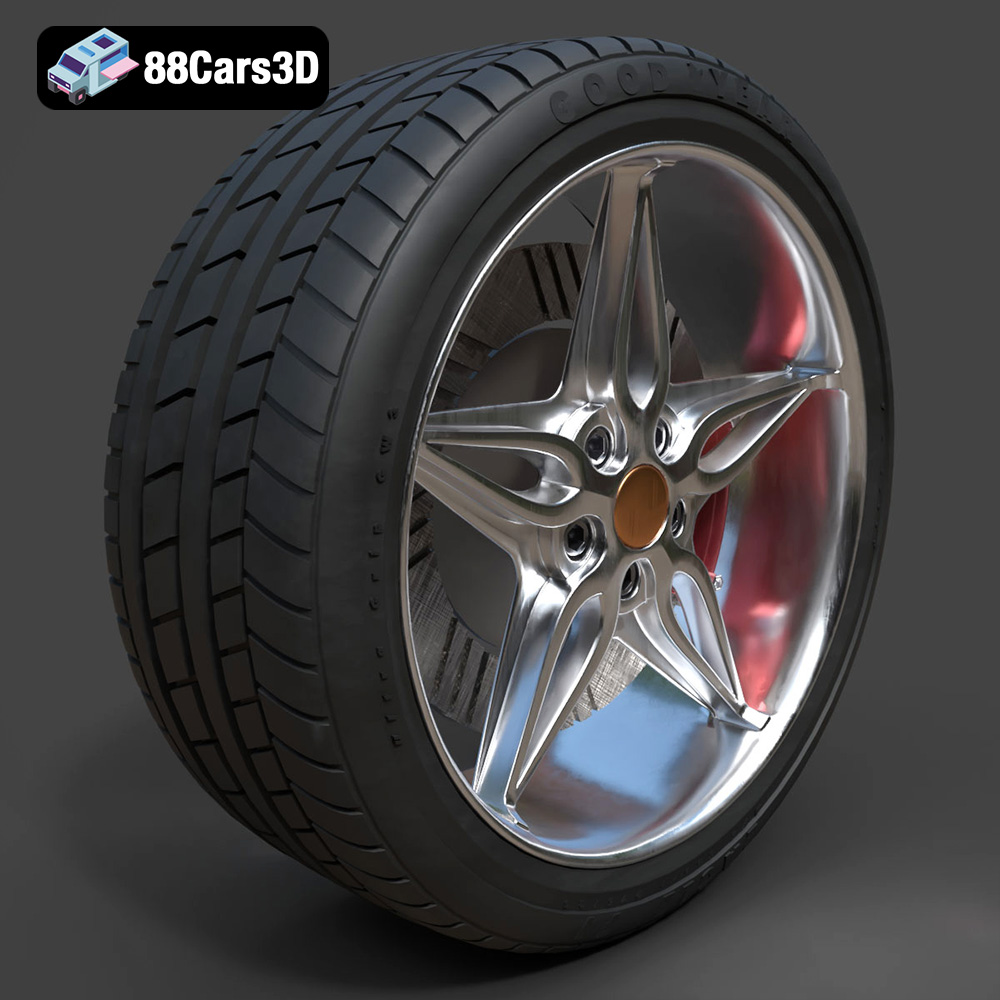
Achieving realistic car paint, for instance, involves complex PBR setups that layer metallic flakes, clear coat reflections, and subtle orange peel effects. Tire materials require intricate normal maps for tread patterns and subtle roughness variations to simulate rubber. Interior materials, such as leather, fabric, and polished chrome, each demand their own tailored PBR approach to accurately capture their unique visual characteristics.
Even the most detailed 3D car model and meticulously crafted materials will fall flat without proper lighting and camera work. Automotive rendering often employs studio-like lighting setups, mimicking professional photography. This typically involves:
The camera setup is equally important. Utilizing real-world camera settings like focal length, aperture (for depth of field), and shutter speed (for motion blur in animations) helps ground the render in reality. Compositional techniques, such as the rule of thirds or leading lines, guide the viewer’s eye, transforming a mere technical visualization into a compelling piece of automotive art.
While high-fidelity rendering prioritizes visual quality above all else, real-time game engines like Unreal Engine and Unity demand a delicate balance between visual fidelity and performance. Optimizing 3D car models for games is a specialized skill focused on efficiency without sacrificing too much detail.
One of the most critical aspects of game optimization is managing polygon count. Every polygon contributes to the computational load on the GPU. High-end car models for cinematic renders might have millions of polygons, but for games, especially racing titles or open-world environments, a single car needs to fit within a tight poly budget (e.g., 50,000-150,000 triangles for a hero vehicle, much less for background traffic). This often involves:
Efficient UV mapping is paramount for game assets. Every polygon face must have its corresponding UV coordinates neatly packed into a 0-1 texture space. Overlapping UVs are generally avoided unless specifically for mirrored parts to save texture space. For 3D car models, multiple UV channels might be used: one for diffuse/normal maps, another for lightmaps, and perhaps a third for decals or custom paint jobs.
In Unreal Engine, PBR texturing is standard. Artists create texture sets (Albedo, Normal, Roughness, Metallic, Ambient Occlusion) which are then compressed efficiently. Material Instances are a key optimization. Instead of creating a new material for every slight variation (e.g., different paint colors on the same car model), a master material is created, and instances are derived from it. These instances allow artists to tweak parameters like color, roughness, or texture tiling without recompiling the entire shader, offering significant performance gains and workflow flexibility.
For a 3D car model to truly come alive in a game, it needs rigging and physics. A car rig typically includes:
In Unreal Engine, vehicle physics are often handled by dedicated components, such as Chaos Vehicles, which allow developers to define parameters like engine torque, gear ratios, suspension travel, and tire friction. Animating a 3D car model in a game context might involve simple idle animations, damage states, or more complex sequences for cutscenes, all of which need to be performant and integrated seamlessly with the game’s logic. Sourcing pre-rigged and animated 3D car models, like those available on 88cars3d.com, can significantly accelerate game development.
The utility of high-quality 3D car models is continually expanding, driven by advancements in technology and evolving user expectations. Beyond traditional rendering and game development, these assets are finding critical roles in cutting-edge fields.
VR and AR are transforming how we interact with cars. In virtual showrooms, customers can “sit” inside a 3D car model, explore its interior, change colors, and even take it for a virtual test drive, all before it’s physically built. AR applications allow users to project a full-scale 3D car model into their real-world environment via a smartphone or tablet, examining it from every angle in their driveway. These applications demand exceptionally optimized models that maintain visual fidelity while adhering to strict performance budgets for smooth, immersive experiences. The .glb format, with its web and AR/VR optimization, is often a go-to choice for these interactive applications.
While often starting as digital concepts, 3D car models frequently cross into the physical realm through 3D printing. Automotive designers use 3D printing for rapid prototyping of components, scale models of new vehicles, or even functional parts for testing. The precision of the digital model, often exported as an .stl file, directly translates to the accuracy of the physical print. This allows for quick iteration and tactile evaluation of designs, significantly shortening development cycles and identifying potential issues early on.
The concept of a “digital twin” – a virtual replica of a physical object, system, or process – is gaining traction in the automotive industry. High-fidelity 3D car models form the core of these digital twins, allowing engineers to monitor real-time performance data, simulate scenarios, and predict maintenance needs. As the metaverse evolves, these digital twins will increasingly populate virtual spaces, allowing users to own, customize, and interact with virtual versions of their dream cars. This future demands models that are not only visually stunning but also rich in metadata and capable of dynamic interaction, pushing the boundaries of what a 3D car model can represent.
The time and resources required to create a truly high-quality 3D car model from scratch can be immense. For many projects, particularly those under tight deadlines or with limited artistic resources, sourcing pre-made, production-ready assets becomes a strategic advantage. However, the quality of these sourced assets is paramount, as a poorly constructed model can introduce more problems than it solves.
A production-ready 3D car model is more than just a pretty render. It means the model has clean, optimized topology, correctly configured PBR materials, efficient UV mapping, and often comes with pre-built LODs or animation rigs. These attributes save countless hours in cleanup, optimization, and setup. A model designed for rendering will have the intricate details necessary for close-up shots, while a game-ready asset will be structured to integrate seamlessly into an engine, complete with appropriate collision meshes and material instances. Investing in such models ensures that your project maintains a professional standard and avoids costly delays down the line due to technical deficiencies.
This is where specialized marketplaces like 88cars3d.com become invaluable. By offering a curated collection of professional-grade 3D car models, 88cars3d.com eliminates the guesswork and risk associated with sourcing digital assets. Each model is designed and optimized for specific use cases, whether it’s for stunning automotive rendering, efficient game development, immersive AR/VR experiences, or precise 3D printing. The availability of various file formats—from editable .max and .blend files to game-engine-ready .fbx and AR-optimized .glb—ensures that artists and developers can find exactly what they need, confident in the technical quality and usability of their purchase. This focus on quality and versatility empowers creators to focus on their vision, knowing their foundational assets are robust and reliable.
The journey from a conceptual sketch to a fully realized 3D car model is a testament to the power of digital artistry and technical engineering. These sophisticated assets are no longer just static images; they are dynamic tools that power everything from blockbuster films and cutting-edge video games to revolutionary automotive design processes and immersive virtual experiences. We’ve explored the critical role of file formats in defining utility, delved into the meticulous workflows for achieving photorealism, and understood the rigorous optimization demanded by real-time environments.
As technology continues to advance, the capabilities and applications of 3D car models will only grow. The emphasis on high-quality, production-ready assets remains constant. Whether you are crafting the next generation of virtual vehicles or pushing the boundaries of physical design through digital prototyping, the foundation built upon exceptional 3D car models is indispensable. By understanding the intricacies of their creation and selection, creators are better equipped to drive innovation and bring their most ambitious visions to stunning, tangible reality. For those seeking to elevate their projects, platforms like 88cars3d.com offer a gateway to a world of meticulously crafted digital automotive excellence.