
Bentley Continental Flying Spur 3D Model – Unleashing Automotive Vision: The Power of Premium 3D Car Models in Modern Workflows

Unleashing Automotive Vision: The Power of Premium 3D Car Models in Modern Workflows
In the dynamic worlds of automotive design, cinematic production, game development, and architectural visualization, the demand for exceptionally detailed and versatile 3D car models has never been higher. These digital assets are far more than mere visual representations; they are fundamental building blocks that empower creators to bring their visions to life with unparalleled realism and efficiency. From crafting breathtaking photorealistic renders to populating expansive virtual worlds, the quality of a 3D car model directly impacts the success and authenticity of any project.
Consider the prestige and engineering excellence embodied by a vehicle like the Bentley Continental Flying Spur. To translate such a sophisticated machine into a digital asset requires immense precision and an expert understanding of 3D modeling principles. A premium 3D model, such as the Bentley Continental Flying Spur 3D Model available on 88cars3d.com, encapsulates this dedication to detail, offering professionals a ready-to-use solution that streamlines complex workflows and elevates the final output. These models serve as critical components for anyone looking to achieve stunning visual fidelity and robust performance across a multitude of applications.
Understanding 3D Model File Formats: The Backbone of Digital Automotive Assets
The versatility of a 3D car model largely depends on the file formats it supports. Each format is designed with specific use cases and software compatibility in mind, making the choice of format crucial for efficient workflow and optimal performance. The Bentley Continental Flying Spur 3D Model, for instance, offers a comprehensive suite of formats, ensuring it can be integrated seamlessly into virtually any professional pipeline.
.blend – The Native Blender Powerhouse
The .blend file format is native to Blender, a powerful open-source 3D creation suite. A .blend file typically includes not just the mesh data, but also materials, textures, lighting setups, camera positions, animation data, and even physics simulations. For artists and studios primarily working within the Blender ecosystem, a .blend file offers maximum editability and flexibility. It allows full access to modifiers, node-based materials, and the entire scene hierarchy, making it ideal for customization, re-lighting, or further animation. The included .blend for the Bentley Continental Flying Spur ensures Blender users can dive straight into their projects with all materials and a lighting setup pre-configured.
.fbx – The Industry-Standard Exchange Format
.fbx (Filmbox) is arguably the most widely adopted proprietary 3D file format, developed by Autodesk. It’s the go-to format for transferring 3D data between various software applications like 3ds Max, Maya, Cinema 4D, and critically, game engines like Unreal Engine and Unity. FBX excels at preserving a wide range of data, including geometry, materials, textures, animations, and skeletal structures. Its robust nature makes it ideal for complex assets intended for real-time environments, where efficient data transfer and animation support are paramount. The .fbx version of the Bentley Continental Flying Spur is specifically “game-engine ready,” signifying its optimized structure for performance.
.obj – The Universal Workhorse
The .obj (Wavefront OBJ) format is one of the oldest and most universally compatible 3D file formats. It’s a simple, text-based format that primarily stores geometry (vertices, normals, texture coordinates, and faces) and references to external material files (.mtl). While it doesn’t support animation or scene data, its simplicity ensures near-universal compatibility across almost all 3D software. For basic mesh transfer or as a fallback option when other formats fail, .obj remains an indispensable tool. It’s a reliable choice for the Bentley model if you need a clean mesh for a wide array of applications.
.glb – Optimized for AR/VR and Web
.glb (GL Transmission Format Binary) is the binary version of glTF, an open-standard format specifically designed for efficient transmission and loading of 3D scenes and models by applications. It’s quickly becoming the standard for AR, VR, and web-based 3D experiences due to its compact file size and ability to embed all necessary data (geometry, materials, textures, animations) into a single file. For developers looking to showcase the Bentley Continental Flying Spur in an augmented reality app or directly within a web browser, the .glb format provides an optimized, ready-to-display solution.
.stl – The 3D Printing Standard
.stl (STereoLithography) is the de facto standard file format for 3D printing. It represents a 3D model as a series of connected triangles, defining only the surface geometry without color or texture information. For prototyping, creating physical models, or leveraging additive manufacturing, the .stl version of the Bentley Continental Flying Spur is essential. It requires a watertight, manifold mesh to print successfully, which professional models like this one are designed to provide.
.ply – Precision Mesh for Analysis
The .ply (Polygon File Format, also known as Stanford Triangle Format) is another format for storing 3D data, particularly useful for scanned data, point clouds, and general polygon meshes. It supports properties such as color, transparency, normals, texture coordinates, and confidence values. While less common for everyday artistic exchange, .ply is often favored in scientific, engineering, and CAD applications where precision and additional data attributes are critical for analysis and visualization. The inclusion of .ply for the Bentley model caters to specialized needs requiring a robust polygon mesh.
.unreal – Engine-Ready for Epic Games
The .unreal designation implies a model specifically prepared and potentially packaged for direct import or even as a pre-built asset within Unreal Engine. This often means textures are correctly linked, materials are set up using Unreal’s physically-based rendering (PBR) system, and the asset might even include blueprints for basic interactivity or LODs (Levels of Detail) configured for optimal real-time performance. For projects leveraging Epic Games’ powerful engine, the .unreal format of the Bentley Continental Flying Spur 3D Model offers significant time savings and a streamlined integration process.
.max – The 3ds Max Native File
Finally, the .max file format is the native scene file for Autodesk 3ds Max, a leading software for 3D modeling, animation, and rendering. Similar to .blend, a .max file stores the entire scene, including geometry, materials, lights, cameras, animations, and render settings. For artists and studios deeply entrenched in the 3ds Max ecosystem, having the native .max file for the Bentley Continental Flying Spur provides unparalleled control for detailed scene setup, complex animations, or integrating with powerful renderers like V-Ray or Corona.
The inclusion of such a diverse array of formats for the Bentley Continental Flying Spur 3D Model highlights its professional-grade versatility, ensuring that designers, developers, and artists can utilize it across virtually any platform or purpose.
Achieving Photorealistic Automotive Rendering: Crafting Digital Masterpieces
Photorealistic rendering of vehicles demands a meticulous approach to every element, from the underlying mesh to the final pixel. The Bentley Continental Flying Spur 3D Model provides an excellent foundation, boasting clean topology and realistic materials designed to shine in high-fidelity render engines.
The Art of Material and Texture Creation for Realism
True photorealism hinges on convincing materials and textures. Modern rendering relies heavily on Physically Based Rendering (PBR) workflows, where material properties like albedo (base color), roughness, metallic, normal, and ambient occlusion maps accurately simulate how light interacts with surfaces. For the Bentley model, this means meticulously crafted shaders that replicate the subtle reflections of polished chrome, the deep sheen of automotive paint, the distinct grain of leather interiors, and the clear refraction of glass. The “realistic materials and textures applied across the body, glass, chrome, and leather surfaces” are crucial for achieving that believable look, whether you’re rendering in Blender’s Cycles, 3ds Max’s V-Ray, or another engine.
Lighting and Environment Setup: The Key to Atmosphere
Even the most perfect 3D car model will fall flat without appropriate lighting. Automotive renders often leverage High Dynamic Range Images (HDRIs) for realistic environmental lighting, providing complex reflections and natural ambient illumination. Coupled with targeted physical lights (like area lights for studio setups or directional lights for sunlight), this creates depth and mood. Global Illumination (GI) and ray tracing techniques, increasingly common in modern renderers, further enhance realism by simulating how light bounces and interacts within the scene. A professionally prepared model like the Bentley Continental Flying Spur 3D Model responds beautifully to these advanced lighting setups, showcasing its detailed surfaces and intricate reflections.
Advanced Rendering Techniques in 3ds Max and Blender
Both 3ds Max and Blender offer robust rendering capabilities that professionals utilize for automotive visualization. In 3ds Max, powerful renderers like V-Ray and Corona Renderer are industry staples, known for their production-ready features, advanced material systems, and efficient GI solutions. Artists can fine-tune render settings for anti-aliasing, depth of field, motion blur, and color mapping to achieve cinematic quality. Blender’s Cycles renderer, with its unbiased ray tracing, delivers stunning results, especially when paired with powerful GPUs. For quicker, stylistic renders, Blender’s Eevee real-time renderer can also produce impressive visuals with careful material and lighting setup. The included .max and .blend files for the Bentley model are prepped for these environments, reducing setup time significantly.
Integrating 3D Car Models into Game Engines: Performance Meets Visuals
Game development demands a delicate balance between visual fidelity and real-time performance. High-quality 3D car models, such as the Bentley Continental Flying Spur 3D Model, are designed with this balance in mind, ensuring they look stunning while running smoothly in interactive environments.
Optimizing for Real-Time Performance: The Core Challenge
For game engines like Unreal Engine and Unity, optimization is paramount. This involves careful management of polygon counts, texture resolutions, and draw calls. The “exceptionally clean topology optimized for performance without sacrificing visual fidelity” of the Bentley model is a critical advantage here. This typically means an efficient edge flow, minimal ngons (polygons with more than four sides), and intelligent subdivision. Additionally, Level of Detail (LOD) models are often created, which are progressively simpler versions of the same asset that load at greater distances, saving precious rendering resources. Collision meshes, often simplified versions of the visual mesh, are also essential for realistic physics interactions.
Workflow with Unreal Engine: Epic Integrations
Unreal Engine, known for its cinematic quality and advanced rendering features, provides a robust pipeline for integrating 3D car models. Importing the .fbx or the specific .unreal format for the Bentley model is a straightforward process. Once imported, materials need to be set up using Unreal’s physically-based material editor, linking texture maps to their respective channels (Base Color, Normal, Roughness, Metallic, etc.). For interactive elements, such as opening doors or working lights, Unreal’s Blueprint visual scripting system can be employed. The “pre-configured for Unreal Engine use” aspect of the Bentley Continental Flying Spur 3D Model significantly accelerates this setup, allowing developers to focus on gameplay and scene composition.
Workflow with Unity: Versatility for Diverse Games
Unity, a versatile engine popular for a wide range of game genres, also benefits greatly from high-quality 3D car models. Importing the .fbx of the Bentley Continental Flying Spur is the primary method. Developers then assign materials, either standard PBR materials or those tailored for Unity’s Universal Render Pipeline (URP) or High Definition Render Pipeline (HDRP) for more advanced visuals. Setting up vehicle physics often involves adding collider components and configuring a Rigidbody for realistic movement. The model’s clean topology ensures that physics calculations are accurate and efficient, which is vital for driving simulators or racing games. Whether for static background elements or player-controlled vehicles, the Bentley model is “built for reliable performance.”
Beyond Rendering: AR/VR, 3D Printing, and Simulation
The utility of a high-quality 3D car model extends far beyond traditional static renders or interactive game environments. These versatile assets are increasingly integral to emerging technologies and specialized applications, showcasing their adaptability across various professional domains.
Deploying in AR/VR Experiences: Immersive Car Showcases
Augmented Reality (AR) and Virtual Reality (VR) platforms are revolutionizing how we interact with digital content, offering immersive experiences for product showcases, virtual showrooms, and interactive training. High-quality 3D car models, like the Bentley Continental Flying Spur, are perfect candidates for these environments. The .glb (glTF Binary) format is particularly suited here, as it’s optimized for efficient loading and rendering on mobile devices and VR headsets. Developers can use the model to create virtual test drives, allow customers to explore car features in AR, or integrate it into larger VR worlds, offering a dynamic and engaging way to experience the vehicle without needing a physical prototype. The clean topology and optimized materials are crucial for maintaining smooth framerates in these resource-sensitive applications.
Preparing for 3D Printing and Prototyping: From Digital to Tangible
The journey of a 3D model can even extend into the physical realm through 3D printing. Designers often create rapid prototypes of car components or even full-scale concept models for evaluation. The .stl format included with the Bentley Continental Flying Spur 3D Model is the standard for 3D printing. For successful printing, the mesh must be “watertight” – meaning it has no holes or non-manifold geometry – and correctly scaled. A professionally crafted model ensures these requirements are met, allowing for accurate physical representations for design validation, educational purposes, or creating highly detailed collector’s items. The detailed chassis elements mentioned in the description imply a model robust enough for such translation.
Vehicle Dynamics and Simulation: Training and Design Validation
Beyond visual aesthetics, accurate 3D car models are fundamental to advanced simulation applications. Automotive engineers and researchers use these models in virtual testing environments to simulate vehicle dynamics, crash tests, aerodynamics, and driver assistance systems. High-fidelity models provide the necessary geometrical accuracy for precise calculations in computational fluid dynamics (CFD) or finite element analysis (FEA). Driving simulators, used for driver training, research, and entertainment, rely on realistic 3D vehicles to provide an authentic experience. The “detailed vehicle simulations” mentioned for the Bentley model underscore its suitability for these rigorous, data-driven applications, where geometrical integrity and scale are paramount.
Optimizing 3D Models for Performance and Quality: The Professional Standard
The true mark of a professional 3D car model lies in its meticulous construction and optimization. It’s not just about looking good; it’s about performing flawlessly across diverse platforms and use cases. The Bentley Continental Flying Spur 3D Model exemplifies this commitment to excellence.
Topology and Polygon Count: The Foundation of Performance
Clean topology – the arrangement of polygons (faces, edges, vertices) – is the bedrock of any high-quality 3D model. It ensures smooth deformations during animation, efficient UV mapping, and predictable subdivision. For performance-critical applications like game engines, maintaining an optimized polygon count is vital. While high-resolution models for rendering might feature millions of polygons, game-ready assets employ techniques like normal mapping to retain detail with fewer polygons. The “exceptionally clean topology optimized for performance” of the Bentley model means its mesh is structured intelligently, allowing for both detailed renders and efficient real-time use, often through the strategic use of LODs.
UV Mapping and Texture Efficiency: Maximizing Visual Fidelity
UV mapping is the process of flattening a 3D model’s surface into a 2D space so that textures can be applied without stretching or distortion. Professional models feature clean, non-overlapping UV layouts that maximize texture resolution and minimize wasted space. This efficiency is critical for game assets, where texture memory is a concern, and for rendering, where clean UVs prevent texture artifacts. The “realistic materials and textures” of the Bentley Continental Flying Spur 3D Model are applied over meticulously crafted UVs, ensuring that the chrome shines correctly, and the leather grain appears authentic from every angle.
Material Setup and Render Engine Compatibility: A Seamless Experience
For a 3D model to be truly versatile, its materials must be set up to be compatible with various render engines. This often involves using PBR principles and providing separate texture maps (albedo, normal, roughness, metallic, etc.) that can be interpreted by different renderers (e.g., Cycles, V-Ray, Unity’s URP/HDRP, Unreal Engine’s native shaders). The inclusion of multiple native file formats (.blend, .max, .unreal) for the Bentley Continental Flying Spur ensures that the material setup is either pre-configured or easily adaptable, saving artists significant time in recreating complex shaders.
The Value of Premium 3D Assets: Elevating Professional Projects with 88cars3d.com
In today’s fast-paced digital production environment, time is a precious commodity. Creating a truly photorealistic and technically sound 3D car model from scratch is an incredibly time-consuming and skill-intensive endeavor. This is where premium 3D assets, like those found on 88cars3d.com, become indispensable.
Time and Cost Efficiency: Streamlining Your Workflow
Developing a high-fidelity 3D car model, complete with clean topology, optimized UVs, and realistic PBR materials, can take hundreds of hours for a skilled artist. This represents a significant investment in both time and financial resources. By sourcing a professionally prepared model like the Bentley Continental Flying Spur 3D Model, studios and individual artists can instantly gain access to a production-ready asset. This dramatically reduces project timelines and overall costs, allowing teams to allocate their valuable resources to other critical aspects of their production, such as scene composition, animation, or interactive logic.
Consistency and Reliability: Building on a Solid Foundation
Professional projects demand consistency and reliability. When you acquire a 3D model from a reputable source like 88cars3d.com, you are investing in an asset that has been rigorously created and checked for quality. This includes ensuring accurate scale, real-world dimensions, consistent material properties, and error-free geometry. The “meticulously modeled, including complex interior details, chassis elements, and authentic exterior badging” of the Bentley Continental Flying Spur 3D Model highlights this commitment to accuracy. Such reliability is crucial when integrating assets into larger scenes or complex simulations, preventing unexpected issues that can derail a project.
Future-Proofing Your Projects: Versatility and Adaptability
A high-quality 3D car model isn’t a one-off purchase; it’s a long-term investment. Its versatility across multiple file formats and its inherent adaptability to various software and engines mean it can serve numerous projects over its lifetime. Whether you need it for an architectural visualization project today, a game asset tomorrow, or an AR/VR experience next year, a robust model like the Bentley Continental Flying Spur will continue to deliver. This multi-purpose utility ensures that your digital asset library remains current and capable of meeting diverse creative demands.
Conclusion
The journey of a 3D car model from concept to a fully realized digital asset is a testament to the blend of artistic skill and technical mastery. From the foundational choice of file formats to the intricate details of material science and real-time optimization, every step contributes to the final impact of a project. High-quality 3D car models are not just commodities; they are essential tools that empower creators across industries to achieve their most ambitious visions with unparalleled efficiency and realism.
The Bentley Continental Flying Spur 3D Model stands as a prime example of such an indispensable asset. Its precise detailing, clean topology, and comprehensive file format support make it an ideal choice for anyone striving for excellence in automotive rendering, game development, AR/VR experiences, or simulation. By leveraging assets like this from trusted marketplaces such as 88cars3d.com, professionals can bypass the arduous modeling process and directly focus on crafting compelling narratives and immersive experiences. Investing in premium 3D car models is investing in the quality and efficiency of your creative endeavors, ensuring your projects always stand out in a visually demanding world.
Featured 3D Model
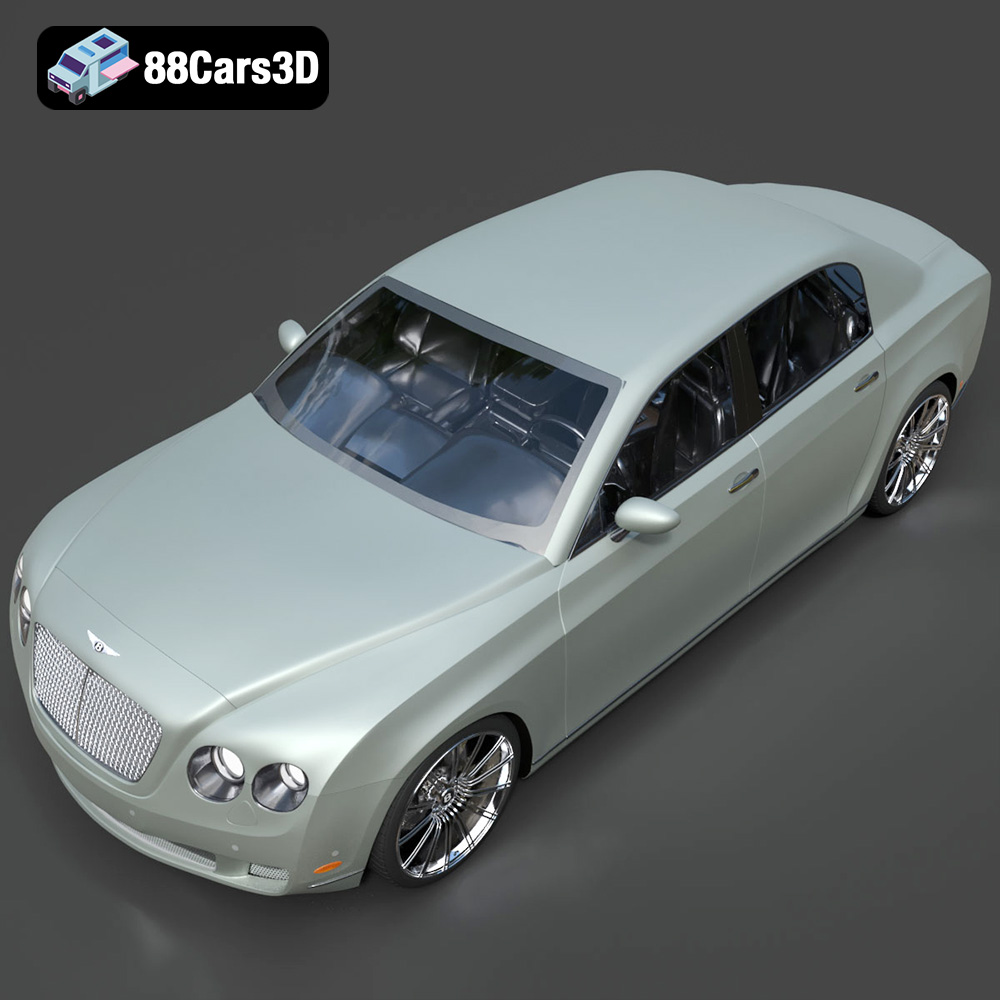
Bentley Continental Flying Spur 3D Model
Experience the sophistication of luxury motoring with this precise 3D model of the Bentley Continental Flying Spur. This model captures the iconic silhouette and detailed engineering of the executive sedan, making it perfect for photorealistic rendering projects, automotive visualization, and virtual production environments.
The asset features exceptionally clean topology optimized for performance without sacrificing visual fidelity. All components are meticulously modeled, including complex interior details, chassis elements, and authentic exterior badging. Realistic materials and textures are applied across the body, glass, chrome, and leather surfaces, ensuring professional results in any rendering engine.
Designed for maximum versatility, the Bentley Continental Flying Spur 3D Model is suitable for professional applications including architectural visualization (ArchViz), cinematic sequences, detailed vehicle simulations, and integration into modern game engines like Unity and Unreal Engine. Whether you require a static render or a dynamic asset for a driving simulator, this model is built for reliable performance.
$14.99
Product Image Gallery




Related Tags
.arvr
.bentley
.blend
.car3dmodel
.continental
.continentalflyingspur
.executivecar
.fbx
.flyingspur
.gameasset
.glb
.luxurycar
.max
.obj
.ply
.rendering
.sedan
.simulation
.stl
.unreal
