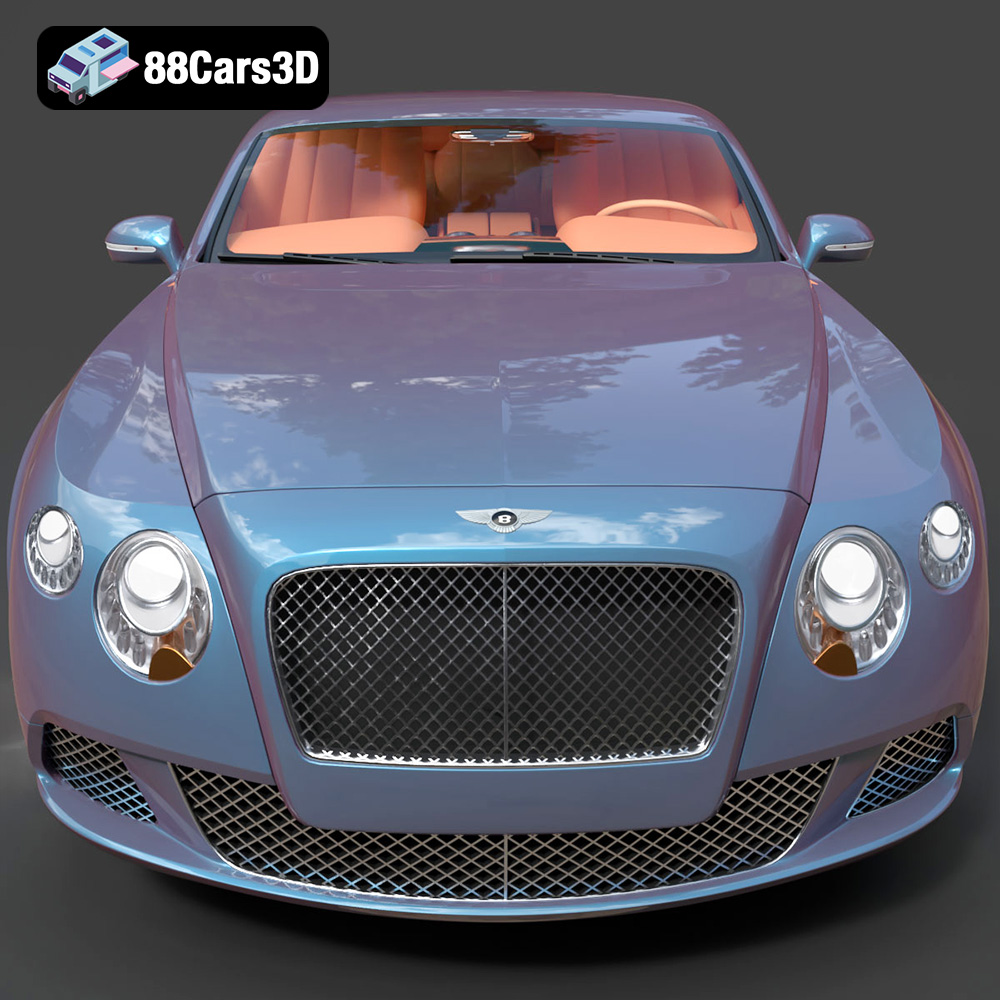
Bentley Continental GT 2011 3D Model – Driving Digital Dreams: The Essential Role of High-Fidelity 3D Car Models in Modern Visualizations and Interactive Experiences

Driving Digital Dreams: The Essential Role of High-Fidelity 3D Car Models in Modern Visualizations and Interactive Experiences
In the rapidly evolving landscape of digital media, the demand for exceptionally detailed and technically robust 3D assets has never been higher. From breathtaking cinematic renders that blur the line between virtual and reality, to immersive gaming environments and cutting-edge augmented and virtual reality applications, the quality of a 3D model can make or break a project. Automotive models, in particular, stand at the forefront of this demand, requiring not just aesthetic accuracy but also meticulous technical execution.
Today, we delve into the intricate world of professional 3D car modeling, exploring what makes an asset truly stand out and how it seamlessly integrates into diverse pipelines. We will specifically highlight an exemplary product, the Bentley Continental GT 2011 3D Model, available at 88cars3d.com. This asset is a prime example of a meticulously engineered digital representation, designed to elevate professional projects with its blend of aesthetic fidelity and technical adaptability. Whether your goal is a photorealistic advertisement, an interactive experience, or a crucial component of a game environment, understanding the nuances of such models is paramount.
The Art and Engineering of 3D Automotive Visualization
Automotive visualization is a sophisticated discipline that marries artistic vision with engineering precision. It’s about more than just recreating a car; it’s about capturing its essence, its material properties, and its presence in a scene. The digital representation of a vehicle like the Bentley Continental GT 2011 demands an understanding of light, shadow, surface reflectance, and the subtleties of manufacturing finishes.
The Pursuit of Photorealism
Achieving photorealism in 3D automotive models is a complex dance between geometry, texturing, and lighting. It begins with an accurate mesh that faithfully reproduces every curve, panel gap, and vent. Surface details, often subtle in real life, must be meticulously translated into the digital realm without excessive polygon counts that could hinder performance. Materials are paramount; car paint, for instance, isn’t just a color, but a layered shader incorporating metallic flakes, clear coat reflections, and subsurface scattering properties. Leather interiors require intricate normal maps and specular values to convey texture and suppleness. Glass needs accurate refraction and reflection properties. When these elements are expertly combined and lit correctly, the resulting render can be indistinguishable from a photograph, making models like the Bentley Continental GT 2011 an invaluable asset for marketing and design studies.
The Role of Automotive 3D Models in Design and Marketing
Long before a physical prototype exists, 3D automotive models play a critical role in the design process, allowing designers to iterate rapidly on forms, evaluate aesthetics, and identify potential issues. These models are also indispensable tools for marketing. High-quality renders of cars, even before they are mass-produced, can generate excitement and provide detailed visuals for advertising campaigns, brochures, and online configurators. The ability to showcase a vehicle from any angle, in any environment, under various lighting conditions, all without the expense and logistical challenges of physical photography, underscores the profound impact of professional 3D car models. They empower brands to tell compelling visual stories and allow consumers to engage with products in dynamic, interactive ways, solidifying their status as essential assets in the automotive industry.
Understanding 3D Model File Formats
The versatility of a 3D car model is heavily influenced by the file formats it supports. Each format is designed with specific use cases and technical considerations in mind, making the availability of multiple formats a significant advantage for any professional asset. The Bentley Continental GT 2011 3D Model from 88cars3d.com, for example, comes with a comprehensive suite of formats, ensuring broad compatibility and utility across various pipelines.
.blend – Blender’s Native Powerhouse
The `.blend` file format is Blender’s native format, renowned for encapsulating an entire scene, including not just the model geometry but also materials, textures, lighting setups, animation data, and even physics simulations. This makes it an incredibly powerful format for artists and studios who use Blender as their primary 3D creation suite. A `.blend` file for the Bentley Continental GT 2011 means that all shaders, textures, and potentially even studio lighting environments are pre-configured, ready for immediate rendering or further customization. It offers full editability, allowing users to delve into the model’s construction, modify components, or adapt materials with Blender’s extensive toolset, ensuring maximum flexibility for creative control.
.fbx – The Industry Workhorse
Autodesk’s `.fbx` (Filmbox) format has become an industry standard for 3D data exchange, particularly between different software applications and for game development. It supports geometry, materials, textures, animations, and skeletal data, making it ideal for real-time pipelines like Unreal Engine and Unity. When a 3D car model is provided in `.fbx` format, it typically means it’s optimized for efficient import and performance in these engines, often including proper scaling and hierarchical structures. The Bentley Continental GT 2011 3D Model’s `.fbx` version is designed to be game-engine ready, facilitating smooth integration into interactive projects where performance and consistent data transfer are critical.
.obj – Universal Compatibility
The `.obj` (Wavefront Object) format is one of the oldest and most universally supported 3D file formats. While it primarily stores geometric data (vertices, normals, UVs, and faces), it can also reference external `.mtl` (material template library) files for basic material properties and texture maps. Its widespread compatibility makes it a safe bet for cross-software workflows, ensuring that almost any 3D application can open and interpret the model. For static meshes like the Bentley Continental GT 2011, the `.obj` format offers a robust and straightforward way to transfer the core geometry, making it a foundational component of many professional pipelines.
.glb – Web and XR Optimization
The `.glb` (GL Transmission Format Binary) format is increasingly vital for web-based 3D applications, augmented reality (AR), and virtual reality (VR). It’s an efficient, single-file format that includes geometry, materials, textures, and even animation, all packaged into one binary asset. Critically, `.glb` natively supports Physically Based Rendering (PBR) materials, ensuring consistent visual quality across different platforms and viewers. For showcasing the Bentley Continental GT 2011 in an interactive web viewer, an AR app on a smartphone, or a VR showroom, the `.glb` format provides optimized performance and ease of deployment, making it perfect for immersive and accessible digital experiences.
.stl – 3D Printing’s Foundation
The `.stl` (Stereolithography) format is the de facto standard for 3D printing and rapid prototyping. It represents a 3D model as a series of connected triangles, defining only the surface geometry without color, texture, or material information. While not suitable for rendering or animation, the `.stl` version of the Bentley Continental GT 2011 3D Model opens up possibilities for physical creation, allowing users to produce scale models, functional prototypes, or artistic interpretations through additive manufacturing. Its simplicity and robust support across 3D printing software make it an indispensable format for physical realization.
.ply – Precision and Scan Data
The `.ply` (Polygon File Format) is often used for storing 3D data from 3D scanners, including point clouds and polygonal meshes. It can store a wide range of properties, such as color per vertex, normals, and even transparency, making it suitable for scientific applications, reverse engineering, and high-precision CAD work. While less common for everyday rendering compared to .fbx or .obj, the `.ply` format for the Bentley Continental GT 2011 offers a highly detailed, precise mesh representation that could be valuable for specific analysis or visualization tasks where vertex-level data is crucial.
.unreal – Engine-Ready Immersion
The `.unreal` format, or more accurately, assets pre-configured for Unreal Engine, represents a significant advantage for developers. These are typically `.uasset` files or structured folders containing optimized meshes, PBR materials, textures, and sometimes even blueprints or level setups designed specifically for Unreal Engine. This means the Bentley Continental GT 2011 3D Model in this format is truly “engine-ready,” minimizing the setup time and ensuring that the visual quality and performance are optimized out-of-the-box. Developers can drop the asset directly into their Unreal projects, saving countless hours on material creation, scaling, and LOD generation.
.max – 3ds Max Professional Environment
The `.max` file is the native format for Autodesk 3ds Max, a powerful 3D modeling, animation, and rendering software widely used in architectural visualization, automotive design, and film production. A `.max` file contains all scene data, including geometry, modifiers, materials, lights, cameras, and animation curves. For users of 3ds Max, the Bentley Continental GT 2011 3D Model in this format offers the highest level of editability and integration within their established workflows. It allows for advanced rendering with engines like V-Ray or Corona, complex animation sequences, and intricate scene compositions, leveraging the full power of 3ds Max’s professional environment for top-tier visualization.
Designing for Detail: The Bentley Continental GT 2011 3D Model in Depth
The quality of a 3D model is not just about how it looks, but how it’s built. For a luxury vehicle like the Bentley Continental GT 2011, this means a rigorous approach to every aspect of its digital construction, ensuring both visual fidelity and technical robustness for a range of applications.
Geometry and Topology for Performance and Fidelity
At the heart of any excellent 3D model lies its geometry and topology. The Bentley Continental GT 2011 3D Model boasts clean, optimized geometry, which is crucial for both close-up renders and demanding real-time applications. This implies a careful balance of polygon count—enough to capture the intricate curves and details of the car without unnecessarily burdening rendering engines or game performance. Clean topology, often achieved with quad-based meshes, ensures smooth subdivision surfaces and facilitates deformation if animation is required. Furthermore, meticulous UV mapping is essential. Well-laid-out UVs prevent texture stretching, allow for precise texture painting, and enable efficient texture packing, contributing significantly to the model’s overall realism and versatility. This attention to detail means the model can perform equally well in a high-resolution cinematic render as it can in a real-time interactive experience.
Materials, Textures, and Realism
The visual impact of a luxury car largely depends on the perception of its materials. The Bentley Continental GT 2011 3D Model features materials set up for photorealistic results, accurately replicating the sleek exterior finish and luxurious interior components. This involves a comprehensive Physically Based Rendering (PBR) workflow, where materials are defined by their base color, metallic properties, roughness, normal maps, and ambient occlusion. The car paint is not merely a flat color but incorporates metallic flakes and clear coat layers that interact realistically with light. Interior elements like leather seats, wood trim, and metallic accents are crafted with specific texture maps to convey their unique surface properties, ensuring that the model captures the opulent feel of a Bentley. This meticulous material work allows the model to respond authentically to diverse lighting conditions, from studio setups to dynamic outdoor environments.
Structured for Seamless Integration
Beyond its visual appeal, a professional-grade 3D model must be well-organized and easy to work with. The Bentley Continental GT 2011 3D Model is described as having a well-organized structure, which is a key indicator of its production readiness. This typically means logical naming conventions for objects, materials, and textures, as well as a clean scene hierarchy. Such organization facilitates effortless integration into existing projects, reducing the time and effort required for setup. Whether you need to adjust a specific component, re-texture a part, or integrate it into a larger scene, a well-structured model simplifies the process, making it a truly practical asset for busy professionals across automotive visualization, game development, and AR/VR.
Integrating High-Fidelity 3D Car Models into Professional Workflows
The true power of a high-fidelity 3D car model, such as the Bentley Continental GT 2011 3D Model from 88cars3d.com, lies in its seamless integration into diverse professional workflows. These assets are not mere static objects but dynamic tools that enhance visual projects across various industries.
Automotive Rendering and Visualization with 3ds Max and V-Ray/Corona
For professionals in automotive advertising, product visualization, and design studios, 3ds Max remains a cornerstone. Leveraging the included `.max` file, artists can drop the Bentley Continental GT 2011 into highly complex scenes, setting up sophisticated lighting rigs – from subtle studio softboxes to dramatic environmental HDRIs. Paired with industry-leading rendering engines like V-Ray or Corona Renderer, the model’s meticulously crafted materials truly shine. Artists can experiment with various paint finishes, interior leather textures, and wheel options, generating photorealistic stills and cinematic animations that highlight the car’s luxurious appeal. The flexibility of 3ds Max allows for intricate camera paths, depth of field effects, and motion blur, making it possible to create visuals that are virtually indistinguishable from real-world photography and videography.
Blender for Independent Artists and Studios
Blender has emerged as a powerful, versatile alternative, embraced by independent artists and burgeoning studios worldwide. With the `.blend` file included, users gain access to a fully editable scene of the Bentley Continental GT 2011. This means all materials, textures, and even potential lighting setups are ready to be used with Blender’s Cycles or Eevee rendering engines. Artists can easily modify components, explore new material variations, or integrate the Bentley into custom environments. Blender’s robust animation tools also allow for dynamic presentations, from showcasing the vehicle’s features to creating compelling fly-throughs. The accessibility and power of Blender, combined with a production-ready model, make it an ideal choice for projects seeking high quality without proprietary software barriers.
Enhancing ArchViz Projects
Architectural Visualization (ArchViz) often requires more than just buildings; it demands a sense of lifestyle and context. Integrating a premium vehicle like the Bentley Continental GT 2011 3D Model can dramatically elevate the realism and aspirational quality of architectural renderings. Imagine a luxurious villa driveway, a penthouse garage, or an urban street scene brought to life by the presence of this iconic grand tourer. The model provides an instant touch of class and sophistication, helping to tell a more complete story about the environment. Its precise detailing ensures it holds up in close-up shots within an architectural render, perfectly complementing the high-fidelity of the surrounding structure and landscape.
Beyond Rendering: Game Development, AR/VR, and Simulation
While stunning renders are crucial, the utility of high-quality 3D car models extends far into interactive digital realms, demanding specific optimizations and file formats to deliver seamless experiences.
Optimizing for Real-Time Game Engines (Unreal Engine & Unity)
For game developers, the Bentley Continental GT 2011 3D Model is a treasure trove. The inclusion of `.fbx` and pre-configured `.unreal` files means it’s ready for immediate import into engines like Unreal Engine and Unity. However, real-time applications come with unique performance demands. Game developers can utilize techniques like Levels of Detail (LODs), where simpler versions of the model are swapped in as the camera moves further away, to maintain high frame rates. Collision meshes are also critical for realistic physics interaction within the game world. Furthermore, material instancing allows for efficient customization of the car’s appearance (e.g., paint colors, wheel types) without creating entirely new materials for each variation. A professionally prepared model minimizes the tedious optimization work, allowing developers to focus on gameplay and immersive world-building, making the Bentley a perfect high-end vehicle for racing simulators, open-world adventures, or virtual car showrooms within games.
Immersive Experiences with AR/VR
Augmented Reality (AR) and Virtual Reality (VR) applications are redefining how we interact with digital content, and 3D car models are central to these experiences. The `.glb` format included with the Bentley Continental GT 2011 3D Model is specifically optimized for web-based AR/VR and mobile deployment, offering efficient loading times and consistent visual quality across devices. This allows for the creation of virtual showrooms where users can explore the car in a 3D space, interacting with its features, changing colors, or even placing it in their real-world environment via AR. Imagine walking around the Bentley Continental GT 2011 in your living room, or experiencing it in a high-fidelity VR car configurator. Such immersive applications provide unparalleled engagement, offering a new dimension to product visualization and marketing.
Driving Simulations and Training
Beyond entertainment, highly accurate 3D car models are vital for professional driving simulations and training programs. Whether it’s for driver education, autonomous vehicle development, or even professional motorsport training, the precision of the Bentley Continental GT 2011 3D Model allows for realistic physics integration and visual feedback. Simulators can accurately render the car’s behavior, interior, and exterior in a controlled digital environment. This is invaluable for testing vehicle dynamics, training emergency responders, or developing advanced driver-assistance systems (ADAS) in a safe, repeatable virtual setting. The detailed polygon mesh and accurate proportions ensure that the simulation data correlates closely with real-world scenarios, making the model a powerful tool for serious technical applications.
The Value of Production-Ready 3D Assets
In any professional pipeline, resources are finite. The decision to purchase a pre-made 3D asset like the Bentley Continental GT 2011 3D Model from a reputable source like 88cars3d.com isn’t just about convenience; it’s a strategic investment that pays dividends in both time and quality.
Time and Cost Efficiency
Creating a highly detailed, technically robust 3D car model from scratch is an incredibly time-consuming and expensive endeavor. It requires specialized skills in modeling, UV unwrapping, texturing, material creation, and optimization across various platforms. For most projects, the time and cost associated with this process can be prohibitive. By acquiring a production-ready asset, studios and individual artists can drastically reduce development cycles and allocate their resources to other critical aspects of their project, such as creative direction, animation, or scene composition. The upfront investment in a premium model pales in comparison to the labor costs of building one internally, offering significant savings and accelerating project timelines.
Assured Quality and Technical Reliability
When you purchase a professional 3D car model from a trusted marketplace like 88cars3d.com, you are investing in assured quality and technical reliability. These models are typically crafted by experienced artists who adhere to industry best practices: clean topology, optimized polygon counts, properly laid-out UVs, and PBR-ready materials. They are often tested across different software and engines to ensure compatibility and performance. This eliminates the uncertainty and potential rework associated with models that might have hidden issues, such as faulty geometry, unoptimized meshes, or incorrect material setups. A model that “just works” out-of-the-box frees artists to focus on their creative vision rather than debugging technical problems, providing a seamless experience from acquisition to final render or integration.
Conclusion
The landscape of 3D visualization and interactive experiences is continuously pushing the boundaries of realism and immersion. At the heart of this evolution are high-fidelity 3D assets, none more demanding or impactful than detailed automotive models. We’ve explored the intricate technical considerations that go into creating and utilizing such assets, from the nuances of various file formats like .blend, .fbx, and .unreal, to their indispensable roles in photorealistic rendering, game development, AR/VR, and simulation.
The Bentley Continental GT 2011 3D Model stands as a testament to what a meticulously engineered digital asset can achieve. Its clean geometry, photorealistic materials, and broad compatibility across professional software and real-time engines make it an invaluable tool for any project aiming for excellence. By choosing such production-ready models from reputable sources like 88cars3d.com, artists and studios not only save crucial time and resources but also ensure the highest standard of quality and technical reliability in their creative endeavors. Elevate your projects and bring your digital visions to life with assets designed for the pinnacle of performance and fidelity.
Featured 3D Model
Bentley Continental GT 2011 3D Model
Presenting the Bentley Continental GT 2011 3D model, engineered for accurate visualization. This asset captures the essence of the luxury grand tourer, offering a meticulously detailed digital representation ready for professional pipelines and detailed rendering. The model features clean, optimized geometry suitable for close-up renders and demanding real-time applications. Materials are set up for photorealistic results, accurately replicating the sleek exterior finish and luxurious interior components of the Continental GT. Every effort was made to ensure the structure is well-organized, facilitating easy integration and modification within your existing projects. Versatile for various industry needs, this asset is ideal for automotive visualization, architecture visualization (ArchViz), simulation training, interactive augmented reality (AR) and virtual reality (VR) experiences, and high-fidelity game development projects.
$14.99
Product Image Gallery