BMW 3-005 3D Model – Mastering Automotive 3D: Elevating Your Projects with Premium Car Models

Mastering Automotive 3D: Elevating Your Projects with Premium Car Models
In the dynamic world of 3D visualization, automotive design, and real-time graphics, the quality of your assets can make or break a project. From photo-realistic renders that captivate clients to immersive game environments that pull players in, precision and technical excellence are paramount. Crafting a vehicle from scratch, replete with intricate details, optimized topology, and production-ready materials, is a monumental task that often requires hundreds of hours of dedicated artistry and engineering.
This is where professional-grade 3D car models become indispensable. They serve as the bedrock for countless applications, allowing artists, developers, and designers to focus on creative execution rather than foundational modeling. Today, we’re diving deep into the technical intricacies and creative potential offered by expertly crafted 3D vehicles, exemplified by a standout asset: the BMW 3-005 3D Model. This particular model embodies the meticulous approach necessary for high-end projects, offering a balanced level of detail and versatility across various demanding workflows. Whether you’re an architect visualizing a scene, a game developer building a new world, or a marketing agency producing a compelling ad, understanding the nuances of these assets is key to achieving unparalleled results.
Understanding 3D Model File Formats
One of the most crucial aspects of working with 3D models, especially complex automotive assets like the BMW 3-005, is understanding the various file formats. Each format serves a specific purpose, offering unique advantages in terms of compatibility, data preservation, and workflow efficiency. Choosing the right format for your project can significantly streamline your production pipeline and ensure your asset performs as intended.
.blend – Fully Editable Blender Scene with Materials
The .blend format is Blender’s native file type. It encapsulates an entire Blender project, including all geometry, materials, textures, lighting, cameras, animation, and even physics simulations. For artists primarily working within the Blender ecosystem, a .blend file offers maximum editability and fidelity. You can access every modifier, node setup, and object hierarchy, allowing for deep customization of the BMW 3-005 3D Model. This format is ideal for those who wish to dissect the model, learn from its construction, or make significant modifications to its structure, materials, or rig before exporting to other platforms. It guarantees that all Blender-specific features, such as Cycles or Eevee material setups, are preserved perfectly.
.fbx – Ideal for Unreal, Unity, and Real-Time Pipelines
.fbx (Filmbox) is an industry-standard format developed by Autodesk, renowned for its robust support for 3D model data, including geometry, materials, textures, lights, and crucially, animation and skeletal data. It’s the go-to format for transferring assets between different 3D software packages and into game engines like Unreal Engine and Unity. When acquiring a model like the BMW 3-005, an .fbx file ensures that components like separate doors, the hood, and trunk maintain their hierarchical relationships and pivot points, ready for animation. For real-time applications, .fbx is critical for importing rigged vehicles with wheel rotations or suspension animations directly into the engine, making it a cornerstone for game development and interactive simulations.
.obj – Universal Format for Cross-Software Compatibility
The .obj (Wavefront OBJ) format is one of the oldest and most widely supported 3D file formats. It’s a universal standard, compatible with virtually every 3D application on the market. While it primarily stores geometric data (vertices, normals, UVs, and faces), it can also reference external material files (.mtl) for basic color and texture information. The .obj format for the BMW 3-005 is excellent for straightforward geometry transfer when you need maximum compatibility and don’t require complex animation or proprietary material setups to be preserved. It’s often used as a fallback or for situations where only the mesh data is needed, perhaps for retopology or high-poly sculpting.
.glb – Optimized for AR, VR, and Browser-Based Display
.glb (GLB format) is the binary representation of the glTF (Graphics Language Transmission Format), designed for efficient transmission and loading of 3D scenes and models by applications. It’s become the standard for AR (Augmented Reality), VR (Virtual Reality), and web-based 3D viewers due to its compact size and comprehensive data encapsulation, including geometry, materials, textures, and animation, all within a single file. For developers aiming to showcase the BMW 3-005 in a web-based configurator, an AR app on a smartphone, or a lightweight VR experience, the .glb format provides an optimized, ready-to-deploy solution that ensures fast loading and consistent visual quality across different platforms.
.stl – Suitable for 3D Printing Output
The .stl (Stereolithography) format is the standard for 3D printing. It describes only the surface geometry of a 3D object using a collection of connected triangles. Unlike other formats, .stl does not contain color, texture, or material information. When preparing the BMW 3-005 3D Model for physical production, converting it to .stl is the necessary step. While scaling and ensuring watertight geometry are crucial for successful prints, having an .stl option immediately available simplifies the process for creating physical prototypes, miniature models, or educational aids from your digital asset.
.ply – Precision Mesh Format for CAD or Analysis
.ply (Polygon File Format) is another format for storing 3D data, particularly known for its ability to store various properties beyond just geometry, such as color, transparency, normals, texture coordinates, and even reliability information. It’s often used in scientific and engineering applications, 3D scanning, and CAD workflows where precise mesh data and attribute preservation are critical. While less common for direct game asset use, a .ply version of the BMW 3-005 could be invaluable for detailed analysis, reverse engineering workflows, or integration into specialized CAD software where its precision mesh properties are beneficial.
.unreal – Engine-Ready Asset for Real-Time Environments
A dedicated .unreal file implies an asset specifically prepared or packaged for Unreal Engine. This isn’t a standard file extension in the same way .fbx or .obj are, but rather denotes a pre-configured Unreal Engine project or asset package. This is a significant advantage for users, as it means the BMW 3-005 3D Model has likely been imported, had its materials set up using Unreal’s physically-based rendering (PBR) system, and potentially even includes blueprints for interactive elements or optimized LODs (Levels of Detail). This dramatically reduces setup time, allowing developers to drop the car directly into their scenes with minimal fuss, ensuring it looks and performs optimally within the engine environment.
.max – Editable 3ds Max Project for Animation and Rendering
Finally, the .max format is Autodesk 3ds Max’s native scene file. Similar to Blender’s .blend, it contains all the information within a 3ds Max project, including geometry, modifiers, materials (V-Ray, Corona, Arnold, etc.), lighting, cameras, and animation. For professionals entrenched in 3ds Max for architectural visualization, product rendering, or cinematic animation, the .max file of the BMW 3-005 3D Model offers the most flexibility. It allows full access to the modeling stack, material assignments, and scene setup, ensuring compatibility with advanced rendering features and providing the freedom to customize every aspect to match specific project requirements.
The Art and Engineering of High-Fidelity Automotive 3D Models
Creating a truly professional 3D car model, such as the BMW 3-005 available on 88cars3d.com, is a blend of artistic vision and rigorous technical execution. It goes far beyond simply replicating shapes; it involves understanding the subtle curves, reflections, and mechanical principles that give a vehicle its character and realism.
Precision Modeling and Topology for Flawless Surfaces
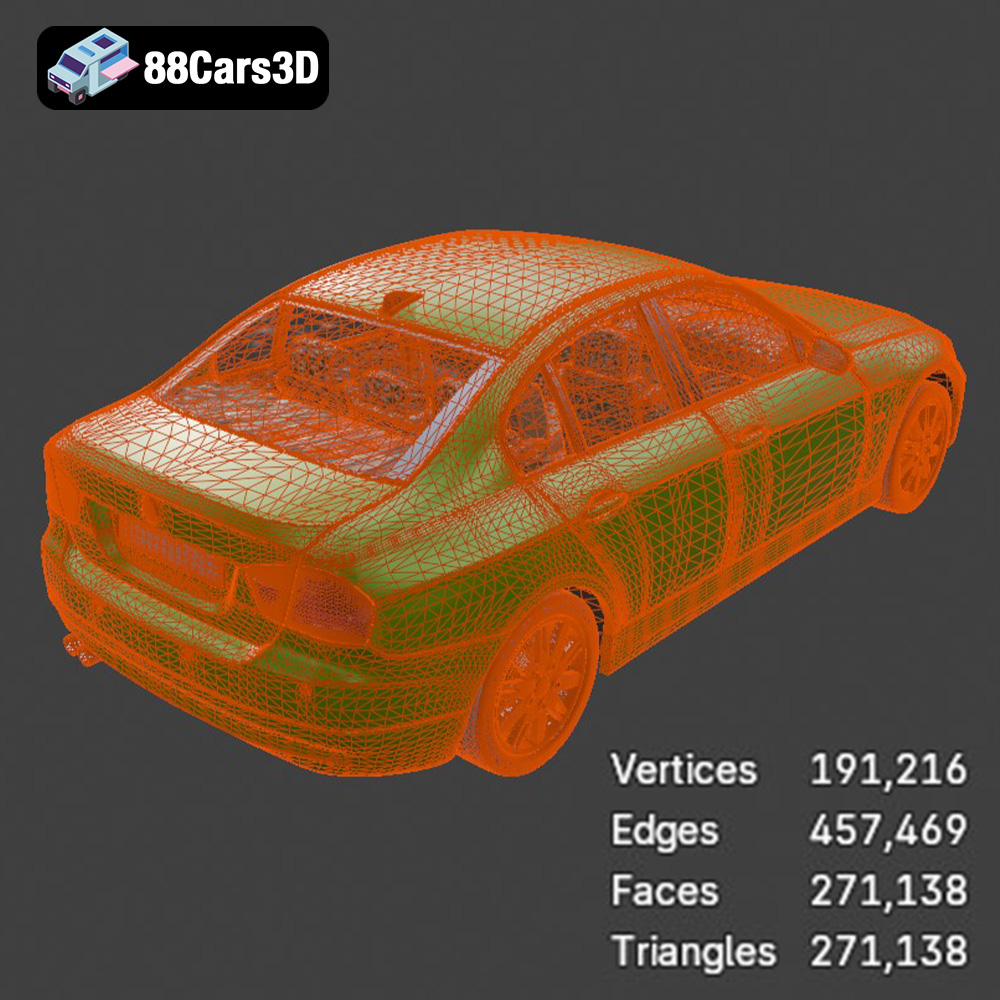
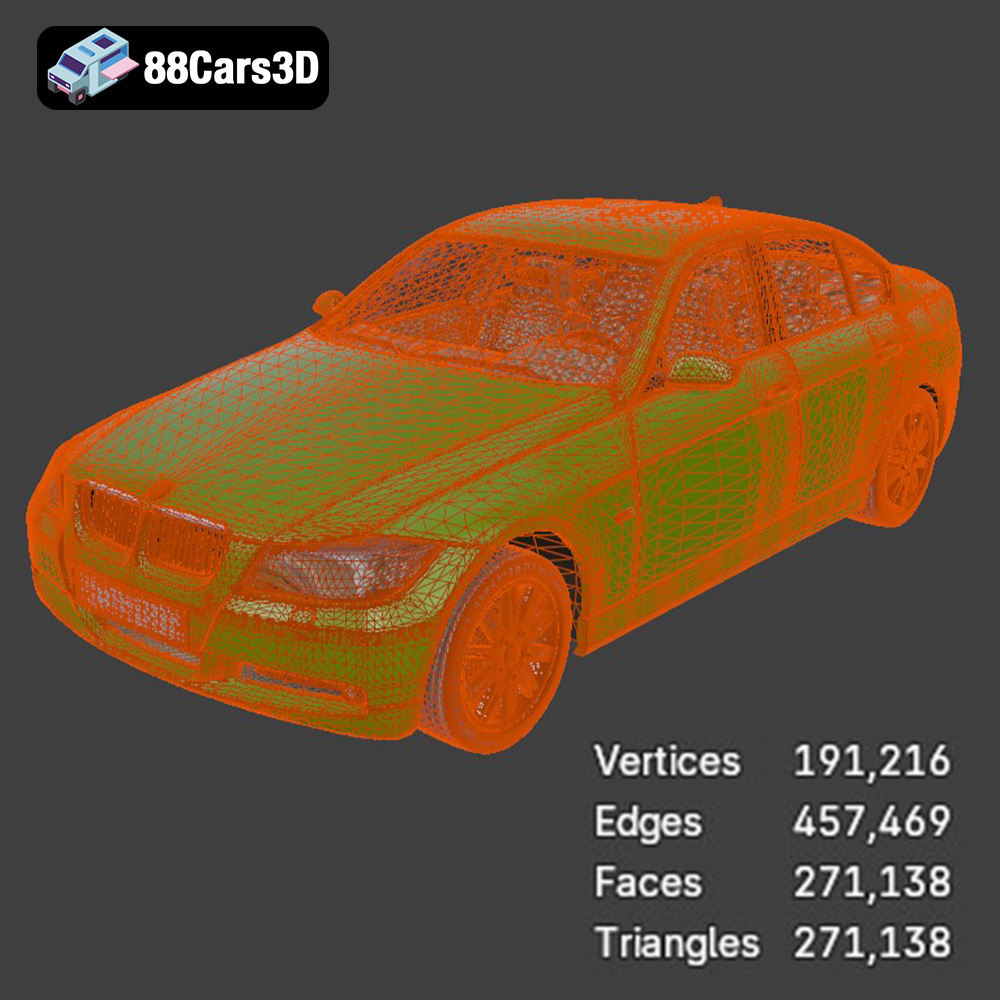
At the core of any premium 3D vehicle model is its geometry. The BMW 3-005 3D Model, for instance, boasts clean, quad-dominant topology. This isn’t just an aesthetic choice; it’s a critical technical advantage. Quad-based meshes deform smoothly, which is essential for animation (e.g., doors opening, wheels turning, body panels reacting to impacts) and for applying subdivision surfaces without artifacts. Bad topology, characterized by triangles or N-gons in areas meant to be smooth, leads to pinching, undesirable reflections, and difficulty in further editing. The accurate modeling of body panels, headlights, and subtle character lines ensures that light interacts with the surfaces just as it would in the real world, producing believable reflections and highlights – a cornerstone of high-quality automotive rendering.
Material Definition and Realism: The Power of PBR
Beyond the mesh itself, realistic materials are what truly bring a 3D car to life. Modern workflows heavily rely on Physically Based Rendering (PBR) pipelines, which simulate how light interacts with surfaces in the real world. For the BMW 3-005, this means meticulously defined materials for reflective paint finishes, chrome accents, transparent windows, and realistic tire tread patterns. PBR materials require texture maps for properties like albedo (base color), roughness, metallic, normal, and ambient occlusion. These maps, combined with carefully crafted shader networks in software like 3ds Max (using V-Ray or Corona) or Unreal Engine, allow artists to achieve astonishing visual fidelity, making the digital model indistinguishable from its physical counterpart in a well-lit scene.
Scale, Hierarchy, and UV Mapping for Production Readiness
A production-ready asset isn’t just about good looks; it’s about usability. The BMW 3-005 3D Model is modeled to real-world scale, which is vital for accurate integration into architectural scenes, simulations, or virtual environments where proportion matters. Furthermore, a logically organized hierarchy with properly set pivots for components like doors, hood, and trunk dramatically simplifies animation and manipulation. Artists don’t have to waste time cleaning up the model; they can immediately begin animating. Efficient UV mapping, which unwraps the 3D surface into a 2D space for texture application, is another technical advantage. Clean UVs prevent texture stretching, allow for easy texture modification (like applying custom liveries), and maximize texture resolution utilization, ensuring that every detail, from the BMW emblem to the stitching on the seats, looks crisp and realistic.
Integrating the BMW 3-005 into Professional Workflows
The versatility of a premium 3D car model is best demonstrated by its seamless integration into various professional software environments. The BMW 3-005 3D Model, with its diverse file format support, is designed precisely for this purpose.
3ds Max: Architectural Visualization and Cinematic Rendering
For architectural visualization studios and cinematic artists, 3ds Max remains a dominant force. With the included .max file, users can directly open the BMW 3-005 3D Model within their preferred rendering engine like V-Ray, Corona Renderer, or Arnold. This allows for immediate integration into an exterior architectural scene, a showroom setup, or a high-impact product animation. The logically organized hierarchy means that an artist can effortlessly open the car doors for an interior shot or animate it driving through a meticulously crafted digital environment. The high-quality topology and materials translate directly into stunning, photorealistic renders that meet the demanding standards of advertising and film production.
Blender: Indie Development and Flexible Customization
Blender’s rise has made it a powerful contender for 3D production across the board. The .blend file for the BMW 3-005 3D Model provides a fully editable scene, allowing Blender users complete freedom. Indie game developers or visualization artists can leverage Blender’s Cycles or Eevee render engines to create impressive visuals. The model’s clean topology makes it easy to add further details, sculpt specific damage, or even retopologize for ultra-low-poly applications if needed. Artists can easily adjust materials using Blender’s node editor, swap out textures, or integrate the vehicle into an existing Blender scene with minimal effort, making it an invaluable asset for flexible and cost-effective production.
Unreal Engine: Real-Time Interactive Experiences and Games
Unreal Engine stands at the forefront of real-time rendering and interactive experiences. The inclusion of an .fbx file, and especially the pre-configured .unreal project setup, makes the BMW 3-005 3D Model a powerful asset for game developers and AR/VR creators. With the .fbx, developers can import the model, apply Unreal’s PBR materials, and set up collision meshes and physics. The .unreal setup likely streamlines this even further, offering an engine-ready asset with optimized materials and perhaps even basic vehicle blueprints. This allows for quick integration into racing simulations, open-world games, or interactive configurators, where the model’s optimized mesh quality ensures a balance between visual fidelity and real-time performance, crucial for maintaining high frame rates.
Beyond Rendering: Diverse Applications of Premium 3D Car Models
The utility of a high-quality 3D car model extends far beyond static images. The BMW 3-005 3D Model from 88cars3d.com is designed for a multitude of applications, reflecting the evolving landscape of 3D technology.
Game Development: Driving Immersive Experiences
For game developers, vehicles are often central to the player experience. Whether it’s a high-octane racing simulator, an open-world adventure, or a tactical urban environment, realistic car models are essential. The BMW 3-005, with its optimized mesh, separated components for animation (doors, wheels), and compatibility with .fbx and .unreal formats, is an ideal game asset. Its clean topology allows for easy LOD generation, crucial for performance optimization across different platforms and viewing distances. Game artists can quickly apply custom liveries, damage models, or integrate it with vehicle physics systems to deliver compelling gameplay.
AR/VR: Bridging the Digital and Physical Worlds
Augmented Reality and Virtual Reality applications demand high-quality, performant 3D assets. The immersive nature of AR/VR means that visual artifacts or low-fidelity models are immediately jarring. The BMW 3-005 3D Model, particularly in its .glb format, is perfectly suited for these environments. The compact, single-file nature of .glb ensures quick loading times in AR apps that overlay the car onto the real world, or in VR experiences that place users inside a virtual showroom. Its realistic materials and accurate scale contribute to a believable and engaging interactive experience, allowing users to inspect the vehicle from all angles or even “sit” inside it.
Simulation & Training: Realism for Education and Analysis
Automotive simulations are critical for driver training, vehicle dynamics analysis, and urban planning. These applications require models that are not only visually accurate but also adhere to real-world scale and mechanical principles. The BMW 3-005’s detailed interior, exterior, and even basic drivetrain components make it suitable for these uses. Its precise geometry can be used to simulate aerodynamic properties, crash dynamics, or simply as a realistic visual placeholder in complex traffic simulations. Educational institutions and engineering firms can leverage such models to create powerful, insightful training and analysis tools.
3D Printing: Bringing Digital Concepts to Life
While often overlooked, the ability to transition from digital to physical is a powerful asset. The inclusion of an .stl format means the BMW 3-005 3D Model is ready for 3D printing. Artists and engineers can produce physical prototypes, scale models for display, or even create custom parts. While scaling and ensuring manifold geometry are typically required steps, having a clean, well-modeled base like this significantly simplifies the preparation process, allowing for the rapid realization of physical objects from the digital design.
Optimizing Your 3D Workflow: Tips for Success with 88cars3d.com Assets
Leveraging premium 3D assets like the BMW 3-005 3D Model from 88cars3d.com is a smart strategy for efficiency and quality. Here are some tips to maximize your investment and streamline your projects.
Pre-Visualization and Planning
Before integrating any 3D model, have a clear vision of your final output. Will it be a static render, an animation, a game asset, or an AR experience? This will help you select the appropriate file format and determine what level of detail and optimization you’ll need. For instance, if you’re targeting mobile AR, the .glb format and potentially further mesh optimization might be necessary, even if the base model is already efficient. For high-end cinematic rendering, you’ll focus on material setup and lighting in your chosen renderer, leveraging the .max or .blend files.
Leveraging Included Formats and Customization Options
88cars3d.com provides the BMW 3-005 3D Model in a variety of formats for a reason. Don’t limit yourself to just one. Use the .max or .blend files for deep customization of materials or structural modifications. Export to .fbx for game engine integration, or .glb for web deployment. Experiment with the customization options mentioned in the product description: easily modify paint finishes, apply custom liveries, or adjust material properties to match your specific scene requirements. This flexibility saves valuable time that would otherwise be spent on fundamental modeling and texturing.
Smart Scene Management and Optimization
Even with a well-optimized model like the BMW 3-005, efficient scene management is crucial. Utilize proper layer/collection organization, instance objects where appropriate, and optimize lighting and render settings for your target platform. In game engines, use LODs (Levels of Detail) to swap out higher-poly versions of the car for lower-poly ones when viewed from a distance, drastically improving performance. For rendering, employ render passes and compositing techniques to achieve complex visual effects without over-rendering your entire scene.
Conclusion
The journey from concept to a stunning 3D visualization or an immersive interactive experience is complex and demanding. However, with the right tools and assets, the path becomes significantly smoother and more efficient. The BMW 3-005 3D Model stands as a testament to the power of high-quality, production-ready assets in today’s fast-paced digital landscape. Its meticulous construction, diverse file format support – from the fully editable .blend and .max files to engine-ready .fbx and .unreal, and web-optimized .glb – and inherent flexibility make it an indispensable tool for professionals across automotive rendering, game development, AR/VR, and simulation.
By understanding the technical advantages of such models and integrating them intelligently into your workflow, you can elevate the realism, performance, and overall impact of your projects. Investing in assets from reputable sources like 88cars3d.com ensures you’re starting with a solid foundation, allowing you to dedicate your creative energy to innovation and refinement, ultimately delivering results that truly stand out in a competitive market.
Featured 3D Model
BMW 3-005 3D Model
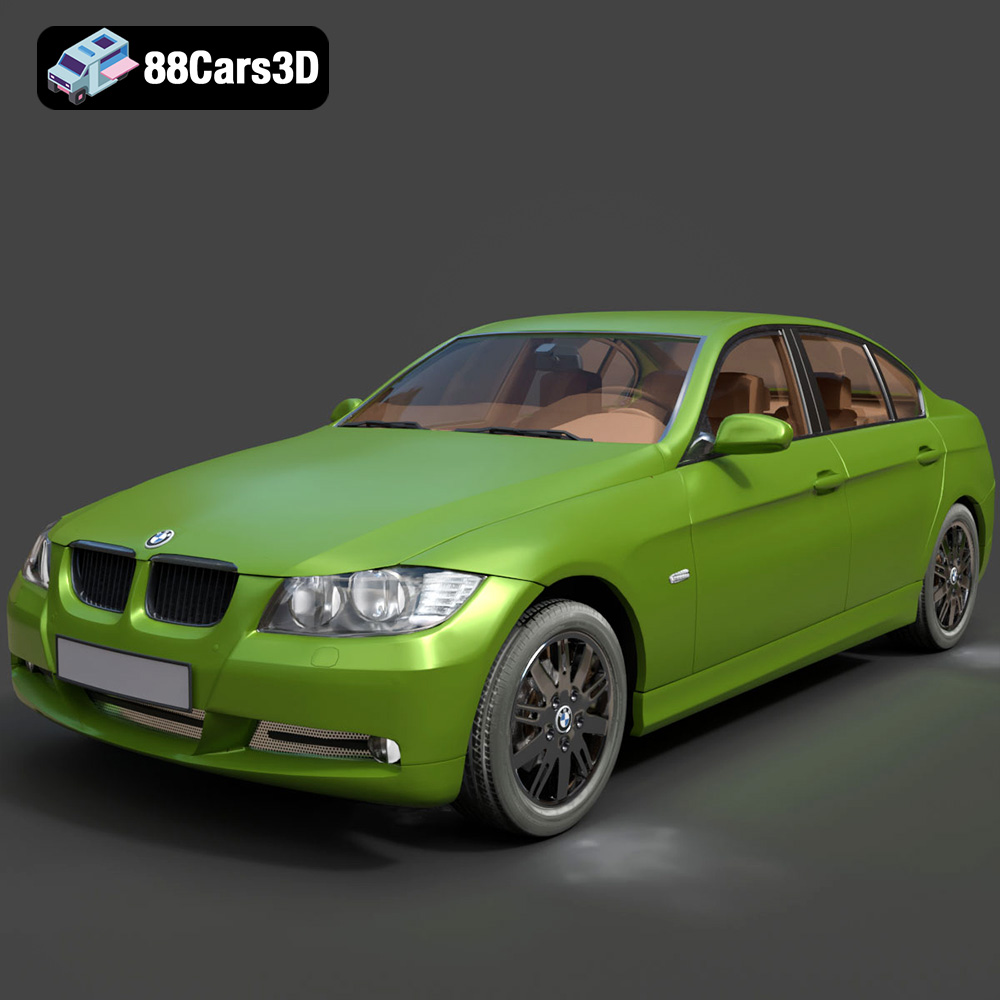
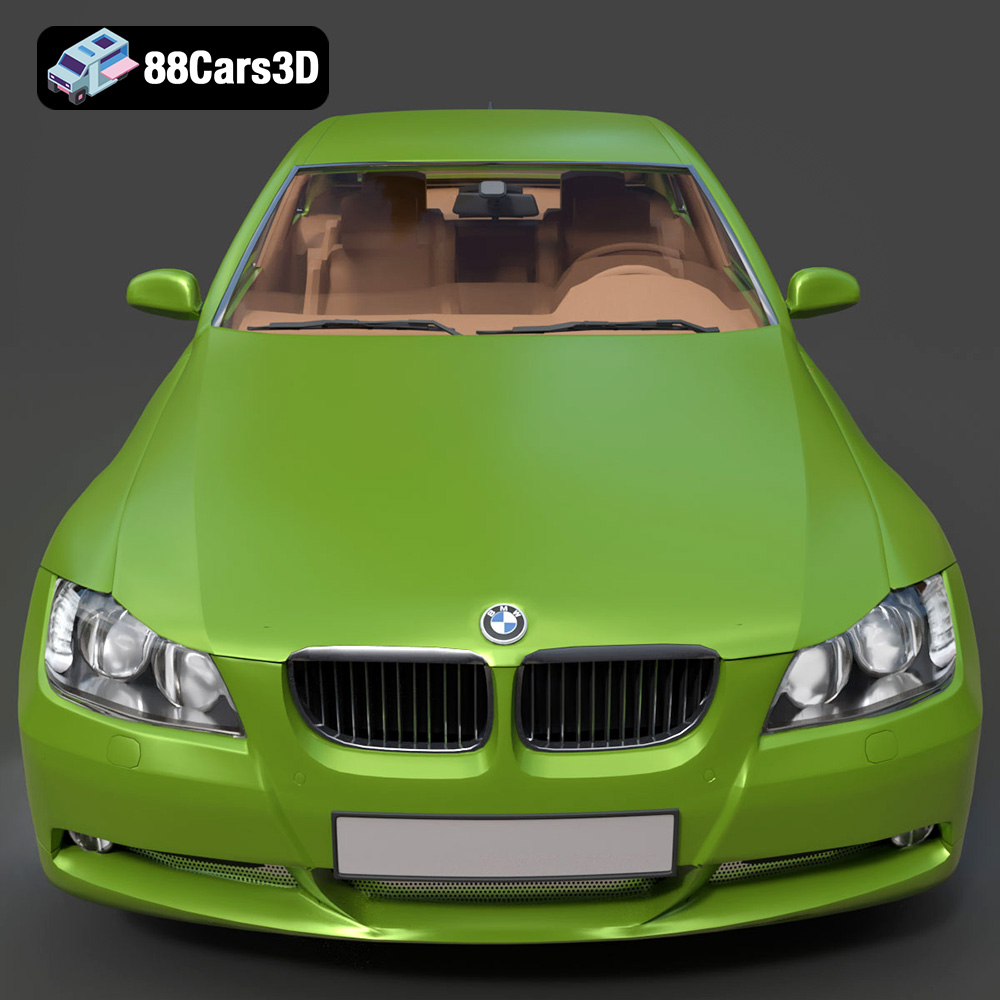
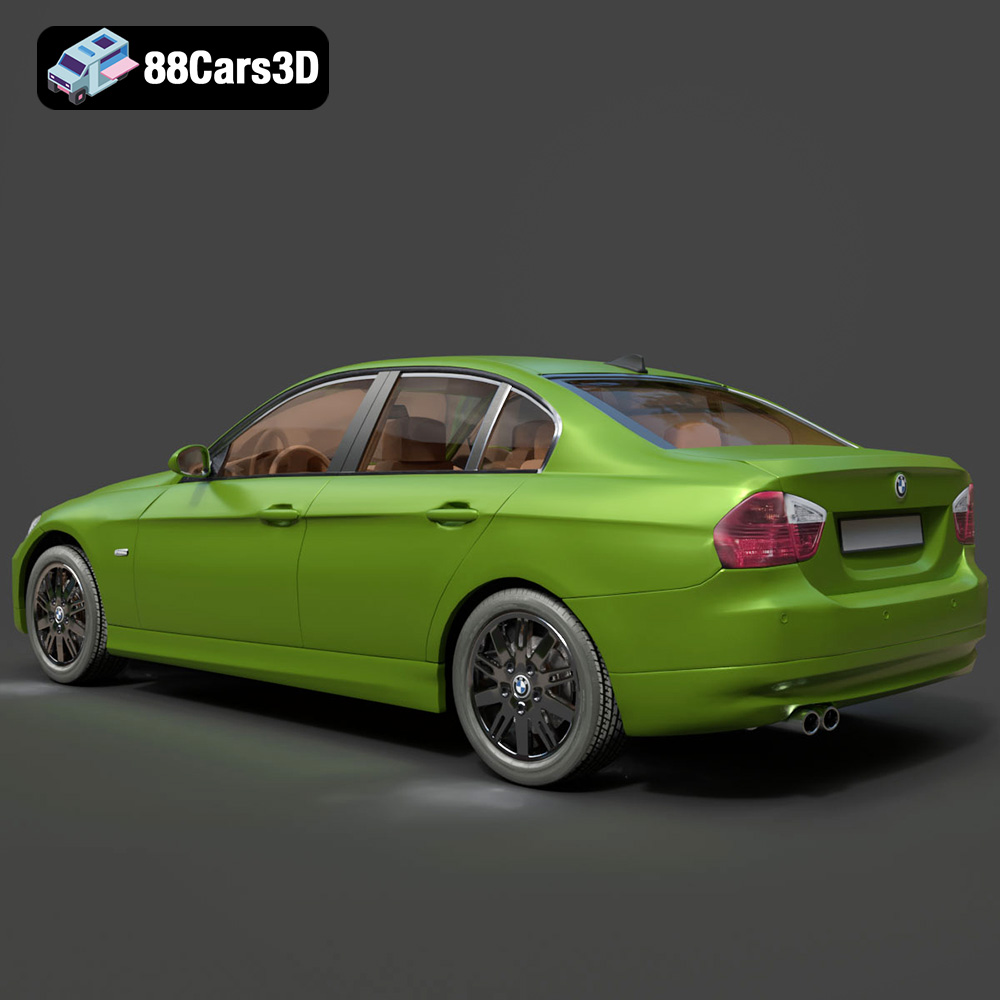
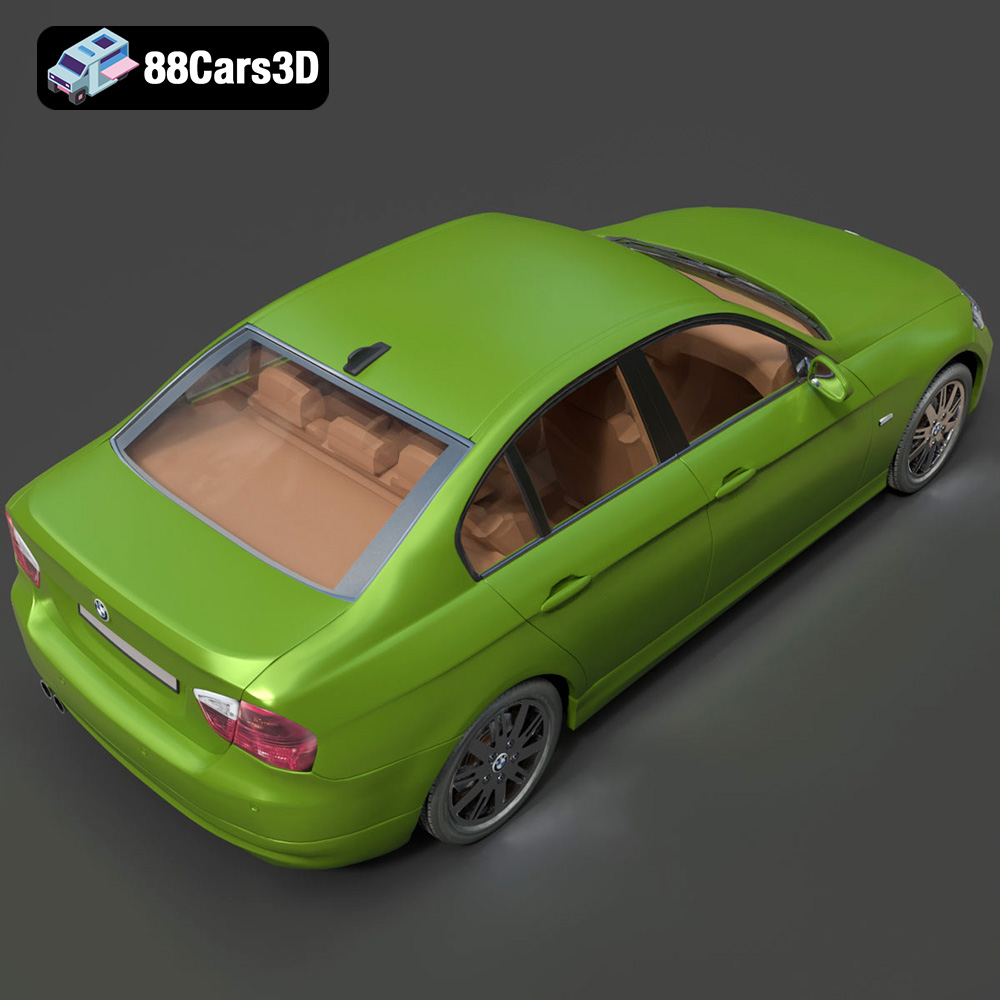
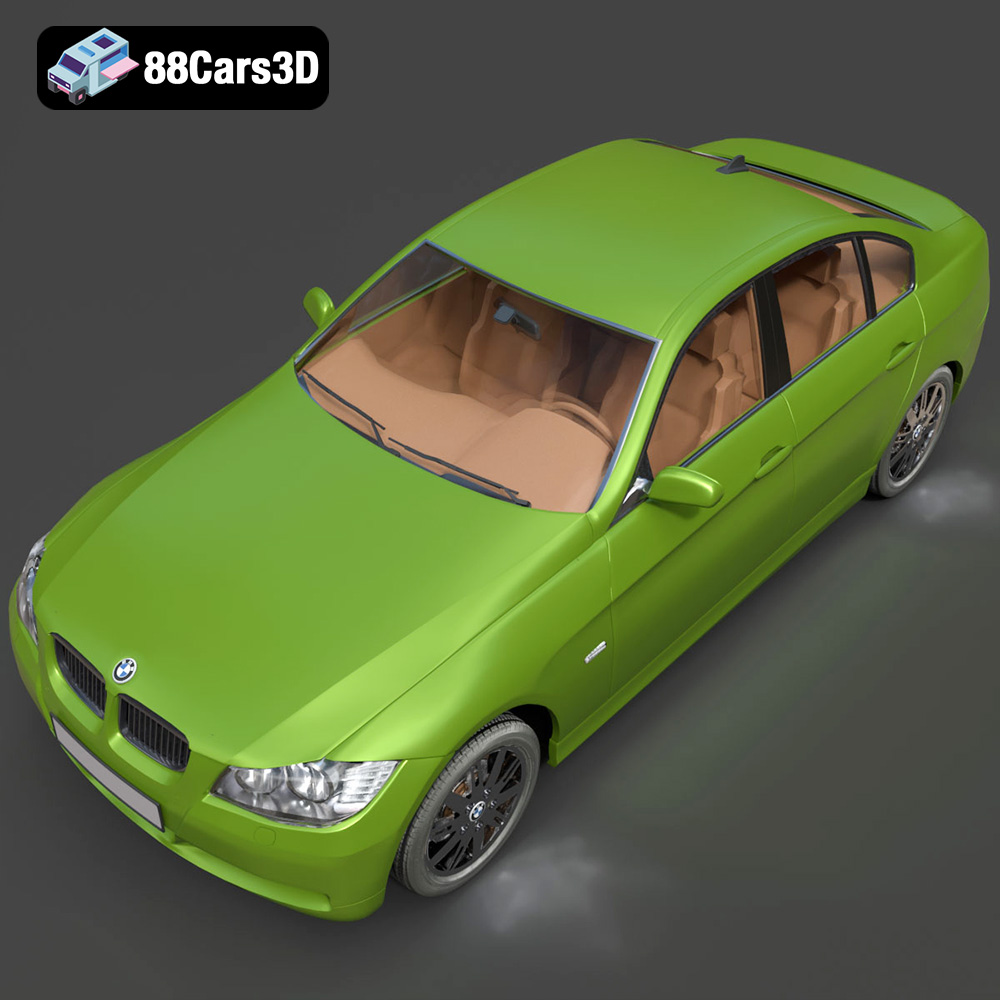
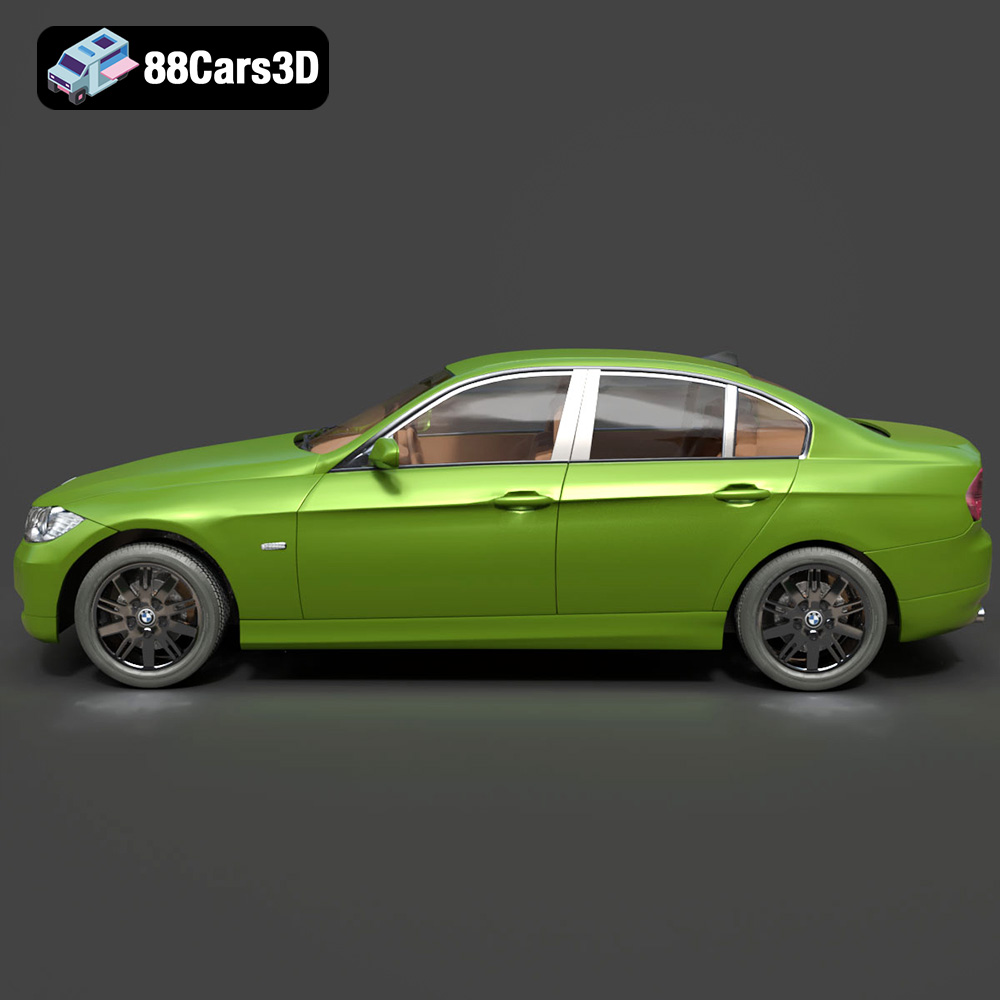
Presenting the professional-grade BMW 3-005 3D Model, a meticulously crafted digital representation of BMW’s iconic design philosophy. This model captures the essence of a modern luxury vehicle, featuring clean, optimized geometry and a balanced level of detail perfect for a wide range of applications. Built with precision, it’s an ideal asset for high-quality rendering, realistic animation, immersive simulation projects, and detailed game development.
Exterior Features:
- Accurately modeled body panels reflecting BMW’s distinctive styling
- Detailed headlights and taillights with realistic material definitions
- High-fidelity wheels and tires with proper tread patterns
- Separated components such as doors, hood, and trunk for easy animation workflows
- Transparent materials for windows, allowing for realistic light interaction
- Reflective paint finishes and chrome accents for a premium look
Interior / Mechanical Features:
- Detailed dashboard, steering wheel, and control elements
- Comfortable seating with realistic fabric or leather textures
- Visible engine and basic drivetrain components for mechanical accuracy (where applicable)
- Optimized mesh quality for a balance of detail and performance
Technical Advantages:
- Clean, quad-dominant topology ensures smooth subdivisions and deformation
- Modeled to real-world scale for accurate integration into scenes
- Logically organized hierarchy with properly set pivots for easy animation and manipulation
- Efficient UV mapping for straightforward texture application
Applications:
- Rendering & Visualization: Create stunning studio renders, cinematic sequences, and product visualizations.
- Game Development: Integrate into racing games, open-world environments, or simulation titles as a high-quality game asset.
- AR/VR: Develop immersive augmented reality and virtual reality experiences with realistic vehicle interactions.
- Simulation & Training: Utilize for automotive simulations, driving trainers, or educational presentations.
- 3D Printing: Easily convert to .stl for physical model production (scaling may be required).
Customization Options:
- Easily modify paint finishes, apply custom liveries, or integrate brand graphics.
- Adjust material properties for metal, chrome, glass, rubber, and plastics to match specific scene requirements.
- Adapt lighting setups to achieve diverse moods and atmospheric conditions.
The BMW 3-005 3D Model is an indispensable asset for professionals seeking a high-quality, versatile, and production-ready vehicle model. Its exceptional detail and technical advantages make it a superior choice for any demanding 3D project.
Included File Formats:
- .blend – Blender project with materials
- .fbx – Compatible with Unreal, Unity, and major 3D engines
- .obj – Universal format for nearly all 3D software
- .glb – Optimized for AR, VR, and web-based visualization
- .stl – Ready for 3D printing
- .ply – Mesh format for analysis and CAD workflows
- .unreal – Unreal Engine project setup
- .max – Editable 3ds Max scene for rendering and animation
$14.99
Product Image Gallery