
BMW 3 Series E21 3D Model – The Art and Science of High-Fidelity 3D Car Models

The world of 3D modeling is a fascinating intersection of art and engineering, particularly when it comes to replicating the intricate beauty of automotive design. From the sleek curves of modern supercars to the timeless elegance of vintage classics, 3D car models serve as the digital backbone for a myriad of industries: film, advertising, game development, virtual reality, and even forensic analysis. But creating a truly exceptional 3D car model is no trivial task; it demands meticulous attention to detail, a deep understanding of topology, and an appreciation for the vehicle’s real-world counterpart. Today, we’re diving into precisely such a model, one that encapsulates the spirit of an automotive legend: the BMW 3 Series E21.
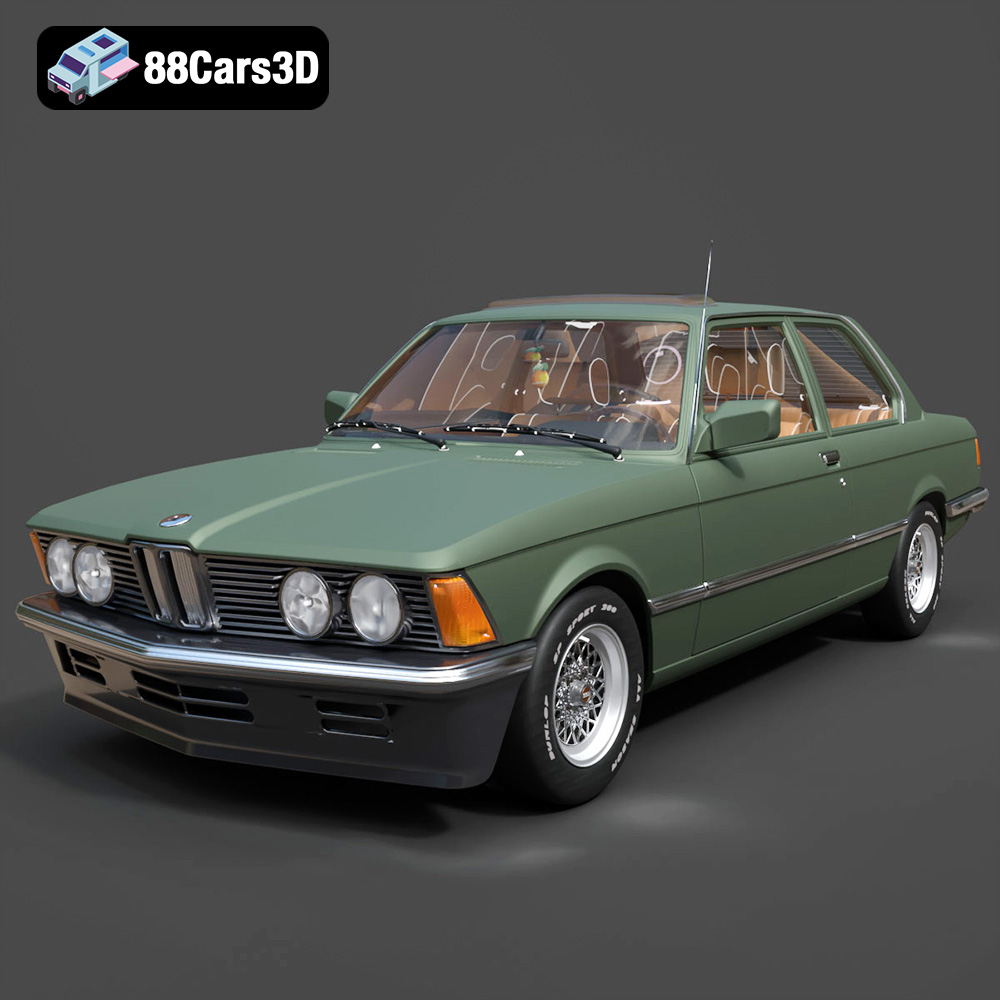
The BMW E21, the progenitor of the immensely popular 3 Series line, holds a special place in automotive history. Its launch in the mid-1970s marked a new era for compact executive cars, combining sporty handling with sophisticated styling. Recreating this icon in three dimensions requires a delicate balance of faithfulness to the original design and technical optimization for digital environments. The BMW 3 Series E21 3D Model available on 88cars3d.com is a testament to this craft, offering a meticulously designed asset ready to elevate any professional project. It’s not just a mesh; it’s a fully realized digital twin, poised for high-quality rendering, immersive game experiences, or precise simulations.
The Art and Science of High-Fidelity 3D Car Models
The creation of a high-fidelity 3D car model is a multi-faceted process that merges artistic vision with rigorous technical standards. It’s about more than just making a car look good; it’s about ensuring it performs flawlessly across diverse digital applications. From the curvature of a fender to the intricate details of an interior, every element must be carefully considered to achieve photorealism and functional versatility.
Capturing Automotive Heritage in Digital Form: The E21 Specifics
The BMW 3 Series E21 is a classic, known for its clean lines, distinctive kidney grille, and driver-focused cockpit. Translating these characteristics into a 3D model requires an understanding of the vehicle’s design language. The model meticulously reproduces the E21’s timeless bodywork, ensuring accurate panel gaps and surface curvatures that mirror the original vehicle’s aesthetic. This isn’t just about exterior beauty; it extends to detailed wheel rims with realistic tread patterns and transparent materials for windows, headlights, and taillights, crucial for realistic light interaction in rendering.
Inside, the model continues to impress with detailed interior elements, including the dashboard, steering wheel, seats, and door panels. These components are crafted for visual authenticity, replicating controls and gauges to create an immersive experience. Even underlying mechanical components, such as basic suspension and brake caliper forms, are included, optimized for efficient mesh quality. This level of comprehensive detail ensures that whether your project demands a close-up interior shot or a dynamic exterior animation, the BMW E21 model delivers.
The Precision of Quad-Dominant Topology
At the heart of any high-quality 3D model lies its topology. The BMW 3 Series E21 3D Model boasts clean, quad-dominant topology, a hallmark of professional 3D car models. Quads (four-sided polygons) are essential for several reasons: they deform smoothly during animation, allow for predictable subdivision for higher detail levels (e.g., using subdivision surfaces in Blender or 3ds Max), and are generally preferred for clean UV mapping. This geometric precision prevents unsightly pinches or artifacts that can plague models built with triangles (tris) or N-gons in areas requiring smooth curves. Furthermore, the model is built to real-world scale, ensuring seamless integration into diverse scenes without the need for manual scaling adjustments, a significant time-saver in production workflows.
Understanding 3D Model File Formats
The choice of file format for a 3D model is as critical as the model’s geometry itself. Different formats are optimized for different purposes, software ecosystems, and pipelines. A truly versatile 3D asset, such as the BMW 3 Series E21 3D Model, provides a comprehensive array of formats to cater to virtually any professional need. Understanding each one is key to maximizing its utility.
.blend – Fully Editable Blender Scene with Materials
The .blend format is Blender’s native file type. It encapsulates an entire Blender project, including all mesh data, materials, textures, lighting, cameras, animation data, and even modifiers. For users entrenched in the Blender ecosystem, this format is invaluable as it provides the most comprehensive and editable version of the model. Artists can directly open the file, inspect the clean quad topology, modify materials (Cycles or Eevee), adjust lighting, or even extend the model with additional details using Blender’s powerful toolset. It offers the greatest flexibility for customization and deep integration into a Blender-centric workflow.
.fbx – Ideal for Unreal, Unity, and Real-Time Pipelines
Autodesk’s .fbx (Filmbox) format is a widely adopted standard for 3D data exchange, particularly prevalent in game development. It’s renowned for its ability to store not just mesh data, but also animations, skinning information, cameras, and lights, making it incredibly versatile for transferring animated assets between different software. When importing the E21 model as .fbx into game engines like Unreal Engine or Unity, developers benefit from its robust compatibility. The format maintains hierarchies, pivot points, and UV maps effectively, streamlining the import process for creating game-ready assets. It’s often the go-to choice for real-time applications where performance and animation fidelity are paramount.
.obj – Universal Format for Cross-Software Compatibility
The .obj (Wavefront OBJ) format is one of the most universal and oldest 3D file formats. It primarily stores geometric data—vertices, normals, texture coordinates, and faces—and can reference external material files (.mtl). Its strength lies in its widespread compatibility; nearly every 3D software package can import and export .obj files. While it doesn’t typically support animation or complex scene data, its simplicity makes it excellent for transferring static mesh data between disparate applications like ZBrush, Maya, 3ds Max, or Blender, where the focus is on sculpting, modeling, or texture painting. The E21 model’s .obj variant ensures broad access for any artist, regardless of their preferred primary software.
.glb – Optimized for AR, VR, and Browser-Based Display
.glb (GL Transmission Format Binary) is the binary version of .gltf, designed for efficient transmission and loading of 3D scenes and models. It packages all assets—geometry, materials, textures, and even animation—into a single file, making it incredibly efficient for web-based 3D, augmented reality (AR), and virtual reality (VR) applications. Its compact size and optimized structure ensure fast loading times and smooth performance in real-time environments. The E21 model in .glb format is perfectly suited for interactive web viewers, AR apps on mobile devices, or lightweight VR experiences, offering a streamlined way to showcase the vehicle without heavy downloads.
.stl – Suitable for 3D Printing Output
.stl (STereoLithography) is the standard file format for 3D printing. It represents a 3D model as a series of connected triangles, describing only the surface geometry of an object without color, texture, or other CAD attributes. For the E21 model, the availability of an .stl file means it can be directly prepared for physical fabrication. Its “watertight” geometry is crucial for 3D printing, ensuring that the mesh is a completely closed volume, preventing errors during slicing and printing. This allows designers to create physical scale models of the classic BMW E21 for display, prototyping, or educational purposes.
.ply – Precision Mesh Format for CAD or Analysis
The .ply (Polygon File Format, also known as Stanford Triangle Format) is a versatile format often used to store 3D data from 3D scanners, CAD software, and various modeling applications. It can store a wide range of properties, including color, transparency, normals, texture coordinates, and even reliability information. While less common for general animation, .ply is excellent for precision mesh data, especially when integrating with CAD workflows, scientific visualization, or detailed analysis where vertex and face properties need to be preserved meticulously. For the E21, this format offers a robust option for those needing raw, precise mesh data for engineering or simulation studies.
.unreal – Engine-Ready Asset for Real-Time Environments
The .unreal designation implies a version of the model specifically optimized and configured for Unreal Engine. This typically means that the asset has been imported, materials have been set up using Unreal’s physically based rendering (PBR) system (e.g., as master materials and instances), textures are correctly assigned, and potentially collision meshes or level of detail (LOD) assets are configured. It provides a drag-and-drop solution for developers, significantly cutting down on setup time within Unreal Engine projects. The E21 model, provided in this format, offers an “out-of-the-box” experience for Unreal developers, allowing them to quickly integrate and utilize the car in their real-time environments.
.max – Editable 3ds Max Project for Animation and Rendering
Autodesk’s .max format is the native file type for 3ds Max, a leading software for 3D modeling, animation, and rendering. Like .blend, it stores the entire scene, including geometry, materials (V-Ray, Corona, Arnold), lighting setups, cameras, and animation data. For professionals using 3ds Max, this format offers the highest level of editability and provides the complete scene as envisioned by the model creator. Artists can leverage 3ds Max’s robust toolset for high-end rendering, complex animations, or integrating the E21 model into detailed architectural visualizations, offering unparalleled control and flexibility.
Professional Workflows: Integrating the BMW E21 into Your Pipeline
The true value of a versatile 3D asset lies in its seamless integration into various professional workflows. The BMW 3 Series E21 3D Model, with its high-quality construction and array of file formats, is designed to be a cornerstone for diverse creative and technical projects.
Rendering Masterpiece in 3ds Max and Blender
For cinematic renders and marketing visualizations, precision and aesthetic quality are paramount. In 3ds Max, artists can load the provided .max file, which often comes with pre-configured materials compatible with industry-standard renderers like V-Ray or Corona. This allows for immediate high-quality output. The E21’s separated components for doors, hood, and trunk enable dynamic animations, perfect for car commercials or product showcases. Imagine a scene where the E21 glides into view, sunlight glinting off its meticulously modeled chrome, before an elegant camera pan reveals its detailed interior.
Similarly, Blender users can leverage the .blend file, tapping into Cycles or Eevee for stunning visuals. The clean quad-dominant topology ensures smooth subdivision for close-up shots, while the organized hierarchy simplifies the setup of complex animations. The model’s accurate scale and material definitions allow artists to easily customize paint finishes, apply intricate livery designs, and adjust material properties for metals, plastics, and chrome to achieve hyper-realistic visual effects, crucial for automotive rendering.
Game Development Ready: Unreal Engine & Unity
In game development, performance is king, but visual fidelity is increasingly critical. The BMW E21 model’s .fbx and .unreal formats make it an ideal game asset. For Unreal Engine, the .unreal file can be directly imported, often with optimized materials and textures already configured for Unreal’s physically-based rendering pipeline. Developers can further optimize the model by implementing Level of Detail (LOD) meshes, ensuring efficient rendering across various distances without sacrificing visual quality up close. Collision meshes can be automatically generated or custom-created to allow for realistic vehicle physics and interaction within the game world. The detailed interior and separated parts are perfect for first-person driving experiences or customizable car mechanics in racing games or open-world environments.
For Unity, the .fbx file provides a solid base. Developers can import the model, set up PBR materials, and then integrate it into their vehicle physics systems. The model’s organized hierarchy with proper pivot points for wheels, doors, and steering wheel greatly simplifies rigging and animation setup, allowing for dynamic and interactive gameplay. This professionally crafted model from 88cars3d.com significantly reduces development time, letting teams focus on gameplay rather than asset creation from scratch.
Immersive Experiences: AR/VR and WebGL with .glb
The rise of augmented reality (AR), virtual reality (VR), and interactive web experiences demands highly optimized, yet visually rich, 3D models. The .glb format of the BMW E21 model shines here. Its single-file nature and efficient data structure make it perfect for rapid deployment in AR applications on mobile devices, allowing users to place the E21 in their real-world environment. In VR, the optimized mesh ensures smooth framerates, crucial for preventing motion sickness and providing a comfortable, immersive experience. For web-based configurators or interactive car showrooms, the .glb format enables stunning 3D visualizations directly within a browser, offering users an engaging way to explore the E21 from any angle, customize its features, and experience its classic allure without needing specialized software.
Beyond Visualization: Advanced Applications and Customization
A professional 3D car model’s utility extends far beyond mere visual representation. The BMW 3 Series E21 3D Model is engineered to serve a wide range of advanced applications, from technical simulations to tangible physical products, while also offering extensive customization options to meet specific project needs.
Engineering, Simulation, and Training
The precise modeling of the BMW E21, including its underlying mechanical components, makes it highly suitable for technical simulations. For vehicle dynamics simulations, the accurate scale and detailed geometry allow engineers to test virtual prototypes, analyze aerodynamic properties, or even simulate crash scenarios. In driver training modules, a highly realistic 3D model provides an immersive and responsive environment for trainees to practice driving skills in a virtual setting. The .ply format, with its ability to store detailed mesh data, can be particularly useful for integrating the model into CAD software for further engineering analysis or reverse-engineering studies, leveraging the precise forms of the digital asset.
The Tangible Digital: 3D Printing with .stl
The increasing accessibility of 3D printing technology opens new avenues for 3D models. The BMW E21 3D Model, provided with a watertight .stl file, is inherently ready for physical production. This means hobbyists, collectors, or professionals can transform the digital asset into a tangible scale model. Imagine having a perfectly accurate miniature of the iconic E21 on your desk, or using a larger printed model for design reviews and ergonomic studies. The clean geometry of the model ensures a smooth transition from screen to physical object, minimizing post-processing and ensuring a high-quality print result.
Tailoring the E21: Customization and Iteration
One of the significant advantages of working with a professional 3D model is the inherent flexibility for customization. The BMW E21 model allows artists and developers to easily personalize various aspects to fit specific project requirements. This includes modifying paint finishes to achieve different looks, from factory-fresh gloss to a weathered vintage patina. Livery designs and decal placements can be easily added for racing applications or special editions. Furthermore, material properties for components like metals, plastics, chrome, and rubber can be adjusted to achieve desired visual effects, whether it’s the polished gleam of a show car or the duller finish of a daily driver. Beyond materials, modifying lighting setups is straightforward, enabling the creation of various atmospheric conditions and scene moods, from sunny outdoor shots to dramatic studio lighting, ensuring the E21 always looks its best in any context.
The Technical Edge: Why Quality Assets Matter for Success
In the fast-paced world of 3D production, time is a precious commodity. The choice between creating an asset from scratch or acquiring a pre-made one often comes down to budget, timeline, and the required level of quality. Investing in high-quality 3D car models, such as the BMW 3 Series E21 from 88cars3d.com, offers a significant technical edge and ultimately contributes to project success.
Optimized Geometry and Real-World Scale
The core of any great 3D model is its geometry. The BMW E21 model’s clean, quad-dominant topology isn’t just an aesthetic preference; it’s a technical advantage. This ensures predictable deformation for animation, allows for efficient subdivision, and facilitates clean UV mapping for texture application. Such optimized geometry translates directly into better performance in real-time engines and cleaner renders in offline renderers. Furthermore, being modeled to real-world scale eliminates the tedious task of scaling and re-scaling, preventing potential issues with physics engines, lighting calculations, and seamless integration into larger scenes. This precision saves countless hours of technical adjustments, allowing artists to focus on creative tasks.
Organized Hierarchy for Seamless Animation
A poorly organized 3D model can be a nightmare to work with, especially when animation is involved. The BMW 3 Series E21 3D Model features an organized hierarchy with proper pivot points for its separated components: doors, hood, trunk, and wheels. This thoughtful arrangement is critical for efficient animation workflows. Animators can easily select and rotate parts around their natural pivot points, making the creation of realistic opening doors, rolling wheels, or steering movements intuitive and straightforward. Without this, animators would waste valuable time manually adjusting pivot points or struggling with complex rigging, ultimately impacting project deadlines and quality. This attention to structural organization highlights the professional craftsmanship embedded in every aspect of the model.
The inherent quality of this 3D car model ensures that you’re not just purchasing a file, but gaining a robust, production-ready asset that withstands scrutiny and performs reliably across all applications. It eliminates the hidden costs associated with fixing poorly constructed models – from topology errors and bad UVs to incorrectly scaled objects or messy hierarchies. With models like the BMW E21 from 88cars3d.com, you invest in efficiency, reliability, and ultimately, superior creative outcomes.
Conclusion
In the dynamic world of 3D visualization and simulation, the demand for high-quality, versatile 3D car models continues to grow. The BMW 3 Series E21 3D Model stands as a prime example of an asset that meets these stringent professional requirements. From its meticulously recreated exterior and detailed interior to its clean quad-dominant topology and comprehensive range of file formats, every aspect is designed for seamless integration into the most demanding workflows.
Whether you are a seasoned 3D artist aiming for photorealistic renders in 3ds Max or Blender, a game developer building an immersive racing experience in Unreal Engine, an AR/VR creator crafting interactive experiences, or an engineer requiring precise geometry for simulations, this model provides the technical foundation for success. Its versatility, robust technical specifications, and broad compatibility across various software and engines make it an invaluable addition to any digital asset library.
Embrace the efficiency and quality that professionally crafted 3D car models offer. By leveraging assets like the BMW 3 Series E21 from 88cars3d.com, you can significantly accelerate your production pipeline, achieve stunning visual results, and deliver projects that truly stand out. Explore this exceptional model and discover a world of high-fidelity 3D assets that empower your creative vision.
Featured 3D Model
BMW 3 Series E21 3D Model
Presenting a meticulously crafted 3D model of the iconic BMW 3 Series E21, representing the first generation of BMW’s compact executive car. This model captures the distinctive styling and classic allure of the E21 era, known for its elegant lines and driver-focused design. Built with clean geometry and a balanced level of detail, it is optimized for high-quality rendering, realistic animations, precise simulations, and robust integration into game development projects.
Exterior Features:
- Faithful reproduction of the BMW 3 Series E21’s timeless bodywork, including its signature kidney grille and dual headlights.
- Accurate panel gaps and surface curvatures, reflecting the vehicle’s original design.
- Detailed wheel rims and tires with realistic tread patterns.
- Separated components for doors, hood, trunk, and wheels, allowing for dynamic animation workflows.
- Transparent materials applied to windows, headlights, and taillights for realistic light interaction.
Interior / Mechanical Features:
- Detailed interior elements, including dashboard, steering wheel, seats, and door panels, crafted for visual authenticity.
- Replicated controls and gauges within the cockpit for an immersive experience.
- Underlying mechanical components such as basic suspension and brake caliper forms, optimized for efficient mesh quality.
Technical Advantages:
- Clean, quad-dominant topology ensures smooth subdivision and deformation.
- Modeled to real-world scale for accurate integration into diverse scenes and environments.
- Organized hierarchy with proper pivot points for easy manipulation and animation of doors, wheels, and other moving parts.
Applications:
- Rendering & Visualization: Perfect for creating stunning studio renders, cinematic sequences, and architectural visualizations.
- Game Development: A production-ready asset suitable for racing games, open-world environments, and interactive experiences.
- AR/VR: Optimized for real-time applications, enabling immersive augmented and virtual reality experiences.
- Simulation & Training: Ideal for vehicle dynamics simulations, driver training modules, and educational content.
- 3D Printing: Geometry is watertight and can be easily converted to .stl for physical model creation.
Customization Options:
- Easily customize paint finishes, livery designs, and decal placements to match specific project requirements.
- Adjust material properties for metals, plastics, chrome, and rubber to achieve desired visual effects.
- Modify lighting setups to create various atmospheric conditions and scene moods.
Elevate your projects with this professionally crafted BMW 3 Series E21 3D model. Its exceptional detail, technical precision, and broad compatibility make it an invaluable asset for any serious 3D artist, developer, or simulator.
Included File Formats:
- .blend – Blender project with materials
- .fbx – Compatible with Unreal, Unity, and major 3D engines
- .obj – Universal format for nearly all 3D software
- .glb – Optimized for AR, VR, and web-based visualization
- .stl – Ready for 3D printing
- .ply – Mesh format for analysis and CAD workflows
- .unreal – Unreal Engine project setup
- .max – Editable 3ds Max scene for rendering and animation
Tags:
.bmw,.3seriese21,.coupe,.classiccar,.vintagecar,.rendering,.simulation,.gameasset,.arvr,.blend,.fbx,.obj,.glb,.stl,.ply,.unreal,.maxLamborghini Diablo SV 1995 3D Model
$20.79
Product Image Gallery


Related Tags
.3seriese21
.arvr
.blend
.bmw
.classiccar
.coupe
.fbx
.gameasset
.glb
.max
.obj
.ply
.rendering
.simulation
.stl
.unreal
.vintagecar
