
BMW 7 Series 2016 3D Model – The Apex of Automotive Detail: Why High-Quality 3D Car Models Matter

The Apex of Automotive Detail: Why High-Quality 3D Car Models Matter
In the fast-paced world of digital content creation, the pursuit of photorealism and immersive experiences drives innovation across industries. From cinematic visual effects and captivating video games to cutting-edge architectural visualizations and interactive AR/VR applications, the demand for exceptionally detailed and technically sound 3D assets has never been higher. At the heart of many such projects lies the quintessential symbol of design and engineering prowess: the automobile.
Creating a high-fidelity 3D car model from scratch is a monumental task, requiring hundreds of hours of expert modeling, texturing, and optimization. This is where professional-grade 3D car models become indispensable tools for designers, artists, and developers. They serve as robust foundations, significantly accelerating workflows and ensuring consistent quality across diverse projects. Consider, for instance, the intricate elegance of the BMW 7 Series 2016. Replicating its sophisticated lines, luxurious interior, and iconic details demands an unparalleled level of precision and expertise. A premium 3D model of such a vehicle doesn’t just represent a car; it embodies a commitment to visual excellence and technical integrity.
The Foundation of Visual Excellence
For any project aiming for realism, the quality of its foundational assets is paramount. A poorly modeled car, with incorrect proportions, messy geometry, or low-resolution textures, can detract significantly from the overall visual impact, regardless of how expertly it’s lit or rendered. High-quality 3D car models provide a “ready-to-go” solution that immediately elevates the aesthetic and technical bar. They come with meticulous attention to detail, from the curvature of the body panels to the subtle textures of the dashboard, ensuring every angle holds up under scrutiny.
These assets are built with performance and flexibility in mind. They feature clean, quad-dominant topology for smooth subdivisions and deformations, real-world scaling for accurate integration, and an organized hierarchy of components for ease of manipulation. This technical cleanliness allows artists to focus on creative aspects like scene composition, lighting, and animation, rather than wrestling with foundational modeling issues. For professionals, time is money, and a well-engineered 3D model like the BMW 7 Series 2016 saves countless hours, enabling quicker iterations and superior final output.
Bridging Creativity with Technical Precision
The beauty of a professional 3D car model lies in its ability to bridge artistic vision with technical precision. Artists can leverage these assets to explore creative narratives, design breathtaking renders, or build compelling interactive experiences, confident that the underlying model is structurally sound. The BMW 7 Series 2016 3D Model, available on 88cars3d.com, exemplifies this perfect synergy.
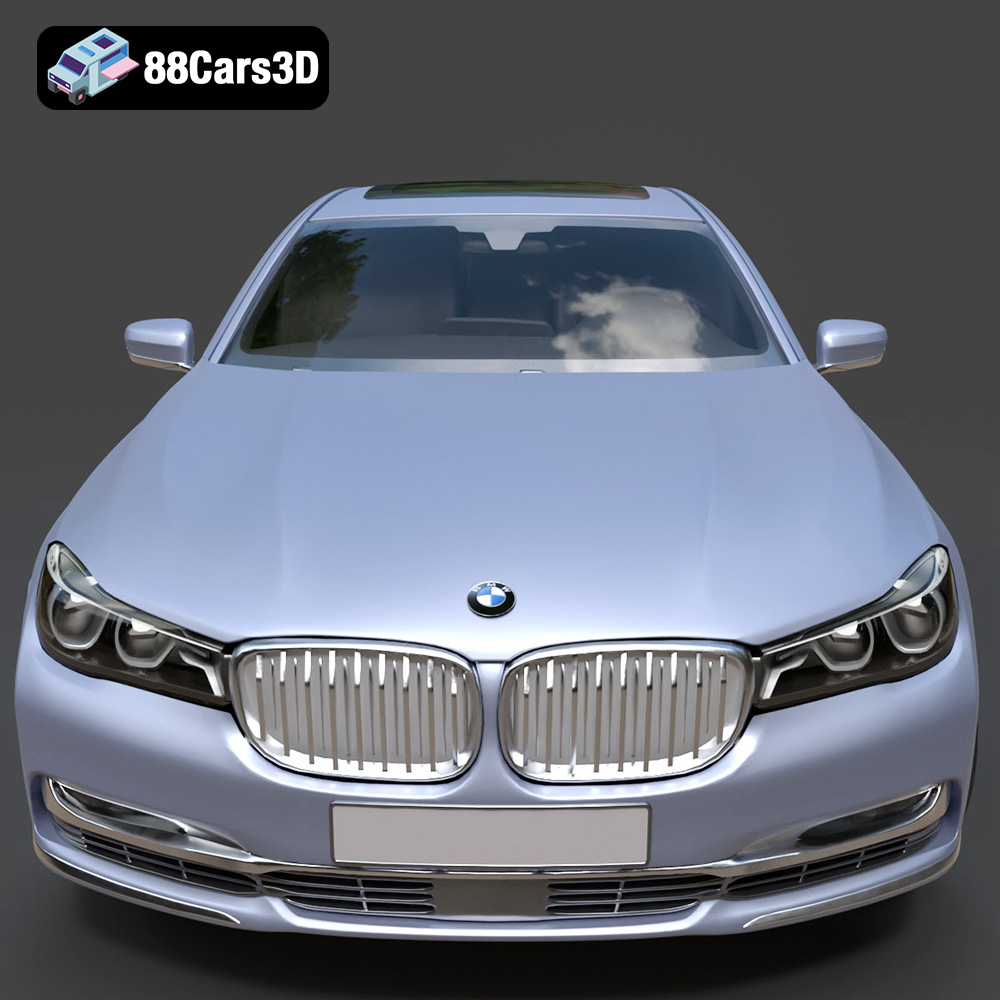
It’s a model crafted for versatility, suitable for high-fidelity renders, intricate animations, realistic simulations, and immersive game development. Its accurately modeled body panels, detailed grille, iconic ‘kidney’ design, and authentic badging ensure that the essence of the executive sedan is perfectly captured. From precision-engineered headlights to high-resolution wheels and tires, every exterior feature is faithfully replicated. Inside, the comprehensive interior detailing, visible gauges, and optimized mesh quality provide a complete representation, making it perfect for virtual tours or close-up shots. This level of detail and technical rigor ensures that whether you’re creating a promotional video or a next-gen game, the BMW 7 Series 2016 will stand out.
Understanding 3D Model File Formats
The world of 3D modeling is rich with a multitude of file formats, each designed with specific purposes, compatibilities, and technical advantages. Choosing the right format is critical for an efficient workflow, seamless integration, and achieving the desired outcome for your project. High-quality 3D car models, such as the BMW 7 Series 2016, are often provided in a variety of formats to ensure maximum versatility across different software and platforms.
Native Project Files: Deep Customization and Control
Native project files offer the deepest level of control and editability within their respective software environments. They contain not just the mesh data, but also scene information, lighting, camera setups, animation data, and complex material definitions that are specific to the originating application.
- .blend – Fully editable Blender scene with materials: Blender’s native format, .blend files, are comprehensive packages. They encapsulate everything within a Blender project, including meshes, materials (often configured with Cycles or Eevee shaders), textures, lighting, cameras, animations, and even physics simulations. This format is ideal for artists who primarily work in Blender and require full access to modify every aspect of the model, apply custom modifiers, re-rig, or create complex render setups. For the BMW 7 Series 2016, the .blend file allows for extensive customization, leveraging Blender’s powerful open-source ecosystem.
- .max – Editable 3ds Max project for animation and rendering: Similar to .blend, .max files are the native format for Autodesk 3ds Max, a industry-standard software for professional rendering, animation, and visualization. A .max file includes all scene elements – geometry, materials (often V-Ray or Corona specific), lights, cameras, modifiers, and animation curves. It’s the go-to format for users in professional studios that rely on 3ds Max for architectural visualization, product rendering, or character animation, providing unparalleled flexibility for modifications and advanced rendering workflows.
- .unreal – Engine-ready asset for real-time environments: While technically not a single file, this refers to a set of optimized assets and configurations specifically prepared for Unreal Engine. It often includes highly optimized meshes, PBR (Physically Based Rendering) materials, LODs (Levels of Detail), collision meshes, and blueprints within an Unreal Engine project structure. This format minimizes import issues and allows for immediate drag-and-drop integration into Unreal Engine projects, making it invaluable for game developers and real-time visualization specialists who use the engine.
Universal Exchange and Real-time Optimization
These formats are designed for interoperability and efficient deployment across various software and real-time engines, often stripping away software-specific features to focus on core mesh, material, and animation data.
- .fbx – Ideal for Unreal, Unity, and real-time pipelines: Autodesk’s Filmbox (.fbx) is one of the most widely adopted proprietary 3D exchange formats. It’s excellent for transferring geometry, materials (basic properties, though complex shaders might need re-creation), textures, skeletal animations, and cameras between different 3D software and, critically, into game engines like Unreal Engine and Unity. Its strength lies in its ability to maintain scene hierarchy and animation data, making it a staple for game development and cinematics.
- .obj – Universal format for cross-software compatibility: The Wavefront .obj format is perhaps the most universally supported 3D file format. It’s a simple, text-based format that primarily stores geometric data (vertices, normals, UV coordinates, and faces) and references to external material files (.mtl). While it doesn’t support animation or complex scene data, its broad compatibility makes it a reliable choice for transferring static meshes between almost any 3D software, ensuring that the core geometry of the BMW 7 Series 2016 can be utilized anywhere.
- .glb – Optimized for AR, VR, and browser-based display: The GL Transmission Format (.gltf) and its binary counterpart, .glb, are royalty-free formats designed for efficient transmission and loading of 3D scenes and models by engines and applications. They are highly optimized for web-based 3D, AR, and VR applications, supporting PBR materials, animations, and scene hierarchies in a compact package. .glb files are “self-contained,” embedding all textures and data, making them perfect for quick deployment in virtual showrooms or augmented reality experiences.
Specialized Formats for Niche Applications
Beyond general-purpose formats, some are tailored for very specific use cases, from physical manufacturing to scientific analysis.
- .stl – Suitable for 3D printing output: The Stereolithography (.stl) format is the standard for 3D printing. It represents a 3D model as a series of connected triangles, describing only the surface geometry without color, texture, or material information. While it simplifies the model, it’s precisely what 3D printers need to interpret the shape of an object for physical fabrication. Converting the BMW 7 Series 2016 to .stl allows for creating physical prototypes or display models.
- .ply – Precision mesh format for CAD or analysis: The Polygon File Format (.ply) can store a wider range of data than .obj or .stl, including color, transparency, and even properties like confidence values for data scanned from physical objects. It’s often used in scientific and CAD applications where precise mesh data and additional per-vertex or per-face information are crucial for analysis, measurement, or highly detailed industrial design workflows.
Understanding these formats empowers artists and developers to select the best option for their current task, ensuring the BMW 7 Series 2016 3D model integrates smoothly into any pipeline.
Crafting Immersive Worlds: Automotive Rendering and Visualization
Automotive rendering and visualization are critical stages in the product design, marketing, and architectural industries. High-quality 3D car models like the BMW 7 Series 2016 elevate these processes, transforming mere concepts into stunning, photorealistic imagery and animations that captivate audiences and convey detailed information.
Achieving Photorealism: Materials, Lighting, and Environment
The quest for photorealism in automotive rendering hinges on the masterful interplay of materials, lighting, and environmental context. A premium 3D model provides the perfect canvas for this artistry. The BMW 7 Series 2016 3D Model, with its detailed body panels, reflective chrome accents, and realistic window glass, is engineered for visual fidelity.
- Materials: Professional models come with carefully optimized materials, often using Physically Based Rendering (PBR) workflows. This means surfaces like metal, plastic, leather, and chrome react accurately to light, producing realistic reflections, refractions, and diffuse shading. With the BMW 7 Series 2016, users can easily modify paint finishes, apply custom graphics, and adjust material properties to match specific branding or desired atmospheric conditions. This flexibility ensures that whether the car is portrayed under a dramatic sunset or clinical studio lighting, its inherent quality shines through.
- Lighting: Effective lighting is the soul of a render. Artists use a combination of HDRI (High Dynamic Range Image) environments for realistic global illumination, area lights for studio setups, and spot lights for dramatic accents. The real-world scale and accurate geometry of the BMW 7 Series 2016 ensure that light interacts with its surfaces exactly as it would in reality, casting correct shadows and producing authentic specular highlights. This precision allows for creating stunning studio renders, cinematic sequences, or subtle architectural visualizations where the vehicle seamlessly integrates into the scene.
- Environment: Placing a 3D car model within a well-crafted environment adds context and depth. For architectural visualizations, the BMW 7 Series 2016 can populate a driveway, a showroom, or a city street, giving scale and a sense of lifestyle to the scene. Its realistic proportions and detailed features make it a convincing element in any digital landscape.
Animation and Cinematic Storytelling
Beyond static images, high-quality 3D car models are vital for creating dynamic animations and cinematic sequences. The BMW 7 Series 2016 3D Model is designed with animation in mind, featuring separated components such as doors, hood, and trunk, all with properly set pivot points.
- Interactive Elements: This modularity allows animators to easily open doors, raise the hood to reveal an engine (if detailed), or animate steering wheel turns and wheel rotations. This is crucial for product showcases, where a client might want to see the car from all angles, with interior access.
- Cinematic Flows: For advertising or film pre-visualization, the model can be integrated into complex camera paths and motion graphics, simulating driving sequences, revealing its design features in slow motion, or showcasing luxury branding. Its clean topology ensures smooth deformation during high-speed animations or close-up camera moves, preventing visual artifacts.
Architectural Integration and Product Showcases
Architects and product designers frequently use 3D car models to enhance their presentations. The BMW 7 Series 2016 is an ideal asset for:
- Architectural Visualization: Adding a luxury vehicle to an architectural render of a high-end property or commercial space immediately elevates the perceived value and realism of the scene. The model’s real-world scale ensures it fits naturally within virtual environments, offering a tangible sense of proportion and lifestyle.
- Product Showcases: For automotive accessories, tire manufacturers, or even custom car part designers, the BMW 7 Series 2016 provides a professional, accurate base model on which to showcase their products. The ability to easily customize paint finishes and material properties allows for seamless integration of new elements onto the existing vehicle.
Driving Digital Experiences: 3D Car Models in Game Development
Game development is one of the most demanding applications for 3D assets, requiring a delicate balance between visual fidelity and performance optimization. High-quality 3D car models are essential for creating immersive, believable game worlds, and products like the BMW 7 Series 2016 3D Model are specifically engineered to meet these stringent requirements, offering a game-ready asset for various genres.
Optimizing for Performance: From High-Poly to Game-Ready
A common misconception is that “high-quality” automatically means “high-polygon count” and therefore unsuitable for games. While initial high-poly models might be used for baking normal maps and other textures, professional game assets undergo rigorous optimization. The BMW 7 Series 2016 model strikes this balance effectively.
- Mesh Optimization: The model boasts optimized mesh quality to ensure efficient performance while maintaining intricate details. This often involves reducing polygon count strategically (LODs – Levels of Detail) for objects further from the camera, careful UV mapping for texture efficiency, and ensuring clean topology. The clean, quad-dominant topology of the BMW 7 Series 2016 ensures smooth deformations for damage systems or suspension, while being efficient enough for real-time engines.
- PBR Materials for Engines: Game engines like Unreal and Unity leverage Physically Based Rendering (PBR) to achieve realistic surfaces. The provided .fbx and .unreal formats of the BMW 7 Series 2016 model are designed to work seamlessly with these systems, allowing developers to quickly integrate the vehicle with its intended material properties, ensuring consistent visual quality across different lighting conditions within the game engine.
- Collision Meshes: For realistic physics and player interaction, game assets require accurate collision meshes. While not explicitly detailed in the description, professional 3D car models often come with or are easily adaptable for creating simplified collision geometries, crucial for driving games and open-world environments.
The Role of Detailed Assets in Player Immersion
In modern gaming, player immersion is paramount. A highly detailed and accurate 3D car model significantly contributes to this, especially in genres where vehicles are central to the gameplay experience.
- Racing Games: In titles focused on racing, the authenticity of the vehicles is a core selling point. Players expect to see their favorite luxury cars, like the BMW 7 Series 2016, replicated with extreme fidelity, from the precise curve of the headlights to the detailed dashboard and steering wheel. Such a model provides that level of authenticity directly, without requiring extensive post-purchase work.
- Open-World Environments: For open-world games where players can drive or interact with numerous vehicles, a library of high-quality 3D car models populates the world, making it feel more alive and believable. The BMW 7 Series 2016 can serve as a high-end civilian vehicle, enhancing the realism of virtual cities and landscapes.
- Interactive Experiences: For game-like configurators or virtual showrooms built in game engines, the comprehensive interior detailing and visible gauges of this model allow for highly interactive explorations, where players can “sit” inside the car and examine its luxurious features up close.
Integration with Game Engines like Unreal and Unity
The provision of dedicated game engine formats like .unreal and universal exchange formats like .fbx makes the BMW 7 Series 2016 an incredibly versatile asset for game developers.
- Unreal Engine: The .unreal format means the asset comes pre-configured for the engine, potentially with optimized meshes, PBR materials, LODs, and possibly even basic physics setups. This vastly reduces the time and effort required for import and setup, allowing developers to drop the BMW 7 Series 2016 directly into their scenes and begin scripting interactions or driving mechanics immediately.
- Unity: The .fbx format is a cornerstone for Unity development. Developers can import the model, apply their chosen PBR shaders, set up collision geometry, and integrate it into Unity’s physics system. The clean hierarchy with properly named components of the BMW 7 Series 2016 model facilitates easy rigging and animation within Unity, enabling realistic vehicle dynamics and visual effects.
By leveraging such meticulously prepared assets, game developers can focus their efforts on gameplay innovation and world-building, confident that their vehicles are visually stunning and performant.
Beyond the Screen: AR/VR, Simulation, and 3D Printing
The applications of high-quality 3D car models extend far beyond traditional rendering and game development. Fields like Augmented Reality (AR), Virtual Reality (VR), professional simulation, and even 3D printing are increasingly relying on detailed and accurate digital assets to create immersive, interactive, and tangible experiences. The BMW 7 Series 2016 3D Model, with its versatile file formats and robust design, is perfectly suited for these cutting-edge applications.
Immersive Interactivity in Augmented and Virtual Reality
AR and VR are transforming how we interact with digital content, offering unparalleled levels of immersion and interactivity. High-fidelity 3D car models are central to these experiences, particularly in automotive showcases and virtual configurators.
- AR Car Configurators: Imagine placing a full-scale, photorealistic BMW 7 Series 2016 directly into your driveway using a smartphone or tablet. AR applications allow potential buyers to visualize the car in their own environment, change paint colors, view interior details, and even “walk around” the vehicle as if it were truly there. The .glb format of the BMW 7 Series 2016 is specifically optimized for AR, VR, and web-based visualization, ensuring efficient loading and smooth performance on mobile devices and headsets.
- VR Showrooms and Driving Experiences: In VR, users can be transported into virtual showrooms to explore the BMW 7 Series 2016 from every angle, sitting inside to examine the dashboard, steering wheel, and luxurious interior detailing. Developers can create immersive driving experiences, allowing users to virtually test drive the car in various environments. The model’s optimized mesh quality and comprehensive interior detailing are crucial here, providing the high level of realism necessary to prevent “presence breaks” in VR.
Real-World Training and Simulation Fidelity
Professional simulators are used across various industries, from pilot training to heavy machinery operation. Driving simulators benefit immensely from high-fidelity 3D car models, providing a realistic visual and interactive experience for training, research, or entertainment.
- Driving Simulators: Integrating the BMW 7 Series 2016 into a driving simulator offers a highly realistic vehicle interaction. The model’s real-world scale ensures accurate physics calculations for vehicle dynamics, while its detailed exterior and interior provide the visual cues necessary for an authentic driving feel. This is invaluable for training aspiring drivers, evaluating vehicle ergonomics, or conducting research on driver behavior in a controlled virtual environment. The .fbx and .unreal formats are particularly useful here for seamless integration into simulation platforms.
- Educational Modules: Beyond driving, 3D car models can be used in educational settings to teach automotive design, engineering, or mechanics. Students can virtually dismantle the BMW 7 Series 2016, explore its components, and understand its structure in a way that static diagrams cannot convey. The organized hierarchy and separate components (doors, hood, trunk) facilitate such interactive learning experiences.
Bringing Digital Designs to Life with 3D Printing
3D printing bridges the gap between the digital and physical worlds, allowing for rapid prototyping, creation of display models, or even functional parts. High-quality 3D models are the starting point for this transformative technology.
- Physical Prototyping: Product designers can use the BMW 7 Series 2016 3D Model as a base for creating physical prototypes of custom accessories, scaled-down models for presentations, or even parts for wind tunnel testing. The .stl format provided is specifically ready for 3D printing, simplifying the conversion process and ensuring the geometric integrity required for manufacturing.
- Display Models: Enthusiasts or marketing teams can 3D print scale models of the BMW 7 Series 2016 for display purposes, showcasing the vehicle’s design in a tangible form. The clean geometry of the digital model ensures that the printed output is precise and free from artifacts.
The versatility of the BMW 7 Series 2016 3D Model demonstrates how a single, well-crafted asset can serve a multitude of advanced applications, making it an indispensable tool for forward-thinking professionals.
The Technical Edge: Unpacking Professional 3D Asset Quality
While visual appeal is often the first thing noticed in a 3D model, it’s the underlying technical quality that truly defines a professional-grade asset. For demanding applications like automotive rendering, game development, and simulation, the internal structure and organization of a 3D model are as crucial as its outward appearance. The BMW 7 Series 2016 3D Model from 88cars3d.com exemplifies these technical advantages, designed for seamless integration and optimal performance across various workflows.
The Power of Clean Topology and UV Mapping
At the heart of any excellent 3D model is its topology and UV layout. These fundamental aspects dictate how well the model deforms, how efficiently it’s rendered, and how easily it can be textured or modified.
- Clean, Quad-Dominant Topology: The BMW 7 Series 2016 boasts clean, quad-dominant topology. This means its mesh is primarily composed of four-sided polygons (quads), which are ideal for several reasons:
- Smooth Subdivisions: Quads subdivide predictably and smoothly, allowing for effortless addition of detail without introducing pinching or artifacts. This is critical for achieving high-fidelity renders where the car’s curves must appear flawless.
- Efficient Deformation: For animation, particularly in simulations where the vehicle might deform (e.g., suspension compression, minor collisions), quad-based meshes deform much more cleanly than triangle-based meshes, preventing unnatural creases or stretching.
- Optimized for Performance: While appearing dense, well-managed quad topology is also efficient. It allows for creating appropriate Levels of Detail (LODs) for game engines, where the polygon count can be dynamically reduced for objects further from the camera without compromising visual integrity up close.
- Efficient UV Mapping: Though not explicitly detailed in the product description, professional 3D car models like this BMW 7 Series 2016 typically feature clean, non-overlapping UV maps. UV mapping is the process of flattening the 3D surface onto a 2D plane so that textures can be applied without distortion. Good UVs are essential for:
- Realistic Texturing: Allowing high-resolution textures for paint, interior fabrics, or tire treads to be applied without stretching or seams.
- Baking: Enabling the baking of ambient occlusion, normal maps, and other procedural textures from a high-poly sculpt onto a lower-poly game mesh, transferring detail efficiently.
Real-World Scale and Organized Scene Hierarchies
Consistency and organization are paramount in professional 3D workflows, especially when dealing with complex assets like vehicles.
- Modeled to Real-World Scale: The BMW 7 Series 2016 3D Model is modeled to real-world scale. This is a seemingly simple yet profoundly important technical advantage:
- Accurate Physics: Essential for simulations, where physical properties (mass, inertia) are calculated based on realistic dimensions.
- Seamless Integration: Allows the model to be dropped directly into existing scenes (e.g., architectural visualizations, game environments) without the need for manual scaling, preventing scale mismatches and saving valuable time.
- Correct Lighting and Camera Setup: Ensures that lights and cameras, which often behave differently based on scene scale, react appropriately, leading to more accurate renders.
- Organized Hierarchy with Properly Named Components and Pivot Points: A chaotic scene hierarchy can turn a powerful 3D model into a frustrating mess. This BMW model features:
- Logical Grouping: Components like doors, wheels, interior elements, and lights are logically grouped, making it easy to select, hide, or manipulate specific parts of the vehicle.
- Clear Naming Conventions: Proper naming (e.g., “BMW_7Series_FrontLeftDoor,” “BMW_7Series_SteeringWheel”) prevents confusion, especially when multiple artists are working on a project or when transferring the asset between departments.
- Correct Pivot Points: Critical for animation, ensuring that doors hinge correctly, wheels rotate around their centers, and the steering wheel pivots naturally. This saves animators hours of manual adjustment and ensures realistic motion.
Seamless Integration and Customization Potential
The cumulative effect of these technical advantages is seamless integration and immense customization potential. The BMW 7 Series 2016 is not a static display piece but a dynamic foundation for creative endeavors. Its optimized structure means it’s ready to be textured, lit, animated, or even further detailed, giving artists and developers the freedom to push their projects to new heights without wrestling with foundational asset issues. This ensures exceptional results across a broad spectrum of professional 3D applications.
Maximizing Your Investment: Versatility and Future-Proofing
Investing in a premium 3D asset like the BMW 7 Series 2016 3D Model is more than just acquiring a digital object; it’s an investment in efficiency, quality, and versatility that can pay dividends across numerous projects and over an extended period. The true value of such an asset lies in its ability to adapt, evolve, and remain relevant in an ever-changing technological landscape.
Adapting to Diverse Project Needs
One of the primary benefits of a well-crafted 3D car model is its inherent versatility. The BMW 7 Series 2016 is designed to be a multi-purpose tool, ready for deployment in a wide array of scenarios:
- Cross-Industry Application: Whether your next project is an architectural walkthrough, a cinematic advertisement, a next-gen racing game, an interactive AR/VR experience, or even a 3D print for a physical prototype, this single model can fulfill the requirement. This reduces the need to source or create different models for different purposes, streamlining asset management and maintaining visual consistency across an entire portfolio.
- Multiple Software Environments: By offering a comprehensive suite of file formats – .blend, .fbx, .obj, .glb, .stl, .ply, .unreal, and .max – the BMW 7 Series 2016 ensures compatibility with virtually any professional 3D software or game engine. This eliminates compatibility headaches and allows artists to work in their preferred environment without compromising on asset quality. This forward-thinking approach makes it a truly universal resource for any 3D professional.
- Scalability of Detail: The clean, quad-dominant topology means the model can be easily subdivided for extreme close-ups in high-fidelity renders, or optimized with LODs for real-time applications where performance is critical. This inherent scalability makes it suitable for both high-end presentations and performance-constrained interactive experiences.
Customization for Branding and Creative Vision
While the BMW 7 Series 2016 is meticulously detailed, it also offers extensive customization options, allowing artists to tailor it to specific project requirements or creative visions:
- Material and Color Modification: Easily modify paint finishes, apply custom graphics, and adjust material properties for various surfaces (metal, plastic, leather, chrome). This is crucial for matching corporate branding, creating unique liveries for games, or experimenting with different aesthetic styles for visualization projects.
- Lighting Configuration: Configure lighting setups to achieve dynamic visual effects and moods for your renders. The accurate physical properties of the materials in the model ensure that it will react realistically to any lighting scenario, from a harsh midday sun to the soft glow of a virtual showroom.
- Modular Components: The separated components such as doors, hood, and trunk, along with properly set pivot points, allow for extensive animation and customization. This flexibility is invaluable for interactive elements, exploded views, or complex cinematic sequences where specific parts of the car need to move or be highlighted.
The Long-Term Value of a Premium Asset Library
Building a library of premium 3D assets from reputable sources like 88cars3d.com is a strategic move for any serious professional or studio. Assets like the BMW 7 Series 2016 3D Model are an investment in:
- Time Savings: Drastically reduces modeling and texturing time, allowing teams to allocate resources to more complex, unique elements of a project.
- Consistent Quality: Ensures a baseline of high visual and technical quality across projects, enhancing professionalism and client satisfaction.
- Future-Proofing: A well-structured model in widely supported formats will remain usable even as software and hardware evolve. The core geometry and material setup will continue to be compatible, making it a reliable asset for years to come.
Ultimately, a high-quality, versatile 3D car model like this BMW 7 Series 2016 isn’t just a purchase; it’s an enablement tool that empowers creators to produce stunning results faster and more efficiently, pushing the boundaries of what’s possible in digital art and interactive experiences.
Conclusion: Drive Your Digital Projects with Unparalleled Realism
The landscape of 3D visualization is continually evolving, driven by an insatiable demand for realism, immersion, and efficiency. Whether you’re an automotive designer, a game developer, an architectural visualizer, or an AR/VR innovator, the foundation of your success often rests on the quality of your core assets. A meticulously crafted 3D car model is more than just a component; it’s a testament to precision engineering and artistic vision, capable of transforming ordinary projects into extraordinary experiences.
The BMW 7 Series 2016 3D Model embodies this philosophy, offering an unparalleled blend of aesthetic fidelity and technical robustness. From its clean, quad-dominant topology and real-world scale to its comprehensive interior detailing and versatile file format support, every aspect has been optimized for professional use. It provides a seamless entry point for high-fidelity rendering in 3ds Max or Blender, a game-ready asset for Unreal and Unity, and an ideal foundation for immersive AR/VR applications, simulations, and even 3D printing.
By integrating such a high-caliber asset into your workflow, you unlock immense potential for creativity, drastically reduce development time, and elevate the overall quality of your output. This isn’t just about saving hours; it’s about setting a new standard for your projects, leveraging assets designed by experts for experts. For those seeking to infuse their digital worlds with the epitome of automotive luxury and precision, the BMW 7 Series 2016 3D Model, available on 88cars3d.com, is an indispensable tool. Drive your projects forward with confidence and unparalleled realism.
Featured 3D Model
BMW 7 Series 2016 3D Model
Experience the epitome of automotive luxury with this professional 3D model of the BMW 7 Series 2016. Meticulously crafted to capture the essence of this executive sedan, the model boasts clean geometry and balanced detailing, making it ideal for a wide range of applications. Whether you’re working on high-fidelity renders, intricate animations, realistic simulations, or immersive game development, this 3D model provides a robust and accurate foundation for your projects.
Exterior Features:
- Accurately modeled body panels reflecting the sophisticated design of the BMW 7 Series.
- Detailed grille, iconic ‘kidney’ design, and authentic badging.
- Precision-engineered headlights and taillights with realistic transparent materials.
- High-resolution wheels and tires, faithfully replicating the specific design for the 2016 model year.
- Separated components such as doors, hood, and trunk for ease of animation and customization.
- Reflective chrome accents and realistic window glass for stunning visual fidelity.
Interior / Mechanical Features:
- Comprehensive interior detailing, including the dashboard, steering wheel, seats, door panels, and center console.
- Visible gauges and controls, enhancing realism for close-up shots and virtual tours.
- Optimized mesh quality to ensure efficient performance while maintaining intricate details within the cabin.
- Basic undercarriage and visible mechanical components where appropriate, providing a complete representation.
Technical Advantages:
- Clean, quad-dominant topology ensures smooth subdivisions and deformation.
- Modeled to real-world scale for seamless integration into existing scenes and accurate physical simulations.
- Organized hierarchy with properly named components and pivot points for intuitive manipulation and animation workflows.
- Optimized for performance while retaining high visual fidelity.
Applications:
- Rendering & Visualization: Perfect for creating stunning studio renders, cinematic sequences, and architectural visualizations.
- Game Development: A game-ready asset suitable for racing games, open-world environments, and interactive experiences.
- AR/VR: Utilize in augmented and virtual reality applications for immersive car configurators or virtual showrooms.
- Simulation & Training: Integrate into driving simulators or educational modules for realistic vehicle interaction.
- 3D Printing: Easily convertible to .stl format for physical prototyping or display models.
Customization Options:
- Easily modify paint finishes and apply custom graphics to match branding or personal preferences.
- Adjust material properties for various surfaces such as metal, plastic, leather, and chrome to suit different lighting environments.
- Configure lighting setups to achieve dynamic visual effects and moods for your renders.
This BMW 7 Series 2016 3D model offers unparalleled quality and versatility, making it an indispensable asset for any professional 3D project. Its detailed design, optimized structure, and broad compatibility ensure a smooth workflow and exceptional results.
Included File Formats:
- .blend – Blender project with materials
- .fbx – Compatible with Unreal, Unity, and major 3D engines
- .obj – Universal format for nearly all 3D software
- .glb – Optimized for AR, VR, and web-based visualization
- .stl – Ready for 3D printing
- .ply – Mesh format for analysis and CAD workflows
- .unreal – Unreal Engine project setup
- .max – Editable 3ds Max scene for rendering and animation
$10.79
Product Image Gallery




Related Tags
.7series
.arvr
.blend
.bmw
.car
.fbx
.gameasset
.glb
.luxurycar
.max
.obj
.ply
.rendering
.sedan
.simulation
.stl
.unreal
