
BMW Z4 E85 2005 3D Model – Unleashing Creativity: The Power of High-Fidelity 3D Car Models in Modern Production

Unleashing Creativity: The Power of High-Fidelity 3D Car Models in Modern Production
In the rapidly evolving world of digital visualization, the demand for high-quality 3D assets is insatiable. From breathtaking cinematic sequences to immersive real-time game environments and cutting-edge architectural presentations, accurate and detailed 3D models form the backbone of countless creative and technical projects. Automotive design, in particular, benefits immensely from meticulously crafted digital representations, allowing designers, marketers, and developers to explore, present, and interact with vehicles in ways previously unimaginable.
A prime example of such an asset, perfectly embodying precision and versatility, is the BMW Z4 E85 2005 3D Model. This digital replica captures the iconic roadster’s essence with remarkable fidelity, making it an indispensable tool for professionals seeking unparalleled visual accuracy. Whether your project involves a photorealistic render, an interactive virtual reality experience, or an integrated game environment, a model of this caliber simplifies complex workflows and elevates the final output. Understanding the technical intricacies behind such models and their diverse applications is key to unlocking their full potential in professional pipelines.
Understanding 3D Model File Formats: Choosing the Right Tool for Your Project
The versatility of a professional 3D car model, such as the BMW Z4 E85 2005 3D Model, is significantly enhanced by its availability in multiple file formats. Each format caters to specific software, engines, or use cases, providing flexibility and ensuring seamless integration into diverse production pipelines. Selecting the correct format is crucial for maintaining data integrity, optimizing performance, and achieving your project’s desired outcome. Let’s explore the common file formats included with high-quality assets and when to use them.
.blend – The Blender Powerhouse
The .blend format is native to Blender, a powerful open-source 3D creation suite. When a model like the BMW Z4 E85 is provided as a .blend file, it typically includes the fully editable scene with all materials, textures, lighting setups, and even potentially animation rigs pre-configured within Blender. This makes it ideal for users who work primarily in Blender, offering maximum flexibility for customization, rendering with Cycles or Eevee, and further development. Artists can easily modify geometry, adjust materials, or integrate the car into complex scenes directly within their familiar environment without concerns about data loss or compatibility issues often encountered when importing foreign formats.
.fbx – The Universal Exchange Format
.fbx (Filmbox) is one of the most widely adopted proprietary file formats for 3D data exchange, particularly prevalent in game development and animation. It supports geometry, materials, textures, animations, and skeletal data, making it incredibly robust for transferring complex models between different 3D software applications like 3ds Max, Maya, and Blender, and crucially, into game engines like Unreal Engine and Unity. For a game-engine ready asset like the BMW Z4 E85, the .fbx version is often optimized for real-time performance, potentially including simplified meshes, LODs (Levels of Detail), and PBR (Physically Based Rendering) material setups. Its comprehensive data support makes it an excellent choice for real-time pipelines where seamless import and correct data interpretation are paramount.
.obj – The Enduring Standard
The .obj (Wavefront OBJ) format is a simple, universal 3D model format renowned for its widespread compatibility. Almost every 3D software application can import and export .obj files. It primarily stores geometric data (vertices, normals, texture coordinates, and faces) and can reference external .mtl (material library) files for basic material properties. While it doesn’t support animations or advanced scene data, its simplicity makes it incredibly reliable for cross-software compatibility. If you need to bring the BMW Z4 E85 3D Model into a niche application or ensure maximum compatibility across different artist workstations, the .obj format is a dependable choice.
.glb – Optimized for the Web and AR/VR
.glb (GL Transmission Format Binary) is the binary version of glTF, a royalty-free specification for the efficient transmission and loading of 3D scenes and models by applications. It’s quickly becoming the “JPEG of 3D” due to its optimization for web-based applications, AR/VR experiences, and mobile platforms. A .glb file encapsulates all necessary data—geometry, textures, materials, and animations—into a single file, making it incredibly easy to share and display models like the BMW Z4 E85 in browsers or augmented reality apps with minimal loading times. For interactive product showcases or AR marketing, .glb is the format of choice.
.stl – The 3D Printing Workhorse
.stl (Stereolithography) is the de facto standard file format for 3D printing and rapid prototyping. It represents a 3D model as a series of connected triangles, describing only the surface geometry of an object without color, texture, or other CAD attributes. When a model like the BMW Z4 E85 is provided in .stl, it’s typically a “watertight” mesh, meaning it has no holes or gaps, which is essential for successful 3D printing. If your goal is to physically manifest the digital roadster, the .stl format is precisely what you need for your FDM, SLA, or industrial 3D printer.
.ply – Precision Mesh for Analysis
.ply (Polygon File Format or Stanford Triangle Format) is a versatile format for storing 3D data, particularly suited for scanner data and meshes with color per vertex, normal information, and other properties. It can store models as both triangular meshes and point clouds. While less common for general-purpose model exchange than .fbx or .obj, it’s highly valued in scientific, engineering, and CAD applications where precise mesh data, potentially with additional attribute information, is critical for analysis, measurement, or high-fidelity visualization. The BMW Z4 E85 in .ply could be used for advanced surface analysis or integration into specific engineering software.
.unreal – Engine-Ready for Real-Time Excellence
The .unreal format typically refers to an asset that has been specifically packaged or configured for direct import and optimal performance within Unreal Engine. This might involve pre-set material instances, collision meshes, LODs, and potentially even Blueprints. While .fbx is the primary import format for Unreal, a .unreal file or a pre-configured Unreal project often means less setup time and immediate usability for game developers. This makes the BMW Z4 E85 2005 3D Model an incredibly valuable asset for anyone working on real-time environments, offering an expedited path to integration into high-performance virtual worlds.
.max – The 3ds Max Standard
The .max format is the native file type for Autodesk 3ds Max, a leading software for 3D modeling, animation, and rendering. An editable .max file of the BMW Z4 E85 3D Model offers comprehensive access to the original scene setup, including the modifier stack, intricate material networks (often V-Ray or Corona), lighting, and camera configurations. This is indispensable for professionals who use 3ds Max for architectural visualization, automotive marketing, or cinematic rendering, providing complete control for detailed customization, animation, and high-fidelity output. The inclusion of the .max file ensures that users can leverage all the advanced features of 3ds Max without any conversion artifacts or loss of data fidelity.
The Art and Science of Automotive Rendering
Automotive rendering stands at the intersection of artistic vision and technical precision. The goal is to create images so photorealistic they are indistinguishable from photographs, or to craft stylized visuals that capture a specific mood or brand identity. A premium asset like the BMW Z4 E85 2005 3D Model from 88cars3d.com provides the ideal foundation for achieving these objectives, thanks to its meticulously crafted geometry and realistic material definitions.
PBR Material Workflows for Unmatched Realism
At the heart of modern rendering lies Physically Based Rendering (PBR). This methodology simulates how light interacts with surfaces in the real world, producing incredibly convincing visuals. For the BMW Z4 E85 model, this means that its exterior paint, tire rubber, glass, and interior leather components are all equipped with PBR materials. These materials are defined by properties such as Albedo (base color), Roughness, Metallic, Normal maps (for fine surface detail), and Ambient Occlusion. When these PBR textures are correctly applied in render engines like V-Ray, Corona Renderer, Blender’s Cycles, or Arnold, the result is a car that reflects light accurately, with realistic reflections, refractions, and surface imperfections. This attention to detail is paramount for close-up renders and animations where every nuance matters.
Advanced Lighting and Environment Design
Even the most detailed 3D car models require sophisticated lighting to truly shine. Automotive rendering often employs High Dynamic Range Image (HDRI) maps to simulate real-world lighting environments, such as a sunny outdoor scene or a dimly lit studio. These HDRIs provide both illumination and reflections, lending incredible realism to the vehicle’s surfaces. Beyond HDRIs, skilled artists use area lights, spotlights, and volumetric effects to highlight specific contours of the BMW Z4 E85, emphasize its design elements, and create a dramatic atmosphere. The interplay of realistic PBR materials and intelligent lighting is what transforms a static 3D model into a dynamic visual experience.
Post-Processing for Cinematic Impact
After the initial render, post-processing is a critical step in achieving a polished, cinematic look. This involves adjustments typically made in software like Adobe Photoshop or Blackmagic Design Fusion. Techniques include color grading to set the mood, adding depth of field to draw focus, applying motion blur for dynamic shots, and incorporating lens flares or glow effects for visual flair. The goal is to enhance the raw render, making the BMW Z4 E85 pop and integrate seamlessly into its intended visual narrative, whether it’s a marketing campaign or a film sequence. The clean geometry and well-defined UVs of the 88cars3d.com model simplify this post-processing, as artifacts are minimized and selections are precise.
Integrating 3D Car Models into Game Development
The game industry constantly pushes the boundaries of visual fidelity and interactive experiences. Incorporating high-quality 3D car models like the BMW Z4 E85 into game engines requires a meticulous approach to optimization, performance, and engine-specific workflows. A well-prepared asset can significantly accelerate development and ensure a smooth, immersive player experience.
Real-time Asset Optimization and LODs
For game development, raw poly count and texture resolution from high-fidelity rendering models often need careful optimization. While the BMW Z4 E85 2005 3D Model is built with efficiency in mind, further adjustments might be needed depending on the target platform and performance budget. This includes generating Levels of Detail (LODs), which are simplified versions of the model that automatically swap in at greater distances from the camera, drastically reducing the computational load. Creating efficient UV layouts for texture packing and baking normal maps from high-poly details onto lower-poly meshes are also crucial steps to maintain visual quality while ensuring real-time performance. The clean topology of a professional model makes this optimization process much more straightforward.
Unreal Engine and Unity Integration
Modern game engines like Unreal Engine and Unity are designed to handle complex assets efficiently. When importing the BMW Z4 E85 3D Model (often via .fbx or the dedicated .unreal format for Unreal Engine), developers set up materials using the engine’s PBR shader systems. This involves linking Albedo, Normal, Roughness, Metallic, and Ambient Occlusion maps to create physically accurate surfaces. Setting up collision meshes (simplified geometric representations used for physics interactions) is also essential. For Unreal Engine users, the availability of a pre-configured .unreal file or an optimized .fbx means less time spent on setup and more time on gameplay mechanics and world-building, truly leveraging the model’s “game-engine ready” aspect.
Physics and Collision for Interactive Experiences
In a racing game or an open-world environment, a car needs to interact realistically with its surroundings. This involves implementing robust physics systems and accurate collision detection. The BMW Z4 E85 model, with its true-to-life proportions, provides an excellent foundation for this. Developers create simplified collision hulls that approximate the car’s shape, allowing for realistic bounces, impacts, and interactions with other objects or the terrain. Accurate suspension setups, tire friction models, and engine parameters are then layered on top, bringing the digital roadster to life with dynamic and responsive handling, making every drive an engaging experience for the player.
Beyond Rendering: AR/VR, Simulation, and 3D Printing
The utility of a high-quality 3D car model extends far beyond traditional rendering and game development. The BMW Z4 E85 2005 3D Model, with its diverse file formats, is perfectly positioned for deployment in emerging technologies and specialized applications, showcasing the true versatility of professional 3D assets.
Immersive AR/VR Experiences
Augmented Reality (AR) and Virtual Reality (VR) are transforming how we interact with digital content. From virtual showrooms to interactive training simulations, 3D car models are central to creating compelling immersive experiences. For AR/VR, models must be highly optimized for performance on various devices, from high-end VR headsets to mobile phones. The .glb format, specifically designed for efficient transmission and loading, makes the BMW Z4 E85 an ideal candidate for these applications. Imagine placing the digital Z4 in your driveway using an AR app, or exploring its interior in a fully immersive VR environment – the meticulous detailing of the model ensures a believable and engaging interaction.
Engineering Simulations and Prototyping
Beyond visual fidelity, accurate 3D models serve critical roles in engineering and design. The precise geometry of the BMW Z4 E85 can be utilized for various simulations, such as aerodynamic analysis, crash testing simulations (albeit with further structural detailing), or ergonomic studies. While these often require CAD-specific models, a high-quality mesh-based model in formats like .ply or a meticulously converted .obj can provide valuable visual and spatial data for preliminary analysis. Furthermore, the .stl format allows for physical prototyping through 3D printing. Designers can quickly iterate on scale models of the Z4’s components or even the entire vehicle, testing form factors and validating designs before costly physical manufacturing begins.
Leveraging 3D Models for Product Visualization and Education
High-fidelity 3D car models are invaluable tools for product visualization, enabling businesses to showcase their offerings in dynamic and interactive ways. Automotive manufacturers and dealerships can use models like the BMW Z4 E85 for configurators, allowing potential buyers to customize colors, wheels, and interior options in real-time. This level of detail enhances the customer experience and accelerates purchasing decisions. In educational contexts, these models can be used to teach automotive design, engineering principles, or even driver safety in engaging, visual ways. The ability to manipulate, dissect, and analyze the model from every angle provides a powerful learning aid that static images or videos cannot match.
Optimizing Workflows with Professional 3D Assets
In any professional pipeline, efficiency and quality are paramount. The decision to integrate pre-made, professional-grade 3D assets like those found on 88cars3d.com can dramatically streamline workflows, reduce production costs, and elevate the overall quality of a project. The BMW Z4 E85 2005 3D Model exemplifies how a well-crafted asset can be a strategic investment.
Time-Saving and Efficiency in Production
Modeling a complex vehicle from scratch, especially one with the intricate details of a BMW Z4 E85, can take hundreds of hours for even an experienced artist. This process involves extensive research, blueprint matching, precise polygon modeling, UV unwrapping, texturing, and material setup. By purchasing a ready-made, high-quality 3D model, studios and individual artists can save an immense amount of time and allocate resources to other critical aspects of their project, such as scene composition, animation, or advanced scripting. This efficiency translates directly into faster project completion times and reduced labor costs, making models from 88cars3d.com a smart choice for demanding schedules.
Quality Assurance and Consistency
Professional 3D marketplaces like 88cars3d.com curate models that meet rigorous quality standards. This means the BMW Z4 E85 2005 3D Model comes with clean, optimized geometry, accurate proportions, properly laid out UVs, and PBR-ready materials. Such consistency and quality assurance are difficult to achieve in-house, especially for smaller teams or projects with tight deadlines. Relying on pre-verified assets eliminates the guesswork and potential for errors that can arise from inconsistent modeling practices, ensuring that the final output maintains a high level of visual fidelity and technical integrity across all applications. This is crucial for maintaining brand image and professional reputation.
Customization and Flexibility for Specific Needs
While ready-made, professional models are designed for immediate use, they also offer significant flexibility for customization. The BMW Z4 E85 3D Model, provided in editable formats like .blend, .max, and .obj, allows artists to modify elements to suit specific project requirements. Need a custom paint job? Easy. Want to adjust the interior details or add specific accessories? The clean topology and organized scene structure of such a model facilitate these modifications without breaking the mesh or causing texturing issues. This blend of out-of-the-box usability and customizability provides the best of both worlds, enabling unique creative expressions while maintaining a robust technical foundation.
Conclusion
The landscape of 3D visualization is continually expanding, demanding increasingly sophisticated and versatile assets. High-fidelity 3D car models are not just static representations but dynamic tools that drive innovation across a multitude of industries, from photorealistic advertising and cinematic rendering to immersive game development and advanced AR/VR experiences. Understanding the technical nuances of file formats, material workflows, and optimization techniques is crucial for harnessing their full potential.
The BMW Z4 E85 2005 3D Model stands as a testament to this principle, offering unparalleled detail and flexibility through its comprehensive set of included file formats. Whether you’re a seasoned professional seeking to accelerate your automotive rendering pipeline in 3ds Max or Blender, a game developer looking for an optimized asset for Unreal Engine, or an innovator exploring AR/VR possibilities with .glb, this model provides a robust and reliable foundation. By choosing professional-grade 3D car models from trusted sources like 88cars3d.com, you invest in efficiency, quality, and the limitless creative possibilities that truly exceptional digital assets can unlock.
Featured 3D Model
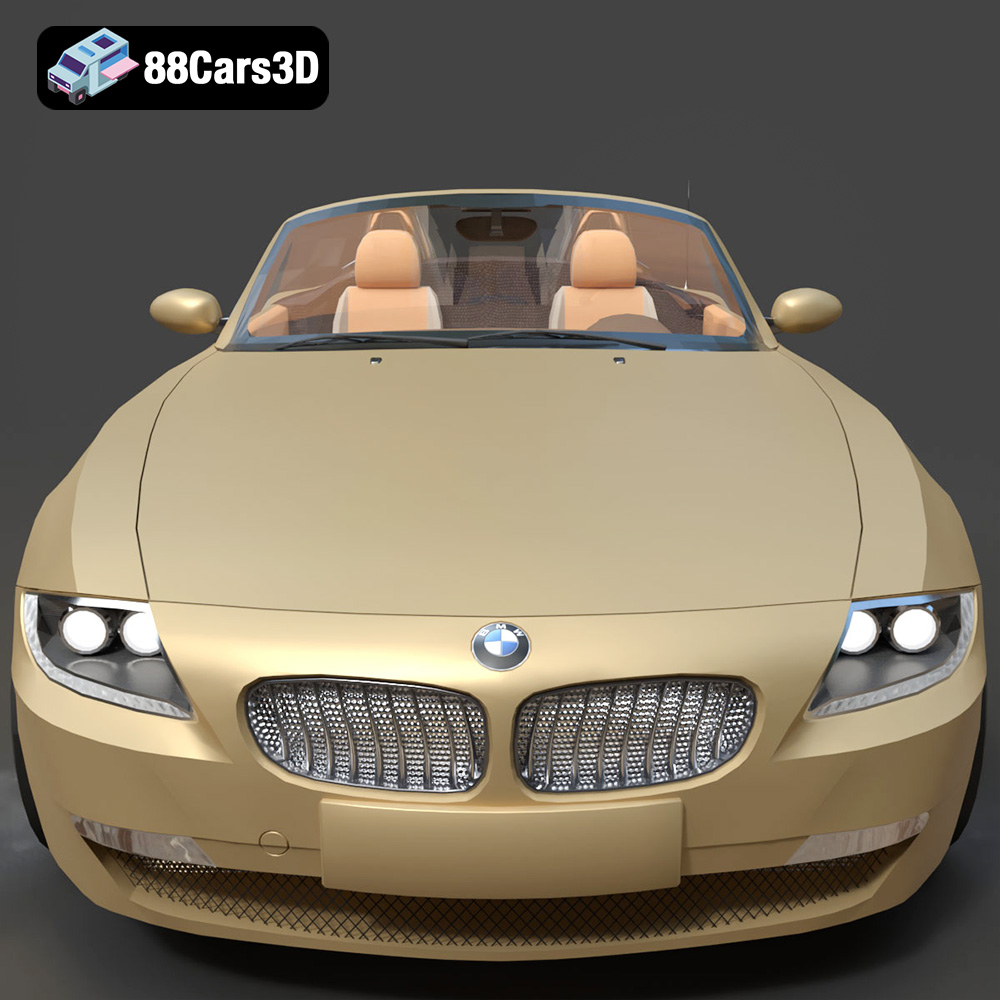
BMW Z4 E85 2005 3D Model
Capture the essence of German engineering with the highly detailed BMW Z4 E85 2005 3D Model. This meticulously crafted digital asset accurately represents the iconic roadster, offering unparalleled visual fidelity for professional projects. The model maintains true-to-life proportions and surface definition, making it ideal for close-up renders and detailed animations.This professional asset features clean, optimized geometry suitable for demanding production pipelines. All components, including the exterior body panels, wheels, and detailed interior, utilize realistic materials and textures to ensure immediate usability in any rendering environment. The model is built with efficiency and accuracy in mind, simplifying the integration process for designers and developers.The BMW Z4 E85 model is designed for versatile use across multiple industries. It serves as an excellent foundation for real-time game development (Unreal Engine, Unity), architectural visualization (arch-viz), automotive marketing content, interactive AR/VR experiences, and cinematic rendering projects. Its robust structure ensures reliable performance in both static renders and dynamic simulations.
$13.99
Product Image Gallery



Related Tags
.arvr
.blend
.bmw
.bmwz4
.car3dmodel
.convertible
.e85
.fbx
.gameasset
.glb
.max
.obj
.ply
.rendering
.roadster
.simulation
.sportsCar
.stl
.unreal
.z4
