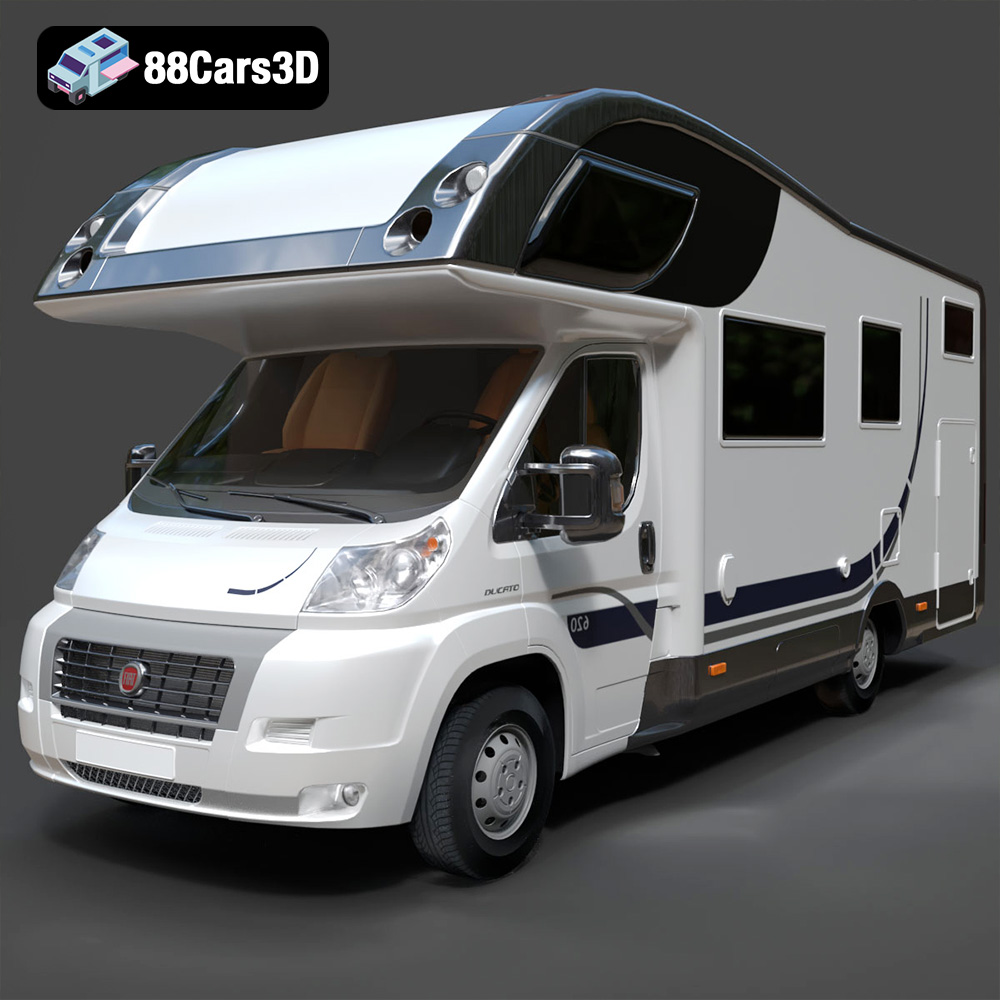
Fiat Ducato Mc Louis Tandy 620-007 3D Model – Unlocking Creative Potential: The Versatility of High-Quality 3D Vehicle Models

Unlocking Creative Potential: The Versatility of High-Quality 3D Vehicle Models
In the dynamic worlds of digital design, entertainment, and engineering, the demand for high-fidelity 3D assets continues to surge. From crafting breathtaking cinematic sequences to building immersive virtual worlds and even prototyping physical products, a meticulously designed 3D model is the bedrock of any successful project. For automotive enthusiasts, game developers, architectural visualization artists, and simulation engineers, vehicles represent a unique challenge and opportunity. They are complex machines, demanding intricate detail, accurate proportions, and robust technical construction to truly shine.
Today, we delve into the comprehensive capabilities and technical advantages offered by premium 3D vehicle assets, exemplified by a standout model available on 88cars3d.com: the Fiat Ducato Mc Louis Tandy 620-007 3D Model. This particular model isn’t just a digital representation; it’s a testament to the precision and versatility required in modern 3D workflows, designed to empower professionals across a spectrum of industries. It promises clean geometry, balanced detailing, and an array of features that make it ideal for everything from photorealistic renders to real-time interactive experiences.
Understanding 3D Model File Formats
The choice of file format for a 3D model is paramount, dictating its compatibility, features, and optimal use cases across different software and pipelines. Understanding these formats is crucial for leveraging assets like the Fiat Ducato Mc Louis Tandy 620-007 3D Model to their fullest potential. Each format serves a specific purpose, offering unique advantages for various stages of a project.
.blend – The Blender Powerhouse
The .blend format is native to Blender, a powerful open-source 3D creation suite. When you acquire a .blend file, you’re not just getting the mesh; you’re often receiving a complete Blender scene. This includes all materials (often PBR setups using Cycles or Eevee), textures, lighting, camera setups, and even animation data if present. For artists working within Blender, this is the most flexible format, allowing for full editability, re-rigging, scene adjustments, and direct rendering without any conversion loss. The Fiat Ducato Mc Louis Tandy 620-007 3D Model in .blend format provides an immediate, production-ready environment for Blender users, ensuring all aspects of the original asset are preserved and accessible.
.fbx – The Industry Standard for Interchange
Autodesk’s .fbx (Filmbox) format has become an unofficial industry standard for exchanging 3D data between different software applications. Its strength lies in its ability to store a wide array of 3D scene elements, including geometry, materials (though material definitions can sometimes be simplified during export/import), textures, lights, cameras, and crucial animation data like skeletal rigs and blend shapes. For game developers and animators, .fbx is indispensable as it provides a robust pipeline for importing complex animated models into game engines like Unreal Engine and Unity, or other DCC (Digital Content Creation) tools such as Maya, 3ds Max, and Cinema 4D. The .fbx version of the Fiat Ducato Mc Louis Tandy 620-007 is perfectly suited for integrating this camper van into real-time environments or complex animation projects, ensuring proper hierarchy and pivot points are maintained.
.obj – Universal Compatibility and Simplicity
The .obj (Wavefront Object) format is one of the oldest and most universally supported 3D file types. Its primary advantage is its simplicity and compatibility; nearly every 3D software can import and export .obj files. However, this simplicity comes with limitations: .obj primarily stores mesh data (vertices, normals, UVs, and faces), along with basic material references (via an accompanying .mtl file). It does not natively support animation, rigging, or advanced material properties. Despite this, .obj remains a go-to for simple geometry exchange or when absolute compatibility across diverse platforms is required. For the Fiat Ducato Mc Louis Tandy 620-007, the .obj file offers a clean, foundational mesh that can be imported into virtually any 3D application for custom material setup and further development.
.glb – Web-Optimized for AR/VR
.glb (GL Transmission Format Binary) is the binary version of glTF, a royalty-free specification for the efficient transmission and loading of 3D scenes and models by applications. Developed by the Khronos Group, glTF is often dubbed the “JPEG of 3D” due to its optimization for web-based, AR, and VR applications. A .glb file packages all necessary data—geometry, materials, textures, animations—into a single, self-contained binary file, making it incredibly easy to share and display across browsers and AR/VR platforms. The Fiat Ducato Mc Louis Tandy 620-007’s .glb format is tailor-made for developers looking to create interactive augmented reality experiences or web-based 3D viewers, allowing users to explore the camper van interactively on a phone or within a browser.
.stl – The Backbone of 3D Printing
The .stl (Stereolithography) format is the de facto standard for 3D printing. It describes only the surface geometry of a 3D object using a collection of interconnected triangles. While extremely efficient for manufacturing processes, .stl files do not contain color, texture, or material information, nor do they support animation or complex hierarchies. For users interested in bringing the Fiat Ducato Mc Louis Tandy 620-007 into the physical realm—whether for prototyping, creating scale models, or educational purposes—the .stl file provides a direct pathway from digital model to physical print. It’s crucial for the model to be “manifold” (watertight) for successful 3D printing, a characteristic usually ensured in professionally prepared assets.
.ply – Precision for Technical Applications
The .ply (Polygon File Format, or Stanford Triangle Format) is another format for storing 3D data, particularly useful in applications requiring precision and comprehensive mesh information, such as 3D scanning, CAD, and scientific analysis. Like .obj, it stores geometric data, but it also supports additional properties like color, transparency, confidence values, and surface normals per vertex or face. This makes it a robust choice for detailed mesh analysis or when integrating models into engineering workflows where exact data is paramount. The .ply version of the Fiat Ducato Mc Louis Tandy 620-007 offers a high-fidelity mesh for technical scrutiny or specialized rendering pipelines that benefit from this richer data set.
.unreal – Native Integration for Real-Time Excellence
The .unreal designation isn’t a standalone file format in the traditional sense, but rather implies a project that has been specifically prepared and configured for direct import and use within Unreal Engine. This often means the asset includes optimized meshes with proper UVs for lightmaps, pre-built material instances using Unreal’s PBR workflow, collision meshes, LODs (Levels of Detail), and potentially even Blueprint integrations for interactive elements. For game developers or real-time visualization artists using Unreal Engine, the .unreal asset of the Fiat Ducato Mc Louis Tandy 620-007 is invaluable, as it significantly reduces setup time and ensures optimal performance and visual quality within the engine’s ecosystem.
.max – 3ds Max: Comprehensive Scene Data
Similar to .blend for Blender, the .max format is native to Autodesk 3ds Max, one of the leading software packages for 3D modeling, animation, and rendering. A .max file contains the entire scene data, including geometry, materials (often V-Ray or Corona setups), textures, lights, cameras, animation paths, modifiers, and scene hierarchy. For professionals relying on 3ds Max for their automotive rendering or animation projects, having the Fiat Ducato Mc Louis Tandy 620-007 in its native .max format ensures complete editability, access to advanced rendering features, and seamless integration into existing 3ds Max pipelines. This provides the highest level of control and flexibility for creating stunning cinematic renders and complex animations.
The provision of such a comprehensive range of formats for the Fiat Ducato Mc Louis Tandy 620-007 3D Model highlights its versatility and professional readiness, accommodating diverse workflows from high-end rendering to game development and 3D printing.
The Art of Automotive Rendering: Bringing the Fiat Ducato to Life
Automotive rendering is a specialized field within 3D visualization, demanding an acute eye for detail, a deep understanding of physics-based rendering (PBR) principles, and mastery over lighting and material properties. The Fiat Ducato Mc Louis Tandy 620-007 3D Model, with its meticulously crafted details, provides an excellent foundation for achieving photorealistic results.
Achieving Photorealism with Advanced Materials and Textures
The journey to photorealism begins with materials. The Fiat Ducato Mc Louis Tandy 620-007 3D Model comes with detailed material definitions for various components, crucial for conveying realism. This includes transparent materials for headlights and taillights, reflective chrome and metal surfaces, rugged rubber for tires with distinct tread patterns, and varied textures for the interior fabrics and dashboard. Leveraging PBR workflows, artists can accurately define properties like albedo (base color), roughness, metallic, normal, and ambient occlusion maps. This ensures that the camper van reacts to light precisely as it would in the real world, whether it’s the subtle sheen of the paintwork or the slight worn texture of the dashboard. The model’s clean quad-dominant topology is vital here, allowing for smooth subdivision and perfect UV mapping, which prevents distortions in texture application and ensures high-quality renders even at close-up.
Mastering Lighting and Environment for Impactful Visuals
Beyond materials, lighting is the single most important factor in transforming a good render into a great one. For the Fiat Ducato, artists can experiment with diverse lighting scenarios: a sunny outdoor scene reflecting a vibrant sky, a moody overcast day, or a dramatic studio setup with controlled highlights and shadows. High Dynamic Range Images (HDRIs) are indispensable for this, providing realistic environmental lighting that captures complex real-world illumination. Combined with physically accurate light sources (area lights, spot lights), HDRIs can create stunning reflections on the camper’s body and glass, defining its form and presence. The Fiat Ducato Mc Louis Tandy 620-007’s accurate real-world scale also ensures that it integrates seamlessly into architectural visualizations or pre-existing environments, with correct proportions relative to surrounding elements like buildings, roads, or natural landscapes.
Workflow Example: High-Quality Renders in 3ds Max/V-Ray
Consider a typical workflow using the .max format of the Fiat Ducato in Autodesk 3ds Max with a powerful renderer like V-Ray or Corona.
- Import and Scene Setup: Load the .max file. The model’s organized hierarchy and proper pivot points (e.g., for doors, wheels) are immediately beneficial, allowing for easy placement and preliminary animation.
- Material Refinement: The included materials serve as an excellent starting point. Artists can further tweak PBR parameters, add dirt or wear layers using blend materials, or apply specific car paint shaders for realistic clear coat effects.
- Lighting and Environment: Drop in an HDRI for global illumination. Supplement with V-Ray lights to emphasize specific features – an area light above for a studio look, or a directional light to simulate sunlight.
- Camera Setup: Compose cinematic shots, utilizing depth of field to draw attention to key areas like the detailed headlights or the interior living space.
- Rendering: Utilize V-Ray’s powerful rendering capabilities for high-resolution output, often leveraging render elements for post-production compositing in software like Photoshop or Nuke, allowing fine-tuning of reflections, shadows, and light passes.
This workflow capitalizes on the model’s professional construction, minimizing setup time and maximizing creative potential for stunning automotive renders.
Driving Immersion: Integrating the Fiat Ducato into Game Development
Game development places unique demands on 3D assets. While visual fidelity is crucial, performance is paramount. The Fiat Ducato Mc Louis Tandy 620-007 3D Model is engineered to meet these challenges, making it a stellar asset for virtual road trips, open-world simulations, or interactive experiences.
Optimizing for Real-time Performance in Unreal Engine
For game engines like Unreal Engine and Unity, optimization is key. While the Fiat Ducato model is high-quality, professional assets often provide options or are structured for optimization. This includes:
- Polycount Management: Clean quad-dominant topology means easier creation of Levels of Detail (LODs). LODs are lower-polygon versions of the model that swap in when the vehicle is further from the camera, significantly improving frame rates without noticeable visual degradation.
- Efficient UV Mapping: The model’s excellent UVs are critical for texture mapping and, more importantly in game engines, for lightmap generation. Proper lightmap UVs ensure static lighting bakes correctly onto the vehicle, adding realism with minimal performance cost.
- PBR Material Workflow: Adhering to PBR (Physically Based Rendering) principles ensures that materials behave realistically under varying lighting conditions in real-time. The .unreal and .fbx formats are designed for seamless integration into Unreal’s material editor, allowing for quick setup of metallic, roughness, and normal maps.
- Collision Meshes: For realistic physics and player interaction, dedicated collision meshes (simpler geometry invisible to the player) are essential. While not always explicit in the product description, professional assets often support or are easily adapted for this.
The .unreal format for the Fiat Ducato is specifically tailored for this, providing an engine-ready asset that streamlines the integration process, allowing developers to focus on gameplay and environment building.
Rigging and Animation for Interactive Experiences
An interactive vehicle needs to move. The Fiat Ducato Mc Louis Tandy 620-007 3D Model features separated components like doors and wheels, with proper pivot points. This significantly simplifies the rigging process for animation:
- Wheel Rotation: Wheels can be easily animated to rotate, turn, and react to terrain.
- Door Functionality: The separated doors can be animated to open and close, crucial for player entry/exit in games or interactive VR experiences.
- Suspension: Basic mechanical components under the chassis, including elements of the engine block and suspension, hint at the possibility of simulating realistic suspension compression and extension.
These features enable developers to create compelling, dynamic game experiences where the camper van isn’t just a static prop but an active, integral part of the virtual world. Imagine a player driving the Fiat Ducato through an open-world adventure, parking it, and then stepping out to explore the meticulously modeled interior.
Crafting Realistic Environments with Game Assets
A high-quality vehicle like the Fiat Ducato doesn’t exist in a vacuum. It demands an equally compelling environment. Game developers can leverage this asset to populate virtual roadsides, campgrounds, or even urban scenarios, adding a layer of realism and narrative depth. The model’s real-world scale and detailed exterior/interior ensure it looks authentic alongside other environmental assets, from trees and rocks to buildings and props. Whether it’s a backdrop in a racing game or a explorable vehicle in an adventure title, the Fiat Ducato Mc Louis Tandy 620-007 3D Model from 88cars3d.com serves as a foundational element for building believable and engaging game worlds.
Beyond Visualization: AR/VR, Simulation, and 3D Printing
The utility of a high-quality 3D model extends far beyond traditional rendering and game development. The Fiat Ducato Mc Louis Tandy 620-007 3D Model, with its diverse file formats and robust construction, is perfectly positioned for a range of innovative applications, from immersive augmented reality to critical simulation and even physical prototyping.
Interactive Exploration in AR/VR with GLB Format
Augmented Reality (AR) and Virtual Reality (VR) are transforming how we interact with digital content. For industries like automotive sales, tourism, or even educational purposes, being able to interactively explore a vehicle is invaluable. The .glb format of the Fiat Ducato Mc Louis Tandy 620-007 3D Model is optimized specifically for these applications.
- Web-based AR/VR: Its single-file, optimized structure makes it ideal for embedding directly into websites, allowing users to spin, zoom, and even place the camper van in their real-world environment via a smartphone or tablet.
- Immersive Experiences: In a VR environment, users could virtually step inside the camper van, explore the detailed living quarters, open doors, and visualize themselves embarking on a virtual road trip. This level of immersion is critical for engaging users and conveying the practical comfort of the vehicle.
- Training and Product Demos: AR/VR applications can use the model for interactive product demonstrations, allowing potential buyers to customize colors and materials in real-time, or for training purposes, teaching users about the layout and features of a camper van without needing a physical prototype.
Simulation and Training Applications
Precision and accuracy are paramount in simulation and training. The Fiat Ducato’s accurate real-world dimensions and detailed mechanical components (even basic ones under the chassis) make it suitable for various simulation contexts:
- Vehicle Dynamics Simulations: While not a full CAD model, the detailed geometry can be used as a visual representation in vehicle dynamics simulations, where its scale and proportion are crucial for accurate visual feedback.
- Driver Training Modules: For training aspiring camper van drivers, the model can be integrated into virtual driving simulators, allowing trainees to familiarize themselves with the cabin layout, visibility, and vehicle dimensions in a safe, controlled environment.
- Logistics and Planning: Companies involved in fleet management or outdoor event planning could use the model to visualize how a camper van fits into a specific space, plan layouts, or simulate vehicle deployment scenarios.
The clean geometry and organized hierarchy of the model also facilitate integration into these more rigorous technical applications.
From Digital Model to Physical Object: 3D Printing Considerations
The bridge between the digital and physical world is 3D printing, and the .stl format of the Fiat Ducato Mc Louis Tandy 620-007 3D Model caters directly to this.
- Prototyping and Scale Models: Artists and engineers can use the .stl file to create physical prototypes, miniature scale models for display, or even functional parts for dioramas.
- Educational Tools: Printed models can serve as tangible educational tools, allowing students to study the form, proportions, and design of the camper van in a hands-on manner.
- Preparation for Print: When preparing for 3D printing, the model’s professional construction (ensuring a “manifold” or watertight mesh) is critical. Artists might need to adjust wall thickness or add support structures depending on the printer and material, but the underlying geometry from the 88cars3d.com model provides a solid foundation.
This multi-faceted utility underscores the immense value of investing in a professionally prepared 3D asset like the Fiat Ducato Mc Louis Tandy 620-007.
Technical Precision and Workflow Advantages of 88cars3d.com Models
The true measure of a professional 3D model lies not just in its visual appeal but in its underlying technical construction. The Fiat Ducato Mc Louis Tandy 620-007 3D Model from 88cars3d.com exemplifies these critical technical advantages, ensuring it’s a valuable asset for any demanding project.
Clean Topology and Real-World Scale
One of the foremost technical advantages is its clean quad-dominant topology. This refers to the underlying mesh structure being primarily composed of four-sided polygons (quads). Why is this important?
- Smooth Subdivision: Quads deform and subdivide (e.g., using a Turbosmooth or Subdivision Surface modifier) much more smoothly than triangles (tris), leading to cleaner, more organic shapes at higher resolutions, crucial for high-quality renders and animations.
- Easier Editing: A quad-based mesh is inherently easier to edit, UV unwrap, and rig, as edge loops flow logically around the model.
- Reduced Artifacts: It minimizes pinching, distortions, and other visual artifacts that can plague models with messy or overly triangular topology, especially during animation or when lights catch complex surfaces.
Furthermore, the model is accurately scaled to real-world dimensions. This is not a minor detail; it’s fundamental for realistic rendering, architectural visualization, and simulation. Objects that are not to scale will interact incorrectly with physics engines, light inaccurately in renderers, and look out of place when composited into photographic backplates or integrated into larger scenes. This precision saves countless hours of adjustment and ensures immediate visual credibility.
Streamlined Customization and Animation Potential
The Fiat Ducato Mc Louis Tandy 620-007 is built for flexibility:
- Organized Hierarchy and Naming: The model boasts an organized hierarchy with logical naming conventions. This means that components like ‘Body_Main’, ‘Wheel_Front_Left’, ‘Door_Cabin_Right’ are clearly identified and parented correctly. This structure is a massive time-saver for animators and artists who need to quickly select and manipulate specific parts.
- Proper Pivot Points: Essential movable parts like doors and wheels have their pivot points set correctly. For instance, a door’s pivot point will be at its hinge, allowing it to swing open naturally with a simple rotation. Without this, an artist would have to manually adjust the pivot for every animated component, a tedious and error-prone process.
- Customization Options: The ability to easily modify paint finishes, add custom graphics, and adjust material properties (metal, chrome, rubber, glass, interior fabrics) directly translates into creative freedom. Artists can quickly reskin the camper van for different scenarios, clients, or visual styles without having to rebuild complex shader networks.
These features contribute to a highly efficient workflow, enabling rapid iteration and customization for diverse project requirements.
The Value Proposition of Professional-Grade Assets
Acquiring a professionally crafted 3D model like the Fiat Ducato Mc Louis Tandy 620-007 from 88cars3d.com represents a significant value proposition. It means:
- Time Savings: Less time spent on modeling, topology cleanup, UV unwrapping, and basic material setup. Artists can jump straight into rendering, animation, or engine integration.
- Consistent Quality: Guaranteed high standards of mesh quality, material definition, and organizational structure, reducing the risk of technical issues downstream.
- Versatility: A single asset capable of serving multiple purposes—from high-fidelity renders to real-time game assets and even 3D prints—maximizes investment.
- Focus on Creativity: By offloading the technical minutiae of asset creation, artists can dedicate more energy to creative aspects like scene composition, lighting design, and storytelling.
In essence, the technical advantages of this model empower professionals to achieve superior results more efficiently, making it an indispensable addition to any 3D asset library.
Conclusion
The world of 3D modeling thrives on precision, versatility, and efficiency. Whether you’re an automotive visualization expert aiming for photorealism, a game developer building interactive experiences, or an innovator exploring the frontiers of AR/VR, the quality of your foundational assets dictates the success of your project. The Fiat Ducato Mc Louis Tandy 620-007 3D Model stands as a prime example of a meticulously crafted asset, designed to meet the rigorous demands of professional workflows across various industries.
Its comprehensive features—from accurate exterior and detailed interior elements to clean quad-dominant topology, real-world scaling, and an organized hierarchy with proper pivot points—ensure it is not merely a visual prop but a robust, production-ready tool. Coupled with its availability in a wide array of optimized file formats, including .blend, .fbx, .obj, .glb, .stl, .ply, .unreal, and .max, this model offers unparalleled compatibility and flexibility for virtually any 3D application.
By investing in such high-quality 3D car models, professionals can significantly streamline their workflows, reduce development time, and elevate the overall impact of their creative and technical endeavors. Explore the potential of premium assets like the Fiat Ducato Mc Louis Tandy 620-007 3D Model and discover a vast array of other exceptional 3D car models at 88cars3d.com, where quality and versatility empower your next project.
Featured 3D Model
Fiat Ducato Mc Louis Tandy 620-007 3D Model
Presenting the Fiat Ducato Mc Louis Tandy 620-007 3D Model, a meticulously crafted digital representation of a popular and versatile camper van. This model captures the essence of mobile living, featuring a practical yet comfortable design ideal for virtual road trips and outdoor scenes. Engineered with clean geometry and balanced detailing, it offers a high-quality asset for professional rendering, immersive animation sequences, detailed simulations, and engaging game development projects.
$19.99
Product Image Gallery