
Generic Bicycle 3D Model – Elevating Digital Realism: The Indispensable Role of High-Quality 3D Models in Modern Pipelines

Elevating Digital Realism: The Indispensable Role of High-Quality 3D Models in Modern Pipelines
In the expansive and ever-evolving landscape of 3D visualization, from cinematic rendering to immersive game environments and cutting-edge AR/VR experiences, the foundation of any successful project lies in the quality of its core assets. A meticulously crafted 3D model isn’t just a collection of polygons; it’s a digital blueprint for realism, performance, and creative flexibility. Professional artists, developers, and designers understand that opting for anything less than top-tier assets can lead to workflow bottlenecks, visual inconsistencies, and ultimately, a compromised final product.
The journey from concept to a polished 3D scene demands not only artistic vision but also technical precision. Every curve, every surface, and every material definition contributes to the perceived authenticity of a digital object. This is particularly true for everyday objects that audiences instinctively recognize, where even minor inaccuracies can break immersion. Take, for instance, a seemingly simple object like a bicycle. Recreating its intricate mechanical features, delicate spokes, and dynamic form with genuine fidelity requires a specialized skill set and a commitment to detail. This is precisely where assets like the Generic Bicycle 3D Model shine, offering a pre-engineered solution that empowers creators to focus on their narrative and design, rather than getting bogged down in the intricacies of model creation from scratch.
Throughout this comprehensive guide, we will delve into the critical aspects of professional 3D asset utilization, exploring the technical nuances, workflow integrations, and diverse applications that high-quality models bring to the table. We’ll examine how precision-engineered assets elevate various digital projects and explore the strategic advantages of leveraging expertly prepared resources, like those found at 88cars3d.com, to streamline production and achieve unparalleled visual results.
Understanding 3D Model File Formats: Choosing the Right Tool for the Job
The world of 3D modeling is rich with a variety of file formats, each serving specific purposes and excelling in different stages of a project pipeline. Understanding these formats is crucial for ensuring compatibility, maintaining data integrity, and optimizing workflows. The Generic Bicycle 3D Model from 88cars3d.com exemplifies a product that anticipates these diverse needs, offering a comprehensive suite of formats to cater to virtually any professional application.
.blend – The Blender Powerhouse
The `.blend` file format is native to Blender, the popular open-source 3D creation suite. When you acquire a `.blend` file, you’re not just getting a mesh; you’re often getting a complete scene, including materials, textures, lighting, cameras, and even animation data. For the Generic Bicycle 3D Model, this means a fully editable Blender project, ready for immediate use. Artists can dive in to modify geometry, adjust material nodes, set up advanced rigs, or integrate the bicycle into a larger Blender-based scene with all its inherent properties and relationships intact. It’s the ultimate format for Blender users seeking maximum flexibility and an uncompromised native experience.
.fbx – The Industry Standard for Interchange
FBX (Filmbox) is arguably the most widely adopted proprietary 3D file format for interchange between various 3D software applications and game engines like Unreal Engine and Unity. Developed by Autodesk, `.fbx` is excellent at preserving animation, rigging, skinning, and material assignments when transferring assets. For the Generic Bicycle 3D Model, the `.fbx` version is meticulously prepared to ensure smooth import into real-time pipelines, making it ideal for game development where optimized meshes and correct pivot points for animation are paramount. Its robust nature makes it a go-to for complex scene transfers.
.obj – The Universal Workhorse
OBJ (or Wavefront OBJ) is a universal, open-standard format that has been a cornerstone of 3D graphics for decades. It stores geometry data (vertices, normals, texture coordinates, faces) and can reference external material files (.mtl) for basic shading information. While `.obj` doesn’t typically store animation or rigging data, its simplicity and widespread support make it compatible with virtually every 3D software package on the market. The `.obj` version of the Generic Bicycle 3D Model ensures cross-software compatibility, offering a robust foundation for artists working across different platforms or needing a clean, unrigged mesh.
.glb – Optimized for Web, AR, and VR
GLB (GL Transmission Format Binary) is a relatively newer format rapidly gaining traction, especially for web-based 3D, Augmented Reality (AR), and Virtual Reality (VR) applications. It’s a binary format that bundles models, materials, textures, and even animation into a single, compact file, making it highly efficient for transmission and loading on various devices and platforms. The `.glb` version of the Generic Bicycle 3D Model is perfect for interactive 3D viewers on websites, AR apps that overlay digital content onto the real world, or light VR experiences where performance and small file size are critical.
.stl – The 3D Printing Standard
STL (STereoLithography) is the de facto standard file format for 3D printing. It represents a 3D model as a series of connected triangles, describing only the surface geometry of an object. The key characteristic of a good `.stl` file is a “watertight” mesh, meaning it has no holes or gaps in its surface, which is essential for successful 3D printing. The Generic Bicycle 3D Model‘s geometry is designed to be watertight, making its `.stl` output directly suitable for physical model production, whether for prototyping or creating intricate miniature replicas.
.ply – Precision Mesh for Analysis
PLY (Polygon File Format, also Stanford Triangle Format) is another format for storing 3D data, particularly useful for scanned data and academic research. It can store a wider range of properties than `.stl`, including color, transparency, texture coordinates, and normal vectors, either per vertex or per face. While less common for general asset distribution, the `.ply` version of the Generic Bicycle 3D Model would be beneficial for applications requiring precise mesh analysis, CAD integration, or specific data visualization tools where detailed surface information is critical.
.unreal – Engine-Ready for Real-Time
The `.unreal` format typically refers to asset configurations and packages directly prepared for Unreal Engine. This isn’t a single file like `.fbx`, but rather a collection of files and settings, often including a `.uasset` file, textures, materials, and sometimes even blueprint setups, all optimized and ready to drop into an Unreal project. The Generic Bicycle 3D Model supplied in this format means it comes pre-configured with Unreal-specific materials, collision meshes, and LODs (Levels of Detail), significantly reducing setup time for game developers and real-time visualization specialists within the Unreal ecosystem.
.max – The 3ds Max Native Experience
Similar to `.blend` for Blender, `.max` is the native file format for Autodesk 3ds Max, a powerful and widely used software for 3D modeling, animation, and rendering. The `.max` file of the Generic Bicycle 3D Model provides the complete 3ds Max scene, including all modifiers, lights, cameras, and render settings. This offers 3ds Max users full control over the asset, allowing for complex animation rigging, high-fidelity V-Ray or Corona renders, and seamless integration into existing 3ds Max projects without any loss of data or needing to re-establish material networks.
The Art of Crafting High-Fidelity 3D Assets: Beyond the Polygonal Count
Creating a truly high-quality 3D model involves a delicate balance of artistic vision and rigorous technical execution. It’s far more than just sculpting a recognizable form; it’s about building an asset that is robust, versatile, and performant across a multitude of applications. The Generic Bicycle 3D Model exemplifies these principles through its meticulous construction.
Optimized Topology and Mesh Quality
At the core of any professional 3D asset lies its topology – the arrangement of vertices, edges, and faces that define the model’s surface. The Generic Bicycle 3D Model boasts a clean, quad-dominant topology. This is crucial for several reasons:
- Smooth Subdivision: Quad-based meshes deform much more predictably and cleanly when subdivided (e.g., using a Subdivision Surface modifier in Blender or Turbosmooth in 3ds Max), allowing for smooth, high-resolution renders without introducing artifacts.
- Animation Readiness: Good topology ensures that the mesh deforms naturally during animation, preventing pinching or undesirable stretching, especially around areas like the chain and brake mechanisms that undergo complex movements.
- Ease of Modification: A clean edge flow makes it significantly easier for artists to select, manipulate, or sculpt specific areas of the model without affecting unintended parts. This is vital for customization, such as altering the frame design or adding unique components.
Furthermore, the model’s optimized mesh quality ensures efficient performance. This means achieving visual fidelity without excessive polygon counts that could bog down real-time engines. It’s a testament to skilled modeling, knowing where to add detail and where to simplify.
Material Definition and UV Unwrapping Precision
Visual realism is largely conveyed through materials and textures. The Generic Bicycle 3D Model includes high-quality material definitions for its metal, rubber, and plastic components. This isn’t just about color; it involves sophisticated shader networks that define reflections, refractions, roughness, and other physical properties that mimic real-world materials.
Integral to effective material application is precise UV unwrapping. UVs are 2D coordinates that map a 3D model’s surface to a 2D texture map. A well-unwrapped model:
- Prevents Texture Distortion: Ensures textures, such as intricate frame decals or tire treads, appear without stretching or blurring.
- Maximizes Texture Resolution: Allocates appropriate UV space to critical areas, allowing for higher detail where it matters most.
- Facilitates Customization: Clean UV layouts make it straightforward to create and apply custom paint finishes, graphics, or weathered effects without needing to re-unwrap the model.
The separation of major components in the bicycle model further enhances material application and customization, allowing artists to individually adjust properties for each part – perhaps a glossy metallic frame, a matte rubber tire, and a subtly worn leather seat.
Seamless Integration: Professional Workflows with the Generic Bicycle 3D Model
One of the primary advantages of a professionally prepared asset like the Generic Bicycle 3D Model is its ability to drop into diverse professional workflows with minimal friction. This eliminates the time-consuming process of correcting scale, fixing pivot points, or rebuilding materials, allowing artists and developers to maintain their focus on creative execution.
Integrating into 3ds Max for High-Fidelity Rendering and Animation
For 3ds Max users, the inclusion of a native `.max` file is invaluable. When opened, the Generic Bicycle 3D Model appears with its logically organized hierarchy, properly set pivot points for all movable parts (wheels, handlebars, pedals), and pre-defined materials. This significantly speeds up setup for complex scenes.
- Architectural Visualization: Imagine integrating the bicycle into an arch-viz scene of a bustling city street or a modern home’s garage. With the model correctly scaled to real-world dimensions, it seamlessly blends with other elements. Artists can quickly adjust V-Ray or Corona materials to match specific lighting conditions, perhaps adding subtle dust or reflective properties to the frame to enhance realism in an exterior rendering.
- Product Rendering: For a marketing campaign focusing on urban mobility, the bicycle can be positioned in a studio lighting setup. Its clean topology allows for smooth subdivisions, resulting in pristine, close-up renders that highlight its detailed frame structure and mechanical components. With pivot points already set, animating the wheels or handlebars for a promotional video becomes a straightforward process, ready for advanced rigging workflows.
Leveraging Blender for Customization and Scene Assembly
The `.blend` file for the Generic Bicycle 3D Model provides a native Blender experience, offering full control over the asset. Blender’s powerful non-destructive modifiers and node-based material system can be fully exploited.
- Customization and Texturing: Artists can easily modify paint finishes, adding custom graphics or decals to the frame using Blender’s UV editing and texture painting tools. The separate components (frame, wheels, seat) make it simple to apply different material variations – perhaps a carbon fiber texture for the frame, distressed leather for the seat, or chrome accents on the spokes.
- Short Film Production: For independent animators or small studios, integrating the bicycle into a short film environment is effortless. Its animation readiness means character rigs can be quickly linked, and the bicycle can be animated along paths or with inverse kinematics for realistic motion sequences, all within Blender’s comprehensive animation toolset.
Preparing for Unreal Engine: Game-Ready Asset Pipeline
The `.fbx` and `.unreal` formats are critical for game developers. The `.fbx` file, designed for real-time pipelines, ensures the model imports cleanly with correct transforms and potentially basic materials, ready for further setup in Unreal Engine.
- Game Asset Integration: Developers can import the Generic Bicycle 3D Model into Unreal Engine, where its optimized mesh quality ensures efficient performance even in densely populated open-world games. The pre-set pivot points are crucial for setting up physics assets or simple animations for interactive elements, such as a player character mounting the bicycle or it being dynamically placed within a level. The `.unreal` package further streamlines this, providing a ready-to-use asset with appropriate materials, collision, and LODs configured for the engine.
- Real-time Architectural Walkthroughs: For architects looking to add life to their virtual walkthroughs, placing the bicycle alongside a building creates a sense of scale and realism. Its game-ready optimization ensures smooth framerates, even in interactive, ray-traced environments, without compromising visual fidelity.
Beyond Visualization: Real-World Applications of the Generic Bicycle 3D Model
The utility of a meticulously crafted 3D asset like the Generic Bicycle 3D Model extends far beyond static renders or cinematic sequences. Its robust construction and versatile file format support unlock a myriad of applications in diverse industries, from interactive experiences to physical manufacturing.
Game Development: Enhancing Immersive Worlds
In the competitive realm of game development, realistic and optimized assets are paramount. The Generic Bicycle 3D Model serves as an exceptional game-ready asset. Its clean, optimized geometry ensures low draw calls and efficient rendering, crucial for maintaining high framerates in demanding open-world games or racing simulations. The logically organized hierarchy and properly set pivot points are invaluable for rigging the bicycle for player characters, NPCs, or even as dynamic environmental props. Imagine a player character freely cycling through a sprawling urban environment, or bicycles realistically populating a virtual city street, adding layers of immersion that are difficult to achieve with generic or low-quality assets. The included .fbx and .unreal formats are specifically tailored for this purpose, drastically reducing development time and ensuring seamless integration into game engines.
AR/VR Experiences: Bridging the Digital and Physical Divide
Augmented Reality (AR) and Virtual Reality (VR) applications demand highly optimized and realistic 3D models to create convincing immersive experiences. The Generic Bicycle 3D Model, with its balanced detailing and efficient mesh, is an excellent candidate for these platforms. The .glb format, specifically designed for web-based and mobile AR/VR, facilitates quick loading and smooth interaction. Developers can use this model to:
- Virtual Product Showcases: Allow potential customers to “see” a virtual bicycle in their driveway via an AR app, assessing its size and appearance in a real-world context.
- Interactive VR Training: Create virtual cycling simulations for training purposes, perhaps teaching safe riding techniques in a simulated urban environment.
- Immersive Storytelling: Populate VR environments with realistic bicycles to enhance narrative depth and environmental realism in interactive stories or virtual tours.
The model’s accuracy and realism are key to preventing the “uncanny valley” effect often seen with lower-quality assets in AR/VR.
Simulation and Training: Fostering Practical Learning
High-fidelity 3D models are increasingly vital in simulation and training platforms. Whether for urban planning, safety simulations, or educational tools, accuracy and detail are non-negotiable. The Generic Bicycle 3D Model provides a robust foundation for such applications:
- Bicycle Safety Simulations: Create interactive scenarios where users learn to navigate traffic, understand road signs, and practice defensive cycling techniques using a realistic bicycle model.
- Urban Planning Visualizations: Integrate realistic bicycles into proposed urban layouts to visualize pedestrian and cyclist flow, assess infrastructure impact, and present concepts with greater clarity to stakeholders.
- Mechanical Training: While primarily an exterior model, its detailed drivetrain and brake mechanisms can be used for conceptual mechanical training, allowing students to understand how components interact in a virtual environment.
3D Printing: From Digital Asset to Physical Object
The journey of a 3D model can culminate in a tangible, physical object through 3D printing. The Generic Bicycle 3D Model is designed with this potential in mind. Its geometry is watertight, a critical requirement for successful 3D printing, ensuring that the `.stl` output will produce a solid, printable object without errors. Artists and engineers can:
- Create Physical Prototypes: Rapidly prototype miniature versions of urban furniture or architectural models featuring bicycles.
- Produce Collectible Figurines: Fabricate highly detailed scale models for enthusiasts or collectors.
- Educational Aids: Print tactile models to aid in design education or mechanical studies.
The ability to transition effortlessly from a digital asset to a physical one underscores the model’s versatility and professional-grade construction.
The 88cars3d.com Advantage: Why Quality Matters for Your Project
In a saturated market of digital assets, discerning creators understand that true value lies in quality, precision, and efficiency. 88cars3d.com distinguishes itself by offering meticulously crafted 3D models that meet the rigorous demands of professional production pipelines. The Generic Bicycle 3D Model is a prime example of this commitment to excellence.
Every asset available on 88cars3d.com is developed with an unwavering focus on clean topology, accurate scaling, and robust material definitions. This attention to detail means that when you acquire a model, you’re not just purchasing polygons; you’re investing in a ready-to-use solution that saves invaluable production time. Artists and developers are freed from the tedious task of correcting messy geometry, re-unwrapping UVs, or rebuilding complex material networks from scratch. This allows them to allocate their resources and creativity to what truly matters: storytelling, design refinement, and project innovation.
The extensive file format support, as demonstrated by the Generic Bicycle 3D Model‘s offerings (from .blend and .max for native editing to .fbx and .unreal for real-time, and .glb for web/AR/VR), ensures unparalleled compatibility across the industry’s leading software and engines. This foresight in asset preparation is a cornerstone of the 88cars3d.com philosophy, providing a seamless experience regardless of your chosen workflow. For any project demanding high-quality 3D car models or other vehicle assets, 88cars3d.com stands as a reliable source for professional-grade assets that deliver on performance and visual fidelity.
Conclusion: Empowering Creativity with Superior 3D Assets
The journey through the world of professional 3D asset utilization reveals a clear truth: the quality of your foundational models directly impacts the efficiency, realism, and ultimate success of your digital projects. From the meticulous crafting of optimized topology and precise UVs to the strategic selection of appropriate file formats for diverse applications, every technical detail plays a pivotal role. Whether you are an architectural visualizer aiming for photorealism, a game developer striving for immersive gameplay, an AR/VR creator building interactive experiences, or a designer preparing for 3D printing, the demands for high-fidelity assets are universal.
The Generic Bicycle 3D Model serves as an exemplary case study, embodying the blend of artistic craftsmanship and technical expertise required for modern 3D pipelines. Its clean geometry, real-world scaling, properly set pivot points, and comprehensive file format support ensure it’s not just a model, but a versatile tool ready to elevate any project. By leveraging such expertly prepared assets, creators can circumvent the significant time and effort involved in modeling from the ground up, redirecting their energy towards innovation and creative refinement.
Ultimately, investing in high-quality 3D models from trusted sources like 88cars3d.com is a strategic decision that empowers artists and developers to achieve their creative visions with greater efficiency and unparalleled visual fidelity. It’s about building better worlds, telling richer stories, and delivering more compelling experiences. The future of 3D is dynamic and demanding, and with the right assets, you are perfectly positioned to meet its challenges and opportunities.
Featured 3D Model
Generic Bicycle 3D Model
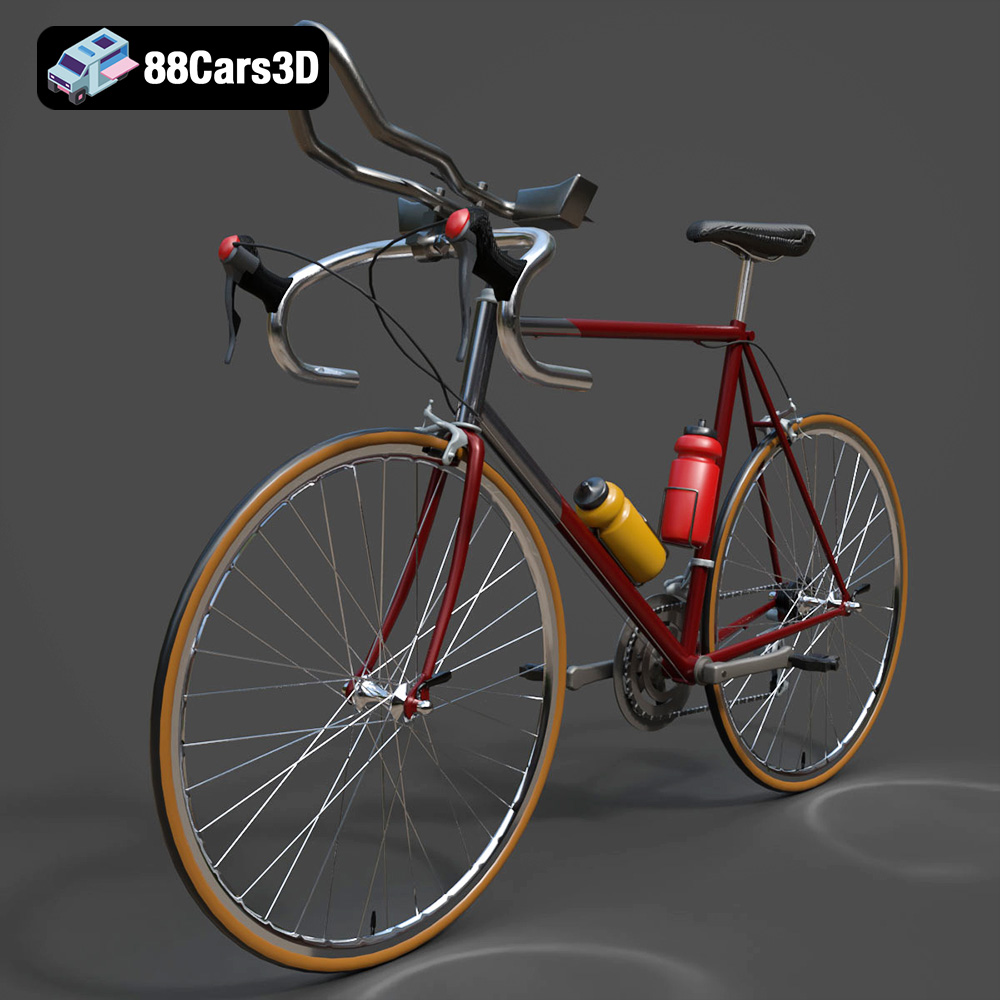
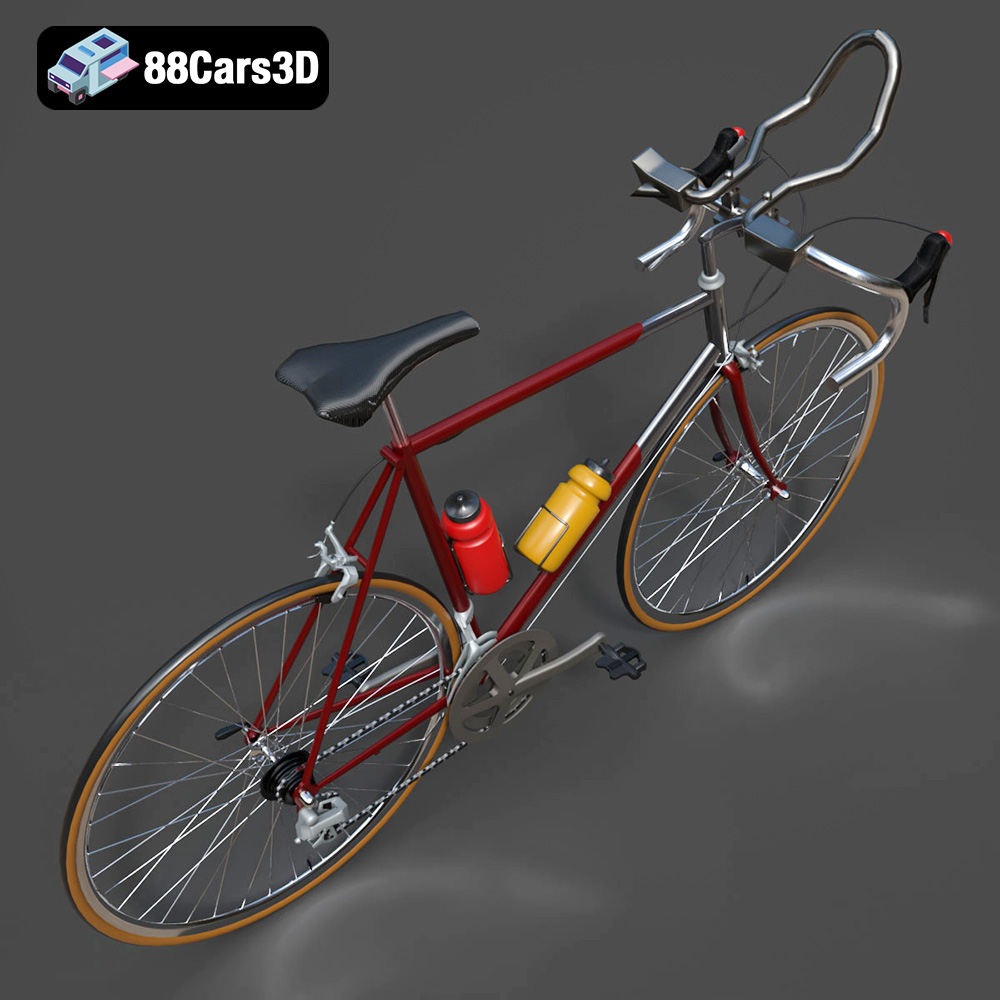
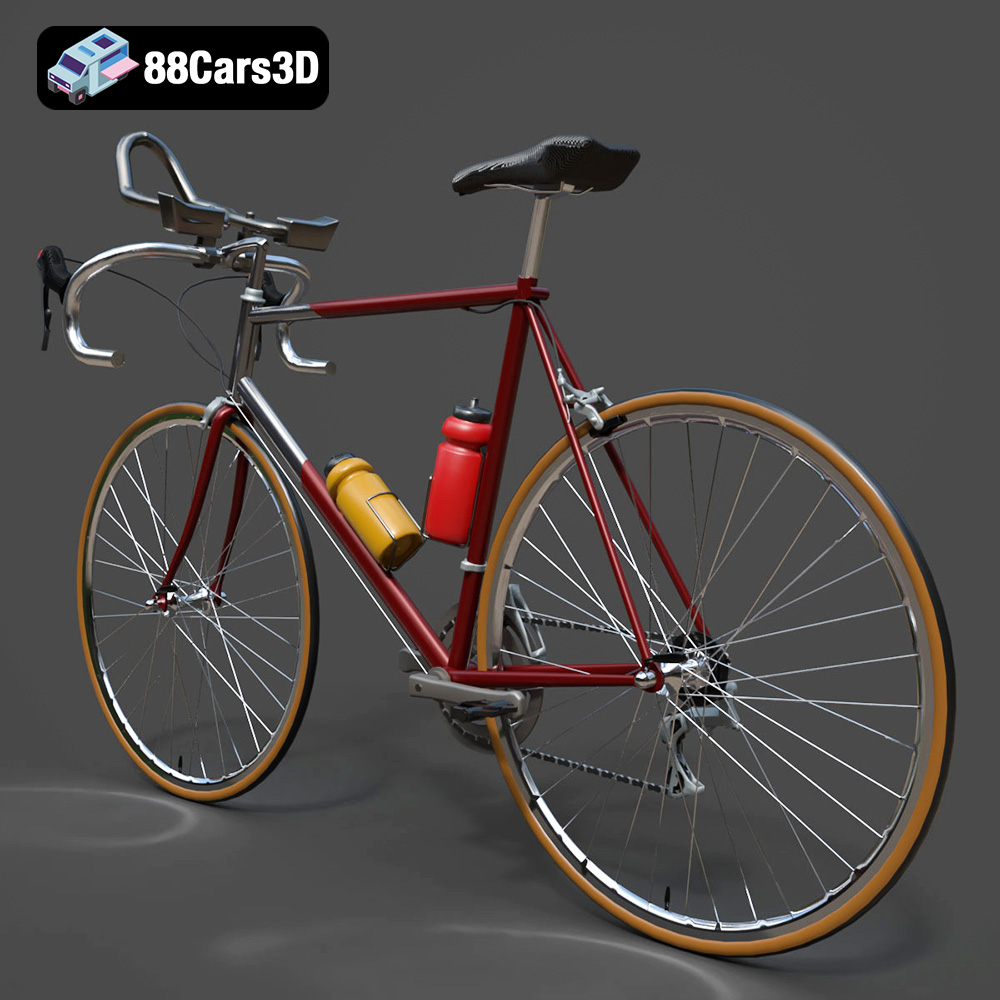
Presenting the high-quality Generic Bicycle 3D Model, a meticulously crafted digital asset designed for exceptional realism and performance. This model accurately represents a modern bicycle, featuring a clean, optimized geometry and balanced detailing across all components. Ideal for a wide range of applications, including high-fidelity rendering, detailed animations, realistic simulations, and robust game development.
Exterior Features:
- Detailed frame structure
- Fully modeled wheels with spokes, tires, and hubs
- Handlebars with grips and brake levers
- Pedals with treads
- Functional chain and gear system
- Comfortable seat design
- Accurate brake calipers and cables
- High-quality material definitions for metal, rubber, and plastic components
- All major components are separated for ease of animation and customization
Interior / Mechanical Features:
- Intricately modeled drivetrain, including chain, front and rear sprockets, and pedal cranks
- Detailed brake mechanisms
- Optimized mesh quality ensures efficient performance in real-time applications without sacrificing visual fidelity
- No interior elements as this is an exterior vehicle model
Technical Advantages:
- Clean, quad-dominant topology for smooth subdivision and easy modifications
- Accurately scaled to real-world dimensions for seamless integration into existing scenes
- Logically organized hierarchy with properly set pivot points for all movable parts (wheels, handlebars, pedals)
- Ready for advanced rigging and animation workflows
Applications:
- Rendering & Visualization: Perfect for studio renders, architectural visualizations, urban scene dressing, and cinematic sequences.
- Game Development: Optimized as a game-ready asset for open-world games, racing simulations, and interactive experiences.
- AR/VR: Excellent for immersive augmented and virtual reality applications, providing realistic virtual objects.
- Simulation & Training: Suitable for bicycle safety simulations, urban planning, and educational tools.
- 3D Printing: Geometry is watertight and can be easily converted to .stl for physical model production.
Customization Options:
- Easily modify paint finishes and add custom graphics or decals to the frame.
- Adjust material properties for different components (e.g., polished chrome, matte black rubber, various seat textures).
- Integrate into diverse lighting setups to achieve desired visual moods and realism.
The Generic Bicycle 3D Model offers unparalleled quality and versatility for any project requiring a realistic and highly detailed bicycle. Its professional construction and extensive file format support make it an indispensable asset for artists, developers, and designers.
Included File Formats:
- .blend – Blender project with materials
- .fbx – Compatible with Unreal, Unity, and major 3D engines
- .obj – Universal format for nearly all 3D software
- .glb – Optimized for AR, VR, and web-based visualization
- .stl – Ready for 3D printing
- .ply – Mesh format for analysis and CAD workflows
- .unreal – Unreal Engine project setup
- .max – Editable 3ds Max scene for rendering and animation
$19.99
Product Image Gallery



Related Tags
.generic.bicycle.bike.vehicle.transport.twowheeler.rendering.simulation.gameasset.arvr.blend.fbx.obj.glb.stl.ply.unreal.max
