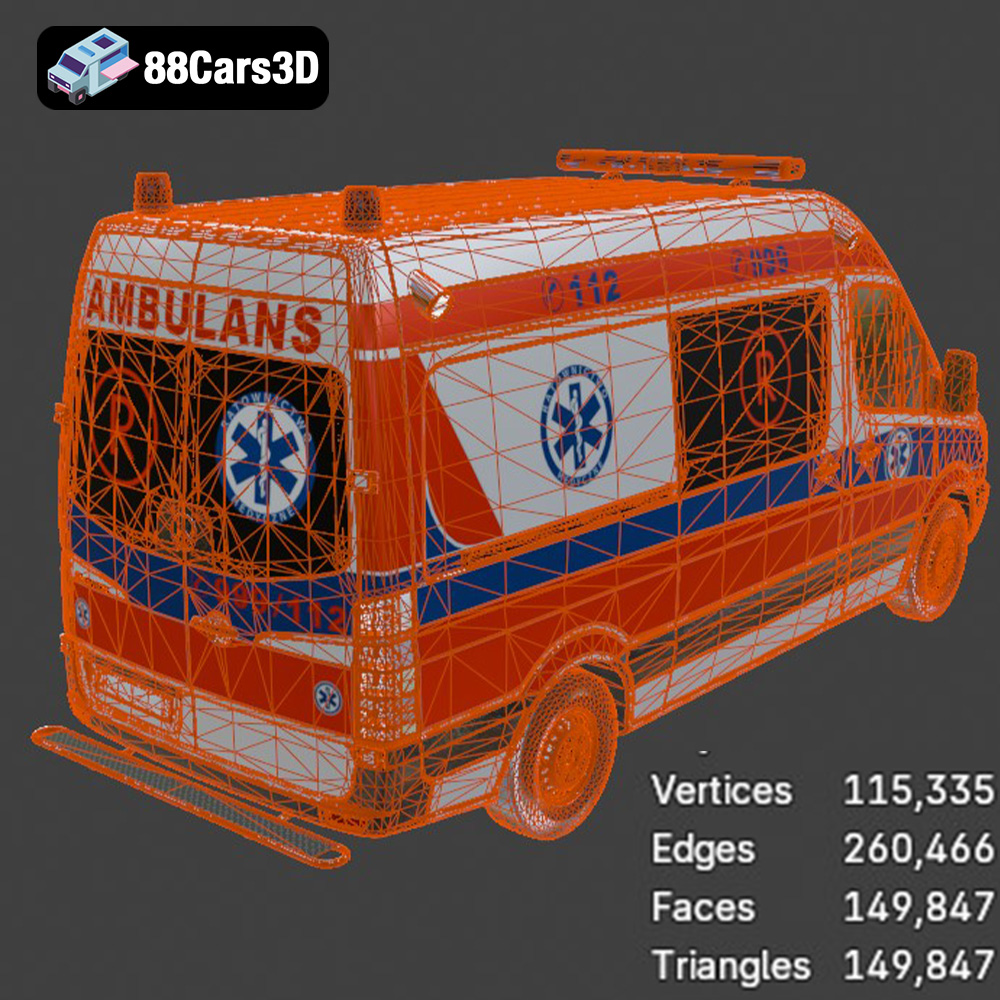
Mercedes-Benz Sprinter Ambulance 3D Model – The Heartbeat of Digital Realism: Elevating Projects with Professional 3D Car Models

The Heartbeat of Digital Realism: Elevating Projects with Professional 3D Car Models
In the dynamic worlds of automotive rendering, game development, and advanced simulation, the quality of 3D assets is paramount. A meticulously crafted 3D model doesn’t just fill a scene; it breathes life into it, conveying detail, purpose, and a sense of tangible realism. Whether you’re a visualization artist aiming for photorealism, a game developer building an immersive open world, or a simulation engineer creating a training environment, the demand for high-fidelity, production-ready assets is constant.
Emergency vehicles, in particular, require a unique level of precision. They are not merely objects but symbols of urgency and critical function. Capturing their distinct characteristics, from the intricate light bars to the functional interiors, is essential for authenticity. This is where specialized assets truly shine. Today, we’ll delve into the profound impact of professional-grade 3D car models, with a spotlight on an exceptional example: the Mercedes-Benz Sprinter Ambulance 3D Model available on 88cars3d.com. This asset exemplifies the blend of technical excellence and artistic integrity required to elevate any digital project.
Understanding 3D Model File Formats: The Backbone of Your Workflow
The choice of a 3D model file format is far more than a mere technicality; it’s a critical decision that dictates compatibility, performance, and workflow efficiency across diverse digital projects. Professional artists and developers need a clear understanding of each format’s strengths and ideal applications. The Mercedes-Benz Sprinter Ambulance 3D model, for instance, comes equipped with a comprehensive suite of file formats, ensuring maximum flexibility for any pipeline. Let’s explore these essential formats in detail.
.blend – The Blender Powerhouse
The .blend format is native to Blender, the powerful open-source 3D creation suite. When you receive a .blend file, you’re getting a complete Blender scene, often including not just the model mesh, but also materials, textures, lighting setups, cameras, and even animation data. This makes it an incredibly versatile format for users already working within the Blender ecosystem. Artists can dive straight into editing, re-texturing, rigging, or animating the Mercedes-Benz Sprinter Ambulance with all its existing scene data intact. Its strengths lie in preserving all aspects of the original project, allowing for deep customization and iteration within a single, integrated environment.
.fbx – The Industry’s Exchange Standard
.fbx (Filmbox) is arguably the most widely adopted proprietary file format for 3D content exchange, developed by Autodesk. It excels at transferring 3D models, animation, and various scene data between different 3D software applications and game engines like Unreal Engine and Unity. Its robust support for geometry, materials, skeletons, blend shapes, and cameras makes it an indispensable tool in pipelines where multiple software packages are used. For game developers using the Mercedes-Benz Sprinter Ambulance, an .fbx file ensures that the model’s mesh, UVs, and basic material assignments are readily importable, providing a solid foundation for real-time optimization and integration. While highly compatible, users should always check import settings to ensure all desired data is correctly transferred.
.obj – The Universal Geometry Carrier
The .obj (Wavefront OBJ) format is a universal, open-standard format primarily used for transferring 3D geometry data. It stores vertex positions, UV coordinates, normals, and material group information. While it doesn’t natively support animation, rigging, or advanced material properties beyond basic color and texture maps (often referenced via an accompanying .mtl file), its simplicity and widespread compatibility make it a reliable choice for mesh exchange. Almost every 3D software can import and export .obj files, making the Mercedes-Benz Sprinter Ambulance in this format accessible to virtually any artist, regardless of their preferred software. It’s excellent for clean mesh transfer or as a fallback when other formats fail.
.glb – Optimized for AR, VR, and Web
.glb (GL Transmission Format Binary) is a relatively newer format, rapidly gaining traction for its efficiency and optimization for web-based 3D, augmented reality (AR), and virtual reality (VR) applications. It’s a binary container that bundles 3D models, textures, animations, and other scene data into a single, self-contained file. This means faster loading times and easier distribution compared to formats that require external texture files. The .glb version of the Mercedes-Benz Sprinter Ambulance 3D model is perfect for interactive product viewers on websites, AR experiences on mobile devices, or lightweight VR simulations, offering a streamlined asset for highly optimized environments.
.stl – The 3D Printing Standard
.stl (STereoLithography) is the de facto standard for 3D printing. This format represents a 3D model as a series of connected triangles, describing only the surface geometry without color, texture, or internal structure. Its simplicity makes it ideal for rapid prototyping and physical model production. While the Mercedes-Benz Sprinter Ambulance model isn’t designed *solely* for 3D printing, providing it in .stl format means designers can easily convert it for physical fabrication, creating scale models or prototypes, demonstrating its versatility beyond digital screens.
.ply – Precision Mesh for CAD or Analysis
The .ply (Polygon File Format or Stanford Triangle Format) is a versatile format for storing 3D data from 3D scanners, CAD software, and other sources. It can store a variety of properties beyond geometry, including color, transparency, surface normals, and even data reliability for each vertex. It supports both triangular and polygonal faces. For the Mercedes-Benz Sprinter Ambulance, the .ply format offers a precision mesh representation that can be valuable for engineering analysis, reverse engineering workflows, or integration into CAD-centric environments where detailed geometric data is paramount, offering a slightly more comprehensive dataset than .obj for certain technical applications.
.unreal – Engine-Ready Asset for Real-time Environments
The .unreal format signifies an asset pre-configured or optimized for direct import and use within Unreal Engine. This often means the asset has been exported with specific settings, naming conventions, or even includes an existing Unreal project setup. For the Mercedes-Benz Sprinter Ambulance, an .unreal file or project setup streamlines the integration process, potentially including pre-configured materials, textures, and even basic collision meshes, saving significant setup time for game developers aiming for peak performance and visual quality within Epic’s powerful engine.
.max – The 3ds Max Project
Finally, the .max format is the native file type for Autodesk 3ds Max, a leading software for 3D modeling, animation, and rendering. Like .blend, a .max file contains the entire scene data, including geometry, materials, textures, lighting, cameras, animation, and scene hierarchy. It’s the ultimate format for users deep within the 3ds Max ecosystem, offering full editability and control over every aspect of the Mercedes-Benz Sprinter Ambulance model. This is ideal for high-end cinematic rendering, architectural visualization integrations, or complex animation sequences where 3ds Max’s robust tools are essential.
Having access to the Mercedes-Benz Sprinter Ambulance 3D model in this array of formats from 88cars3d.com ensures that professionals can seamlessly integrate it into virtually any pipeline, from the most demanding rendering farm to the latest AR application, without compromise.
The Foundation of Digital Realism: Why High-Quality 3D Car Models Matter
In every facet of digital creation, from blockbuster movies to interactive training modules, realism is often the ultimate goal. For automotive subjects, this quest for authenticity is intensified. A high-quality 3D car model is more than just a visual prop; it’s a meticulously engineered digital twin that can tell a story, evoke emotion, or provide critical information. The Mercedes-Benz Sprinter Ambulance 3D model exemplifies this principle, standing as a testament to what professional-grade assets can achieve.
Precision in Automotive Rendering: Crafting Photorealism
Photorealistic rendering demands unparalleled detail and accuracy. A poorly modeled car, even with the best textures and lighting, will always betray its artificiality. High-quality 3D car models feature clean, quad-dominant topology, which is crucial for smooth subdivision and deformation, preventing unsightly pinching or artifacts. This ensures that every curve of the Mercedes-Benz Sprinter Ambulance’s bodywork, every seam, and every intricate component renders flawlessly. Accurate UV mapping, properly organized material IDs, and real-world scale are non-negotiable for achieving cinematic-level visuals in advertising, film, or architectural visualization projects where an emergency vehicle might be featured prominently.
Beyond geometry, materials play a vital role. Professional models come with carefully set up materials that simulate real-world physics – the metallic glint of the paint, the reflectivity of glass, the subtle imperfections of rubber. These elements, combined with advanced rendering engines, transform a digital mesh into a compelling, believable vehicle.
Game-Ready Assets: Balancing Detail and Performance
For game developers, the challenge is to strike a delicate balance between visual fidelity and real-time performance. Game engines like Unreal and Unity demand optimized assets that maintain a high level of detail without bogging down frame rates. A well-constructed 3D car model, such as the Mercedes-Benz Sprinter Ambulance, provides this equilibrium. It features optimized mesh quality, ensuring efficient rendering while still offering the visual richness required for immersive gameplay.
This optimization often involves strategic poly-count management, efficient UV layouts for texture atlases, and the potential for multiple Levels of Detail (LODs) that swap out meshes based on camera distance. These technical considerations mean that the ambulance can look fantastic up close in a cinematic cutscene and still perform flawlessly when seen from a distance in a fast-paced open-world environment. The inclusion of a dedicated .unreal file or .fbx optimized for game engines underscores its readiness for demanding real-time applications.
Deep Dive into the Mercedes-Benz Sprinter Ambulance 3D Model’s Craftsmanship
The Mercedes-Benz Sprinter Ambulance 3D model from 88cars3d.com is a prime example of expert craftsmanship, designed to meet the rigorous demands of professional production. Every element, from its outer shell to its intricate interior, has been thoughtfully constructed to offer both aesthetic appeal and technical flexibility.
Exterior Authenticity and Detail
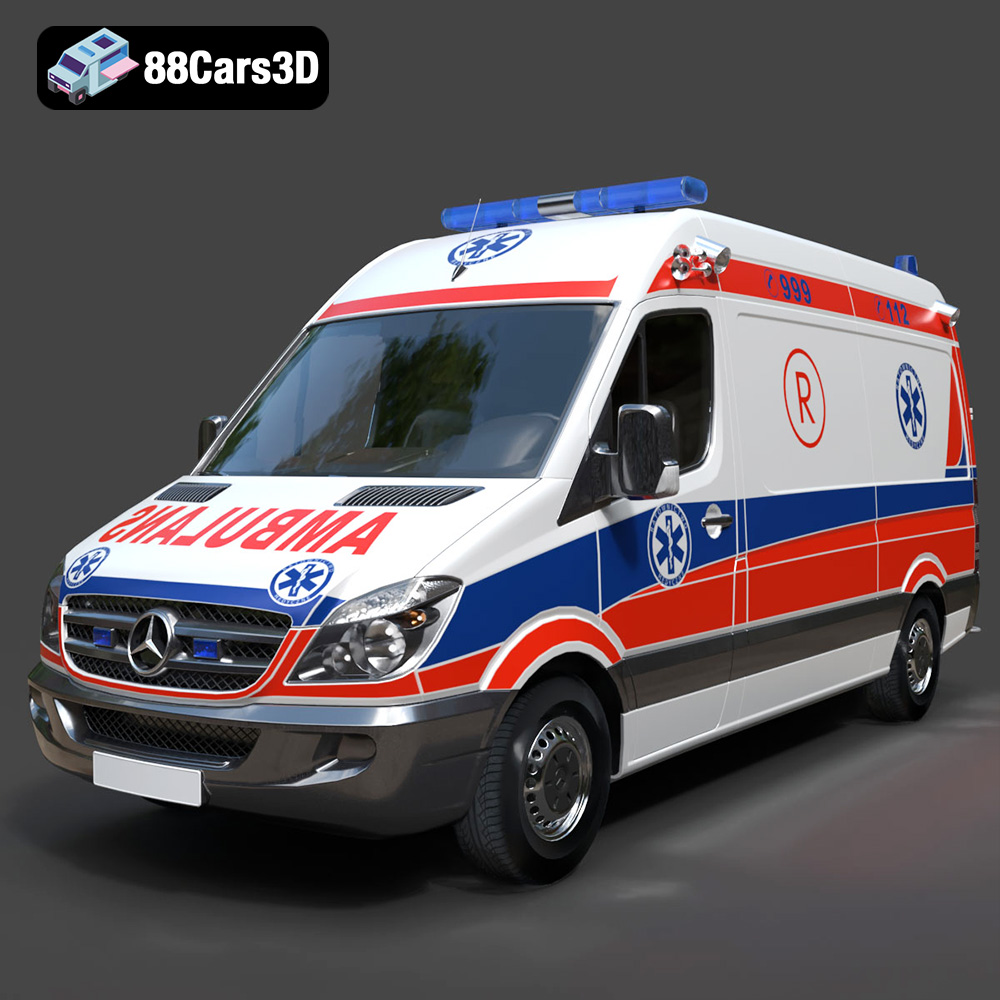
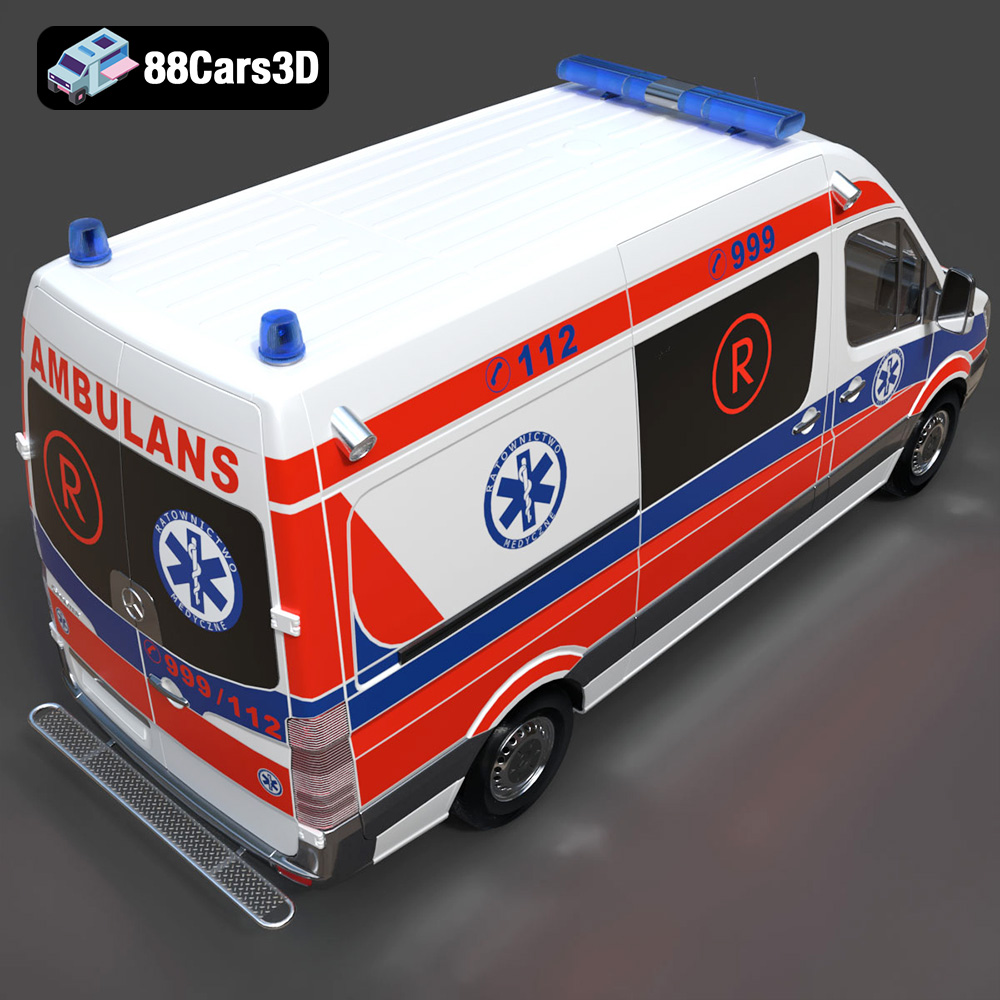
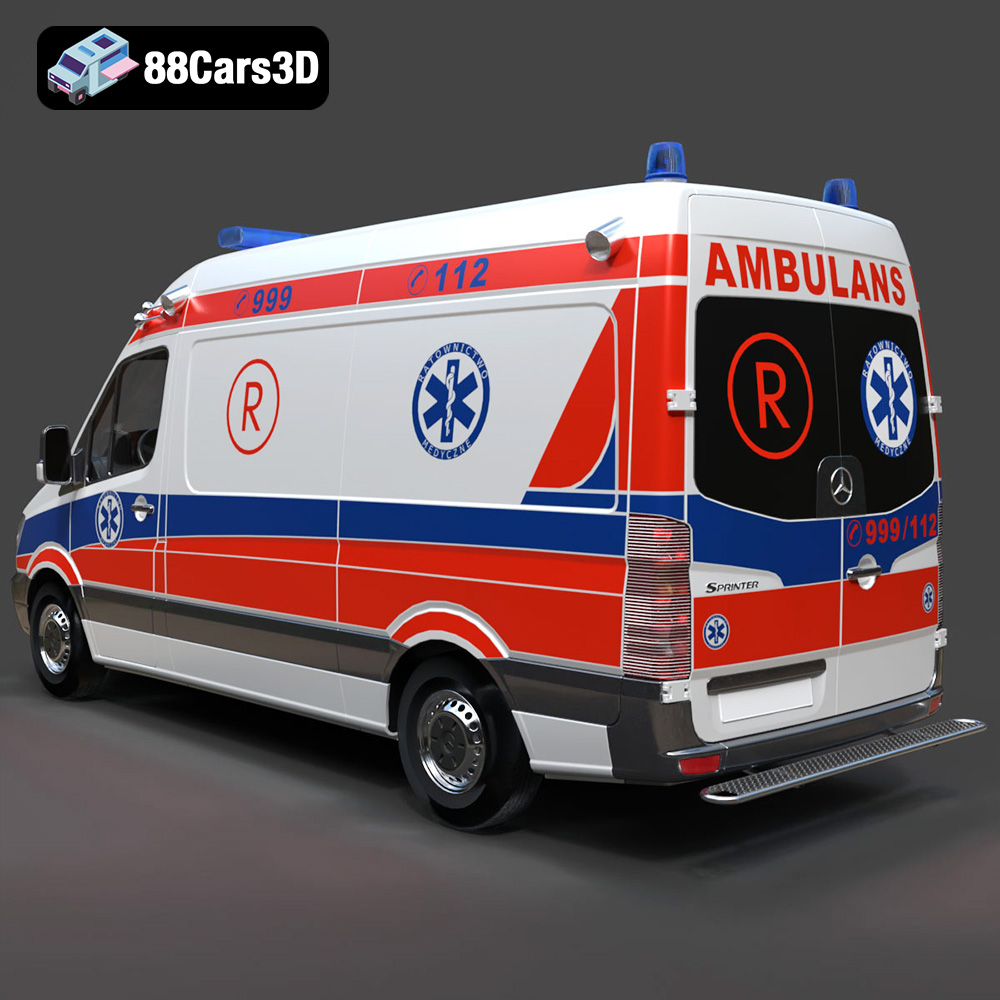
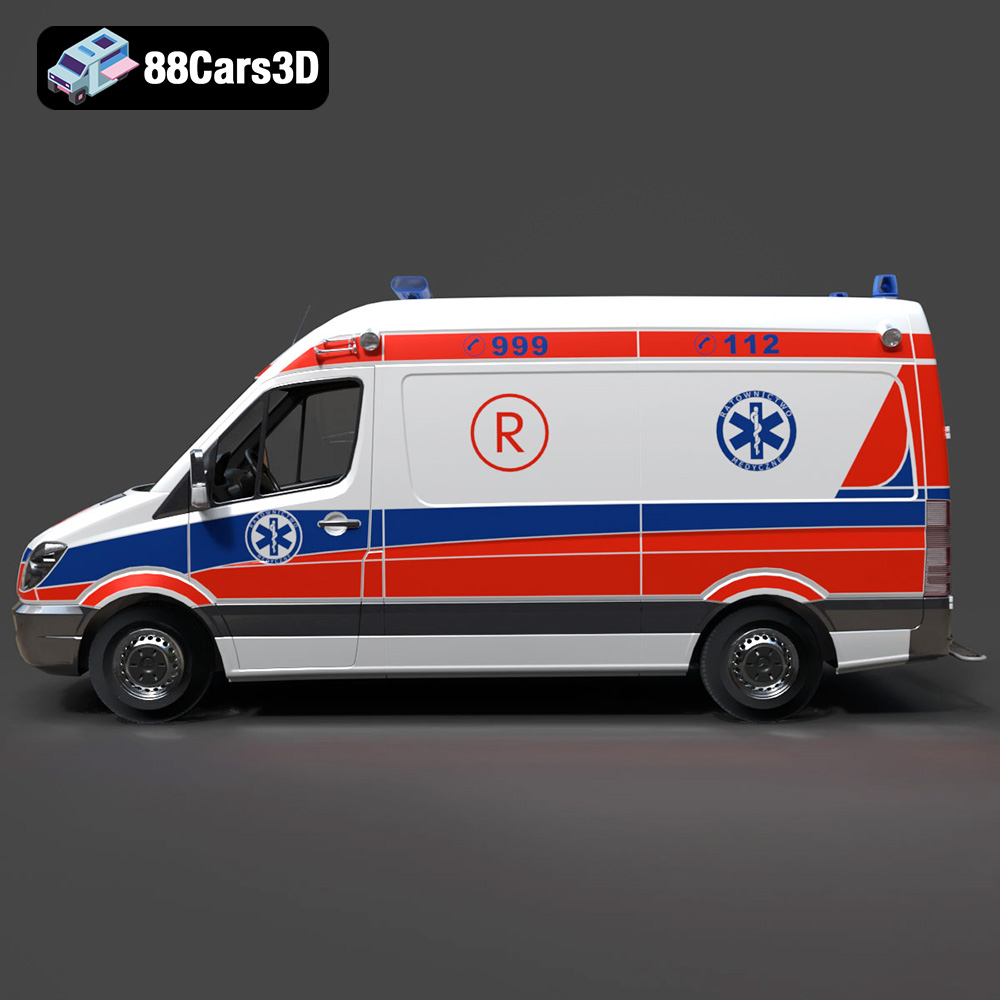
The exterior of this Sprinter Ambulance model is a masterclass in automotive fidelity. It authentically replicates the iconic Mercedes-Benz Sprinter body panels and chassis, ensuring immediate recognition and realistic proportions. The emergency light bars, both roof-mounted and front/rear, are not merely static elements but feature transparent materials, ready for dynamic lighting and animation effects. Siren speakers, floodlights, and custom ambulance livery with decals are accurately represented, adding to its visual credibility. Even the wheels and tires boast high-resolution details and realistic tread patterns, essential for close-up renders and believable ground interaction. Crucially, doors and compartments are separated, a key feature for animation workflows, allowing for realistic opening and closing sequences without complex rigging modifications.
Interior Immersion and Functional Design
The commitment to detail extends well beyond the surface. The Mercedes-Benz Sprinter Ambulance 3D model features a fully modeled driver’s cockpit, complete with dashboard controls, a steering wheel, and seating – vital for any first-person view or interior render. The comprehensive patient compartment is equally impressive, featuring a stretcher, various medical equipment, and storage units. This level of interior modeling is invaluable for simulations, training scenarios, or cinematic sequences requiring a glimpse inside the vehicle, truly enhancing immersive experiences.
Technical Advantages for Professional Workflows
Beyond visual appeal, the model boasts significant technical advantages. Its clean, quad-dominant topology simplifies subdivision and deformation, making it highly adaptable for complex rigging or further modifications. The accurate, real-world scale ensures seamless integration into existing scenes, whether it’s an architectural visualization or a virtual city environment, eliminating the need for tedious scaling adjustments. Furthermore, a logically organized hierarchy with proper pivot points for animation and rigging drastically speeds up production time. This attention to underlying structure means animators and riggers can immediately begin working on dynamic shots without extensive cleanup or re-setup.
Professional Workflows: Integrating the Sprinter Ambulance Model
The versatility of the Mercedes-Benz Sprinter Ambulance 3D model makes it an indispensable asset across a multitude of professional disciplines. Its robust design and multiple file formats ensure smooth integration into diverse pipelines, from high-end rendering to interactive simulations.
Cinematic Rendering & Architectural Visualization
In cinematic productions, commercials, or high-fidelity architectural visualizations, the Sprinter Ambulance model shines. Using software like 3ds Max or Blender, artists can leverage its detailed geometry and well-structured materials to create photorealistic scenes. Imagine a tense street chase, an ambulance rushing to a scene, or simply parked outside a newly rendered hospital building – the model’s authentic details, from the flashing emergency lights to the accurate livery, lend immediate credibility. Its real-world scale ensures it fits perfectly within environmental contexts, while separated doors allow for dynamic interactions, such as paramedics exiting the vehicle. The clean topology also means it holds up under extreme close-ups and high-resolution renders.
Game Development Pipelines (Unreal Engine & Unity)
For game developers, the Mercedes-Benz Sprinter Ambulance serves as a prime example of a game-ready asset. Its optimized mesh quality, coupled with available .fbx and .unreal formats, ensures efficient integration into leading engines like Unreal Engine and Unity. Developers can quickly import the model, apply game-optimized materials and textures, and configure collision meshes for realistic physical interactions within the game world. Whether it’s a detailed vehicle in an open-world emergency services simulator, a key element in a mission, or a background prop populating a virtual city, this model provides the necessary balance between visual fidelity and real-time performance. The logically organized hierarchy also aids in setting up vehicle physics, interior cameras, and interactive elements for player interaction.
Simulation, Training, and AR/VR Experiences
The demand for realistic simulations and immersive AR/VR experiences is rapidly growing, particularly in training and educational sectors. The Mercedes-Benz Sprinter Ambulance 3D model is invaluable here. For emergency response training, highly detailed simulations can replicate real-world scenarios, allowing first responders to practice procedures within a safe, virtual environment. The fully modeled interior, complete with medical equipment, enables precise interaction and spatial awareness training. In AR/VR, the .glb format provides an optimized asset for immersive experiences, allowing users to explore the ambulance in 3D space, either virtually or overlaid onto the real world. This transforms abstract concepts into tangible, interactive learning opportunities, making the training more effective and engaging.
Customization and Adaptability: Tailoring Your Digital Emergency Vehicle
While the Mercedes-Benz Sprinter Ambulance 3D model arrives production-ready, its true power lies in its adaptability. Professionals often need to tailor assets to specific project requirements, and this model is built with customization in mind, offering extensive flexibility for varied scenarios and creative visions.
Livery and Material Adjustments
The ability to easily adjust paint finishes for the bodywork and customize ambulance liveries is a significant advantage. Artists can quickly change the vehicle’s base color, apply different PBR (Physically Based Rendering) material properties to simulate matte, metallic, or glossy surfaces, and integrate unique decals and branding. This means the Sprinter Ambulance can represent a specific real-world emergency service, be adapted for a fictional universe, or even serve multiple roles within a single project just by swapping textures or tweaking material nodes. The flexible material adjustments for metal, glass, rubber, and emergency lighting elements ensure that every component can be fine-tuned to achieve the desired visual outcome, from the glint of chrome to the worn texture of tires.
Lighting and Environmental Integration
Emergency vehicles are defined by their dynamic lighting. The model’s design facilitates modifiable lighting setups to simulate different scenarios and environments. Artists can animate the transparent emergency light covers, implement flashing sequences, and adjust the intensity and color of internal and external lights to match specific times of day, weather conditions, or narrative demands. Integrating the model into diverse scenes is straightforward due to its accurate real-world scale and clean structure, making it a seamless addition to cityscapes, rural environments, or incident scenes within a digital world.
Extending Functionality: Rigging and Animation Potential
Thanks to its logically organized hierarchy and separated doors and compartments, the Mercedes-Benz Sprinter Ambulance 3D model is perfectly primed for advanced rigging and animation. Animators can effortlessly rig the wheels for rotation, articulate the steering, and create complex opening and closing sequences for all doors and access panels. This inherent flexibility allows for highly dynamic shots, from a speeding ambulance with flashing lights and opening rear doors to a static scene where paramedics are extracting equipment. This extends the model’s utility beyond mere static visualization into a fully interactive and dynamic asset for any project.
Conclusion: Drive Your Projects Forward with Premium 3D Car Models
The world of 3D content creation thrives on quality and versatility. As we’ve explored, a high-fidelity 3D car model, such as the Mercedes-Benz Sprinter Ambulance 3D model, is a foundational asset that empowers professionals across various industries. From cinematic rendering and game development to immersive simulations and AR/VR experiences, the meticulous craftsmanship, technical advantages, and broad format compatibility of this model make it an invaluable tool.
Its clean topology, accurate details, and animation-ready features streamline complex workflows, while the inclusion of diverse file formats ensures seamless integration into virtually any production pipeline. By investing in such expertly crafted assets, creators can save countless hours of development time, focus on their creative vision, and ultimately deliver projects that resonate with unparalleled realism and quality.
Whether you’re crafting the next big game, designing a crucial training simulation, or producing stunning visualizations, the Mercedes-Benz Sprinter Ambulance 3D model from 88cars3d.com offers the fidelity and flexibility you need to bring your digital worlds to life. Elevate your projects and achieve photorealistic results with assets built for professional excellence.
Featured 3D Model
Mercedes-Benz Sprinter Ambulance 3D Model
Presenting the Mercedes-Benz Sprinter Ambulance 3D model, a highly detailed and accurate representation of a modern emergency vehicle. This model is meticulously crafted to capture the essence of the Sprinter’s utility and the critical function of an ambulance, featuring clean geometry and balanced detailing. It is an ideal asset for professional rendering projects, realistic animation sequences, immersive simulations, and robust game development.
$21.99
Product Image Gallery