
BMW 5 Series Touring F11-007 3D Model – The Anatomy of Automotive Excellence: Why Precision 3D Car Models Define Professional Visualization

The Anatomy of Automotive Excellence: Why Precision 3D Car Models Define Professional Visualization
In the highly demanding fields of automotive design, AAA game development, and photorealistic rendering, the quality of your 3D car models is the absolute foundation of your project’s success. Mediocre assets lead to compromised visuals, inefficient workflows, and frustrating technical bottlenecks. Professionals require models that are not just visually accurate, but meticulously engineered for performance across disparate platforms—from high-poly offline render engines to constrained real-time environments.
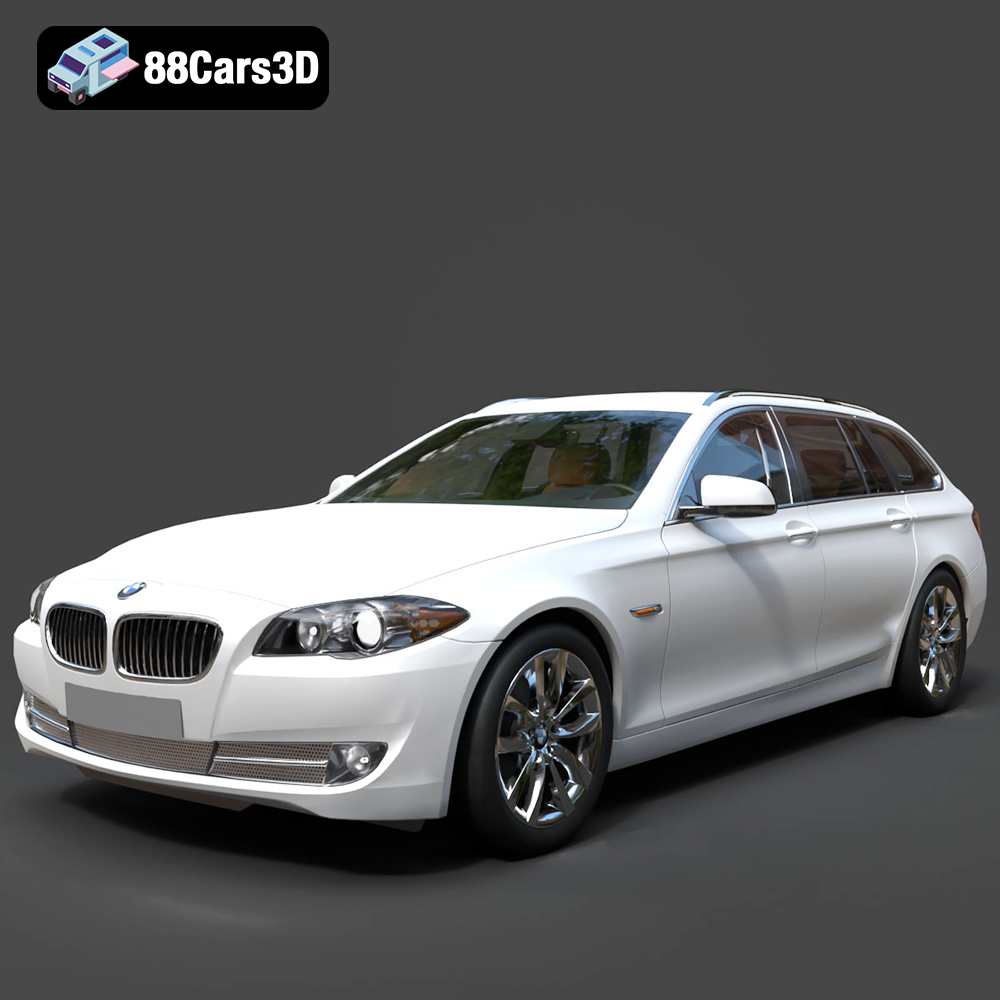
We are diving deep into the technical specifications that define professional automotive assets, using the exceptional BMW 5 Series Touring F11-007 3D Model as our benchmark. This luxury station wagon, known for its sleek design and balanced proportions, serves as a perfect case study for demonstrating how clean geometry, meticulous UV mapping, and comprehensive file support streamline complex production pipelines. Whether your goal is generating high-impact automotive rendering or delivering optimized game assets, understanding the underlying structure of a model like the F11-007 is essential for maximizing its utility.
This model, available through 88cars3d.com, is designed not merely for aesthetic appeal, but for true functional integration, offering separated components, quad-dominant topology, and a complete suite of export formats ready for any professional workflow.
Understanding 3D Model File Formats: The Backbone of Cross-Platform Compatibility
The versatility of a professional 3D asset is often judged by the breadth and quality of its included file formats. A single, high-fidelity model must be adaptable to environments ranging from specialized rendering packages to lightweight AR viewers. The BMW 5 Series Touring F11-007 model provides eight distinct format options, each tailored for a specific stage of the production pipeline. Choosing the correct format ensures data integrity, maximizes efficiency, and preserves essential metadata like materials and rigging.
.max – The 3ds Max Native Powerhouse
The .max file format represents the original, fully editable scene environment within Autodesk 3ds Max. For professionals utilizing this package for complex animation, advanced parametric modeling, or V-Ray/Corona rendering, the .max file is invaluable. It retains scene hierarchy, modifier stacks, lighting setups, and specific Max-based materials, allowing for deep customization of the F11-007 down to the sub-object level.
.blend – Fully Editable Blender Scenes
The .blend format provides a native project file for Blender users. It ensures that the mesh geometry is perfectly integrated with Blender’s procedural workflow, allowing artists to leverage Cycles or Eevee rendering engines immediately. Crucially, this format often includes shader node networks, making material modification (such as changing paint metallics or glass refraction) intuitive and non-destructive.
.fbx – The Universal Transfer Standard for Game Assets
.fbx (FilmBox) is the industry workhorse for data interchange, especially crucial when transferring assets between DCC tools (like Maya or 3ds Max) and real-time engines (Unreal Engine or Unity). The strength of FBX lies in its robust support for mesh data, UV layouts, complex material assignments, and, most importantly, animation curves and skeletal information, making it the primary choice for creating dynamic game assets.
.obj – Universal Format for Cross-Software Compatibility
The .obj (Wavefront) file format is the simplest, most universal option. While it typically excludes advanced data like animation or PBR material properties, it guarantees geometry, UV coordinates, and basic material group information can be read by virtually any 3D software ever created. It serves as a reliable fallback for cross-platform workflows and precision mesh delivery.
.unreal – Engine-Ready Asset Deployment
The specialized .unreal format signifies a pre-packaged asset pipeline optimized specifically for Epic Games’ Unreal Engine. This often means the asset has already undergone rigorous validation checks, has proper scale calibration (cm or meters), and potentially includes pre-set material instances and collision meshes, significantly reducing the setup time required for immediate real-time implementation.
.glb – Optimized for AR, VR, and Browser-Based Display
.glb (Binary glTF) is the modern standard for delivering lightweight 3D content to web browsers, augmented reality (AR), and virtual reality (VR) devices. GLB models are optimized for quick loading and efficient performance, typically bundling geometry, textures, and material definitions into a single file. This is essential for deploying the BMW F11-007 model in immersive mobile applications or interactive website showcases.
.stl – Suitable for 3D Printing Output
The .stl (Stereolithography) format is mandatory for additive manufacturing (3D printing). Unlike rendering formats that prefer quads, STL uses a triangulated mesh to define the surface geometry required by slicing software. Preparing the F11-007 for 3D printing requires ensuring the mesh is “manifold” (watertight) and scaled appropriately for physical output.
.ply – Precision Mesh Format for CAD or Analysis
The .ply (Polygon File Format) is often used in applications requiring high geometric accuracy, such as 3D scanning, scientific visualization, or bridging to Computer-Aided Design (CAD) workflows. It supports additional mesh data like color or transparency per vertex, making it valuable for detailed analysis or engineering visualization.
Topology and Technical Rigor: Building a Production-Ready 3D Car Model
The true cost savings of purchasing high-quality 3D car models from a source like 88cars3d.com come not from the visuals, but from the underlying topology. A clean, optimized mesh saves hours of cleanup, retopology, and error correction.
Quad-Dominant Geometry and Subdivision
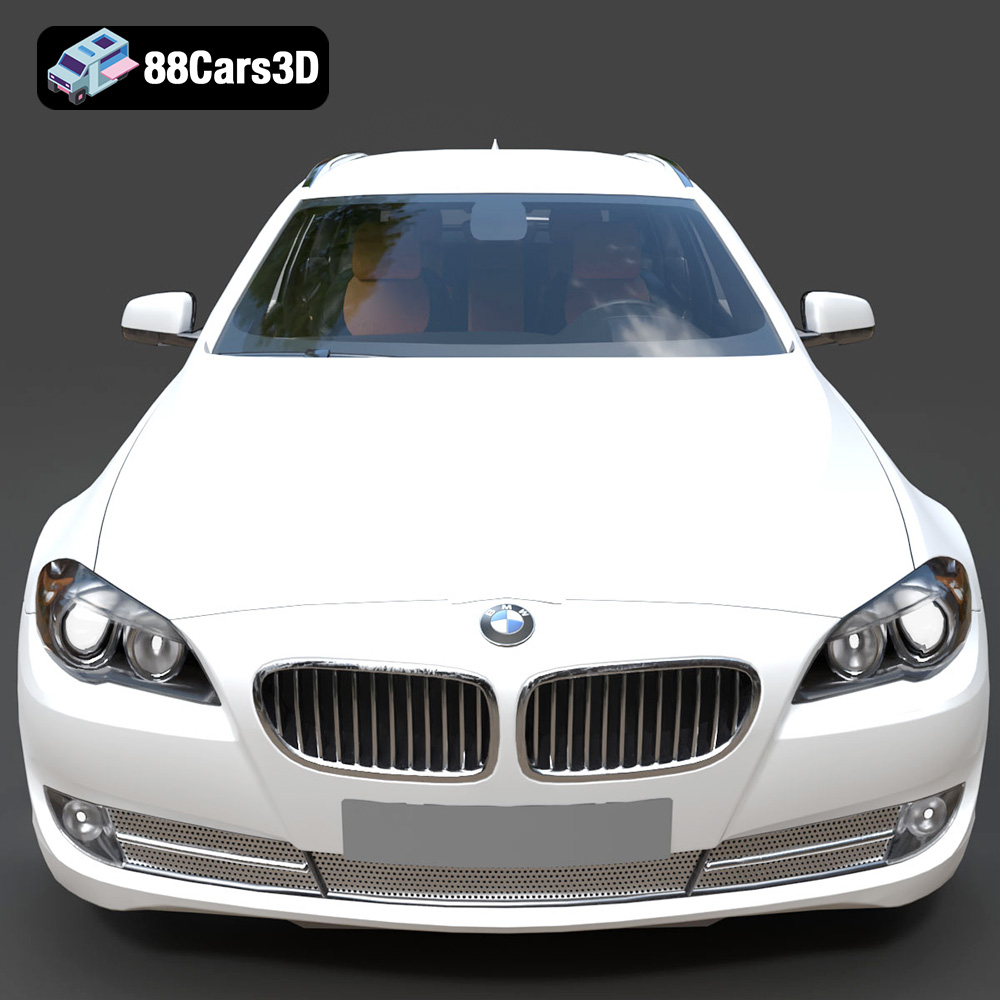
The BMW 5 Series Touring F11-007 boasts clean, quad-dominant topology. This is non-negotiable for professional automotive rendering. Quads (four-sided polygons) ensure predictable deformation and allow for smooth, controlled application of subdivision surfaces (like Turbosmooth or OpenSubdiv). When rendered at high resolution, especially in close-ups of curved surfaces like the fender flares or the iconic kidney grille, this topology prevents pinching and surface artifacts that plague models built with excessive tris or N-gons.
UV Mapping and Material Definition Integrity
Effective UV mapping is critical for advanced texturing and efficient real-time performance. Non-overlapping, clean UV layouts are necessary for applying PBR (Physically Based Rendering) texture maps—normal maps, roughness, metallic, and ambient occlusion—without distortion. Furthermore, in real-time environments, clean UVs are essential for baking efficient, high-quality light maps, ensuring realistic shading within game engines.
Accurate Scale and Optimized Asset Hierarchy
Integration begins with scale. The BMW F11-007 model is built to accurate real-world scale (typically meters or centimeters, depending on the native software). This prevents scaling errors when importing into engineering visualizations or physics-driven simulation environments. Equally important is the logical asset hierarchy: doors, wheels, steering wheel, hood, and trunk are separated and parented correctly. This organization is vital for keyframe animation and rapid manipulation, ensuring pivot points are correctly placed for natural movement (e.g., the pivot point of the door hinge is aligned with the real mechanism).
Integrating the F11-007 into Real-Time Engine Workflows
The modern pipeline often culminates in real-time visualization, where efficiency is paramount. For developers creating racing simulators or cinematic experiences, the BMW 5 Series Touring F11-007 model excels as a robust game asset.
LOD Creation for Performance Optimization
A high-fidelity automotive model designed for rendering (LOD0) often contains millions of polygons, which is unsustainable for typical game framerates. Professional workflow dictates the creation of Level of Detail (LOD) meshes. LOD1 (mid-distance) might reduce the poly count by 50-70% by eliminating internal components and simplifying minor details. LOD2 (far distance) can reduce the count by up to 95%, using texture baking to replace geometry (like door seams or grille details). The clean, quad-dominant base of the F11-007 makes this decimation and optimization process much simpler and cleaner.
Material Instancing and PBR Car Paint Shaders
Achieving realistic car paint—which involves metallic flakes, clear coat reflection, and accurate color absorption—in a game engine like Unreal requires setting up complex PBR shaders. By utilizing material instances based on a master car paint material, developers can quickly iterate on hundreds of paint colors for the F11-007 without duplicating complex shader logic. The provided .fbx and .unreal files help bridge this gap, ensuring that the initial material groups map correctly to engine-specific material definitions.
Animation Rigging for Interactive Simulations
Since the doors, hood, and trunk are separated and feature correctly placed pivots, integrating basic animation rigs is straightforward. This is essential for interactive showcases where users can virtually walk around the vehicle and open elements, or for simulation environments where damage models and component failure must be visually represented. The robust organization of this asset significantly speeds up the rigging process compared to monolithic car meshes.
Mastering Automotive Rendering and Visualization
While game engines focus on speed, offline automotive rendering demands absolute photorealism. This requires deep control over lighting, material properties, and camera effects.
Studio Lighting Techniques for Cinematic Quality
To produce truly cinematic renders of the BMW F11-007, artists often rely on high-dynamic-range imaging (HDRI) environments combined with targeted geometric light sources (area lights). HDRI provides realistic reflections on the glossy paint and chrome accents. For studio renders, employing a classic three-point lighting setup (Key, Fill, Rim) helps reveal the subtle curves and body lines characteristic of the F11 design. A powerful rim light tracing the edges of the roofline and side mirrors dramatically enhances the visual separation and impact.
Advanced Material Definition for High Fidelity
Achieving realism goes beyond the paint. Materials must be calibrated based on real-world reference values:
- Tire Rubber: Should utilize subsurface scattering maps or complex roughness variations to look worn and porous, not simply a flat dark gray.
- Glass Shaders: Require accurate IOR (Index of Refraction) values and subtle imperfection maps (smudges, dust) to break up perfect reflection, providing that crucial photographic realism.
- Chrome and Metal Accents: Must possess extremely low roughness values and be accurately measured as metallic surfaces within the PBR workflow.
The meticulous material definitions supplied with the BMW F11-007 asset ensure these details are immediately available in native formats like .max and .blend.
Depth of Field and Post-Processing Effects
A great render is often defined by the camera work. Using subtle depth of field (DoF) to focus on the vehicle emblem or a wheel arch elevates a simple visualization to an artwork. Furthermore, post-processing—including lens distortion, chromatic aberration, and carefully calibrated color grading—can push the final image from ‘3D model’ into ‘professional photography.’ These techniques are fundamental for high-impact marketing visuals, often generated for client pitches and marketing collateral created using professional 3D car models.
Beyond Visualization: AR/VR and 3D Printing Applications
The utility of a high-quality model like this extends well beyond standard screen-based rendering. Modern technology allows for immersive, physical, and engineering-focused applications.
Leveraging .GLB for Immersive Web Experiences
Augmented Reality (AR) and Virtual Reality (VR) are becoming essential tools for automotive retail and training. The optimized .glb format allows the BMW F11-007 to be integrated quickly into web viewers, mobile AR apps (like Apple’s ARKit or Google’s ARCore), and dedicated VR training simulators. Because the geometry is already clean and optimized for real-time performance, the process of porting the asset into these environments is significantly streamlined, enabling users to interact with the vehicle in their physical space.
Preparing the Mesh for Additive Manufacturing
The ability to convert the digital model into a physical prototype using 3D printing is a valuable feature for designers and engineers. While the source mesh is primarily quads, the included .stl format is essential for preparing the model for additive manufacturing. This triangulated output requires specific attention to wall thickness and manifold geometry (ensuring there are no holes or disconnected faces) to guarantee a successful print, enabling the creation of physical scale models for display or wind tunnel testing.
Conclusion: Elevating Your Automotive Pipeline
The production of world-class automotive rendering and robust game assets hinges entirely on the quality and technical preparedness of the initial 3D car models. The BMW 5 Series Touring F11-007 3D Model exemplifies the standard necessary for professional work, offering immaculate geometry, accurate component separation, and comprehensive file format support across the entire digital spectrum.
By investing in professionally engineered models, artists and developers bypass countless hours of optimization and focus purely on creative execution. The detailed structure and extensive format list, including .fbx, .blend, and .unreal, ensure seamless integration into any high-end workflow.
To explore this model and others that meet the stringent requirements of professional production, visit 88cars3d.com. Elevate your projects today with assets engineered for precision and performance.
Featured 3D Model
BMW 5 Series Touring F11-007 3D Model
Experience the precision and elegance of the BMW 5 Series Touring F11-007 with this professional 3D model. Meticulously crafted to capture the iconic design and functional aesthetics of the luxury station wagon, this model boasts clean geometry and balanced detailing. It is optimized for a wide range of applications, including high-fidelity rendering, realistic animation sequences, immersive simulation environments, and robust game development.
$10.79
Product Image Gallery




Related Tags
.bmw.5series.touring.f11007.car.wagon.stationwagon.familycar.rendering.simulation.gameasset.arvr.blend.fbx.obj.glb.stl.ply.unreal.max
