
BMW 5 Series Touring F11-007 3D Model – The Foundation of Realism: Topology and Technical Specifications

The pursuit of photorealism in digital visualization demands foundational assets built on precision engineering and robust technical specifications. Whether you are developing a next-generation racing title, producing high-fidelity advertising materials, or creating immersive training simulations, the quality of your base mesh dictates the ceiling of your project’s success. Low-polygon models might suffice for distant background elements, but when the focus is on showcasing a vehicle—the hero asset—compromises simply are not an option.
This necessity for quality is precisely why specialized marketplaces like 88cars3d.com exist. They cater exclusively to professionals who require assets that are not just visually accurate, but meticulously structured for complex, multi-platform workflows. Today, we delve into the technical anatomy of one such asset: the BMW 5 Series Touring F11-007 3D Model, using it as a benchmark to understand the critical requirements for high-end 3D car models in modern production pipelines, spanning from advanced automotive rendering to optimized game assets.
The F11-007 Touring model offers a masterclass in preparing automotive geometry. It is designed from the ground up to support deep customization, animation rigging, and seamless transition between offline renderers (like V-Ray or Cycles) and real-time engines (Unreal Engine or Unity). Understanding the technical specifics of its topology and material preparation is crucial for any artist or developer looking to elevate their final product.
The Foundation of Realism: Topology and Technical Specifications
In high-fidelity modeling, realism is not a result of poly count alone, but of intelligent topology management. The quality of the mesh dictates how well the surface responds to shading, reflection, and subdivision. For an asset like the BMW 5 Series Touring F11-007, the technical specifications are paramount for professional adoption.
Optimizing Mesh Density for Performance
The F11-007 model utilizes clean, quad-dominant topology. This is the gold standard for automotive and hard-surface modeling because quads deform smoothly and allow for predictable application of subdivision surfaces (like Turbosmooth or Subdivision Surface modifiers). In contrast, models riddled with triangles or N-gons often result in pinching, artifacts, and unpredictable surface curvature, especially on reflective surfaces like car paint.
Furthermore, the mesh density is optimized. This means details that require high polygon density (like subtle curvature around wheel wells or sharp creases in the body panels) are allocated sufficient polys, while flat or broad surfaces maintain a lower density. This balance ensures that the model provides exceptional detail for close-up renders without crippling real-time performance when used as a game asset. The technical specification notes the separation of key components—doors, hood, and trunk—which, while simple, is essential. Separation allows artists to instantly rig the vehicle for dynamic sequences, like opening the rear hatch or animating a crash sequence, without complex mesh cutting or destructive boolean operations.
Implementing Realistic UV Mapping and Texture Sets
Proper UV unwrapping is non-negotiable for professional 3D car models. The BMW F11-007, like other high-quality assets, features non-overlapping UVs suitable for baking high-resolution texture maps, including ambient occlusion, normal maps, and curvature maps. For automotive rendering, however, the complexity often lies in the material shaders rather than texture maps applied directly to the body panels.
The model’s included materials are defined for specific real-world behaviors: highly reflective, multi-layered car paint (often requiring a clear coat layer in the shader); realistic glass transparency with subtle imperfections; and physically accurate rubber and chrome. The UVs primarily serve the interior (dashboard, seating fabric) and intricate mechanical details (tire sidewalls, brake calipers), allowing for detailed PBR (Physically Based Rendering) texture sets that maintain consistency across platforms.
Understanding 3D Model File Formats
The true measure of a versatile 3D asset is its ability to integrate flawlessly into diverse software environments. A professional model must be agile, transitioning effortlessly from the meticulous subdivision workflow of 3ds Max to the performance-driven ecosystem of Unreal Engine. The BMW 5 Series Touring F11-007 provides a comprehensive set of file formats, each serving a distinct purpose in the pipeline.
When purchasing assets from 88cars3d.com, users expect specialized formats tailored for specific tasks. Here is a technical breakdown of the formats included with the F11-007 model and their primary use cases:
- .blend – Fully Editable Blender Scene: This is the native file format for Blender. It is ideal for artists using the open-source suite who require full editability, including access to modifiers, node-based material setups (Cycles/Eevee), and complex scene collections. For the F11-007, the .blend file allows immediate iteration on lighting and shader adjustments within a powerful, free environment.
- .max – Editable 3ds Max Project: The .max file is indispensable for professionals working in V-Ray, Corona, or mental ray workflows. It often contains scene-specific setups, procedural textures, and complex rigging structures that are preserved within the Autodesk ecosystem. This format is the go-to for high-end offline automotive rendering and studio animation.
- .fbx – Ideal for Real-Time Pipelines: The Filmbox (.fbx) format is the industry standard for asset exchange between different software packages and, crucially, real-time game engines like Unreal Engine and Unity. It efficiently packages geometry, basic materials, UVs, and animation data. Using the .fbx version of the F11-007 guarantees proper scaling and hierarchy retention during the critical import process into game environments.
- .unreal – Engine-Ready Asset: This is a highly optimized version specifically prepared for the Unreal Engine pipeline. It often includes correctly segmented mesh sections, pre-applied basic collision meshes, and potentially even LOD (Level of Detail) groups, saving game developers significant setup time. This immediately transforms the model into a functional game asset.
- .obj – Universal Compatibility: The Wavefront .obj format is perhaps the most universally supported format. While it does not handle complex animation data or scene specifics as gracefully as .fbx or native formats, it reliably transfers geometry and basic UV mapping across nearly every 3D application, making it the fallback format for cross-software compatibility and archival.
- .glb – Optimized for AR, VR, and Web Display: The GL Transmission Format (.glb) is based on the JSON-based GLTF structure and is critical for modern deployment. It bundles geometry, textures, and shading information into a single, highly compressed file optimized for fast loading in browser-based viewers, augmented reality (AR) apps, and virtual reality (VR) environments.
- .stl – Suitable for 3D Printing Output: The Stereolithography (.stl) format is purely geometrical and triangulation-based, focusing solely on surface geometry for additive manufacturing. While the F11-007 is a high-poly model, the .stl conversion allows users to create physical prototypes, scale models, or detailed parts for hobbyists and designers utilizing 3D printing technology.
- .ply – Precision Mesh Format: Polygon File Format (.ply) is often used for high-precision data derived from 3D scanning or for transferring dense mesh geometry in CAD, engineering, or scientific analysis workflows. It is a niche format for users who require precise, vertex-based data outside of standard animation pipelines.
Bridging the Gap: Real-Time vs. Offline Rendering Formats
The distinction between .max/.blend (offline rendering) and .fbx/.unreal (real-time) is critical. Offline formats preserve every detail of the construction, allowing for highly nuanced adjustments in subsurface scattering, complex volumetric fog, and ray tracing accuracy. Real-time formats prioritize draw call efficiency and optimized poly counts, enabling smooth frame rates within an interactive environment. The availability of both ensures that the BMW 5 Series model can serve dual purposes—cinematic production and interactive experience—without requiring artists to manually rebuild the asset.
Preparing Models for AR/VR and Web Visualization
The inclusion of the .glb format demonstrates forward-thinking asset design. As marketing and visualization increasingly move to web browsers and mobile AR applications, compressed, PBR-ready formats are essential. The F11-007 can be dropped directly into an online configurator or an AR experience showing the car in a real-world setting, a capability highly valued by contemporary automotive marketing agencies.
Automotive Rendering Workflows: From Studio Setup to Final Output
Automotive rendering requires mastery over shading, lighting, and environmental context. Using the F11-007 model as our subject, we can define a professional rendering workflow that ensures maximum visual impact.
Achieving Photorealism with Advanced PBR Materials
The materials provided with the BMW F11-007 are based on PBR principles, ensuring they react correctly to light regardless of the rendering engine (V-Ray, Arnold, Cycles, or even Eevee). The complexity lies in the layered nature of car paint. A high-quality car shader is composed of several layers:
- The base diffuse color.
- A metallic flake layer (simulating the sparkle).
- A protective clear coat layer (high-gloss specular reflection).
Artists must fine-tune parameters like Fresnel reflectivity and roughness maps to simulate subtle wear or dust accumulation. Because the model uses logical organization and standard material definitions, adjusting the paint to an OEM shade, like Mediterranean Blue or Alpine White, is a straightforward adjustment to the material base color and flake size.
Crafting Cinematic Lighting for the F11-007 Touring
For studio renders, automotive professionals rely on HDRI (High Dynamic Range Image) maps for realistic global illumination, combined with targeted area lights to define the vehicle’s shape. The elongated form of the F11 Touring model requires large, soft area lights positioned strategically to draw out the body lines and emphasize the contrast between highly reflective panels and sharp creases. Utilizing a “seamless cyclorama” or infinite backdrop environment within 3ds Max or Blender helps focus the viewer’s attention solely on the car’s exquisite detail, which, thanks to the F11-007’s clean geometry, holds up perfectly under intense scrutiny.
Integrating High-Fidelity Game Assets into Real-Time Engines
Transitioning an asset from a visually perfect offline render to a performance-optimized real-time environment (like Unreal Engine) involves distinct technical considerations. The BMW 5 Series Touring F11-007, provided with .fbx and .unreal formats, is pre-optimized for this shift, simplifying the job for game developers.
Setting Up Physics and Collision for Realistic Driving Simulations
For the model to function as a viable game asset in a racing or simulation title, it requires precise collision meshes. The professional approach avoids using the high-resolution visualization mesh for collision calculations, as this would be extremely performance intensive. Instead, a simpler, convex hull collision mesh (or multiple simple box/sphere primitives) is created, often prefixed with “UCX_” in the mesh naming convention. The F11-007’s organized geometry facilitates the quick creation and attachment of these essential collision proxies, ensuring realistic behavior when driving, crashing, or interacting with the game world.
The Importance of Logical Hierarchy for Vehicle Rigs
Animation and physics simulation rely entirely on the model’s pivot points and hierarchical structure. The F11-007 asset is engineered with logically organized elements:
- The root node controls the entire vehicle.
- Child nodes for each wheel, properly centered at the axle, allow for independent rotation and suspension travel.
- Separated geometry for the steering wheel, doors, and tailgate enables easy rigging using constraints or skeleton bones within the game engine, facilitating smooth character entry/exit and damage modeling.
This organized hierarchy minimizes setup time and prevents the frustrating “gimbal lock” or rotation issues often encountered with poorly constructed imported models.
Beyond Visualization: Prototyping and AR Applications
The utility of professional 3D car models extends beyond pure digital media. Companies use these highly accurate representations for everything from manufacturing quality control to advanced driver-training simulation modules.
Converting the F11-007 for High-Resolution 3D Printing
Although the primary mesh of the BMW Touring model is high-resolution, converting it for 3D printing via the included .stl format requires attention to wall thickness and scale. For high-detail resin printing, the geometry usually holds up well, but specific elements—like fine grilles or extremely thin mirrors—may need slight thickening or merging to ensure structural integrity in the physical output. The real-world scale accuracy of the F11-007 ensures that the final printed prototype maintains correct proportions for physical display.
Leveraging Real-World Scale in Augmented Reality
AR visualization demands adherence to real-world scale (1 unit = 1 meter). Since the BMW 5 Series Touring F11-007 3D model is built to accurate metric dimensions, integration into AR platforms like Apple ARKit or Google ARCore using the optimized .glb file is straightforward. This accuracy is paramount for applications where a user needs to realistically place the car in their driveway or garage via their smartphone, making it a powerful tool for retail and architectural visualization.
Case Study: Using the BMW F11-007 Model in Professional Production
Consider a hypothetical automotive design studio tasked with creating a launch video for an accessories line compatible with the F11 generation. Purchasing a professional asset like the BMW F11-007 from a reliable source like 88cars3d.com significantly accelerates the production timeline. Instead of spending weeks modeling and validating the geometry, the team can immediately focus on creative tasks.
Customization and Livery Application
One primary advantage of this model’s clean UV layout is the ease of applying custom liveries or graphics. By isolating the body paint UV shell, designers can generate a single, non-stretched texture map for decals, sponsorship logos, or camouflage wraps. They can also quickly cycle through different custom paint finishes—from matte satin to vibrant pearlescent effects—by simply adjusting the material parameters without needing to touch the geometry.
Animation Rigging for Doors, Hood, and Trunk
Since the geometry is already separated and pivot points are logically defined, rigging the vehicle for animation takes hours, not days. A professional animator can set up controls for the steering, wheel rotation, and suspension travel instantly, allowing for complex cinematic movements where the car transitions from static beauty shots to dynamic driving sequences. The detailed headlights and taillights, provided with transparent material zones, enable realistic lighting sequences—essential for showcasing the vehicle’s luxury features in automotive rendering.
Conclusion: The Value of Precision in 3D Car Models
The journey from a foundational mesh to a final, photorealistic image or a high-performance game asset is complex, fraught with technical challenges related to topology, material handling, and format compatibility. The BMW 5 Series Touring F11-007 3D Model serves as a textbook example of a professional asset engineered to solve these challenges across multiple industries.
By providing quad-dominant geometry, accurate real-world scaling, and an extensive suite of eight distinct file formats (.max, .blend, .fbx, .unreal, .obj, .glb, .stl, .ply), this model ensures that users—whether they are visualizing future products, building immersive games, or crafting cinematic renders—have a robust and versatile foundation. Investing in quality assets, such as those found on 88cars3d.com, is not just a purchase; it is a commitment to efficiency and uncompromising visual fidelity in every project.
Featured 3D Model
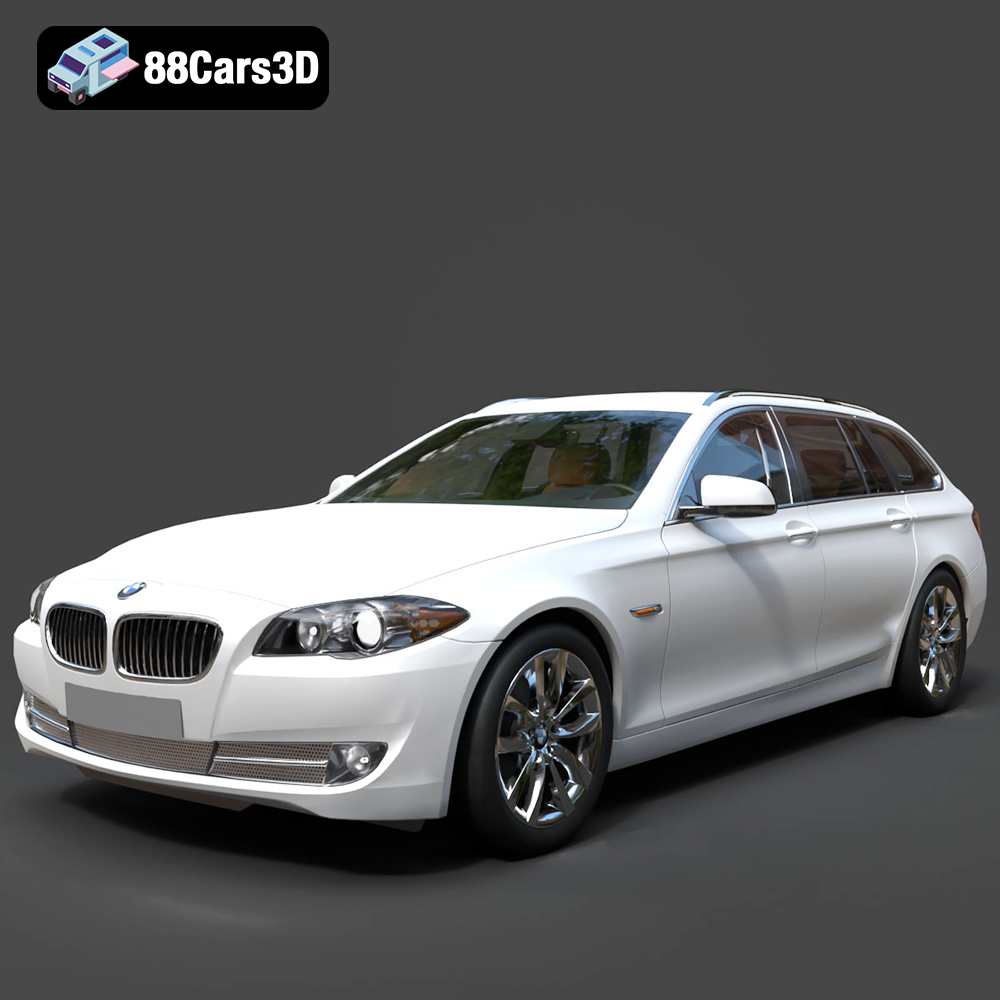
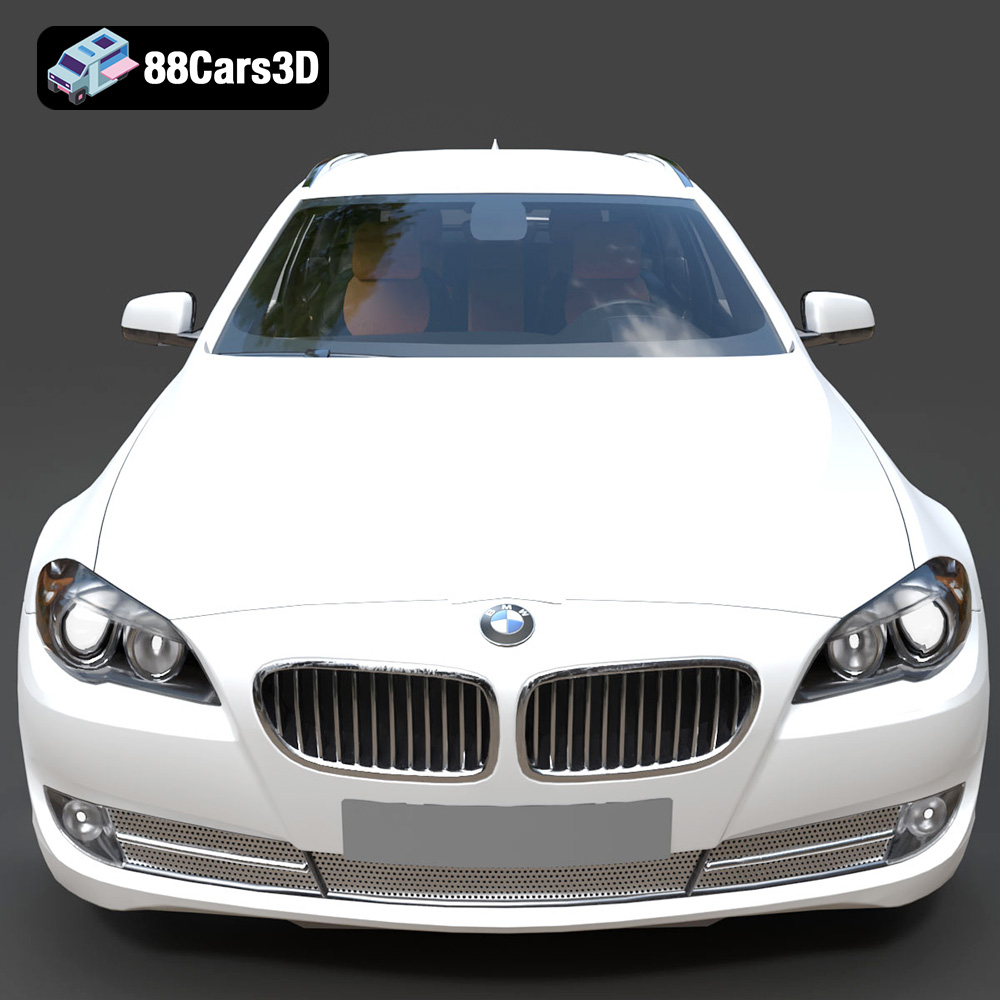
BMW 5 Series Touring F11-007 3D Model
Experience the precision and elegance of the BMW 5 Series Touring F11-007 with this professional 3D model. Meticulously crafted to capture the iconic design and functional aesthetics of the luxury station wagon, this model boasts clean geometry and balanced detailing. It is optimized for a wide range of applications, including high-fidelity rendering, realistic animation sequences, immersive simulation environments, and robust game development.
Exterior Features:
- Accurately modeled body panels reflecting the F11 generation’s design language
- Detailed headlights and taillights with transparent materials for realistic illumination
- Authentic BMW kidney grille, emblems, and badging
- High-resolution wheels and tires with distinct tread patterns
- Separated doors, hood, and trunk for easy animation workflows
- Realistic material definitions for paintwork, glass, chrome accents, and rubber components
Interior / Mechanical Features:
- Detailed dashboard, steering wheel, and center console elements
- Comfortable seating and door panels with optimized mesh quality
- Basic engine bay and chassis components for exterior realism in open states
- Clean and optimized mesh structure suitable for close-up renders
Technical Advantages:
- Clean, quad-dominant topology for smooth subdivision and deformation
- Accurate real-world scale to ensure seamless integration into existing scenes
- Logically organized hierarchy with proper pivot points for animation and manipulation
- Optimized mesh density for efficient performance across various platforms
Applications:
- Rendering & Visualization: Perfect for studio renders, automotive showcases, and cinematic scenes
- Game Development: High-performance asset for racing games, open-world environments, and virtual experiences
- AR/VR: Ideal for immersive augmented and virtual reality applications
- Simulation & Training: Suitable for driving simulators, architectural visualizations, and educational modules
- 3D Printing: Convertible to .stl for creating physical models and prototypes
Customization Options:
- Easily modify paint finishes and apply custom graphics or liveries
- Adjust material properties for metals, chrome, rubber, and plastics to match specific visual styles
- Implement diverse lighting setups to achieve varied atmospheric effects and moods
Elevate your projects with the authentic representation of the BMW 5 Series Touring F11-007 3D model. Its professional quality and versatile design make it an indispensable asset for any creative endeavor requiring precision and realism.
Included File Formats:
- .blend – Blender project with materials
- .fbx – Compatible with Unreal, Unity, and major 3D engines
- .obj – Universal format for nearly all 3D software
- .glb – Optimized for AR, VR, and web-based visualization
- .stl – Ready for 3D printing
- .ply – Mesh format for analysis and CAD workflows
- .unreal – Unreal Engine project setup
- .max – Editable 3ds Max scene for rendering and animation
Tags:
.bmw.5series.touring.f11007.car.wagon.stationwagon.familycar.rendering.simulation.gameasset.arvr.blend.fbx.obj.glb.stl.ply.unreal.maxMercedes Benz CLS 500 3D Model
$10.79
Product Image Gallery




Related Tags
.bmw.5series.touring.f11007.car.wagon.stationwagon.familycar.rendering.simulation.gameasset.arvr.blend.fbx.obj.glb.stl.ply.unreal.max
