
BMW 525i E34 1993 3D Model – The Professional Pipeline: Utilizing High-Fidelity 3D Car Models for Automotive Rendering and Game Asset Development

The Professional Pipeline: Utilizing High-Fidelity 3D Car Models for Automotive Rendering and Game Asset Development
The demand for highly accurate, production-ready 3D automotive assets has never been higher. Whether you are creating a photorealistic advertisement, designing a massive open-world game environment, or fabricating a scale model via 3D printing, the quality of the base geometry dictates the final output. Few cars capture the essence of classic German engineering and executive styling quite like the BMW 525i E34 1993.
For professionals seeking a benchmark asset that blends detailed history with modern optimization, the BMW 525i E34 1993 3D Model stands out. This asset is specifically designed to transition seamlessly across various platforms—from the high-polygon demands of cinematic automotive rendering in V-Ray or Cycles to the strict optimization requirements of real-time game assets in Unreal Engine and Unity. This versatility, coupled with meticulous attention to the vehicle’s original proportions and surface curvature, makes it an invaluable addition to any professional library, readily available through marketplaces like 88cars3d.com.
In this comprehensive technical guide, we will explore the professional workflows this specific 3D car model supports, focusing on the critical technical details—geometry, UV mapping, material definition, and, most importantly, the strategic use of multiple file formats to maximize efficiency across diverse pipelines.
Understanding 3D Model File Formats: The Backbone of Professional Exchange
In high-end 3D production, an asset’s true value often lies not just in its polygon count and texturing, but in the variety and integrity of its provided file formats. A single, versatile model, such as the BMW 525i E34, must be packaged to meet the disparate technical demands of cinematic rendering, real-time engines, and physical fabrication. Selecting the correct format is crucial for maintaining data integrity, optimizing performance, and ensuring project compatibility. Here, we break down the eight key formats provided with this professional 3D car model.
.max – Editable 3ds Max Project
The .max format represents the native scene file for Autodesk 3ds Max. This is often the foundational file for those specializing in traditional automotive rendering and visualization, particularly when utilizing renderers like V-Ray or Corona. The .max file includes all scene information: lights, cameras, modifiers, animation paths, and the detailed material hierarchy. For complex rigging (e.g., suspension systems or detailed interior animations), starting with the .max file ensures maximum editability and non-destructive workflow.
.blend – Fully Editable Blender Scene
For the rapidly expanding professional community utilizing Blender, the .blend file provides a complete, ready-to-render setup. This includes the E34 geometry, PBR material definitions optimized for Cycles or Eevee, and often a pre-configured lighting environment (like an HDRI dome). The benefit of the .blend format is its ability to preserve procedural textures and complex nodal setups unique to Blender’s powerful shading system.
.fbx – The Universal Pipeline Interchange
The .fbx (Filmbox) format is the industry standard for transferring 3D data between various applications, making it essential for game assets. It excels at carrying crucial data such as clean mesh geometry, UV layouts, material assignments, skeletal data (rigging), and animation curves. When moving the BMW 525i E34 into Unreal Engine or Unity, the .fbx file is preferred because it maintains the hierarchical structure of the vehicle (chassis, doors, wheels) necessary for proper real-time physics and manipulation.
.unreal – Engine-Ready Asset for Real-Time Environments
This specialized configuration signifies an asset pre-processed specifically for Unreal Engine’s complex requirements. An .unreal asset often goes beyond a simple mesh import. It typically includes optimized LOD (Level of Detail) meshes, collision meshes (UCX), proper material instances, and optimized texture resolutions packaged according to engine standards. This drastically reduces the necessary setup time for developers deploying the E34 model in driving simulators or interactive architectural visualization (ArchViz).
.obj – Universal Format for Cross-Software Compatibility
The .obj (Wavefront Object) format is a robust, ASCII-based universal format that guarantees compatibility across virtually all 3D software packages (Maya, ZBrush, Cinema 4D, etc.). While it reliably transfers geometry and basic UV data, it typically does not retain complex material definitions, lighting, or rigging information. It is best used for basic geometry exchange or as a fail-safe backup when integration requires pure mesh data.
.glb – Optimized for AR, VR, and Browser-Based Display
The .glb (Binary glTF) format is critical for modern deployment, especially within Augmented Reality (AR) and Virtual Reality (VR) environments, and web-based 3D viewers. It consolidates the geometry, materials, and textures into a single, highly compressed binary file. The E34 model provided in .glb format is ready for rapid display on platforms like Apple QuickLook or browser-based configurators, demanding minimal loading time while retaining acceptable visual fidelity.
.stl – Suitable for 3D Printing Output
For designers interested in physical prototyping or creating collector’s models, the .stl (Stereolithography) format is the standard for additive manufacturing. It defines geometry purely through interconnected triangles, completely disregarding color, texture, and materials. An .stl file derived from this detailed BMW E34 model ensures a manifold, watertight mesh suitable for direct slicing and 3D printing, enabling the creation of physical prototypes or highly detailed scale models.
.ply – Precision Mesh Format for CAD or Analysis
The .ply (Polygon File Format) is often used when high-precision mesh data is required, sometimes involving color per vertex. It is a precise format frequently encountered in 3D scanning, scientific visualization, or CAD/reverse engineering workflows. For detailed analytical assessments or archival quality representation of the E34’s exact geometry, the .ply format offers a robust, detailed polygon mesh.
Achieving Photorealism: Advanced Automotive Rendering Techniques
The hallmark of professional 3D car models is their ability to produce indistinguishable renders. The BMW 525i E34 1993 model is built with automotive rendering in mind, meaning its topology and material slots are configured to leverage the sophisticated shading models of modern path tracers.
Material Definition and PBR Workflows
Photorealistic rendering relies heavily on accurate Physical Based Rendering (PBR) materials. For the E34, this involves several complex shaders:
- Car Paint: Automotive paint is a multi-layered material. A successful render requires a base diffuse color, metallic flake map (for depth and sparkle), and a high-refraction clear coat layer with carefully controlled roughness. The underlying geometry must be perfectly smooth to avoid visible faceting in reflections.
- Glass and Optics: Headlights and taillights demand realistic transmission and refraction. The E34’s classic round headlights require dedicated glass shaders with appropriate Index of Refraction (IOR) values, ensuring internal reflectors catch the light realistically.
- Interior Fabrics: The interior elements—leather seats, dashboard plastics, and carpet—utilize separate PBR texture sets (Albedo, Roughness, Normal, Metallic) to accurately capture subtle surface micro-details, essential for close-up cockpit shots.
Lighting and Environment Setup (HDRI)
No 3D car model can look real without professional lighting. Automotive rendering heavily utilizes High Dynamic Range Imagery (HDRI) environments. The E34 model, when imported into 3ds Max or Blender, should be placed within a high-resolution 32-bit HDRI environment. This technique provides natural, varied light sources and, crucially, highly realistic reflections across the vehicle’s glossy surfaces, which is key to showcasing the classic body lines of the E34 generation. Studio setups, conversely, rely on large area lights and softboxes placed specifically to define the contours and character lines of the sedan.
Integration into Real-Time Environments: Game Asset Optimization
Moving from a cinematic render pipeline to a real-time engine requires rigorous optimization. The high-fidelity nature of the BMW 525i E34 1993 3D Model means it must be intelligently scaled down for performance without losing visual integrity. This is where its optimized geometry and multi-format offering truly shine, serving as excellent game assets.
LOD Creation and Optimization Pipelines
Modern game engines cannot render the full poly-count version of the E34 (which could easily exceed 500,000 polygons for a hero asset) across an entire scene. Professional game assets utilize Level of Detail (LOD) systems. The initial high-poly mesh (LOD 0) is reserved for close-ups. Subsequent LODs (LOD 1, LOD 2, LOD 3) are automatically swapped in by the engine as the player moves away. Effective optimization includes:
- Decimating the mesh judiciously (e.g., LOD 3 might be 15,000 tris).
- Baking high-resolution normal maps from the high-poly geometry onto the low-poly LODs to retain crucial surface detail (like subtle body panel seams and creases) without the performance cost.
- Removing geometry that is completely obscured (e.g., the engine block if the hood never opens).
Setting Up Physics and Colliders in Unreal Engine
The .unreal and optimized .fbx files are engineered to facilitate the immediate setup of driving mechanics. For a realistic driving simulation using the E34, developers need:
- Separate Components: Wheels, chassis, suspension arms, and steering wheel must be independently grouped and pivoted correctly.
- Collision Meshes (UCX): Unreal Engine requires simplified, convex collision hulls (often named UCX_) to manage physical interaction efficiently. A detailed asset like this provides the necessary base geometry to generate accurate collision for ground interaction and dynamic impact.
- Lightmap UVs: For static lighting solutions in games, dedicated lightmap UVs (often UV Channel 1) must be created without overlapping, ensuring consistent and shadow accuracy in the game environment.
Mastering the Geometry: Topology, UVs, and Surface Detailing
Technical quality in 3D car models is defined by how well the geometry is constructed. Clean topology is not just about aesthetics; it is vital for stable rendering and proper deformation during animation.
Clean Topology for Deformation and Animation
The BMW 525i E34 1993 model adheres to professional standards by using primarily quad-based geometry. Quad topology is preferred because it supports subdivision surfaces perfectly (allowing for incredible close-up detail if needed) and ensures predictable deformation. Crucially, clean geometry is essential for:
- Panel Gaps: Precise modeling of door gaps, hood seams, and trunk lines prevents shading errors (pinching or artifacts) when reflections pass over these crucial intersections.
- Suspension Rigging: If the model is rigged for animation (e.g., driving sequences), the geometry around the wheel wells and suspension components must allow for clean movement without stretching or tearing.
Non-Overlapping UV Mapping
High-quality 3D car models rely on meticulous UV mapping. The UV layout is the 2D representation of the 3D surface, enabling the application of high-resolution textures. For a complex asset like the E34, non-overlapping UVs are mandatory for several reasons:
- PBR Texturing: Non-overlapping UVs ensure texture resolution is maximized and prevents texture bleeding or stretching, especially visible on critical areas like the grilles or dashboard.
- Decals and Liveries: If the user needs to apply custom decals, racing stripes, or warning labels, accurate and organized UV sheets simplify the texturing process dramatically.
- Lightmap Generation: As noted above, separate, non-overlapping UV channels are required for efficient light baking in game engines, ensuring consistent shadow detail whether the asset is used for automotive rendering or as a game asset.
The Precision of Prototyping: Using the E34 for Visualization and 3D Printing
The application of high-detail 3D models extends beyond the screen. For industrial design, marketing visualization, and prototyping, the E34 model provides a solid base for physical fabrication and interactive viewing.
Converting for Additive Manufacturing (STL Preparation)
While the provided .stl format is print-ready, users should understand the underlying preparation involved. For the 3D printing pipeline, all interior spaces must be considered “watertight.” This means the model must be a single, enclosed, manifold mesh without holes or inverted normals. Using the detailed geometry from the .max or .obj file, designers can scale the model, shell it (create wall thickness), and ensure all components meet the minimum feature size requirements of the chosen 3D printer.
Augmented Reality Deployment via GLB
The highly compact .glb format is transforming automotive marketing and sales. By utilizing the BMW 525i E34 1993 model in a .glb container, visualization professionals can allow potential customers or clients to instantly view the car in their own environment using a smartphone. This immersive AR experience offers a dynamic, interactive way to showcase the classic design and exterior finishing, providing an unparalleled level of detail compared to traditional photography.
Case Studies: From Cinematic Shots to Interactive AR Experiences
Professional visualization studios leverage highly accurate 3D car models to drive impactful narratives and solutions across various industries.
Cinematic Visualization (The Digital Car Commercial)
Before a new variant or classic restoration is physically completed, advertising agencies often produce high-budget digital commercials. The E34 model, with its detail and included formats, allows studios to create stunning virtual footage—driving through scenic routes, performing dramatic close-ups of the iconic kidney grille, and showcasing interior craftsmanship—all achieved months before a physical camera crew is involved. This use case is entirely dependent on the high resolution and photorealistic material setup inherent in assets sourced from 88cars3d.com.
Integration into Architectural Visualization (Archviz)
In Archviz, context is key. Adding realistic vehicle assets to renders of buildings or urban developments instantly grounds the scene in reality. Placing the classic BMW 525i E34 1993 in the driveway of a modern home or parked on an urban street adds a layer of sophistication, realism, and storytelling. It provides visual weight and scale, turning a dry architectural image into a living scene. Because the asset is optimized, it integrates seamlessly into the rendering process without causing undue computational strain on massive scene files.
Conclusion
The modern demands of 3D production require more than just a high polygon count—they demand versatility, optimization, and absolute technical cleanliness. The BMW 525i E34 1993 3D Model meets this high standard, offering a meticulously crafted asset suitable for every professional workflow, from the highest resolution automotive rendering to optimized, performance-critical game assets.
The extensive package of file formats—including .blend, .max, .fbx, and the specialized .unreal and .glb—ensures that designers, developers, and artists can integrate this classic sedan into their projects immediately, regardless of their primary software or final output medium. Whether you are creating the next generation of driving simulators or striving for that perfect cinematic close-up, investing in high-quality 3D car models like this E34 ensures a superior final product. Discover this and other professionally structured assets designed for performance and detail exclusively at 88cars3d.com.
Featured 3D Model
BMW 525i E34 1993 3D Model
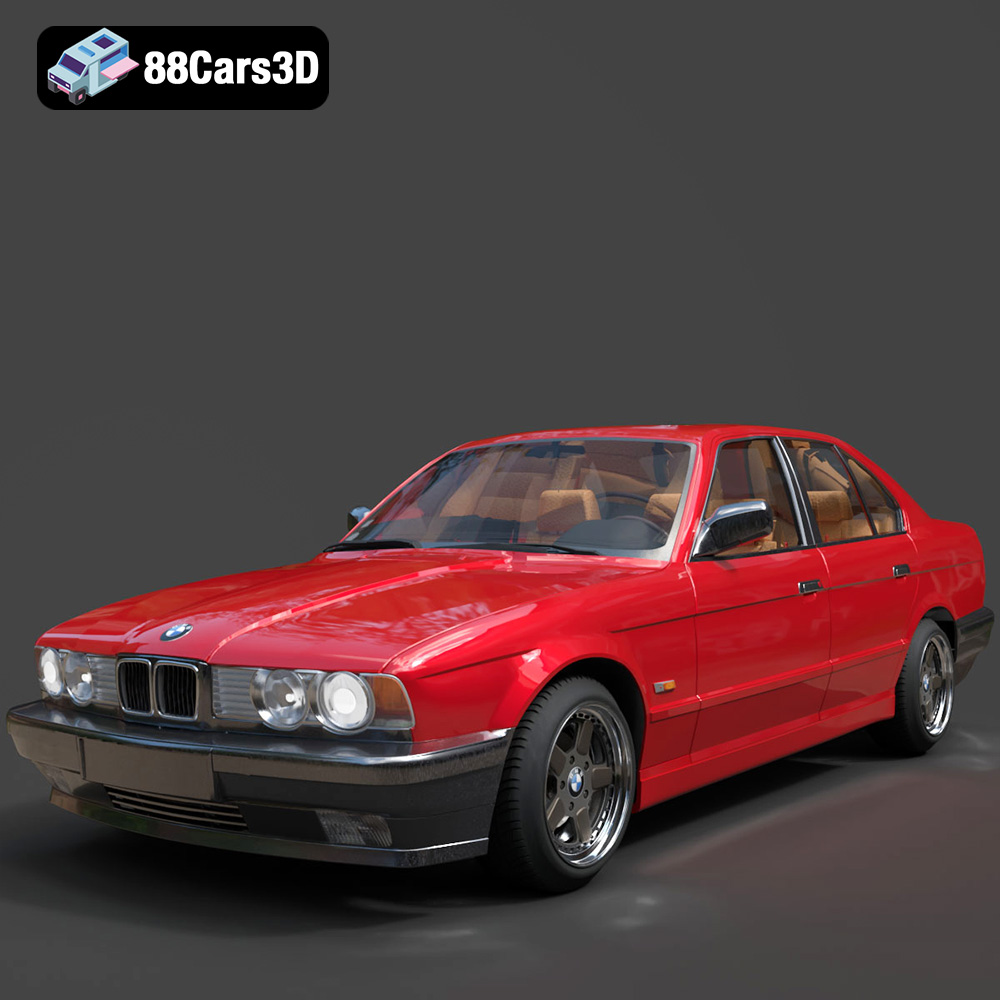
Bring the iconic German executive sedan to your projects with the highly accurate BMW 525i E34 1993 3D Model. This model captures the precision and styling of the celebrated E34 generation, suitable for close-up renders, detailed automotive visualizations, and interactive experiences. The asset features optimized, clean geometry built for performance across various platforms. Surfaces are meticulously modeled to reflect the true proportions and curvature of the original vehicle. It includes a detailed interior and realistic material definitions, ensuring photorealistic results straight out of the box.
$12.99
Product Image Gallery


Related Tags
.525i
.arvr
.blend
.bmw
.car3dmodel
.classiccar
.e34
.fbx
.gameasset
.glb
.max
.obj
.ply
.rendering
.sedan
.simulation
.stl
.unreal
