
BMW 6 Coupe E63 3D Model – Unlocking Creative Potential: The Power of High-Fidelity 3D Automotive Models

Unlocking Creative Potential: The Power of High-Fidelity 3D Automotive Models
In the fast-paced worlds of automotive design, game development, cinematic rendering, and virtual reality, the quality of your 3D assets is paramount. A truly exceptional 3D model doesn’t just look good; it’s a meticulously engineered digital twin, ready to integrate seamlessly into a multitude of professional pipelines. It’s the difference between a placeholder and a cornerstone asset that defines the visual fidelity and immersive experience of your project.
Whether you’re an architect visualizing a new urban landscape with a dynamic vehicle, a game developer crafting an immersive racing experience, or an advertiser creating a stunning product showcase, the demand for authentic, high-detail 3D car models has never been greater. These aren’t just pretty pictures; they’re intricate digital constructs designed for performance, flexibility, and stunning realism.
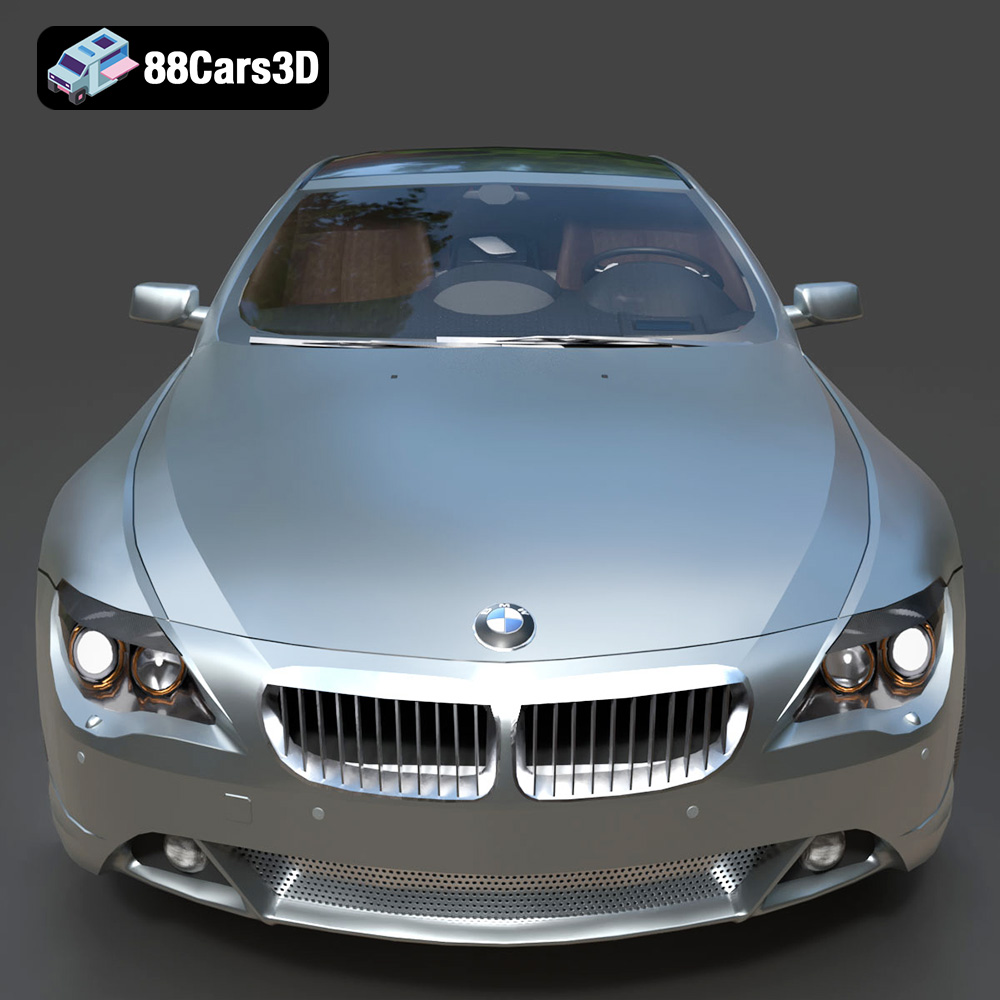
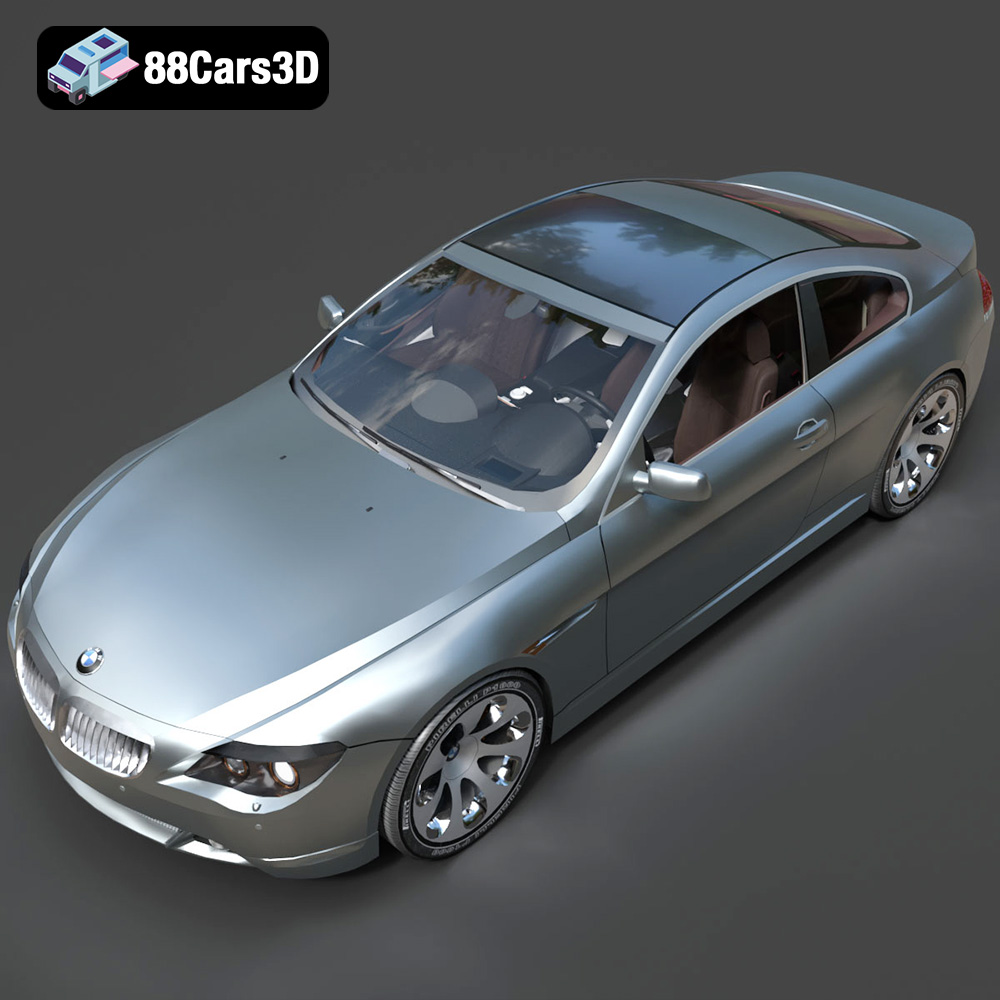
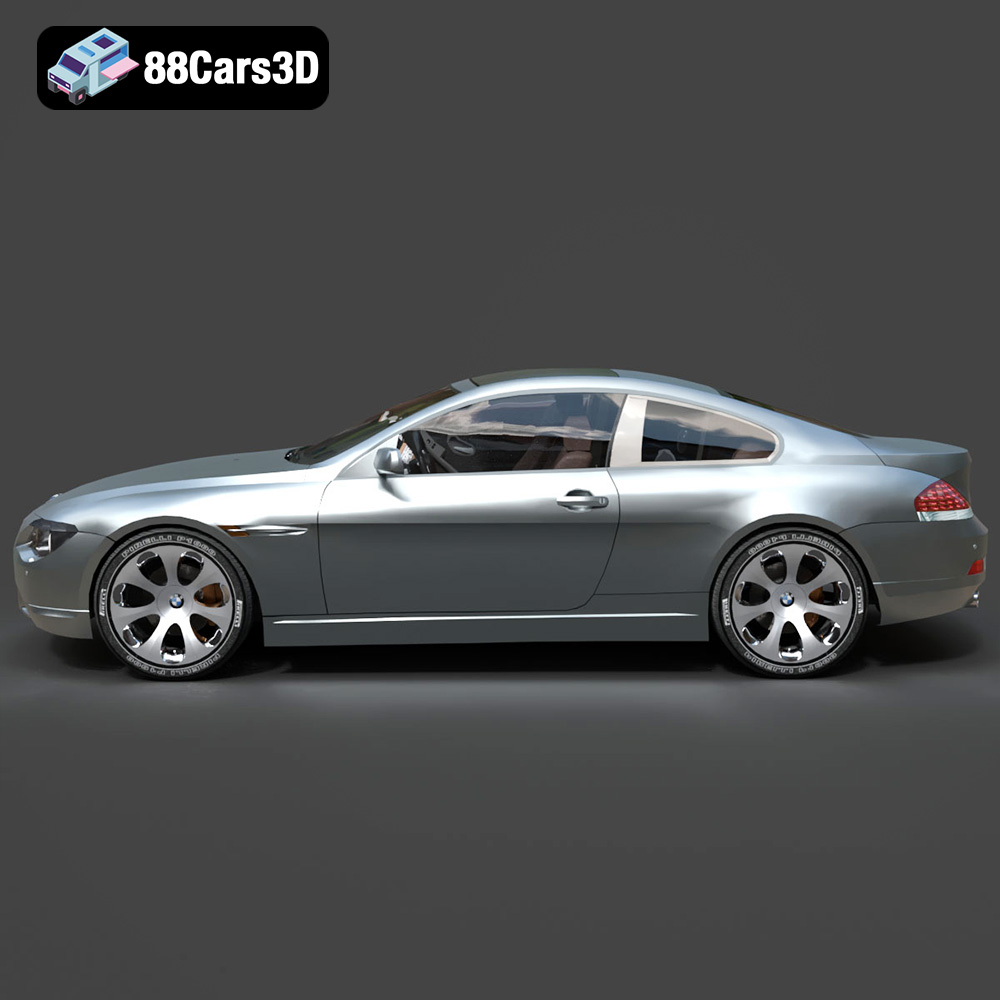
At 88cars3d.com, we understand this critical need. Our curated collection provides artists and developers with professional-grade assets, enabling them to achieve their creative visions without compromising on quality or efficiency. Take, for instance, the BMW 6 Coupe E63 3D Model. This particular model isn’t just a representation; it’s an experience. It captures the iconic luxury grand tourer’s sleek lines, assertive stance, and refined details, offering both visual fidelity and optimal performance across diverse applications. Its clean geometry, balanced detailing, and array of included file formats exemplify the standard of excellence required for today’s demanding projects.
Understanding 3D Model File Formats: The Backbone of Your Workflow
Choosing the correct 3D model file format is a critical decision that impacts workflow efficiency, compatibility, and the ultimate quality of your final output. Different formats are optimized for distinct purposes, from real-time engine integration to high-fidelity rendering or even physical production through 3D printing. Understanding these nuances is essential for any professional working with 3D car models.
.blend – The Native Blender Scene
The .blend format is Blender’s native project file. When you acquire a .blend file, you’re getting a complete Blender scene, often including materials, lighting setups, animation data, and modifiers. This format is ideal for users deeply integrated into the Blender ecosystem, providing full editability and the ability to leverage Blender’s powerful Cycles or Eevee render engines. For a model like the BMW 6 Coupe E63, the .blend file allows artists to dive straight into customization, modify topology, adjust materials, or re-rig components with ease, taking full advantage of Blender’s non-destructive workflows.
.fbx – The Industry Standard for Interoperability
.fbx (Filmbox) is arguably the most widely used interchange format in the 3D industry, especially for game development and animation. Developed by Autodesk, it’s designed to preserve a broad range of data, including geometry, animation, skinning, materials, and even camera and light information. Its robustness makes it the go-to choice for transferring assets between major 3D software packages like 3ds Max, Maya, Blender, and directly into game engines like Unreal Engine and Unity. When integrating the BMW E63 model into a real-time pipeline, the .fbx file ensures that the mesh, UVs, and hierarchical structure are maintained, minimizing conversion issues and streamlining the asset import process.
.obj – The Universal Geometry Carrier
The .obj (Wavefront OBJ) format is a truly universal standard, primarily carrying geometric data (vertices, normals, UVs, and faces). While it doesn’t typically store advanced material properties or animation, its simplicity and widespread support make it an excellent choice for cross-software compatibility. If you need to import the BMW 6 Coupe E63 into a niche 3D application or convert it to another format, .obj is a reliable intermediary. It’s also often paired with .mtl (material template library) files that define basic material colors and texture references.
.glb – Optimized for AR, VR, and Web
.glb (GL Transmission Format Binary) is quickly becoming the standard for 3D model delivery in web-based applications, augmented reality (AR), and virtual reality (VR) experiences. It’s a binary format that bundles the 3D model, textures, and animations into a single, self-contained file, making it highly efficient for streaming and display on platforms like Google’s 3D Viewer or various AR/VR SDKs. For showcasing the BMW E63 in an interactive web viewer or an AR app, the .glb format provides an optimized, lightweight, and performant solution, ensuring quick load times and smooth interaction.
.stl – The Gateway to 3D Printing
.stl (Stereolithography) is the dominant file format for 3D printing. It represents a 3D model as a series of connected triangular facets, defining the surface geometry without color or texture information. While not suitable for rendering or animation, it’s indispensable for creating physical prototypes or models. If a client desires a physical model of the BMW 6 Coupe E63, converting the mesh to .stl ensures it’s ready for slicing software and subsequent additive manufacturing processes, producing a tangible representation of the digital asset.
.ply – Precision Mesh for Analysis and CAD
The .ply (Polygon File Format) is another mesh format capable of storing more complex data than .obj, including color per vertex, normal information, and even material properties. It’s often used in scientific and engineering applications for storing 3D scan data, CAD models, and precision meshes where detailed vertex information is critical. For specialized analysis or integration into certain CAD workflows for the BMW E63, the .ply format offers a robust option for preserving intricate mesh details.
.unreal – Engine-Ready for Real-Time Environments
A native .unreal file (or an asset specifically packaged for Unreal Engine) denotes a model that has been pre-configured or exported with Unreal Engine’s specific requirements in mind. This often means optimized meshes, PBR (Physically Based Rendering) materials set up with correct textures, collision meshes, and sometimes even LODs (Levels of Detail) or basic blueprint functionality. For the BMW E63, an .unreal file dramatically accelerates the integration into an Unreal Engine project, saving countless hours on material setup and ensuring the model looks and performs as intended within the engine’s real-time rendering environment.
.max – The 3ds Max Project File
Finally, the .max format is Autodesk 3ds Max’s native project file. Similar to .blend for Blender, a .max file provides a complete 3ds Max scene, including geometry, materials, textures, lighting, cameras, and animation. This format is invaluable for professionals using 3ds Max for high-end rendering with V-Ray or Corona, detailed animation, or complex scene assembly. The .max file for the BMW 6 Coupe E63 offers full flexibility for artists to modify any aspect of the model, leverage 3ds Max’s extensive modifier stack, or integrate it into larger architectural visualization or cinematic projects.
The availability of multiple formats for the BMW 6 Coupe E63 3D model from 88cars3d.com underscores its versatility and professional-grade readiness for any pipeline.
Mastering Automotive Rendering and Visualization
Automotive rendering is an art form, demanding precision, an understanding of light physics, and mastery of 3D software. The goal is to create visuals so compelling they are indistinguishable from photographs, or to craft stylized scenes that evoke specific emotions. High-quality 3D car models are the bedrock of this process.
The Role of 3ds Max and V-Ray/Corona for Photorealism
For decades, 3ds Max has been a powerhouse in architectural visualization and product rendering, and automotive rendering is no exception. Paired with industry-leading renderers like V-Ray or Corona Renderer, 3ds Max enables artists to achieve unparalleled photorealism. The workflow typically involves importing a clean, quad-dominant model like the BMW 6 Coupe E63, then meticulously setting up materials using PBR (Physically Based Rendering) principles. This means carefully crafting textures for diffuse color, roughness, metalness, and normal maps, ensuring reflections and refractions behave authentically. Lighting is crucial, often involving HDRIs (High Dynamic Range Images) for realistic environment lighting, augmented by targeted studio lights to highlight the vehicle’s curves and details. The BMW E63’s organized hierarchy and properly set pivots are invaluable here, simplifying the process of opening doors, turning wheels, or positioning the model within a complex scene, ready for those breathtaking studio renders or cinematic sequences.
Blender’s Ascent: Eevee and Cycles for Stunning Visuals
Blender has rapidly evolved into a comprehensive 3D suite, favored by a growing community for its powerful modeling, animation, and rendering capabilities. With its Cycles renderer, Blender can produce photorealistic images on par with commercial alternatives, offering advanced features like GPU rendering and adaptive sampling. For artists needing real-time feedback, Blender’s Eevee renderer delivers stunning visuals almost instantly, making it ideal for rapid iteration and concept development. The .blend file included with the BMW 6 Coupe E63 3D Model provides a ready-to-use scene, allowing Blender artists to immediately leverage these powerful render engines to create impressive renders, modify paint finishes, or integrate custom graphics, truly elevating their creative projects.
Crafting Cinematic Sequences and Product Showcases
Beyond static images, 3D car models are essential for dynamic cinematic sequences and product showcases. Animating vehicles requires precise control over individual components. The BMW E63 model, with its separated components like doors, hood, trunk, and wheels, simplifies this process immensely. Artists can animate individual parts to demonstrate features, create engaging vehicle commercials, or populate virtual environments with realistic motion. Furthermore, accurate real-world scale dimensions ensure that the model integrates precisely into any scene, whether it’s navigating a digital city street or rotating gracefully on a virtual turntable, providing a true-to-life representation that resonates with audiences.
Optimizing 3D Car Models for Real-Time Game Development
Game development presents a unique set of challenges for 3D artists, where visual fidelity must be balanced with strict performance requirements. High-quality 3D car models, such as those found on 88cars3d.com, are developed with these considerations in mind, making them invaluable game assets.
Unreal Engine and Unity: Powering Immersive Experiences
Unreal Engine and Unity are the two titans of game development, each offering robust tools for creating interactive, real-time experiences. Integrating a 3D car model into these engines requires more than just importing a mesh; it demands optimized geometry, efficient UV mapping, and properly configured PBR materials. The .fbx format is the preferred bridge for bringing assets like the BMW 6 Coupe E63 into these engines, ensuring that mesh data, hierarchical structures, and often basic material assignments are transferred correctly. The included .unreal file specifically for the BMW E63 model further streamlines this, offering an engine-ready asset with potentially pre-configured materials and collision setups, dramatically reducing development time and ensuring consistent visual quality within the engine.
Balancing Detail and Performance: LODs and Collision Meshes
In real-time environments, every polygon and texture draw call counts. While the BMW E63 model boasts balanced detailing for visual fidelity, game developers often employ techniques like Levels of Detail (LODs) to manage performance. LODs are simplified versions of the model that automatically swap in when the vehicle is further from the camera, reducing the computational load without a noticeable drop in visual quality. Similarly, creating efficient collision meshes (simplified geometries used for physics calculations) is crucial for realistic vehicle interactions in a game world. A clean, quad-dominant topology, like that of the BMW E63, makes it easier for game artists to generate these optimized meshes, ensuring smooth physics and efficient rendering in racing games, open-world simulations, or interactive experiences.
Material Optimization and PBR Workflows
Modern game engines rely heavily on Physically Based Rendering (PBR) to achieve realistic materials. This involves a set of texture maps (albedo/base color, roughness, metalness, normal, ambient occlusion) that accurately simulate how light interacts with surfaces. When working with the BMW E63 model, game artists would typically export its textures or create PBR maps if they are not already supplied, then apply them within the engine’s material editor. This allows for realistic chrome accents, window trims, paint finishes, and interior fabrics that respond accurately to the dynamic lighting of the game environment. The ability to easily modify paint finishes or apply custom graphics ensures that the vehicle can be tailored to various in-game liveries or player customizations, expanding its utility as a versatile game asset.
Beyond the Screen: AR/VR, Simulation, and 3D Printing
The applications of high-quality 3D car models extend far beyond traditional rendering and game development, venturing into cutting-edge fields like augmented and virtual reality, advanced simulations, and even physical manufacturing.
Immersive Experiences in AR/VR
Augmented Reality (AR) and Virtual Reality (VR) are transforming how we interact with digital content, placing realistic 3D objects directly into our physical world or transporting us to entirely new ones. For automotive industries, this means virtual showrooms, interactive design reviews, or even driver training simulations. Models like the BMW 6 Coupe E63 are perfect for these applications. The .glb format, specifically optimized for AR/VR and web-based visualization, allows for seamless integration into various AR/VR platforms and browser-based viewers, delivering immersive augmented and virtual reality applications with a realistic vehicle presence. Imagine viewing the BMW E63 in your driveway through your phone’s camera, or exploring its fully detailed interior in a VR headset – the possibilities for engagement are immense.
Simulation and Training: A New Frontier
Precision 3D car models are vital for high-fidelity simulation and training environments. This includes sophisticated driver training simulators, forensic reconstruction, or advanced automotive design studies. In these scenarios, accurate real-world scale dimensions and precisely modeled components are paramount. The BMW E63 model’s attention to detail, from its accurately modeled body panels to its detailed interior, makes it an ideal candidate for such rigorous applications. Engineers can use these models to study aerodynamic flow, simulate crash impacts, or visualize ergonomic designs within a virtual cockpit, providing invaluable data and insights before physical prototypes are ever built.
From Digital Mesh to Physical Model: 3D Printing
The ability to transform a digital 3D model into a tangible physical object is one of the most exciting capabilities of modern technology. 3D printing allows designers and enthusiasts to produce detailed physical models, prototypes, or even functional parts. The .stl file format included with the BMW 6 Coupe E63 3D Model specifically caters to this application. By providing a clean, manifold mesh (a mesh without holes or self-intersections), the .stl file ensures that the model is ready for slicing software, which prepares it for various 3D printing technologies. This allows for producing detailed physical models of the vehicle, whether for display, scale models, or even custom aftermarket part prototypes, bridging the gap between the virtual and physical realms.
The Workflow Advantage: Integrating Professional 3D Models into Your Pipeline
Efficiency is key in any professional creative pipeline. A high-quality 3D car model isn’t just about aesthetics; it’s about how well it integrates into existing workflows, saving time and resources. The BMW 6 Coupe E63 3D Model exemplifies these technical advantages.
Clean Topology and Subdivision Ready
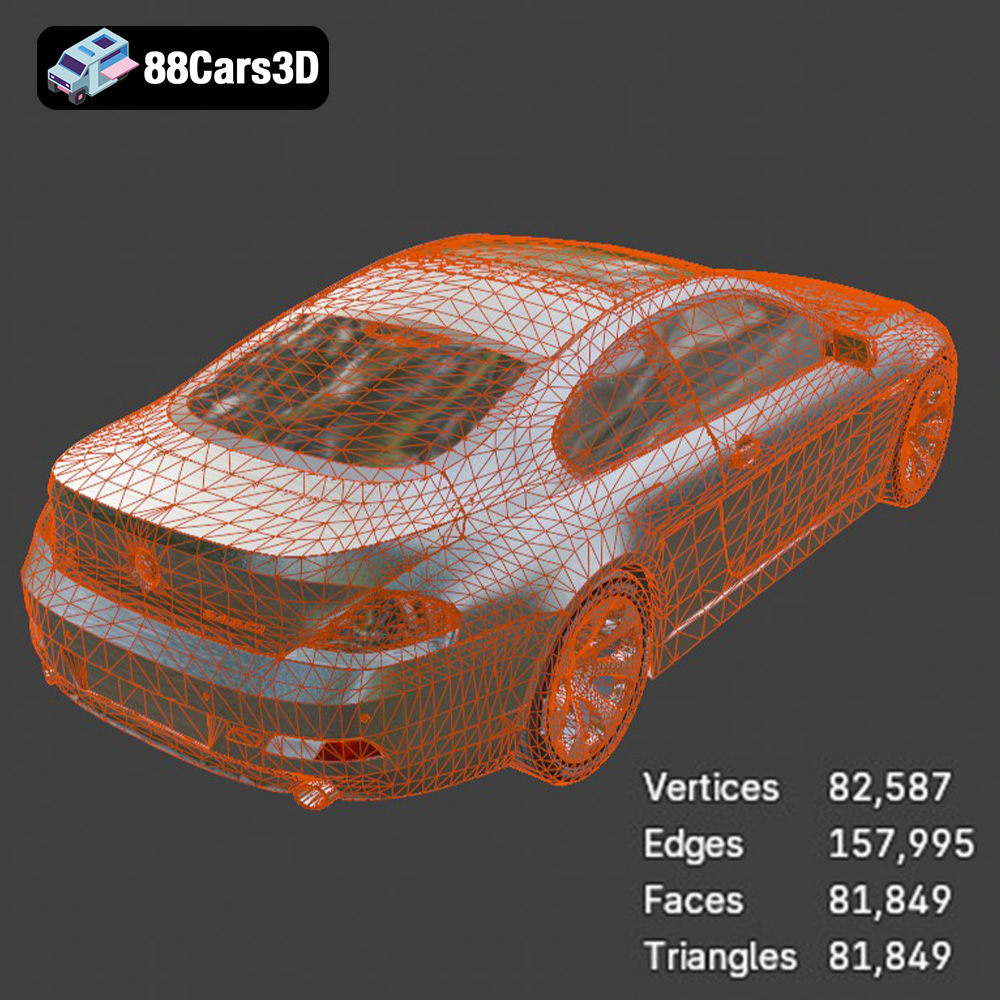
One of the most significant advantages of a professional 3D model is its clean, quad-dominant topology. This refers to the arrangement of polygons, where faces are primarily made of four vertices. Quad topology is crucial because it allows for smooth subdivision (adding more detail to the mesh without distorting its shape) and easy modifications. For the BMW E63, this means artists can effortlessly increase the mesh density for extreme close-ups in high-end renders or simplify it for game engine optimization, all while maintaining the integrity of its sleek lines and complex curves. This flexibility is a hallmark of truly professional 3D car models, ensuring they remain versatile throughout a project’s lifecycle.
Accurate Real-World Scale and Organized Hierarchy
Integration into any scene requires precise dimensions. The BMW E63 model is built with accurate real-world scale, ensuring it fits perfectly into architectural visualizations, urban simulations, or automotive photography scenes without needing manual resizing. Furthermore, an organized hierarchy with properly set pivots for individual components (like doors, wheels, and steering wheel) is a massive time-saver for animators. This intuitive setup allows for easy animation and manipulation, eliminating the tedious process of realigning pivot points or grouping components, accelerating the animation workflow for vehicle cinematics or interactive experiences. This attention to structural detail significantly enhances usability across diverse applications.
Customization and Flexibility for Diverse Artistic Visions
Professional projects often demand unique artistic interpretations. A versatile 3D model like the BMW 6 Coupe E63 empowers artists with extensive customization options. Easily modifying paint finishes, applying custom graphics, or creating unique livery designs is straightforward due to well-structured UVs and material setups. Artists can adjust material properties for metals, chrome, rubber, glass, and interior fabrics to suit specific artistic visions, whether aiming for a gritty, weathered look or a pristine, showroom finish. The ability to integrate the model into diverse lighting setups further enhances this flexibility, allowing creators to achieve varied moods and environments, making the BMW E63 an invaluable asset for any demanding visualization or interactive application.
Conclusion: Elevating Your Projects with Premium 3D Car Models
The journey from concept to a stunning final render or an immersive interactive experience is complex and demanding. The quality of your 3D assets can either be a seamless facilitator or a frustrating bottleneck. As we’ve explored, high-fidelity 3D car models are not just about visual appeal; they are technical marvels, engineered for performance, versatility, and professional integration across a spectrum of industries.
From the critical importance of understanding various file formats like .blend, .fbx, and .unreal for specific workflows, to the meticulous process of automotive rendering in 3ds Max or Blender, and the performance optimizations required for game development in Unreal Engine or Unity, every aspect underscores the value of a professionally crafted asset. Beyond traditional applications, these models are driving innovation in AR/VR, advanced simulations, and even bringing digital designs to life through 3D printing.
The BMW 6 Coupe E63 3D Model from 88cars3d.com stands as a testament to these principles. Its clean, quad-dominant topology, accurate real-world scale, organized hierarchy, and comprehensive suite of included file formats make it an exceptional choice for any professional seeking to elevate their creative projects. Investing in such a high-quality 3D car model means investing in efficiency, flexibility, and the ability to realize your most ambitious visions without compromise. Explore the possibilities and enhance your digital library with premium assets from 88cars3d.com, where precision meets passion.
Featured 3D Model
BMW 6 Coupe E63 3D Model
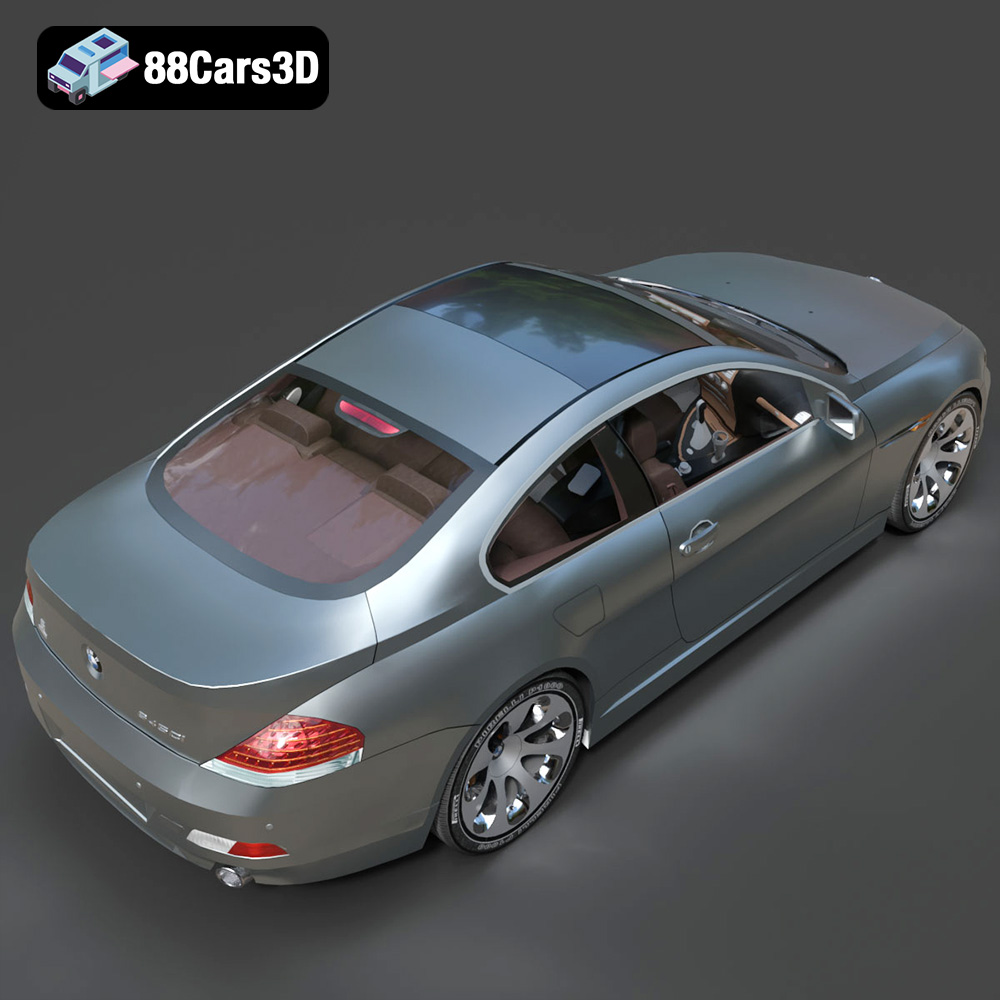
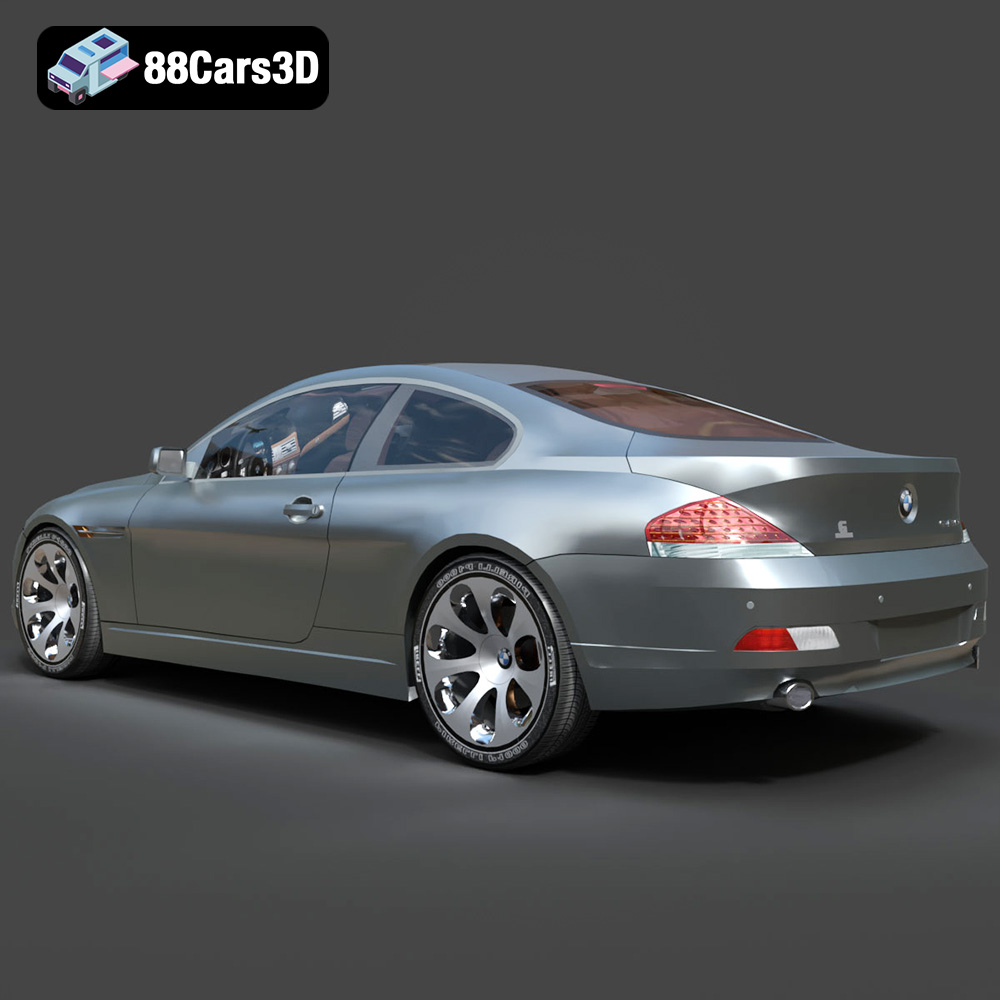
Experience the elegance and dynamic performance of the BMW 6 Coupe E63 with this meticulously crafted 3D model. Representing the iconic luxury grand tourer, this model captures the sleek lines, assertive stance, and refined details of the E63 generation. Built with clean geometry and balanced detailing, it offers both visual fidelity and optimal performance. Ideal for professional rendering, immersive animation, realistic simulations, and high-quality game development projects.
Exterior Features:
- Accurately modeled body panels and aerodynamics
- Detailed headlights, tail lights, and fog lamps with transparent materials
- Authentic BMW kidney grille and badging
- Realistic wheels and tires with proper tread patterns
- Separated components like doors, hood, trunk, and wheels for easy animation workflows
- Chrome accents and window trims for enhanced realism
Interior / Mechanical Features:
- Fully detailed interior including dashboard, steering wheel, seats, and center console
- Precisely modeled door panels and interior trim
- Optimized mesh quality for efficient rendering of interior scenes
Technical Advantages:
- Clean, quad-dominant topology for smooth subdivision and easy modifications
- Accurate real-world scale dimensions for precise integration into any scene
- Organized hierarchy with properly set pivots for intuitive animation and manipulation
Applications:
- Rendering & Visualization: Create stunning studio renders, cinematic sequences, and product showcases
- Game Development: Integrate as a high-fidelity asset in racing games, open-world simulations, or interactive experiences
- AR/VR: Develop immersive augmented and virtual reality applications with realistic vehicle presence
- Simulation & Training: Utilize for automotive design studies, driver training simulators, or forensic reconstructions
- 3D Printing: Convert to .stl for producing detailed physical models of the vehicle
Customization Options:
- Easily modify paint finishes, apply custom graphics, or create unique livery designs
- Adjust material properties for metals, chrome, rubber, glass, and interior fabrics to suit specific artistic visions
- Integrate into diverse lighting setups to achieve varied moods and environments
Elevate your creative projects with the BMW 6 Coupe E63 3D model. Its professional quality, versatile design, and comprehensive feature set make it an invaluable asset for any demanding visualization or interactive application.
Included File Formats:
- .blend – Blender project with materials
- .fbx – Compatible with Unreal, Unity, and major 3D engines
- .obj – Universal format for nearly all 3D software
- .glb – Optimized for AR, VR, and web-based visualization
- .stl – Ready for 3D printing
- .ply – Mesh format for analysis and CAD workflows
- .unreal – Unreal Engine project setup
- .max – Editable 3ds Max scene for rendering and animation
Tags:
.bmw,.6coupee63,.coupe,.luxurycar,.sportscar,.rendering,.simulation,.gameasset,.arvr,.blend,.fbx,.obj,.glb,.stl,.ply,.unreal,.max
$10.79
Product Image Gallery


Related Tags
.6coupee63
.arvr
.blend
.bmw
.coupe
.fbx
.gameasset
.glb
.luxurycar
.max
.obj
.ply
.rendering
.simulation
.sportsCar
.stl
.unreal
