⚡ FLASH SALE: Get 60% OFF All Premium 3D & STL Models! ⚡

In today’s visually driven world, the demand for stunningly realistic and highly detailed 3D car models spans far beyond niche artistic endeavors. From blockbuster game titles and cinematic advertisements to cutting-edge architectural visualizations and advanced engineering simulations, precise digital representations of vehicles are fundamental. They serve as the bedrock upon which entire virtual worlds, compelling narratives, and immersive experiences are built. The quality of these 3D assets directly impacts the realism, performance, and overall impact of any project.
Whether you’re an automotive designer visualizing a new concept, a game developer populating an open world, an architect integrating vehicles into a scene, or a marketing professional crafting a product launch, the availability of professional-grade 3D car models is paramount. It saves countless hours in production, ensures consistency, and allows artists and developers to focus on creativity rather than foundational asset creation. This comprehensive guide delves into the technical intricacies, diverse applications, and critical considerations when working with high-quality 3D car models, highlighting why a reliable source like 88cars3d.com is essential for industry professionals.
The pursuit of photorealism and immersive experiences in digital media hinges significantly on the fidelity of its assets. For anything involving vehicles, the quality of your 3D car models is not just a preference; it’s a necessity. Poorly modeled or unoptimized assets can cripple performance, break immersion, and ultimately undermine the credibility of an entire project.
Automotive design is an iterative process, and 3D car models are at its heart. Before a single physical prototype is built, designers rely on these digital representations to refine aesthetics, test ergonomics, and even conduct aerodynamic simulations. High-polygon models, often boasting millions of polygons, capture every curve, vent, and seam with exquisite detail, providing an accurate canvas for material studies and lighting tests. This precision allows for detailed renders that are virtually indistinguishable from photographs, crucial for marketing materials, presentations, and design reviews.
For architects and urban planners, integrating realistic vehicles into renders of buildings and cityscapes adds context, scale, and a sense of life. A meticulously detailed car can elevate a scene from a mere blueprint to a living environment, offering a deeper understanding of spatial relationships and aesthetic impact. Without high-quality models, the illusion can quickly break, detracting from the overall presentation.
Time is a valuable commodity in any production pipeline. Creating a complex car model from scratch can take hundreds of hours, even for experienced artists. Sourcing pre-made, high-quality 3D car models significantly streamlines workflows across various industries. For game developers, this means faster level design and content population; for advertising agencies, quicker turnaround on campaign visuals; and for animators, more time dedicated to storytelling and camera work.
Furthermore, well-constructed models often come with optimized UV mapping, clean topology, and correctly applied PBR (Physically Based Rendering) materials, which are ready for immediate integration. This “production-ready” aspect minimizes the need for extensive post-purchase cleanup or re-texturing, ensuring that projects stay on schedule and within budget. Leveraging expertly crafted assets ensures a consistent level of quality throughout a project, allowing teams to scale their efforts more effectively.
The world of 3D modeling relies on a diverse ecosystem of file formats, each with its strengths, weaknesses, and ideal use cases. Choosing the correct format for your project is crucial for compatibility, performance, and preserving the integrity of your 3D car models. Understanding these formats is a cornerstone of efficient 3D production.
The .blend file format is native to Blender, the powerful open-source 3D creation suite. A .blend file is a complete package, containing not just the 3D mesh data but also materials, textures, lighting setups, animation data, camera information, modifiers, and even scene layouts. It’s ideal for artists who primarily work within Blender or for projects that will undergo significant customization and iteration within the software. The key advantage is that it preserves all aspects of the Blender scene, making it fully editable and allowing for non-destructive workflows. However, its native nature means direct compatibility outside of Blender can be limited without export.
Developed by Autodesk, the .fbx format has become the de facto industry standard for 3D data exchange, especially between different 3D software packages and game engines. It supports geometry, materials, textures, animations, skinning, and camera data. Its strength lies in its broad adoption, making it excellent for transferring complex scenes with animations from 3ds Max or Maya into Unreal Engine, Unity, or other applications. When working with 3D car models for game development or real-time visualization, .fbx is often the preferred choice due to its robust support for skeletal animation and efficient data handling.
The .obj (Wavefront OBJ) format is one of the oldest and most widely supported 3D file formats. It’s a universal format known for its simplicity and excellent cross-software compatibility. An .obj file primarily stores geometry data (vertices, normals, UVs, faces) and can reference external .mtl (material library) files for basic material properties. While it doesn’t support animation or advanced scene data like lights or cameras, its ubiquity makes it perfect for sharing raw mesh data between almost any 3D application. For simple static 3D car models where only geometry is needed, .obj is a reliable choice.
The .glb (GL Transmission Format Binary) is the binary version of glTF, an open-standard, royalty-free specification for 3D scenes and models. .glb files are highly optimized for efficiency and compactness, making them ideal for web-based 3D applications, augmented reality (AR), virtual reality (VR), and mobile experiences. A .glb file encapsulates geometry, materials, textures, and even animations into a single, self-contained file. Its focus on efficient transmission and runtime loading makes it a perfect format for interactive 3D car models on websites or in AR/VR showrooms.
The .stl (STereoLithography) format is the standard file type for 3D printing. It represents a 3D model as a series of connected triangles, describing only the surface geometry of an object without color, texture, or material information. While it lacks aesthetic data, its simplicity is precisely what makes it effective for rapid prototyping and manufacturing. If your goal is to physically manifest a 3D car model, .stl is the format you will need to prepare for your 3D printer.
The .ply (Polygon File Format) is another widely used format, particularly in applications involving 3D scanning, point clouds, and scientific data. It can store not only geometry but also color, transparency, and often confidence values, making it excellent for representing real-world scanned data with high fidelity. While less common for artistic 3D car models directly, it’s invaluable for reverse engineering existing vehicles or integrating precise scanned components into a CAD workflow.
While not a direct export format from DCC software, when assets are imported into Unreal Engine, they become part of the engine’s proprietary asset system, often referred to conceptually as “.unreal” assets within the project structure. These are engine-ready assets specifically optimized for real-time environments. Importing a well-prepared .fbx file of a 3D car model into Unreal Engine transforms it into an engine-optimized mesh, complete with materials, collision data, and level of detail (LOD) settings, ready for immediate use in interactive simulations, games, and cinematics. 88cars3d.com often provides models pre-configured for this pipeline.
The .max file format is the native scene file for Autodesk 3ds Max, a leading software for 3D modeling, animation, and rendering. Similar to .blend, a .max file encapsulates the entire scene, including geometry, lights, cameras, materials, textures, animations, and render settings. It’s the go-to format for professionals who use 3ds Max for high-end automotive rendering, detailed architectural visualization, and complex animation projects. It offers full editability and access to all of 3ds Max’s powerful features, making it indispensable for advanced customization and sophisticated scene setups.
Automotive rendering is an art form that transforms static 3D car models into dynamic, photorealistic images or animations. It’s where technical proficiency meets artistic vision, utilizing advanced lighting, shading, and camera techniques to evoke emotion and showcase design.
Achieving photorealism involves meticulous attention to detail. This starts with the 3D car model itself – a clean mesh, perfectly unwrapped UVs, and accurate proportions are non-negotiable. Then comes the material definition, typically using PBR workflows that simulate how light interacts with surfaces in the real world (e.g., metallic paint, rubber tires, glass, leather interiors). Environment lighting, often using HDRI (High Dynamic Range Image) maps, plays a crucial role in casting realistic reflections and soft shadows, grounding the car within its surroundings. Post-processing in tools like Photoshop can further enhance the image with color grading, depth of field effects, and atmospheric touches, pushing the render closer to photographic perfection.
Beyond still images, automotive rendering extends to dynamic animations. This involves keyframing camera paths, animating car components (like opening doors or spinning wheels), and integrating the vehicle into animated environments. Sophisticated techniques such as motion blur, depth of field transitions, and dynamic lighting further enhance the cinematic quality. For high-fidelity output, render farms are often employed to handle the computational demands of rendering complex animations, ensuring smooth playback and consistent visual quality across every frame.
The choice of software and renderer significantly impacts the workflow and final output quality.
To truly sell realism, advanced shading and texturing are vital. PBR (Physically Based Rendering) material workflows are standard, where textures like Albedo, Normal, Roughness, Metallic, and Ambient Occlusion define how light interacts with the surface. For extremely high-resolution models, especially vehicles with intricate details like dashboards or engine bays, UDIM (U-Dimension) texturing allows artists to use multiple UV tiles per object, preventing texture resolution limitations and ensuring crisp details even in close-up shots. Properly applied decals, dirt maps, and subtle imperfections add to the authenticity, preventing the car from looking “too perfect” and digital.
The demands of real-time environments, such as video games and interactive simulations, are distinctly different from offline rendering. Here, performance is king, and every polygon, texture, and shader must be optimized without sacrificing visual quality. High-quality 3D car models are indispensable for creating immersive game worlds.
Game engines must render frames at a rapid pace (e.g., 60 frames per second), which necessitates rigorous optimization. A critical technique is Level of Detail (LOD). This involves creating multiple versions of a 3D car model, each with a progressively lower polygon count. When the car is close to the camera, the highest detail LOD is rendered; as it moves further away, lower detail versions are swapped in, significantly reducing GPU load without noticeable loss of quality to the player. Game developers also work within strict poly budgets, often aiming for specific polygon counts for vehicle models (e.g., 50,000-150,000 triangles for a hero car, down to a few thousand for background traffic). Efficient UV mapping and texture packing are also crucial to minimize draw calls and memory footprint.
Once a 3D car model is optimized, it needs to be properly set up within the game engine. For Unreal Engine, this often means importing an .fbx file, creating appropriate PBR materials, setting up skeletal meshes for animations (like suspension movement or opening doors), and configuring the asset’s properties. Unity follows a similar pipeline, with specific tools for importing and configuring models, textures, and animations. Both engines require careful attention to material instances, shader complexity, and asset management to ensure smooth integration and optimal performance. For complex vehicles, modular approaches are often used, separating wheels, doors, and interior components for easier animation and customization.
For interactive vehicles, collision detection and physics simulation are vital. A separate, simplified collision mesh is typically created for each 3D car model. This mesh, often a low-polygon approximation of the visual model, is used by the game engine’s physics system to detect impacts with other objects or the environment. Using the detailed visual mesh for collision would be too computationally expensive. Furthermore, robust vehicle physics systems within engines like Unreal and Unity allow developers to define parameters for suspension, tire grip, engine power, and weight distribution, enabling realistic driving experiences. High-quality 3D car models from 88cars3d.com often come with clean topology suitable for creating these crucial collision meshes.
Acquiring a high-quality 3D car model is just the first step. Integrating it seamlessly into your specific project requires an understanding of practical workflows, involving customization, optimization, and export strategies tailored to your target application.
Even the most perfectly crafted 3D car model may need modifications to fit a project’s unique requirements. In software like 3ds Max or Blender, artists can make a myriad of changes. This could involve adjusting the vehicle’s stance, modifying specific body panels, adding custom accessories (like spoilers or roof racks), or even converting a coupe into a convertible. Materials might need to be tweaked to match a specific brand color palette, or logos could be added via decals. For models with clean topology, these modifications are straightforward. For instance, using subdivision surface modeling in Blender allows for smooth, precise adjustments without sacrificing detail. In 3ds Max, tools like FFD modifiers or mesh editing tools offer similar flexibility.
When preparing a customized 3D car model for real-time applications like games or AR/VR, the export process is critical. This typically involves several steps:
Each step requires careful consideration to balance visual fidelity with real-time performance, ensuring the asset is ready for deployment.
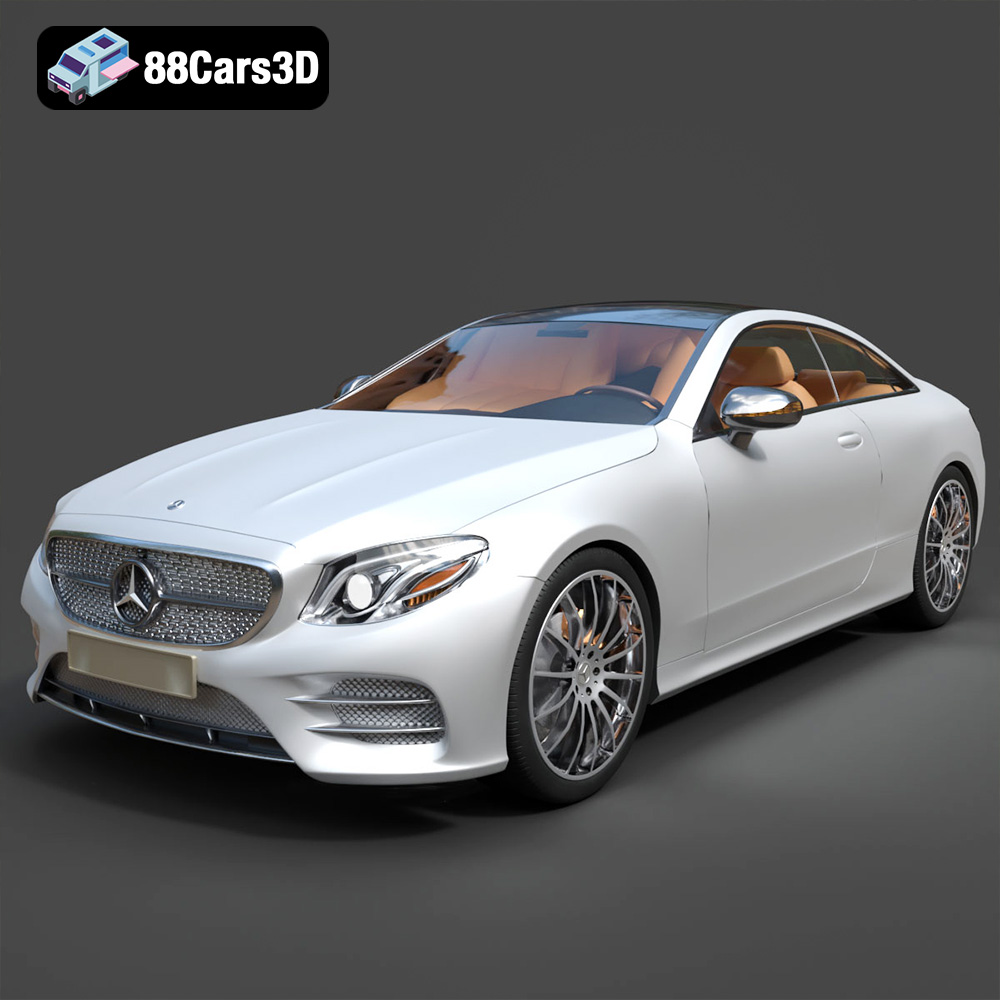
Consider an advertising agency tasked with launching a new luxury electric vehicle. They acquire a highly detailed 3D car model from 88cars3d.com, delivered in both .max and .fbx formats. The .max file is loaded into 3ds Max for the primary rendering work. Artists then set up a studio environment, utilizing HDRI lighting and carefully crafted material shaders to achieve photorealistic reflections on the car’s paintwork and glass. High-resolution texture maps define the intricate details of the interior leather and carbon fiber trims. For the animated sequences, camera moves are meticulously choreographed to highlight the car’s sleek lines and advanced features. The .fbx version is simultaneously imported into Unreal Engine for creating interactive web configurators, allowing potential buyers to explore color options and interior features in real-time. This dual-pronged approach showcases how a single, high-quality asset can serve multiple marketing channels with exceptional results.
The digital automotive landscape is continually evolving, with emerging technologies like augmented reality (AR), virtual reality (VR), and the metaverse opening up unprecedented opportunities for interaction with 3D car models. These frontiers demand even greater sophistication and optimization from digital assets.
AR and VR are transforming how we interact with vehicles. Imagine stepping into a virtual showroom and walking around a car that doesn’t physically exist, examining every detail as if it were real. Or, using AR on your smartphone, placing a full-scale 3D car model in your driveway to see how it looks before committing to a purchase. These immersive experiences require exceptionally optimized models (often in .glb format) that can load quickly and render smoothly on mobile devices or VR headsets. The challenge lies in delivering photorealistic quality within the strict performance constraints of these real-time platforms.
The metaverse promises persistent, shared virtual spaces where digital assets will have real value and utility. 3D car models will be central to this, serving as vehicles for navigation, status symbols, and objects of commerce. Virtual showrooms will allow users to customize their dream car in intricate detail, perhaps even taking it for a virtual test drive before purchasing a real-world counterpart. These configurators demand highly modular 3D car models with extensive customization options, where components like wheels, paint colors, and interior trim can be swapped out dynamically. The ability to integrate these models seamlessly into diverse metaverse platforms will be a key differentiator for brands and creators alike.
The journey from a blank canvas to a stunningly rendered image or an interactive game asset is complex, but it begins with the quality of the raw materials. High-fidelity 3D car models are the indispensable backbone for success in automotive rendering, game development, AR/VR, and countless other visualization tasks. They not only elevate the visual appeal of a project but also drive efficiency, consistency, and enable deeper immersion for audiences.
Understanding the nuances of file formats, optimization techniques, and rendering workflows empowers creators to unlock the full potential of these digital assets. As technology continues to push the boundaries of realism and interactivity, the demand for expertly crafted 3D car models will only grow. For professionals seeking an expansive library of production-ready, high-quality assets across various formats, 88cars3d.com stands as a premier destination, providing the foundational excellence needed to bring any digital automotive vision to life.

Price: $129.99

Price: $99.99

Price: $89.99