⚡ FLASH SALE: Get 60% OFF All Premium 3D & STL Models! ⚡

In today’s visually driven world, the demand for highly realistic and technically accurate 3D assets spans across an incredible array of industries. From cinematic automotive rendering to intricate game development, and from immersive AR/VR experiences to precise 3D printing, the foundational element is always a meticulously crafted 3D model. These digital creations are far more than just pretty pictures; they are robust, versatile data packages designed to perform across diverse platforms and applications.
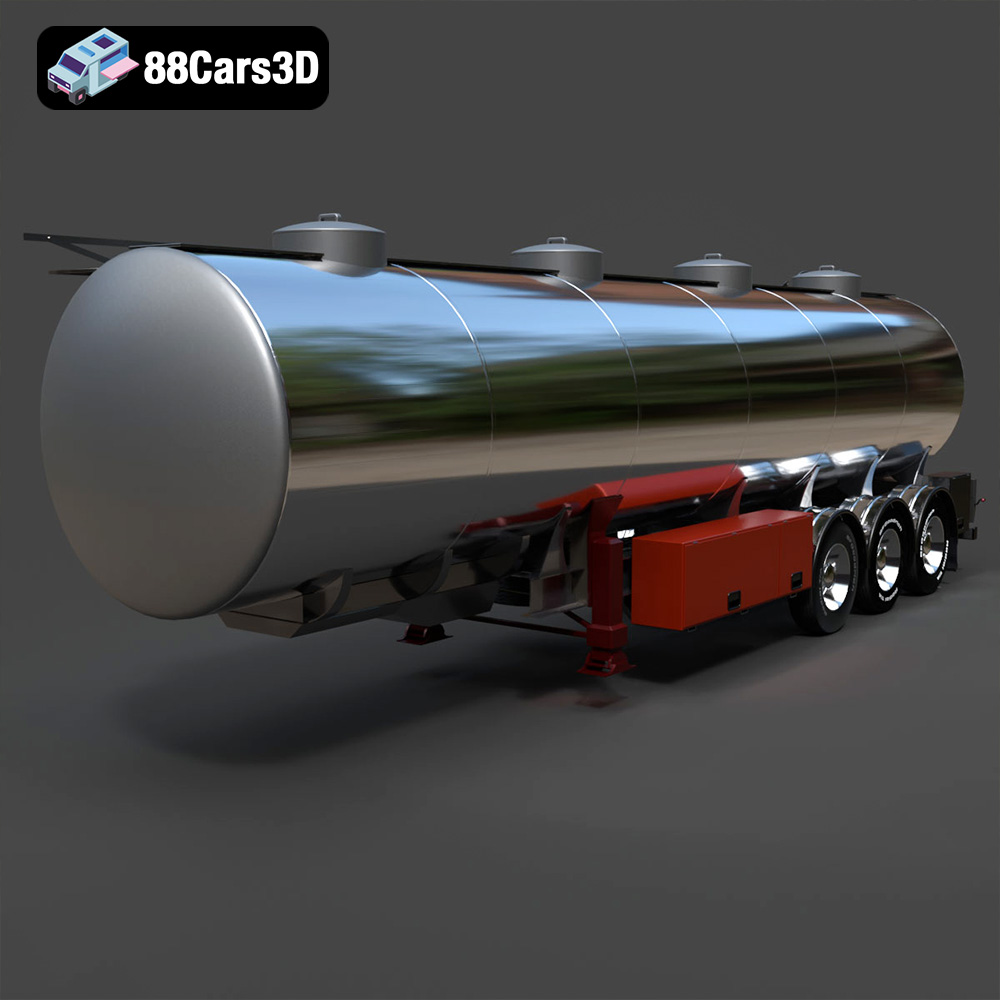
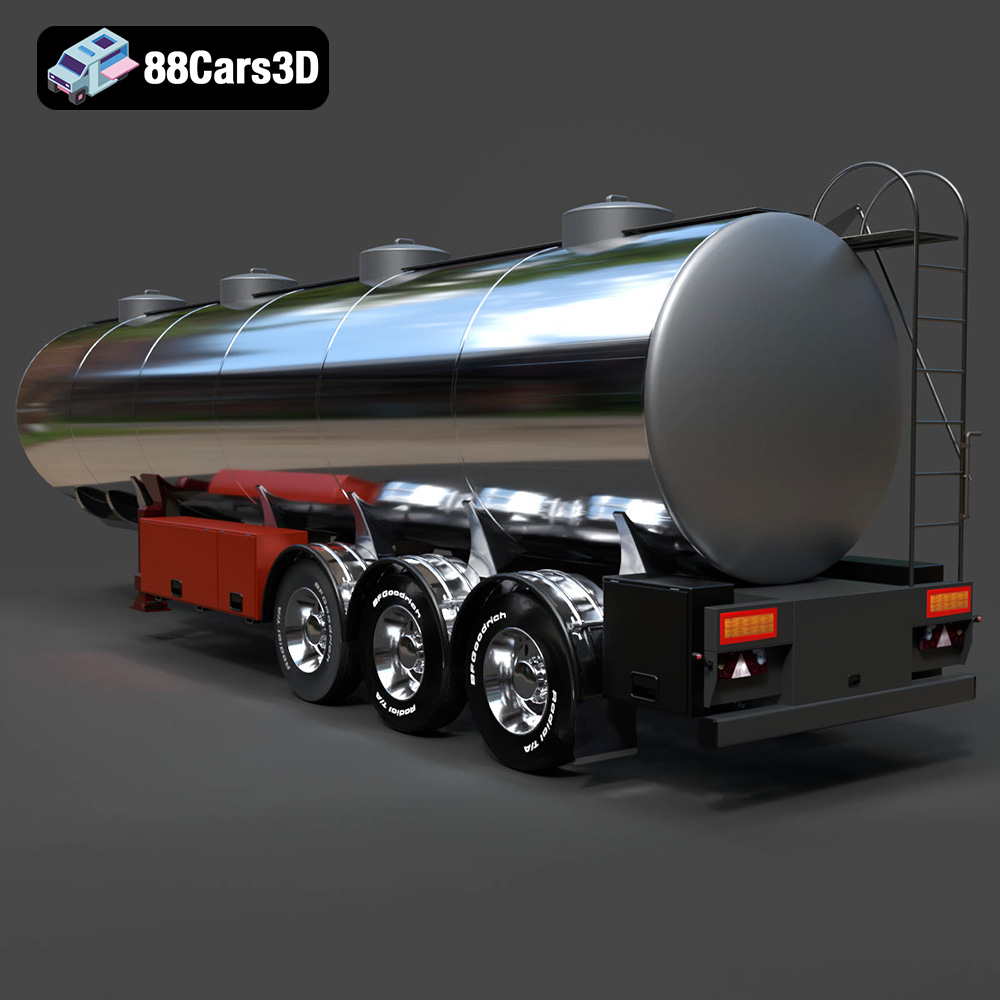
One excellent example of such a specialized asset, engineered for both aesthetic quality and technical utility, is the Fuel Tank Trailer 3D Model. This high-detail digital recreation of a heavy-duty tanker trailer is designed for transporting fuel and liquid petroleum products, reflecting real-world structural integrity and cylindrical tank design. Whether you’re building a new simulation, crafting compelling marketing visuals, or prototyping a physical model, the quality and versatility of your base asset are paramount. This model, available through platforms like 88cars3d.com, exemplifies how specialized assets can streamline complex projects and elevate visual fidelity across the board.
The choice of file format for a 3D model is not merely a preference; it’s a critical technical decision that dictates compatibility, performance, and the scope of manipulation within different software environments and pipelines. The Fuel Tank Trailer 3D Model is exceptionally versatile, offering a wide range of formats to suit nearly any professional workflow. Understanding each format’s strengths is key to maximizing its utility.
The .blend format is Blender’s native file type. It’s a powerhouse, encapsulating an entire Blender scene with not just the mesh data, but also materials, textures, lighting, cameras, animations, physics simulations, and even custom scripts. For artists and studios primarily working within Blender, this format is indispensable as it provides a fully editable, robust project file. When you acquire the Fuel Tank Trailer as a .blend file, you gain immediate access to all its layered components, allowing for deep customization, material adjustments, or animation setup directly within your Blender environment without any loss of data fidelity during conversion.
.fbx (Filmbox) is arguably the most widely adopted proprietary 3D file format for exchanging 3D data between different software applications. Developed by Autodesk, it excels at storing not only mesh geometry but also critical information like materials, textures, animations, rigging, and even camera data. It’s the go-to format for real-time pipelines, making it ideal for direct import into game engines like Unreal Engine and Unity. For the Fuel Tank Trailer, the .fbx format ensures that its separate wheels, chassis, and detailed components retain their pivot points and hierarchical structure, making it ready for animation or complex scene assembly in diverse 3D packages.
.obj (Wavefront OBJ) is a universal, open-standard file format that has been a cornerstone of 3D modeling for decades. Primarily, it stores geometric data – vertices, faces, normals, and UV coordinates – and can reference external material definition files (.mtl) for basic color and texture mapping. While it doesn’t support animation or complex scene data, its widespread compatibility makes it an excellent choice for static mesh exchange between virtually any 3D software. The Fuel Tank Trailer in .obj format provides a clean, reliable mesh that can be imported and textured in almost any 3D application, making it a dependable backup or starting point for new projects.
.glb is the binary representation of the glTF (GL Transmission Format) spec, designed for efficient transmission and loading of 3D scenes and models by applications. It’s quickly becoming the standard for 3D web content, AR, and VR experiences due to its compact size and comprehensive support for geometry, materials, textures, and animations in a single file. For the Fuel Tank Trailer, a .glb file would be perfectly optimized for quickly displaying the model in browser-based configurators, augmented reality apps for fleet visualization, or light VR training scenarios.
.stl (Stereolithography) is the most common file format for 3D printing. It describes only the surface geometry of a 3D object using a collection of interconnected triangles. For successful 3D printing, an .stl file must represent a “manifold” geometry, meaning it’s a completely enclosed volume without holes or overlapping faces. The Fuel Tank Trailer, when provided as an .stl, is ready to be sliced and printed, enabling the creation of physical scale models, prototypes, or display miniatures. This format is crucial for users looking to bring the digital asset into the tangible world.
.ply (Polygon File Format) is often used to store data from 3D scanners, providing a rich description of a 3D object’s surface with color, transparency, normals, and even texture coordinates. It supports both triangular and quadrangular faces and can store point cloud data. While less common for general 3D asset exchange than .fbx or .obj, it’s a precision mesh format valuable for applications requiring high fidelity data, such as reverse engineering, CAD integration, or detailed mesh analysis. The Fuel Tank Trailer in .ply could be used for precise measurement or integration into engineering workflows.
The .unreal designation typically refers to assets specifically packaged or optimized for direct use within Unreal Engine projects. This might involve optimized mesh geometry, pre-configured materials, collision meshes, LODs (Levels of Detail), and blueprints. While .fbx is often used for import, an .unreal file or package indicates that the asset has already gone through the engine’s import pipeline and is ready for immediate deployment, saving significant setup time. For the Fuel Tank Trailer, an .unreal asset would mean seamless integration into your truck simulators or industrial visualization projects within Unreal Engine.
Like .blend for Blender, .max is the native file format for Autodesk 3ds Max, a leading software in architectural visualization, design, and animation. A .max file contains the complete scene data, including all models, materials, textures, lighting, cameras, animation keyframes, and modifiers. For professionals relying on 3ds Max for complex automotive rendering or animation, the .max version of the Fuel Tank Trailer offers the highest level of editability and integration into their existing 3ds Max workflows.
Creating a 3D model that transcends basic representation requires a deep understanding of both aesthetics and engineering. The Fuel Tank Trailer 3D Model from 88cars3d.com is a testament to this philosophy, engineered for realism and industrial accuracy, reflecting the structural integrity and design of real-world logistics vehicles.
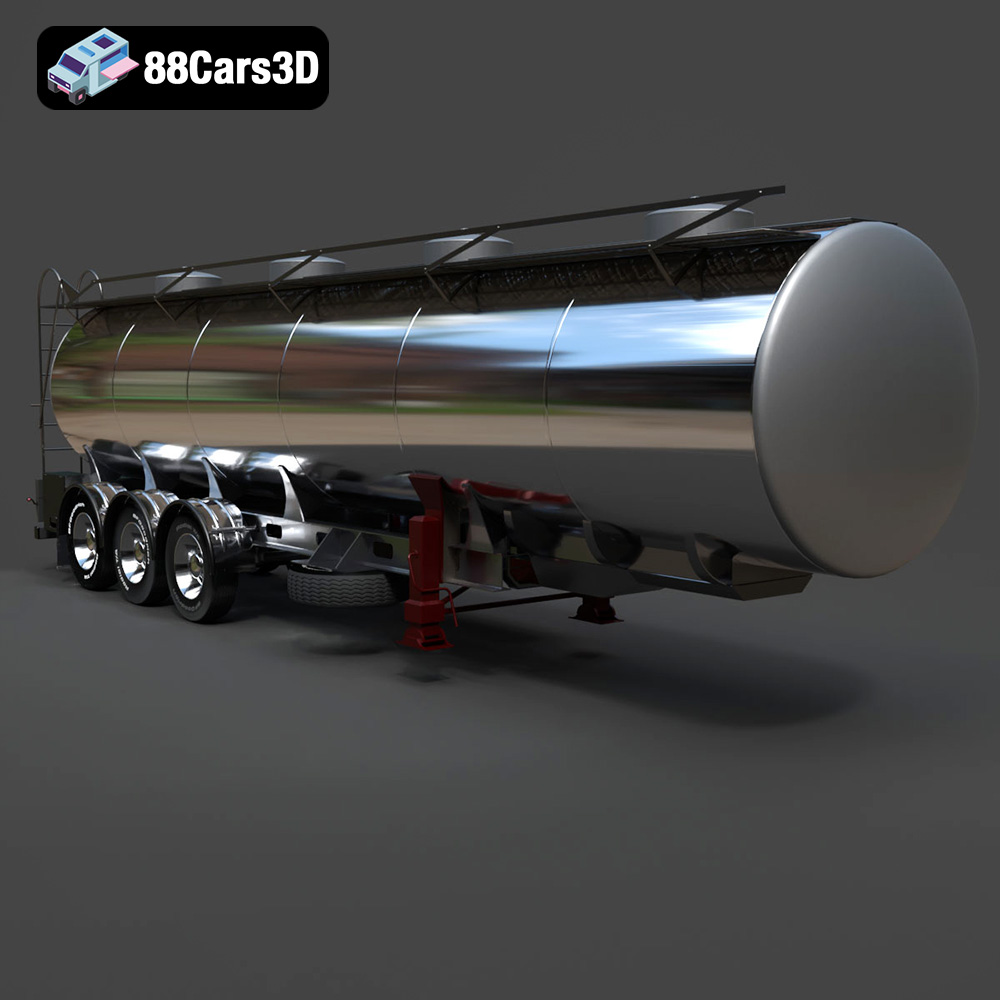
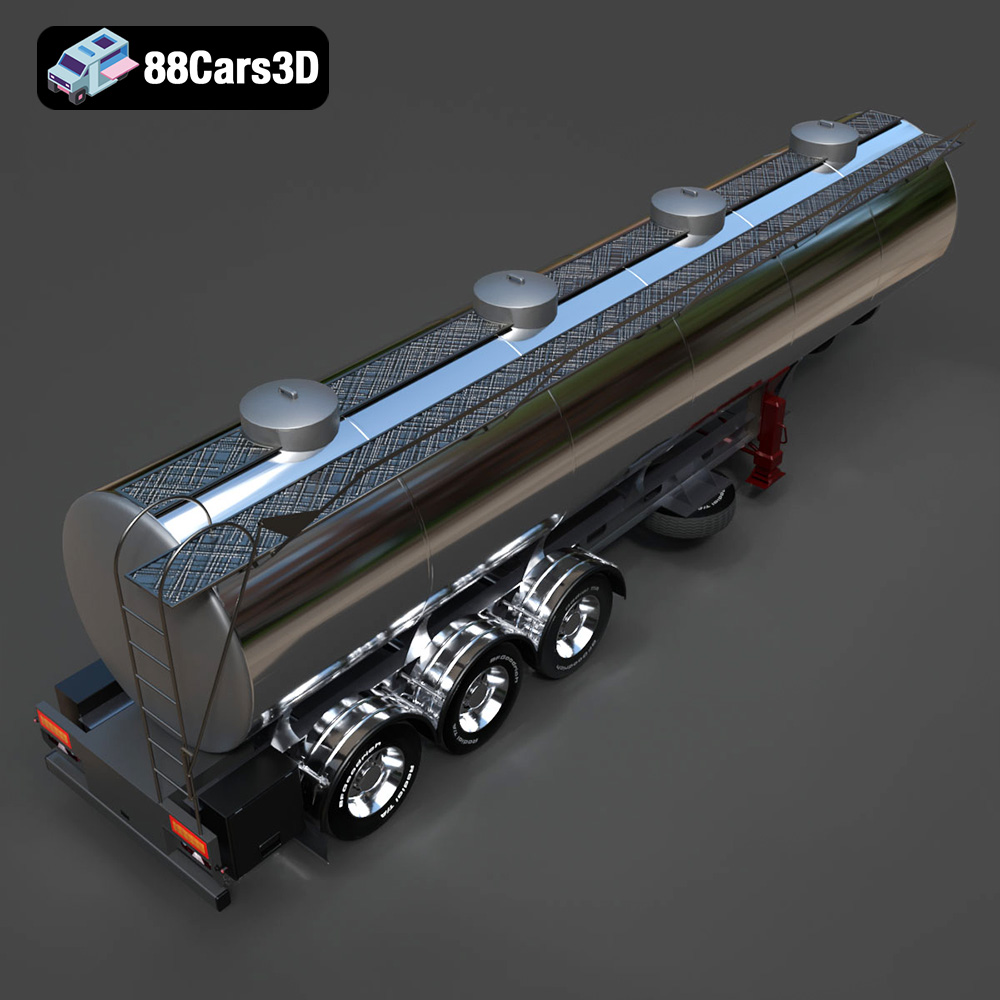
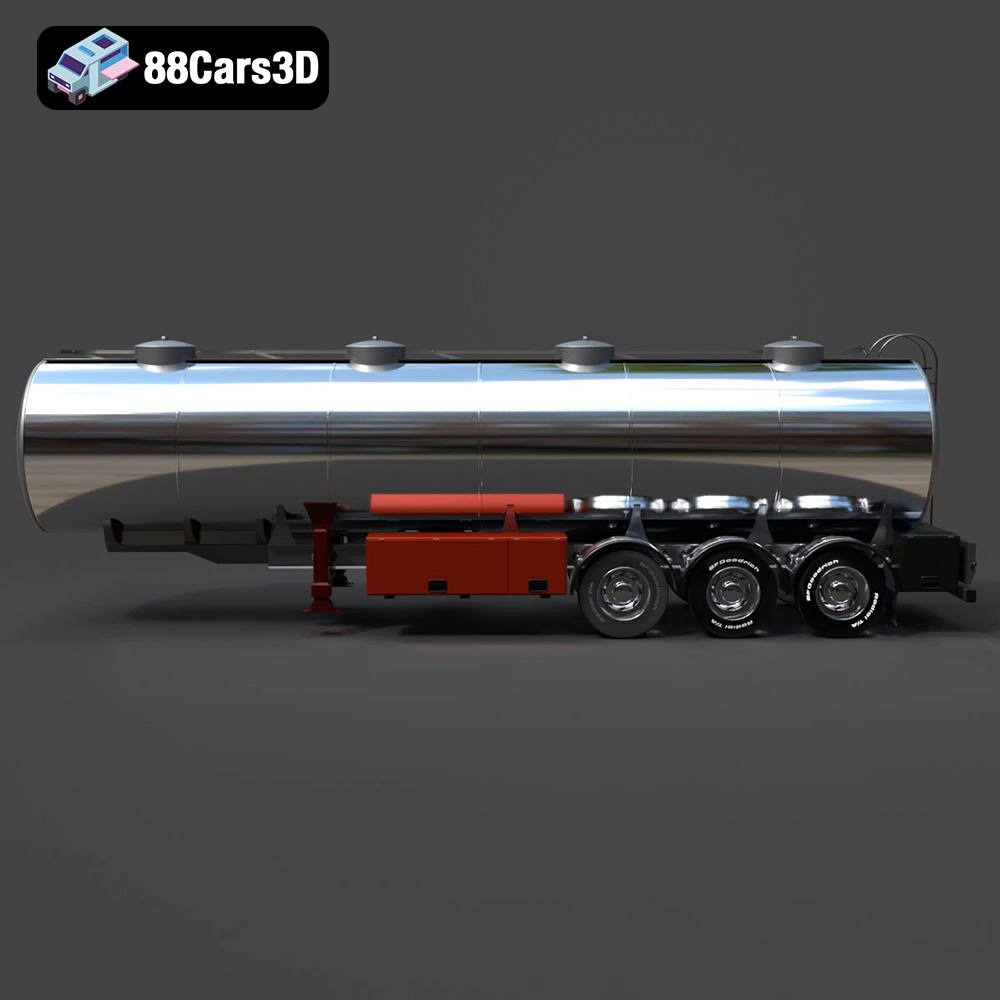
The exterior of the Fuel Tank Trailer model has been meticulously crafted to capture every essential detail. Its core, the elongated cylindrical tank body, is modeled with accurate proportions, instantly conveying its purpose. This isn’t just a generic cylinder; it includes the subtle curvature and reinforcement common to real-world tankers. Supporting this is a detailed chassis frame and support structure, providing the backbone of the trailer. Further enhancing its realism are features such as a realistic axle configuration with a suspension system, crucial for dynamic simulations and realistic animations. Crucially, the model includes modeled fuel discharge valves and a piping system, a rear ladder for access to the top, safety railings, and practical hose storage compartments. The inclusion of mudguards, reflectors, and safety markings adds layers of visual authenticity, making it indistinguishable from its real-life counterpart in high-resolution renders. The separate wheels are a technical advantage, allowing for independent animation and rotation, essential for realistic vehicle movement.
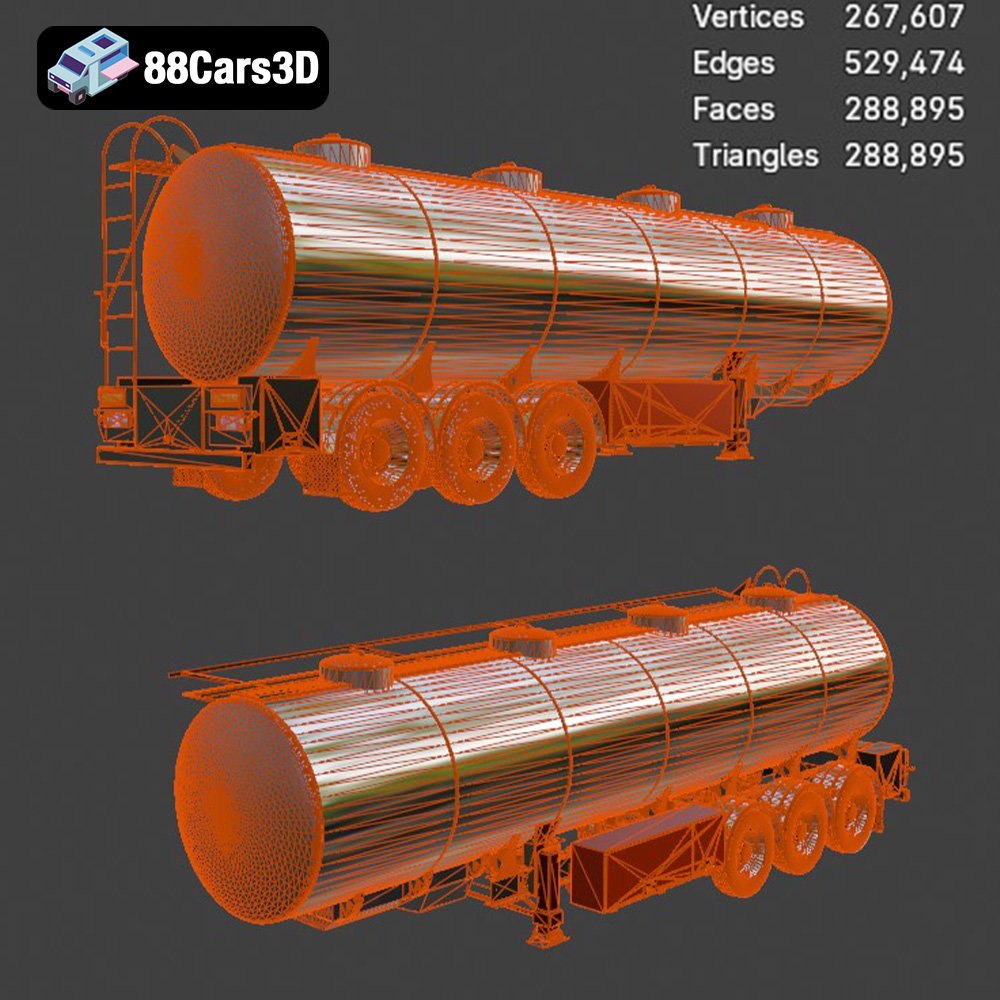
Beyond the visible components, the model boasts robust internal and structural considerations. For multi-compartment versions, internal tank segmentation could be present, adding to the structural realism and enabling complex simulation scenarios. Reinforced mounting brackets ensure the tank appears securely fastened to the chassis. Realistic connection points for tractor attachment are modeled, allowing for accurate hitching in simulations and animations. A key technical advantage of this model is its optimized geometry, which features a clean and well-organized mesh structure with optimized polygon flow. This optimization is crucial; it ensures the model performs efficiently in real-time engines like Unreal Engine while maintaining high visual quality for rendering. Real-world scale accuracy is maintained throughout, ensuring proper integration into existing scenes and environments.
The utility of a high-quality 3D asset like the Fuel Tank Trailer 3D Model is defined by its seamless integration into various professional pipelines. Its versatility makes it a cornerstone for diverse projects, from captivating marketing campaigns to rigorous simulations.
For professionals in automotive rendering, advertising, and industrial visualization, the Fuel Tank Trailer model is an invaluable asset. Using software like 3ds Max or Blender, artists can leverage its clean topology and detailed materials to create stunning, photorealistic images and animations. Imagine a dramatic highway transport scene, with the tanker traversing a scenic route, or a detailed visualization of a fuel depot environment. The model is perfect for logistics presentations, demonstrating efficiency and scale, or for creating compelling industrial advertising content that highlights robust transportation solutions. The proper pivot setup for wheel rotation simplifies animation, allowing for realistic rolling motion without complex rigging. With appropriate lighting and environment settings, this model can elevate any visual narrative, offering a powerful tool for showcasing operational excellence.
In the realm of game development, high-quality 3D car models and industrial vehicles are essential for creating immersive worlds. The Fuel Tank Trailer 3D Model is highly suitable for truck simulators, open-world logistics games, and hazardous material transport systems. Its optimized geometry and clean mesh structure ensure efficient performance within real-time engines like Unreal Engine and Unity. Developers can easily integrate the provided .fbx or .unreal formats, which are typically pre-configured for efficient engine use, often including optimized UV maps for texture atlases and efficient material setup. This allows for quick iteration and ensures smooth gameplay even with multiple vehicles on screen. The accurate proportions and detailed features contribute significantly to the player’s immersion, making the virtual world feel more authentic and believable.
Augmented Reality (AR) and Virtual Reality (VR) are transforming training and interactive demonstrations. The Fuel Tank Trailer is perfectly suited for interactive fleet demonstrations and immersive industrial training simulations. Using its .glb or optimized .fbx versions, developers can create environments where users can explore the trailer in 3D, inspect its components, or practice loading and unloading procedures in a safe, virtual space. The real-world scale accuracy is critical here, providing a true sense of presence. For simulation and training, the model is useful for fuel transport training modules, allowing operators to understand the vehicle’s mechanics and operational parameters. It can also be integrated into industrial safety visualization platforms, helping to train personnel on hazardous material handling and emergency response protocols, all within an engaging and interactive virtual setting.
The beauty of a versatile 3D model lies not just in its digital applications but also in its potential to transcend the screen and manifest as a tangible object. The Fuel Tank Trailer 3D Model is designed with 3D printing in mind, making it convertible to the ubiquitous .stl format for physical production.
Converting the digital Fuel Tank Trailer into a physical object requires careful consideration of 3D printing parameters. The model’s clean, manifold geometry, which is a hallmark of high-quality assets on 88cars3d.com, is inherently suited for additive manufacturing. Users can choose from several recommended scales: 1:32, 1:24, 1:18, or 1:14, depending on the desired size and level of detail. For FDM (Fused Deposition Modeling) printers, typical layer heights of 0.12–0.20 mm are recommended to capture surface details while maintaining reasonable print times. Wall thickness should be set between 2–3 mm to ensure the structural integrity of the printed parts, preventing brittleness. An infill of 20–35% provides a good balance between material usage and model strength. For finer details and smaller scales, resin (SLA/DLP) printing might be preferred for its superior resolution and smoother surface finish.
Successful 3D printing often hinges on proper support structures and orientation. For the Fuel Tank Trailer, supports will likely be required for intricate parts like the rear ladder, safety railings, and the various valve assemblies to prevent drooping and ensure accurate geometry. Strategic print orientation is also key: printing the main tank horizontally can reduce the need for excessive supports on its large cylindrical surface, while the chassis might be best printed flat for stability and strength. The wheels should ideally be printed separately to achieve enhanced detail and allow for easy post-processing and assembly. Once printed, the physical model benefits greatly from post-processing. This typically includes sanding to smooth layer lines, applying a primer coat for an even surface, and then a final industrial paint finish. Adding optional hazard decals and company logos can bring the scale model to life, creating a realistic miniature for display, tabletop gaming, or even as a collectible for automotive enthusiasts.
One of the most significant advantages of starting with a professionally crafted 3D model like the Fuel Tank Trailer is its inherent adaptability. It provides a robust foundation upon which endless customizations can be built, saving significant development time and resources.
The model’s design allows for extensive aesthetic customization. Users can easily change the tank color and apply different fuel branding to match specific company fleets or fictional settings. Adding custom company logos or unique hazard markings is straightforward, making the trailer fit perfectly into any corporate presentation or game environment. For projects requiring a more lived-in or worn look, adjusting weathering parameters allows artists to simulate years of road wear, rust, or dirt, adding an extra layer of realism. This level of visual flexibility ensures that the model can be seamlessly integrated into a wide range of visual styles and narratives.
Beyond surface aesthetics, the Fuel Tank Trailer 3D Model offers the flexibility for structural and functional modifications. Artists or engineers can modify the axle configuration, easily switching between a 2-axle or 3-axle version to represent different load capacities or regional variations. Adding specific safety decals and reflective strips, perhaps mandated by different transport regulations, can be done with precision. The model’s clean geometry and organized mesh structure facilitate these changes, ensuring that modifications are efficient and maintain the overall integrity of the asset. This inherent adaptability makes the Fuel Tank Trailer 3D Model from 88cars3d.com a truly versatile asset, capable of evolving with the specific demands of any project, from realistic simulations to detailed 3D printable miniatures.
In the demanding fields of 3D modeling, automotive rendering, and game asset development, the quality and versatility of your digital assets dictate the success of your project. The Fuel Tank Trailer 3D Model stands out as a prime example of a meticulously crafted asset, engineered for both realism and unparalleled technical utility across multiple industries. Its detailed exterior and structural integrity make it ideal for high-fidelity renders, while its optimized geometry ensures smooth performance in real-time game engines and AR/VR simulations.
The availability of multiple file formats—from .blend and .max for native software users, to .fbx and .unreal for game development, and crucially, .stl for 3D printing—underscores its adaptability. This model offers a solid foundation for any project requiring a heavy-duty tanker, providing a versatile base for customization, animation, and visualization. Whether you’re a professional seeking a robust asset for industrial training or an enthusiast looking to 3D print a scale model, the Fuel Tank Trailer offers the precision and flexibility you need. Explore this and other high-quality 3D car models at 88cars3d.com to elevate your next project with assets that truly deliver.
The Fuel Tank Trailer 3D Model is a high-detail digital recreation of a heavy-duty tanker trailer designed for transporting fuel and liquid petroleum products. Engineered for realism and industrial accuracy, this model reflects the structural integrity and cylindrical tank design commonly used in logistics, petroleum distribution, and hazardous material transport operations. This 3D model accurately represents the elongated cylindrical tank body, reinforced chassis frame, axle system, rear ladder access, safety railings, hose compartments, and fuel discharge valves. Designed with clean topology and real-world proportions, it is ideal for rendering, animation, simulation, game development, and AR/VR industrial visualization. Perfect for highway transport scenes, fuel depot environments, logistics simulations, industrial yards, refinery visuals, and commercial fleet presentations. Convertible to .stl format for scale tanker trailer models and display miniatures.
$14.9
.arvr
.blend
.fbx
.fueltanktrailer
.fueltransport
.gameasset
.glb
.industrialvehicle
.logisticsvehicle
.max
.obj
.petroleumtransport
.ply
.rendering
.simulation
.stl
.tankertrailer
.trucktrailer
.unreal