⚡ FLASH SALE: Get 60% OFF All Premium 3D & STL Models! ⚡

The landscape of 3D content creation has been irrevocably transformed by the advent of Unreal Engine 5, and at its core lies the revolutionary virtualized geometry system, Nanite. For professionals in automotive visualization, game development, and real-time rendering, Nanite is not just an incremental improvement; it’s a paradigm shift that unlocks unprecedented levels of detail and visual fidelity without the traditional performance bottlenecks. Gone are the days of laboring over polygon budgets and meticulously crafting multiple levels of detail (LODs) for every asset. Nanite empowers artists and developers to import film-quality source art, like the meticulously crafted 3D car models found on 88cars3d.com, directly into Unreal Engine, maintaining every polygon and intricate detail.
This comprehensive guide delves deep into Unreal Engine 5’s Nanite technology, exploring how it revolutionizes 3D workflows, particularly for the demanding world of automotive visualization. We’ll cover everything from understanding Nanite’s technical underpinnings to practical implementation, optimization strategies, and its synergy with other powerful UE5 features like Lumen and Blueprint. Whether you’re a seasoned Unreal Engine developer, a 3D artist aiming for photorealism, or an automotive designer pushing the boundaries of interactive experiences, prepare to unlock a new era of visual excellence and streamlined asset pipelines. Let’s explore how Nanite is making previously impossible levels of detail a real-time reality.
At its heart, Nanite is a virtualized geometry system designed to intelligently stream and process only the necessary detail of a mesh, regardless of its original polygon count. Traditional rendering pipelines struggle with high polygon counts due to limitations in memory bandwidth and draw calls. Every triangle in a mesh, especially those close to the camera, needs to be processed, leading to a rapid increase in computational cost with complex models. Nanite tackles this fundamental problem by employing a highly efficient mesh representation and streaming architecture.
Instead of rendering individual triangles, Nanite breaks down static meshes into a hierarchical structure of tiny, self-contained clusters of triangles. At render time, it dynamically determines which clusters are visible and what level of detail is required for each, based on factors like camera distance, screen space, and occlusion. This process, often referred to as “virtualized geometry,” allows Unreal Engine to render scenes with billions of polygons in real-time. For instance, a single 3D car model, which previously might have been optimized down to 200,000-500,000 polygons for real-time applications, can now exist in Unreal Engine with its original CAD-level detail, potentially tens of millions of polygons, with minimal performance impact. This capability is especially beneficial for complex assets like detailed vehicle interiors or intricate engine components, where every bolt and texture matters.
Nanite achieves its efficiency through several sophisticated techniques. Firstly, it leverages GPU-driven rendering, offloading much of the mesh processing from the CPU to the GPU. This includes culling (removing unseen geometry) and LOD selection, which is no longer a manual process but an automatic, continuous function handled by the GPU. Secondly, it utilizes a novel streaming system that loads mesh data on demand. This means only the necessary clusters are loaded into memory and rendered at any given time, significantly reducing VRAM footprint compared to traditional methods that would attempt to load the entire high-resolution mesh. The data is stored in a highly compressed format, allowing for massive scenes without overwhelming memory. For a deeper dive into the underlying technology, Epic Games’ official documentation provides extensive resources on Unreal Engine’s rendering pipeline via their learning platform.
The automotive industry often works with extremely high-fidelity CAD data, sometimes boasting hundreds of millions of polygons. Historically, translating this data into a real-time engine meant an arduous optimization process involving retopology, decimation, and baking normal maps – a workflow that inevitably led to some loss of original detail and introduced artifacting. Nanite bypasses much of this struggle. Artists can now import their raw, high-poly CAD data (often converted to FBX or USD) directly into Unreal Engine, enabling them to visualize intricate designs, conduct detailed reviews, and create stunning marketing materials with unprecedented accuracy. This dramatically accelerates the asset pipeline and ensures visual integrity, a critical factor for brands that prioritize fidelity in their digital representations.
Integrating high-quality 3D car models into Unreal Engine 5 with Nanite is a straightforward process, yet understanding the nuances can optimize your workflow significantly. When sourcing automotive assets, platforms like 88cars3d.com offer pre-optimized models that are often already structured well for engine integration, making the Nanite conversion even smoother. The key is to ensure your source model is clean and watertight, even if it has a high polygon count, as Nanite still benefits from well-formed geometry.
The import process typically begins by dragging your FBX or USD file directly into the Unreal Engine Content Browser. During import, you’ll be presented with various options. The most crucial one for our discussion is the “Build Nanite” checkbox. Activating this tells Unreal Engine to process the mesh using the Nanite pipeline. If you forget this step during import, you can always enable Nanite later within the Static Mesh Editor by checking the “Enable Nanite” box under the “Nanite Settings” section. Once enabled, Unreal Engine will generate the necessary Nanite data for the mesh in the background, which might take a moment for extremely complex models. It’s recommended to import individual components of the car (body, wheels, interior, engine parts) as separate Nanite meshes where appropriate, as this allows for more flexible material assignments and interaction.
While Nanite removes the traditional polygon budget constraint, certain mesh requirements remain important. Your models should have proper UV mapping for textures, as Nanite primarily handles geometry, not UVs. Overlapping UVs, especially for lightmaps (if you plan to use them, though Lumen often makes this less critical), can still cause issues. Ensure your normals are correctly calculated and consistent. While Nanite can handle meshes with non-manifold geometry to some extent, clean topology from your DCC application (Digital Content Creation tool) is always preferable for predictable results and ease of material application. Models with very thin, disconnected surfaces might sometimes exhibit rendering artifacts with Nanite, though this is less common with well-constructed car models.
It’s important to note that not all geometry types are compatible with Nanite, or at least not fully optimized for it. Nanite primarily works with static meshes. Currently, geometry requiring specific rendering paths like masked materials, translucent materials (e.g., windows, headlights), and certain types of deformers (like skeletal meshes for character animation) do not fully utilize the Nanite pipeline. For translucent elements, you’ll need to use traditional rendering methods. This means that while your car body and interior can be full Nanite, the windshield and window glass will be standard meshes. Similarly, while Nanite can handle instances, dynamic objects that are frequently moving or deforming (like a car chassis undergoing complex physics simulation) still benefit from traditional optimization or careful integration with other UE5 systems like Chaos Physics. Understanding these limitations allows for strategic application of Nanite where it offers the most benefit, while gracefully handling other elements with traditional techniques.
The true power of Unreal Engine 5’s photorealism comes from the synergistic combination of Nanite’s virtualized geometry, Lumen’s global illumination, and physically based rendering (PBR) materials. Together, these technologies enable the creation of automotive visuals that are virtually indistinguishable from reality, making them ideal for high-end marketing, virtual showrooms, and cinematic sequences. Nanite provides the geometric detail, Lumen handles the incredibly realistic lighting, and PBR materials ensure that surfaces react to light accurately, completing the illusion.
Lumen, Unreal Engine 5’s default global illumination and reflections system, dynamically reacts to changes in lighting and geometry. When paired with Nanite, Lumen can calculate bounces of light off surfaces with an unprecedented level of geometric detail, resulting in incredibly nuanced and lifelike lighting scenarios. For instance, the subtle reflections on a car’s metallic paint finish, the way ambient light fills a vehicle’s interior, or the intricate play of light and shadow within complex engine bay geometry, all benefit immensely from this combination. The intricate details provided by Nanite meshes feed directly into Lumen’s calculations, enhancing the fidelity of indirect lighting and reflections far beyond what was previously possible in real-time. This combination is especially potent for automotive scenes where subtle reflections and accurate lighting are paramount to showcasing a vehicle’s design and finish.
With Nanite handling the geometry, your focus can shift entirely to crafting exquisitely detailed PBR materials. Car paints are notoriously complex, often involving multiple layers: a base metallic color, a clear coat for gloss and reflection, and sometimes flakes for pearlescent effects. In Unreal Engine’s Material Editor, you can construct these layered shaders using blend modes and material functions. For example, a typical car paint material might involve a base color texture, a metallic map (to control metallic vs. dielectric properties), a roughness map (for surface smoothness), and a normal map for micro-surface details that catch the light. On top of this, you can add a clear coat layer with its own roughness and normal, simulating the protective lacquer. Detail normal maps, applied in world space, can simulate subtle orange peel or swirl marks on the paint, further enhancing realism. Utilizing high-resolution textures (4K, 8K, or even 16K) for these maps is now feasible thanks to Nanite’s efficient streaming, ensuring every pore, scratch, and reflection holds up even in close-up shots.
Achieving true photorealism requires meticulous attention to how light interacts with surfaces. For car windows and headlights, which often rely on traditional translucent materials, careful attention to refraction and reflections is key. Using physically accurate values for Roughness, Metallic, Specular, and IOR (Index of Refraction) is crucial. Screen Space Reflections (SSR) and Lumen’s powerful ray-traced reflections contribute significantly to the realism of metallic and glossy surfaces. For highly reflective materials like chrome, consider using Cube Maps or Planar Reflections in specific areas if Lumen’s reflections aren’t capturing the desired effect with enough fidelity, though Lumen is incredibly capable. Leveraging advanced lighting techniques, such as HDRI sky domes for environment lighting and carefully placed spotlights with IES profiles, further grounds the vehicle in a realistic scene. The combination of Nanite’s geometric precision and expertly crafted PBR materials, illuminated by Lumen, delivers an unparalleled level of visual authenticity for automotive rendering.
The true potential of Nanite extends beyond static renders and cinematics; it opens up unprecedented possibilities for interactive automotive experiences. Imagine virtual showrooms where customers can explore a car’s interior with photorealistic detail, configure options in real-time, and even take a virtual test drive, all without any noticeable drop in performance due to geometry complexity. Nanite makes this level of fidelity achievable, transforming how automotive brands engage with their audience.
Automotive configurators are a prime example of where Nanite shines. Previously, real-time configurators were often limited by polygon budgets, forcing compromises on detail when swapping out wheels, paint colors, or interior trims. With Nanite, developers can present a vast array of high-fidelity options. Swapping a standard wheel for a multi-spoke alloy, or changing a fabric interior to premium leather, involves simply hiding one Nanite mesh and revealing another. Each component can maintain its full, unoptimized detail, ensuring that every configuration looks stunning. Blueprint visual scripting in Unreal Engine further empowers these experiences, allowing developers to create intuitive user interfaces and complex logic for option selection, color changes, and even animated parts like opening doors or adjusting seats.
Blueprint, Unreal Engine’s powerful visual scripting system, is instrumental in bringing Nanite-powered automotive assets to life. For an interactive car configurator, Blueprint scripts can handle:
For example, a simple Blueprint script could detect a user’s click on a “door open” button, trigger a Sequencer animation for the door, and then play a sound effect. All the while, the surrounding car body and interior maintain their Nanite-enabled, ultra-high fidelity.
Beyond configurators, Nanite is a game-changer for virtual production, especially in environments utilizing large LED walls. For automotive commercials or film sequences, vehicles are often placed in front of dynamic LED backdrops displaying realistic environments. With Nanite, the digital twin of a car on the LED wall can achieve the same level of detail as the physical prop in the foreground, ensuring seamless integration and visual continuity. The ability to render incredibly detailed environments and vehicles in real-time at resolutions suitable for massive LED screens (often requiring 4K or even 8K output) without performance hitches is invaluable for filmmakers and advertisers. This allows for dynamic creative iterations on set, changing environments or vehicle configurations instantly, and dramatically reducing post-production time and costs.
While Nanite liberates developers from many traditional polygon optimization burdens, it doesn’t eliminate the need for intelligent performance strategies entirely. Understanding how Nanite interacts with other Unreal Engine systems and knowing when to apply additional optimizations is key to creating truly robust and efficient automotive projects, especially for demanding applications like AR/VR or high-frame-rate simulations.
Nanite’s primary benefit is its automatic, continuous level of detail system. Unlike traditional LODs, where you manually create several mesh variations (e.g., LOD0, LOD1, LOD2, etc.) and specify distances for switching, Nanite handles this seamlessly at a sub-triangle level. It dynamically generates the optimal number of triangles to render for each part of a mesh based on screen-space resolution, ensuring maximum detail where needed and minimal detail elsewhere, all without perceptible pop-in. This dramatically reduces the memory footprint and draw calls associated with high-poly meshes. However, it’s crucial to remember that Nanite primarily optimizes GPU geometry processing. While it helps with CPU draw calls by reducing the number of objects to consider, complex scenes with thousands of Nanite meshes can still incur CPU overhead if not managed efficiently. Furthermore, features not supported by Nanite (like complex transparent materials, certain physics setups, or meshes that deform) still require traditional optimization.
Despite Nanite’s power, there are still scenarios where traditional optimization techniques are relevant:
Understanding these limitations allows you to make informed decisions about your asset pipeline and prioritize optimization efforts where they will have the most impact.
Nanite elevates the capabilities of Unreal Engine’s Sequencer, the robust multi-track non-linear editor for creating cinematic sequences. With Nanite, you can render breathtaking automotive commercials, short films, or product showcases with unparalleled geometric fidelity. Every curve, panel gap, and interior stitch of a car model from 88cars3d.com will appear crisp and detailed, even in 4K or 8K renders, without the need for offline render farms or extensive baking. This significantly speeds up cinematic content creation for the automotive industry.
Furthermore, Nanite meshes can integrate seamlessly with Unreal Engine’s Chaos Physics system. Imagine realistic vehicle destruction simulations where every crumpled fender and shattering headlight retains its intricate Nanite detail during deformation, driven by Chaos. While directly deforming a single high-poly Nanite mesh in real-time is complex, Nanite still allows for high-detail fractured meshes to be simulated and rendered efficiently, opening up new possibilities for realistic damage and dynamic environments. For simpler vehicle dynamics, such as tire deformation or suspension travel, Nanite supports attaching non-Nanite skeletal meshes to key deformation points, while the main body remains a high-fidelity Nanite asset.
While Nanite is incredibly powerful, like any advanced technology, it comes with its own set of considerations and best practices to ensure optimal results. Understanding these can help avoid common pitfalls and streamline your 3D automotive workflows in Unreal Engine 5.
One common challenge is the temptation to overuse Nanite. While it handles billions of polygons, it’s not a silver bullet for *all* geometry. For extremely small objects that barely occupy a few pixels on screen, or distant background elements that will never be seen up close, enabling Nanite might introduce unnecessary overhead without providing a significant visual benefit. In such cases, traditional, lower-polygon static meshes might still be more efficient. The key is to be judicious: enable Nanite where high detail is crucial and visible, such as the main car model, detailed interior components, or hero props in a scene. For elements like distant foliage or background buildings, a standard static mesh with aggressive LODs might still be the better choice. Monitoring your GPU performance using Unreal Engine’s profiling tools (like ‘stat gpu’ and ‘stat nanite’) can help identify areas of inefficiency.
Managing complex automotive scenes with many Nanite assets requires a structured approach.
By adhering to these strategies, you can build incredibly detailed automotive environments that run smoothly in real-time, even on high-end hardware.
Nanite is continuously evolving. Epic Games is actively working on expanding its capabilities to support more geometry types, including potentially transparent materials and deformable meshes more comprehensively. Keeping an eye on Unreal Engine’s release notes and updates is crucial for staying ahead. For artists and developers, the workflow shift is significant:
Embracing Nanite means rethinking traditional asset pipelines, allowing for a creative freedom that was once limited to offline rendering, now delivered in real-time.
Unreal Engine 5’s Nanite technology marks a monumental leap forward for 3D content creation, particularly within the demanding realm of automotive visualization. By effectively removing the traditional polygon count barrier, Nanite empowers artists and developers to import and render incredibly detailed 3D car models, such as those available on 88cars3d.com, with unprecedented fidelity and performance. Its synergy with Lumen for real-time global illumination and advanced PBR materials culminates in photorealistic visuals that redefine what’s possible in real-time rendering.
We’ve explored how Nanite streamlines asset pipelines, enhances interactive experiences like automotive configurators, and provides the geometric foundation for cinematic virtual productions. While it offers immense liberation, understanding its technical underpinnings, limitations, and best practices remains crucial for optimizing complex scenes and achieving peak performance. As Unreal Engine continues to evolve, Nanite will undoubtedly expand its capabilities, further blurring the lines between real-time and offline rendering. The future of automotive design, marketing, and immersive experiences is bright, driven by the limitless detail that Nanite brings to the forefront. Embrace this revolutionary technology, experiment with its capabilities, and unlock a new era of visual excellence in your Unreal Engine 5 projects.

Texture: Yes | Material: Yes | 3D Printable: Yes. Download the Italian Thoroughbreds Bundle featuring 5 iconic 3D models: Lamborghini Huracán Performante, Ferrari 458 Italia, Lamborghini Urus, Diablo SV, and Maserati GT. Optimized for 4K rendering and 3D printing (STL included). Save 50% with this ultimate Italian vehicle collection.
Price: $199.99

Download the Elite Future Mobility Bundle featuring 4 highly optimized 3D models: Tesla Model S, Avatr 11, Li L9, and Zoox Robotaxi. Perfect for ArchViz, Smart City renders, and game dev. Optimized for Unreal Engine and Blender. Includes .fbx, .obj, and .max formats.
Price: $99

🚗 5 Iconic German Cars (BMW M4 G82, M5 CS, X3, 1 Series & Mercedes E-Class). ✅ Optimized for ArchViz: Ready for Corona & V-Ray. 💰 Save €71 with this limited-time collection! 🚀 Instant Download after purchase.
Price: $119

Download the Extreme Off-Road & Survival 3D Models Bundle! Includes the Brabus 800 Adventure, Dodge Ram Bigfoot, Spec Truck, and a Caravan. Save over €210 on this premium 4-in-1 off-grid vehicle pack for ArchViz and game development.
Price: $149.99

Download the Heavy Duty & Commercial Logistics 3D Models Bundle! Includes the Ford Sterling, Caterpillar CT680, Mercedes Citaro Bus, and Vito Van. Save over €130 on this massive, game-ready 4-in-1 industrial vehicle pack.
Price: $109.99

Download the Ultimate Custom Motorcycles 3D Models Bundle. Includes a Custom Chopper, Ducati 916 Café Fighter, Harley XR1200X, and BMW K100. Perfect premium props for luxury ArchViz garages. Save over €250 today!
Price: $159.99

Download the ultimate JDM Street Racing 3D Models Bundle! Includes the Nissan GT-R, Toyota Supra, Mazda RX-7, Lancer Evo IX, and Honda NSX. Save big on this highly optimized, game-ready 5-in-1 Japanese legend car pack.
Price: $129.99

Download the ultimate American Muscle & Cinematic Classics 3D Models Bundle! Includes the Dodge Charger ’68, Mustang Eleanor GT500, Camaro Z28 ’79, and a custom ’69 Mustang. Save over €240 on this game-ready, premium 4-in-1 pack.
Price: $149.99

Download the Everyday City Traffic 3D Models Bundle. Includes the VW Golf, Kia Picanto, Hyundai Tucson, Toyota Yaris, and a DHL Ford Transit Van. Save big on this 5-in-1 pack, perfectly optimized for realistic ArchViz streets and game traffic.
Price: $99.99
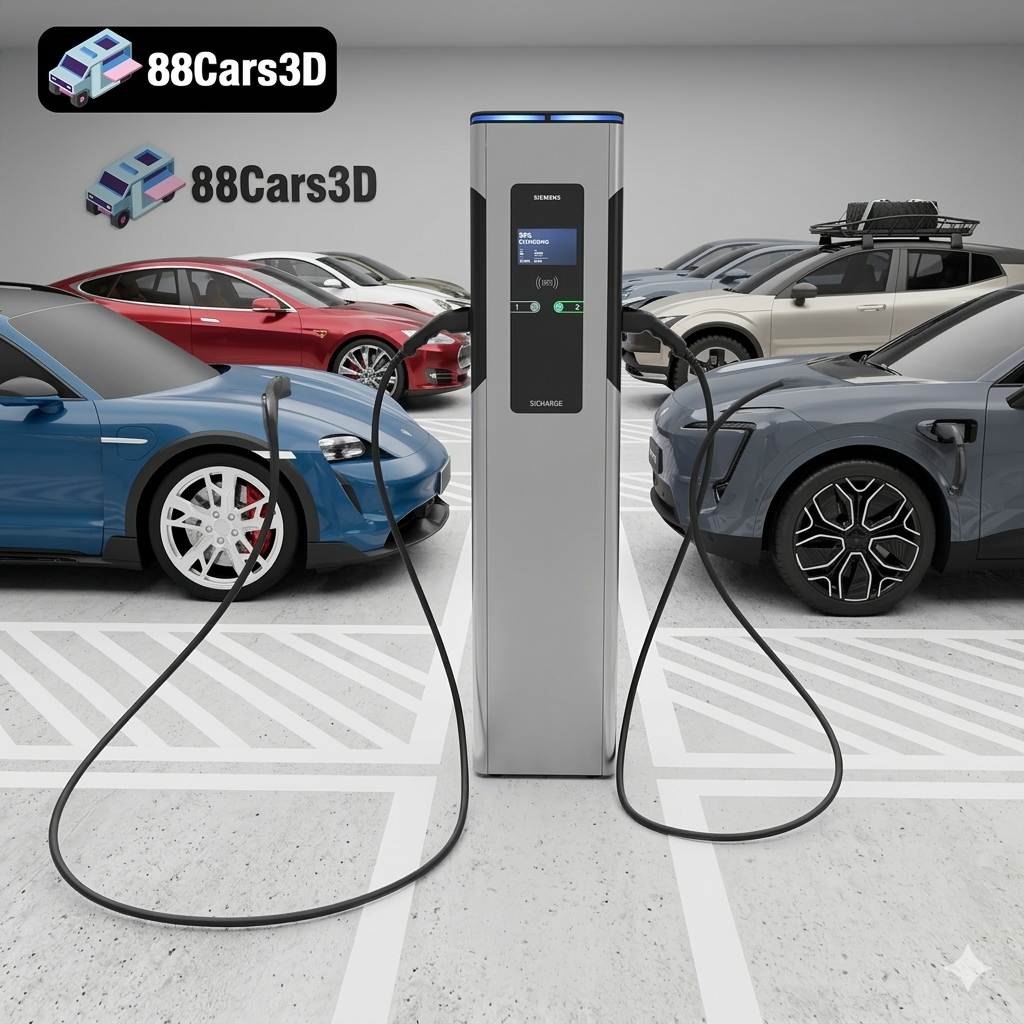
Download the Future of Mobility EV 3D Models Bundle. Includes the Volvo EX30, Tesla Model S, AVATR 11, Porsche Taycan, and a Siemens EV Charger. Save big on this highly optimized 5-in-1 pack for ArchViz and game development!
Price: $89.99

