⚡ FLASH SALE: Get 60% OFF All Premium 3D & STL Models! ⚡

In the dynamic world of 3D modeling, precision and optimization are paramount. Whether you’re a game developer crafting immersive open worlds, an automotive designer visualizing future concepts, or an architect bringing environments to life, the quality of your 3D assets dictates the fidelity of your final output. High-quality 3D models not only save invaluable production time but also unlock new creative possibilities, ensuring your projects stand out.
Today, we’re taking a comprehensive look at an exceptional asset that embodies this philosophy: the Fantic Caballero 500 Scrambler 3D Model. This digital masterpiece, available on 88cars3d.com, is far more than just a static representation; it’s a meticulously engineered digital twin designed for peak performance across a multitude of applications. From its iconic 1970s retro dirt-track aesthetics to its contemporary engineering details, this model offers a unique blend of visual appeal and technical robustness, ready to be integrated into any professional workflow.
Join us as we explore the intricate details, technical advantages, and versatile applications of this outstanding 3D model, understanding how it can elevate your next project, whether it involves stunning automotive rendering, fluid game development, or innovative AR/VR experiences.
The choice of a 3D model file format is a critical decision that impacts workflow, compatibility, and ultimately, the success of your project. Each format is designed with specific use cases and technical considerations in mind. The Fantic Caballero 500 Scrambler 3D Model comes bundled with an impressive array of formats, ensuring maximum flexibility for any professional application. Let’s break down these essential formats:
The .blend format is the native file type for Blender, the powerful open-source 3D creation suite. When you download the Fantic Caballero 500 Scrambler in .blend format, you gain access to a fully editable Blender scene. This means all materials, textures, lighting setups, and even animation rigs (if applicable) are preserved within the file. For users entrenched in the Blender ecosystem, this format offers unparalleled flexibility for further customization, scene integration, and direct rendering within Blender’s Cycles or Eevee engines. It’s perfect for artists who want to tweak every last detail, from material shaders to pivot points, without any loss of data during conversion.
Autodesk’s .fbx (Filmbox) format has become the de facto industry standard for exchanging 3D data between different software applications. Its robust support for geometry, materials, animations, and even skeletal data makes it ideal for pipelines involving Unreal Engine, Unity, 3ds Max, Maya, and more. For game development, the .fbx version of the Fantic Caballero 500 Scrambler is often the go-to choice due to its efficiency in transferring models directly into real-time environments, maintaining mesh integrity, UVs, and hierarchical structures crucial for animation and interactive experiences. Its widespread adoption ensures a smooth transition across various software suites.
The .obj (Wavefront Object) format is one of the oldest and most universally compatible 3D file formats. It primarily stores geometric data (vertices, normals, texture coordinates, and faces) and can link to external .mtl (material template library) files for basic material definitions. While it doesn’t support animation or complex scene data like .fbx, its simplicity and ubiquitous support across virtually all 3D software make it an excellent choice for basic mesh exchange. If you need a clean mesh of the Fantic Caballero 500 Scrambler that can be imported anywhere, the .obj is a reliable foundation to start with.
.glb (GL Transmission Format Binary) is a relatively newer format, rapidly gaining traction for web-based 3D, AR (Augmented Reality), and VR (Virtual Reality) applications. It’s a binary version of the glTF format, consolidating all necessary data (geometry, materials, textures, animations) into a single, highly optimized file. This makes the .glb version of the Caballero 500 perfect for fast loading and efficient rendering in browser-based configurators, mobile AR apps, or WebGL projects. Its compact nature and modern design ensure a seamless experience in bandwidth-sensitive environments.
The .stl (Stereolithography) format is synonymous with 3D printing. It represents a 3D model as a series of connected triangles, defining only the surface geometry of the object. While it lacks color, texture, or material information, its simplicity makes it the universal standard for communicating 3D printable designs to slicing software. The Fantic Caballero 500 Scrambler’s availability in .stl format means it’s ready for immediate physical manifestation, allowing hobbyists and professionals to create tangible scale models of this iconic motorcycle. Precision for 3D printing requires manifold geometry, which this model provides.
The .ply (Polygon File Format or Stanford Triangle Format) is a format designed to store three-dimensional data from 3D scanners. It can store a wider range of properties, including color, transparency, and often normal vectors, making it suitable for representing complex meshes, especially those derived from real-world scans. For analytical purposes, precise reverse engineering, or integrating the Caballero 500 into CAD workflows, the .ply format offers a robust and detailed representation of the mesh data, often preferred for its explicit handling of vertex and face properties.
The .unreal format refers to engine-ready assets specifically packaged for Unreal Engine. While often derived from .fbx imports, a dedicated .unreal asset implies it has undergone specific preparation, material setup, and optimization within the Unreal Editor itself. This could include pre-configured static meshes, skeletal meshes, physics assets, and material instances tailored for optimal performance and visual fidelity within the engine. For those working with Unreal Engine, having the Fantic Caballero 500 Scrambler directly as an .unreal asset streamlines the import process and ensures it adheres to best practices for real-time environments, saving significant setup time.
The .max format is the native file type for Autodesk 3ds Max, a leading software in architectural visualization, game development, and animation. Like .blend, the .max file contains the complete scene, including geometry, lights, cameras, materials, modifiers, and animation data. For 3ds Max users, this means the Fantic Caballero 500 Scrambler can be opened directly within their primary working environment, offering full access to its layered structure and allowing for complex scene assembly, advanced rendering with V-Ray or Corona, and intricate animation sequences without any compatibility hurdles.
This diverse range of formats ensures that no matter your preferred software or project requirements, the Fantic Caballero 500 Scrambler 3D Model from 88cars3d.com is ready to integrate seamlessly into your pipeline, providing a solid foundation for creative excellence.
Automotive rendering is a specialized field that demands an acute attention to detail, material accuracy, and lighting mastery. The Fantic Caballero 500 Scrambler 3D Model provides an exceptional foundation for achieving breathtaking visualizations, from lifestyle brand campaigns to detailed product showcases.
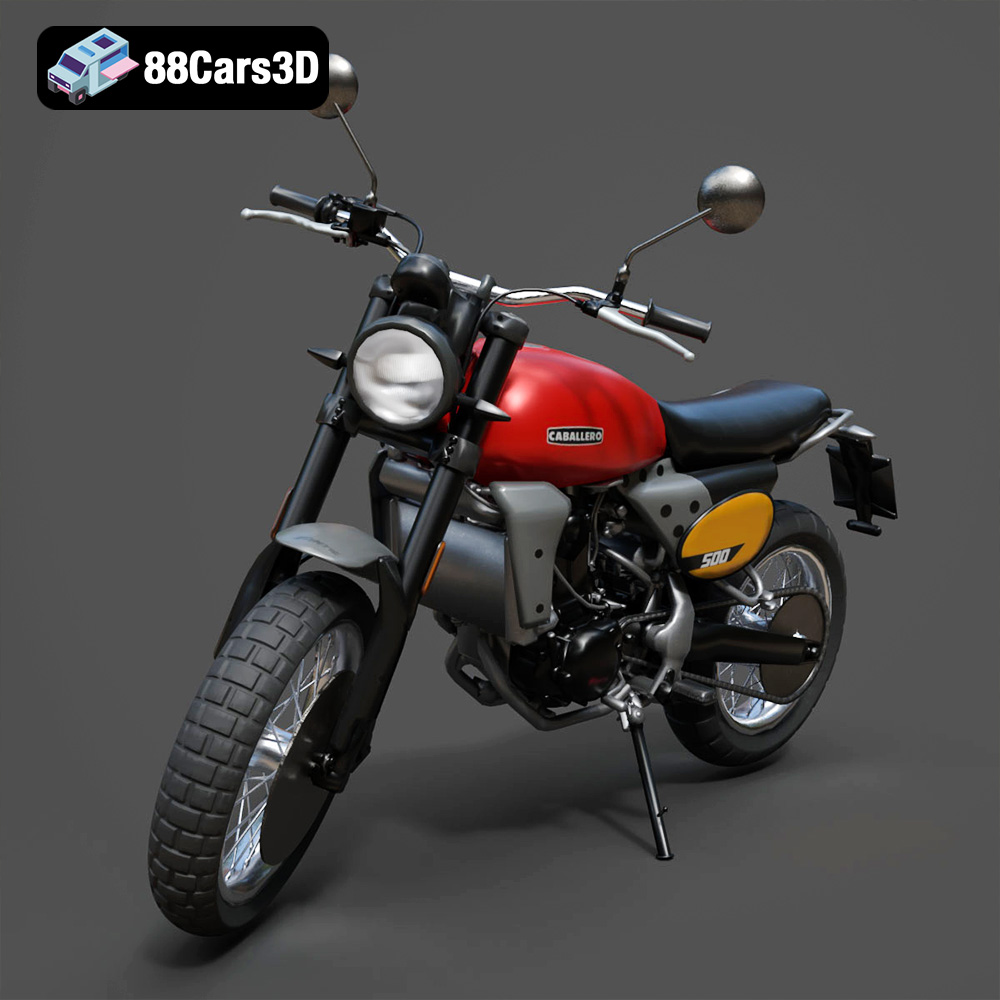
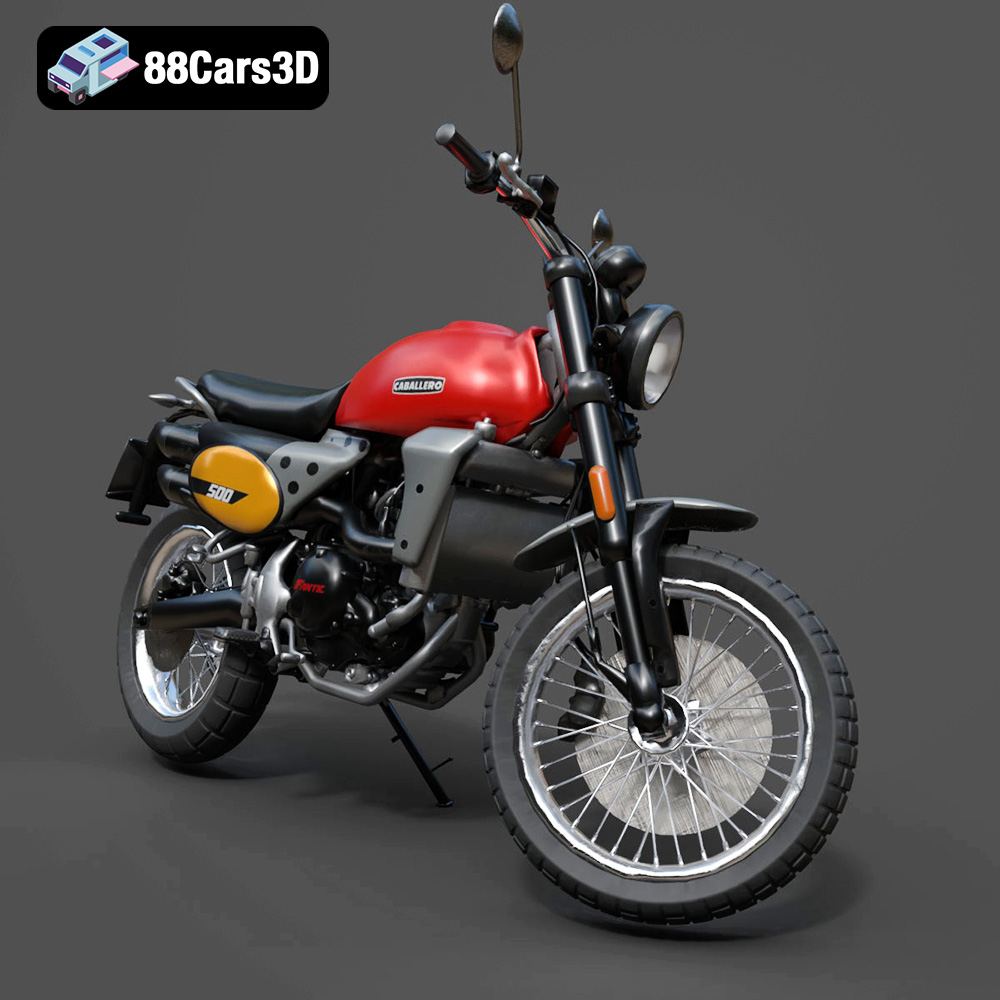
Photorealism is the holy grail of rendering, and the Caballero 500 model is built to achieve it. Its meticulously modeled geometry, capturing the rugged suspension details including the USD (upside-down) front forks, the signature dual-exit high-mount Arrow exhaust system, and the exposed single-cylinder engine block, provides the perfect canvas. Artists can leverage advanced rendering engines like V-Ray, Corona, or Cycles to simulate realistic material properties – the subtle gleam of chrome, the textured matte of plastic, the rich depth of painted metal, and the coarse grip of the knobby tires. Proper UV mapping, which is inherent in high-quality 3D car models like this, allows for the application of detailed textures, scratches, and wear, pushing the realism further. By carefully crafting lighting setups – mimicking natural sunlight or stylized studio illumination – the model truly comes to life, showcasing its classic round LED headlight and retro proportions.
Beyond static images, the Fantic Caballero 500 Scrambler 3D Model is engineered for animation. Crucially, it features separate wheels, suspension forks, and steering components, each with proper pivot setups. This modularity is a game-changer for animators. Imagine a cinematic sequence where the bike leans into a turn, its suspension compressing, and the wheels rotating realistically. These individual components allow for precise control over movement, enabling fluid and believable animations. Whether it’s a short promotional video for a lifestyle brand, an intro sequence for a game, or a detailed breakdown of the bike’s mechanics, the model’s structure facilitates complex motion without requiring extensive rigging efforts.
The applications for such a high-fidelity automotive rendering asset are vast. In marketing, the Caballero 500 can be placed in diverse digital environments – from dusty off-road trails to vibrant urban retro street environments – without the cost or logistical challenges of a real photoshoot. Product configurators can allow potential buyers to customize fuel tank colors (e.g., Classic Fantic Red, Stealth Black) or adjust seat materials (classic black ribbed vinyl vs. distressed brown leather) in real-time. Automotive design studios can use it for early-stage visualization, virtual prototyping, or presenting concepts to stakeholders. The detailed engine block and radiator, along with the authentic badging on the teardrop fuel tank, provide a level of realism that can significantly enhance brand messaging and product understanding.
For game developers and those building interactive experiences, the Fantic Caballero 500 Scrambler 3D Model offers an ideal balance of visual fidelity and real-time performance. Its “game-ready” designation is not merely a label, but a testament to its optimized construction.
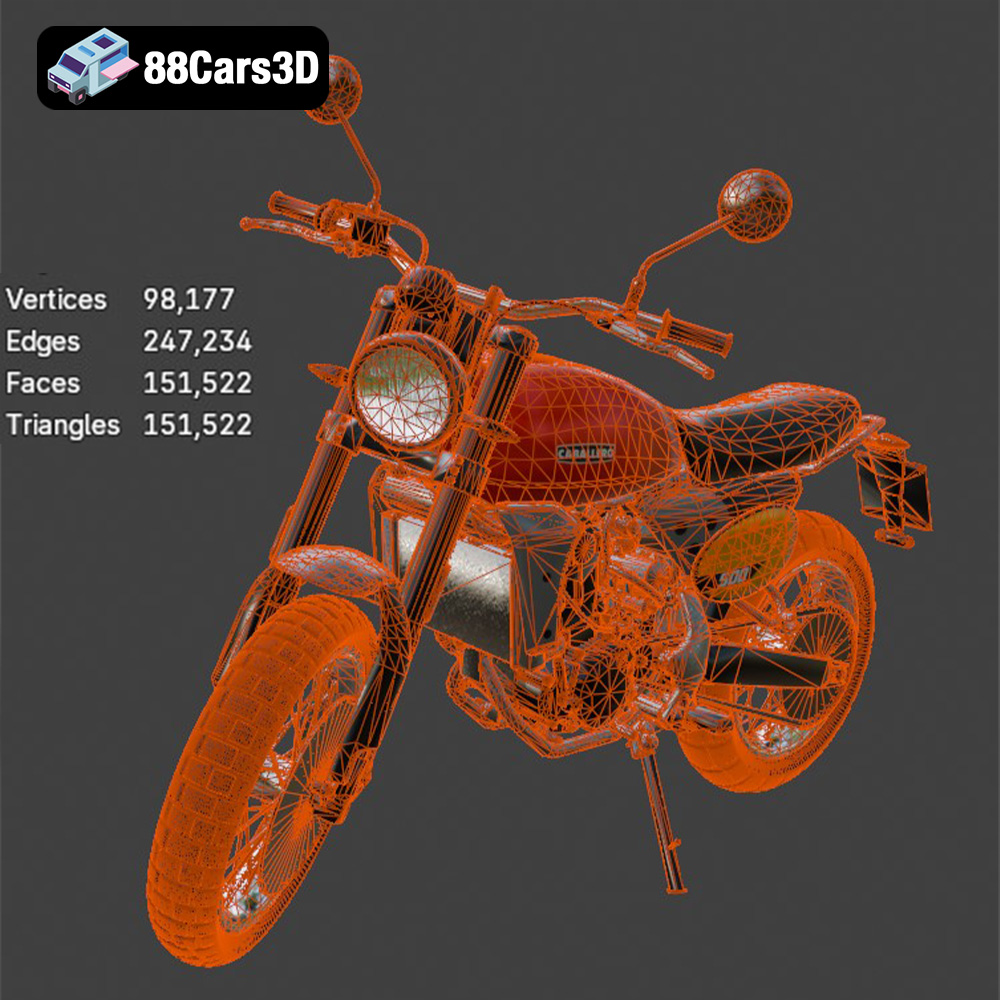
The technical specifications of the Caballero 500 are a developer’s dream: 151,522 triangles. This poly count strikes a sweet spot, providing enough detail for high-end visual realism on modern hardware while remaining efficient enough to be integrated into open-world games and other demanding real-time environments without bogging down frame rates. This careful optimization means developers don’t have to spend precious time retopologizing or reducing polygons, a common bottleneck in game asset pipelines. The clean topology also ensures smooth deformation if further rigging for advanced physics or character interaction is required. The model’s real-world scale accuracy further simplifies integration, ensuring it fits seamlessly into virtual environments without visual discrepancies.
For Unreal Engine users, the availability of a dedicated .unreal file, along with the robust .fbx format, makes integration remarkably straightforward. Once imported, the model can leverage Unreal’s powerful material editor to apply PBR (Physically Based Rendering) materials, enhancing the realism of its exposed steel tube frame and aggressive knobby tires. The separate, animatable components (wheels, forks, steering) are perfect for setting up vehicle physics and interactive controls within Unreal’s Blueprint system or C++. Developers can easily implement driving mechanics, suspension dynamics, and camera setups, including optimized geometry for seamless first-person POV, making the Fantic Caballero 500 Scrambler a fully functional, playable vehicle within minutes.
The Fantic Caballero 500 Scrambler 3D Model is also perfectly suited for AR/VR applications. Its optimized poly count and clean geometry ensure smooth performance in immersive environments where maintaining high frame rates is crucial to prevent motion sickness and ensure a comfortable user experience. With the .glb format included, it’s ready for web-based AR configurators, allowing users to place the virtual motorcycle in their physical space via a smartphone or tablet. In VR, it can populate virtual showrooms, interactive museums, or even serve as a rideable vehicle in virtual worlds. The realistic detailing, from the minimalist round digital instrument cluster to the authentic footpeg and pedal placement, enhances the sense of presence and immersion, making users feel truly connected to the iconic scrambler.
The true value of a premium 3D asset lies in its underlying technical quality. The Fantic Caballero 500 Scrambler 3D Model exemplifies this, showcasing meticulous craftsmanship that supports professional workflows across diverse applications.
At its core, any outstanding 3D model begins with impeccable geometry and topology. The Fantic Caballero 500 Scrambler boasts 98,177 vertices, 247,234 edges, and 151,522 faces (polygons/triangles). This count is a carefully considered balance: high enough to capture the intricate curves of the teardrop fuel tank, the precise detailing of the 450cc/500cc single-cylinder engine, and the aggressive tread of the knobby tires, yet optimized to ensure efficient rendering and real-time performance. Clean, all-quad (or predominantly quad-based before triangulation for game engines) topology is crucial for smooth subdivisions, deformations, and UV unwrapping. This model’s clean mesh means fewer artifacts during rendering, easier integration into existing scenes, and superior performance for interactive applications.
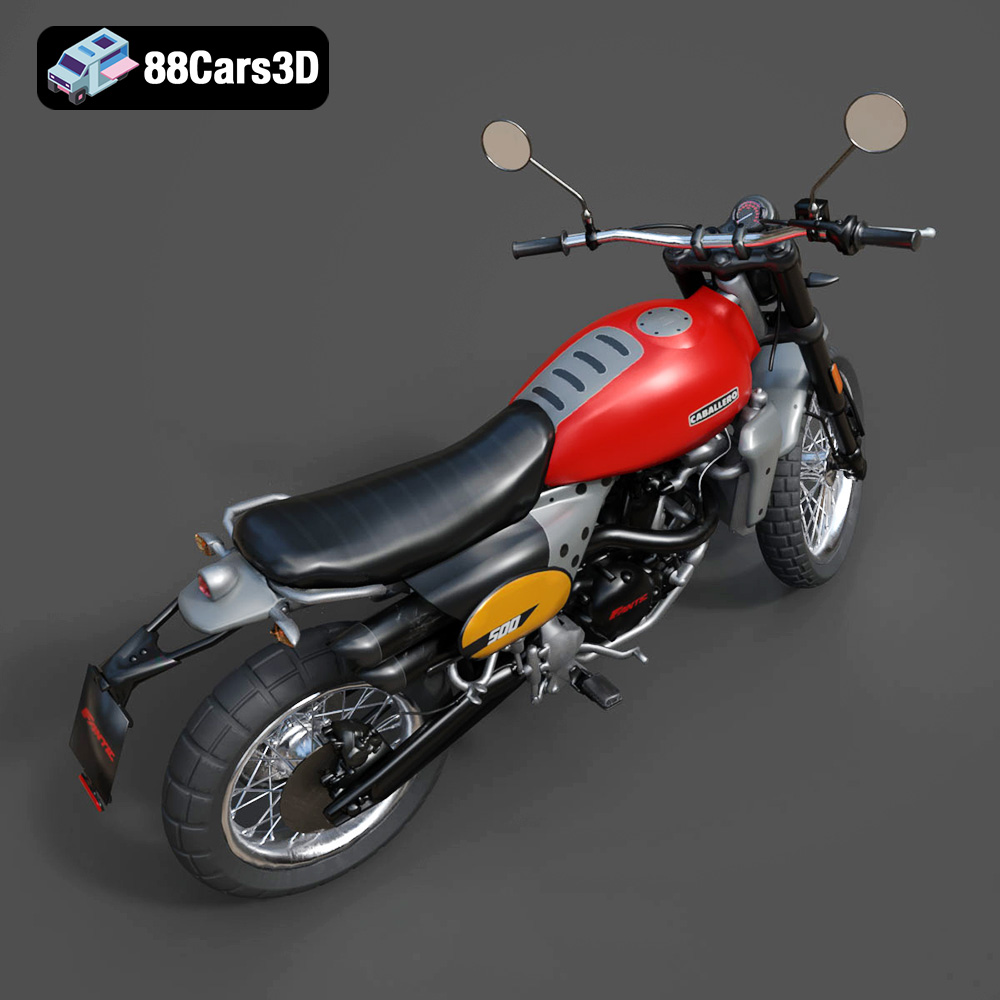
The level of detail captured in this model is extensive. The exposed, detailed engine block and radiator are not just simple blocks; they feature authentic components that contribute to the motorcycle’s rugged character. The signature dual-exit high-mount Arrow exhaust system is accurately reproduced, a key visual identifier of the Caballero 500. Even smaller elements like the classic round LED headlight, minimalist taillight assembly, and spoked wheels are meticulously crafted. For animators and game developers, the inclusion of separate parts for wheels, suspension forks, and steering components, each with properly set pivots, is invaluable. This forethought saves hours of rigging and setup, allowing immediate implementation of realistic movement. The cockpit and rider interface, including the flat retro-style ribbed saddle, wide dirt-track handlebars with detailed grips, and the minimalist digital instrument cluster, are designed for visual authenticity and even optimized for first-person POV in gaming, crucial for an immersive experience.
The Fantic Caballero 500 Scrambler 3D Model isn’t just a static replica; it’s a flexible base for creative customization. Its organized structure allows for easy modification of material properties, opening up a world of possibilities for tailoring the aesthetic. Users can effortlessly change fuel tank colors to match various brand identities or moods, such as a classic Fantic Red for a retro feel or a modern Stealth Black. Tire textures can be swapped – from aggressive knobby off-road tires to smoother street tires – to create different variants like a ‘Flat Track’ version. Seat materials can be adjusted, perhaps from the included classic black ribbed vinyl to a distressed brown leather, further enhancing its bespoke appeal. This inherent flexibility, combined with its real-world scale accuracy, ensures the model can be adapted to virtually any creative brief, maximizing its utility for professionals seeking high-quality 3D car models and motorcycle assets.
The advent of 3D printing has opened new avenues for designers and enthusiasts to bring digital creations into the physical world. The Fantic Caballero 500 Scrambler 3D Model, with its .stl format inclusion, is fully ready for this transition, allowing you to hold a miniature replica of this iconic motorcycle in your hands.
Converting a high-detail digital model for 3D printing requires specific considerations. The provided .stl format of the Fantic Caballero 500 Scrambler 3D Model is optimized for this purpose, featuring manifold geometry essential for successful slicing. When preparing to print, choosing the right scale is crucial; recommended scales like 1:12, 1:10, or 1:8 offer a good balance between detail retention and manageable print size. Using slicing software, the model needs to be carefully oriented to minimize supports and maximize surface quality. For a motorcycle with intricate details like spokes, handlebars, and the high-mount exhaust, strategic orientation is key to a clean print. Separating components like the spoked wheels from the main frame before printing can significantly improve detail fidelity and simplify post-processing.
To capture the delicate features of the Caballero 500, resin printing (SLA/DLP) is highly recommended over FDM (Fused Deposition Modeling). Resin printers excel at finer details, which are critical for elements like engine fins, brake calipers, and the thin spokes of the wheels. A layer height of 0.04–0.12 mm is ideal for achieving smooth surfaces and sharp edges. For structural integrity, a wall thickness of 1.2–2.0 mm and an infill of 20–30% are recommended. Supports will be necessary for complex overhangs such as the handlebars, the high-mount Arrow exhaust, the kickstand, and the footpegs. Printing the frame angled can improve structural integrity, while printing spoked wheels separately allows for optimal support placement and detail resolution. Adhering to these settings will yield a robust and visually accurate physical model.
Once printed, the physical Fantic Caballero 500 Scrambler miniature enters the post-processing phase, where it truly comes to life. This involves carefully removing supports, sanding any rough areas, and applying a primer coat to prepare for painting. This stage is where personalization truly shines. Imagine painting the fuel tank in the classic Fantic Red, contrasting it with a matte black for the exposed steel tube frame, and meticulously applying metallic finishes to the engine components and the iconic Arrow exhaust. Weathering effects can add a touch of realism for a “well-ridden” look, enhancing its rugged scrambler aesthetic. For hobbyists, this process is as rewarding as the digital creation, culminating in a tangible piece of automotive art that embodies the spirit of the Fantic Caballero 500 Scrambler.
The Fantic Caballero 500 Scrambler 3D Model stands as a testament to what high-quality digital assets can achieve. From its impeccable, game-ready topology and real-world scale accuracy to its comprehensive range of included file formats, this model is a versatile powerhouse for professionals across various industries. Whether your goal is to produce stunning automotive rendering, integrate a responsive vehicle into a cutting-edge video game, craft an immersive AR/VR experience, or even bring a physical miniature to life through 3D printing, this asset from 88cars3d.com provides the robust foundation you need.
Its detailed features, from the iconic Arrow exhaust to the aggressive knobby tires and authentic engine components, are designed to enhance realism and provide ample customization opportunities. By offering optimized geometry and proper pivot setups, it streamlines complex workflows, allowing artists and developers to focus on creativity rather than technical hurdles. Investing in high-quality 3D car models and motorcycle assets like the Fantic Caballero 500 Scrambler is not just about acquiring a file; it’s about unlocking efficiency, elevating visual standards, and empowering your creative vision.
Explore the potential of premium 3D assets and discover how the Fantic Caballero 500 Scrambler 3D Model can transform your next project. Visit 88cars3d.com today and take the first step towards exceptional digital craftsmanship.
The Fantic Caballero 500 Scrambler 3D Model is a highly detailed, optimized digital recreation of the iconic Italian modern-classic motorcycle. Blends 1970s retro dirt-track aesthetics with contemporary engineering, the Caballero 500 is famous for its rugged off-road stance, punchy single-cylinder engine, signature dual Arrow exhaust, and aggressive knobby tires. This 3D model accurately captures the essence of the scrambler lifestyle, featuring the classic round LED headlight, teardrop fuel tank with authentic badging, exposed steel tube frame, and flat dirt-style saddle. Built with incredibly clean, game-ready topology (just over 150k triangles), it delivers premium visual fidelity without bogging down real-time engines. It is the perfect asset for game development, AR/VR experiences, animation, and lifestyle automotive visualization.
$39.99
.blend
.fbx
.obj
.rendering
.scrambler
caballero-500
dirt-bike
fantic
flat-tracker
game asset
game-ready
low-poly
motorcycle-3d-model
optimized
retro-motorcycle
VR/AR