⚡ FLASH SALE: Get 60% OFF All Premium 3D & STL Models! ⚡

In the vast landscape of 3D content creation, where detail battles optimization and realism clashes with performance, the demand for truly versatile assets is higher than ever. Whether you’re a game developer crafting immersive open worlds, an automotive designer visualizing concepts, or an architect populating a scene, the need for high-quality, performant 3D models of iconic vehicles is paramount. Few vehicles encapsulate a sense of freedom and American heritage quite like the Harley-Davidson Road King. Its classic lines, powerful V-twin engine, and touring capabilities have cemented its place as a legend on the asphalt.
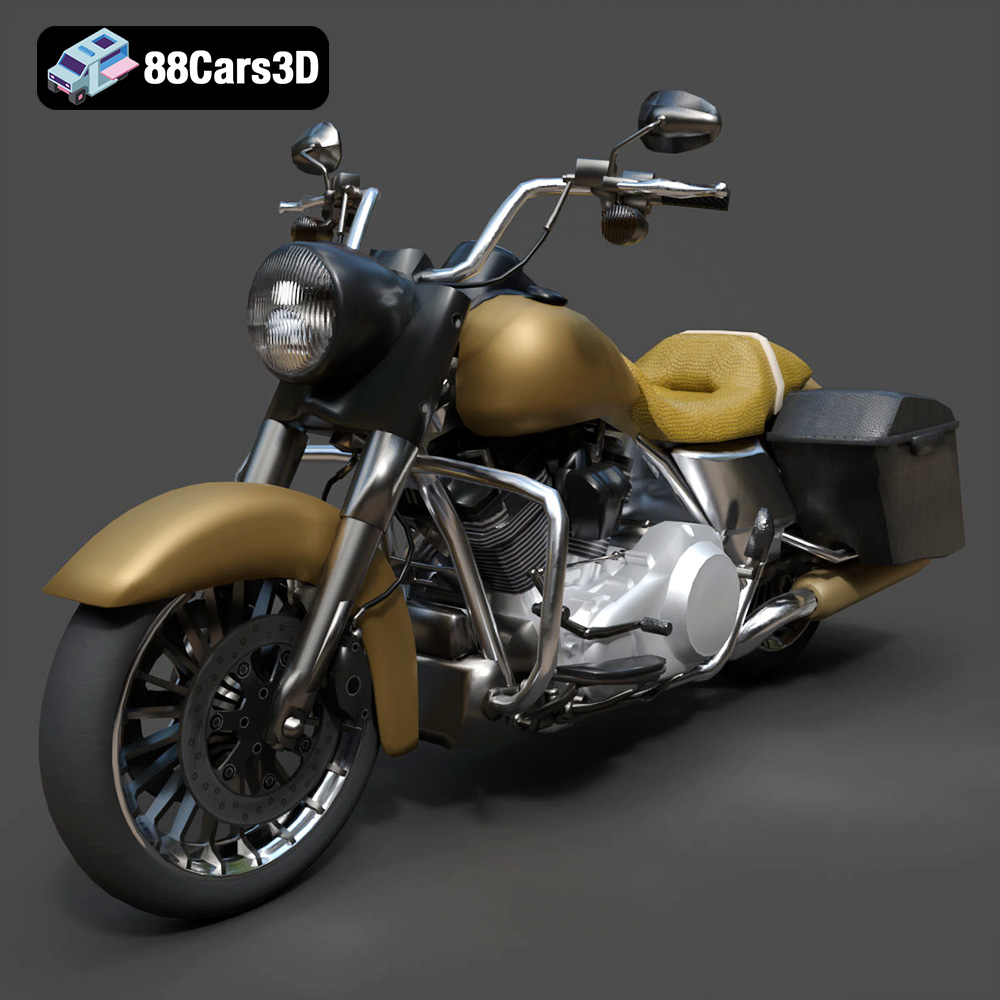
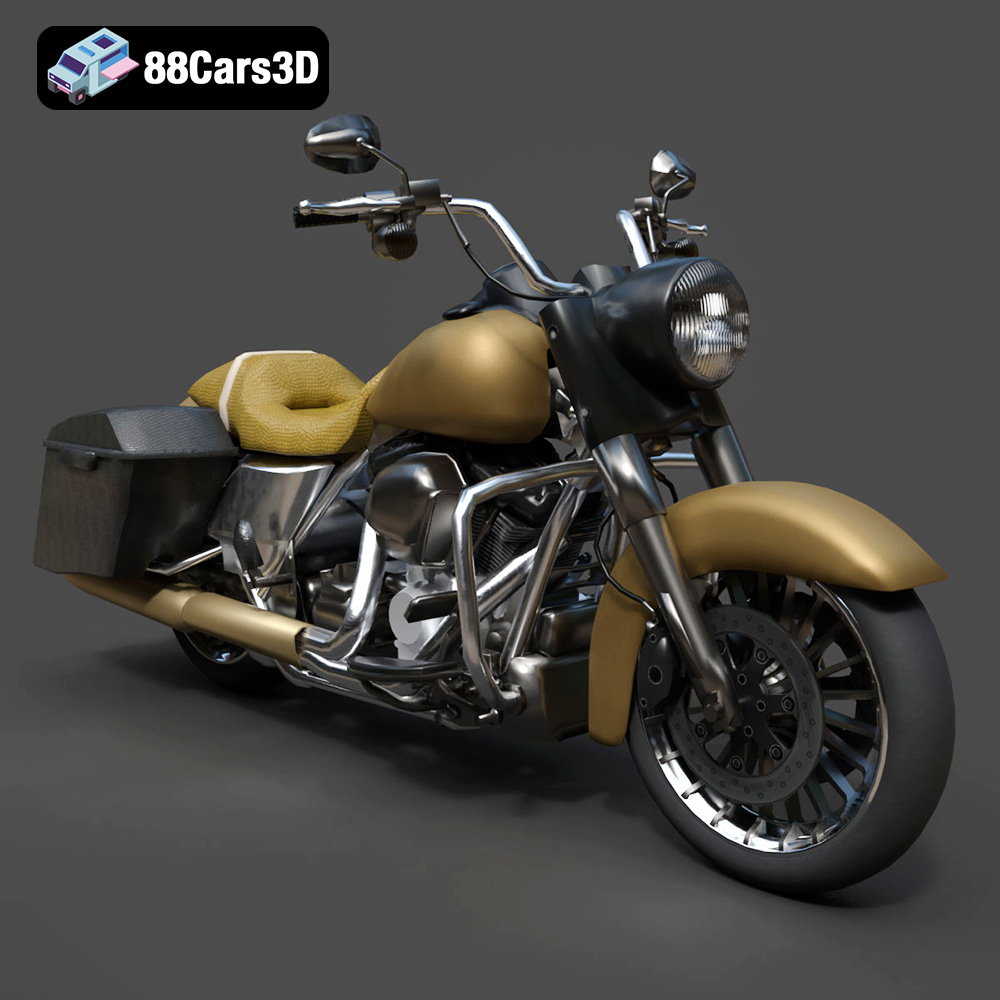
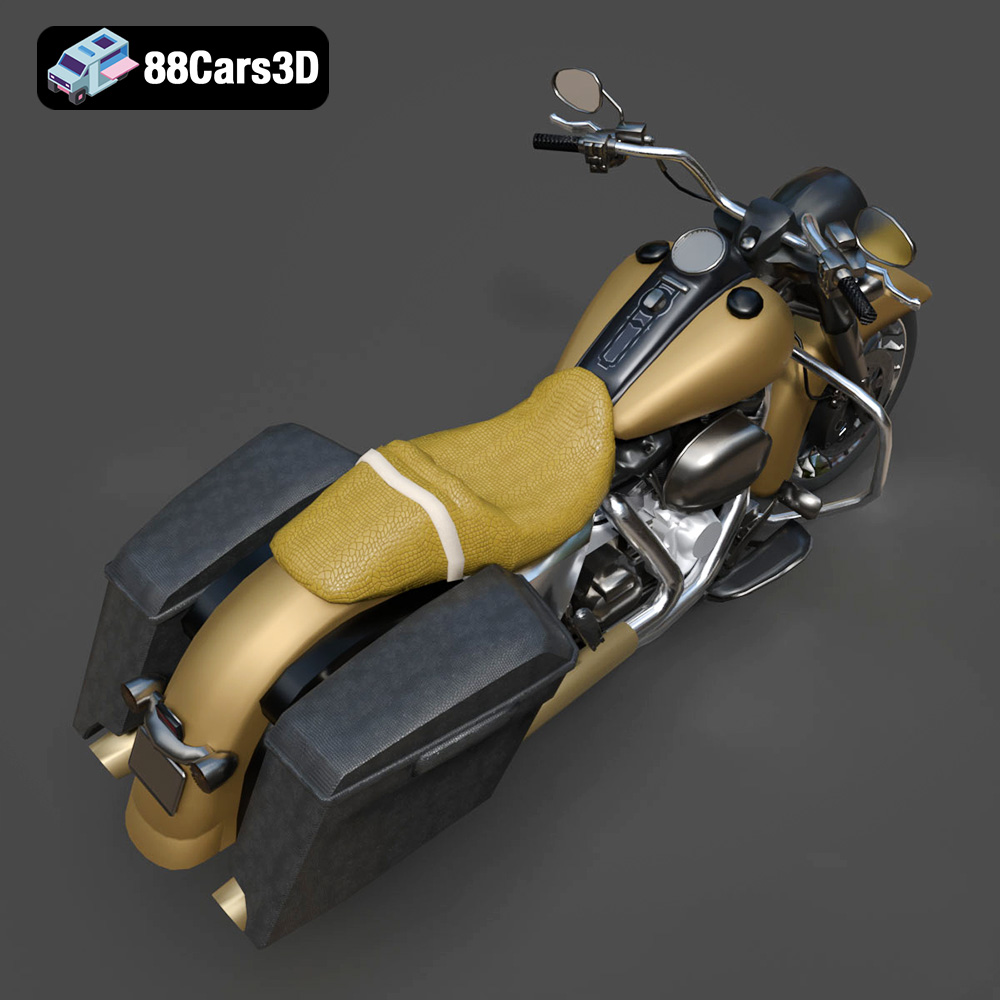
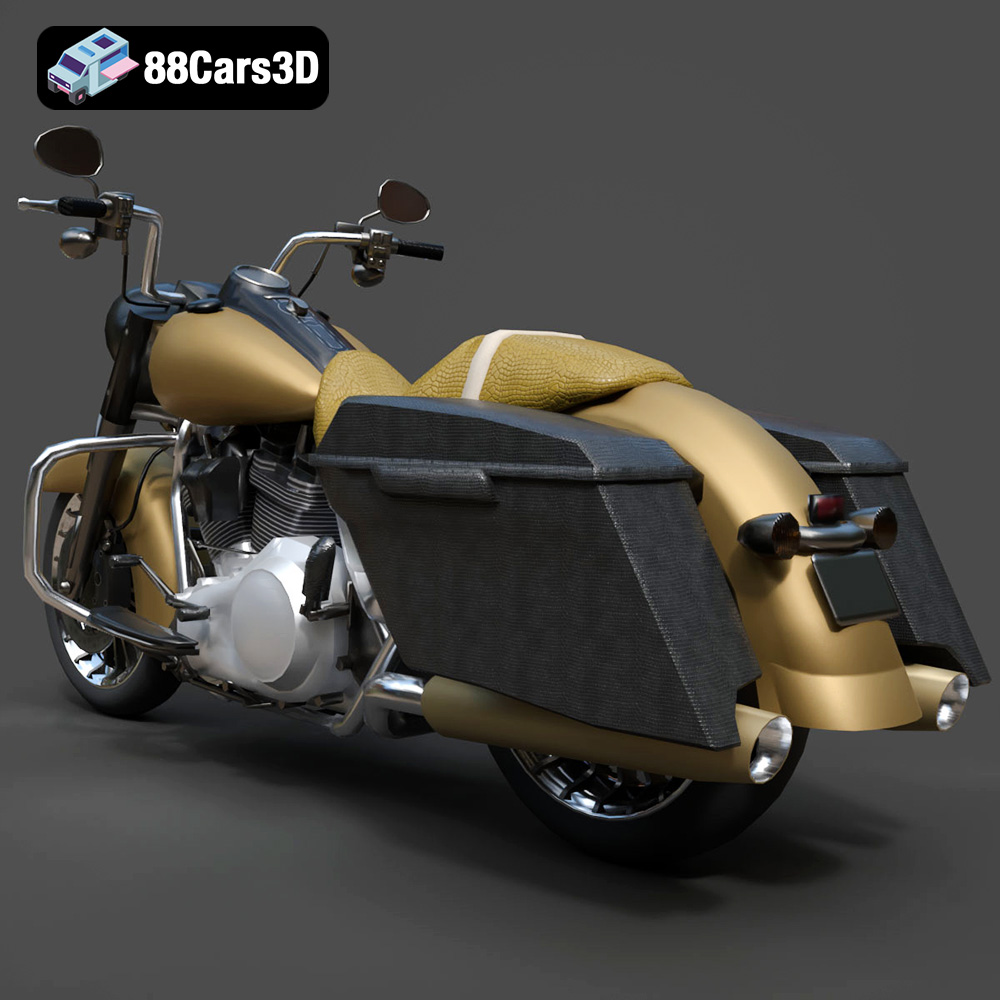
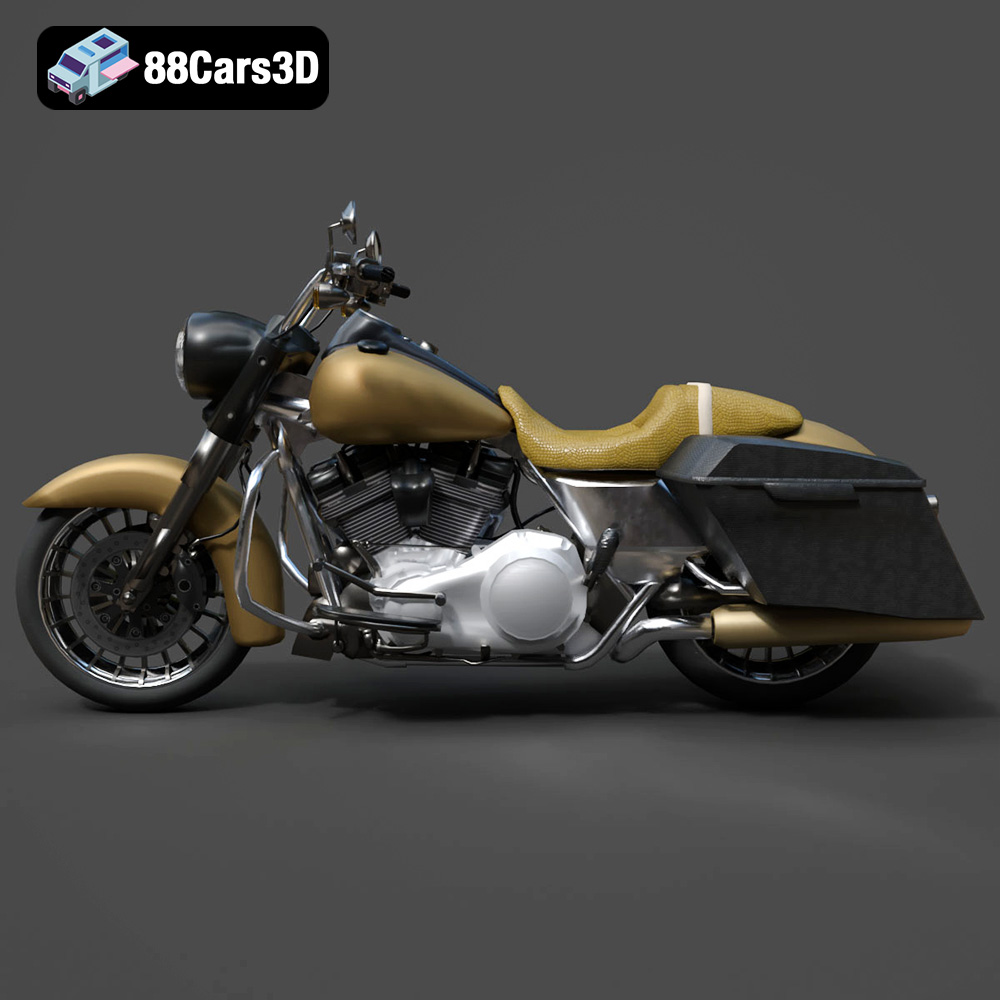
Today, we’re not just admiring the physical machine; we’re diving deep into its digital counterpart: the Harley-Davidson Road King 3D Model. This particular asset, available on 88cars3d.com, stands out as a prime example of expert craftsmanship, balancing an authentic representation of this beloved cruiser with meticulous optimization for game-ready performance and broader visualization applications. From its distinctive chrome headlight nacelle to its sweeping dual exhaust, every element has been thoughtfully considered, making it an invaluable addition to any professional’s toolkit.
In the realm of 3D modeling, especially for interactive applications like video games and augmented/virtual reality, optimization is not merely a preference; it’s a necessity. A stunningly detailed 3D car model with millions of polygons might look incredible in a static render, but it would cripple the performance of a real-time engine. This is where the skill of a 3D artist truly shines – the ability to capture the essence and key features of an object with the fewest possible computational resources. For 3D car models, striking this balance is critical.
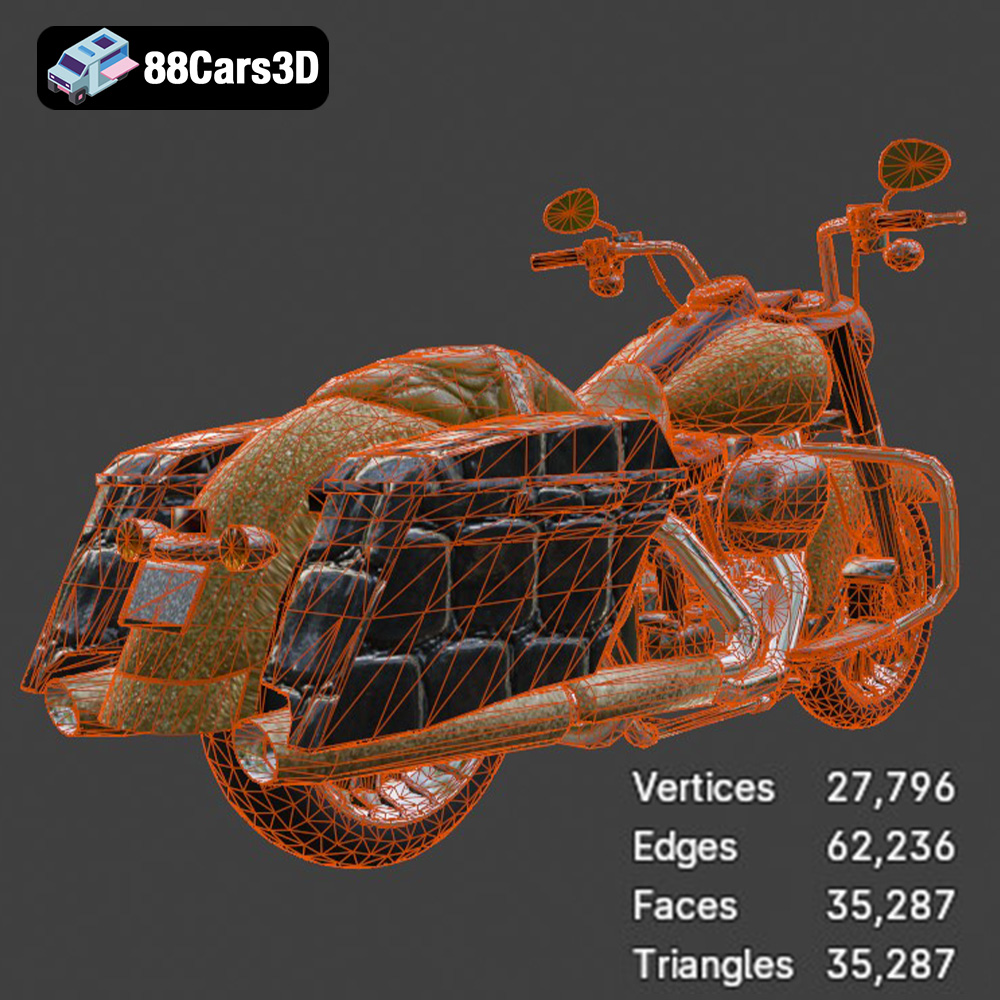
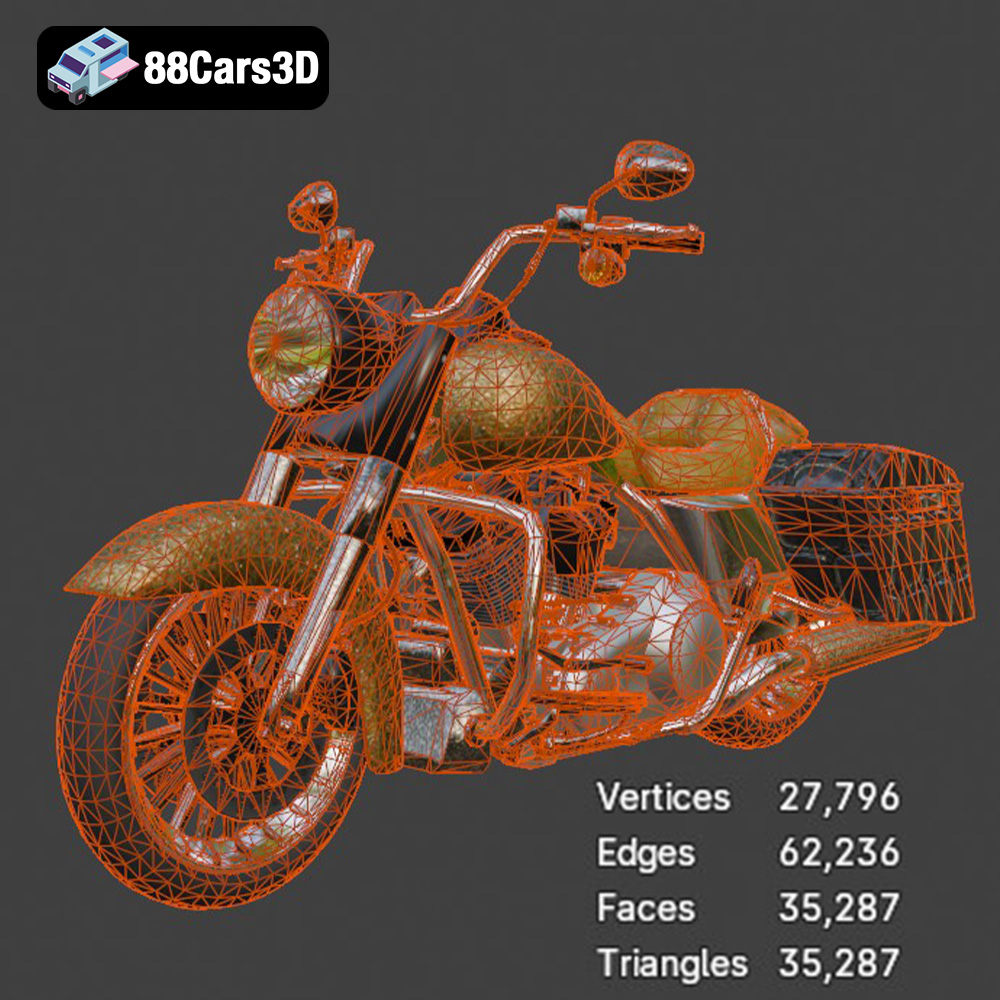
The Harley-Davidson Road King 3D Model exemplifies this balance perfectly. At just over 35,000 triangles (specifically, 35,287 triangles from 27,796 vertices and 62,236 edges), it achieves a remarkable feat: it maintains the iconic silhouette and recognizable features of the Road King while remaining incredibly lightweight. To put this into perspective, a high-detail cinematic model could easily exceed a million polygons for a single wheel, let alone an entire motorcycle. The Road King model’s efficient topology means that it looks convincing even in close-up shots within a game’s third-person perspective, without sacrificing frame rates.
This level of optimization is not achieved through simple decimation but through careful modeling decisions. Essential elements like the large chrome headlight nacelle, the classic V-twin engine profile, and the hard saddlebags are all present, with their shapes clearly defined. The geometry for components like the wheels is designed to appear smooth and detailed from a typical game camera distance, rather than consuming excessive polygons on elements that would rarely be scrutinized at extreme proximity in a real-time environment.
The low-polygon nature of this game-ready asset offers a massive performance advantage across various platforms and applications. For mobile game development, where hardware resources are limited, a model like this ensures smooth gameplay and quick loading times. Imagine an open-world mobile title needing dozens of vehicles on screen simultaneously; heavy models would bring the experience to a crawl. Similarly, in AR/VR applications, maintaining high frame rates is crucial for immersion and preventing motion sickness. The Harley-Davidson Road King 3D Model is ideally suited for lightweight interactive browser configurators or augmented reality experiences where efficiency is king.
Even for larger-scale projects, such as PC or console games, or complex automotive rendering scenes, this model can serve as an excellent base. It can be used as background traffic, part of a larger scene’s environmental dressing, or as a primary vehicle for stylized games. Its proper pivot setup for steering, wheel rotation, and kickstand articulation further enhances its utility, allowing for dynamic animations and physics rigging right out of the box.
The versatility of any 3D model is often defined by the range of file formats it supports. Different formats are optimized for different stages of the 3D pipeline, from initial modeling and animation to real-time rendering and 3D printing. The Harley-Davidson Road King 3D Model from 88cars3d.com is provided in a comprehensive suite of formats, ensuring maximum compatibility and utility for diverse projects. Understanding each format’s strengths is key to a streamlined workflow.
The .blend format is the native file type for Blender, one of the most popular free and open-source 3D creation suites. When you receive a .blend file, you’re getting a complete Blender scene, often including cameras, lighting, material setups, and any modifiers used during the modeling process. This format is ideal if Blender is your primary software, as it allows for full editability, including adjusting topology, refining materials, or even re-rigging components. For the Harley-Davidson Road King model, the .blend file would provide access to the original model’s structure, offering maximum flexibility for customization within Blender’s ecosystem.
Known as a Filmbox file, .fbx is arguably the most widely adopted interchange format across the 3D industry. Developed by Autodesk, it’s a robust format capable of storing not just geometry and UVs, but also material assignments, textures, animations, rigging data, and even camera information. This makes .fbx incredibly versatile for transferring assets between different 3D software packages (like Maya, 3ds Max, Blender) and, critically, for importing into game engines such as Unreal Engine and Unity. For a game-ready asset like the Road King, the .fbx ensures that all crucial data – geometry, pivot points for animation, and material slots – are preserved and readily usable in your real-time pipeline.
The .obj (Wavefront Object) format is a highly universal and widely supported format, often considered a “lowest common denominator” for 3D geometry. It primarily stores vertex positions, UV coordinates, and face information, along with references to external material (.mtl) files. While .obj typically doesn’t support advanced features like animation or rigging, its simplicity ensures compatibility across virtually all 3D software. For simple geometry transfer or when you need a clean mesh to start with, the .obj format of the Harley-Davidson Road King 3D Model is an excellent choice, providing a base for texturing and integration into various rendering or modeling environments.
Part of the glTF (GL Transmission Format) family, .glb is a binary version of glTF designed for efficient transmission and loading of 3D scenes and models by engines and applications. Its primary advantage is that it packages all necessary data—geometry, materials, textures, and even animation—into a single file. This makes it incredibly efficient for web-based 3D applications, augmented reality (AR), virtual reality (VR), and mobile experiences, where fast loading and minimal file requests are crucial. The .glb version of the Road King is perfect for quickly embedding the model into a web viewer or deploying it in a mobile AR app, providing a smooth, optimized user experience.
The Standard Tessellation Language, or .stl, is the de facto standard format for 3D printing. It represents a 3D model as a collection of unconnected triangles that define its surface geometry. Crucially, for successful 3D printing, an .stl model must be “manifold,” meaning it has a completely closed and watertight surface with no gaps or intersecting faces. The .stl version of the Harley-Davidson Road King 3D Model is prepared for 3D printing, allowing creators to produce physical replicas, albeit optimized for smaller scales due to its game-ready polygon count. This opens up possibilities for tabletop displays, dioramas, or collectible scale models.
The Polygon File Format, or .ply, is a versatile format often used for storing 3D scanner data and meshes with additional properties. Unlike .stl, .ply can store not only geometric information but also attributes like color, transparency, surface normals, and texture coordinates associated with each vertex or face. This makes it valuable for applications requiring precise data or visualization of scanned objects, as well as for certain CAD or scientific analysis workflows. For the Road King, the .ply format could be used in scenarios demanding richer per-vertex data, offering a more comprehensive representation than .obj for specific technical analyses.
While not a universal file format in the same way .fbx is, the inclusion of .unreal implies a specifically prepared asset for Unreal Engine. This could mean the model has already been imported, optimized, and perhaps even had basic materials, textures, and collision meshes configured within an Unreal project structure. For developers working exclusively within Unreal Engine, this format represents a significant time-saver, bypassing many initial setup steps and providing an asset that is truly “drop-in” and ready for integration into a project, making the Harley-Davidson Road King 3D Model immediately actionable within this powerful game engine.
The .max format is the native file type for Autodesk 3ds Max, another industry-leading 3D modeling, animation, and rendering software. Similar to .blend, a .max file contains the entire scene data, including hierarchy, layers, animation keyframes, complex material setups (like V-Ray or Corona materials), and modifiers. This format is ideal for professionals whose primary workflow revolves around 3ds Max, offering the highest level of editability and control over the model. Artists can refine the geometry, adjust UVs, or leverage 3ds Max’s robust animation tools to create custom sequences with the Harley-Davidson Road King 3D Model.
The Harley-Davidson Road King 3D Model is explicitly designed with game development in mind, making it an ideal candidate for integration into various real-time engines. Its “game-ready” label is not just a marketing term; it reflects careful consideration of polygon count, material efficiency, and structural integrity for interactive environments.
For Unreal Engine developers, the workflow for integrating this model from 88cars3d.com is straightforward. The provided .fbx or .unreal formats are your go-to. Once imported, the model’s separate components (wheels, steering, frame) with proper pivot points become invaluable for setting up vehicle physics and animation blueprints. You can easily create a skeletal mesh for the motorcycle, allowing for dynamic wheel rotation, steering, and suspension. PBR (Physically Based Rendering) materials can then be applied, utilizing textures that simulate chrome, paint, and leather, bringing the Road King to life with realistic reflections and surface properties. The optimized geometry ensures that even with complex PBR materials, performance remains smooth.
The truly standout feature for game developers working on mobile platforms or in AR/VR is the model’s incredibly low polygon count (35,287 triangles). This statistic means that the Harley-Davidson Road King 3D Model can be deployed in environments where every triangle counts. For mobile racing games or open-world titles, it can serve as a primary player vehicle or as efficient background traffic. In AR/VR, where maintaining a high, stable frame rate is paramount for comfort and immersion, this model shines. Its .glb format is perfect for quick deployment in web-based AR experiences or mobile VR applications, allowing users to interact with an authentic Harley-Davidson without bogging down their devices.
While the model is low-poly, it offers ample scope for customization and adding perceived detail. Game artists can bake high-poly details (like engine fins, stitching on the saddle, or intricate chrome accents) onto normal maps, which are then applied to the low-poly mesh. This technique allows for stunning visual fidelity without adding to the polygon budget. Furthermore, the model’s material slots can be easily modified to apply different paint schemes – from classic two-tone to sinister blacked-out textures – or to swap out the hard saddlebags for textures that simulate leather, providing variation and player choice within the game world. This flexibility makes it a powerful base for a range of in-game motorcycles.
While optimized for games, the Harley-Davidson Road King 3D Model‘s accuracy and iconic design also make it a valuable asset for automotive rendering and visualization projects. Its authentic proportions and clear geometric forms translate well to static, high-quality imagery, even if it’s not a million-polygon “hero” asset.
For architectural visualization, product showcases, or environmental renders, the Road King can serve as an excellent “mid-ground” or “background” element. Imagine a highway scene populated with a realistic, yet performant, lineup of motorcycles, or an urban street scene where a parked Road King adds character and realism. With advanced rendering software like V-Ray, Corona, or Arnold, even a low-poly model can be made to look stunning. The key lies in sophisticated lighting, high-resolution textures (potentially enhanced with custom normal and displacement maps), and post-processing. The model’s clean topology ensures that these advanced rendering techniques can be applied effectively, resulting in convincing visual output that enhances the overall scene without heavy computational overhead.
The demand for interactive 3D experiences on the web is growing. Businesses want to showcase products in 3D, allowing customers to rotate, zoom, and even customize them directly in their browser. The .glb format of the Harley-Davidson Road King is perfectly suited for this. Its single-file, optimized nature allows for rapid loading and smooth interaction within webGL viewers. An automotive configurator could allow users to change paint colors, wheel types, or saddlebag materials in real-time, providing an engaging pre-purchase experience for potential buyers or enthusiasts. The lightweight nature of this 3D car model ensures a responsive user interface.
The Road King’s classic aesthetic, stripping away heavy fairings for a more traditional look, gives it a timeless appeal. This makes the 3D model highly versatile for various artistic interpretations. It can be textured and lit to appear brand new and gleaming, or weathered and road-worn, fitting into a post-apocalyptic setting just as easily as a sun-drenched highway scene. Its distinctive features, like the large chrome headlight and prominent V-twin, are instantly recognizable, adding character and narrative depth to any visualization project. The efficient mapping of its standard hard saddlebags provides a clean canvas for custom textures, further extending its visual range.
Beyond the digital screen, the Harley-Davidson Road King 3D Model offers the exciting possibility of becoming a physical object through 3D printing. The inclusion of the .stl and .ply formats directly supports this application, allowing enthusiasts and professionals to bring this iconic cruiser into the real world as a scale model or collectible.
The provided product description offers excellent guidance for 3D printing. The recommended scales (1:32, 1:43, 1:64) are crucial. Due to its optimized, low-polygon nature, printing the model at very large scales might exaggerate the faceting of the mesh. However, at these smaller scales, the optimized geometry actually serves to simplify the print and prevent overly thin features that might break during fabrication. Resin printing is highly recommended, especially for smaller scales, as it offers superior detail resolution compared to FDM (Fused Deposition Modeling) printers, preserving the optimized details of the V-twin engine profile, the headlight nacelle, and the subtle curves of the fenders.
Specific print settings like layer height (0.04–0.08 mm for resin), wall thickness (1.2–2.0 mm), and infill (20–30%) are critical for structural integrity and print quality. The need for supports on elements like the handlebars, saddlebags, and dual exhausts is a common consideration for complex geometries and ensures that overhangs are properly formed. Printing the frame angled and the wheels separately are smart strategies to optimize print quality and reduce the need for excessive supports, while also facilitating easier post-processing and assembly.
Once printed, the physical model becomes a canvas for further customization. Post-processing is key to achieving a professional finish. This typically involves sanding to smooth layer lines or support marks, followed by priming to create an even surface for paint. The real fun begins with painting: applying classic Harley-Davidson Vivid Black or a two-tone classic paint scheme to the tank and fenders, and metallic silver/chrome detailing to the engine, exhaust, and headlight. This tactile customization allows creators to add another layer of realism and personal flair to their miniature Road King. The “Manifold Geometry” inherent in a well-prepared .stl file ensures a clean print base, crucial for these finishing stages.
Whether for a desktop display, a diorama, or a gift for a Harley enthusiast, the ability to physically manifest the Harley-Davidson Road King 3D Model adds immense value and represents a bridge between the digital and physical realms of design and artistry.
The Harley-Davidson Road King 3D Model stands as a testament to intelligent 3D asset creation, offering a highly optimized, game-ready representation of an American icon without compromising on essential details. Its low-polygon count and careful construction make it an indispensable asset for mobile game development, AR/VR experiences, and any project where performance is as crucial as visual fidelity. Furthermore, its versatility extends to automotive rendering for visualizations and even into the tangible world through 3D printing.
With a comprehensive suite of file formats including .blend, .fbx, .obj, .glb, .stl, .ply, .unreal, and .max, this model ensures seamless integration into virtually any professional workflow. Whether you’re building a virtual highway, designing an interactive showroom, or crafting a physical scale model, the Harley-Davidson Road King 3D Model delivers exceptional value and quality. It’s a prime example of the high-quality 3D car models and game assets available on 88cars3d.com, designed to empower creators and bring their visions to life, efficiently and effectively.
The Harley-Davidson Road King 3D Model is an incredibly optimized, game-ready digital recreation of the quintessential American touring cruiser. Stripping away the heavy fairings of other touring models, the Road King is famous for its classic, nostalgic silhouette, featuring a large chrome headlight nacelle, a prominent V-twin engine, and iconic hard saddlebags. This 3D model accurately captures the legendary highway cruiser aesthetic while being engineered with extreme efficiency in mind. Built with highly optimized, low-polygon topology (just over 35k triangles), it delivers the unmistakable Harley-Davidson profile without consuming heavy memory resources. It is the absolute perfect asset for mobile game development, open-world background traffic, GTA-style mods, and lightweight AR/VR applications. Perfect for virtual cross-country highway scenes, biker lifestyle mobile games, and optimized interactive web showrooms.
$15.9
.blend
.cruiser
.fbx
.obj
.rendering
.stl
35k-polygons
car-3d-model
game-ready
harley-davidson
low-poly
mobile-game-asset
optimized
road-king
touring-motorcycle
VR/AR