⚡ FLASH SALE: Get 60% OFF All Premium 3D & STL Models! ⚡

The pursuit of photorealism in real-time rendering has never been more intense, especially within the demanding world of automotive visualization. From showcasing futuristic concepts to delivering immersive interactive experiences, the fidelity of every surface, every gleam, and every reflection hinges on meticulously crafted Physically Based Rendering (PBR) materials. Unreal Engine stands at the forefront of this revolution, offering a robust and flexible Material Editor that empowers artists and developers to achieve stunning levels of visual accuracy.
At 88cars3d.com, we understand that truly exceptional 3D car models are only as good as their materials. Our high-quality assets, featuring clean topology, realistic UVs, and optimized PBR texture sets, provide the perfect foundation. But unlocking their full potential requires a deep dive into Unreal Engine’s advanced material workflows. This comprehensive guide will take you on a journey through the intricacies of PBR in Unreal Engine, focusing on automotive-specific challenges and solutions. We’ll explore techniques for crafting believable car paint, glass, metals, and more, delving into cutting-edge features like Material Layers, Nanite, and Lumen, while also covering vital optimization strategies. Prepare to transform your digital vehicles into indistinguishable replicas of their real-world counterparts.
To build truly compelling automotive materials in Unreal Engine, we must first establish a solid understanding of PBR principles and how they translate into the engine’s Material Editor. PBR is not just a buzzword; it’s a paradigm built on simulating the physical properties of light and surfaces, ensuring materials look correct under any lighting condition. For automotive assets, this means ensuring chrome truly reflects, paint subtly shimmers, and glass refracts light accurately.
Unreal Engine primarily utilizes the Metallic/Roughness PBR workflow, where materials are defined by properties like Base Color (albedo), Metallic, Roughness, Normal, and optionally Ambient Occlusion and Emissive. Base Color dictates the overall hue, while Metallic defines how much a surface behaves like metal (0 for dielectric, 1 for full metal). Roughness controls the scattering of light; a value of 0 indicates a perfectly smooth, mirror-like surface, while 1 implies a completely diffuse, matte finish. Understanding the interplay of these core parameters is crucial. When sourcing automotive assets from marketplaces such as 88cars3d.com, you’ll typically receive these texture maps, pre-calibrated for PBR workflows, which serve as an excellent starting point for customization and enhancement.
The cornerstone of realistic PBR materials lies in adhering to energy conservation and Fresnel reflectance. Energy conservation dictates that a surface cannot reflect more light than it receives; metallic surfaces absorb specific wavelengths for their color and reflect others, while non-metallic (dielectric) surfaces reflect a portion of light from their surface (specular) and transmit/absorb the rest. Fresnel reflectance means that surfaces reflect more light at grazing angles (when viewed nearly edge-on) than when viewed head-on. Unreal Engine’s default shaders handle these complexities automatically, provided your input texture values are physically accurate. For example, a metallic car body should have a Metallic value close to 1, with its Base Color defining the paint’s intrinsic hue, while a rubber tire will have a Metallic value of 0, with a dark Base Color and a higher Roughness. Consistency in these values across all material types is paramount for believable integration. You can find excellent resources and detailed explanations on PBR principles in the official Unreal Engine documentation at https://dev.epicgames.com/community/unreal-engine/learning.
Once you have your PBR texture maps (Base Color, Normal, Metallic, Roughness, Ambient Occlusion), importing them into Unreal Engine is straightforward. However, proper settings are critical for optimal performance and visual fidelity. Base Color and Emissive textures should typically be imported with `sRGB` enabled, as they represent color information. Normal maps *must* have their `sRGB` disabled and their `Compression Settings` set to `Normalmap` to ensure correct tangent space calculations. Metallic, Roughness, and Ambient Occlusion maps, which are grayscale data, should also have `sRGB` disabled and be set to `Masks` or `VectorDisplacementmap` compression (though `Default` is often acceptable if they are single-channel, but `Masks` is safer to prevent sRGB conversions). Always ensure your `Texture Group` is set appropriately, e.g., `World` or `Vehicle`, to allow Unreal Engine to manage streaming and LODs effectively. Creating a master material that combines these textures and exposes key parameters as instances is the most efficient workflow, enabling rapid iteration without recompiling shaders.
Automotive paint is arguably the most challenging and visually critical material to recreate accurately. It’s not a simple flat color; it’s a complex multi-layered system comprising a primer, a colored base coat (often with metallic flakes), and a transparent, glossy clear coat. Unreal Engine’s Material Editor, combined with specific shading models, provides the tools to simulate this intricate structure convincingly.
The key to achieving this realism lies in leveraging Unreal Engine’s `Clear Coat` shading model. This specialized model simulates a transparent layer on top of a base material, perfectly mimicking the clear coat applied to real car paint. It adds an additional specular reflection pass and supports separate roughness controls for the base layer and the clear coat, allowing for subtle variations in reflectivity that are crucial for believability. Beyond the clear coat, the nuances of metallic flakes, pearlescent effects, and even subtle wear and tear contribute significantly to the perceived realism, transforming a simple texture into a dynamic, light-reactive surface.
The `Clear Coat` shading model in Unreal Engine is the cornerstone for realistic car paint. To activate it, simply set the material’s `Shading Model` to `Clear Coat` in the material details panel. This exposes new inputs: `Clear Coat` (a scalar controlling the intensity of the clear coat, typically 1) and `Clear Coat Roughness`. The base color, metallic, and roughness inputs then define the properties of the underlying paint layer. For instance, a vibrant red car paint would have a red `Base Color`, a `Metallic` value around 0.8-1.0 (even non-metallic paints have a metallic-like sheen due to the clear coat), and a `Roughness` value that determines how matte or glossy the underlying color is before the clear coat. The `Clear Coat Roughness` will be a very low value (e.g., 0.05-0.15) to simulate the high gloss of a polished car surface. This separation allows for intricate control, enabling effects like scuffs on the clear coat while the base paint remains pristine underneath, or a subtle dullness of the base paint showing through a slightly rougher clear coat.
Adding metallic flakes or pearlescent pigments is vital for authentic car paint. This effect is achieved by subtly manipulating the normal map or adding a secondary, high-frequency specular highlight. One common technique involves using a `Noise` texture or a custom tileable `flake` texture (often an anisotropic normal map) and blending it with the primary normal map of the car body. You can scale and rotate this flake texture to control the appearance of the metallic particles. For added depth, you can use a `Parallax Occlusion Mapping` node with a very subtle height map derived from the flake texture, making the flakes appear to have actual volume rather than just a surface effect. Another effective method is to use a `Fresnel` node to drive the visibility of the flake texture, making it more prominent at grazing angles, mimicking how metallic particles become more visible as light hits them indirectly. For iridescent or pearlescent effects, you can introduce a subtle color shift based on the viewing angle using a `Fresnel` node combined with `Lerp` operations, blending between slightly different hues or even introducing an additional emissive component that only activates at certain angles. This creates the dynamic, color-shifting effect often seen in high-end automotive finishes.
No car stays showroom pristine forever, and simulating wear and tear adds a layer of realism critical for game environments, simulations, or storytelling. This is achieved through texture blending techniques within the Material Editor. The most common approach involves using a grayscale mask texture to blend between a clean material state and a damaged or dirty state. For example, a “grunge” or “scratch” mask can be painted in a 3D application or generated procedurally and then used to `Lerp` between two sets of PBR parameters (Base Color, Metallic, Roughness, Normal) in the Material Editor. A clean paint might have low roughness and a vibrant color, while the damaged area could have higher roughness, a desaturated color, and a subtle normal map for scratches. For interactive real-time damage, `Vertex Painting` can be used. By painting grayscale values directly onto the car mesh’s vertices in Unreal Engine, artists can define areas where wear and tear materials are blended in, allowing for dynamic damage simulation that responds to impacts or environmental effects. This level of detail elevates visual storytelling and interaction significantly.
As automotive models grow in complexity, managing materials can become a significant challenge. A single car might have dozens of unique surfaces—paint, glass, chrome, rubber, carbon fiber, leather, plastic—each requiring its own set of PBR properties. Manually assigning and tweaking individual materials can be time-consuming and inefficient. This is where advanced concepts like Material Functions, Material Layers, and robust blending techniques become indispensable, allowing for modularity, reusability, and non-destructive workflows that significantly streamline the creation of diverse and highly detailed automotive surfaces.
Material Functions allow you to encapsulate pieces of your material graph into reusable nodes, making complex shaders manageable. Material Layers take this a step further, providing a powerful, non-destructive way to stack and blend multiple materials on a single mesh, akin to layers in a Photoshop document. This approach is particularly effective for vehicles, where you might want to apply a base paint, then blend in a decal, then some dirt, and finally a clear coat, all without modifying the original assets or creating monolithic, hard-to-manage materials. Utilizing these systems transforms the material creation process from a rigid task into a flexible, artistic endeavor.
Material Functions are incredibly powerful for organizing and reusing common material logic. Instead of recreating the same PBR setup for, say, a generic plastic or a specific carbon fiber weave every time, you can encapsulate that logic within a Material Function. For automotive projects, this is invaluable. You might create Material Functions for:
* **PBR Base Layer:** Takes Base Color, Metallic, Roughness, Normal, and AO inputs and outputs standard PBR channels.
* **Flake Effect:** Generates metallic flakes with customizable size, density, and color.
* **Anisotropic Reflection:** Provides parameters for anisotropic effects on brushed metals.
* **Tire Tread:** Generates or processes textures for realistic rubber and tread patterns.
* **Car Paint Clear Coat:** Implements the Clear Coat shading model with specific roughness and normal handling.
To create one, right-click in the Content Browser and select `Materials & Textures > Material Function`. Inside the Material Function, you define `Function Inputs` and `Function Outputs`. When you use this function in a master material, it appears as a single node, significantly cleaning up your graph. This modularity not only speeds up development but also ensures consistency across your assets and makes future updates or tweaks much easier. Imagine needing to adjust the flake intensity across all your car paints; with a Material Function, you change one node, and every material using it updates automatically.
Unreal Engine’s Material Layers feature, a significant addition for complex asset workflows, allows you to stack multiple materials and blend them non-destructively, similar to how layers work in image editing software. This is particularly potent for automotive models. Instead of a single monolithic material graph, you define `Material Layer` assets (which are essentially smaller, focused materials) and `Material Layer Blend` assets (which define how two layers are combined).
For a car, you might have:
1. **Base Layer:** A generic `Car Paint Base` Material Layer.
2. **Layer 1:** A `Decal` Material Layer (e.g., a racing stripe or logo).
3. **Layer 2:** A `Dirt/Grime` Material Layer.
4. **Layer 3:** A `Clear Coat` Material Layer.
These layers are then combined in a `Material Layer Asset` stack. Each `Material Layer Blend` asset uses a mask (e.g., a texture, vertex color, or procedural mask) to determine where the top layer appears on the layer beneath it. This system is incredibly flexible. You can swap out layers, modify blend masks, or reorder layers without ever touching the underlying mesh or creating new UVs. This non-destructive approach is a game-changer for iterating on designs, adding localized wear, or creating interactive customization options for vehicles.
While car paint often steals the spotlight, the realism of supporting materials is equally crucial.
* **Glass:** Realistic glass requires proper `Transmission` and `Refraction` properties. Set the material’s `Blend Mode` to `Translucent` and its `Shading Model` to `Default Lit` or `Thin Translucent` (for single-pane glass). Use a `Refraction` input driven by an `IOR` (Index of Refraction) value (e.g., 1.52 for typical glass) to accurately bend light. A subtle `Base Color` (e.g., light green or blue) and a low `Roughness` (0.01-0.1) contribute to realism. For realistic headlights or taillights, you’ll want to combine `Translucency` with `Emissive` for the light source, and potentially `Subsurface Scattering` for the diffused plastic lens.
* **Rubber (Tires):** Rubber is dielectric, so `Metallic` is 0. Its `Base Color` will be a dark gray, and `Roughness` will be relatively high (0.6-0.8) for matte rubber, potentially with variations for tread and sidewall. A very subtle `Normal Map` from the tire tread adds crucial detail. For dirty tires, blend in a dust layer using a texture mask.
* **Chrome/Metal:** Highly reflective metals like chrome demand a `Metallic` value of 1. The `Base Color` should be near white (RGB 0.9-1.0) for pure chrome or tinted for other metals like gold. `Roughness` will be very low (0.01-0.05) for polished chrome. For brushed metals, anisotropic reflections are key. This can be faked with a custom normal map or achieved with advanced shading models (though often requires custom HLSL or a dedicated clear coat for the anisotropic effect over the base metal). Ensuring accurate `Normal Maps` for subtle surface imperfections is critical for breaking up perfect reflections and adding realism.
Achieving stunning visual fidelity in Unreal Engine often comes with a performance cost. For real-time applications like games, AR/VR, or interactive automotive configurators, it’s essential to optimize PBR materials without sacrificing too much visual quality. This involves a multi-faceted approach, targeting material complexity, texture management, and efficient instancing. Neglecting optimization can lead to slow frame rates, increased memory usage, and a generally poor user experience, undermining even the most meticulously crafted materials.
The goal is to strike a balance: deliver visually rich materials while keeping render times and memory footprints lean. Understanding how Unreal Engine processes materials, textures, and draw calls is crucial. Techniques like reducing material instruction counts, leveraging texture streaming, and utilizing material instancing are fundamental for scalable and performant automotive visualization projects. The high-quality 3D car models available on platforms like 88cars3d.com are typically optimized for polycount and UVs, providing a strong foundation, but material optimization remains a critical layer of work that developers must tackle.
Every node and calculation in a material contributes to its `instruction count`—the number of operations the GPU needs to perform for each pixel. A high instruction count leads to slower rendering. You can view a material’s instruction count in the Material Editor’s `Stats` panel.
* **Simplify Graphs:** Look for opportunities to simplify logic. Can multiple `Lerp` nodes be combined? Can a calculation be done once and passed through instead of being repeated?
* **Use Static Switches:** For features that are either “on” or “off” (e.g., “flake effect enabled”), use `Static Switch Parameters`. This allows the engine to compile a leaner shader variant without the unused logic, saving instructions at runtime.
* **Material Functions for Common Logic:** While functions themselves don’t inherently reduce instruction count, they make it easier to manage and identify redundant calculations that can be optimized.
* **Avoid Unnecessary Operations:** For example, if a texture only contains grayscale data, don’t sample all four channels if you only need one (e.g., use `TextureSample > R` instead of the full `RGB` output).
* **Choose Shading Models Wisely:** `Clear Coat` is more expensive than `Default Lit`. Use it only where necessary. `Hair` or `Cloth` shading models, while powerful, should be avoided for non-hair/cloth parts of a car.
Textures are often the largest memory footprint in a project. Effective management is key:
* **Appropriate Resolution:** Don’t use 4K textures for small, distant details. Use resolutions appropriate to the size and screen-space importance of the asset (e.g., 2K or 4K for primary body paint, 512×512 for small interior details). For cinematic close-ups, 8K may be justified, but use judiciously.
* **Texture Streaming:** Unreal Engine’s texture streaming system helps manage memory by only loading textures at the resolution needed for the current view. Ensure `Enable Streaming` is checked for most textures.
* **Compression Settings:** As discussed earlier, use `Normalmap` for normal maps, `Masks` for single-channel data (Metallic, Roughness, AO), and `DXT1/DXT5` (default) for color. `HDR` textures might use `HDR` compression. Using `BC7` (available for higher-end platforms) often provides better quality at similar or smaller file sizes than `BC1/BC3`.
* **Virtual Texturing (Optional but Powerful):** For extremely large texture sets or unique per-pixel material variations, `Runtime Virtual Texturing (RVT)` can be a powerful but complex solution. It allows for massive, non-repeating textures without excessive memory cost, ideal for large terrain or highly detailed decals, though less common for individual car components unless dealing with very specific needs.
* **Nanite:** While primarily for geometry, Nanite indirectly aids material performance. By allowing exceptionally high-polygon meshes, it reduces the reliance on normal maps to fake geometric detail, potentially simplifying material graphs slightly. However, Nanite’s strength is in rendering large numbers of detailed objects efficiently, rather than directly optimizing individual material instruction counts.
Material Instancing is one of the most fundamental optimization techniques. Instead of creating a new material asset for every variation (e.g., a red car paint, a blue car paint), you create a single `Master Material`. Then, for each variation, you create a `Material Instance` from that master.
* **Parameter Exposure:** In the master material, convert any parameter you want to change (Base Color, Roughness, Flake Intensity, etc.) into `Parameters` (e.g., `Vector Parameter`, `Scalar Parameter`).
* **Creating Instances:** Right-click the master material in the Content Browser and select `Create Material Instance`.
* **Editing Instances:** Open the material instance. You’ll see sliders and color pickers for all exposed parameters. Changes here are live and do not require recompiling the shader, making iteration incredibly fast.
* **Parameter Collections:** For global changes across multiple materials (e.g., a “dirtiness” factor that affects all materials on a car), use `Material Parameter Collections`. These allow a single scalar or vector value to be accessed and modified across many materials and instances, often controlled via Blueprint.
This approach dramatically reduces draw calls and GPU memory by sharing the same compiled shader code across all instances, only varying their parameter values. It’s an absolute must for any project with multiple variations of similar materials.
In the world of automotive visualization, merely rendering a static image or animation is often not enough. Modern applications demand interactivity, allowing users to customize vehicles in real-time, experience dynamic environmental effects, or even simulate physical damage. Unreal Engine’s powerful Blueprint visual scripting system seamlessly integrates with its Material Editor, opening up a realm of possibilities for creating truly dynamic and engaging automotive experiences.
From building intricate car configurators where users can change paint colors and wheel types on the fly, to implementing realistic, physics-driven material effects like brake glow or tire deformation, Blueprint provides the control layer over your meticulously crafted PBR materials. This combination of visual scripting and advanced material design transforms a static 3D model into a responsive, interactive object, crucial for automotive showrooms, marketing experiences, and high-fidelity simulations.
Interactive car configurators are a prime example of Material Editor and Blueprint synergy. The process typically involves:
1. **Master Materials with Exposed Parameters:** As discussed in the optimization section, create master materials for different parts of the car (body, interior, wheels, calipers). Expose parameters like `Paint_BaseColor`, `Paint_Roughness`, `Wheel_Material`, `Caliper_Color`, etc., as `Vector Parameters` or `Scalar Parameters`.
2. **Material Instances:** Create a material instance for each default option (e.g., “Red Paint Instance,” “Black Wheel Instance”).
3. **Blueprint Control:** In a Blueprint class (e.g., your main car Blueprint or an `Actor` responsible for the UI):
* Get a reference to the `Static Mesh Component` of the car body.
* Use the `Create Dynamic Material Instance` node on the relevant material slot. This creates a new material instance at runtime, allowing you to modify it without affecting the original asset.
* Expose this dynamic material instance as a variable.
* When a UI button (e.g., “Change to Blue Paint”) is pressed, use `Set Vector Parameter Value` on the dynamic material instance variable to change `Paint_BaseColor` to blue.
* For changing entire wheel materials, you might have multiple material instances for different wheel types and use `Set Material` on the wheel mesh component to swap them out.
This setup allows users to instantly visualize changes, offering a compelling interactive experience often seen in automotive marketing applications.
Beyond configurators, Blueprint can control material properties for various dynamic effects:
* **Runtime Material Swaps:** Imagine a car needing to show different states – clean, dirty, damaged. You can pre-create multiple `Material Instances` for each state. At runtime, based on game logic or user input, a Blueprint can use `Set Material` on a `Static Mesh Component` to swap out the entire material with a different pre-made instance. For finer control, `Set Material > Set Material in Slot` is useful if the mesh has multiple material slots.
* **Dynamic Decal Projection:** Decals are crucial for adding details like scratches, dirt splatters, or custom liveries without altering the base mesh’s UVs. Unreal Engine’s `Decal Actors` project a material onto surrounding geometry.
* Create a `Material` with `Material Domain` set to `Deferred Decal`. This material will have parameters for Base Color, Normal, and Opacity (often driven by a mask texture).
* In Blueprint, you can spawn `Decal Actors` at specific locations, rotate them, and set their `Decal Material` to your custom decal material. This is perfect for simulating impact damage (a fresh scrape appears where the car hits an object) or dynamic mud splashes. You can even adjust the `Fade Screen Size` and `Fade Start Distance` to optimize decal visibility based on camera distance, ensuring efficient rendering.
Materials can also drive visual effects (VFX), especially when integrated with Unreal Engine’s Niagara particle system or for direct material-based effects:
* **Emissive Lights and Glow:** Headlights, taillights, dashboard displays, and brake lights often utilize emissive properties. By exposing an `Emissive Color` parameter in your material, Blueprint can dynamically control its intensity or color based on vehicle state (e.g., brake pedal pressed = taillight `Emissive Color` brightens). You can also use a subtle `Bloom` post-process effect in Unreal Engine to enhance the glow of emissive materials.
* **Brake Disc Glow:** As brake discs heat up, they can glow. This can be simulated by blending an `Emissive` texture (e.g., a warm orange/red gradient) onto the brake disc material based on a `Scalar Parameter` controlled by Blueprint (e.g., linked to vehicle speed or braking intensity).
* **Exhaust Heat Haze:** A subtle heat distortion effect near the exhaust pipes can add significant realism. This is typically achieved with a translucent material that distorts the background. Create a material with `Blend Mode` set to `Translucent` and `Shading Model` to `Unlit`. Use a `Panner` node with a `Noise` or `Cloud` texture to drive the `World Position Offset` or `Refraction` input, creating a shimmering distortion effect. This material can be applied to small meshes placed strategically near exhaust outlets, and its intensity can be controlled by Blueprint based on engine RPM or temperature.
The landscape of real-time rendering is constantly evolving, and Unreal Engine is at the forefront with groundbreaking technologies that push the boundaries of visual fidelity. For automotive visualization, features like Lumen and hardware-accelerated Ray Tracing fundamentally change how light interacts with PBR materials, elevating realism to unprecedented levels. Furthermore, the adoption of open standards like Universal Scene Description (USD) is streamlining workflows for complex assets, especially in collaborative environments.
These next-generation technologies are not just buzzwords; they represent a paradigm shift in how materials are rendered and how assets are managed across diverse pipelines. Leveraging them effectively ensures that your automotive models look their absolute best, whether for high-end cinematic sequences, virtual production, or demanding visualization projects. Understanding how your PBR materials interact with these systems is key to unlocking the full potential of Unreal Engine.
Unreal Engine 5 introduced Lumen, a fully dynamic global illumination and reflections system, and continues to evolve its hardware-accelerated Ray Tracing capabilities. Both dramatically enhance material realism:
* **Lumen (Global Illumination and Reflections):** Lumen provides real-time global illumination, meaning light bounces realistically between surfaces, coloring and illuminating objects based on their surroundings. For car paint, this means that a red car parked near a white wall will subtly reflect the red onto the wall and vice-versa. Reflections are also dynamic and global, capturing the entire scene, not just screen-space data. This makes car paint, glass, and chrome materials incredibly lifelike, as they accurately reflect their environment without baking light maps or complex reflection probes. The `Roughness` value in your PBR materials becomes even more critical, as Lumen’s reflections respond precisely to surface smoothness.
* **Hardware Ray Tracing:** When enabled (requires compatible GPU), Ray Tracing offers truly cinematic-quality lighting, reflections, refractions, and shadows. For PBR materials, this translates to:
* **Accurate Reflections:** Perfectly sharp and true-to-life reflections on glossy car paint, chrome, and glass, surpassing screen-space limitations.
* **Realistic Refractions:** Light bends correctly through glass, windshields, and headlights, with accurate dispersion and caustics. This is crucial for transparent materials, where light passing through them creates realistic visual effects.
* **Global Illumination:** Ray Tracing can provide even more precise global illumination than Lumen, especially for complex scene geometry and highly reflective surfaces.
* **Shadows:** Ultra-sharp and physically accurate contact shadows enhance the grounding of a vehicle in its environment.
When designing PBR materials for projects leveraging Lumen or Ray Tracing, the emphasis on accurate PBR values (especially `Roughness` and `Metallic`) is paramount, as these systems expose any inaccuracies with brutal clarity.
Universal Scene Description (USD) is an open-source scene description format developed by Pixar, rapidly becoming an industry standard for data interchange across different 3D applications. Unreal Engine offers robust USD import and export capabilities, which is a game-changer for automotive pipelines:
* **Streamlined Collaboration:** Automotive design often involves multiple software packages (CAD, DCC tools, Unreal Engine). USD allows artists and designers to assemble scenes and assets, including complex material assignments, in a neutral format that can be seamlessly transferred.
* **Material X Integration:** USD often pairs with MaterialX, an open standard for describing rich PBR materials. This means that PBR material definitions created in one application (e.g., Substance Designer, Maya, Blender) can be exported via USD with MaterialX descriptions and then imported into Unreal Engine, often maintaining a high degree of fidelity for Base Color, Normal, Metallic, Roughness, etc. While 100% perfect translation can still be challenging due to engine-specific shader features, it vastly improves interoperability compared to traditional FBX imports.
* **Non-Destructive Workflows:** USD promotes non-destructive layering, similar to Unreal’s Material Layers but at a scene level. This is excellent for managing variations of car models or applying changes without directly modifying original assets. When sourcing professional-grade 3D car models from platforms like 88cars3d.com, you can often find them available in USD formats, ready for these advanced workflows.
Virtual Production, especially with large LED volumes, has revolutionized automotive advertising and filmmaking. Here, PBR materials face unique challenges and opportunities:
* **Consistent Appearance:** Materials must look correct and consistent from all camera angles and under dynamic lighting provided by the LED wall. This means physically accurate PBR values are more critical than ever, as any discrepancies will be immediately apparent when juxtaposed with real-world elements or actors.
* **Color Calibration:** The color reproduction of PBR materials needs to be carefully calibrated to match the color space of the LED wall and the physical cameras. This often involves specific `Color Grading` and `Look Up Tables (LUTs)` within Unreal Engine’s post-processing to ensure the digital car blends seamlessly with the practical environment.
* **Reflection Control:** Reflections on automotive surfaces are paramount. On an LED wall, these reflections are crucial for “selling” the illusion that the digital car is truly present in the virtual environment displayed on the wall. The PBR materials must provide clean, accurate reflections of the LED content. Techniques like `Reflection Captures` (for static elements) and Lumen/Ray Tracing (for dynamic reflections) are vital.
* **Environment Integration:** Materials should be designed to subtly pick up light and reflections from the surrounding LED environment. For example, a car’s paint should reflect the virtual road and sky displayed on the LED volume, grounding it in the scene. Materials with highly reflective properties (like chrome) will demonstrate this integration most powerfully.
Mastering advanced PBR workflows in Unreal Engine’s Material Editor is not just about creating pretty pictures; it’s about crafting immersive, interactive, and believable automotive experiences that resonate with audiences. From the subtle glint of a metallic flake in car paint to the realistic refraction of a windshield and the precise reflections on polished chrome, every detail contributes to the overall illusion of reality. We’ve explored the foundational principles of PBR, delved into the intricacies of multi-layered car paint, harnessed the power of Material Functions and Layers for modularity, and optimized materials for peak real-time performance. Furthermore, we’ve connected these techniques to interactive Blueprint functionalities and explored how next-gen features like Lumen, Ray Tracing, and USD are shaping the future of automotive visualization.
The journey to hyper-realism is ongoing, but with the techniques outlined in this guide, you are well-equipped to elevate your 3D car models to new heights. Remember that consistency, physical accuracy, and a keen eye for detail are your most powerful tools. Whether you are developing the next generation of games, creating stunning marketing visuals, or building immersive AR/VR training simulations, the quality of your materials will define the impact of your work. We encourage you to experiment with these advanced workflows, push the boundaries of what’s possible, and continue to refine your craft. For a solid foundation to begin your projects, explore the meticulously crafted 3D car models available at 88cars3d.com, ready to be brought to life with your mastery of Unreal Engine’s Material Editor. Dive in, and let your creativity drive the future of automotive visualization!

Texture: Yes | Material: Yes | 3D Printable: Yes. Download the Italian Thoroughbreds Bundle featuring 5 iconic 3D models: Lamborghini Huracán Performante, Ferrari 458 Italia, Lamborghini Urus, Diablo SV, and Maserati GT. Optimized for 4K rendering and 3D printing (STL included). Save 50% with this ultimate Italian vehicle collection.
Price: $199.99

Download the Elite Future Mobility Bundle featuring 4 highly optimized 3D models: Tesla Model S, Avatr 11, Li L9, and Zoox Robotaxi. Perfect for ArchViz, Smart City renders, and game dev. Optimized for Unreal Engine and Blender. Includes .fbx, .obj, and .max formats.
Price: $99

🚗 5 Iconic German Cars (BMW M4 G82, M5 CS, X3, 1 Series & Mercedes E-Class). ✅ Optimized for ArchViz: Ready for Corona & V-Ray. 💰 Save €71 with this limited-time collection! 🚀 Instant Download after purchase.
Price: $119

Download the Extreme Off-Road & Survival 3D Models Bundle! Includes the Brabus 800 Adventure, Dodge Ram Bigfoot, Spec Truck, and a Caravan. Save over €210 on this premium 4-in-1 off-grid vehicle pack for ArchViz and game development.
Price: $149.99

Download the Heavy Duty & Commercial Logistics 3D Models Bundle! Includes the Ford Sterling, Caterpillar CT680, Mercedes Citaro Bus, and Vito Van. Save over €130 on this massive, game-ready 4-in-1 industrial vehicle pack.
Price: $109.99

Download the Ultimate Custom Motorcycles 3D Models Bundle. Includes a Custom Chopper, Ducati 916 Café Fighter, Harley XR1200X, and BMW K100. Perfect premium props for luxury ArchViz garages. Save over €250 today!
Price: $159.99

Download the ultimate JDM Street Racing 3D Models Bundle! Includes the Nissan GT-R, Toyota Supra, Mazda RX-7, Lancer Evo IX, and Honda NSX. Save big on this highly optimized, game-ready 5-in-1 Japanese legend car pack.
Price: $129.99

Download the ultimate American Muscle & Cinematic Classics 3D Models Bundle! Includes the Dodge Charger ’68, Mustang Eleanor GT500, Camaro Z28 ’79, and a custom ’69 Mustang. Save over €240 on this game-ready, premium 4-in-1 pack.
Price: $149.99

Download the Everyday City Traffic 3D Models Bundle. Includes the VW Golf, Kia Picanto, Hyundai Tucson, Toyota Yaris, and a DHL Ford Transit Van. Save big on this 5-in-1 pack, perfectly optimized for realistic ArchViz streets and game traffic.
Price: $99.99
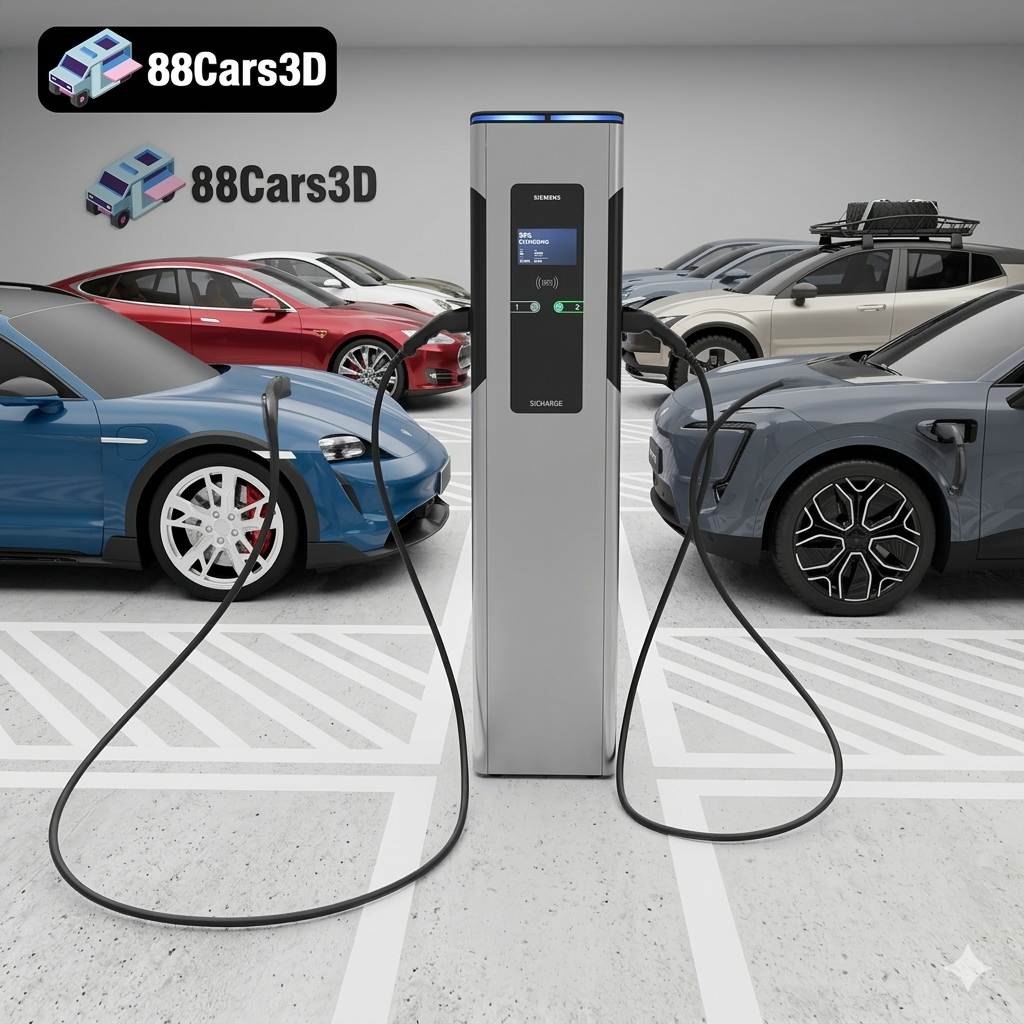
Download the Future of Mobility EV 3D Models Bundle. Includes the Volvo EX30, Tesla Model S, AVATR 11, Porsche Taycan, and a Siemens EV Charger. Save big on this highly optimized 5-in-1 pack for ArchViz and game development!
Price: $89.99

