⚡ FLASH SALE: Get 60% OFF All Premium 3D & STL Models! ⚡

The journey from a precision-engineered CAD file to a stunning, render-ready 3D car model is a complex yet immensely rewarding process. Automotive design, initially conceived with meticulous accuracy in Computer-Aided Design (CAD) software, serves as the bedrock for countless applications, from high-fidelity visualizations and immersive game experiences to augmented reality (AR), virtual reality (VR), and even physical 3D prints. However, directly using raw CAD data in these diverse pipelines presents significant challenges. CAD models, optimized for engineering precision, often contain intricate surface data (NURBS) that translate into unmanageably dense, triangulated, and often non-manifold meshes when converted. This article delves deep into the technical intricacies of transforming these engineering blueprints into production-ready 3D car models, providing a comprehensive guide for artists, developers, and designers. We will explore everything from fundamental topology principles and advanced UV mapping strategies to PBR material creation, rendering workflows, and critical optimization techniques for various platforms. By understanding these essential steps, you’ll be equipped to bridge the gap between engineering and aesthetics, creating high-quality 3D car models that stand out in any professional context, whether for realistic renders or optimized game assets.
The first critical step in converting automotive designs from CAD to 3D models involves a thorough understanding of the source data itself. CAD software, such as SolidWorks, CATIA, or Rhino, excels at creating mathematically precise representations of surfaces (NURBS – Non-Uniform Rational B-Splines). These surfaces define curvature and form with extreme accuracy, ideal for manufacturing and engineering analysis. However, the world of 3D computer graphics primarily operates on polygonal meshes – collections of vertices, edges, and faces that approximate surfaces. Bridging this fundamental difference is where the conversion process truly begins.
Native CAD formats (e.g., .SLDPRT for SolidWorks, .CATPart for CATIA, .3dm for Rhino) are highly proprietary and not directly usable in most 3D modeling or rendering applications. To transfer data, designers typically export to intermediate formats like STEP (.stp), IGES (.igs), or Parasolid (.x_t). These formats aim to preserve the NURBS data or a precise tessellation of it. The primary challenge here is that when these NURBS surfaces are converted to polygons, they often result in meshes with an extremely high, often uneven, polygon count. Furthermore, the resulting mesh can suffer from non-manifold geometry (edges connected to more than two faces, faces with zero area), overlapping faces, and surface inconsistencies that make them unsuitable for subdivision surfacing, clean UV mapping, or real-time rendering without extensive cleanup.
The process of converting NURBS surfaces to polygonal meshes is called tessellation. This is a crucial step where careful parameter control can significantly impact the quality of the initial mesh. Most CAD export tools or dedicated CAD-to-3D conversion software (like Moi3D, Rhino, or specialized plugins for 3ds Max/Maya) offer settings to control the tessellation density. Key parameters include:
Incorrect tessellation can lead to overly dense meshes that are difficult to work with, or meshes that are too coarse, losing the subtle curves and details of the original design. The goal is to achieve a balance: enough detail to capture the design faithfully without creating an unmanageable polygon soup. Even with optimized tessellation, the resulting mesh almost always requires significant re-topology to achieve a clean, animation-friendly, and game-ready asset.
Once the initial tessellation is complete, the art and science of 3D modeling truly begin. The raw mesh derived from CAD is typically a chaotic collection of triangles or poorly organized quads, often with inconsistent density. To create a high-quality 3D car model suitable for rendering, game development, or any other professional application, meticulous re-topology and careful attention to edge flow are paramount. This phase is about transforming a mathematically precise but graphically inefficient model into an artistically optimized and functionally robust asset.
Re-topology is the process of creating a new, clean polygonal mesh over an existing high-polygon model (in this case, the tessellated CAD data). Its importance cannot be overstated for automotive models:
Artists typically employ a combination of manual and semi-automated techniques. Tools like Maya’s Quad Draw, Blender’s Retopology tools, or dedicated add-ons can project new polygons onto the high-poly surface, allowing for interactive mesh creation. The process involves systematically tracing the underlying forms, establishing clean edge loops around key features, and gradually building up the entire mesh. This can be time-consuming but is fundamental to a professional-grade model. When working in Blender, artists can leverage tools within the Retopology features to snap new geometry to the existing high-poly mesh, ensuring accuracy. For detailed guidance on these tools, referring to the official Blender 4.4 documentation for mesh modeling and snapping features is highly recommended.
Good edge flow is not just about having quads; it’s about how those quads are arranged to define the shape and curvature of the automotive body. Principles of optimal edge flow include:
For example, around a wheel arch, edge loops should radiate outwards, cleanly defining the curve. Along a complex body crease, two or three parallel edge loops should run tightly together to support the sharp angle. Target polygon counts vary significantly: a high-fidelity render model might have several hundred thousand polygons (after subdivision), while an optimized game asset could aim for 50,000-150,000 triangles for a hero vehicle, often relying on normal maps to bake in fine details.
With a meticulously re-topologized mesh, the next critical phase is UV mapping – the process of flattening a 3D model’s surface into 2D space so that textures can be applied. For complex automotive surfaces, achieving clean, efficient, and distortion-free UVs requires advanced strategies and a deep understanding of the unwrapping process. Poor UVs can lead to stretched textures, visible seams, or inefficient use of texture memory, significantly detracting from the final visual quality.
The goal of UV unwrapping for a car model is to minimize seams while avoiding stretching and maximizing the use of the available texture space. This is often an iterative process.
Modern 3D software offers robust UV editing tools. In Blender, for example, the UV Editor provides powerful features such as ‘Smart UV Project’ for quick, though sometimes sub-optimal, unwrapping; ‘Seam Placement’ for defining precise cut lines; and tools to ‘Pack Islands’ and ‘Average Island Scale’ for optimizing the layout. Artists can also utilize the ‘Live Unwrap’ feature to see UV changes in real-time as they mark seams. For a detailed guide on effectively using these features for complex geometry, the official Blender 4.4 documentation on UV mapping provides comprehensive instructions and best practices.
Once individual UV shells are unwrapped, they need to be efficiently arranged within the 0-1 UV space (the texture canvas). This process, known as UV packing, aims to:
Many 3D applications have built-in packing algorithms, and specialized add-ons like UV Packmaster offer even more efficient solutions. For large-scale projects or game development, texture atlasing is a crucial optimization technique. This involves combining UVs from multiple different material types or smaller objects into a single, larger UV map. For instance, the UVs for the car’s paint, glass, and rubber might all be placed onto one 8K texture atlas. This reduces the number of draw calls in a game engine, as the engine only needs to load one texture set instead of many, leading to significant performance improvements. Addressing texture resolution is key: high-fidelity rendering often demands 4K or even 8K textures for hero assets, while game assets might use 2K-4K depending on the platform and proximity to the camera.
With a perfectly UV-mapped model, the next step is to breathe life into the automotive surfaces through Physically Based Rendering (PBR) materials. PBR is a modern shading paradigm that aims to simulate how light interacts with surfaces in the real world, leading to highly realistic and consistent results across various lighting conditions. Understanding PBR workflows and building sophisticated shading networks are essential for creating professional-grade 3D car models, like those available on platforms such as 88cars3d.com.
There are two primary PBR workflows, both yielding physically accurate results:
Regardless of the chosen workflow, several essential PBR maps are typically involved:
Creating realistic car paint is a prime example of advanced PBR. It often involves layering: a base color, a metallic flake layer (simulated through complex noise patterns or procedural textures), and a clear coat layer (a separate dielectric material with its own roughness and normal map to simulate scratches or a wax finish). This multi-layered approach is key to achieving the depth and luster of real-world automotive finishes.
Modern 3D software provides powerful node-based shader editors (Blender’s Shader Editor, 3ds Max’s Slate Material Editor, Maya’s Hypershade) that allow artists to construct highly complex and physically accurate materials. These networks connect various texture maps, mathematical nodes, and procedural generators to define how light interacts with every part of the car.
A well-constructed shading network not only looks realistic but is also optimized. Using texture atlases (as discussed in UV mapping) helps reduce the number of material calls, improving rendering performance in both offline renderers and real-time engines.
Once the 3D car model is meticulously crafted with clean topology, optimized UVs, and stunning PBR materials, the next stage involves bringing it to life, either through high-fidelity rendering for visualization or optimizing it for real-time interaction in game engines. Each path demands distinct technical considerations and best practices.
Automotive rendering is about creating photorealistic images or animations that showcase the vehicle’s design, aesthetics, and features. This typically involves dedicated offline render engines:
For real-time applications like video games or interactive configurators, the focus shifts dramatically from raw fidelity to performance. Optimized 3D car models are crucial for smooth frame rates and efficient resource usage. Platforms like 88cars3d.com often provide models specifically prepared for game engines.
By employing these techniques, artists can ensure that their beautifully crafted 3D car models perform flawlessly in even the most demanding real-time environments.
Beyond traditional rendering and game development, 3D car models find powerful applications in emerging technologies like Augmented Reality (AR), Virtual Reality (VR), and additive manufacturing (3D printing). Each of these fields presents its own unique set of optimization challenges and technical requirements, demanding specialized preparation to ensure optimal performance and physical accuracy.
AR and VR experiences are perhaps the most demanding in terms of real-time performance. They require consistently high frame rates (typically 90 FPS or higher) to prevent motion sickness and ensure immersion. This necessitates aggressive optimization for 3D car models:
These formats are crucial for enabling interactive 3D content directly within web browsers, social media, or dedicated AR apps without requiring extensive setup.
3D printing transforms digital models into physical objects, but it requires a very different set of considerations than rendering or real-time applications. The model must be geometrically sound and physically plausible:
By meticulously addressing these technical demands, 3D car models can successfully transition from virtual showcases to tangible, physical objects, enabling rapid prototyping, scale model creation, and even custom parts manufacturing.
The transformation of engineering CAD data into a polished, production-ready 3D car model is a sophisticated process that requires a blend of technical expertise, artistic vision, and meticulous attention to detail. We’ve navigated the complex journey from understanding the inherent challenges of CAD tessellation to mastering re-topology for clean edge flow, employing advanced UV mapping strategies, and crafting realistic PBR materials. We’ve also explored the distinct optimization requirements for high-fidelity rendering, real-time game engines, and specialized applications like AR/VR and 3D printing.
Each stage, from carefully controlled tessellation to the strategic placement of UV seams and the nuanced layering of PBR shaders, contributes significantly to the final quality and versatility of the 3D asset. Whether your goal is a breathtaking automotive visualization, a high-performance game asset, an interactive AR experience, or a physically accurate 3D print, the underlying principles of clean geometry, efficient texturing, and smart optimization remain paramount. The demand for high-quality 3D car models continues to grow across industries, driving innovation and pushing the boundaries of what’s possible in digital content creation.
By investing the time to understand and implement these advanced workflows, you empower yourself to create truly professional-grade automotive models. When seeking to jumpstart your projects with premium, pre-optimized assets, platforms like 88cars3d.com offer an excellent resource for high-quality 3D car models designed for a multitude of applications. Embrace these techniques, refine your skills, and unlock the full potential of your automotive designs in the dynamic world of 3D.
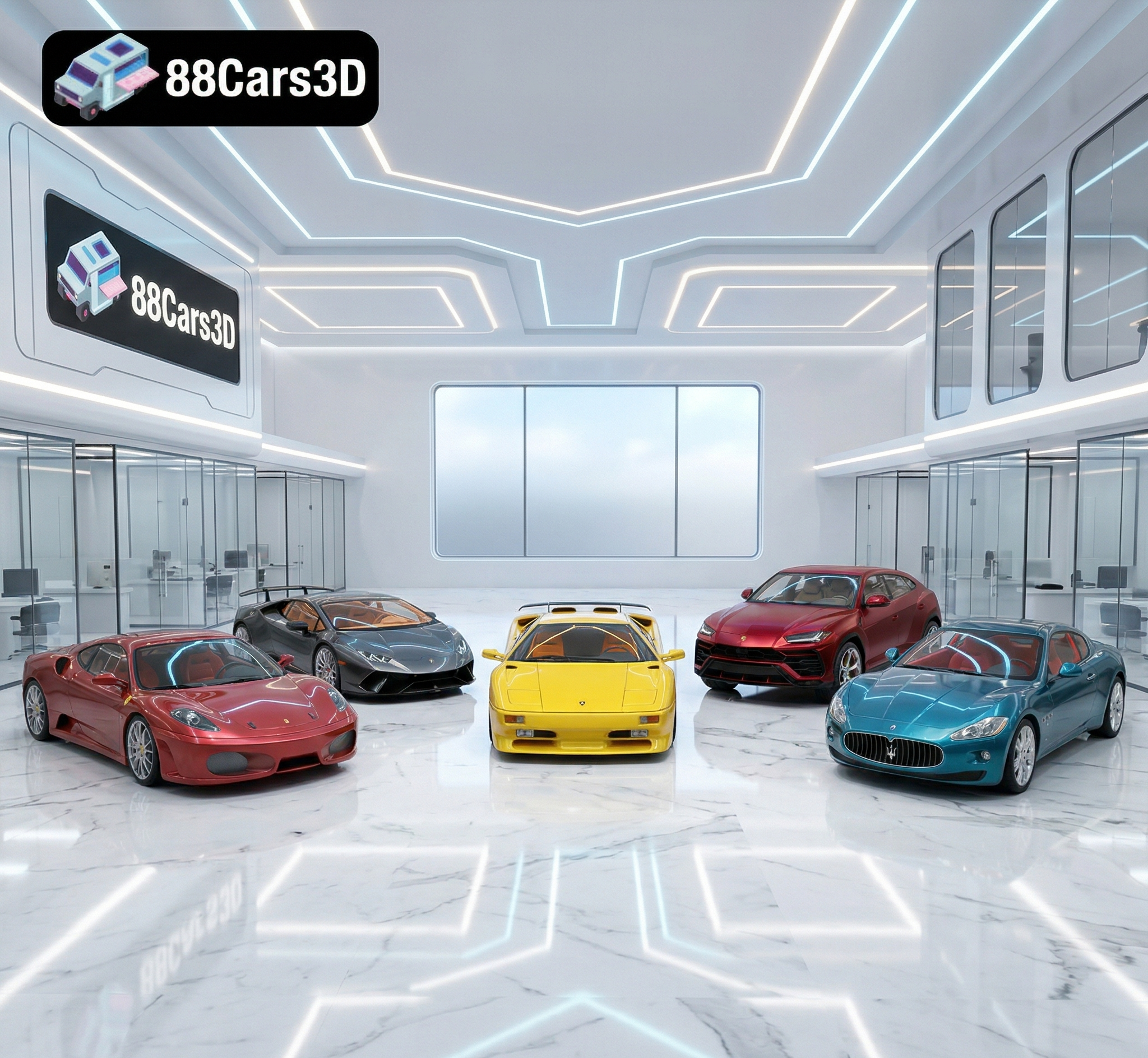
Texture: Yes | Material: Yes | 3D Printable: Yes. Download the Italian Thoroughbreds Bundle featuring 5 iconic 3D models: Lamborghini Huracán Performante, Ferrari 458 Italia, Lamborghini Urus, Diablo SV, and Maserati GT. Optimized for 4K rendering and 3D printing (STL included). Save 50% with this ultimate Italian vehicle collection.
Price: $199.99

Download the Elite Future Mobility Bundle featuring 4 highly optimized 3D models: Tesla Model S, Avatr 11, Li L9, and Zoox Robotaxi. Perfect for ArchViz, Smart City renders, and game dev. Optimized for Unreal Engine and Blender. Includes .fbx, .obj, and .max formats.
Price: $99
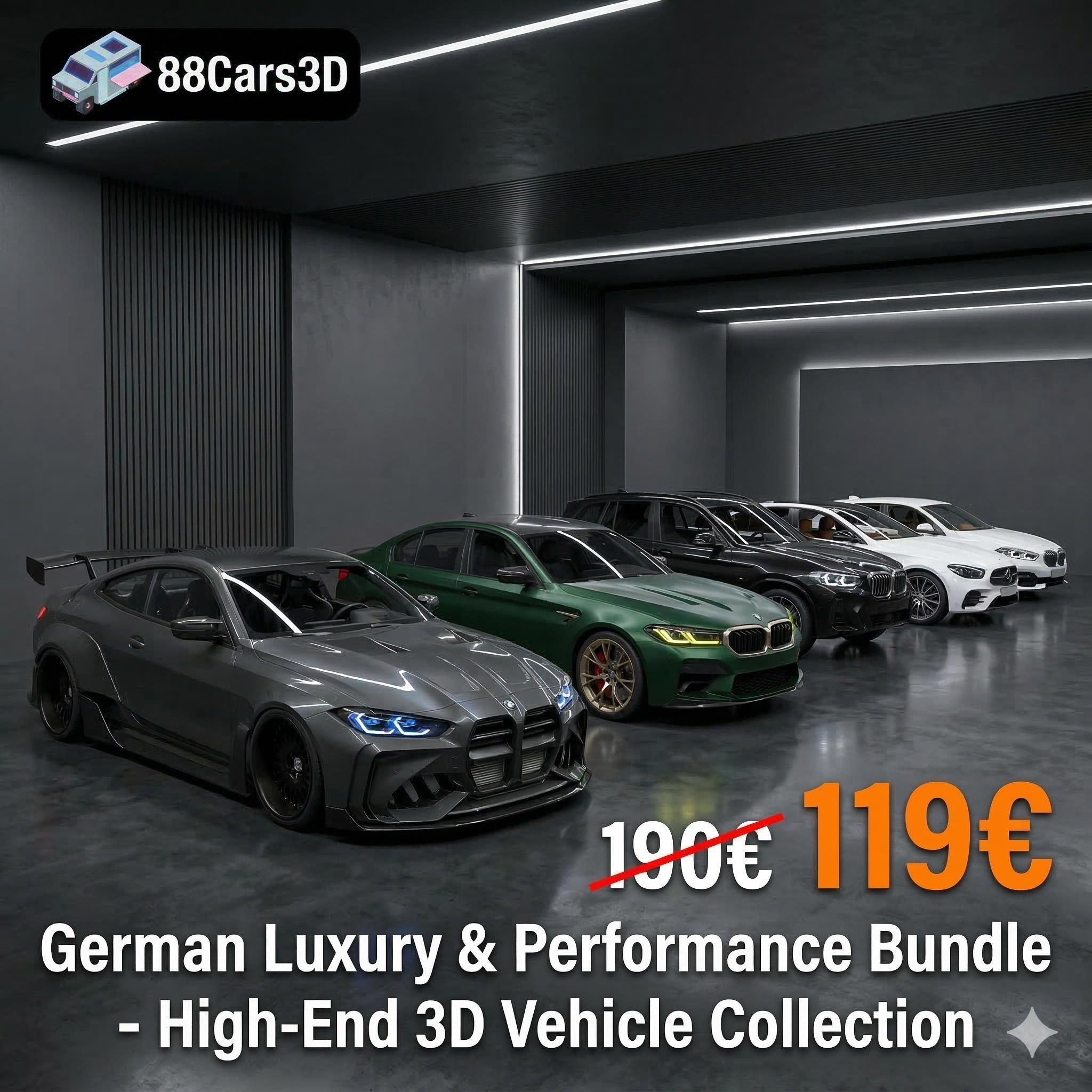
🚗 5 Iconic German Cars (BMW M4 G82, M5 CS, X3, 1 Series & Mercedes E-Class). ✅ Optimized for ArchViz: Ready for Corona & V-Ray. 💰 Save €71 with this limited-time collection! 🚀 Instant Download after purchase.
Price: $119
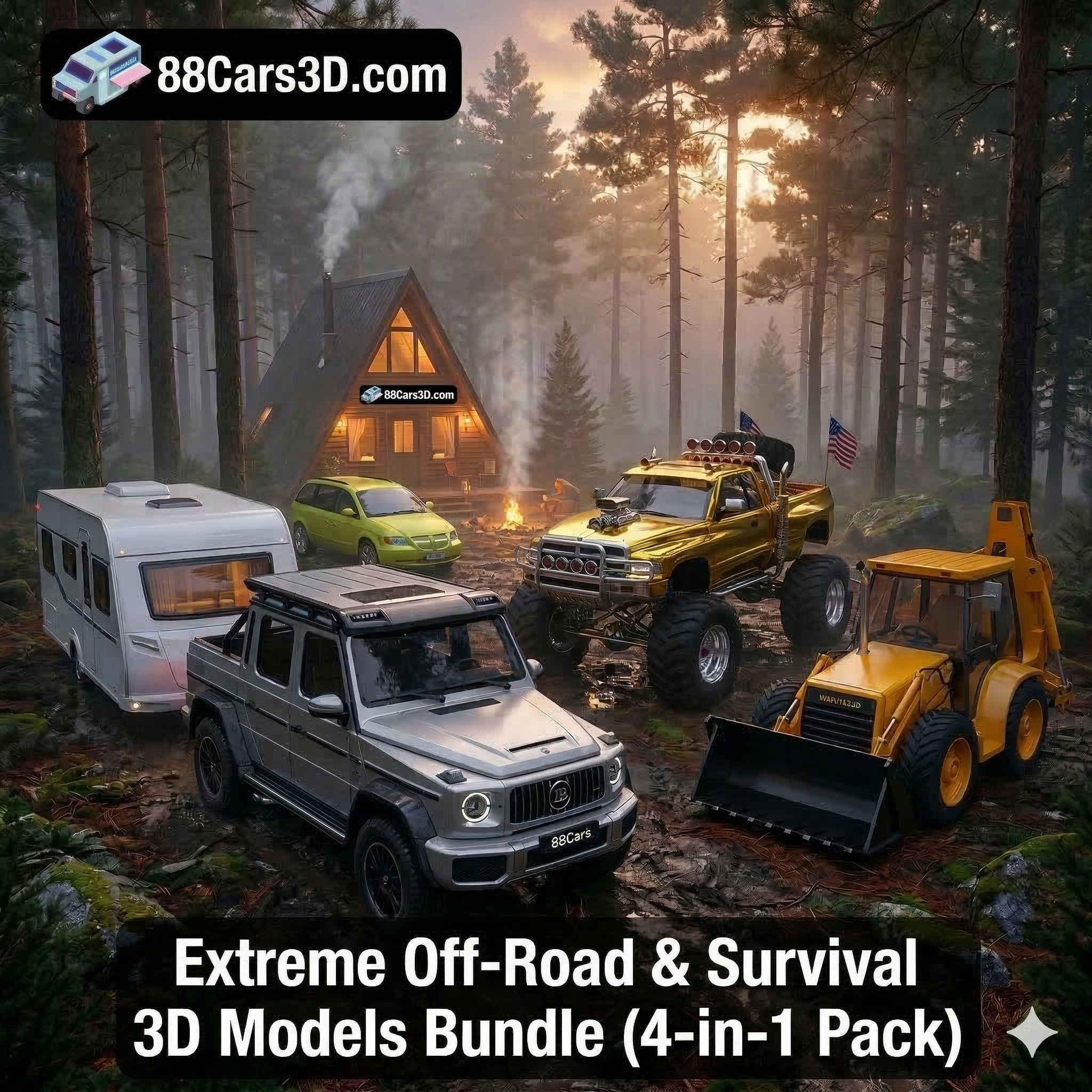
Download the Extreme Off-Road & Survival 3D Models Bundle! Includes the Brabus 800 Adventure, Dodge Ram Bigfoot, Spec Truck, and a Caravan. Save over €210 on this premium 4-in-1 off-grid vehicle pack for ArchViz and game development.
Price: $149.99
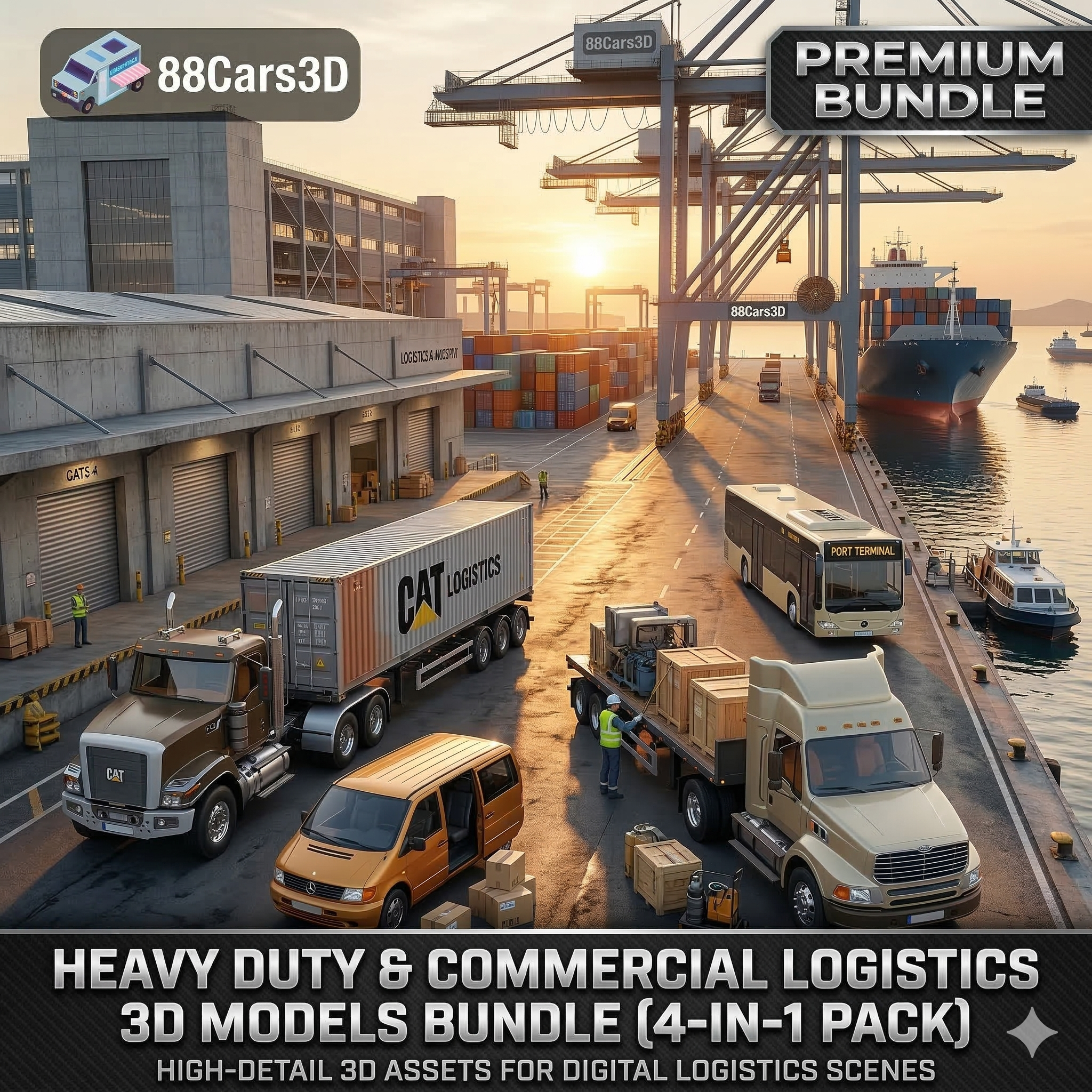
Download the Heavy Duty & Commercial Logistics 3D Models Bundle! Includes the Ford Sterling, Caterpillar CT680, Mercedes Citaro Bus, and Vito Van. Save over €130 on this massive, game-ready 4-in-1 industrial vehicle pack.
Price: $109.99

Download the Ultimate Custom Motorcycles 3D Models Bundle. Includes a Custom Chopper, Ducati 916 Café Fighter, Harley XR1200X, and BMW K100. Perfect premium props for luxury ArchViz garages. Save over €250 today!
Price: $159.99

Download the ultimate JDM Street Racing 3D Models Bundle! Includes the Nissan GT-R, Toyota Supra, Mazda RX-7, Lancer Evo IX, and Honda NSX. Save big on this highly optimized, game-ready 5-in-1 Japanese legend car pack.
Price: $129.99

Download the ultimate American Muscle & Cinematic Classics 3D Models Bundle! Includes the Dodge Charger ’68, Mustang Eleanor GT500, Camaro Z28 ’79, and a custom ’69 Mustang. Save over €240 on this game-ready, premium 4-in-1 pack.
Price: $149.99
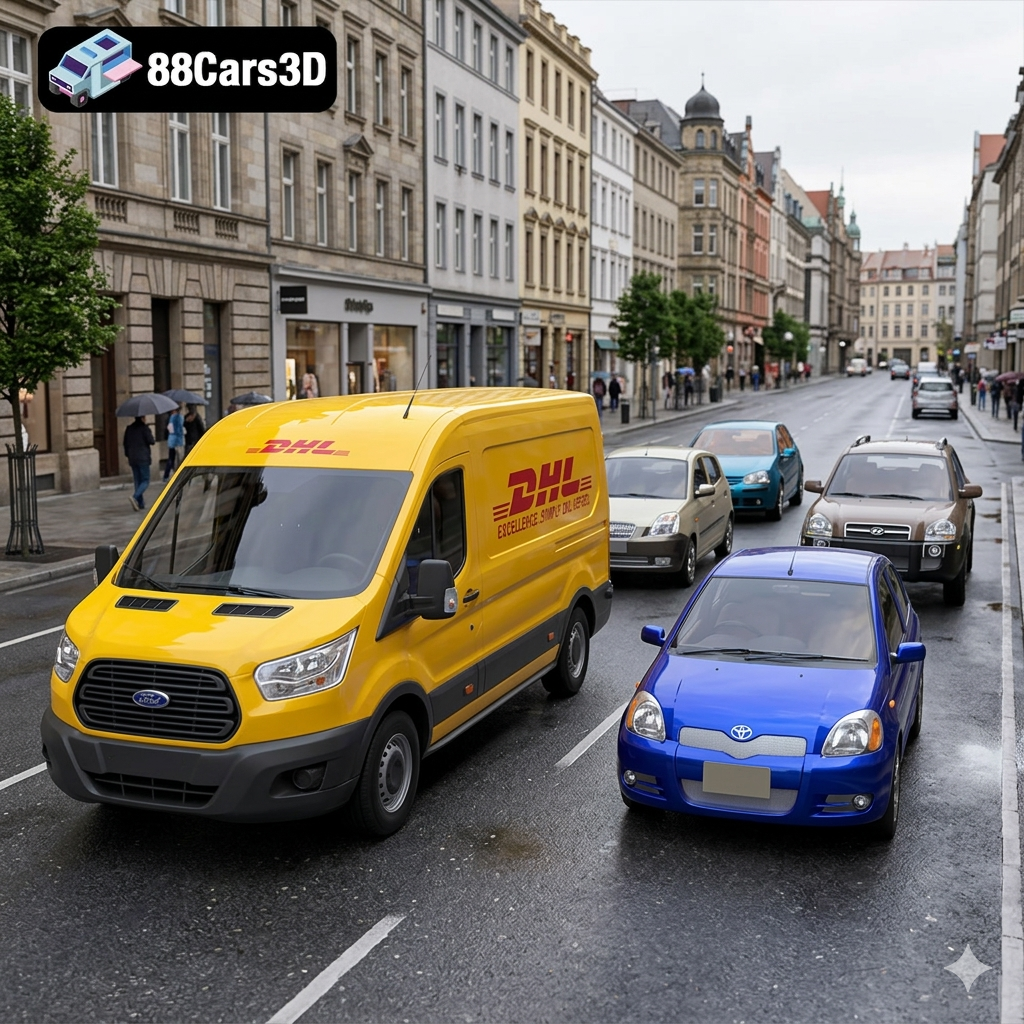
Download the Everyday City Traffic 3D Models Bundle. Includes the VW Golf, Kia Picanto, Hyundai Tucson, Toyota Yaris, and a DHL Ford Transit Van. Save big on this 5-in-1 pack, perfectly optimized for realistic ArchViz streets and game traffic.
Price: $99.99
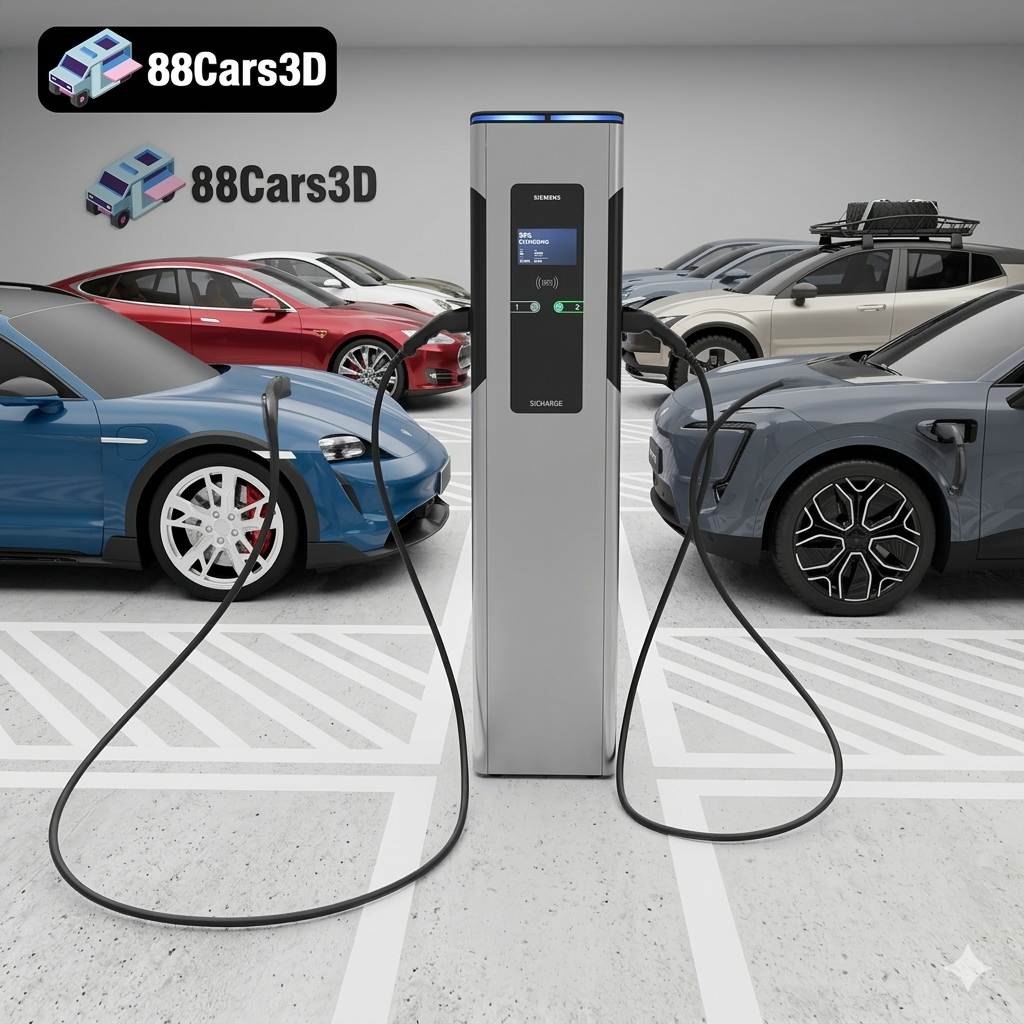
Download the Future of Mobility EV 3D Models Bundle. Includes the Volvo EX30, Tesla Model S, AVATR 11, Porsche Taycan, and a Siemens EV Charger. Save big on this highly optimized 5-in-1 pack for ArchViz and game development!
Price: $89.99

