⚡ FLASH SALE: Get 60% OFF All Premium 3D & STL Models! ⚡

In the rapidly evolving world of digital visualization, the demand for incredibly detailed and technically precise 3D assets has never been higher. From blockbuster game titles and cinematic automotive commercials to immersive AR/VR experiences and intricate 3D-printed scale models, the foundation of excellence lies in the quality of the digital assets used. Few subjects command as much passion and technical scrutiny as high-performance automobiles, and capturing their essence in three dimensions is an art form in itself.
Today, we’re taking a closer look at a prime example of digital automotive mastery: the Aston Martin Vantage 2019 3D Model. This isn’t just any 3D car model; it’s a meticulously crafted digital recreation designed to meet the rigorous demands of professional artists and developers across various industries. Representing the aggressive stance, sharp aerodynamic profile, and performance-focused engineering of the real-world British sports coupe, this asset provides an unparalleled starting point for your next project, whether it involves stunning
automotive rendering, dynamic game assets, or even tangible 3D prints.
The 2019 Aston Martin Vantage, a modern icon, redefined the brand’s entry-level sports car with its bold front fascia, sculpted side intakes, lightweight aluminum structure, and potent twin-turbocharged V8. The challenge for 3D artists is to translate this physical elegance and engineering prowess into a digital form that retains every curve, every shadow, and every detail. This particular 3D model rises to that challenge, offering a highly optimized and versatile solution that seamlessly integrates into diverse workflows. Let’s explore the technical underpinnings and creative opportunities this exceptional asset provides.
The versatility of any high-quality 3D asset hinges significantly on the file formats it supports. Different stages of a professional pipeline, from initial modeling and texturing to real-time deployment and physical manufacturing, necessitate specific file types, each with its own advantages and technical considerations. The Aston Martin Vantage 2019 3D Model excels in this regard, offering a comprehensive suite of formats to ensure maximum compatibility and utility. Understanding these is crucial for optimizing your workflow and achieving your project goals.
The .blend format is Blender’s native file type, containing a complete scene with all objects, meshes, materials, textures, lighting, cameras, animations, and even physics simulations. For artists working primarily in Blender, this is the most desirable format as it allows for full editability and seamless integration into existing Blender projects. It preserves modifiers, node-based materials, and any specific Blender-centric features, making it ideal for those who wish to deeply customize the model, make topological adjustments, or leverage Blender’s powerful rendering capabilities with Cycles or Eevee.
.fbx (Filmbox) is a proprietary file format developed by Autodesk, widely recognized as an industry-standard interchange format, especially for real-time engines. It supports mesh geometry, materials, textures, animation, and even skeletal data, making it invaluable for exporting assets to platforms like Unreal Engine, Unity, and various 3D animation software. When importing an .fbx, developers expect clean topology, proper UV mapping, and correctly assigned materials, all of which are characteristic of the Aston Martin Vantage 2019 3D Model. Its robust nature makes it ideal for pipelines requiring smooth data transfer between different applications.
The .obj (Wavefront OBJ) format is one of the oldest and most universally supported 3D file formats. It primarily stores geometric data—vertices, normals, texture coordinates, and faces—alongside references to external material files (.mtl) that define surface properties. While it doesn’t support animation or advanced scene data, its simplicity and widespread compatibility make it an excellent choice for cross-software transfers where only the mesh data is required. Virtually every 3D application can open and interpret an .obj file, making it a reliable fallback for foundational mesh integration.
.glb (GL Transmission Format Binary) is the binary version of glTF, an open-standard 3D file format designed for efficient transmission and loading of 3D scenes and models by applications. It’s particularly optimized for AR, VR, and web-based displays, as it bundles the model’s geometry, textures, and animations into a single, self-contained file. This makes the Aston Martin Vantage 3D model incredibly easy to deploy in interactive online configurators, virtual showrooms, or augmented reality apps, delivering high-quality visuals with minimal loading times.
.stl (Stereolithography) is the most common file format for 3D printing. It represents a 3D model as a series of connected triangles (a tessellated surface) without color, texture, or other CAD attributes. Its simplicity makes it universally compatible with 3D printers and slicing software. The Aston Martin Vantage 2019 3D Model, when converted to .stl, provides a manifold mesh structure, essential for successful 3D printing. This means it’s ready to be scaled, sliced, and brought into the physical world as a collectible miniature or prototype, showcasing the meticulous detail of the digital asset in a tangible form.
The .ply (Polygon File Format) is often used for storing 3D data from 3D scanners, CAD systems, and other sources that require high-precision mesh information. It can store not only geometry but also color, transparency, and other properties per vertex or face. While less common for general animation, .ply is valuable for applications involving reverse engineering, precise measurement, or analytical purposes where the integrity of scanned or CAD-derived data is paramount.
The inclusion of a dedicated .unreal file (often a .uasset or a packed Unreal-ready folder) indicates that the asset has been specifically pre-optimized and configured for direct import into Unreal Engine. This often means textures are correctly linked, materials are set up with appropriate shaders, and potentially LODs (Levels of Detail) or collision meshes are already included. This format significantly streamlines the development process for game designers and visualization specialists working within Unreal Engine, allowing them to drop the Aston Martin Vantage 3D model directly into their scenes with minimal setup.
Similar to .blend for Blender, .max is the native file format for Autodesk 3ds Max. It contains all scene information, including geometry, modifiers, materials, lights, cameras, and animation data. For professionals using 3ds Max, this format provides full editability and access to the original scene setup, making it ideal for complex animation, advanced rendering with V-Ray or Corona, and further development within the 3ds Max ecosystem. The clean topology and organized structure of the Aston Martin Vantage model are fully preserved in this format, offering maximum flexibility.
The true value of a premium 3D car model lies in its ability to convincingly replicate its real-world counterpart. The Aston Martin Vantage 2019 3D Model is an exemplary case study in this philosophy, capturing the essence of modern British automotive design through meticulous digital craftsmanship. Every design element, from the aggressive front grille to the elegant rear haunches, has been faithfully translated into a high-fidelity asset, ready for a myriad of professional applications.
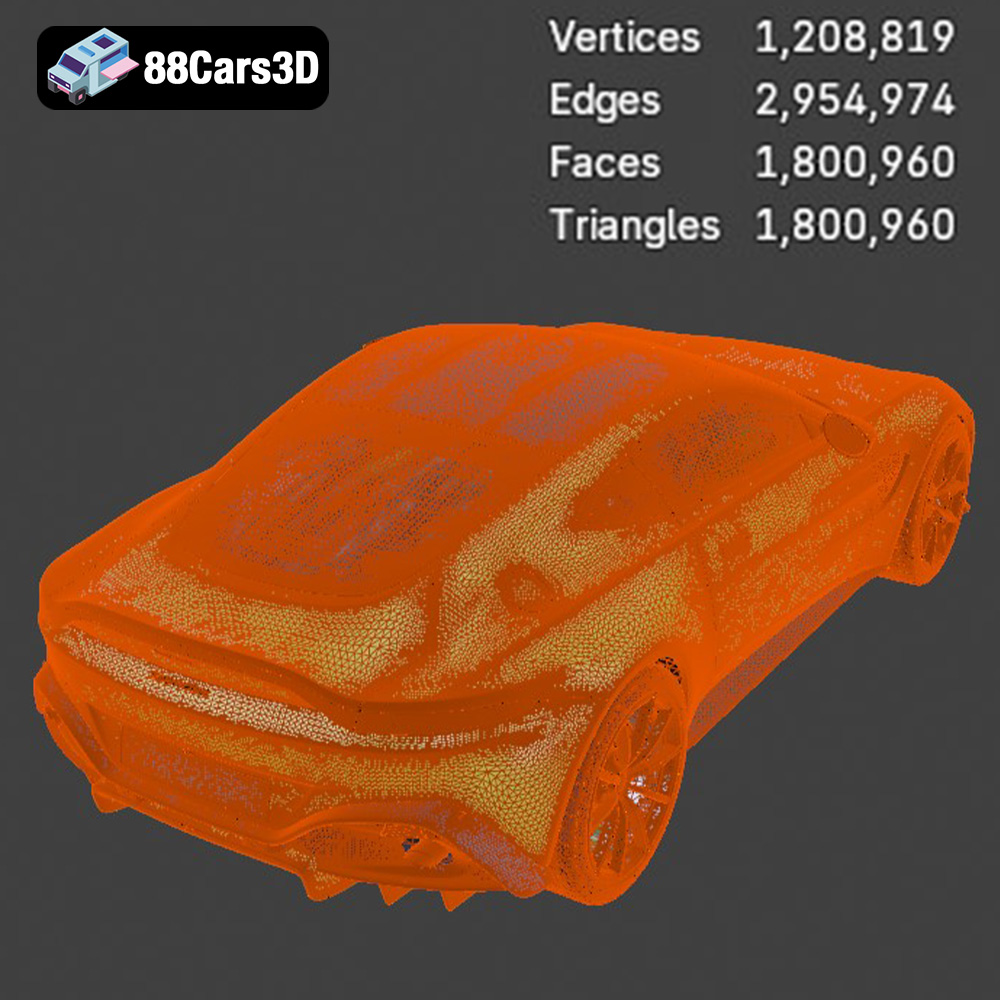
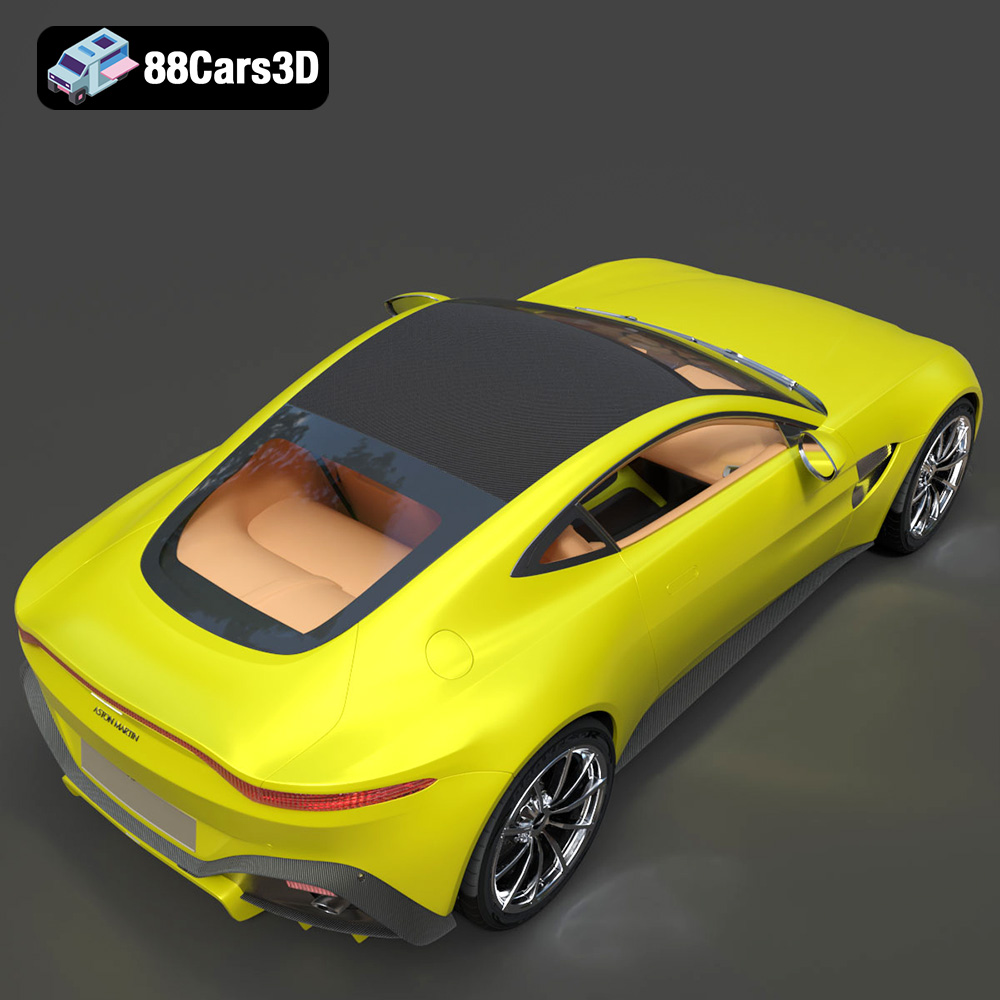
The exterior of the 2019 Vantage is a masterclass in aggressive yet refined styling, and this 3D model replicates it with stunning accuracy. The asset showcases the car’s accurate body proportions, which are critical for maintaining the vehicle’s recognizable silhouette and stance. Key details include the distinct wide front grille and the sharp aerodynamic front splitter, which give the Vantage its unmistakable road presence. The sleek LED headlights and taillights are not merely textured but often feature distinct geometry and material separation, allowing for realistic illumination and refraction in renders. Sculpted side air intakes, integral to the car’s cooling and aerodynamic performance, are precisely modeled, contributing to the overall realism. At the rear, the intricate diffuser and quad exhaust configuration are meticulously detailed, reflecting the car’s performance pedigree. Crucially, the model includes high-detail alloy wheels with accurately replicated brake discs and calipers, often separated for easier texturing and animation. Transparent glass materials and mirror detailing are also refined, ensuring reflections and refractions behave realistically. For animators, the separation of wheels and steering components is a significant advantage, enabling precise and convincing vehicle motion.
Beyond the impressive exterior, the Aston Martin Vantage 2019 3D Model extends its fidelity to the interior. A modeled sport dashboard layout captures the modern, driver-focused cockpit, complete with a detailed digital instrument cluster. The sport steering wheel, with its multifunction controls, is faithfully recreated, enhancing the sense of realism. Performance bucket seats feature intricate stitching detail, adding to the luxury feel and providing excellent visual anchors for close-up renders. The center console and infotainment system are also present, often with separate elements for screens and buttons, allowing for customization of display content. This level of interior detail is not just for show; it’s optimized geometry for real-time engines and high-quality renders alike, ensuring that whether the car is viewed from the outside or explored from within, the experience is consistently immersive and believable.
The true power of a versatile 3D asset like the Aston Martin Vantage 2019 3D Model lies in its applicability across diverse professional workflows. From generating photorealistic marketing materials to building engaging interactive experiences, a high-quality 3D car model acts as a foundational element that streamlines production and elevates the final output.
For automotive advertising, architectural visualization, or cinematic presentations, the demand for photorealistic imagery is paramount. Using a model from 88cars3d.com, artists can leverage powerful rendering engines like V-Ray, Corona Renderer, Octane, or Blender’s Cycles to create breathtaking visuals. The process typically involves importing the .max, .blend, or .fbx file into the chosen software. Artists then focus on setting up a virtual studio environment with realistic lighting, often employing HDRIs (High Dynamic Range Images) for environmental reflections and studio-like light setups for controlled illumination. Material adjustments are key; optimizing the car paint, chrome, glass, and interior fabrics using PBR (Physically Based Rendering) workflows ensures accurate light interaction. Camera angles are carefully chosen to emphasize the car’s lines and features, much like a professional automotive photographer would. Post-production in software like Adobe Photoshop or DaVinci Resolve further refines the image, adding depth, color grading, and subtle effects to achieve that polished, magazine-quality look. Imagine a luxury brand launching a new campaign; utilizing such a detailed 3D model allows for countless scene variations, paint finishes, and lighting scenarios without the logistical costs of physical photoshoots, proving invaluable for promotional campaigns.
In the realm of video games, AR/VR, and interactive simulations, performance is as critical as visual fidelity. The Aston Martin Vantage 2019 3D Model, with its optimized geometry and clean topology, is perfectly suited to serve as a high-performance game asset. Game developers typically import the .fbx or .unreal format into engines like Unreal Engine or Unity. The workflow includes creating multiple Levels of Detail (LODs) for the model, which are simplified versions that swap in and out based on distance from the camera, significantly reducing polygon count and boosting frame rates. Efficient UV mapping is essential for baking realistic textures and normal maps, while collision meshes are created to define the car’s physical boundaries for interactions within the game world. In Unreal Engine, for instance, the .fbx can be imported, materials re-instanced from a master shader for consistency, and then integrated into a vehicle blueprint, complete with realistic physics and driving mechanics. This allows the car to become a playable vehicle in a racing simulator, an AI-controlled element in an open-world driving game, or a showpiece in a virtual showroom. The inclusion of separate wheels and steering components directly facilitates setting up advanced vehicle physics and animation systems.
Augmented Reality (AR) and Virtual Reality (VR) applications are transforming how consumers interact with products, especially in the automotive sector. The Aston Martin Vantage 2019 3D Model is an excellent candidate for interactive car configurators and immersive virtual showroom experiences, thanks in large part to its availability in the .glb format. The workflow involves integrating the model into AR/VR platforms like Unity, Unreal Engine, or web-based AR frameworks. Developers can create interactive elements, allowing users to change body colors, modify wheel designs, or even open doors and explore the interior in real-time. The optimized nature of the model ensures smooth performance even on mobile AR devices or tethered VR headsets. Imagine a prospective buyer using an AR app on their phone to virtually place the Aston Martin Vantage in their driveway, or stepping into a VR showroom to customize their dream car before making a purchase. The fidelity of the model allows for a truly convincing and engaging experience, blurring the lines between the digital and the physical.
One of the most exciting and tangible applications of high-quality 3D car models is their conversion into physical objects through 3D printing. The Aston Martin Vantage 2019 3D Model, notably available in the .stl format, bridges the gap between digital design and physical reality, allowing enthusiasts and professionals alike to create stunning scale replicas or prototypes.
Converting a complex digital model into a print-ready file requires careful attention to detail. The .stl format is specifically designed for this purpose, representing the model’s surface as a mesh of triangles. For successful 3D printing, the geometry must be “manifold,” meaning it has a watertight, continuous surface without holes or flipped normals, preventing errors during slicing. The Aston Martin Vantage 3D model is designed with this in mind, ensuring a clean, printable mesh. When preparing for printing, determining the desired scale is crucial. The product recommends scales like 1:32, 1:24, 1:18, or 1:14, offering a range from compact collectible miniatures to larger, more detailed display pieces. Each scale will influence the necessary print settings and the level of detail that can be captured. Depending on the scale and desired fidelity, one might choose between FDM (Fused Deposition Modeling) for larger, robust prints or resin (SLA/DLP) printing for finer details and smoother surfaces, especially for smaller scales.
Once the model is scaled and checked for manifold geometry, the next step involves optimizing the 3D print settings in a slicer software. Key parameters include layer height, which dictates the vertical resolution and smoothness of the print – typically 0.10–0.16 mm for good balance. Wall thickness (1.5–2.5 mm) is crucial for structural integrity, especially for thin features. Infill density (15–25%) provides internal support without excessive material consumption. Supports are almost always required for complex automotive shapes to prevent overhangs from collapsing during printing. For the Vantage, specific areas like mirrors, diffuser fins, and splitter edges will need careful support placement. Print orientation also plays a significant role in surface quality and minimizing support structures; printing the body angled can yield smoother top surfaces, while wheels are often printed separately for optimal detail and easier assembly. After printing, post-processing transforms the raw print into a finished model. This typically involves removing supports, sanding to smooth layer lines, applying primer to create a uniform surface, and then painting with gloss automotive paint finishes. Optional carbon-fiber detailing can be added to mirrors or aerodynamic elements, mirroring the real car’s luxury and performance aesthetics. The meticulous digital design of the Aston Martin Vantage 3D model directly translates to a highly detailed and satisfying physical print.
In today’s fast-paced production environments, the decision to use pre-built 3D assets versus creating them from scratch is often a strategic one. For
automotive rendering, game assets, and visualization projects, sourcing high-quality 3D car models like the Aston Martin Vantage 2019 from platforms such as 88cars3d.com offers significant advantages that directly impact project timelines, budgets, and overall quality.
Creating a highly detailed, production-ready 3D car model from scratch is an incredibly labor-intensive process. It involves extensive blueprint research, precise modeling of complex surfaces, meticulous UV mapping, texturing, material setup, and often rigging for animation. This can take hundreds, if not thousands, of hours for an experienced artist or team. By acquiring a professionally made model like the Aston Martin Vantage 2019 3D Model, artists and studios can bypass this entire, lengthy process. This translates into substantial savings in both time and development costs, allowing teams to allocate resources to other critical aspects of the project, such as creative direction, environment design, animation, or interactive programming. The speed at which projects can be brought to market is a crucial competitive edge, and ready-to-use assets are key enablers.
The quality of a 3D asset directly impacts the realism and performance of any digital project. High-quality 3D car models from reputable marketplaces like 88cars3d.com are built by experienced professionals who adhere to industry best practices. This ensures clean, optimized mesh structures with proper polygon flow, real-world scale accuracy, and well-organized UV layouts. Textures and materials are typically set up for Physically Based Rendering (PBR), guaranteeing realistic light interaction. Furthermore, compatibility across major 3D software platforms and game engines is a given, often including pre-configured files for specific engines like Unreal. This technical excellence minimizes troubleshooting, reduces the need for extensive cleanup, and ensures the asset performs as expected, allowing artists to focus on creative output rather than fixing underlying technical issues.
While pre-built, high-quality 3D car models save immense development time, they don’t stifle creativity. In fact, they often enhance it. Models like the Aston Martin Vantage 2019 are designed to be highly customizable. Artists can easily change body colors, modify trim accents, add carbon-fiber exterior packages, swap out wheel designs, adjust brake caliper colors, and even configure ride height and stance to match specific project requirements. The included file formats (such as .blend, .max, .fbx) provide the flexibility to dive deep into the model’s structure, enabling extensive modifications for unique visual styles or specific brand identities. This versatility ensures that while the foundation is pre-made, the final output can be entirely unique and tailored to the project’s vision, making these models an indispensable tool for diverse creative endeavors.
The Aston Martin Vantage 2019 3D Model represents the pinnacle of digital automotive craftsmanship, offering an unparalleled level of detail and technical versatility. Whether your objective is to produce stunning
automotive rendering for a high-stakes advertising campaign, integrate dynamic
game assets into an immersive racing simulator, develop cutting-edge AR/VR experiences, or even bring a physical replica to life through 3D printing, this model is engineered to exceed expectations. Its comprehensive range of supported file formats, from .blend and .max for full editability to .fbx for game engines and .stl for manufacturing, ensures seamless integration into any professional workflow.
By investing in high-quality 3D car models from trusted sources like 88cars3d.com, creators are not just purchasing a digital file; they are acquiring a powerful tool that saves time, guarantees technical excellence, and unlocks a vast spectrum of creative possibilities. The Aston Martin Vantage 2019 3D Model is more than an asset; it’s an opportunity to elevate your projects, capturing the elegance and power of this iconic sports car in every pixel and every print. Explore this model and many other exceptional 3D car models at 88cars3d.com to transform your digital visions into reality.
The Aston Martin Vantage 2019 3D Model is a high-detail digital recreation of the modern British sports coupe known for its aggressive stance, sharp aerodynamic profile, and performance-focused engineering. Redesigned for 2019, the Vantage features a bold front fascia, sculpted side intakes, lightweight aluminum structure, and a powerful twin-turbocharged V8 configuration. This 3D model accurately represents the wide grille design, aerodynamic splitter, sleek LED headlights, muscular rear haunches, rear diffuser, quad exhaust system, and premium sport-focused interior layout. Built with clean topology and real-world scale accuracy, it is ideal for rendering, animation, automotive visualization, game development, and AR/VR showroom applications. Perfect for racing environments, luxury showroom scenes, cinematic automotive renders, promotional campaigns, and high-performance driving simulations.
$39.99