⚡ FLASH SALE: Get 60% OFF All Premium 3D & STL Models! ⚡

The automotive industry has always pushed the boundaries of visual fidelity, from stunning concept art to breathtaking real-time configurators. In today’s digital landscape, the demand for photorealistic visualization is higher than ever, driving innovation in game development, virtual production, and interactive design. At the forefront of this revolution stands Unreal Engine, a powerful real-time 3D creation tool that empowers artists and developers to build truly immersive and lifelike environments.
Creating a compelling automotive scene isn’t just about the car; it’s about the entire experience. The environment, lighting, materials, and interactivity all converge to tell a story and evoke emotion. This deep dive will explore the essential techniques and advanced features within Unreal Engine that enable the creation of stunningly realistic automotive environments. We’ll cover everything from project setup and material authoring to advanced lighting with Lumen and leveraging Nanite for unparalleled detail. Whether you’re a game developer, an automotive designer, or a visualization professional, mastering these workflows will elevate your projects to cinematic quality. To begin this journey, having access to high-quality 3D car models, such as those found on platforms like 88cars3d.com, is paramount. These meticulously crafted assets provide the perfect foundation for achieving the realism we’re aiming for.
The journey to photorealism in Unreal Engine begins with a solid foundation: proper project setup and the integration of high-quality assets. A well-configured project ensures optimal performance and visual fidelity, while premium 3D car models are the undisputed star of your scene. Starting with a clean slate allows you to tailor your engine settings specifically for automotive visualization, enabling cutting-edge features and optimized rendering paths.
When initiating a new project in Unreal Engine, selecting the right template and configuring key settings are critical first steps. For automotive visualization, it’s often best to start with an “Empty” or “Blank” project to maintain full control over asset loading and feature activation, preventing unnecessary bloat. Once created, immediately navigate to **Edit > Project Settings** and enable essential features:
* **Ray Tracing:** Crucial for achieving realistic reflections, shadows, and global illumination. Enable “Support Hardware Ray Tracing” under **Engine > Rendering**.
* **Lumen:** Unreal Engine’s real-time global illumination and reflections system, which works hand-in-hand with Ray Tracing for dynamic and physically accurate lighting. Ensure “Lumen Global Illumination” and “Lumen Reflections” are enabled under **Engine > Rendering > Global Illumination** and **Reflections**.
* **Nanite:** Essential for handling the incredibly high polygon counts often found in detailed automotive models without significant performance penalties. Enable “Nanite Support” under **Engine > Rendering**.
* **Virtual Textures:** For large texture assets like high-resolution ground planes or environmental backdrops, Virtual Textures can optimize memory usage. Enable “Enable Virtual Texture Support” under **Engine > Rendering**.
* **Post Processing:** Ensure “HDR Display Output” is enabled if you plan to target HDR displays for your final renders, offering a wider dynamic range and vibrant colors.
Beyond these, consider enabling plugins like **Datasmith** (if you’re importing CAD data directly, though FBX/USD are more common for pre-optimized models), **Chaos Vehicles** for advanced physics, and potentially **OpenXR** or **SteamVR** if targeting AR/VR experiences. These initial settings set the stage for harnessing Unreal Engine’s full power for automotive excellence. For a more in-depth guide on setting up your project, refer to the official Unreal Engine documentation at https://dev.epicgames.com/community/unreal-engine/learning.
The quality of your 3D car model directly impacts the realism of your scene. Platforms like 88cars3d.com specialize in providing high-fidelity automotive assets that are pre-optimized for real-time engines. When importing these models, whether FBX, USD, or other formats, several considerations are vital:
1. **Preparation:** Before import, ensure the model’s pivot point is at the origin (0,0,0) and the scale is correct (Unreal Engine uses centimeters by default). Grouping meshes logically (e.g., body, wheels, interior) within your 3D modeling software before export can streamline the import process.
2. **Import Settings:** In Unreal Engine, drag and drop your FBX or USD file into the Content Browser. In the import dialog, enable:
* **Skeletal Mesh:** If the car has animated parts (e.g., doors, suspension), though often car models are static meshes.
* **Combine Meshes:** Often useful to combine smaller components of the car body into a single static mesh, reducing draw calls.
* **Generate Missing Collision:** For basic interaction, though custom collision meshes are often better for vehicles.
* **Import Materials/Textures:** If the model includes them, Unreal will attempt to set them up.
* **Nanite Support:** Crucially, check “Build Nanite” for meshes that will benefit from it. High-poly models from 88cars3d.com are ideal candidates for Nanite, allowing you to maintain incredible geometric detail without the usual performance hit.
3. **Post-Import Optimization:**
* **Nanite Meshes:** Verify Nanite is active for high-detail components. You can adjust Nanite settings per mesh in the Static Mesh Editor.
* **LODs (Level of Detail):** Even with Nanite, consider traditional LODs for meshes that don’t support Nanite (e.g., skeletal meshes for animations, translucent parts) or for very distant objects. Unreal Engine can automatically generate LODs, or you can import custom ones.
* **Collision:** Create custom collision meshes for accurate physics interactions, especially for the chassis and wheels.
* **Material Slots:** Review and organize material slots. Ensure materials are correctly assigned to the respective parts of the car.
High-quality assets from 88cars3d.com reduce much of this manual optimization, as they often come with clean topology and efficient UV mapping, providing a significant head start.
Consistency in scale is paramount for realistic rendering, especially when dealing with lighting, physics, and visual effects. Unreal Engine operates on a default scale where 1 unit equals 1 centimeter. This means a real-world car that is, for instance, 4.5 meters long should be imported or scaled to 450 units in Unreal Engine.
* **Import Scale:** Ensure your 3D software’s export settings align with Unreal’s centimeter scale. If your model is authored in meters or inches, adjust the import scale factor in Unreal Engine accordingly (e.g., 100 for meters to centimeters).
* **Coordinate System:** Unreal Engine uses a Z-up coordinate system. Most 3D software packages (e.g., Blender, 3ds Max) use Z-up, but some (like Maya) use Y-up. Be mindful of this during export to avoid rotation issues upon import.
* **Impact on Lighting:** Incorrect scale can drastically affect how light interacts with your scene. A tiny car in a massive world will receive disproportionately low light, while an oversized car in a small world will appear over-lit. Global illumination calculations, volumetric fog, and even lens flares are all sensitive to scene scale.
* **Physics Simulation:** For accurate vehicle dynamics using Unreal’s Chaos physics engine, the car’s physical dimensions in Unreal Engine must match its real-world counterparts. This affects mass distribution, collision volumes, and tire friction properties, which are crucial for believable driving simulations. Always cross-reference real-world dimensions during import and initial placement to ensure your vehicle behaves as expected.
Materials are the skin of your 3D models, defining how light interacts with their surfaces. To achieve photorealism, mastering Physically Based Rendering (PBR) workflows is absolutely essential. PBR materials simulate real-world physical properties of surfaces, ensuring they react consistently to light, regardless of the lighting environment. For automotive visualization, this means meticulously recreating everything from metallic car paint to intricate interior fabrics.
PBR is a rendering approach that aims to simulate the physical properties of materials more accurately than older rendering methods. It focuses on how light bounces off surfaces, adhering to the laws of physics. In Unreal Engine, PBR materials typically use a set of textures and parameters to define a surface’s properties:
* **Base Color (or Albedo):** This map defines the color of the surface and its diffuse reflection. For non-metallic surfaces, it’s the actual color; for metals, it should typically be darker, as metals reflect light directly rather than scattering it.
* **Metallic:** A grayscale map (0 to 1) indicating how metallic a surface is. 0 (black) is non-metallic (dielectric), 1 (white) is fully metallic. There are very few “in-between” values in the real world.
* **Roughness:** A grayscale map defining the microscopic surface irregularities. Low roughness (black) means a smooth, mirror-like surface; high roughness (white) means a rough, diffuse surface. This is critical for reflections.
* **Normal Map:** A tangent-space normal map simulates fine surface detail without adding actual geometry. It fakes bumps, scratches, and texture by modifying the direction of surface normals, influencing how light reflects across tiny details.
* **Ambient Occlusion (AO):** While not strictly part of PBR reflection, an AO map provides pre-calculated soft shadows in crevices and corners, enhancing depth and realism, especially when global illumination is less prominent or for static details.
* **Emissive:** Defines parts of the material that emit light, like headlights or dashboard displays.
The power of PBR lies in its consistency. Once correctly set up, your materials will look realistic under any lighting condition, making them ideal for dynamic automotive scenes.
Automotive materials are notoriously complex, especially car paint. It’s not just a single color; it’s a layered surface with clear coats, metallic flakes, and often pearlescent effects.
* **Car Paint:**
* **Layered Materials:** In Unreal Engine, you’ll often use a Layered Material or Blend Material setup. The base layer is the metallic paint, using a high Metallic value (e.g., 0.9-1.0) and a carefully chosen Base Color that reflects the desired hue. Roughness will be very low for glossy paint.
* **Clear Coat:** Overlay a clear coat layer with its own set of Metallic and Roughness parameters. The clear coat should have extremely low roughness (near 0) for that mirror-like finish. Unreal Engine’s Material Editor includes dedicated “Clear Coat” and “Clear Coat Roughness” inputs that simulate this physically accurate layer.
* **Flakes (Optional):** For metallic or pearlescent paints, you might integrate a normal map or a procedural texture to simulate micro-flakes. This often involves a custom material function that uses camera vectors and noise textures to create subtle sparkle and anisotropic reflections. Anisotropy is key for car paint, allowing light to stretch across the surface in a specific direction, which can be achieved through specific material nodes or custom functions.
* **Interior Materials:** These require a diverse range of textures:
* **Leather/Fabric:** Use detailed normal maps for stitching and weave patterns. Base Color and Roughness maps are crucial to define the specific sheen and texture. Subsurface Scattering (SSS) can be used for softer materials to simulate light scattering within the surface.
* **Plastics:** Vary roughness and metallic values. Glossy plastics have low roughness; matte plastics have higher roughness. Normal maps can add fine grain details.
* **Glass:** Use a Translucent material or a specialized car glass material. Focus on proper refraction, reflections, and subtle dirt/smudge normal maps. Ensure “Screen Space Reflections” or “Lumen Reflections” are active for realistic car windows.
* **Carbon Fiber:** Requires intricate normal and metallic maps to capture its unique woven pattern and metallic sheen.
Utilizing material instances is crucial for iteration. Create a master material for each material type (e.g., “M_CarPaint_Master,” “M_Interior_Leather”) and then create instances for specific variations (e.g., “MI_CarPaint_Red,” “MI_Interior_BlackLeather”). This allows artists to quickly adjust parameters like color, roughness, and normal map intensity without recompiling shaders, greatly speeding up the workflow.
The fidelity of your materials is directly tied to the resolution and quality of your textures. For high-end automotive visualization, especially for close-up shots, texture resolutions of 4K (4096×4096) or even 8K (8192×8192) are common for critical areas like the car body, tires, and detailed interior elements. Less critical areas, such as hidden undercarriage components or distant environment meshes, can use 2K or 1K textures to optimize performance.
* **UV Mapping:** Ensure your 3D car models (like those from 88cars3d.com) have clean and optimized UV mapping. This means no overlapping UVs (unless intentional for specific effects), minimized distortion, and efficient use of texture space. Good UVs are essential for high-quality texture application and preventing artifacts.
* **Texture Packing:** To save memory and reduce draw calls, it’s a common practice to pack multiple grayscale texture maps into the channels (Red, Green, Blue, Alpha) of a single texture. For example, Roughness, Metallic, and Ambient Occlusion can often be combined into an RMA map, or AO, Roughness, and Height into another.
* **Material Instances:** As mentioned earlier, material instances are a cornerstone of efficient material management in Unreal Engine. A master material graph defines the core logic and equations for a material type, while material instances allow artists to tweak exposed parameters (colors, texture inputs, scalar values) without recompiling the entire shader. This not only significantly speeds up iteration but also reduces memory footprint by reusing the base shader code, making it invaluable for creating multiple car colors or interior trims efficiently. This allows for powerful configurator functionalities later on.
Lighting is the ultimate sculptor of realism. It defines mood, highlights form, and provides the visual cues that convince the eye a scene is real. Unreal Engine offers a robust suite of lighting tools, from physically accurate global illumination systems like Lumen to intricate local lights and atmospheric effects, enabling artists to create truly breathtaking automotive renders.
Lumen is Unreal Engine’s revolutionary dynamic global illumination (GI) and reflections system, replacing static pre-baked lighting solutions for real-time environments. For automotive visualization, Lumen is a game-changer, allowing for dynamic changes in lighting conditions (e.g., time of day, studio setups) without requiring lengthy re-bakes.
* **How Lumen Works:** Lumen generates real-time GI by tracing rays from surfaces into the scene to calculate bounces of light. It achieves this using a combination of software ray tracing (for coarser details and larger bounces) and hardware ray tracing (for finer details and reflections if supported by the GPU).
* **Setup:** Ensure Lumen Global Illumination and Lumen Reflections are enabled in **Project Settings > Engine > Rendering**. For optimal quality, ensure “Support Hardware Ray Tracing” is also active. In your Post Process Volume, set “Global Illumination Method” to “Lumen” and “Reflection Method” to “Lumen.”
* **Optimizing Lumen:**
* **Lumen Scene Detail:** Adjust “Lumen Scene Detail” in the Post Process Volume for a balance between visual fidelity and performance. Higher values increase detail but also computation.
* **Screen Traces:** Enable “Screen Traces” in the Post Process Volume under Global Illumination to use screen-space information for initial GI bounces, improving performance.
* **Light Importance Volume:** For large scenes, place a Light Importance Volume around your primary area of interest (the car and its immediate environment) to tell Lumen to prioritize quality within that zone.
* **Materials:** Ensure your PBR materials have accurate Base Color and Emissive values, as Lumen relies on these for GI calculations.
Lumen’s dynamic nature means you can move lights, change materials, and even swap car models, and the GI will update in real-time, drastically accelerating iteration and creative freedom.
A realistic sky is the foundation of any outdoor scene’s lighting. It provides natural ambient light, color, and reflections. Unreal Engine offers several powerful tools for this:
* **HDRI Backdrops:** High Dynamic Range Images (HDRIs) are 360-degree panoramic images that capture real-world lighting information. Importing an HDRI into Unreal and applying it to a Sky Light is one of the quickest ways to achieve convincing ambient lighting and reflections.
* To use an HDRI: Import it as an HDR texture. Create a Sky Light actor in your scene. In the Sky Light details panel, set “Source Type” to “SLS Captured Scene” and then assign your HDRI texture to the “Source Cubemap” slot. Adjust “Intensity Scale” and “Cubemap Resolution” for desired brightness and quality. Rotate the Sky Light to position the sun/main light source from the HDRI.
* **Sky Atmosphere:** For dynamic outdoor environments, Unreal’s Sky Atmosphere component is essential. It simulates a physically accurate sky, including sun position, atmospheric scattering, and cloud rendering.
* Add a **Sky Atmosphere** actor, a **Directional Light** (representing the sun), and a **Sky Light** to your scene. Ensure the Directional Light casts shadows and its “Atmosphere Sun Light” boolean is checked. The Sky Light should use “SLS Captured Scene” and automatically update its capture based on the Sky Atmosphere.
* The Sky Atmosphere reacts realistically as you change the sun’s direction (by rotating the Directional Light), simulating sunsets, sunrises, and varying atmospheric conditions.
* **Volumetric Clouds:** Combine Sky Atmosphere with the Volumetric Clouds actor for dynamic, realistic cloud formations that respond to your lighting. This adds incredible depth and realism to your environmental renders.
These elements, when combined, create a cohesive and physically accurate lighting environment that perfectly complements your 3D car models.
While environmental lighting provides the overall mood, local lights are crucial for shaping form, adding highlights, and creating specific atmospheric effects.
* **Spot Lights & Point Lights:** Use these for focused illumination. Spot lights are excellent for replicating car headlights, studio lights, or adding dramatic accents. Point lights simulate light bulbs or general area illumination.
* **Rect Lights:** These simulate rectangular light sources, ideal for studio lighting setups, window light, or large softboxes. They produce soft, even illumination and are fantastic for showcasing the curves and reflections on a car’s body.
* **IES Profiles:** For hyper-realistic lighting, particularly for car headlights and interior lighting, use IES (Illuminating Engineering Society) light profiles. These are photometric web files that describe the intensity distribution of a light source, providing extremely accurate light patterns. Simply import an IES texture and assign it to the “IES Texture” slot in your Rect Light or Spot Light details.
* **Light Functions:** Light functions are materials applied to lights that allow you to project patterns, textures, or even animated effects. This is powerful for creating realistic gobo effects, intricate light projections, or dynamic volumetric light shafts. For instance, you could use a grunge texture as a light function to break up harsh shadows or simulate atmospheric dust.
* **Volumetric Fog:** To add depth, atmosphere, and visible light shafts, enable Volumetric Fog (in a Post Process Volume or by adding a dedicated Volumetric Fog actor). Local lights can then interact with the fog, creating dramatic god rays and visible light cones, enhancing the sense of realism and immersion. Adjust fog density, scattering coefficients, and light contribution for desired effects.
By strategically combining these lighting elements, you can achieve nuanced and visually rich environments that bring your automotive visualizations to life.
Unreal Engine 5 introduces groundbreaking features designed to push the boundaries of real-time rendering, while simultaneously providing robust tools for optimization. Leveraging these technologies is crucial for achieving cinematic-quality automotive visualization without sacrificing performance.
Nanite is Unreal Engine’s virtualized geometry system, a revolutionary technology that allows artists to import and render incredibly high-polygon models—even entire CAD datasets—with unprecedented geometric detail and without traditional LOD management. For detailed 3D car models from 88cars3d.com, Nanite is a game-changer.
* **The Nanite Advantage:**
* **Unconstrained Detail:** Forget poly budgets. Nanite renders only the pixel-sized detail necessary for a given frame, allowing millions or even billions of polygons in a single scene. This means you can import highly detailed car models and environments directly, preserving every subtle curve and intricate component.
* **Performance:** Despite the high detail, Nanite delivers excellent performance by smartly streaming and processing geometry on demand. It significantly reduces CPU overhead and memory footprint associated with traditional high-poly meshes.
* **Automatic LODs:** Nanite automatically handles LODs, dynamically adjusting the geometric complexity based on distance and screen size. This frees artists from the laborious manual creation and management of multiple LOD levels.
* **Workflow with Nanite:**
* **Enable Nanite on Import:** As mentioned previously, when importing static meshes, ensure “Build Nanite” is checked in the import dialog.
* **Converting Existing Meshes:** For existing static meshes, open the Static Mesh Editor, navigate to the “Nanite Settings” section, and click “Enable Nanite.” You can also adjust settings like “Fallback Relative Error” (controls the simplification quality for distant views) and “Preserve Area” (attempts to maintain surface area during simplification).
* **Limitations:** While incredibly powerful, Nanite has some current limitations:
* It only supports static meshes (not skeletal meshes for animated parts).
* It doesn’t yet support meshes with custom UVs for World Position Offset, or those that rely heavily on translucent materials (though workarounds exist for opacity masks).
* Forward rendering, which is often used in VR, currently does not support Nanite.
Despite these, for the core geometric detail of a high-quality car model and its immediate environment, Nanite is indispensable. It allows you to focus on artistic vision rather than technical constraints, ensuring your automotive assets look stunning up close.
Even with Nanite handling your main vehicle geometry, traditional Level of Detail (LOD) and culling techniques remain vital for optimizing overall scene performance, especially for non-Nanite meshes, complex environments, and diverse target platforms.
* **Traditional LODs:** For assets that don’t support Nanite (like animated doors, glass, or complex interior meshes with unique shaders) or for objects outside the Nanite processing pipeline (e.g., environmental props that are far away), manual or automatically generated LODs are critical.
* **Generation:** Unreal Engine can automatically generate LODs for a static mesh based on screen percentage or polygon reduction settings. You can find this in the Static Mesh Editor under the “LOD Settings” section.
* **Custom LODs:** For critical assets, manually creating custom LODs in your 3D modeling software offers the best control over the reduction quality and ensuring key features remain visible at a distance.
* **Screen Size Thresholds:** Define at what screen percentage each LOD should switch, ensuring that higher-detail meshes are only rendered when they occupy a significant portion of the screen.
* **Culling Techniques:**
* **Frustum Culling:** Unreal Engine automatically culls (stops rendering) any objects that are outside the camera’s view frustum. This is a fundamental optimization.
* **Occlusion Culling:** This technique prevents rendering of objects that are hidden behind other, closer objects. Unreal’s hardware occlusion queries efficiently determine what’s visible. You can enhance this by ensuring your environment meshes are solid and properly scaled.
* **Distance Culling:** For static meshes, you can manually set “Min Draw Distance” and “Max Draw Distance” in the Static Mesh Details panel. This is useful for props or environmental elements that should disappear at a certain range to save resources.
* **Cull Distance Volumes:** For more granular control over culling in large environments, use Cull Distance Volumes. These allow you to define ranges for different object types, enabling more aggressive culling for small details far away while keeping larger objects visible.
A balanced approach, combining Nanite for core assets with traditional LODs and smart culling for everything else, creates a highly optimized and visually stunning automotive scene.
Post-processing is the final layer of polish that transforms a technically correct render into a cinematic masterpiece. Unreal Engine’s Post Process Volume allows you to apply a wide array of visual effects and color grading, mimicking real-world camera effects and achieving specific artistic looks.
* **Exposure:** Controls the overall brightness of your scene, similar to camera exposure. Setting it to “Manual” and adjusting “Exposure Compensation” offers precise control.
* **Color Grading:** Essential for establishing mood and consistency.
* **Global Adjustments:** Hue, Saturation, Contrast, Gain, Gamma, Lift.
* **Shadows/Midtones/Highlights:** Fine-tune color and luminance in specific tonal ranges.
* **LUTs (Look-Up Tables):** Import custom LUTs created in image editing software (like Photoshop or DaVinci Resolve) for complex and consistent color grades.
* **Bloom:** Simulates light bleeding around bright areas, adding a subtle glow to headlights, reflections, and emissive materials. Adjust “Intensity” and “Threshold.”
* **Vignette:** Darkens the edges of the screen, subtly drawing the viewer’s eye towards the center, enhancing focus on the car.
* **Depth of Field (DoF):** Mimics the optical properties of a real camera lens, blurring elements outside the focal plane. Essential for cinematic shots to highlight specific details (e.g., a close-up on a car badge) and create a sense of scale. Control “Focal Distance,” “Focal Region,” and “Blade Count” for bokeh shape.
* **Screen Space Reflections (SSR) / Global Illumination (SSGI):** While Lumen handles most reflections and GI, SSR and SSGI can act as supplementary effects or provide fallback for specific scenarios. For instance, SSR can add crisp detail to reflections on glossy surfaces where Lumen might be less granular.
* **Lens Flares:** Simulate light scattering within a camera lens, adding dynamic visual elements when looking directly at bright light sources.
* **Chromatic Aberration:** Replicates a common lens distortion where colors separate at high-contrast edges. Use sparingly for a subtle, realistic camera imperfection.
By carefully adjusting these post-processing parameters within a Post Process Volume, you can elevate your automotive visualization from a raw render to a professionally polished and emotionally resonant image or animation.
Photorealistic environments are not just static images; they can be dynamic, interactive experiences or compelling cinematic narratives. Unreal Engine excels at both, offering powerful tools like Blueprint for interactivity and Sequencer for cinematic storytelling.
Blueprint Visual Scripting is Unreal Engine’s node-based visual scripting system, enabling non-programmers and developers alike to create complex gameplay and interactive elements without writing a single line of code. For automotive visualization, Blueprint is indispensable for building interactive configurators and engaging user experiences.
* **Material Swaps:** The most common application for configurators. Blueprint can be used to dynamically change material instances on the car’s body, wheels, or interior components.
* Create a set of Material Instances (e.g., “MI_CarPaint_Red,” “MI_CarPaint_Blue”) for your master car paint material.
* In a Blueprint Actor (e.g., your Car Blueprint), create variables for your car’s mesh components.
* Implement event handlers (e.g., “OnClicked” for UI buttons) that use the “Set Material” node to swap out materials on specific mesh components. You can also use “Set Scalar Parameter Value” or “Set Vector Parameter Value” on Material Instances to change colors or other properties directly.
* **Part Swaps:** Allow users to switch out different wheels, spoilers, or interior trims.
* Import different versions of components as separate static meshes.
* Use Blueprint to toggle the visibility of these meshes (e.g., “Set Visibility”) based on user selection. Ensure pivot points are consistent across interchangeable parts for seamless swapping.
* **Door Opening Animations:** Create simple opening/closing animations for doors, trunks, or hoods using Blueprint and Unreal’s built-in animation tools.
* Import animated meshes (skeletal mesh for individual doors or static meshes animated in an external DCC and imported as rigid body animations).
* Use Timeline nodes in Blueprint to control the animation playback, smoothly interpolating rotation or translation values over time when a user interacts (e.g., presses a button, clicks on the door).
* **Camera Controls:** Implement intuitive camera controls for orbiting, zooming, and panning around the car. This can involve setting up specific camera “hotspots” or a more free-form camera system.
* Use Blueprint to control a Spring Arm Component (for orbiting) and Camera Component. Input events (mouse movement, keyboard presses) can drive rotation and zoom.
* **UI Integration:** Create user interfaces (UI) using Unreal’s UMG (Unreal Motion Graphics) for buttons, sliders, and text displays to drive the configurator functionality. Blueprint connects the UI elements to the car’s interactive features.
Blueprint empowers artists to create complex, dynamic, and intuitive automotive configurators, offering a rich and personalized experience for potential customers or designers.
Unreal Engine’s Sequencer is a powerful multi-track editor for creating cinematic sequences, animations, and even gameplay events. It’s the go-to tool for rendering high-quality automotive commercials, product showcases, or in-engine cutscenes.
* **Key Features for Automotive Cinematics:**
* **Camera Animation:** Animate multiple cinematic cameras with keyframes, splines, and complex camera rigs. Control focal length, aperture, and focus distance for realistic depth of field.
* **Actor Animation:** Animate the car’s movement, suspension, and individual components (doors, wheels). You can even import complex vehicle animations from external DCC software.
* **Material Parameter Tracks:** Animate material parameters, such as changing the car’s paint color or roughness over time, for dynamic visual effects.
* **Lighting Control:** Animate light intensities, colors, and positions to create dynamic lighting scenarios (e.g., a car driving through different environments or a light show).
* **Audio Tracks:** Integrate sound effects and music to enhance the narrative and emotional impact.
* **Particle Systems:** Add dynamic effects like dust, smoke from tires, or rain using Niagara particle systems and control their spawning and properties within Sequencer.
* **Workflow:**
* **Create a Level Sequence:** Right-click in the Content Browser > Animation > Level Sequence.
* **Add Actors:** Drag your car, cameras, lights, and other scene elements into the Sequencer track list.
* **Keyframe Properties:** For each actor, add tracks (e.g., “Transform,” “Material Parameters,” “Visibility”) and set keyframes for their properties over time. Use animation curves for smooth transitions.
* **Director Track:** Use the Director Track to cut between different cameras, mimicking a film editor’s workflow.
* **Render Movie Queue:** Once your sequence is complete, use the Movie Render Queue (MRQ) for high-quality final renders. MRQ offers advanced features like anti-aliasing (temporal and spatial samples), motion blur, and render passes (EXR, PNG sequences) for professional post-production workflows. It’s designed for delivering broadcast-quality output.
Sequencer transforms your static automotive scene into a compelling visual narrative, allowing you to showcase every detail of your 3D car models in a dynamic and engaging way.
Realistic vehicle behavior is crucial for immersive automotive experiences, whether it’s a driving simulator, a game, or an interactive demonstration. Unreal Engine’s Chaos physics engine provides robust tools for simulating vehicle dynamics.
* **Chaos Vehicles:** Unreal Engine 5’s Chaos Vehicles system offers a powerful and flexible framework for creating physically accurate car physics.
* **Setup:** Start with the “Vehicle Advanced” template or add a “Chaos Vehicle Component” to your car Blueprint. This component requires a Skeletal Mesh for your car (even if it’s just a simple one for wheel rotation) and a configured “Vehicle Physics Asset.”
* **Physics Asset:** Create a Physics Asset for your car model, defining collision shapes for the chassis and individual wheels. Configure constraints for suspension, steering, and wheel rotation.
* **Tire Settings:** Adjust tire friction, stiffness, damping, and camber for realistic grip and handling. Different surfaces (asphalt, dirt, wet road) can have different friction values, achievable through physical materials.
* **Engine & Transmission:** Configure engine torque curves, gear ratios, and differential lock for believable acceleration and power delivery.
* **Suspension:** Set up spring rates, damper forces, and rebound for realistic suspension compression and extension.
* **Input Handling:** Use Blueprint to map player input (keyboard, gamepad, steering wheel) to the vehicle’s controls (throttle, brake, steer).
* **Collision:** Beyond the physics asset, ensure your environment has accurate collision meshes. Complex environments often benefit from simplified collision meshes that are separate from the high-detail visual meshes to optimize physics calculations.
* **Destructible Meshes (Optional):** For games or crash simulations, consider using Unreal Engine’s Chaos Destruction system to create destructible versions of car parts or environmental elements. This allows for dynamic deformation and shattering based on impact forces.
Integrating Chaos Vehicles transforms your static 3D car model into a dynamically responsive and engaging vehicle, making your automotive projects truly interactive.
The capabilities of Unreal Engine extend far beyond traditional game development, empowering industries to innovate across various real-world applications. Automotive visualization, powered by high-quality assets from 88cars3d.com, is at the forefront of this industrial transformation.
Virtual Production, the innovative workflow leveraging real-time engines for filmmaking, has revolutionized how movies, TV shows, and commercials are made. Unreal Engine is a central pillar, especially when integrating with LED walls.
* **The Workflow:**
* **Pre-visualization:** Directors can visualize scenes, camera angles, and lighting in real-time before shooting, using high-fidelity environments and vehicle models within Unreal Engine.
* **LED Wall Integration:** For automotive shoots, instead of green screens, photorealistic Unreal Engine environments featuring 3D car models are displayed on massive LED walls surrounding the physical vehicle. This creates realistic reflections on the car’s body and authentic ambient lighting, seamlessly blending the real and virtual.
* **In-Camera VFX:** The magic happens “in-camera.” As the physical camera moves, Unreal Engine renders the background environment from the perspective of the camera in real-time, displaying it on the LED wall. This results in perfect parallax and interactive lighting, eliminating tedious compositing in post-production.
* **Benefits:** Reduces the need for extensive location scouting, enables dynamic lighting changes on set, provides instant feedback for directors, and significantly cuts down on post-production time and costs.
* **Technical Considerations:**
* **Color Calibration:** Ensuring color accuracy between the LED wall, camera, and Unreal Engine’s color space is paramount.
* **Performance:** Maintaining a high and stable frame rate is critical for seamless LED wall displays. This means optimizing your Unreal Engine scene, including efficient Nanite usage, effective LODs, and streamlined Lumen settings.
* **NDisplay:** Unreal Engine’s nDisplay framework is used to synchronize the rendering across multiple display outputs (like the individual panels of an LED wall), creating a single, cohesive virtual background.
This cutting-edge application allows automotive commercials and films to achieve unparalleled realism and creative flexibility, showcasing vehicles from 88cars3d.com in truly stunning virtual settings.
Augmented Reality (AR) and Virtual Reality (VR) offer immersive ways to experience automotive concepts, from interactive showrooms to remote design reviews. However, these platforms demand extreme optimization due to their strict performance requirements.
* **Key Optimizations for AR/VR:**
* **Performance Budget:** AR/VR, especially on standalone headsets like Meta Quest, operates on very tight performance budgets (e.g., aiming for 72-90 frames per second per eye). This means being extremely disciplined with polygon counts (even with Nanite, as it’s not always supported in mobile VR), draw calls, and texture memory.
* **Forward Rendering:** Many AR/VR platforms default to Forward Shading due to its performance benefits over Deferred Shading. This impacts how lighting and transparency are rendered, requiring careful material setup.
* **Baked Lighting:** For performance-critical AR/VR applications, pre-baked static lighting (using Lightmass in Unreal Engine) can provide significant performance gains over dynamic solutions like Lumen. While less flexible, it offers consistent and high-quality static global illumination.
* **Aggressive LODs:** Implement aggressive LOD strategies, ensuring models transition to lower poly versions very quickly as they move away from the viewer.
* **Texture Streaming:** Utilize texture streaming to efficiently manage texture memory, loading higher resolution textures only when needed.
* **Material Complexity:** Simplify complex PBR materials where possible. Avoid overly expensive material functions, multiple clear coats (if not absolutely essential), and complex shader calculations.
* **Culling & Instancing:** Maximize occlusion and frustum culling. Use Instanced Static Meshes for repetitive environmental elements to reduce draw calls.
* **AR Features:** For AR, integrate features like plane detection, anchor tracking, and light estimation to seamlessly blend your virtual car into the real world. Utilize Unreal’s ARCore and ARKit plugins.
* **Applications:**
* **Virtual Showrooms:** Allow customers to explore car models in a virtual environment, changing colors, rims, and interiors.
* **Design Review:** Automotive designers can review and iterate on car designs in immersive VR environments, providing a true sense of scale and presence.
* **Training & Maintenance:** VR simulations for training mechanics or demonstrating complex repair procedures.
Optimizing high-quality 3D car models from 88cars3d.com for AR/VR ensures that these immersive experiences are not only visually compelling but also run smoothly on target hardware.
While automotive visualization often leans towards photorealism, game development brings its own unique set of constraints and opportunities. Many of the techniques discussed also directly apply to creating incredible car games or interactive experiences.
* **Performance Budgets:** In game development, performance is king. Players expect smooth frame rates across a range of hardware. This requires meticulous optimization:
* **Dynamic Resolution Scaling:** Implement dynamic resolution scaling to adjust rendering quality on the fly, maintaining a consistent frame rate.
* **Scalability Settings:** Leverage Unreal’s scalability settings (Epic, High, Medium, Low) to provide players with options to optimize performance for their system.
* **Asset Budgeting:** Strict polygon and texture budgets for every asset, ensuring the entire game world performs well. High-quality game-ready assets from 88cars3d.com often come with optimized polycounts and textures suitable for this.
* **Interactivity & Gameplay Systems:**
* **AI for Traffic/Opponents:** Develop complex AI systems for other vehicles, using Behavior Trees and NavMesh.
* **Race Tracks & Environments:** Create expansive and optimized racing environments with intricate details, considering streaming levels for open-world games.
* **Damage Models:** Implement visual and functional damage systems for cars, leveraging Chaos Destruction and Blueprint for interactive effects.
* **Asset Management:**
* **Asset Streaming:** For large open-world games, efficient asset streaming is crucial. Levels are loaded and unloaded dynamically based on player proximity.
* **Source Control:** Utilize source control systems (Perforce, Git) for collaborative game development.
* **Visualization Projects:** For non-interactive renders or architectural visualization (archviz) with cars, the focus shifts slightly:
* **Higher Quality Settings:** You can often push Lumen, Nanite, and Post Process settings to their absolute maximum for stills or pre-rendered videos, as real-time performance is less of a concern.
* **Static Camera Renders:** Less need for dynamic physics or extensive interactivity, allowing resources to be allocated to pure visual fidelity.
Regardless of the specific application, understanding the underlying principles of photorealism, performance optimization, and Unreal Engine’s powerful toolset will empower you to create compelling automotive experiences.
The journey to creating photorealistic automotive environments in Unreal Engine is a fusion of artistic vision and technical mastery. From the foundational steps of project setup and high-quality asset integration, to the intricate details of PBR material authoring and the transformative power of Lumen and Nanite, every stage is crucial in bringing your virtual vehicles to life. We’ve explored how Blueprint enables dynamic configurators, how Sequencer crafts cinematic narratives, and how advanced physics simulations deliver believable vehicle dynamics. Beyond the immediate screen, these techniques extend into cutting-edge applications like virtual production and immersive AR/VR experiences, pushing the boundaries of what’s possible in real-time visualization.
The key to success lies not only in understanding Unreal Engine’s robust toolset but also in starting with a solid foundation. Sourcing meticulously crafted and optimized 3D car models, like those available on 88cars3d.com, provides an unparalleled starting point, saving countless hours of modeling and optimization while guaranteeing a level of detail that elevates your entire project.
As technology continues to evolve, Unreal Engine will undoubtedly remain at the forefront of real-time rendering. By embracing these workflows, continuously experimenting with new features, and committing to the pursuit of realism, you can transform your automotive concepts into breathtaking visual realities. Dive in, experiment, and let your creativity drive the next generation of automotive visualization. Visit 88cars3d.com today to discover the perfect foundation for your next Unreal Engine project.

Texture: Yes | Material: Yes | 3D Printable: Yes. Download the Italian Thoroughbreds Bundle featuring 5 iconic 3D models: Lamborghini Huracán Performante, Ferrari 458 Italia, Lamborghini Urus, Diablo SV, and Maserati GT. Optimized for 4K rendering and 3D printing (STL included). Save 50% with this ultimate Italian vehicle collection.
Price: $199.99

Download the Elite Future Mobility Bundle featuring 4 highly optimized 3D models: Tesla Model S, Avatr 11, Li L9, and Zoox Robotaxi. Perfect for ArchViz, Smart City renders, and game dev. Optimized for Unreal Engine and Blender. Includes .fbx, .obj, and .max formats.
Price: $99

🚗 5 Iconic German Cars (BMW M4 G82, M5 CS, X3, 1 Series & Mercedes E-Class). ✅ Optimized for ArchViz: Ready for Corona & V-Ray. 💰 Save €71 with this limited-time collection! 🚀 Instant Download after purchase.
Price: $119

Download the Extreme Off-Road & Survival 3D Models Bundle! Includes the Brabus 800 Adventure, Dodge Ram Bigfoot, Spec Truck, and a Caravan. Save over €210 on this premium 4-in-1 off-grid vehicle pack for ArchViz and game development.
Price: $149.99

Download the Heavy Duty & Commercial Logistics 3D Models Bundle! Includes the Ford Sterling, Caterpillar CT680, Mercedes Citaro Bus, and Vito Van. Save over €130 on this massive, game-ready 4-in-1 industrial vehicle pack.
Price: $109.99

Download the Ultimate Custom Motorcycles 3D Models Bundle. Includes a Custom Chopper, Ducati 916 Café Fighter, Harley XR1200X, and BMW K100. Perfect premium props for luxury ArchViz garages. Save over €250 today!
Price: $159.99

Download the ultimate JDM Street Racing 3D Models Bundle! Includes the Nissan GT-R, Toyota Supra, Mazda RX-7, Lancer Evo IX, and Honda NSX. Save big on this highly optimized, game-ready 5-in-1 Japanese legend car pack.
Price: $129.99

Download the ultimate American Muscle & Cinematic Classics 3D Models Bundle! Includes the Dodge Charger ’68, Mustang Eleanor GT500, Camaro Z28 ’79, and a custom ’69 Mustang. Save over €240 on this game-ready, premium 4-in-1 pack.
Price: $149.99

Download the Everyday City Traffic 3D Models Bundle. Includes the VW Golf, Kia Picanto, Hyundai Tucson, Toyota Yaris, and a DHL Ford Transit Van. Save big on this 5-in-1 pack, perfectly optimized for realistic ArchViz streets and game traffic.
Price: $99.99
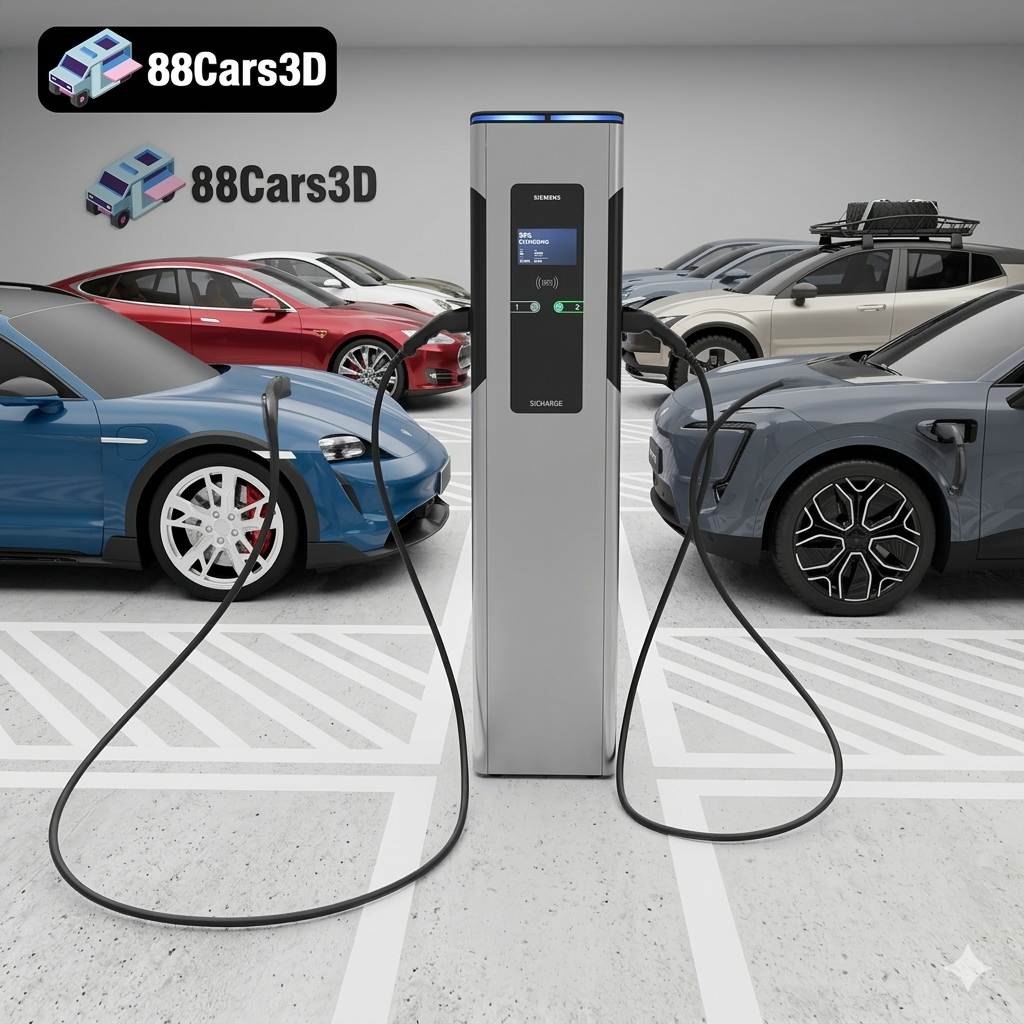
Download the Future of Mobility EV 3D Models Bundle. Includes the Volvo EX30, Tesla Model S, AVATR 11, Porsche Taycan, and a Siemens EV Charger. Save big on this highly optimized 5-in-1 pack for ArchViz and game development!
Price: $89.99

