⚡ FLASH SALE: Get 60% OFF All Premium 3D & STL Models! ⚡

The automotive industry has always been at the forefront of innovation, not just in vehicle design and engineering, but also in how these marvels are presented to the world. In an era where speed, flexibility, and photorealism are paramount, traditional production pipelines are giving way to revolutionary real-time workflows. At the heart of this transformation lies virtual production, particularly the integration of LED walls powered by Unreal Engine. This technology is dramatically reshaping how automotive brands create stunning visuals for marketing, design reviews, and interactive experiences.
Imagine producing a high-end car commercial with dynamic environments, infinite creative iterations, and immediate feedback—all on set, in real-time. This is the promise of LED wall virtual production. For 3D artists, game developers, and automotive visualization professionals, understanding these cutting-edge workflows is no longer a luxury but a necessity. This comprehensive guide will deep dive into leveraging Unreal Engine with LED walls for unparalleled automotive visualization, covering everything from project setup and asset optimization to advanced lighting, nDisplay configuration, and performance strategies. Get ready to unlock new levels of creative freedom and efficiency in your automotive projects.
Virtual production, specifically In-Camera VFX (ICVFX) utilizing LED walls, represents a seismic shift in content creation. It merges the physical and digital worlds seamlessly, allowing filmmakers and artists to interact with high-fidelity 3D environments and assets in real time on a physical set. For automotive visualization, this means no more green screens, extensive location scouting, or lengthy post-production compositing. Instead, a car (physical or a digital twin) can be placed in front of an LED wall displaying a dynamic Unreal Engine environment, with the camera capturing the final composite live.
The benefits are profound: unparalleled creative control, immediate visual feedback, significant cost savings by reducing travel and reshoots, and the ability to iterate rapidly on design and composition. This approach is revolutionizing car advertising, allowing brands to showcase vehicles in diverse, exotic locales without ever leaving the studio. It empowers automotive designers to visualize concepts in lifelike scenarios, making design reviews more immersive and impactful. The flexibility offered by virtual production translates directly into greater creative agility, fostering a new era of visual storytelling for the automotive sector.
A typical LED wall virtual production setup for automotive visualization comprises several key elements working in concert. At its core are the high-resolution LED panels, which form the immersive backdrop. These panels are driven by a cluster of powerful PCs running Unreal Engine, acting as the “media server.” A crucial element is the camera tracking system (e.g., Mo-Sys, Stype, Ncam), which precisely tracks the physical camera’s position and orientation in 3D space. This tracking data is fed into Unreal Engine, enabling it to render the virtual environment from the camera’s perspective, ensuring perfect parallax and perspective alignment. Finally, Unreal Engine’s nDisplay framework orchestrates the distributed rendering across multiple GPUs, projecting the correct perspective-shifted image onto the LED wall. Understanding the interplay of these components is foundational to successful ICVFX.
Adopting a virtual production workflow requires a shift in mindset, moving towards a “pre-visualization is production” approach. Meticulous planning in pre-production is paramount, encompassing everything from environment design and asset preparation to camera blocking and lighting studies—all within Unreal Engine. The quality of your 3D assets, especially the star automotive models, is critical. Clean geometry, accurate PBR materials, and efficient UV mapping directly impact the realism displayed on the LED wall. A collaborative pipeline, where directors, cinematographers, and 3D artists work closely from concept to execution, ensures a cohesive vision. Embracing real-time iteration and problem-solving on set is key, leveraging Unreal Engine’s flexibility to make adjustments instantly rather than waiting for post-production.
Embarking on an LED wall virtual production project begins with a robust Unreal Engine setup. Starting with a blank project is often recommended, giving you full control over installed plugins and features. Essential plugins for virtual production include nDisplay (for LED wall rendering), OpenXR or SteamVR (if AR/VR elements are involved), and relevant camera tracking plugins specific to your chosen system. For detailed information on these, always consult the official Unreal Engine documentation at https://dev.epicgames.com/community/unreal-engine/learning.
The quality of your 3D car models is paramount for photorealistic results on the LED wall. High-fidelity models, with clean topology and accurate PBR materials, will translate directly to stunning visuals that hold up to the scrutiny of a physical camera. Platforms like 88cars3d.com offer meticulously crafted 3D car models, pre-optimized for Unreal Engine, providing a solid foundation for your virtual production needs. Importing these models typically involves FBX, or increasingly, USD/USDZ formats, which offer robust support for complex scene hierarchies, PBR materials, and animation data.
Optimizing 3D car models for virtual production involves a balance of visual fidelity and performance. While Unreal Engine’s Nanite can handle incredibly high polygon counts for static meshes, ICVFX with LED walls often requires careful consideration, especially for dynamic or interactive elements. For hero automotive assets, target polygon counts can range from 200,000 to 1,000,000 triangles or more, with Nanite intelligently streaming geometry. Ensure models have clean, quad-based topology and efficient UV mapping to prevent stretching artifacts and allow for proper texture application.
Level of Detail (LOD) groups are still crucial for objects that might appear further away or are less critical to the immediate foreground, ensuring performance is maintained without sacrificing visual quality. Strategically applying LODs to chassis, interior, and wheel components can significantly reduce render overhead. However, for the hero car directly in front of the LED wall, a high-detail mesh is always preferred. Understanding when and where to leverage Nanite, and its implications for features like reflections and dynamic lighting, is key for an optimized virtual production pipeline.
Photorealistic PBR (Physically Based Rendering) materials are the bedrock of convincing automotive visualization. In Unreal Engine’s Material Editor, crafting these materials involves a precise combination of texture maps:
For hero car models, texture resolutions of 4K to 8K are common for major components (body, interior, wheels) to capture intricate details, while smaller elements might use 2K textures. It’s essential to bake lighting information out of your base color textures, ensuring they are pure albedo, allowing Unreal Engine’s real-time lighting to accurately calculate surface interactions. Consistent naming conventions and folder structures for materials and textures help maintain project organization and workflow efficiency.
Lighting is the cornerstone of any visual production, and in LED wall virtual production, its impact is magnified. Unreal Engine’s dynamic lighting systems, particularly Lumen Global Illumination and Reflections, are indispensable for achieving photorealistic results. Lumen delivers incredibly realistic indirect lighting and reflections, crucial for making the virtual environment seamlessly blend with the physical car and set. It calculates light bounces and reflections in real time, adapting instantly to changes in the environment, light sources, or camera position.
Unlike traditional pre-rendered workflows, real-time rendering demands careful balancing of visual fidelity and performance. Every light source, shadow, and reflection contributes to the overall complexity. For automotive scenes, setting up a believable outdoor or indoor environment with HDRI (High Dynamic Range Image) sky spheres is often the starting point. HDRI maps provide both ambient lighting and distant reflections, immersing the vehicle in a realistic world. Directional lights simulate the sun, while fill lights and point lights can be used to emphasize specific design elements or replicate studio lighting setups.
Lumen’s strength lies in its ability to adapt to dynamic changes. As the virtual environment shifts on the LED wall, Lumen automatically recomputes global illumination and reflections, ensuring that the light spilling onto the physical car and set matches the virtual scene. This is a game-changer for car commercials where a vehicle might transition from a sunny beach to a moonlit city street in a single shot. Paired with Unreal Engine’s Sky Atmosphere system, you can create realistic volumetric clouds, atmospheric perspective, and dynamic time-of-day changes, all interacting correctly with Lumen. To optimize Lumen’s performance, adjusting settings like `r.Lumen.DiffuseTracing` and `r.Lumen.Reflections.MaxIterations` in the console variables can help strike a balance between quality and frame rate, aiming for a consistent 60 FPS for smooth LED wall playback.
Matching the real camera’s physical properties within Unreal Engine is crucial for seamless ICVFX. The Cine Camera Actor in Unreal Engine provides extensive controls to replicate a real-world camera. Pay close attention to:
Post-processing volumes are vital for color grading, exposure compensation, and adding cinematic effects. LUTs (Look Up Tables) can be applied to match the desired color aesthetic or to emulate specific film stocks, ensuring the virtual environment’s look is cohesive with the live-action footage. Careful tuning of exposure, contrast, and bloom helps create a polished, final image that holds up on the large LED canvas.
Unreal Engine’s nDisplay framework is the technological backbone of LED wall virtual production. It allows Unreal Engine to render a single, coherent virtual world across multiple displays (like an LED wall) from different perspectives, ensuring that the scene appears correct from the specific viewpoint of the tracked camera. nDisplay handles the distributed rendering across a cluster of PCs, each rendering a segment of the overall environment, then stitching them together seamlessly on the LED panels.
Configuring nDisplay involves defining a cluster of rendering nodes, specifying the layout and resolution of the LED wall, and meticulously aligning the virtual camera frustums with the physical dimensions and curvature of the LED setup. This process generates a specific perspective for each section of the wall, creating the illusion of a continuous, three-dimensional environment. The nDisplay configuration file (`.ndisplay` asset) is where all these parameters are defined, from host machine IP addresses to screen resolutions and warp meshes for curved walls.
The success of ICVFX hinges on ultra-precise camera tracking. Professional camera tracking systems, such as those from Mo-Sys, Stype, or Ncam, attach encoders to physical cameras and lenses, providing real-time positional (X, Y, Z) and rotational (pitch, yaw, roll) data, along with crucial lens parameters like focal length, focus, and iris. This data is fed into Unreal Engine, typically via a dedicated plugin, informing nDisplay exactly where the physical camera is looking. The virtual scene is then rendered from this exact perspective, ensuring that parallax shifts correctly as the camera moves.
Calibration is a critical, often time-consuming, step. It involves precisely aligning the virtual origin in Unreal Engine with the real-world origin on the set, and accurately mapping the tracking system’s coordinates to Unreal’s coordinate system. Latency management is also paramount; any delay between the physical camera’s movement and the virtual scene’s update on the LED wall can break the illusion. Professional setups aim for minimal latency, often less than 20ms, for a truly seamless experience.
A core concept in nDisplay for ICVFX is the distinction between the “inner frustum” (the camera’s frustum) and the “outer frustum” (the frustum rendered to the LED wall). The inner frustum is rendered from the perspective of the tracked physical camera, ensuring perfect parallax for the camera’s capture. The outer frustum, viewed by the crew and talent, is rendered to provide context and immersive lighting. For performance, nDisplay intelligently culls (removes from rendering) objects outside these frustums.
“Frustum Culling” ensures that only what’s visible to the camera (or the LED wall viewer) is rendered, saving precious GPU resources. For objects behind the camera, a separate “staging” render can be displayed on the LED wall to provide backlighting and reflections, even if the camera isn’t directly facing it. Mastering these concepts allows for highly optimized scenes where the LED wall provides both a visually compelling backdrop for the camera and accurate interactive lighting for the physical set and car, maximizing both realism and performance.
Virtual production with Unreal Engine opens up a world of interactive possibilities for automotive visualization. Beyond static backdrops, LED walls can display dynamic environments that react to user input, showcasing a car’s versatility in real-time.
Unreal Engine’s Blueprint visual scripting system is a powerful tool for creating interactive automotive configurators and dynamic scene elements without writing a single line of code. Imagine a sales associate or a potential buyer interacting with a virtual car on the LED wall:
These interactive capabilities make virtual production highly engaging for design reviews, client presentations, and even live marketing events, offering an unprecedented level of customization and immersion.
For pre-planned cinematic shoots, Unreal Engine’s Sequencer is your non-linear editor for the virtual world. It allows you to choreograph complex camera movements, animate car components, and synchronize environmental changes over a timeline.
Sequencer is essential for crafting polished, high-quality cinematic content for advertising and virtual presentations, giving you precise control over every aspect of the virtual production shoot.
Maintaining a stable and high frame rate (ideally 60 FPS or more) is absolutely critical for LED wall virtual production. Dropped frames or stuttering can ruin the illusion and cause discomfort for the audience and camera. Several strategies are employed for robust performance:
A lean and optimized Unreal Engine project is a happy project when it comes to LED wall production, ensuring smooth playback and seamless integration.
Unreal Engine’s Nanite virtualized geometry system allows for the direct import and real-time rendering of cinematic-quality 3D assets with billions of polygons, without requiring traditional LODs. For automotive visualization, this means incredibly detailed car models from platforms like 88cars3d.com can be dropped into your scene, showcasing every rivet, seam, and intricate surface without performance collapse. Nanite intelligently streams and renders only the necessary detail, making assets incredibly scalable. While Nanite works best for opaque meshes, its benefits for car bodies and intricate interiors are immense.
Complementing Nanite are Virtual Shadow Maps (VSM), which provide consistent, high-resolution shadows across vast distances and for highly detailed geometry. This is crucial for grounding the virtual car realistically within the environment and ensuring shadows cast by the physical car on the LED wall (and vice-versa) are sharp and accurate. When sourcing high-fidelity automotive assets, platforms like 88cars3d.com provide models ready for advanced features like Nanite, ensuring your virtual car shines with unparalleled detail. Understanding how to properly configure Nanite and VSM is vital for achieving cinematic realism in your LED wall productions, pushing the boundaries of real-time photorealism.
Virtual production with LED walls, powered by Unreal Engine, is fundamentally transforming automotive visualization. It’s a technology that grants unparalleled creative freedom, efficiency, and real-time iteration capabilities, making the impossible achievable on set. From breathtaking cinematic commercials to immersive design reviews and interactive configurators, the ability to merge physical and digital worlds seamlessly empowers artists and designers like never before.
By understanding the intricacies of Unreal Engine project setup, optimizing high-quality 3D car models (sourced from trusted marketplaces like 88cars3d.com), mastering dynamic lighting with Lumen, configuring nDisplay with precise camera tracking, and leveraging features like Nanite and Blueprint, professionals can unlock the full potential of this revolutionary workflow. The journey into virtual production is an investment in the future of content creation, promising faster pipelines, superior visual quality, and a truly boundless creative canvas. Embrace these cutting-edge techniques, and propel your automotive visualization projects into the next generation of real-time rendering. The future of automotive storytelling is here, and it’s running on Unreal Engine.

Texture: Yes | Material: Yes | 3D Printable: Yes. Download the Italian Thoroughbreds Bundle featuring 5 iconic 3D models: Lamborghini Huracán Performante, Ferrari 458 Italia, Lamborghini Urus, Diablo SV, and Maserati GT. Optimized for 4K rendering and 3D printing (STL included). Save 50% with this ultimate Italian vehicle collection.
Price: $199.99

Download the Elite Future Mobility Bundle featuring 4 highly optimized 3D models: Tesla Model S, Avatr 11, Li L9, and Zoox Robotaxi. Perfect for ArchViz, Smart City renders, and game dev. Optimized for Unreal Engine and Blender. Includes .fbx, .obj, and .max formats.
Price: $99

🚗 5 Iconic German Cars (BMW M4 G82, M5 CS, X3, 1 Series & Mercedes E-Class). ✅ Optimized for ArchViz: Ready for Corona & V-Ray. 💰 Save €71 with this limited-time collection! 🚀 Instant Download after purchase.
Price: $119

Download the Extreme Off-Road & Survival 3D Models Bundle! Includes the Brabus 800 Adventure, Dodge Ram Bigfoot, Spec Truck, and a Caravan. Save over €210 on this premium 4-in-1 off-grid vehicle pack for ArchViz and game development.
Price: $149.99

Download the Heavy Duty & Commercial Logistics 3D Models Bundle! Includes the Ford Sterling, Caterpillar CT680, Mercedes Citaro Bus, and Vito Van. Save over €130 on this massive, game-ready 4-in-1 industrial vehicle pack.
Price: $109.99

Download the Ultimate Custom Motorcycles 3D Models Bundle. Includes a Custom Chopper, Ducati 916 Café Fighter, Harley XR1200X, and BMW K100. Perfect premium props for luxury ArchViz garages. Save over €250 today!
Price: $159.99

Download the ultimate JDM Street Racing 3D Models Bundle! Includes the Nissan GT-R, Toyota Supra, Mazda RX-7, Lancer Evo IX, and Honda NSX. Save big on this highly optimized, game-ready 5-in-1 Japanese legend car pack.
Price: $129.99

Download the ultimate American Muscle & Cinematic Classics 3D Models Bundle! Includes the Dodge Charger ’68, Mustang Eleanor GT500, Camaro Z28 ’79, and a custom ’69 Mustang. Save over €240 on this game-ready, premium 4-in-1 pack.
Price: $149.99

Download the Everyday City Traffic 3D Models Bundle. Includes the VW Golf, Kia Picanto, Hyundai Tucson, Toyota Yaris, and a DHL Ford Transit Van. Save big on this 5-in-1 pack, perfectly optimized for realistic ArchViz streets and game traffic.
Price: $99.99
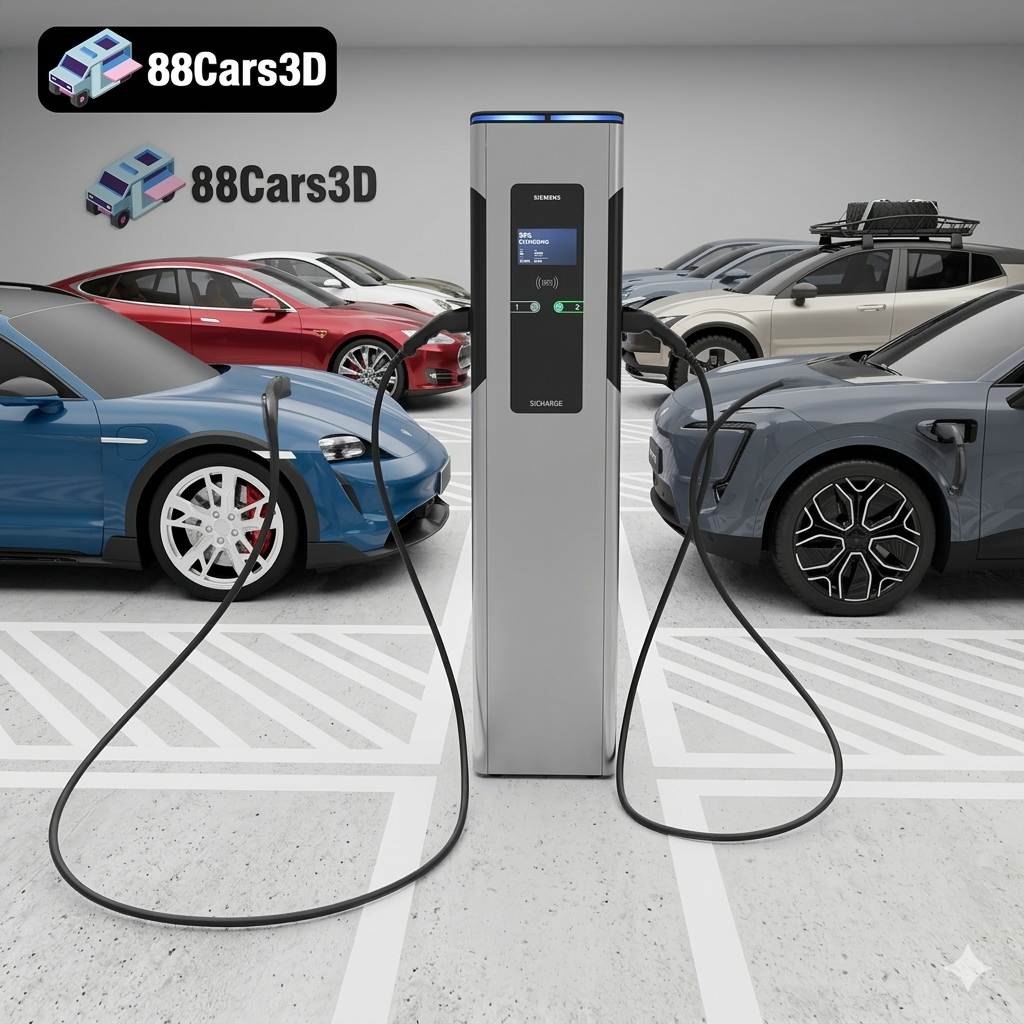
Download the Future of Mobility EV 3D Models Bundle. Includes the Volvo EX30, Tesla Model S, AVATR 11, Porsche Taycan, and a Siemens EV Charger. Save big on this highly optimized 5-in-1 pack for ArchViz and game development!
Price: $89.99

