⚡ FLASH SALE: Get 60% OFF All Premium 3D & STL Models! ⚡

The allure of reaching a global audience across diverse devices is a powerful motivator for game developers today. In an era where players expect seamless experiences on PC, console, mobile, and even AR/VR platforms, building a game for a single target is increasingly limiting. This is where Unreal Engine shines as a foundational technology, offering a robust, feature-rich environment specifically designed to tackle the complexities of cross-platform game development. For anyone serious about crafting immersive interactive automotive experiences, from high-fidelity racing simulations to engaging mobile car configurators, understanding Unreal Engine’s cross-platform capabilities is paramount.
This comprehensive guide delves into the technical intricacies of leveraging Unreal Engine to develop games that thrive on multiple platforms. We’ll explore everything from initial project setup and efficient asset management to advanced optimization techniques and interactive scripting, ensuring your vision translates flawlessly across various hardware specifications. Whether you’re an independent developer aiming for broad reach or a studio seeking to maximize market penetration, mastering these workflows will equip you to deliver stunning, performant automotive content. Prepare to unlock the full potential of Unreal Engine and navigate the exciting landscape of cross-platform game development.
Unreal Engine has long been celebrated for its ability to deliver stunning visual fidelity, but its true power for modern game development lies in its sophisticated architecture designed for multi-platform deployment. The engine’s core philosophy supports a “build once, deploy anywhere” approach, significantly reducing development time and resources compared to maintaining separate codebases for each platform. This is achieved through a highly modular design, abstracting hardware-specific implementations behind a consistent API, allowing developers to focus on gameplay and aesthetics without getting bogged down in platform-specific quirks.
For automotive visualization and game development, this capability is a game-changer. Imagine developing a highly detailed 3D car model, complete with PBR materials and intricate animations, then deploying it to a high-end PC for a breathtaking showcase, a console for an immersive racing title, or a mobile device for a convenient AR experience, all from the same project. Unreal Engine provides the tools to manage these divergent requirements, from scalable rendering features like Nanite and Lumen to comprehensive input mapping systems and platform-specific build configurations. Understanding how to strategically leverage these features from the outset is crucial for successful cross-platform projects.
At its heart, Unreal Engine employs a powerful rendering pipeline and a flexible plugin system that allows it to target a vast array of platforms, including Windows, macOS, Linux, PlayStation, Xbox, Nintendo Switch, iOS, Android, and various XR devices. The engine abstracts away low-level graphics APIs (like DirectX, Vulkan, Metal, OpenGL ES) and input methods, providing a unified interface for developers. This means a Blueprint script or C++ class written for one platform will generally function correctly on others, with platform-specific adjustments often managed through build configurations and scalability settings.
The engine’s build system is highly customizable, allowing developers to include or exclude specific assets, code, or plugins based on the target platform. This is vital for managing memory footprints and ensuring optimal performance. For instance, high-resolution textures suitable for PC might be downscaled or replaced for mobile builds, while complex shader instructions might be simplified. Unreal Engine’s device profiles further enhance this by allowing granular control over rendering features, quality settings, and even specific console variables (CVars) per device, providing an unparalleled level of control over the final output on each platform. More details on device profiles can be found in the official Unreal Engine documentation at https://dev.epicgames.com/community/unreal-engine/learning.
Embarking on a cross-platform project demands careful planning from day one. It’s not simply about ticking boxes for every platform; it’s about making informed decisions that balance scope, budget, and performance targets. The “lowest common denominator” approach can sometimes be effective, where core gameplay and assets are designed to perform well on the least powerful target device, then progressively enhanced for more powerful ones. However, a more robust strategy often involves designing with scalability in mind, using Unreal Engine’s built-in features to dynamically adjust quality.
Key considerations include determining your primary and secondary target platforms, understanding their hardware limitations, and assessing the expected player experience on each. For example, a mobile racing game will have vastly different input requirements, UI/UX considerations, and rendering budgets compared to a PC simulation. Asset creation workflows must account for multiple LODs (Levels of Detail), varying texture resolutions, and potentially different material setups. Establishing a clear understanding of these requirements upfront will save significant time and effort during later stages of development, preventing costly reworks and ensuring a consistent, high-quality experience across your chosen platforms.
Effective project setup and meticulous asset management are foundational to any successful cross-platform endeavor in Unreal Engine. The way you organize your project, import your assets, and manage their optimization will directly impact performance and development efficiency across all target platforms. For automotive projects, where 3D car models are often the hero assets, this becomes even more critical due to their inherent complexity and high fidelity requirements. A structured approach ensures that your beautiful vehicles look great and run smoothly, whether on a high-end gaming PC or a budget smartphone.
Central to this is establishing clear guidelines for asset creation, naming conventions, and folder structures. This helps maintain consistency and makes it easier for teams to collaborate and manage vast libraries of textures, meshes, and animations. Furthermore, leveraging Unreal Engine’s content browser features, such as collections and filters, can streamline the workflow significantly. The goal is to create a scalable project that can be easily configured and optimized for each specific platform without requiring constant manual adjustments or separate asset versions for every deployment.
When sourcing 3D car models for your Unreal Engine project, especially for cross-platform deployments, quality and optimization are paramount. Platforms like 88cars3d.com offer high-quality, pre-optimized 3D car models that are specifically designed for Unreal Engine, featuring clean topology, realistic PBR materials, and efficient UV mapping. However, even with premium assets, further optimization steps are often necessary to ensure peak performance across a range of devices.
Upon importing an FBX or USD file, ensure your settings are appropriate. For high-fidelity meshes, Nanite virtualized geometry (introduced in Unreal Engine 5) is a game-changer, allowing millions of polygons to be rendered efficiently on PC and next-gen consoles without traditional LODs. However, for mobile and older platforms, traditional LODs are still essential. Most professional 3D car models will come with pre-made LODs, but you might need to generate or refine them within Unreal Engine’s Static Mesh Editor. Aim for a significant reduction in polygon count for lower LODs (e.g., LOD1: 50% reduction, LOD2: 75% reduction, LOD3: 90%+ reduction) to ensure mobile and less powerful hardware can handle the scene. Additionally, ensure proper collision meshes are generated for physics interactions, and that UV channels are correctly set up for lightmapping and textures.
Textures constitute a significant portion of a game’s memory footprint and can heavily impact loading times and performance. For cross-platform development, texture streaming is a critical feature that allows Unreal Engine to load higher-resolution textures only when they are needed and visible, effectively managing memory. Configure texture groups and streaming settings to prioritize essential textures (e.g., car body, tires) while allowing less critical ones to stream at lower resolutions or with delayed loading.
PBR (Physically Based Rendering) materials are the industry standard for achieving realistic visuals. While Unreal Engine’s Material Editor offers immense flexibility, it’s crucial to optimize materials for performance. Complex materials with many layers, intricate blend modes, and extensive instruction counts can be very costly, especially on mobile GPUs. Consider simplifying shader graphs by baking certain details into textures, reducing the number of texture lookups, and consolidating material parameters. Utilize Material Instances for variations (e.g., different car paint colors) rather than creating new master materials, as this reduces shader compilation overhead. For mobile, explore using mobile-specific material functions and ensure that features like parallax occlusion mapping or complex clear coat shaders are appropriately scaled down or disabled via platform-specific quality switches within the material graph or via device profiles.
Achieving consistent visual quality and performance across a spectrum of devices—from high-end PCs to entry-level mobile phones—is one of the most significant challenges in cross-platform game development. Unreal Engine provides a comprehensive suite of tools and systems to manage graphical fidelity, allowing developers to gracefully scale visuals without compromising the core artistic vision. This involves strategically utilizing scalability settings, dynamically adjusting rendering features, and implementing efficient geometry and lighting solutions. The goal is to maintain the essence of your automotive scene while adapting its complexity to the capabilities of each target platform.
A well-implemented scalability strategy ensures that players on all devices experience a visually appealing and smooth gameplay experience. Without this, users on lower-end hardware might encounter frustrating lag and visual glitches, while those on high-end systems might not see their hardware pushed to its full potential. Understanding the interplay between global scalability settings, console variables, and specific rendering features is key to striking this delicate balance and delivering a truly cross-platform capable game.
Unreal Engine’s built-in scalability settings are your first line of defense for managing visual quality. These settings (e.g., View Distance, Anti-Aliasing, Post Processing, Shadow Quality, Texture Quality, Effects Quality) can be adjusted globally or per device profile. For instance, on a high-end PC, you might set everything to “Epic,” while on a mobile device, “Medium” or “Low” might be more appropriate. These settings automatically adjust numerous underlying console variables (CVars) that control various rendering aspects.
For more granular control, developers can directly manipulate CVars through Blueprint, C++, or by editing configuration files. This allows for very specific optimizations, such as adjusting shadow map resolutions (`r.Shadow.MaxResolution`), post-processing effects intensity (`r.Bloom.Size`), or even disabling specific features entirely for certain platforms. When implementing such changes, it’s crucial to document them thoroughly and test extensively on all target platforms to ensure stability and desired visual outcomes. You can find a comprehensive list of CVars in the Unreal Engine documentation, which is an invaluable resource for advanced optimization. https://dev.epicgames.com/community/unreal-engine/learning provides excellent guides on performance and scalability.
Lighting is paramount in automotive visualization, dictating realism and mood. Unreal Engine 5’s Lumen global illumination system offers incredible dynamic real-time lighting, bouncing light realistically off surfaces like car paint and chrome. However, Lumen is computationally intensive and primarily suitable for high-end PCs and next-gen consoles. For older consoles, mobile, or less powerful PCs, a hybrid or baked lighting approach is necessary.
For cross-platform projects, consider designing your scene’s lighting to be adaptable. You might use Lumen for the highest quality settings, while falling back to baked static lighting (using Lightmass) for lower scalability profiles. Baked lighting offers excellent performance as calculations are pre-computed, but lacks dynamic bounce light. A common strategy involves baking indirect lighting, then using dynamic direct lights (e.g., a movable directional light for the sun) to retain some dynamism. Reflection captures (Sphere and Box Reflection Captures) are crucial for realistic car reflections across all platforms, ensuring your 3D car models shine appropriately. For mobile, simpler reflection methods or even pre-rendered environment maps might be necessary due to hardware limitations.
Nanite virtualized geometry is a groundbreaking feature in Unreal Engine 5 that allows developers to import and render incredibly detailed 3D models with millions of polygons at real-time frame rates, without manual LOD creation. This dramatically simplifies asset pipelines for high-fidelity car models and environments. However, Nanite is currently limited to PC and next-gen consoles.
For cross-platform projects targeting older hardware or mobile, a robust LOD (Levels of Detail) strategy remains essential. Properly implemented LODs ensure that objects render with fewer polygons as they move further from the camera, significantly reducing draw calls and vertex processing. Professional 3D car models from marketplaces like 88cars3d.com often include multiple LODs, which can be further refined within Unreal Engine. Beyond mesh LODs, consider material LODs (simplifying shaders for distant objects), texture LODs (lower resolution textures for distant objects), and even cull distances to completely remove objects beyond a certain range. For critical vehicle assets, aim for 3-5 LODs, with significant polygon reductions at each step, especially for LODs intended for mobile or low-spec platforms. Regular profiling will help identify where LODs are most needed.
The essence of a game lies in its interactivity, and cross-platform development introduces the challenge of creating engaging experiences that respond intuitively across a myriad of input devices. From touchscreens on mobile to gamepads on consoles and keyboard/mouse on PC, designing a unified yet adaptable interaction system is crucial. Unreal Engine’s powerful Blueprint visual scripting system and flexible input management tools provide the framework to build these dynamic systems, ensuring that your players can seamlessly interact with your automotive creations, regardless of their preferred platform.
This section will explore how to leverage Unreal Engine’s capabilities to craft interactive logic, design user interfaces that scale gracefully, and manage diverse input methods. The goal is to empower developers to create intuitive controls and user feedback that feel native to each platform, enhancing the overall player experience and engagement with the high-quality 3D car models and environments.
Unreal Engine’s Blueprint visual scripting system is a cornerstone of cross-platform development, allowing developers to implement complex gameplay mechanics and interactive logic without writing C++ code. The visual nature of Blueprint makes it accessible and efficient, and crucially, Blueprint logic is inherently platform-agnostic. This means a Blueprint script for opening a car door, changing a car’s color, or initiating a race sequence will function identically across all target platforms.
For automotive configurators or interactive demos, Blueprint is invaluable. You can script responsive UI elements, implement vehicle customization options, trigger animations (e.g., engine startup, suspension movement), and manage physics-based interactions. When designing Blueprints for cross-platform, focus on modularity and abstraction. For instance, define input events using the Enhanced Input System, which allows for flexible remapping. Use interface Blueprints for communication between different game systems, and leverage data tables or data assets to store platform-specific values or configurations, which can then be read by your Blueprints at runtime. This approach minimizes the need for platform-specific Blueprint variations, streamlining development and reducing potential errors.
User Interface (UI) design is perhaps the most visible area where cross-platform differences become apparent. A UI designed for a large PC monitor with mouse input will not translate well to a small mobile touchscreen or a console played from a couch. Unreal Engine’s UMG (Unreal Motion Graphics) UI Designer provides powerful tools to create scalable and responsive interfaces.
When designing UIs, prioritize a responsive layout that adapts to different screen resolutions and aspect ratios. Use anchors and size boxes effectively to ensure elements maintain their proportions and positions. Create separate widget blueprints or variations for specific platforms if necessary, especially for complex layouts. For mobile, large touch targets are crucial, and gestures might replace mouse clicks. For consoles, ensure full gamepad navigation support, providing clear visual feedback for selected elements. Implement platform-specific input modes (e.g., Game Only, UI Only, Game and UI) to control how input is consumed. Test your UI rigorously on all target devices to identify usability issues and ensure readability across varying screen sizes and pixel densities. This ensures players can intuitively interact with your game’s features, such as customizing their 88cars3d.com purchased car models.
Managing diverse input devices is a core challenge in cross-platform development. Unreal Engine’s Enhanced Input System offers a robust and flexible solution for mapping actions to various inputs (keyboard, mouse, gamepad, touch, VR controllers). This system allows you to define Input Actions (e.g., “Accelerate,” “Steer,” “Brake”) and then map these actions to specific physical inputs for each platform.
Create separate Input Mapping Contexts for different control schemes (e.g., “Vehicle Controls,” “Menu Controls”). Within these contexts, you can specify platform-specific overrides, ensuring that a “Primary Action” might be the ‘Spacebar’ on PC, ‘A’ button on Xbox, ‘Cross’ on PlayStation, and a touch gesture on mobile. For mobile devices, consider virtual joysticks and on-screen buttons, which can be implemented with UMG and tied into the Enhanced Input System. Ensure comprehensive gamepad support for consoles and PC, including rumble feedback for an immersive experience. Providing customizable control options within your game is also highly recommended, allowing players to remap controls to their preference, further enhancing the cross-platform experience.
Performance optimization is not just a final polish step; it’s an ongoing process that is absolutely critical for cross-platform game development. A game might run flawlessly on a high-end PC, but struggle immensely on a mobile device or a less powerful console without dedicated optimization. Poor performance leads to frustration, negative reviews, and ultimately, a reduced player base. Unreal Engine provides a rich set of profiling and debugging tools that are indispensable for identifying bottlenecks and ensuring your game runs smoothly across all target platforms, making the most of your meticulously crafted 3D car models and environments.
This section will dive into the technical aspects of performance monitoring, memory management, and draw call reduction. Mastering these optimization techniques is what separates a merely functional cross-platform game from a truly successful one, delivering a consistently high-quality experience regardless of the hardware it’s running on.
Unreal Engine’s suite of profiling tools is essential for diagnosing performance issues. The primary tools include:
When profiling for cross-platform, it’s vital to test on actual target hardware. Performance profiles on a PC editor often don’t reflect real-world performance on a mobile device or console. Use Unreal Insights to capture data directly from your deployed builds on each target platform. Pay close attention to CPU vs. GPU bottlenecks: mobile devices are often CPU-bound due to slower processors and less efficient memory access, while high-fidelity PC builds can easily become GPU-bound. Understanding the bottleneck will guide your optimization efforts. For comprehensive guidance on profiling, refer to the Unreal Engine documentation on performance tools: https://dev.epicgames.com/community/unreal-engine/learning.
Efficient memory management is paramount, especially for platforms with limited RAM like mobile devices and some consoles.
Draw calls are instructions sent from the CPU to the GPU to render objects. Reducing draw calls is a major optimization for CPU-bound platforms.
The final step in cross-platform development is packaging and deployment. Unreal Engine’s Project Launcher provides a powerful interface for configuring builds for various platforms.
Thorough testing of packaged builds on real hardware is non-negotiable to catch any last-minute platform-specific issues.
As you master the fundamentals of cross-platform game development with Unreal Engine, an array of advanced topics emerge, pushing the boundaries of what’s possible. From creating engaging multiplayer experiences that transcend geographical and hardware barriers to crafting immersive AR/VR automotive applications, these areas demand a deeper understanding of Unreal Engine’s capabilities. Furthermore, adopting forward-looking practices like continuous integration ensures your project remains robust and adaptable to future technological shifts.
This section explores how to extend your cross-platform ambitions into the realms of real-time multiplayer, augmented and virtual reality, and maintain a streamlined development pipeline. These advanced considerations are crucial for delivering truly cutting-edge and future-proof automotive experiences that resonate with a global, multi-device audience.
Multiplayer functionality is a core component of many modern games, and Unreal Engine’s networking framework is designed to facilitate robust real-time experiences. For cross-platform games, the challenge is ensuring a stable and low-latency experience across potentially diverse network conditions and hardware. Unreal Engine uses a client-server model, where a dedicated server or a listen server (one player acts as the server) manages game state and replicates relevant information to connected clients.
When developing for cross-platform multiplayer, several considerations are paramount:
Building a stable multiplayer system requires meticulous testing under various network conditions, specifically on your target platforms, to ensure fairness and responsiveness.
AR (Augmented Reality) and VR (Virtual Reality) offer unparalleled immersion, making them ideal for automotive visualization, interactive configurators, and training simulations. Unreal Engine has extensive support for various AR/VR platforms, including Meta Quest, OpenXR, HoloLens, and ARCore/ARKit for mobile devices.
These specialized applications benefit immensely from clean, optimized 3D car models, such as those found on 88cars3d.com, which provide a strong foundation for performance-critical XR experiences.
For any serious cross-platform project, especially within a team, implementing robust Continuous Integration (CI) and Version Control systems is non-negotiable.
A strong CI/CD workflow significantly reduces the overhead of managing multiple platforms, allows for faster iteration, and ensures consistent build quality across all deployments, making your development process far more efficient and reliable.
Building cross-platform games with Unreal Engine is a challenging yet incredibly rewarding endeavor, opening your projects to a vast global audience across PCs, consoles, mobile, and XR devices. This journey demands a strategic blend of artistic vision and technical mastery, where every decision from asset acquisition to final deployment impacts performance and player experience. We’ve explored the engine’s fundamental architecture for multi-platform deployment, emphasizing the critical role of project planning, efficient asset management, and sophisticated graphical scalability.
From leveraging Nanite for high-fidelity meshes on powerful hardware to implementing robust LOD systems and baked lighting for mobile, Unreal Engine provides the tools to adapt your automotive vision to any target. Mastering Blueprint for interactive logic, designing responsive UIs, and meticulously optimizing performance through profiling and careful memory management are the pillars of success. As you venture into advanced realms like cross-platform multiplayer and immersive AR/VR experiences, remember that Unreal Engine’s versatile framework is designed to empower your ambition.
Embrace the power of Unreal Engine, prioritize optimization, and consistently test on your target platforms. By doing so, you’ll be well-equipped to create stunning, high-performance automotive games and visualizations that captivate players worldwide, regardless of the device they choose. Start building your next cross-platform masterpiece today, leveraging the resources and best practices outlined here to drive your projects to success.

Texture: Yes | Material: Yes | 3D Printable: Yes. Download the Italian Thoroughbreds Bundle featuring 5 iconic 3D models: Lamborghini Huracán Performante, Ferrari 458 Italia, Lamborghini Urus, Diablo SV, and Maserati GT. Optimized for 4K rendering and 3D printing (STL included). Save 50% with this ultimate Italian vehicle collection.
Price: $199.99

Download the Elite Future Mobility Bundle featuring 4 highly optimized 3D models: Tesla Model S, Avatr 11, Li L9, and Zoox Robotaxi. Perfect for ArchViz, Smart City renders, and game dev. Optimized for Unreal Engine and Blender. Includes .fbx, .obj, and .max formats.
Price: $99

🚗 5 Iconic German Cars (BMW M4 G82, M5 CS, X3, 1 Series & Mercedes E-Class). ✅ Optimized for ArchViz: Ready for Corona & V-Ray. 💰 Save €71 with this limited-time collection! 🚀 Instant Download after purchase.
Price: $119

Download the Extreme Off-Road & Survival 3D Models Bundle! Includes the Brabus 800 Adventure, Dodge Ram Bigfoot, Spec Truck, and a Caravan. Save over €210 on this premium 4-in-1 off-grid vehicle pack for ArchViz and game development.
Price: $149.99

Download the Heavy Duty & Commercial Logistics 3D Models Bundle! Includes the Ford Sterling, Caterpillar CT680, Mercedes Citaro Bus, and Vito Van. Save over €130 on this massive, game-ready 4-in-1 industrial vehicle pack.
Price: $109.99

Download the Ultimate Custom Motorcycles 3D Models Bundle. Includes a Custom Chopper, Ducati 916 Café Fighter, Harley XR1200X, and BMW K100. Perfect premium props for luxury ArchViz garages. Save over €250 today!
Price: $159.99

Download the ultimate JDM Street Racing 3D Models Bundle! Includes the Nissan GT-R, Toyota Supra, Mazda RX-7, Lancer Evo IX, and Honda NSX. Save big on this highly optimized, game-ready 5-in-1 Japanese legend car pack.
Price: $129.99

Download the ultimate American Muscle & Cinematic Classics 3D Models Bundle! Includes the Dodge Charger ’68, Mustang Eleanor GT500, Camaro Z28 ’79, and a custom ’69 Mustang. Save over €240 on this game-ready, premium 4-in-1 pack.
Price: $149.99

Download the Everyday City Traffic 3D Models Bundle. Includes the VW Golf, Kia Picanto, Hyundai Tucson, Toyota Yaris, and a DHL Ford Transit Van. Save big on this 5-in-1 pack, perfectly optimized for realistic ArchViz streets and game traffic.
Price: $99.99
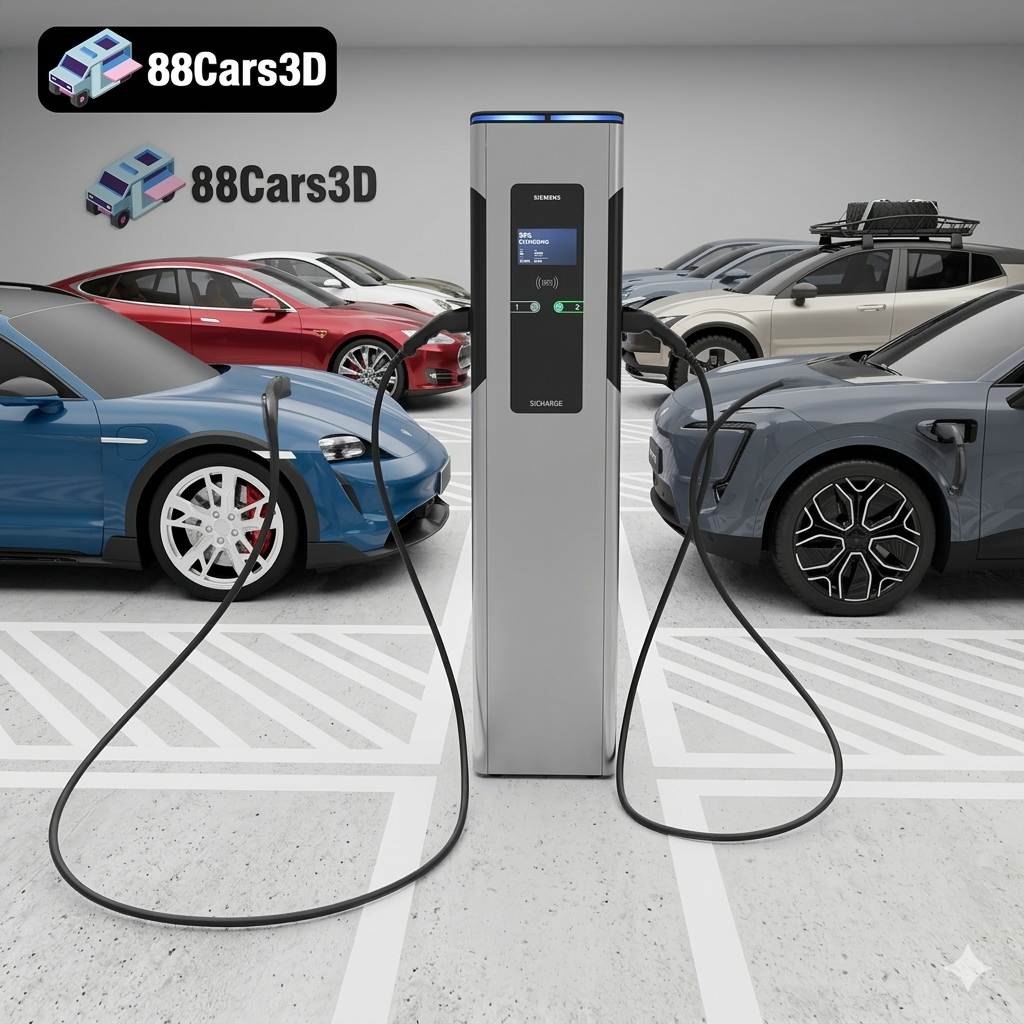
Download the Future of Mobility EV 3D Models Bundle. Includes the Volvo EX30, Tesla Model S, AVATR 11, Porsche Taycan, and a Siemens EV Charger. Save big on this highly optimized 5-in-1 pack for ArchViz and game development!
Price: $89.99

