⚡ FLASH SALE: Get 60% OFF All Premium 3D & STL Models! ⚡

The landscape of real-time rendering has undergone a seismic shift with the advent of Unreal Engine 5, and at its core lies a revolutionary technology: Nanite. For anyone involved in automotive visualization, game development, or producing photorealistic cinematic content, Nanite isn’t just an improvement—it’s a paradigm shift. Traditional 3D pipelines have long been shackled by polygon budget constraints, forcing artists and developers to compromise between visual fidelity and real-time performance. This was particularly challenging for complex, high-detail assets like modern cars, where every curve, panel gap, and intricate interior component contributes to the overall realism.
Nanite shatters these limitations, allowing artists to import and render virtually limitless geometric detail without noticeable performance degradation. This means film-quality source assets, often millions or even billions of polygons, can be directly integrated into a real-time environment. For 3D artists and developers working with sophisticated vehicle models, this heralds an era of unprecedented photorealism and efficiency. This comprehensive guide will delve deep into how Nanite technology in Unreal Engine 5 is revolutionizing 3D workflows, specifically for automotive applications, offering practical insights into leveraging its power for your next project. We’ll explore everything from importing high-fidelity 3D car models to crafting immersive, interactive experiences.
Nanite stands as Unreal Engine 5’s virtualized geometry system, designed to handle an unprecedented level of geometric detail. Unlike traditional rendering methods that require artists to painstakingly create multiple Levels of Detail (LODs) for each asset to manage performance, Nanite intelligently streams and processes geometry on the fly. This fundamentally changes the workflow for high-fidelity assets, especially in sectors like automotive visualization where precision and detail are paramount. Imagine taking CAD data or high-poly sculpts of a car, often tens of millions of polygons, and importing them directly into your engine without prior decimation or optimization. Nanite makes this a reality, rendering only the necessary detail at pixel-level accuracy, effectively making polygon count a concern of the past for static meshes.
The core benefit of Nanite is its ability to render film-quality assets in real-time without the crippling polygon budget constraints that previously defined real-time graphics. This capability has profound implications for automotive visualization, enabling creators to produce marketing materials, configurators, and simulations with a level of realism previously reserved for offline renderers. Artists can focus on creating the most detailed models possible, knowing that Unreal Engine 5, with Nanite, will handle the performance optimization. This not only elevates visual quality but also significantly accelerates the content creation pipeline by eliminating tedious manual optimization steps, allowing for faster iteration and higher quality output from the start. The creative freedom unleashed by Nanite is truly transformative for anyone striving for ultimate photorealism in real-time.
At its heart, Nanite operates on a meshlet-based rendering system, a significant departure from traditional triangle-based rendering. When a mesh is imported and enabled for Nanite, it’s converted into a hierarchical cluster of tiny meshlets. During rendering, Unreal Engine 5 determines which meshlets are visible and how much detail is required based on screen space. Only the necessary meshlets are streamed from storage and rendered, making the entire process incredibly efficient. This on-demand streaming and culling mechanism means that geometry detail scales with screen size; objects far away render with minimal detail, while objects up close are rendered with full, pixel-perfect fidelity. This intelligent processing is what gives Nanite its power, allowing scenes to contain billions of polygons while maintaining smooth frame rates. It’s essentially promising an “infinite detail” pipeline for static meshes, where the engine dynamically manages complexity, freeing artists from the burden of manual optimization. For further technical details, developers can refer to the official Unreal Engine documentation on Unreal Engine 5 Nanite technology.
One of the most significant workflow improvements brought by Nanite is the dramatic reduction, and often elimination, of manual Level of Detail (LOD) creation for static meshes. In traditional pipelines, artists would spend countless hours creating multiple versions of an asset, each with fewer polygons, to ensure performance at various distances from the camera. Nanite largely automates this process by generating its own internal LOD structure, effectively rendering the appropriate detail level based on screen resolution and distance. This not only saves immense production time but also ensures a consistent level of visual quality across all distances, without noticeable popping or transitions between LODs. While Nanite handles the majority of static mesh geometry, traditional LODs might still be relevant for certain scenarios. Skeletal meshes, which are animated, do not currently support Nanite, so they still require traditional LODs. Similarly, for objects that undergo significant deformation, or for specific non-Nanite compatible rendering features, manual LODs may still be necessary. However, for the vast majority of static, high-poly automotive components like car bodies, interior panels, and engine parts, Nanite simplifies the asset pipeline immensely, allowing artists to focus on core design and material fidelity.
Bringing high-fidelity 3D car models into Unreal Engine 5 with Nanite is a straightforward yet critical process that lays the foundation for stunning automotive visualizations. The power of Nanite means you can largely bypass the traditional poly-reduction steps, allowing you to use source models with extremely high polygon counts directly. The key is to start with clean, well-structured source data, regardless of its density. Platforms like 88cars3d.com specialize in providing meticulously crafted 3D car models that are optimized for Unreal Engine workflows, featuring clean topology, proper UV mapping, and realistic materials, making them ideal candidates for Nanite integration. When sourcing automotive assets from marketplaces such as 88cars3d.com, you’re often getting models specifically prepared for high-end rendering, which simplifies the pipeline significantly. These models are designed to capture every intricate detail, from the precision of body panel gaps to the subtle textures of interior upholstery, all of which Nanite can render with remarkable clarity.
Once you have your high-quality 3D car model, the integration into Unreal Engine 5 is relatively simple. The focus shifts from managing polygon counts to ensuring proper material setup, lighting, and interactivity to truly showcase the vehicle’s design. This process typically involves importing the model in a compatible format, enabling Nanite, and then diving into the Material Editor to define the car’s surfaces. The beauty of Nanite is that it handles the complex geometry, allowing you to dedicate your creative energy to perfecting the visual aesthetic—making the car paint gleam realistically, the glass refract light accurately, and the interior materials feel tangible. This streamlined integration empowers artists to achieve cinematic levels of detail in real-time, opening up new possibilities for automotive design review, marketing, and interactive experiences.
The process begins by importing your 3D car model into Unreal Engine 5. The most common and recommended formats for this are FBX, USD, or USDZ. USD (Universal Scene Description) is particularly powerful for complex automotive assemblies, as it efficiently handles hierarchies, instances, and variations. Once imported, your mesh will appear as a static mesh asset in the Content Browser. To enable Nanite, simply double-click on the static mesh asset to open the Static Mesh Editor. In the Details panel, under the “Nanite” section, check the “Enable Nanite” box. You’ll then have options to adjust “Fallback Relative Error” and “Preserve Area” which control the level of detail reduction Nanite performs at extreme distances. For high-detail car models, keeping these values low or at default usually yields excellent results. Nanite automatically handles the internal conversion and optimization, allowing meshes with millions of triangles (e.g., 50 million for a highly detailed car body) to be rendered efficiently. It’s crucial to ensure your source model has clean geometry, meaning no non-manifold edges or inverted normals, as these can cause issues with Nanite’s clustering process. However, Nanite is quite robust and can often handle complex meshes that would traditionally break other real-time renderers.
While Nanite minimizes the need for polygon reduction, preparing your source models correctly can still enhance performance and visual quality. The fundamental principle is to have clean, well-structured geometry. Ideally, models should be composed primarily of quads, though Nanite handles triangulated meshes effectively. Proper UV mapping is absolutely essential, even with Nanite. High-quality textures are critical for PBR materials, and these require organized UV layouts. Ensure your UV maps are clean, non-overlapping, and efficiently packed, utilizing multiple UV sets if necessary (e.g., one for primary textures, another for lightmaps if not using Lumen for global illumination). Baking details into normal maps from extremely high-poly sculpts can still be beneficial for certain scenarios, especially for intricate surface details that might not constitute significant geometric displacement or for non-Nanite compatible elements like decals or foliage. Additionally, ensure correct pivot points are set for individual car parts (e.g., wheels, doors) if you plan on animating or interacting with them in Blueprint. Consistent scaling (e.g., 1 unit = 1cm) across all assets is also a best practice for smooth integration and realistic physics simulations. Adhering to these guidelines ensures your high-quality car models perform optimally and look their best within the Unreal Engine environment.
The visual splendor of a Nanite-enabled 3D car model truly comes to life through the meticulous application of Physically Based Rendering (PBR) materials and sophisticated real-time lighting. Nanite handles the geometric complexity, but it’s the interplay of light and surface properties that defines realism. PBR materials accurately simulate how light interacts with different surfaces in the real world, from the metallic flakes in car paint to the subtle reflections on glass and the dullness of rubber tires. Unreal Engine 5’s Material Editor provides a powerful node-based interface to craft these complex shaders, allowing artists to layer properties and create incredibly convincing representations of automotive finishes. Achieving photorealism means understanding how parameters like Base Color, Metallic, Roughness, Specular, and Normal maps contribute to the final appearance, and how to balance them to reflect the subtle nuances of automotive design materials.
Coupled with PBR, Unreal Engine 5’s advanced real-time lighting solutions, particularly Lumen, elevate the scene to cinematic quality. Lumen is designed to work seamlessly with Nanite, providing dynamic global illumination and reflections that react instantly to changes in light or geometry. This dynamic fidelity is crucial for automotive visualization, where subtle light bounces, reflections on polished surfaces, and the interplay of direct and indirect light are essential for conveying realism. Whether you’re showcasing a car in a studio environment, an urban street, or a natural landscape, Lumen provides the tools to illuminate your Nanite-powered model with stunning accuracy. The combination of Nanite’s geometric detail, PBR’s material accuracy, and Lumen’s dynamic lighting engine empowers creators to achieve unprecedented levels of visual fidelity in real-time, effectively blurring the lines between offline renders and interactive experiences.
In Unreal Engine’s Material Editor, you can construct complex PBR shaders using a node-based system. For automotive surfaces, the challenge lies in replicating specific material properties. Car paint, for example, often requires a multi-layered approach: a Base Color (often with metallic flakes or clear coat properties) combined with varying levels of metallicness and roughness. A clear coat can be simulated using a layered material or by carefully adjusting roughness and specular values. Glass requires transparency, refraction (often controlled by an index of refraction, or IOR, in a custom material function), and subtle reflections, along with a normal map for imperfections. Rubber typically has low metallicness and high roughness. Chrome, on the other hand, is highly metallic with very low roughness. You’ll connect texture maps (Base Color, Metallic, Roughness, Normal) from your 88cars3d.com assets or custom-created ones to the respective input pins of the main Material node. Using Material Instances is a best practice: create a master material, then create instances for different color variations or finishes, allowing for quick adjustments without recompiling the entire shader. This workflow is incredibly efficient for experimenting with various looks for a vehicle. For a deeper dive into materials, Epic Games provides excellent learning resources on getting started with materials.
Lumen is Unreal Engine 5’s fully dynamic global illumination and reflections system, providing an immense leap in lighting realism. To enable Lumen, navigate to Project Settings > Engine > Rendering, and set “Global Illumination” and “Reflections” to Lumen. Lumen works by calculating indirect lighting bounces in real-time, meaning light from a red car body will realistically tint a nearby white wall. This dynamic behavior is crucial for interactive automotive configurators where paint colors can change instantly. For direct lighting, standard Unreal Engine lights (Directional, Point, Spot, Rect Lights) are your primary tools. Directional lights simulate sunlight, Spot and Point lights are great for studio setups, and Rect Lights are excellent for soft, area-based illumination, mimicking studio softboxes. Utilizing High Dynamic Range Image (HDRI) backdrops is also a powerful technique; an HDRI provides realistic environment lighting and reflections, giving your car models believable context. For even higher fidelity, particularly for reflections and complex refractions, hardware ray tracing can be enabled in Project Settings. While more demanding on GPU resources, ray tracing delivers pixel-perfect reflections and accurate global illumination, providing a truly cinematic look that complements Nanite’s geometric detail beautifully.
Beyond static renders, Unreal Engine 5 empowers creators to develop fully interactive automotive experiences, from real-time configurators to advanced simulations. Nanite’s ability to render high-detail models efficiently is foundational here, allowing for rich, detailed vehicles to be the centerpiece of dynamic applications. The magic of interactivity often comes through Blueprint visual scripting, Unreal Engine’s powerful node-based system that allows artists and designers to create complex logic without writing a single line of code. This democratizes development, enabling even non-programmers to implement sophisticated features like changing car colors, swapping wheel designs, opening doors, or even triggering cinematic sequences.
Imagine a customer interacting with a virtual car showroom, customizing every aspect of their dream vehicle in real-time, with every material and geometric detail rendered flawlessly thanks to Nanite. This level of immersion is what sets Unreal Engine 5 apart. Furthermore, for cinematic presentations or realistic training simulations, Sequencer and Chaos Physics integrate seamlessly with Nanite-enabled assets. Sequencer provides a non-linear editor for crafting breathtaking animations and camera movements, turning your car model into the star of a virtual commercial. Chaos Physics brings robust, real-time vehicle dynamics, allowing for realistic driving experiences, suspension articulation, and even soft-body deformation. The combination of Nanite’s fidelity, Blueprint’s interactivity, and UE5’s animation and physics systems creates an unparalleled platform for pushing the boundaries of automotive visualization and interactive media.
Blueprint visual scripting is the backbone of interactive experiences in Unreal Engine. For dynamic car customization, you can create a Master Car Blueprint that manages all configurable parts. For instance, to change car paint color, you would expose a “Vector Parameter” (for Base Color) or “Scalar Parameter” (for Metallic/Roughness) in your car paint material. In Blueprint, you can create events triggered by UI buttons (e.g., “Change Color Red”), which then call a “Set Vector Parameter Value” node on a Dynamic Material Instance applied to the car body mesh. This allows instantaneous color changes. Similarly, for swapping entire components like wheels, you can use “Set Static Mesh” nodes on specific mesh components within your Blueprint, referencing different wheel models. You can also implement logic for opening and closing doors by animating their rotation and linking these animations to button presses or proximity triggers. Blueprint can also handle more advanced interactions, such as enabling or disabling Nanite meshes for specific parts (e.g., an exploded view of the engine or chassis), by toggling the visibility or even enabling/disabling Nanite for specific static mesh components in the world. The flexibility of Blueprint ensures that virtually any interactive concept can be brought to life.
For crafting professional cinematic content, Unreal Engine’s Sequencer is an indispensable tool. It’s a powerful, non-linear editor that allows you to orchestrate camera movements, character animations, object transforms, and even material parameter changes over time. You can import your Nanite-enabled car model into a Sequencer track, add camera tracks for dynamic fly-throughs, and animate individual components like doors opening, steering wheel rotation, or a convertible top retracting. Sequencer also allows you to control lighting changes, particle effects (e.g., exhaust smoke using Niagara), and post-processing effects, enabling you to create stunning product showcases or virtual commercials. For realistic vehicle dynamics, Unreal Engine’s Chaos Physics system offers robust solutions. While Nanite handles the visual geometry, Chaos handles the collision and physical properties. You can implement realistic suspension systems, tire friction models, and even soft-body deformation for crashes, allowing for highly immersive driving simulators or crash test visualizations. By integrating vehicle physics controllers (often found in the Unreal Engine Vehicle Game Template), you can drive your Nanite-detailed car around a scene with believable handling, making it perfect for interactive demos or even full-fledged racing games.
While Nanite effectively removes polygon count as a primary bottleneck for static meshes, performance optimization remains a crucial aspect of creating high-quality Unreal Engine projects. Nanite shifts the focus from managing raw triangle counts to managing other aspects of rendering, such as memory usage, texture streaming, and the complexity of shading. Achieving optimal performance, especially for demanding applications like AR/VR or high-resolution virtual production, requires a holistic approach that considers every part of the rendering pipeline. Understanding how Nanite interacts with other Unreal Engine systems and how to profile your scenes effectively will be key to delivering smooth, high-fidelity experiences across various target platforms.
Advanced workflows also extend to leveraging Nanite in cutting-edge applications such as virtual production and augmented/virtual reality. In virtual production, where real-time scenes are rendered on LED walls for in-camera visual effects, the ability to display high-detail automotive models without pre-baking or heavy optimization is invaluable. For AR/VR, where frame rates are critical to preventing motion sickness, Nanite provides the foundation for delivering rich visual detail while still demanding careful optimization of other scene elements. Mastering these advanced techniques ensures that you can push the boundaries of real-time rendering, delivering visually stunning and performant experiences that captivate your audience, whether they’re experiencing it on a desktop, through a VR headset, or on a massive LED volume.
Even with Nanite, managing performance for diverse platforms requires careful attention. Nanite can consume significant memory, especially for extremely dense meshes, so monitoring memory usage (e.g., using `stat RHI` or `stat memory`) is important. While Nanite significantly reduces draw calls related to geometry, complex materials with many instructions can still impact shader performance. Profile your materials to ensure they are optimized. Texture streaming also plays a vital role; ensure your texture resolutions are appropriate and streaming settings are configured to avoid hitches. For scenes with vast open environments, implement Nanite’s proxy meshes and culling distances effectively to reduce rendering costs for objects far from the camera. The “Stat Nanite” console command is an invaluable tool for analyzing Nanite’s performance, showing statistics like rendered triangles, clusters, and memory usage. For AR/VR applications, maintaining a consistent high frame rate (e.g., 90 FPS) is paramount. This often means reducing overall scene complexity, optimizing post-processing effects, and potentially using features like fixed foveated rendering (if supported by the target headset). Balancing visual fidelity with strict performance targets is an ongoing challenge that requires continuous profiling and iteration.
Nanite is a game-changer for virtual production (VP) workflows, particularly with LED walls. In VP, the virtual environment needs to be rendered in real-time on massive LED screens, and the ability to use high-fidelity, Nanite-enabled car models means that the physical props (like actual cars on set) can seamlessly blend with the digital environment, achieving unparalleled realism. The high geometric detail provided by Nanite ensures that the digital vehicles look convincing even on large displays, greatly enhancing the quality of in-camera VFX. For AR/VR automotive applications, Nanite provides the foundational detail for immersive experiences. Imagine a virtual showroom where customers can walk around a car, open doors, and interact with the interior, all rendered with photo-real detail. While Nanite provides the geometry, AR/VR experiences demand additional optimization. This includes minimizing the number of dynamic lights, optimizing post-processing volumes, and carefully managing particle effects and transparency. The interoperability of USD and USDZ formats is also crucial here; high-quality 3D car models exported to USDZ can be seamlessly deployed to AR-enabled devices like iOS, ensuring that detailed automotive assets can reach a broader audience through mobile augmented reality experiences, maintaining a high level of visual integrity thanks to the underlying Nanite-ready assets.
The introduction of Nanite in Unreal Engine 5 marks a monumental leap forward for real-time rendering, particularly within the demanding field of automotive visualization. We’ve explored how this virtualized geometry system frees artists and developers from the decades-old struggle with polygon budgets, enabling the direct integration of film-quality 3D car models into interactive, real-time environments. From simplifying asset pipelines and achieving unparalleled geometric detail to facilitating the creation of hyper-realistic PBR materials and dynamic lighting with Lumen, Nanite empowers creators to realize their boldest visions.
The synergy between Nanite’s geometric prowess, Blueprint’s interactivity, Sequencer’s cinematic capabilities, and robust physics simulation opens up a vast array of possibilities: from immersive product configurators and highly accurate design reviews to compelling marketing content and advanced virtual production workflows. The ability to use assets from platforms like 88cars3d.com, which are optimized for high-fidelity rendering, further streamlines this process, allowing you to hit the ground running with top-tier automotive models. This technology fundamentally changes how we approach content creation, prioritizing artistic freedom and visual quality above all else. Embracing Nanite isn’t just about adopting a new tool; it’s about stepping into the future of real-time rendering. We encourage you to dive into Unreal Engine 5, experiment with Nanite, and unlock the boundless potential it offers for your next automotive visualization project. The era of limitless detail is here, and it’s more accessible than ever before.

Texture: Yes | Material: Yes | 3D Printable: Yes. Download the Italian Thoroughbreds Bundle featuring 5 iconic 3D models: Lamborghini Huracán Performante, Ferrari 458 Italia, Lamborghini Urus, Diablo SV, and Maserati GT. Optimized for 4K rendering and 3D printing (STL included). Save 50% with this ultimate Italian vehicle collection.
Price: $199.99

Download the Elite Future Mobility Bundle featuring 4 highly optimized 3D models: Tesla Model S, Avatr 11, Li L9, and Zoox Robotaxi. Perfect for ArchViz, Smart City renders, and game dev. Optimized for Unreal Engine and Blender. Includes .fbx, .obj, and .max formats.
Price: $99

🚗 5 Iconic German Cars (BMW M4 G82, M5 CS, X3, 1 Series & Mercedes E-Class). ✅ Optimized for ArchViz: Ready for Corona & V-Ray. 💰 Save €71 with this limited-time collection! 🚀 Instant Download after purchase.
Price: $119

Download the Extreme Off-Road & Survival 3D Models Bundle! Includes the Brabus 800 Adventure, Dodge Ram Bigfoot, Spec Truck, and a Caravan. Save over €210 on this premium 4-in-1 off-grid vehicle pack for ArchViz and game development.
Price: $149.99

Download the Heavy Duty & Commercial Logistics 3D Models Bundle! Includes the Ford Sterling, Caterpillar CT680, Mercedes Citaro Bus, and Vito Van. Save over €130 on this massive, game-ready 4-in-1 industrial vehicle pack.
Price: $109.99

Download the Ultimate Custom Motorcycles 3D Models Bundle. Includes a Custom Chopper, Ducati 916 Café Fighter, Harley XR1200X, and BMW K100. Perfect premium props for luxury ArchViz garages. Save over €250 today!
Price: $159.99

Download the ultimate JDM Street Racing 3D Models Bundle! Includes the Nissan GT-R, Toyota Supra, Mazda RX-7, Lancer Evo IX, and Honda NSX. Save big on this highly optimized, game-ready 5-in-1 Japanese legend car pack.
Price: $129.99

Download the ultimate American Muscle & Cinematic Classics 3D Models Bundle! Includes the Dodge Charger ’68, Mustang Eleanor GT500, Camaro Z28 ’79, and a custom ’69 Mustang. Save over €240 on this game-ready, premium 4-in-1 pack.
Price: $149.99

Download the Everyday City Traffic 3D Models Bundle. Includes the VW Golf, Kia Picanto, Hyundai Tucson, Toyota Yaris, and a DHL Ford Transit Van. Save big on this 5-in-1 pack, perfectly optimized for realistic ArchViz streets and game traffic.
Price: $99.99
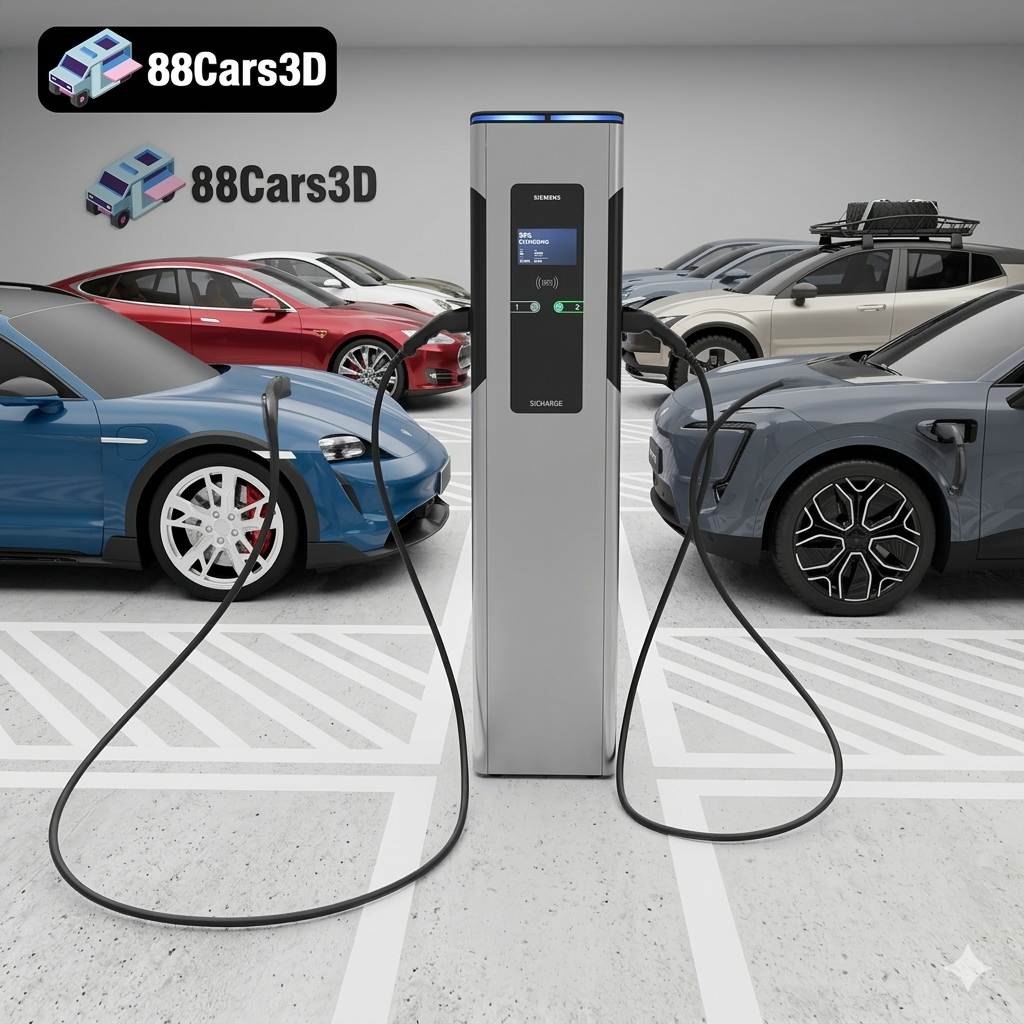
Download the Future of Mobility EV 3D Models Bundle. Includes the Volvo EX30, Tesla Model S, AVATR 11, Porsche Taycan, and a Siemens EV Charger. Save big on this highly optimized 5-in-1 pack for ArchViz and game development!
Price: $89.99

