⚡ FLASH SALE: Get 60% OFF All Premium 3D & STL Models! ⚡

In the rapidly evolving world of 3D visualization, the demand for high-fidelity assets is constant and growing across diverse industries. From creating stunning automotive rendering for marketing campaigns to populating immersive game assets, the foundation of any successful project lies in the quality of its 3D models. A truly exceptional model goes beyond mere aesthetics; it embodies technical precision, thoughtful optimization, and versatility across multiple platforms and pipelines. This is precisely what the BMW X5 (G05) M Sport 2019 3D Model offers, providing a meticulously crafted digital recreation of a modern luxury SUV.
This article will explore the intricate details and extensive applications of this premium 3D model. We’ll delve into the various file formats it supports, its technical advantages for different professional workflows, and how it empowers creators in fields ranging from cinematic production to 3D printing. Whether you’re a seasoned professional seeking the next cornerstone asset for your projects or an enthusiast looking to understand the technical prowess behind top-tier 3D car models, this comprehensive guide will illuminate why a model like the BMW X5 (G05) M Sport 2019 is an indispensable tool in the modern digital landscape. Sourced from a curated marketplace like 88cars3d.com, such assets represent not just digital files, but gateways to unparalleled creative freedom and efficiency.
The versatility of a 3D model is often defined by the array of file formats it provides. Each format serves a specific purpose, catering to different software, engines, and end-use applications. For a premium asset like the BMW X5 (G05) M Sport 2019 3D Model, offering a comprehensive suite of formats ensures maximum compatibility and utility for professionals across various sectors. Understanding these formats is crucial for optimizing workflows and achieving desired results.
The .blend file format is Blender’s native project file. It’s an invaluable asset for anyone working within the Blender ecosystem, providing a fully editable scene. This means not just the mesh data, but also materials, textures, lighting setups, cameras, animation data, modifiers, and even custom scripts are encapsulated within a single file. For the BMW X5 model, a .blend file allows artists to dive directly into the original scene, examine the clean topology, dissect the material nodes, and make granular adjustments without losing any fidelity. It’s perfect for complex automotive rendering setups or for integrating the vehicle into a Blender-based animation project, offering unparalleled flexibility and a non-destructive workflow.
As a proprietary file format owned by Autodesk, .fbx has become an undisputed industry standard for 3D model interchange, particularly between different software packages and real-time engines. It excels at preserving scene data like geometry, materials, textures, cameras, and importantly, animation and rigging information. For game developers using Unreal Engine or Unity, an .fbx export of the BMW X5 (G05) M Sport is ideal. It efficiently transfers the model, its PBR materials, and any pre-setup pivot points for components like wheels and steering, ensuring a smooth transition into the game development pipeline. Its robust nature makes it highly reliable for commercial productions.
The .obj (Wavefront OBJ) format is one of the oldest and most widely supported 3D file formats. While it doesn’t store animation or complex material nodes, it’s a universal choice for transferring static mesh geometry, UV mapping data, and basic material references (via an accompanying .mtl file). Its simplicity makes it highly compatible with virtually all 3D software. For the BMW X5, an .obj file ensures that the core mesh data is accessible to any artist, regardless of their primary software. It’s often used as a fallback or for situations where only the clean mesh is required, perhaps for sculpting or further re-topology in a specialized application.
The .glb (GL Transmission Format Binary) is an increasingly vital format, especially for modern applications like AR/VR experiences, web-based 3D viewers, and browser-based games. It is a compact, self-contained binary file that efficiently delivers 3D scenes and models. Critically, it embeds textures and animations directly into the file, making it incredibly easy to share and load. For showcasing the BMW X5 (G05) M Sport 2019 in an interactive virtual showroom on a website, or for deploying it in an augmented reality app, the .glb format is optimized for fast loading and rendering on less powerful hardware, ensuring a smooth and responsive user experience.
The .stl (Stereolithography) format is the de facto standard for 3D printing. It represents a 3D model as a series of connected triangles, describing only the surface geometry of an object without color, texture, or material information. For designers looking to convert the BMW X5 (G05) M Sport into a physical collectible or a scale model, the .stl file is indispensable. It provides the necessary manifold geometry for slicer software to prepare the model for additive manufacturing, ensuring a watertight mesh ready for FDM or resin printing, as highlighted by the product’s 3D print settings.
The .ply (Polygon File Format) is often used for storing 3D data from 3D scanners, CAD, or other precision modeling tools. It can store not only vertex and face data but also additional properties like color, transparency, normals, texture coordinates, and even reliability information. While less common for direct artistic manipulation compared to .fbx or .blend, its inclusion for the BMW X5 model suggests a focus on providing granular, high-fidelity mesh data, potentially useful for reverse engineering, detailed analysis, or specialized manufacturing workflows where precise geometrical accuracy is paramount.
The .unreal format, or more accurately, assets packaged for Unreal Engine, implies a highly optimized, engine-ready asset. This isn’t a single file like .fbx, but rather a collection of files (meshes, materials, textures, blueprints) organized within an Unreal project structure. It means the BMW X5 model has been specifically prepared, potentially with proper scaling, collision meshes, Levels of Detail (LODs), and material instances configured for optimal performance and integration within Unreal Engine. This significantly streamlines the workflow for game development and high-fidelity real-time simulations, saving countless hours of preparation.
Similar to .blend for Blender, the .max file format is the native project file for Autodesk 3ds Max. This provides a complete scene, including geometry, lights, cameras, materials (V-Ray, Corona, Arnold, etc.), textures, and any animation or rigging specific to 3ds Max. For professionals whose primary rendering and animation suite is 3ds Max, the .max file offers the most comprehensive access to the BMW X5 model, allowing for direct modification, advanced scene setup, and seamless integration into existing 3ds Max projects, leveraging the software’s powerful rendering capabilities for top-tier automotive rendering.
The availability of such a diverse range of formats for the BMW X5 (G05) M Sport 2019 3D Model underscores its professional-grade nature, ensuring that artists, developers, and designers can seamlessly integrate it into virtually any pipeline with minimal friction, showcasing the commitment to flexibility and utility that 88cars3d.com champions.
The essence of a high-quality 3D car model lies in its ability to faithfully replicate the real-world vehicle, capturing not just its silhouette but also its intricate design elements and character. The BMW X5 (G05) M Sport 2019 3D Model stands as a testament to this principle, meticulously recreating the fourth-generation luxury SUV with an emphasis on realism and technical accuracy.
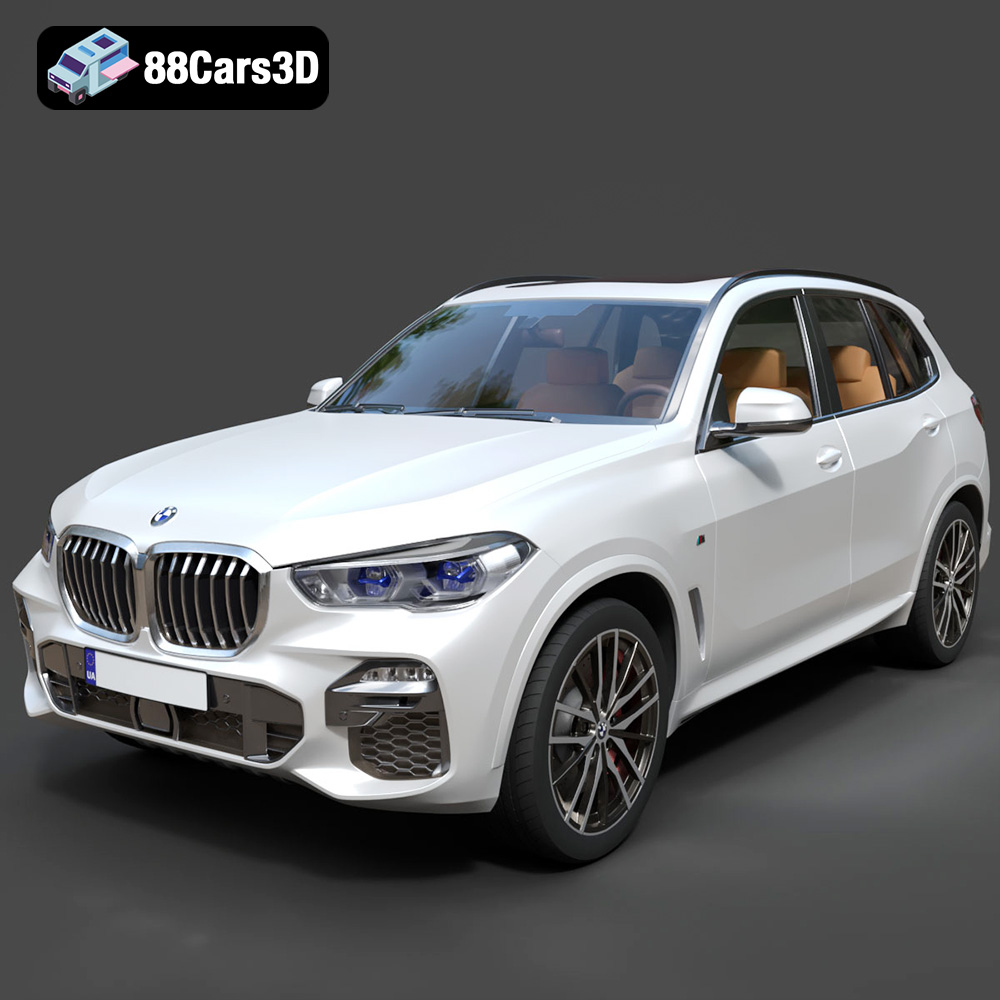
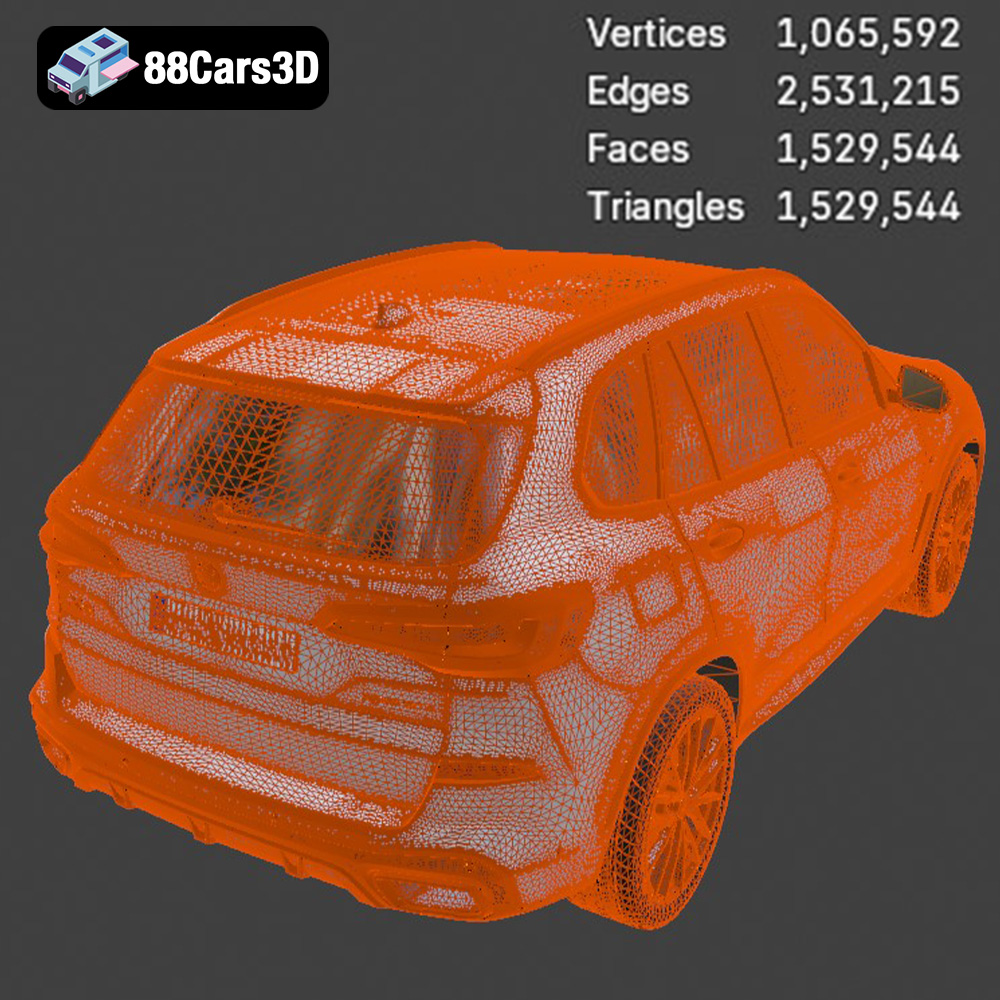
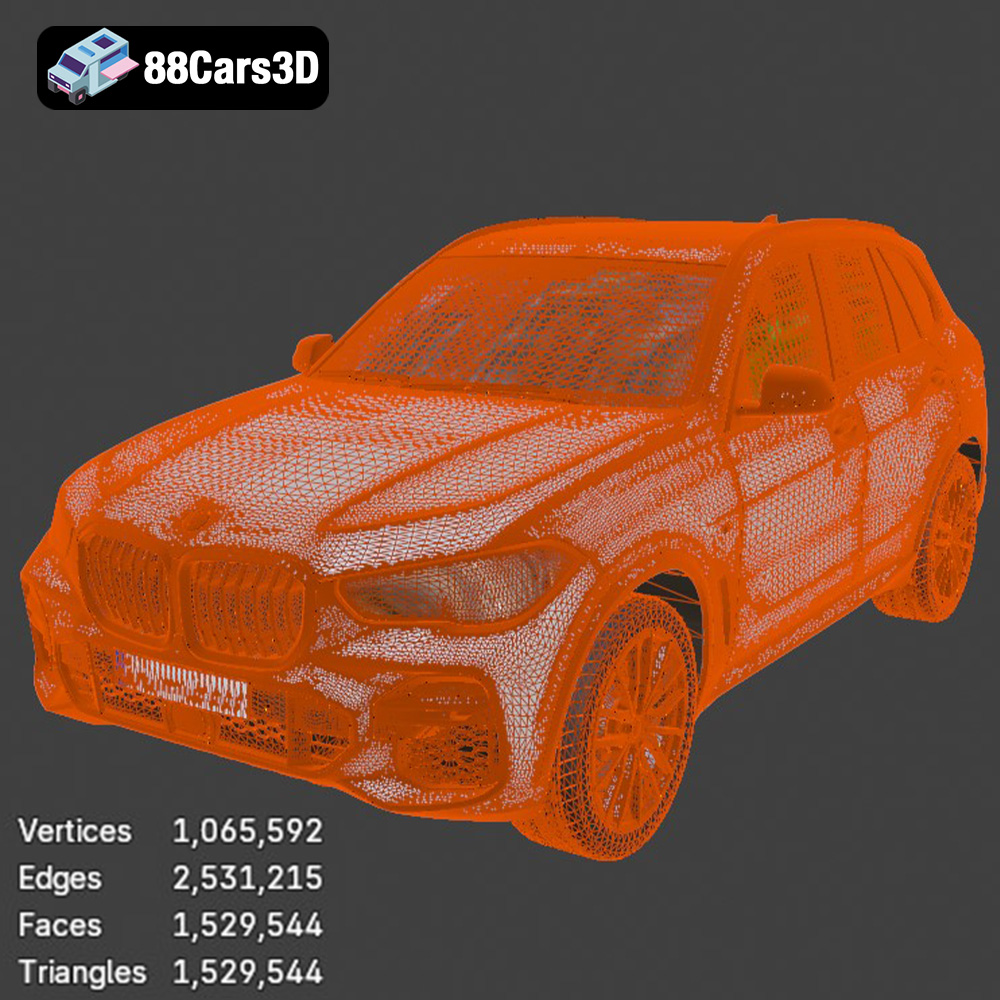
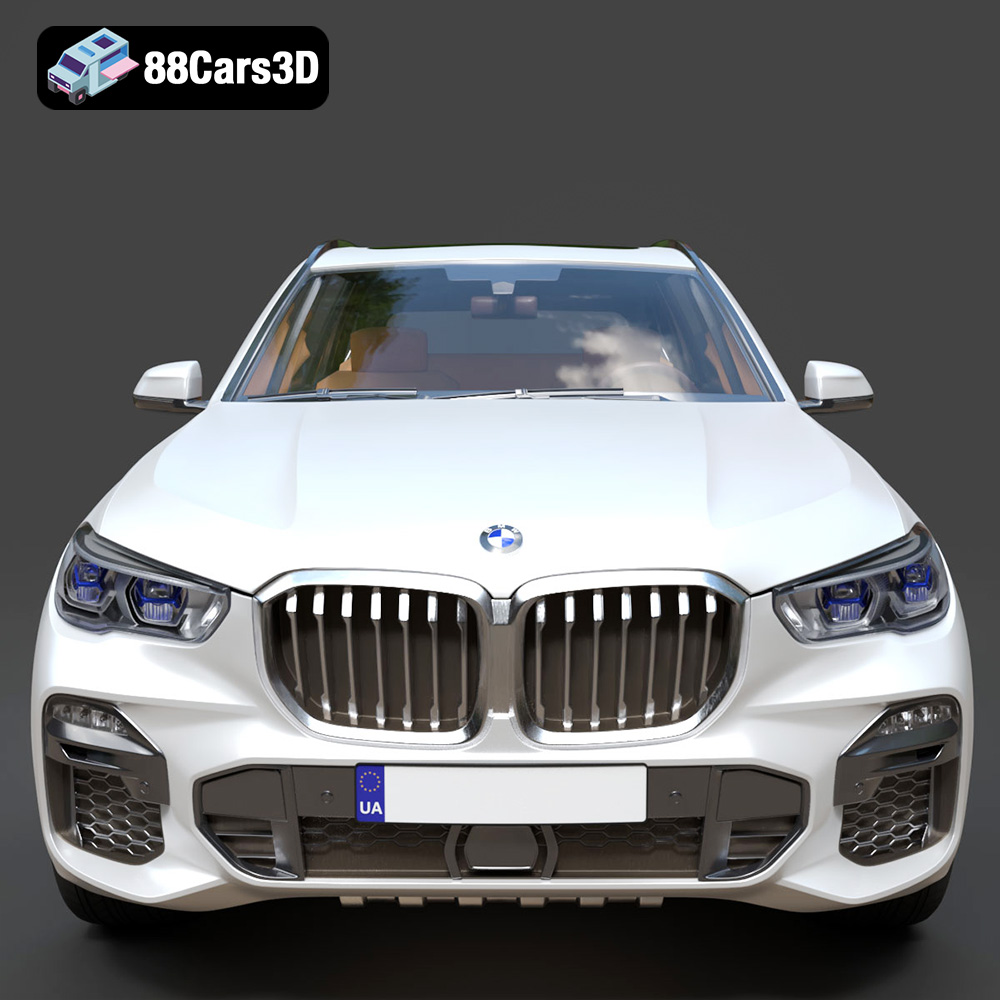
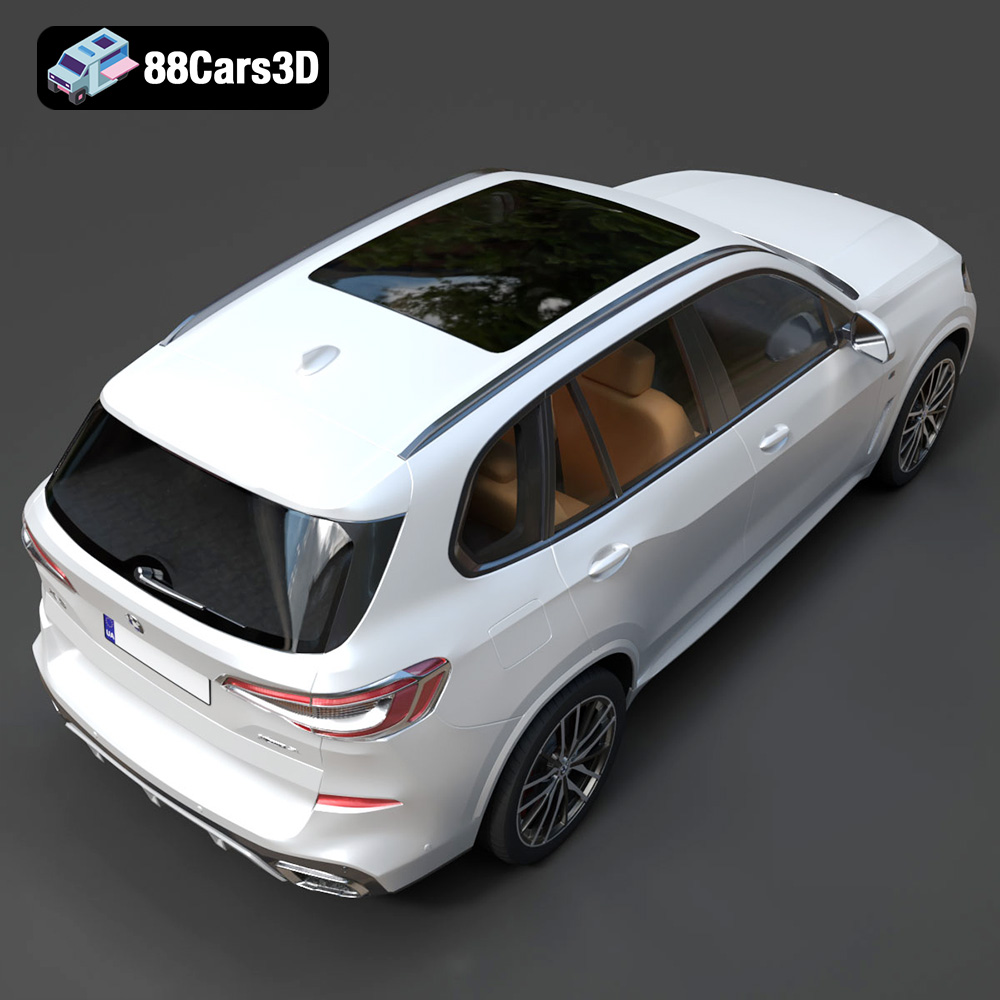
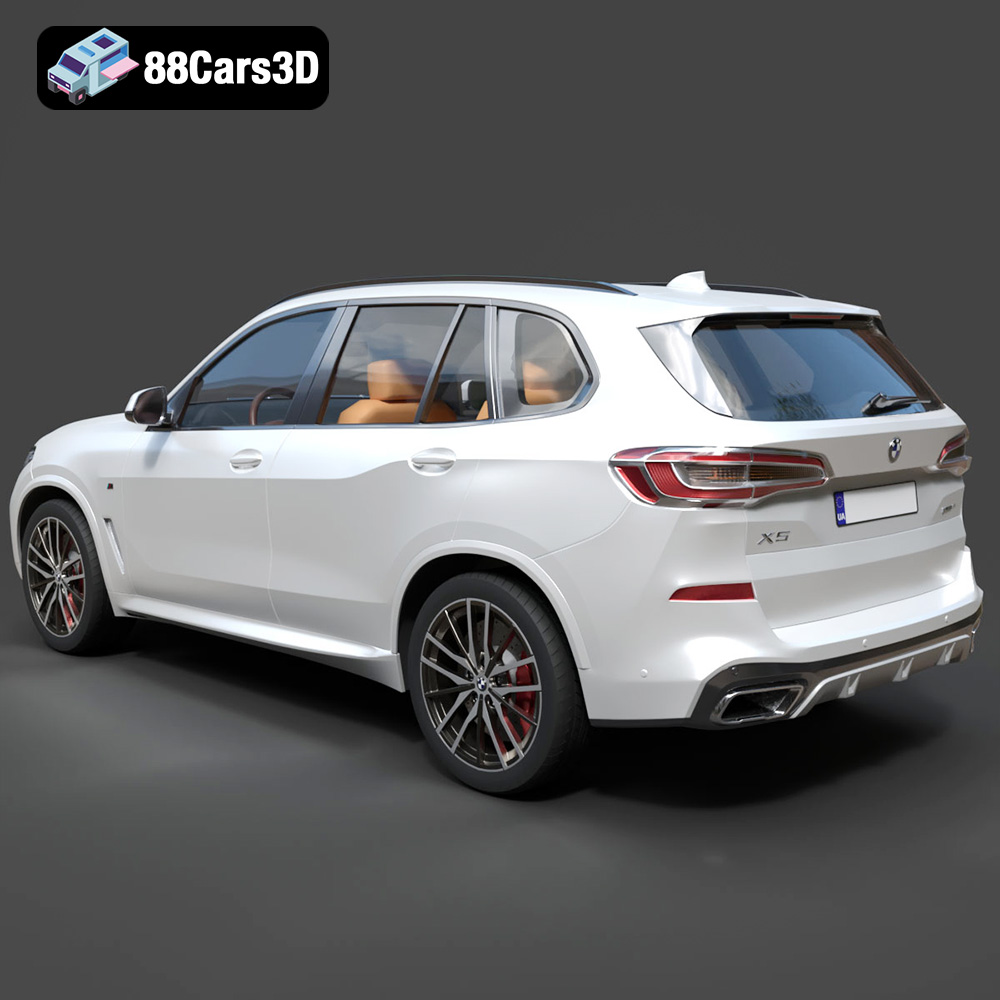
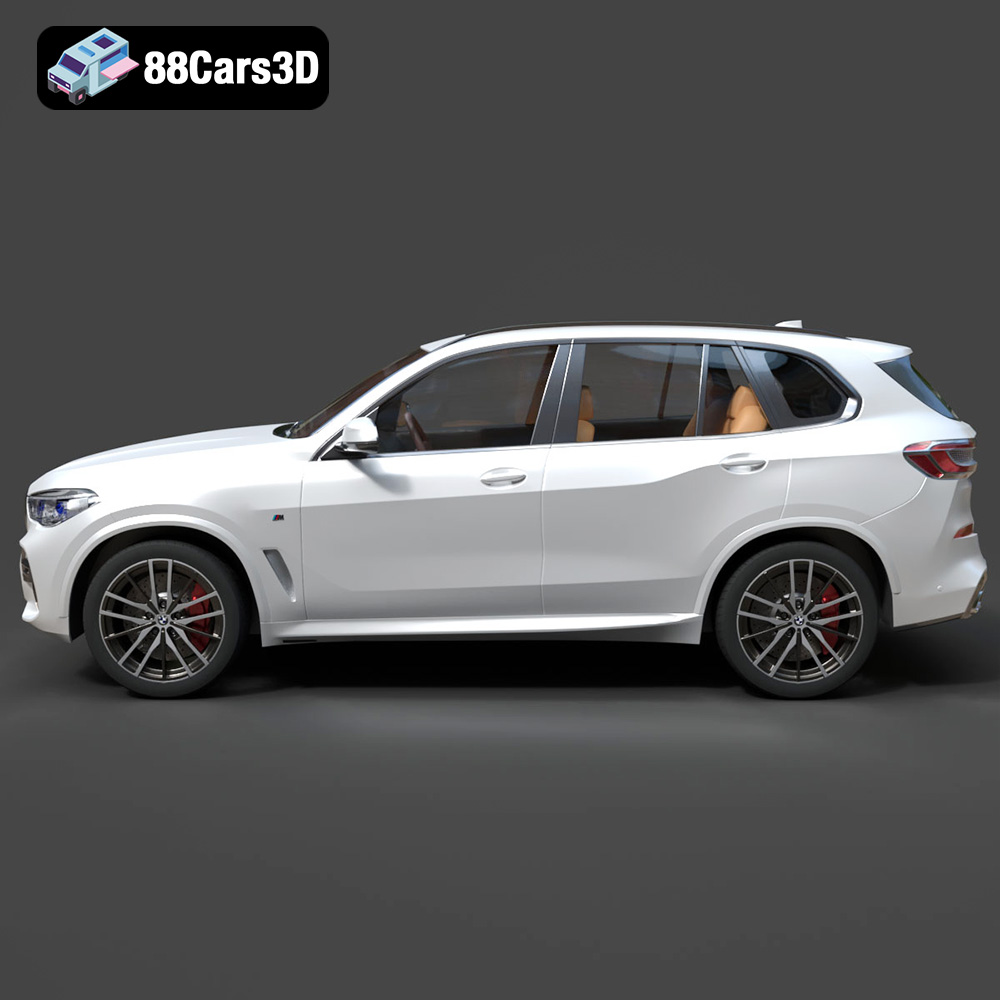
The exterior of the BMW X5 (G05) M Sport is characterized by a blend of elegance and aggression, and this 3D model captures every nuance. The enlarged BMW kidney grille design, a signature of modern BMWs, is accurately represented, along with the sharp adaptive LED headlight and taillight detailing that define its assertive presence. Crucially, the M Sport front and rear bumper styling and sculpted side character lines are not merely approximated but modeled with precision, reflecting the aerodynamic enhancements and visual flair of the M Sport package. The inclusion of large multi-spoke M Sport alloy wheels, with separate components for animation, ensures that the model is not only visually stunning but also functionally ready for driving simulations and cinematic sequences. The underlying geometry is clean and well-organized, which is vital for smooth deformations during animation and efficient rendering. This attention to detail extends to factors like polygon count, which, while not explicitly stated, would be optimized to balance visual fidelity for close-up renders with efficient performance for real-time applications, often utilizing techniques like subdivision surfaces and normal mapping to achieve high detail without excessive mesh density.
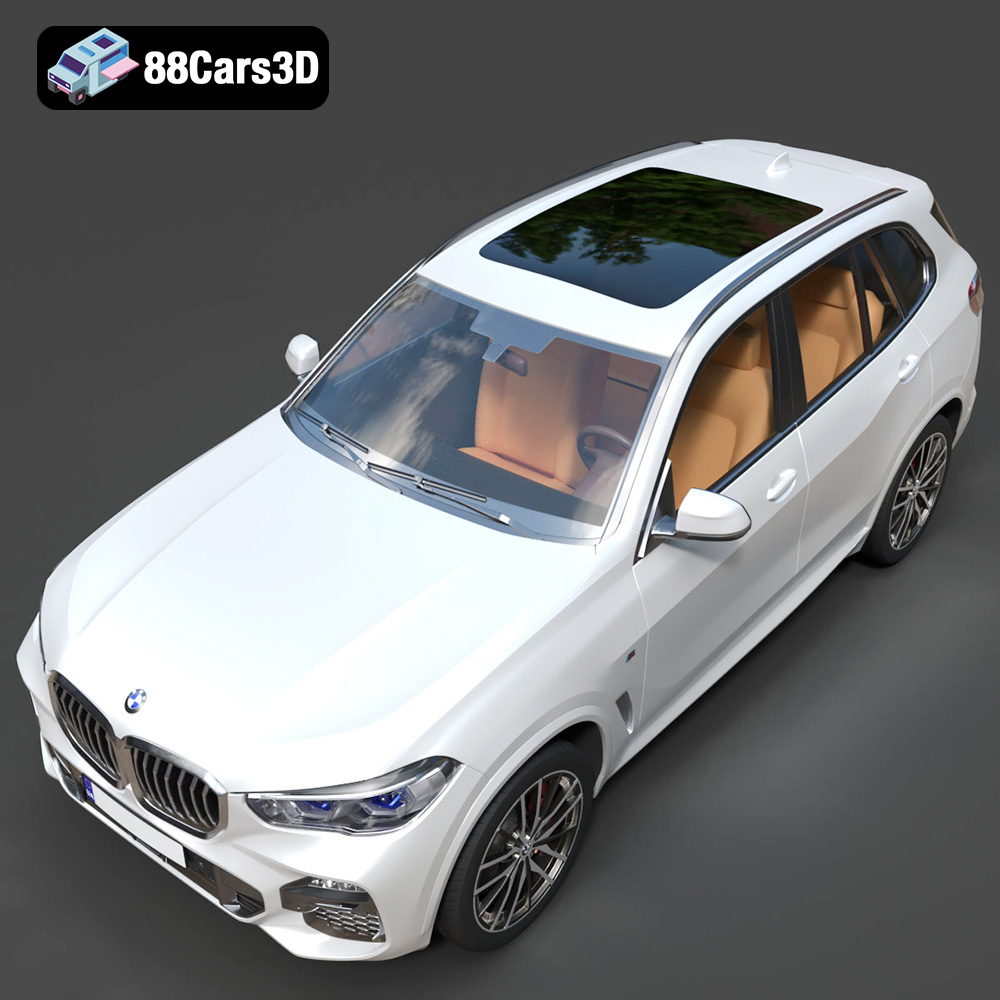
Beyond the impressive exterior, the BMW X5 (G05) M Sport 2019 3D Model offers a highly detailed interior, crucial for immersive AR/VR experiences and close-up automotive visualization. The premium dashboard with digital instrument cluster, multifunction M Sport steering wheel, and center console with infotainment display are all accurately replicated. This level of detail extends to the luxury seat geometry with stitching detail and door panel trim and metallic accent detailing, creating a rich and believable cabin environment. For professional workflows, this means less time spent modeling interior components and more time on lighting, materials, and scene composition. The optimized geometry ensures that even with such high detail, the model remains performant enough for demanding applications, a hallmark of well-engineered 3D car models.
Realism in 3D is heavily reliant on sophisticated material and texture work. The BMW X5 (G05) M Sport 2019 3D Model would utilize Physically Based Rendering (PBR) materials, common across modern rendering engines and real-time platforms. This involves carefully crafted texture maps—Albedo/Base Color, Metallic, Roughness, Normal, and potentially Ambient Occlusion—that accurately simulate how light interacts with different surfaces. From the gloss of the paintwork and the reflections on the chrome accents to the subtle texture of the leather seats and the intricate patterns on the carbon fiber trim, PBR materials ensure consistent and believable lighting under any conditions. Efficient UV mapping is also crucial, providing non-overlapping UVs where necessary for texture painting and ensuring that texture resolutions are appropriate for different parts of the vehicle, optimizing both visual quality and memory footprint.
The true value of a versatile 3D asset like the BMW X5 (G05) M Sport 2019 3D Model comes from its seamless integration into diverse professional workflows. Its meticulous construction and multi-format availability make it a cornerstone asset for a wide range of creative and technical projects.
For high-end automotive rendering, 3ds Max and Blender are industry powerhouses. Importing the BMW X5 model via its native .max or .blend format provides immediate access to the full scene, including materials and potentially lighting setups. In 3ds Max, users can leverage renderers like V-Ray or Corona to achieve photorealistic results, adjusting studio lighting, HDRI environments, and material properties to showcase the vehicle in its best light. The optimized polygon flow and proper pivot setup for steering and wheel rotation are invaluable for animating dynamic shots, from subtle camera moves around the parked car to full driving sequences. Similarly, Blender users can harness Cycles or Eevee, utilizing its powerful node-based material system to tweak surfaces, add procedural details, and create stunning visual narratives. This model saves countless hours of modeling and UV unwrapping, allowing artists to focus on artistic direction and final presentation.
For game development, the BMW X5 (G05) M Sport 2019 3D Model is an excellent candidate for integration into engines like Unreal Engine, especially with the included .unreal or .fbx formats. The pre-optimized geometry is critical here, allowing for the creation of Levels of Detail (LODs) to maintain performance across various distances without sacrificing visual quality up close. Developers can set up PBR materials, add collision meshes for realistic physics interaction, and integrate the model into a vehicle blueprint system for drivable gameplay. The separate wheels and steering components are essential for accurate suspension, steering, and tire rotation animations, enhancing the realism of driving simulations. This readiness for real-time environments makes it suitable for “open-world driving games, premium SUV simulations, and modern city environments,” directly aligning with its described applications.
The burgeoning fields of AR/VR experiences and web-based 3D visualizations require highly optimized assets that can be rendered smoothly on diverse hardware, often in real-time. The .glb format is particularly advantageous here, as it’s optimized for efficient transmission and rendering in environments like A-Frame, Three.js, or various AR/VR SDKs. The BMW X5 model can be deployed in virtual showrooms, allowing potential buyers to explore the vehicle’s exterior and interior in an immersive, interactive setting. For augmented reality, placing the digital SUV into a real-world environment provides a powerful visualization tool. The model’s optimized geometry and clean mesh ensure that even on mobile devices or lower-spec VR headsets, the experience remains fluid and visually appealing, offering “immersive virtual showrooms and interactive luxury vehicle experiences.”
The versatility of the BMW X5 (G05) M Sport 2019 3D Model extends beyond digital screens, offering tangible outputs through 3D printing. This opens up avenues for creating physical collectibles, scale models, and even functional prototypes, bridging the gap between digital design and physical reality.
The .stl format, provided with the model, is the cornerstone for additive manufacturing. It represents the BMW X5’s geometry as a triangulated mesh, which must be “manifold” – meaning it’s a completely watertight surface without any holes or intersecting faces – to be successfully sliced and printed. The product description’s recommendations for recommended scale (1:32 / 1:24 / 1:18 / 1:14), layer height (0.08–0.16 mm), and wall thickness (1.2–2.0 mm) are crucial guidelines. For smaller scales, especially, a finer layer height and potentially resin printing (SLA/DLP) would be recommended over FDM to capture the intricate details like the kidney grille, headlight housings, and fine character lines accurately. Slicer software like PrusaSlicer or Cura would be used to prepare the .stl file, generating toolpaths and most importantly, supports. The product correctly identifies that supports are required for mirrors, bumper overhangs, and underbody details to prevent print failures and ensure structural integrity during the printing process. Print orientation, such as printing the body angled and wheels separately, further optimizes surface finish and minimizes support material.
Achieving a truly professional finish for a 3D-printed BMW X5 requires careful post-processing. After printing, removing supports and light sanding are essential to smooth out layer lines and imperfections. Applying a primer not only provides a uniform base but also helps reveal any remaining flaws. The real magic happens with painting; choosing a gloss or metallic paint finish—mimicking BMW’s factory colors—can elevate the model from a printed object to a stunning collectible. Adding optional M Sport decals would complete the authentic look. For multi-part models (e.g., separate wheels and body), careful assembly is required, often using specialized adhesives. This blend of digital precision and artisanal finishing allows designers to create unique, physical representations of this iconic vehicle, perfect for “collectible scale SUV models and display miniatures.”
The utility of a high-fidelity 3D model like the BMW X5 (G05) M Sport 2019 3D Model can be best illustrated through practical, real-world applications. Its robust technical foundation enables a wide array of creative endeavors across industries.
Imagine a premium automotive brand launching a new vehicle or an updated trim like the M Sport. Traditional photography and video are essential, but an interactive 3D model takes the experience to the next level. Using this BMW X5 model, a marketing team could create a virtual showroom where prospective buyers can dynamically rotate the car, open doors, customize paint colors and wheel options (change body color and trim accents, modify wheel design and brake caliper color), and even explore the interior in 360 degrees. For a promotional campaign, the model could be integrated into high-quality cinematic renders, showcasing the SUV in various urban or scenic environments, highlighting its “luxury urban scenes, executive environments, and promotional campaigns” utility. This level of immersion provides a powerful tool for engaging customers and driving sales, setting a new standard for product presentation.
In the realm of game development, detailed 3D car models are crucial for building believable virtual worlds. The BMW X5 model could be a hero vehicle in a high-fidelity racing simulator or a prominent background element in an open-world action-adventure game. Its proper pivot setup for steering and wheel rotation makes it ideal for realistic driving physics and animation. For cinematic productions, whether a commercial, a film sequence, or a music video, pre-visualizing shots with a high-quality vehicle asset can save significant production costs and time. The model can be placed in different scenes, animated to drive through traffic, or positioned for dramatic effect, demonstrating its value for “cinematic productions and driving simulations.” The optimization for real-time engines ensures that these high-quality visuals can also translate into interactive experiences.
Beyond entertainment and marketing, accurate 3D models like the BMW X5 (G05) M Sport serve vital roles in education and industrial design. For automotive visualization and driver simulation projects, this model provides a realistic platform for training and research. Engineering students or future designers could analyze the vehicle’s form, experiment with lighting conditions, or even apply virtual modifications to explore design concepts. Furthermore, in product development, a 3D model can act as a digital prototype, allowing designers to iterate on ideas such as adding blacked-out or chrome styling packages or adjusting ride height or stance before committing to physical production. This reduces costs and accelerates the design cycle, leveraging the flexibility of digital assets.
The BMW X5 (G05) M Sport 2019 3D Model is more than just a digital representation; it’s a meticulously crafted asset that embodies the pinnacle of 3D automotive design. From its precise exterior and detailed interior to its expansive compatibility across numerous file formats, this model is built for professional demands. Whether your goal is to produce breathtaking automotive rendering, develop engaging game assets, create immersive AR/VR experiences, or produce tangible 3D printed collectibles, this model provides the technical foundation for success. Its integration into workflows spanning 3ds Max, Blender, Unreal Engine, and more, ensures that artists and developers can focus on innovation rather than asset creation from scratch.
Investing in high-quality 3D car models from reputable sources like 88cars3d.com is a strategic move for any professional or enthusiast. These assets, exemplified by the BMW X5 (G05) M Sport 2019, streamline production, elevate visual fidelity, and unlock new creative possibilities. Embrace the power of expertly crafted 3D assets to drive your projects forward with unparalleled realism and efficiency.
The BMW X5 (G05) M Sport 2019 3D Model is a high-detail digital recreation of the fourth-generation luxury SUV enhanced with the aggressive M Sport package. Combining premium comfort with dynamic performance styling, the 2019 G05 X5 delivers a bold road presence, advanced technology, and refined interior craftsmanship. This 3D model accurately represents the large kidney grille, sharp adaptive LED headlights, sculpted hood lines, aerodynamic M Sport bumpers, side air intakes, roof rails, muscular rear profile, and performance alloy wheels. Built with clean topology and real-world scale accuracy, it is ideal for rendering, animation, automotive visualization, game development, and AR/VR experiences. Perfect for luxury urban scenes, executive environments, promotional campaigns, cinematic productions, and driving simulations.
$39.99
.2019suv
.arvr
.automotive
.blend
.bmw
.bmwx5
.car3dmodel
.fbx
.gameasset
.glb
.luxurysuv
.max
.msport
.obj
.ply
.rendering
.simulation
.stl
.unreal
.x5g05