⚡ FLASH SALE: Get 60% OFF All Premium 3D & STL Models! ⚡

Ever wished you could bring your stunning 3D car models to life, creating interactive experiences without diving deep into complex coding languages? For many artists, designers, and visualization professionals, traditional programming can feel like a formidable barrier, hindering their ability to craft dynamic real-time content. This is where Unreal Engine’s Blueprint Visual Scripting steps in, offering an incredibly powerful yet intuitive solution that empowers non-programmers to build sophisticated game logic, interactive applications, and cinematic sequences.
In the world of automotive visualization, game development, and real-time rendering, interactivity is key. Whether you’re showcasing a new vehicle design, building a driving simulator, or creating an immersive AR/VR experience, the ability to control elements like car doors, paint colors, engine sounds, and even complex physics is paramount. Blueprint makes this not just possible, but accessible. This comprehensive guide will demystify Blueprint, taking you from the basics of visual scripting to advanced techniques specifically tailored for working with high-quality 3D car models, such as those found on platforms like 88cars3d.com.
We’ll explore how to seamlessly integrate and optimize your automotive assets, craft engaging interactive features, and apply professional best practices to ensure performance. By the end of this article, you’ll have a solid understanding of how Blueprint can transform your creative vision into a tangible, interactive reality within Unreal Engine, opening up new possibilities for your projects in game development, automotive design, virtual production, and more.
At its core, Blueprint Visual Scripting is a complete gameplay scripting system based on the concept of using a node-based interface to create game logic and events. Instead of writing lines of code, you connect visual nodes, each representing a specific action, function, or event. This approach eliminates the common stumbling blocks of syntax errors and complex coding paradigms, allowing artists and designers to focus on the logical flow and creative execution of their ideas.
For individuals accustomed to visual tools like material editors or node-based compositing software, Blueprint feels immediately familiar. It’s a game-changer because it democratizes development, enabling creative professionals to prototype rapidly, iterate quickly, and directly implement interactive features without constant reliance on a dedicated programmer. Imagine being able to make a car door open with a click, change its paint dynamically, or trigger an engine sound, all within a visual drag-and-drop environment.
Unreal Engine utilizes Blueprints extensively, not just for gameplay but also for UI, AI, animation, and even complex editor utilities. This versatility makes it an indispensable tool for anyone working with the engine, especially when dealing with detailed assets like 3D car models that demand sophisticated interactions. You can learn more about the fundamentals of Blueprint on the official Unreal Engine learning portal.
The foundation of any Blueprint script lies in its nodes. Each node performs a specific task, ranging from simple mathematical operations to complex engine functions. These nodes have input and output pins. Execution pins (white arrows) dictate the flow of logic: when one node finishes, it triggers the next node connected via its execution pin. Data pins (various colors) pass information, such as numbers, text, or object references, between nodes.
Events are the starting points of most Blueprint scripts. An event is something that happens in the game world that you want to respond to. Common events include:
Understanding how to connect these events to a sequence of actions using execution pins is the first step to building interactive logic. For example, an “Event BeginPlay” could be connected to a “Print String” node to display a message on the screen, confirming your Blueprint is active.
Variables are containers that store data within your Blueprint. They are essential for holding information that can change during gameplay, such as the current car color, whether a door is open, or a car’s current speed. Unreal Engine supports a wide array of data types, each suited for different kinds of information:
By defining variables and using “Get” and “Set” nodes to access and modify their values, you can create dynamic systems where your 3D car models react intelligently to player input and game events. For instance, a “Set Vector Parameter Value” node could modify a car’s paint color by targeting a Material Instance Dynamic, with the new color being pulled from a Vector variable that the user selects via a UI widget.
Before you can bring your car models to life with Blueprint, they need to be properly integrated and prepared within Unreal Engine. This process involves not just importing the assets but also structuring them in a way that allows for easy manipulation and interaction through scripting. High-quality 3D car models, such as those optimized for Unreal Engine found on marketplaces like 88cars3d.com, often come with clean topology, proper UV mapping, and PBR materials, making this step significantly smoother.
When you acquire a car model, it’s typically provided in formats like FBX or USD. Unreal Engine handles these imports efficiently, creating Static Meshes, Skeletal Meshes (if rigged for animation), and associated materials and textures. The key is to ensure that individual parts of the car that you intend to interact with (e.g., doors, wheels, steering wheel, interior panels) are either separate meshes or clearly defined material IDs within a single mesh, as this offers maximum flexibility for Blueprint control.
Once imported, these raw assets are usually placed into an “Actor Blueprint.” An Actor Blueprint is essentially a container that can hold multiple static meshes, lights, collision components, and most importantly, your Blueprint scripts. By wrapping your car model within an Actor Blueprint, you create a self-contained, reusable asset that can be spawned into your levels and controlled with custom logic.
A well-organized asset hierarchy is critical for efficient Blueprint scripting. When you bring your 3D car model into Unreal Engine, especially if it’s composed of multiple separate meshes (like a body, four doors, hood, trunk, and wheels), you’ll want to assemble these within an Actor Blueprint. This involves setting up parent-child relationships:
Beyond the visual meshes, you’ll need to add various components to facilitate interaction:
By building a robust hierarchy and attaching appropriate components, your Blueprint scripts can easily reference and manipulate specific parts of the car, enabling precise and realistic interactions.
One of the most powerful aspects of Blueprint for automotive visualization is its ability to dynamically change material properties at runtime. This is fundamental for creating interactive car configurators where users can customize paint colors, interior trim, or wheel finishes. The key to achieving this lies in properly set up Physically Based Rendering (PBR) materials, specifically through the use of Material Instances.
A good PBR material typically has parameters for properties like Base Color, Metallic, Roughness, Specular, and Normal. Instead of directly editing the master material for every variation, you create a “Material Instance.” Material Instances are lighter versions of master materials that allow you to override specific parameters without recompiling the entire shader. This is crucial for performance and flexibility.
To enable Blueprint control over these parameters:
Models from 88cars3d.com are often designed with clean PBR material setups and sometimes even pre-configured Material Instances, simplifying this process and allowing you to jump straight into Blueprinting your dynamic customizations.
Now that your 3D car models are prepped, it’s time to dive into practical Blueprint examples that bring them to life. These demonstrations will illustrate how to implement common interactive features using the nodes, events, and variables we’ve discussed, allowing you to build engaging experiences right away.
One of the most requested features in automotive visualization is the ability to change a car’s color dynamically. Blueprint makes this straightforward:
This same principle extends to changing wheel finishes, interior fabric, or even swapping out entire wheel models by controlling visibility or swapping mesh references.
Smooth, controlled animations are crucial for realism. Blueprint’s “Timeline” node is perfect for this, especially for movements like opening car doors:
This setup allows for a smooth, reversible door animation with minimal Blueprint nodes, and can be adapted for hoods, trunks, or even raising/lowering windows.
Beyond visual changes and animations, Blueprint can dramatically increase immersion by adding audio and visual effects:
These simple additions make the interactive experience much more believable and engaging for users exploring your 3D car models.
Once you’re comfortable with fundamental Blueprint operations, you can start building more sophisticated systems. For automotive visualization, this often involves complex configurators, cinematic storytelling, and even basic physics interactions.
Automotive configurators are a cornerstone of modern car marketing, allowing potential buyers to customize vehicles to their exact specifications. Blueprint, combined with Unreal Engine’s UMG (Unreal Motion Graphics) for UI, provides a robust framework for building these interactive tools.
A full configurator often involves:
This level of complexity leverages multiple Blueprints working in concert, demonstrating the power of modular design. Leveraging high-quality assets from marketplaces like 88cars3d.com, which often include multiple part variations and clean material setups, significantly accelerates the development of sophisticated configurators.
Unreal Engine’s Sequencer is a powerful non-linear cinematic editor, allowing you to create stunning trailers, product reveal videos, and in-game cutscenes. Blueprint acts as the perfect trigger and controller for these sequences.
This combination empowers you to produce high-fidelity marketing content or integrate dynamic story-driven events into games, all controlled through visual scripting.
While complex vehicle physics often reside in C++ code (like the Chaos Vehicles plugin), Blueprint can interface with these systems and provide simpler physics interactions for less demanding scenarios.
Blueprint simplifies the control layer, allowing designers to tweak and implement logic around these physics systems without needing to delve into the underlying code. For further details on vehicle physics, consult the Unreal Engine documentation on Chaos Vehicles.
While Blueprint offers incredible flexibility, inefficient scripting can lead to performance bottlenecks, especially in demanding real-time applications like automotive visualization with high-fidelity 3D car models. Adopting best practices and understanding optimization techniques are crucial for maintaining smooth framerates and a professional workflow.
Optimized Blueprints are not just about speed; they’re also about maintainability and readability. Here are key practices:
By adhering to these principles, your Blueprint graphs will be cleaner, easier to debug, and perform significantly better, especially with the high asset fidelity expected in modern automotive visualization.
For identifying and resolving performance issues, Unreal Engine provides built-in profiling tools:
For shipping projects, particularly those demanding the absolute best performance (e.g., high-framerate VR automotive experiences), “Blueprint Nativization” is a powerful optimization feature:
By regularly profiling and selectively using Nativization, you can ensure your Unreal Engine projects, rich with interactive 3D car models, run smoothly across target platforms.
Blueprint Visual Scripting isn’t just a development tool; it’s an enabler for innovation across various industries. Its accessibility and power have made it a cornerstone in everything from interactive product showcases to cutting-edge virtual production pipelines, especially when paired with high-quality 3D car models.
The automotive industry has fully embraced real-time technology for marketing and sales. Blueprint is fundamental to creating the next generation of interactive showrooms and virtual product launches:
Furthermore, Blueprint plays a vital role in AR/VR applications. For AR, it can handle placing a virtual car model into a real-world environment, allowing users to scale, rotate, and interact with it. In VR, Blueprint handles all controller inputs, teleportation mechanics, and direct interaction with the car, such as grabbing a door handle to open it. Optimizing Blueprints for performance is especially critical in AR/VR to maintain comfortable framerates.
Beyond marketing, Blueprint is transforming how we train and produce content:
The ability of Blueprint to bridge creative vision with technical execution, all within a visual framework, makes it an indispensable tool for these advanced real-time applications. It empowers a broader range of professionals to contribute to and lead the development of incredibly complex and immersive experiences.
Unreal Engine’s Blueprint Visual Scripting is far more than just a convenience; it’s a revolutionary tool that has democratized game development and real-time visualization. For artists, designers, and automotive professionals, it removes the steep learning curve of traditional programming, unlocking an immense creative potential to build compelling, interactive experiences around their high-quality 3D car models.
Throughout this guide, we’ve journeyed from the fundamental concepts of nodes, events, and variables to advanced techniques like building intricate configurators, orchestrating cinematics with Sequencer, and even touching upon physics interactions. We’ve emphasized the importance of properly integrating and preparing your 3D assets, utilizing PBR materials for dynamic control, and implementing crucial optimization strategies to ensure your projects run smoothly and efficiently.
The impact of Blueprint extends across industries, enabling everything from captivating virtual showrooms and product launches to highly realistic training simulators and cutting-edge virtual production pipelines. By empowering non-programmers to take direct control of interactivity, Blueprint fosters innovation and allows for rapid iteration, bringing concepts to life with unprecedented speed and flexibility. Platforms like 88cars3d.com offer the kind of optimized 3D car models that truly shine when brought to life with Blueprint.
Your journey with Blueprint is just beginning. The best way to master this powerful tool is through hands-on practice. Start experimenting with simple interactions, then gradually build up to more complex systems. Explore the official Unreal Engine documentation for deeper dives into specific nodes and features. With Blueprint, your ability to transform static 3D models into dynamic, engaging, and fully interactive real-time experiences is limited only by your imagination.
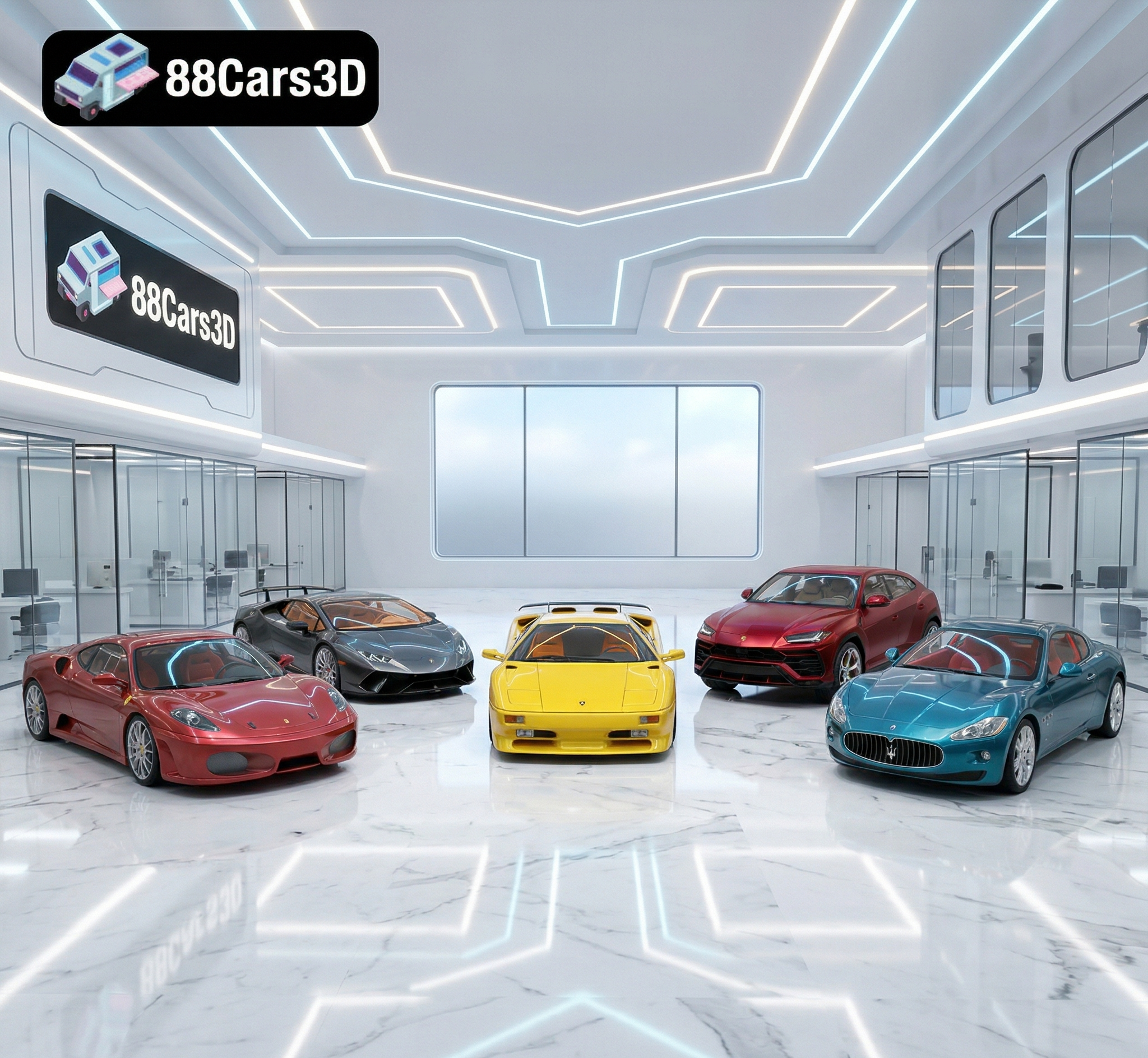
Texture: Yes | Material: Yes | 3D Printable: Yes. Download the Italian Thoroughbreds Bundle featuring 5 iconic 3D models: Lamborghini Huracán Performante, Ferrari 458 Italia, Lamborghini Urus, Diablo SV, and Maserati GT. Optimized for 4K rendering and 3D printing (STL included). Save 50% with this ultimate Italian vehicle collection.
Price: $199.99

Download the Elite Future Mobility Bundle featuring 4 highly optimized 3D models: Tesla Model S, Avatr 11, Li L9, and Zoox Robotaxi. Perfect for ArchViz, Smart City renders, and game dev. Optimized for Unreal Engine and Blender. Includes .fbx, .obj, and .max formats.
Price: $99

🚗 5 Iconic German Cars (BMW M4 G82, M5 CS, X3, 1 Series & Mercedes E-Class). ✅ Optimized for ArchViz: Ready for Corona & V-Ray. 💰 Save €71 with this limited-time collection! 🚀 Instant Download after purchase.
Price: $119
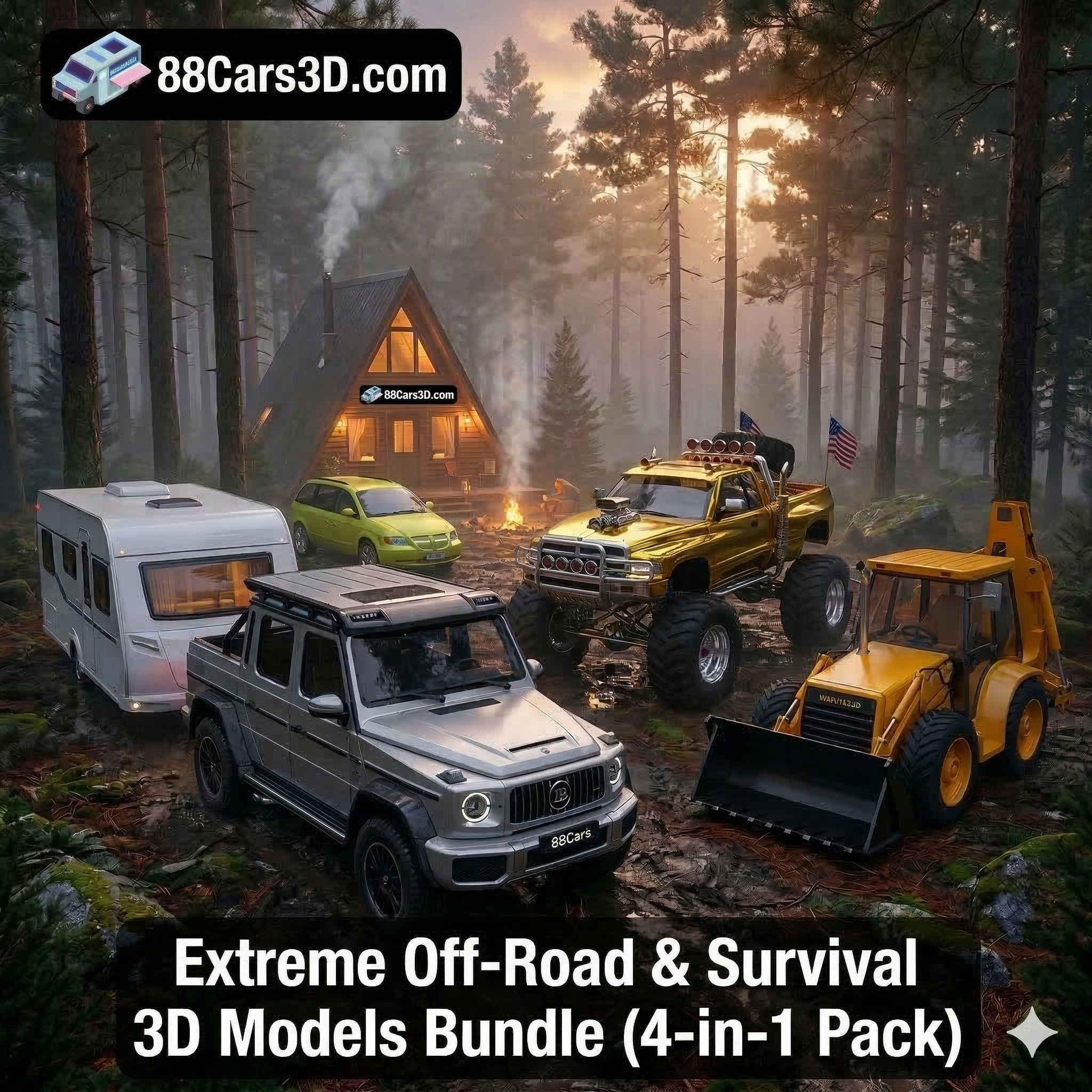
Download the Extreme Off-Road & Survival 3D Models Bundle! Includes the Brabus 800 Adventure, Dodge Ram Bigfoot, Spec Truck, and a Caravan. Save over €210 on this premium 4-in-1 off-grid vehicle pack for ArchViz and game development.
Price: $149.99
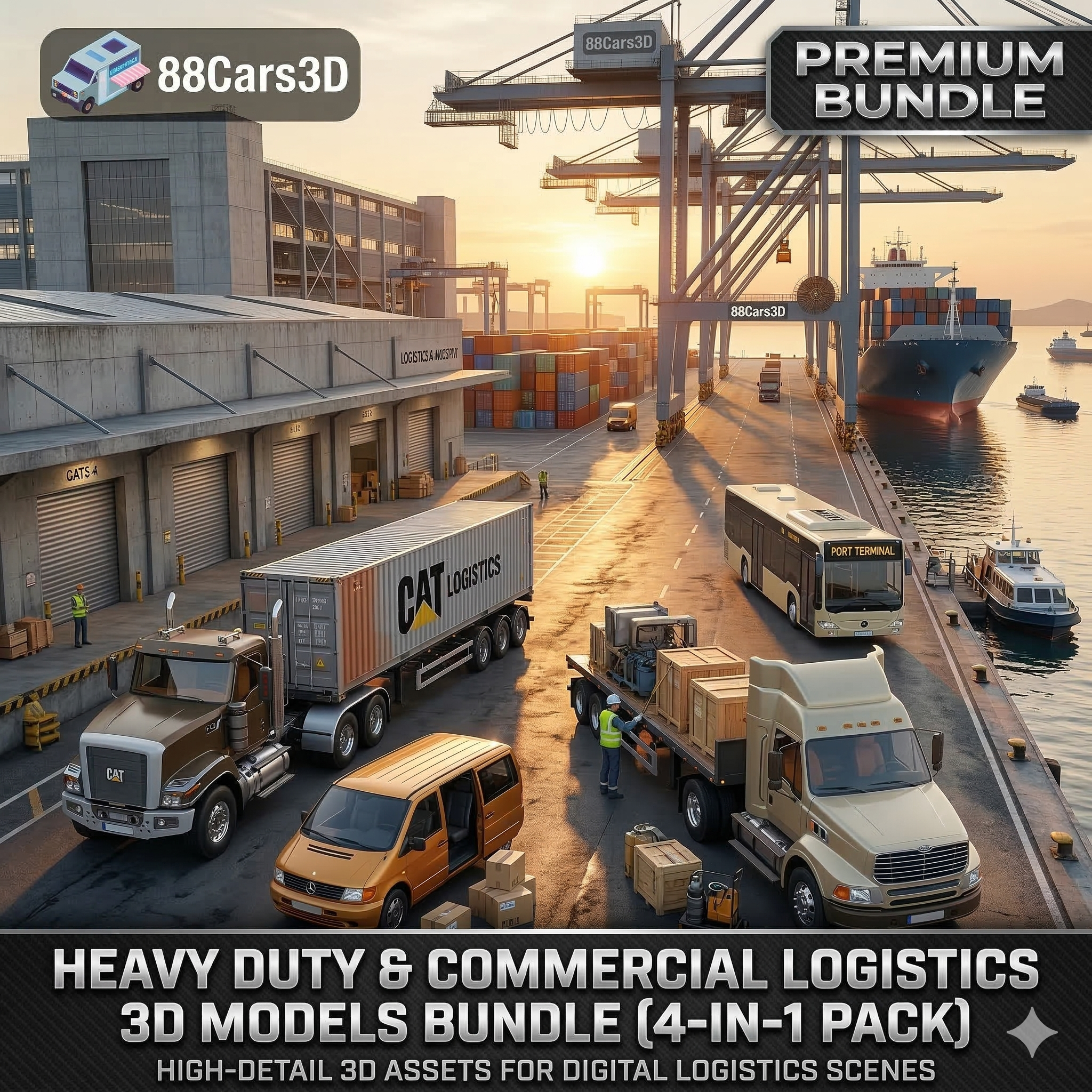
Download the Heavy Duty & Commercial Logistics 3D Models Bundle! Includes the Ford Sterling, Caterpillar CT680, Mercedes Citaro Bus, and Vito Van. Save over €130 on this massive, game-ready 4-in-1 industrial vehicle pack.
Price: $109.99

Download the Ultimate Custom Motorcycles 3D Models Bundle. Includes a Custom Chopper, Ducati 916 Café Fighter, Harley XR1200X, and BMW K100. Perfect premium props for luxury ArchViz garages. Save over €250 today!
Price: $159.99

Download the ultimate JDM Street Racing 3D Models Bundle! Includes the Nissan GT-R, Toyota Supra, Mazda RX-7, Lancer Evo IX, and Honda NSX. Save big on this highly optimized, game-ready 5-in-1 Japanese legend car pack.
Price: $129.99

Download the ultimate American Muscle & Cinematic Classics 3D Models Bundle! Includes the Dodge Charger ’68, Mustang Eleanor GT500, Camaro Z28 ’79, and a custom ’69 Mustang. Save over €240 on this game-ready, premium 4-in-1 pack.
Price: $149.99
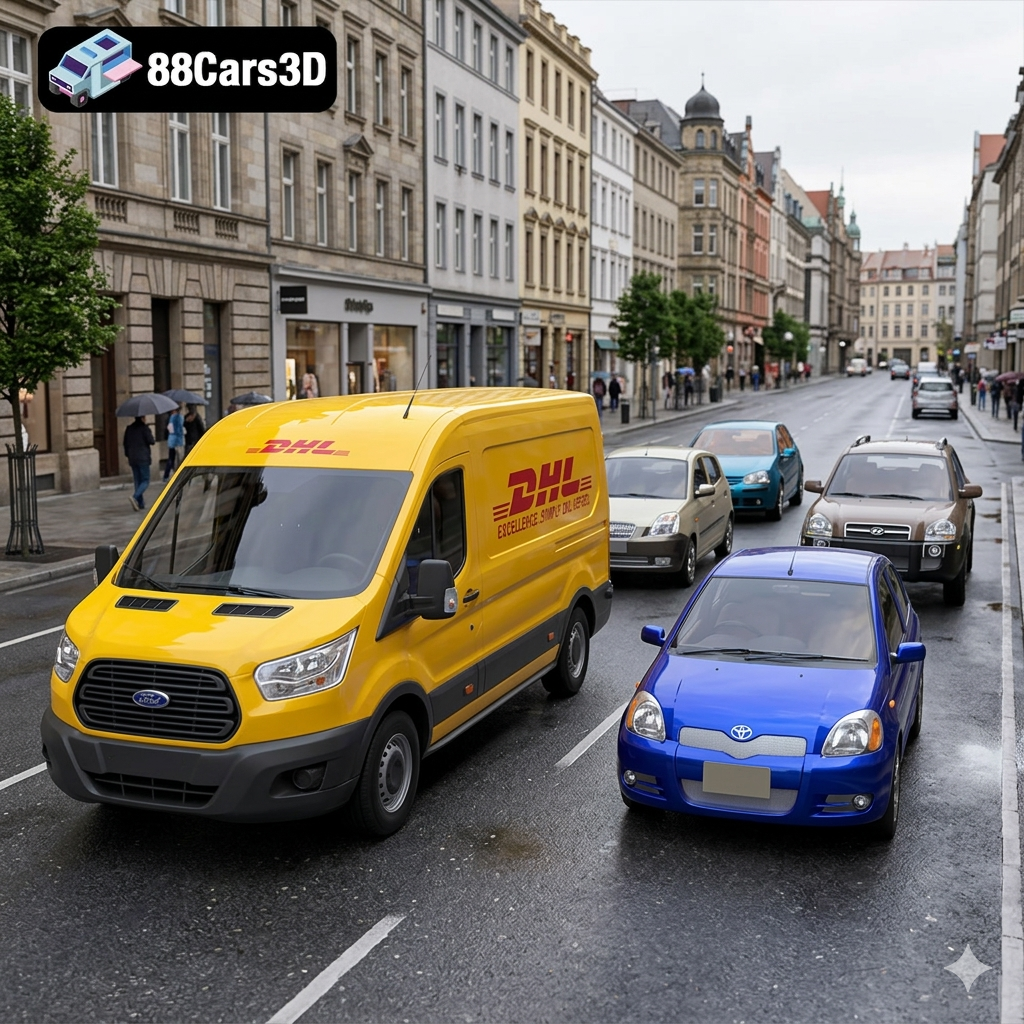
Download the Everyday City Traffic 3D Models Bundle. Includes the VW Golf, Kia Picanto, Hyundai Tucson, Toyota Yaris, and a DHL Ford Transit Van. Save big on this 5-in-1 pack, perfectly optimized for realistic ArchViz streets and game traffic.
Price: $99.99
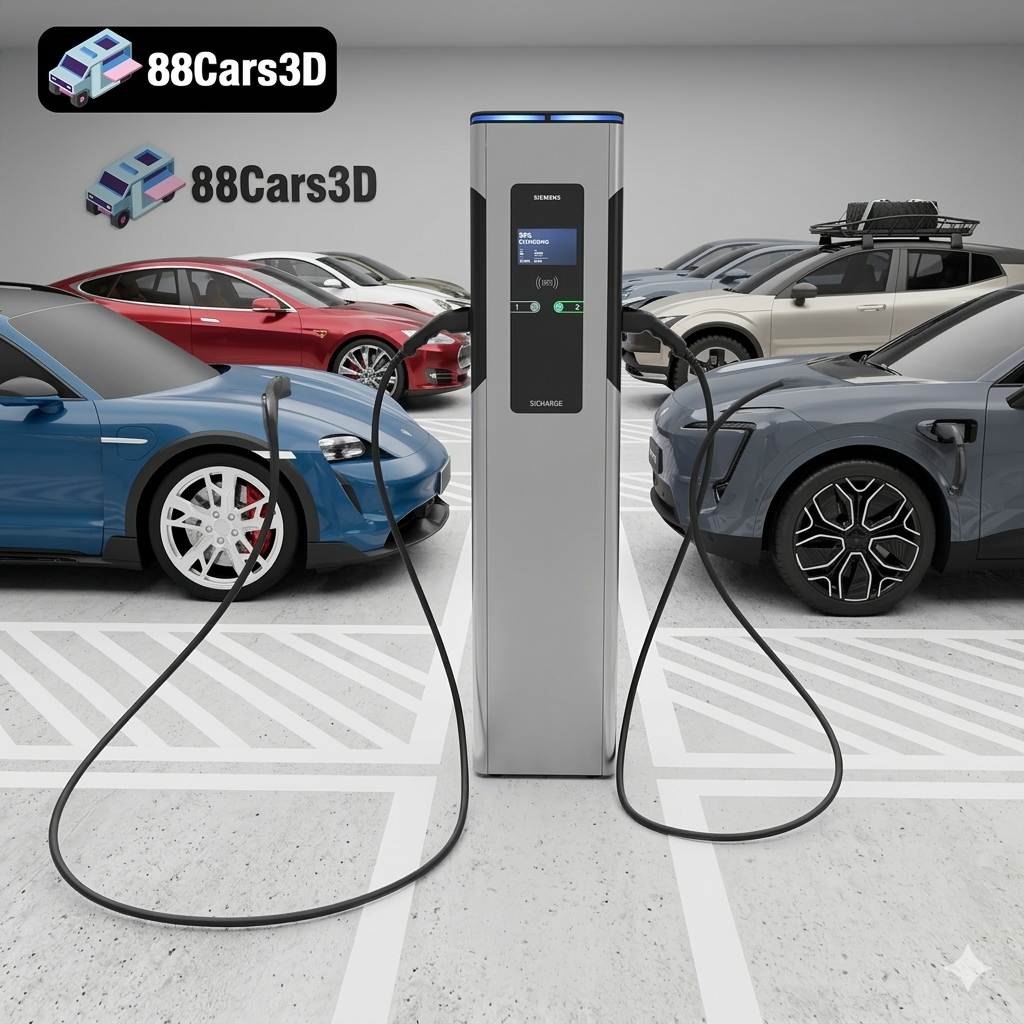
Download the Future of Mobility EV 3D Models Bundle. Includes the Volvo EX30, Tesla Model S, AVATR 11, Porsche Taycan, and a Siemens EV Charger. Save big on this highly optimized 5-in-1 pack for ArchViz and game development!
Price: $89.99

