⚡ FLASH SALE: Get 60% OFF All Premium 3D & STL Models! ⚡

In the vibrant world of automotive design, few concepts ignite as much passion as the “restomod.” It’s where the timeless aesthetic of a classic car meets the cutting-edge performance and technology of the modern era. This fusion creates vehicles that are both nostalgic and exhilaratingly contemporary. When translated into the realm of 3D modeling, this philosophy opens up incredible possibilities for artists, designers, and enthusiasts alike.
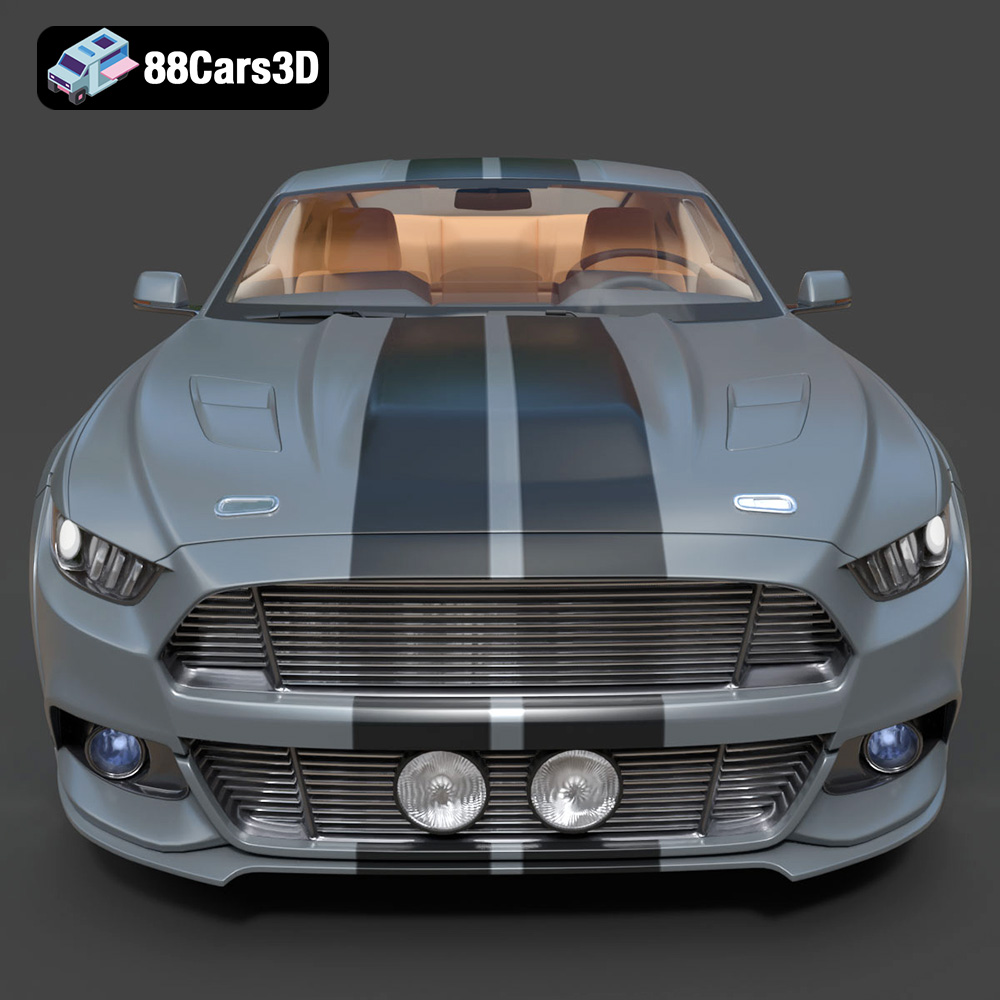
The allure of a classic silhouette, re-engineered for today’s roads, is undeniable. But what if you could visualize that perfect blend of past and present without ever lifting a wrench? That’s precisely the power of high-fidelity 3D car models. They allow for an unparalleled level of exploration, from conceptual design to photo-realistic visualization. Today, we delve into a remarkable example of this digital craftsmanship: the Ford Mustang Eleanor 2015 Custom 3D Model. This extraordinary asset takes the fierce persona of the legendary 1967 Shelby GT500 “Eleanor” and seamlessly integrates it onto the aggressive lines of the modern S550 (2015) Ford Mustang. It’s a testament to the meticulous detail and creative vision available to those working with premium 3D assets, ready for everything from stunning automotive rendering to being a foundational piece for detailed game assets.
When working with professional-grade 3D car models, selecting the correct file format is crucial for workflow efficiency, compatibility, and achieving optimal results. Each format serves specific purposes, catering to different stages of production, software environments, and end-use applications. Understanding these distinctions ensures you maximize the utility of assets like the Ford Mustang Eleanor 2015 Custom 3D Model, which comes equipped with a comprehensive suite of options.
The .blend format is the native file type for Blender, the popular open-source 3D creation suite. When you download a .blend file, you’re getting a fully editable Blender scene. This includes not just the mesh geometry but also materials, textures, lighting, cameras, animation data, and even modifiers. It’s ideal for Blender users who want to dive straight into a project with all elements pre-configured. For the Ford Mustang Eleanor 2015 Custom 3D Model, the .blend file provides a ready-to-render setup, allowing for immediate scene manipulation, material adjustments, or animation integration within Blender.
.fbx (Filmbox) is a proprietary file format owned by Autodesk, widely recognized as the industry standard for 3D data exchange between different software applications. Its strength lies in its ability to store a broad range of 3D data, including models, materials (often with texture references), animations, skeletal rigs, and scene hierarchies. The .fbx format is particularly ideal for transferring assets into game engines like Unreal Engine and Unity, or between DCC (Digital Content Creation) tools such as Maya, 3ds Max, and Cinema 4D. For real-time pipelines, .fbx ensures that crucial data like pivot points for animation (e.g., wheels and doors on the Mustang) are preserved, making it an excellent choice for a hero asset like our featured Mustang.
The .obj (Wavefront OBJ) format is one of the oldest and most universally compatible 3D file formats. It primarily stores geometry data – vertices, normals, UV coordinates, and faces – and can reference external material (.mtl) files for color and basic texture information. While it doesn’t support animation or rigging, its simplicity and widespread support make it perfect for cross-software compatibility. If you need to import the Ford Mustang Eleanor into a less common 3D application or prefer to rebuild materials from scratch, .obj is a reliable foundation.
.glb (GLB format for glTF) is an increasingly popular, relatively new format designed for efficient transmission and loading of 3D scenes and models by engines and applications. It’s the binary version of glTF (GL Transmission Format), embodying a “runtime asset delivery” philosophy. .glb packages all necessary data (geometry, textures, animations) into a single file, making it highly optimized for web-based 3D viewers, Augmented Reality (AR), and Virtual Reality (VR) applications. For showcasing the Ford Mustang Eleanor 2015 in an interactive web viewer or an AR experience, .glb offers an excellent balance of fidelity and performance.
.stl (STereoLithography) is the de facto standard file format for 3D printing. It represents a 3D model as a collection of unconnected triangular facets, defining only the surface geometry of an object without color, texture, or other model attributes. While basic, its ubiquity in the 3D printing world is unmatched. The Ford Mustang Eleanor 2015 Custom 3D Model’s .stl variant is manifold and ready for slicing, providing a robust base for creating highly detailed physical replicas, as outlined in its 3D print settings.
.ply (Polygon File Format or Stanford Triangle Format) is a file format for storing 3D data, particularly from 3D scanners. It supports various properties such as color, transparency, surface normals, and range data, and can store both polygonal meshes and point clouds. While less common for artistic exchange than .fbx or .obj, it’s a precision mesh format often used in CAD, scientific visualization, or scenarios where accurate geometrical data beyond basic vertices and faces is crucial. For detailed analytical work or specific industrial applications, the .ply version of the Mustang offers robust data.
The .unreal format, or more accurately, assets packaged for Unreal Engine, typically refers to a model that has been specifically prepared and optimized for import into an Unreal Engine project. This often means the geometry, materials, and textures are pre-configured to work within Unreal’s rendering pipeline. While not a standalone file type in the same way .fbx is, having a designated “.unreal” offering from 88cars3d.com implies that the model has undergone specific preparation, potentially including proper scaling, material setup, and even collision mesh generation, to make integration into Unreal Engine as smooth as possible for real-time environments.
Finally, the .max format is the native scene file for Autodesk 3ds Max, a powerful 3D modeling, animation, rendering, and compositing software. Similar to .blend, a .max file encapsulates the entire scene, including geometry, lights, cameras, materials, animations, and render settings. It’s the definitive file for 3ds Max users, offering full editability and access to all parameters of the Ford Mustang Eleanor 2015 Custom 3D Model within its native environment. This is invaluable for high-end cinematic rendering and complex animation tasks where the full power of 3ds Max is leveraged.
Having this diverse array of formats ensures that no matter your software of choice or your project’s final destination, the Ford Mustang Eleanor 2015 Custom 3D Model from 88cars3d.com can seamlessly integrate into your workflow.
The essence of a truly exceptional 3D car model lies not just in its visual appeal but in its underlying technical craftsmanship. The Ford Mustang Eleanor 2015 Custom 3D Model stands out as a premium asset, engineered for maximum fidelity and versatility. This is a model built from the ground up to withstand the scrutiny of extreme close-ups and cinematic rendering.
At the heart of this model’s superiority is its high-poly topology. Boasting 1,215,603 Vertices, 2,661,934 Edges, and 1,539,630 Faces/Triangles, this asset is a powerhouse of detail. This dense mesh structure is critical for achieving photorealistic results, especially in areas with complex curves, sharp edges, and intricate cutouts. Unlike lower-poly models that rely heavily on normal maps to simulate detail, this Eleanor Mustang delivers true geometric fidelity. This means no visible faceting on curved surfaces, perfectly smooth reflections, and robust performance under various lighting conditions, crucial for any demanding automotive rendering project. The organized mesh structure ensures that even with over 1.5 million triangles, the model remains clean and manageable, preventing common issues like pinching or artifacting during rendering.
The challenge of creating a restomod in 3D is blending two distinct design languages seamlessly. This model executes it flawlessly. The base proportions of the modern S550 Mustang are accurately captured, providing a solid foundation. Onto this, the iconic Eleanor body kit elements are integrated with precision: the aggressive front fascia with custom grilles and center-mounted driving lights, the massive custom hood bulge, quarter window louvers, the prominent ducktail rear spoiler, and the unmistakable side-exit exhaust system. Each element is modeled with an obsessive eye for detail, replicating the aggressive stance and powerful presence of the legendary film car onto a contemporary chassis. Even the deep-dish custom alloy wheels wrapped in wide performance tires contribute to this authentic, powerful look.
Beyond the stunning exterior, the interior of the Ford Mustang Eleanor 2015 Custom 3D Model maintains the same high standard of detail. It features an authentic modern 2015 Mustang driver-centric cabin layout, including the classic dual-cowl dashboard, center infotainment screen, sporty multi-function steering wheel, and a detailed center console. Seating geometry is rendered with accurate stitching and contour mapping, making it suitable for high-resolution interior close-up renders. Furthermore, the model is intelligently structured with separate wheels, steering components, and doors. This crucial detail allows for easy animation and rigging, essential for creating dynamic shots in cinematics or interactive experiences where doors open, and wheels turn precisely on their pivots.
High-quality 3D car models like the Ford Mustang Eleanor 2015 Custom are more than just pretty pictures; they are fundamental building blocks for diverse professional applications. From marketing and entertainment to product development and education, these assets empower creators to achieve stunning results efficiently. The comprehensive features of this Mustang model make it a versatile tool across multiple industries.
For film, television, and high-end advertising, visual fidelity is paramount. The Ford Mustang Eleanor 2015 Custom 3D Model, with its 1.53 million triangles and impeccable topology, is perfectly suited as a “hero” vehicle. In automotive commercials, this model can be placed in impossible scenarios, showcasing its dynamic lines and aggressive features with cinematic flair. Imagine the Eleanor tearing through a futuristic city, or artfully displayed in a dramatic studio lighting setup for a luxury brand showcase. Its premium detail eliminates the need for complex displacement maps or post-processing tricks to achieve realism, allowing artists to focus on lighting, camera work, and storytelling. The separate animated components (doors, wheels, steering) facilitate complex rigging for dynamic sequences, making it an invaluable asset for any production studio.
While the Ford Mustang Eleanor 2015 Custom 3D Model is a premium, high-poly asset, its application in real-time environments like game development, AR, and VR requires a nuanced approach. At 1.53 million triangles, it’s designed for maximum visual impact, making it ideal as a “hero” vehicle for close-up shots, in-engine cinematics, or as a static display model within a detailed virtual showroom. For use as a drivable vehicle in standard game engines where performance budgets are tighter, the model serves as an excellent high-resolution source for **retopology, LOD (Level of Detail) generation, or decimation**. This process involves creating lower-polygon versions of the model that retain key visual features but are optimized for real-time performance, allowing the high-poly original to inform multiple lower-res versions for varying distances from the camera. This ensures that even in interactive experiences, the spirit and detail of the Eleanor are preserved.
Beyond the digital realm, the detailed geometry of this 3D model translates beautifully into the physical world through 3D printing. Its clean, manifold topology (as indicated by the included .stl file) is an excellent base for creating highly detailed, large-scale custom diecast hobbyist prints or even small-scale prototypes. The provided 3D print settings – recommending resin printing for fine details, specific layer heights, wall thickness, infill, and support placement – guide users toward achieving optimal physical results. This capability allows designers to move from digital concept to tangible object, perfect for creating collectible models, design showcases, or even functional prototypes for custom parts before manufacturing.
The ultimate goal for many leveraging 3D car models is to produce breathtaking visualizations. The Ford Mustang Eleanor 2015 Custom 3D Model provides a perfect canvas for exploring advanced rendering techniques across various software platforms, enabling artists to create compelling imagery for marketing, design reviews, or personal portfolios.
For users of Autodesk 3ds Max, the included .max file offers an immediate head start. The model’s premium topology and proper pivot setups mean less time cleaning and more time rendering. With powerful renderers like V-Ray or Corona Renderer, artists can create physically accurate lighting environments. Begin by importing the .max file. For materials, leverage 3ds Max’s Slate Material Editor to refine shaders. Car paint materials, in particular, benefit from complex layered shaders that simulate metallic flakes, clear coat reflections, and subtle imperfections. HDRI (High Dynamic Range Image) lighting is essential for realistic reflections and global illumination, mimicking real-world environments. Setting up dynamic cameras with depth of field and motion blur will enhance the sense of speed and drama, perfect for showcasing the Eleanor’s aggressive stance in high-octane automotive commercials or studio shots. The separated parts also allow for quick integration into larger scene builds or even simple animation sequences within Max.
Blender users can take advantage of the native .blend file, which should come with pre-configured materials and potentially a basic lighting setup. For ultimate realism, Blender’s Cycles renderer is the go-to. It’s a physically based path tracer, capable of producing stunningly lifelike renders. Artists can refine the existing materials or create new ones using Blender’s node editor, focusing on realistic car paint, glass, rubber, and chrome shaders. Employing a large studio HDRi or building a custom lighting setup with area lights and environmental textures will dramatically impact the final look. For faster, real-time feedback and even impressive final renders, Blender’s Eevee renderer is an excellent option. While not a path tracer, Eevee can produce highly convincing results with proper material setup and screen-space reflections, making it perfect for quick iterations or even some stylized visualization projects.
While the Ford Mustang Eleanor 2015 Custom 3D Model is high-poly, its “hero asset” status makes it perfect for high-fidelity real-time presentations within Unreal Engine. The provided .fbx or .unreal formats streamline the import process. Once in Unreal, artists can set up exquisite lighting using Lumen (for global illumination and reflections), virtual shadow maps, and custom light sources. Unreal’s material editor, with its node-based workflow, allows for the creation of sophisticated car paint shaders that react realistically to light, enabling stunning real-time visualizations for virtual showrooms, AR/VR experiences, or even short film sequences. For interactive elements, Blueprint visual scripting can be used to animate doors, steering, or even change paint colors on the fly, offering an engaging way to showcase the vehicle’s features. Even if full drivability requires optimization, its high detail is invaluable for marketing renders or in-engine cutscenes, bringing an unprecedented level of realism to real-time applications.
The journey of a 3D car model doesn’t always end with a rendered image or a game asset. For enthusiasts, designers, and hobbyists, the ability to manifest a digital creation into a physical object is incredibly rewarding. The Ford Mustang Eleanor 2015 Custom 3D Model is meticulously prepared for this transition, offering a robust foundation for high-quality 3D prints.
The inclusion of the .stl file format is key for 3D printing. This format strips away textures, materials, and other rendering-specific data, leaving behind a pure, manifold mesh that defines the surface of the object. This simplicity is precisely what 3D printers understand. The Eleanor Mustang’s geometry is clean and watertight, ensuring that the slicing software can correctly interpret the model without errors, which is a common hurdle with poorly constructed models. This means less time fixing and more time printing, whether you’re creating a desktop display model or a larger-scale prototype.
Successfully 3D printing a detailed automotive model requires attention to specific settings, and the provided recommendations for the Eleanor Mustang are invaluable. A recommended scale of 1:24 / 1:18 / 1:12 ensures that intricate details like the custom grille, quarter window louvers, and side exhaust pipes are faithfully reproduced. The suggestion for resin printing (SLA/DLP) with a layer height of 0.04–0.12 mm is crucial. FDM printers, while versatile, struggle with the minute details and smooth finishes required for such a complex car body. Resin printers offer superior resolution, capturing the fine curves and sharp edges with precision. Furthermore, guidance on wall thickness (1.2–2.0 mm), infill (15–25%), and specific support placements (side mirrors, window louvers, side exhausts, ducktail spoiler) are critical for preventing structural failure and ensuring a clean print. Printing the body angled and wheels separately is a veteran trick to maximize surface quality and minimize visible layer lines.
Once printed, the physical model enters the realm of traditional modeling and finishing. Post-processing is where the iconic Eleanor comes to life. Recommendations for sanding, priming, and applying the signature Pepper Gray Metallic paint with classic gloss black racing stripes guide hobbyists through achieving an authentic finish. This iterative process, moving from digital design to physical fabrication and then to hand-finishing, highlights the comprehensive value of a well-engineered 3D model. It bridges the gap between digital artistry and tangible craftsmanship, allowing enthusiasts to hold a piece of cinematic legend in their hands.
One of the most compelling aspects of working with high-quality 3D car models is the immense potential for customization. A premium asset like the Ford Mustang Eleanor 2015 Custom 3D Model is not just a static representation; it’s a dynamic platform for creative exploration, allowing designers and artists to adapt it to an endless array of scenarios and visions.
The ability to change exterior paint colors is a fundamental customization. While the Pepper Gray with black stripes is iconic, imagining the “Eleanor” in different variations—perhaps a stealthy Black with Silver stripes, a vibrant Red with White stripes, or even a deep metallic Blue—can breathe new life into renders and visualizations. This is easily achieved by modifying the material shaders within your chosen 3D software (3ds Max, Blender, Unreal, etc.). Beyond paint, the recommendation to modify the wheel setup opens up a world of possibilities. Swapping the retro-modern deep-dish alloys for sleek, modern track-focused forged wheels or even chunky off-road tires can drastically alter the car’s character, transforming it from a street bruiser to a track demon or a post-apocalyptic cruiser, all with a few clicks. This adaptability makes the model incredibly valuable for showcasing different design philosophies or exploring client briefs.
The model’s high fidelity means it responds beautifully to various lighting conditions, making it adaptable to different environmental contexts. Dramatic, moody garage environments with focused spotlights can emphasize its aggressive lines and powerful presence, ideal for revealing its raw muscle car spirit. Conversely, bright, sunny canyon carving runs, complete with dynamic motion blur and vibrant reflections, can showcase its performance aesthetics. By adjusting HDRI maps, light sources, and atmospheric effects, artists can instantly transport the Eleanor to different locales and moods, telling a new story with each render. This flexibility is essential for creating diverse marketing collateral, concept art, or portfolio pieces without needing to remodel the vehicle for each scenario.
For advanced users, the Ford Mustang Eleanor 2015 Custom 3D Model serves as an exceptional foundation for further design and “modding.” Its clean, dense topology means it’s ready for subtle adjustments or even significant overhauls. Want to experiment with a widebody kit that pushes the boundaries even further? Or perhaps integrate custom aerodynamic elements? The robust base mesh can handle these modifications without breaking down, providing a solid starting point for conceptual designers. This makes it an ideal asset for studios looking to quickly iterate on custom automotive designs or for artists wanting to practice their vehicle modification skills without starting from scratch. Whether it’s adding a supercharger intake, redesigning the headlights, or even integrating a futuristic interior, the model offers the structural integrity and detail necessary to support complex artistic endeavors.
The Ford Mustang Eleanor 2015 Custom 3D Model represents the pinnacle of digital automotive artistry, masterfully blending iconic classic design with modern muscle car aesthetics. We’ve explored how its uncompromising high-poly topology, meticulous detail, and thoughtful structuring make it a powerhouse asset for a wide range of professional applications. From producing breathtaking automotive rendering for cinematic productions and high-end marketing, to serving as a robust base for game assets (with appropriate optimization), and even providing a perfect blueprint for detailed 3D printing, this model is built for excellence.
Understanding the nuances of various file formats like .blend, .fbx, .obj, .glb, .stl, .ply, .unreal, and .max is key to unlocking its full potential, ensuring seamless integration into any workflow, whether you’re using 3ds Max, Blender, or Unreal Engine. The flexibility for customization, from paint schemes to wheel setups and environmental lighting, empowers creators to tell diverse stories and explore countless design variations.
For those seeking to elevate their projects with a truly exceptional 3D car model that embodies both raw power and refined detail, the Ford Mustang Eleanor 2015 Custom 3D Model available at 88cars3d.com is an indispensable resource. It’s more than just a model; it’s an opportunity to own a piece of digital automotive legend, ready to be driven into your next masterpiece.
The Ford Mustang Eleanor 2015 3D Model is a breathtaking digital fusion of modern muscle and legendary cinematic history. This custom build imagines the iconic 1967 Shelby GT500 “Eleanor” aesthetic—made famous by the blockbuster film Gone in 60 Seconds—seamlessly integrated onto the modern S550 (2015) Ford Mustang platform. Built with incredibly dense, uncompromising topology (over 1.5 million triangles), it provides maximum visual fidelity for extreme close-up rendering, cinematic automotive visualization, and high-end 3D printing.
$59.00