⚡ FLASH SALE: Get 60% OFF All Premium 3D & STL Models! ⚡

The automotive industry is in a constant state of innovation, not just in vehicle design but also in how we visualize, interact with, and experience cars. Real-time rendering, powered by engines like Unreal Engine, has revolutionized everything from design reviews and marketing to interactive showrooms and immersive games. However, bringing the breathtaking fidelity of a photorealistic 3D car model – often composed of millions of polygons and intricate material networks – to the resource-constrained environment of mobile devices presents a unique and formidable challenge.
At 88cars3d.com, we understand the demand for top-tier automotive assets that not only look stunning but are also production-ready for diverse platforms. Our high-quality 3D car models are crafted with clean topology, realistic PBR materials, and efficient UV mapping, making them ideal starting points for any project. This article dives deep into the art and science of optimizing these sophisticated assets and your Unreal Engine projects to deliver captivating, high-performance automotive experiences specifically for mobile games and applications. We’ll explore critical workflows, technical specifications, and best practices to ensure your virtual vehicles run smoothly on the go, bridging the gap between desktop-grade visuals and mobile device capabilities.
Embarking on a mobile Unreal Engine project with complex automotive assets requires a strategic approach from the very beginning. Proper project setup and foundational configurations lay the groundwork for efficient development and optimal performance. This isn’t just about tweaking settings later; it’s about establishing an optimized pipeline from day one. Understanding Unreal Engine’s mobile rendering path and its limitations is paramount to making informed decisions that prevent costly reworks down the line.
Setting up Unreal Engine for mobile is more than just selecting a target platform. It involves configuring rendering features, build settings, and ensuring compatibility. Navigate to **Project Settings > Platforms > Android** (or iOS) to set up your SDK, NDK, and JDK paths. Crucially, under **Project Settings > Rendering**, you’ll want to review and disable many features that are typically enabled for high-end desktop rendering, such as Lumen, Nanite (for direct mobile rendering), Hardware Ray Tracing, and certain post-processing effects. Mobile devices often rely on Forward Shading rather than Deferred Shading for performance gains, especially on older hardware. It’s also important to enable **Mobile HDR** if you need high dynamic range rendering on supported devices, but be mindful of the performance cost. Regularly test on target devices to catch performance issues early.
The quality of your source assets directly impacts your optimization efforts. When sourcing automotive assets from marketplaces such as 88cars3d.com, you acquire models specifically designed for high fidelity, featuring clean topology and PBR materials. For mobile, the first step involves drastically reducing the polygon count of these models. Aim for a target range that’s feasible for mobile: for a hero car, perhaps 50,000-150,000 triangles, with surrounding vehicles or background elements much lower (5,000-20,000). Use 3D modeling software to decimate meshes, paying close attention to silhouette and critical details. Ensure your model’s UVs are clean and non-overlapping, as this is crucial for texture efficiency and baking lightmaps. Unreal Engine’s Static Mesh Editor provides tools for quickly checking poly count and UV channels.
Mobile rendering in Unreal Engine operates under strict constraints compared to desktop. Features like Nanite, while transformative for high-poly meshes, are not directly available for mobile platforms (though they can inform asset pipelines for lower-poly versions). Similarly, Lumen and Hardware Ray Tracing are typically unsupported. Mobile rendering often relies on simplified lighting models, forward rendering paths, and a more limited set of post-processing effects. Understanding these limitations means embracing techniques like baked lighting, carefully managed draw calls, efficient material graphs, and aggressive texture compression. Always target the lowest common denominator device you plan to support, then scale up. This “mobile-first” mindset ensures your core experience is performant before considering enhancements for higher-end devices.
Optimizing 3D car models for mobile isn’t just about reducing polygons; it’s about intelligent asset management. Every vertex, every texture pixel, and every material instruction contributes to the final performance. For high-fidelity automotive assets, this means meticulously planning how geometry is simplified, how textures are managed, and how materials are constructed to strike the perfect balance between visual quality and mobile performance.
Level of Detail (LOD) is an indispensable tool for optimizing automotive models in Unreal Engine for mobile. It allows you to swap out high-polygon meshes for lower-polygon versions as the camera moves away, drastically reducing the rendering burden. For a detailed car model, generate at least 3-5 LOD levels. Your highest LOD0 might be 80,000-150,000 triangles for a hero car, but LOD1 could drop to 40,000, LOD2 to 15,000, LOD3 to 5,000, and LOD4 (for distant cars) potentially below 1,000. Use Unreal Engine’s built-in Automatic LOD Generation, but always refine it manually in the Static Mesh Editor. Focus on preserving the car’s silhouette and key features at lower LODs. For internal components or areas never seen, they can be entirely removed at higher LODs. This process requires careful balancing to avoid noticeable pop-in or visual degradation, ensuring a smooth transition between levels.
While Nanite, Unreal Engine’s virtualized geometry system, fundamentally transforms how high-poly meshes are handled, it is *not* currently supported on mobile platforms for direct rendering. Nanite’s strength lies in rendering incredibly dense meshes efficiently on desktop and console. However, this doesn’t mean it’s irrelevant for mobile workflows. Many high-fidelity car models, such as those found on 88cars3d.com, are often created with Nanite-level detail in mind. For mobile, these detailed source models become the *ideal starting point* for generating highly optimized LODs. Instead of building low-poly from scratch, you can use the exquisite detail of a Nanite-ready mesh to bake normal maps, ambient occlusion, and other texture data onto your mobile-optimized, lower-polygon meshes. This workflow leverages the artistic detail of high-poly assets while delivering mobile-friendly performance.
Textures are often the largest contributors to memory usage and loading times on mobile. For automotive models, which rely heavily on high-resolution PBR textures (Albedo, Normal, Roughness, Metallic, Ambient Occlusion), aggressive compression is vital. In Unreal Engine, set texture group to “UI” or “2D Pixels (Uncompressed)” for UI elements, but for most game textures, use appropriate compression settings. For mobile, consider using **ASTC (Adaptive Scalable Texture Compression)** for Android and **PVRTC (PowerVR Texture Compression)** or **ETC2** for broader compatibility. These formats offer excellent quality-to-size ratios. Downscale texture resolutions where possible; a 2K texture might be sufficient for a hero car, while 1K or even 512px might suffice for less prominent parts or background vehicles. Within materials, simplify complex shader networks. Avoid too many expensive operations like procedural noises, extensive masked materials, or multiple clear coat layers if they aren’t absolutely critical. Use Material Instances to share parameters and reduce shader permutations, and ensure textures are packed into fewer maps (e.g., RGB for Metallic, Roughness, AO) to save on texture fetches. More detailed guidelines can be found on the official Unreal Engine documentation for mobile optimization: https://dev.epicgames.com/community/unreal-engine/learning.
Achieving compelling visuals for 3D car models on mobile devices demands a highly optimized approach to lighting and materials. While desktop rendering can leverage advanced features like Lumen for global illumination and complex shader models, mobile requires a strategic blend of simplicity and clever tricks to convey realism without sacrificing performance.
Physically Based Rendering (PBR) is fundamental to achieving realistic materials in Unreal Engine. For mobile, the core principles remain, but the implementation needs to be streamlined. When creating PBR materials for your automotive models, simplify your material graphs as much as possible. Each instruction in a material shader contributes to the rendering cost. Avoid redundant calculations, use static switches to toggle features, and leverage Material Functions for reusable, optimized chunks of logic. For clear coat effects, which are crucial for car paint, opt for simplified clear coat shaders or blend normal maps for a faux clear coat effect if performance is tight, rather than fully simulating complex reflection models. Always ensure your texture inputs are correctly formatted and compressed. Packing multiple grayscale textures (like Metallic, Roughness, AO) into separate channels of a single RGB texture can significantly reduce texture fetches, improving performance.
Unlike high-end desktop rendering that often relies on dynamic global illumination systems like Lumen, mobile platforms heavily favor baked lighting for performance. **Lightmass**, Unreal Engine’s static global illumination solution, is your best friend here. By pre-calculating lighting and shadows into lightmaps, you eliminate the runtime cost of complex light bounces and shadow calculations. This approach is ideal for static environments around your car models, providing rich, realistic illumination and ambient occlusion at virtually no runtime cost. For dynamic elements, like the car itself, you’ll typically use simple movable lights with forward shading, where each light applies its influence directly to the pixel being shaded. For environments, utilize directional light for the sun, a skylight for ambient contribution (often with a low-resolution cubemap), and then bake static point/spot lights. Be mindful of the number of dynamic lights hitting a mesh, as this can quickly become a performance bottleneck on mobile.
Realistic reflections are paramount for automotive visualization, highlighting the curves and finishes of a car model. On mobile, generating real-time reflections can be incredibly expensive. **Reflection Captures** (Sphere and Box) are the standard for static reflections. Place these strategically around your scene to capture the environment and project it onto reflective surfaces. For more dynamic, but still optimized, reflections, consider **Screen Space Reflections (SSR)** with careful settings – reduce resolution and fidelity to meet performance targets. Real-time Planar Reflections are generally too expensive for mobile, save for highly controlled, small surfaces. For post-processing, mobile devices have limited headroom. Disable or simplify effects like Bloom, Ambient Occlusion (unless baked), Depth of Field, and Anti-Aliasing (FXAA is usually the most performant option, but often still resource-intensive). Use a minimal set of post-processing effects, focusing on those that deliver the most visual impact without crippling performance. Experiment and profile constantly to find the sweet spot for your target devices.
Real-time automotive experiences go beyond just visual fidelity; they thrive on interactivity. Whether it’s an interactive car configurator, a driving simulator, or a mobile game, robust scripting and efficient physics are crucial. For mobile platforms, every line of Blueprint or C++ code, and every physics calculation, must be meticulously optimized to avoid performance bottlenecks.
Unreal Engine’s Blueprint visual scripting system is a powerful tool for creating interactive automotive experiences without writing C++ code. For mobile, the key is to design lightweight and efficient Blueprint logic. When developing interactive car configurators, for example, ensure that changing car parts (wheels, colors, interior trims) only loads and unloads necessary assets, and material parameter changes are handled efficiently via Material Instances. Instead of constantly spawning and destroying actors, consider swapping visibility or enabling/disabling components. Avoid Tick-based events where possible, or if necessary, throttle their execution frequency. Use event-driven logic and delegators to trigger actions only when needed. For UI elements, which often use UMG (Unreal Motion Graphics), keep the widget hierarchy shallow and avoid complex animations or constantly updating text fields, as these can incur significant overhead on mobile CPUs.
Implementing realistic vehicle physics is central to many automotive games and simulations. Unreal Engine provides a robust physics engine, but for mobile, it requires careful optimization. The **Chaos Vehicle Physics** system in Unreal Engine 5 offers advanced capabilities, but for mobile, consider simplifying the complexity of your vehicle’s physics setup. Reduce the number of collision primitives on your car and environment meshes. For less critical parts or props, consider using simpler collision shapes (boxes, capsules) rather than complex mesh colliders. Adjust physics sub-stepping settings and overall physics fidelity in **Project Settings > Physics** to find a balance between realism and performance. If a full physics simulation is too heavy, consider using animation-driven movement with simplified collision, or a more arcade-style physics model that is less CPU-intensive. For vehicle dynamics, prioritize gameplay feel over absolute scientific accuracy, especially if it means better frame rates on mobile devices.
User Interface (UI) and User Experience (UX) are critical for mobile applications, and poorly optimized UIs can significantly impact performance. For automotive configurators or games, the UI needs to be responsive and intuitive for touch input. Design your UMG widgets with mobile screen sizes and aspect ratios in mind. Use scalable canvas panels and anchors to ensure UI elements adapt correctly across various devices. Reduce the number of draw calls generated by your UI by consolidating textures into atlases and minimizing overdraw. Avoid using numerous transparent UI elements layered on top of each other. For touch input, implement efficient event handling – avoid polling for touch input on every frame if an event-based approach is sufficient. Ensure touch zones are generously sized for easy interaction. For smoother transitions or animations within the UI, pre-calculate values where possible rather than relying on complex runtime calculations, and utilize Unreal Engine’s built-in animation system within UMG for efficient animated elements.
After foundational setup, asset management, and interactive scripting, advanced optimization techniques and careful deployment strategies are crucial for pushing mobile automotive experiences to their limits. This involves rigorous profiling, making tough decisions on feature sets, and understanding platform-specific considerations for AR/VR and future mobile applications.
Optimization is an iterative process driven by data. Unreal Engine provides powerful tools for profiling your mobile application. Use the **Session Frontend** (under **Window > Developer Tools**) to connect to your running mobile game and analyze CPU and GPU performance. Focus on the **Stat commands** (e.g., `stat fps`, `stat unit`, `stat rhi`, `stat gpu`, `stat game`) to identify bottlenecks. `stat gpu` is invaluable for understanding GPU timings, drawing attention to expensive passes like post-processing, material complexity, or overdraw. `stat game` helps diagnose CPU-bound issues, often related to Blueprint logic, physics, or AI. Pay close attention to **draw calls** and **triangles rendered**, as these are critical mobile performance indicators. Profile on a range of target devices, not just the latest flagship, to get a realistic view of performance across your intended user base. Debugging memory usage is also essential, especially for large automotive environments and numerous vehicle models; use tools like the **Memory Report** or `obj list` console command.
Achieving optimal performance on mobile often means making pragmatic decisions about visual features. Unreal Engine’s **Scalability Settings** (accessible via the `sg.` console commands or built-in UI) are excellent for dynamically adjusting quality levels. Create custom scalability profiles for mobile that target different device tiers. For example, a “High” profile for newer devices might enable some post-processing and higher texture resolutions, while a “Low” profile might disable most post-effects, use lower LODs, and simplify materials. Beyond scalability, implement **feature toggles** directly in your Blueprints or C++ code. This allows you to enable or disable specific functionalities (e.g., advanced reflections on car paint, intricate particle effects, dynamic shadows) based on device performance or user preference. This approach ensures a playable experience across a wider range of devices, while still offering enhanced visuals for those with more powerful hardware. For example, a custom Blueprint system could check device specs on startup and adjust settings accordingly.
Mobile platforms are increasingly becoming hubs for Augmented Reality (AR) and Virtual Reality (VR) experiences, including automotive applications. Optimizing for AR/VR introduces additional complexities: maintaining a stable 60-90+ FPS is paramount to prevent motion sickness, and rendering for two eyes (stereoscopic rendering) incurs a significant performance cost. When building AR/VR automotive experiences with Unreal Engine, all the optimization techniques discussed earlier are even more critical. Prioritize highly optimized 3D car models, aggressive LODs, baked lighting, and streamlined materials. For AR, ensure your virtual car models integrate seamlessly with the real world, meaning careful consideration of scale, lighting matching, and shadow projection. The **OpenXR** plugin in Unreal Engine provides a unified framework for AR/VR development. Future mobile automotive applications will likely leverage advancements in on-device AI for even more personalized and context-aware experiences, but the fundamental need for efficient rendering and asset management will remain central.
Beyond interactive experiences, 3D car models are frequently used for cinematic trailers, marketing visualizations, and virtual production. While the performance constraints differ from real-time mobile games, an efficient asset pipeline and smart content creation workflows ensure that high-quality automotive assets, like those from 88cars3d.com, can be repurposed and scaled effectively for various outputs, including pre-rendered mobile video content.
Unreal Engine’s **Sequencer** is a powerful, non-linear editor for creating stunning cinematic content. For automotive visualization, Sequencer allows artists to choreograph camera movements, animate vehicles (e.g., doors opening, wheels turning, lights activating), and control complex material parameters over time. While the final output for mobile might be a pre-rendered video, efficient use of Sequencer can still impact iteration times and rendering stability. Utilize **Takes** for organizing multiple shots, and **Binding Tracks** to animate specific components of your 3D car models. For high-fidelity renders, you can temporarily enable more demanding features like Lumen and Hardware Ray Tracing, knowing that the final output is a video file and not a real-time mobile experience. However, for in-engine cinematics intended for real-time mobile deployment (e.g., intros or cutscenes), ensure that your Sequencer animations and visual effects adhere to mobile performance guidelines, potentially by swapping to lower-detail assets or simpler effects during playback.
A well-organized project is a performant project, especially when dealing with a multitude of high-quality automotive assets. Establish clear naming conventions for meshes, materials, textures, and Blueprints. Utilize **Folder Structures** to categorize assets logically (e.g., `Content/Cars/Sedan_A/Meshes`, `Content/Materials/CarPaint`). For larger projects or teams, consider using **Source Control** systems like Perforce or Git (with Git LFS for large files) to manage changes and collaborate effectively. Use **Asset Referencing** checks (right-click on an asset > Reference Viewer) to understand dependencies and safely delete unused assets, keeping your project lean. For mobile, it’s particularly important to **migrate assets** carefully, ensuring that only necessary content is included in your mobile build. Use **Data Assets** or **Data Tables** to manage configurable elements (like car colors, wheel options) in a structured and performance-friendly way, avoiding hardcoding values in Blueprints.
When multiple artists and developers are working on an automotive project, robust collaboration practices are essential. Establish clear communication channels and agree on technical standards early on. For example, define polygon budgets for mobile-optimized car models, texture resolution guidelines, and material naming conventions. Leverage Unreal Engine’s **Editor Utility Widgets** to create custom tools that automate repetitive tasks, enforce standards, and streamline workflows, such as automatically generating LODs or checking for mobile-unfriendly material nodes. For content delivery to mobile devices, utilize Unreal Engine’s **Packaging settings** to optimize build size and performance. Package only the necessary maps and assets. Use **Asset Bundles** or **Downloadable Content (DLC)** for larger projects to allow users to download additional cars or environments on demand, reducing the initial app size. Regularly review and optimize your project’s content to ensure that every asset contributes meaningfully to the mobile experience without unnecessary overhead.
Optimizing high-fidelity 3D car models for compelling mobile experiences in Unreal Engine is a multi-faceted endeavor, demanding careful consideration at every stage of development. From meticulously preparing your source assets and crafting efficient PBR materials to leveraging baked lighting and streamlined Blueprint logic, every decision impacts the final performance and visual quality. It’s a journey of balancing stunning aesthetics with the pragmatic constraints of mobile hardware.
By embracing techniques like strategic LOD generation, aggressive texture compression, and mobile-friendly rendering paths, you can transform complex automotive models into sleek, interactive experiences that run smoothly on a wide range of devices. While features like Nanite and Lumen might power your high-end desktop visualizations, understanding their underlying principles helps you create highly optimized assets that can then be adapted for mobile.
Whether you’re building an interactive car configurator, an immersive racing game, or an AR visualization, the principles outlined here will guide you toward success. Platforms like 88cars3d.com provide an excellent foundation with their production-ready 3D car models, giving you a head start in creating exceptional real-time automotive content. The road to mobile optimization is challenging but incredibly rewarding, opening up new avenues for engaging audiences with the power of Unreal Engine.
Ready to put these optimization strategies into practice? Explore the high-quality 3D car models available at 88cars3d.com and start building your next groundbreaking mobile automotive experience today!

Texture: Yes | Material: Yes | 3D Printable: Yes. Download the Italian Thoroughbreds Bundle featuring 5 iconic 3D models: Lamborghini Huracán Performante, Ferrari 458 Italia, Lamborghini Urus, Diablo SV, and Maserati GT. Optimized for 4K rendering and 3D printing (STL included). Save 50% with this ultimate Italian vehicle collection.
Price: $199.99

Download the Elite Future Mobility Bundle featuring 4 highly optimized 3D models: Tesla Model S, Avatr 11, Li L9, and Zoox Robotaxi. Perfect for ArchViz, Smart City renders, and game dev. Optimized for Unreal Engine and Blender. Includes .fbx, .obj, and .max formats.
Price: $99

🚗 5 Iconic German Cars (BMW M4 G82, M5 CS, X3, 1 Series & Mercedes E-Class). ✅ Optimized for ArchViz: Ready for Corona & V-Ray. 💰 Save €71 with this limited-time collection! 🚀 Instant Download after purchase.
Price: $119

Download the Extreme Off-Road & Survival 3D Models Bundle! Includes the Brabus 800 Adventure, Dodge Ram Bigfoot, Spec Truck, and a Caravan. Save over €210 on this premium 4-in-1 off-grid vehicle pack for ArchViz and game development.
Price: $149.99

Download the Heavy Duty & Commercial Logistics 3D Models Bundle! Includes the Ford Sterling, Caterpillar CT680, Mercedes Citaro Bus, and Vito Van. Save over €130 on this massive, game-ready 4-in-1 industrial vehicle pack.
Price: $109.99

Download the Ultimate Custom Motorcycles 3D Models Bundle. Includes a Custom Chopper, Ducati 916 Café Fighter, Harley XR1200X, and BMW K100. Perfect premium props for luxury ArchViz garages. Save over €250 today!
Price: $159.99

Download the ultimate JDM Street Racing 3D Models Bundle! Includes the Nissan GT-R, Toyota Supra, Mazda RX-7, Lancer Evo IX, and Honda NSX. Save big on this highly optimized, game-ready 5-in-1 Japanese legend car pack.
Price: $129.99

Download the ultimate American Muscle & Cinematic Classics 3D Models Bundle! Includes the Dodge Charger ’68, Mustang Eleanor GT500, Camaro Z28 ’79, and a custom ’69 Mustang. Save over €240 on this game-ready, premium 4-in-1 pack.
Price: $149.99

Download the Everyday City Traffic 3D Models Bundle. Includes the VW Golf, Kia Picanto, Hyundai Tucson, Toyota Yaris, and a DHL Ford Transit Van. Save big on this 5-in-1 pack, perfectly optimized for realistic ArchViz streets and game traffic.
Price: $99.99
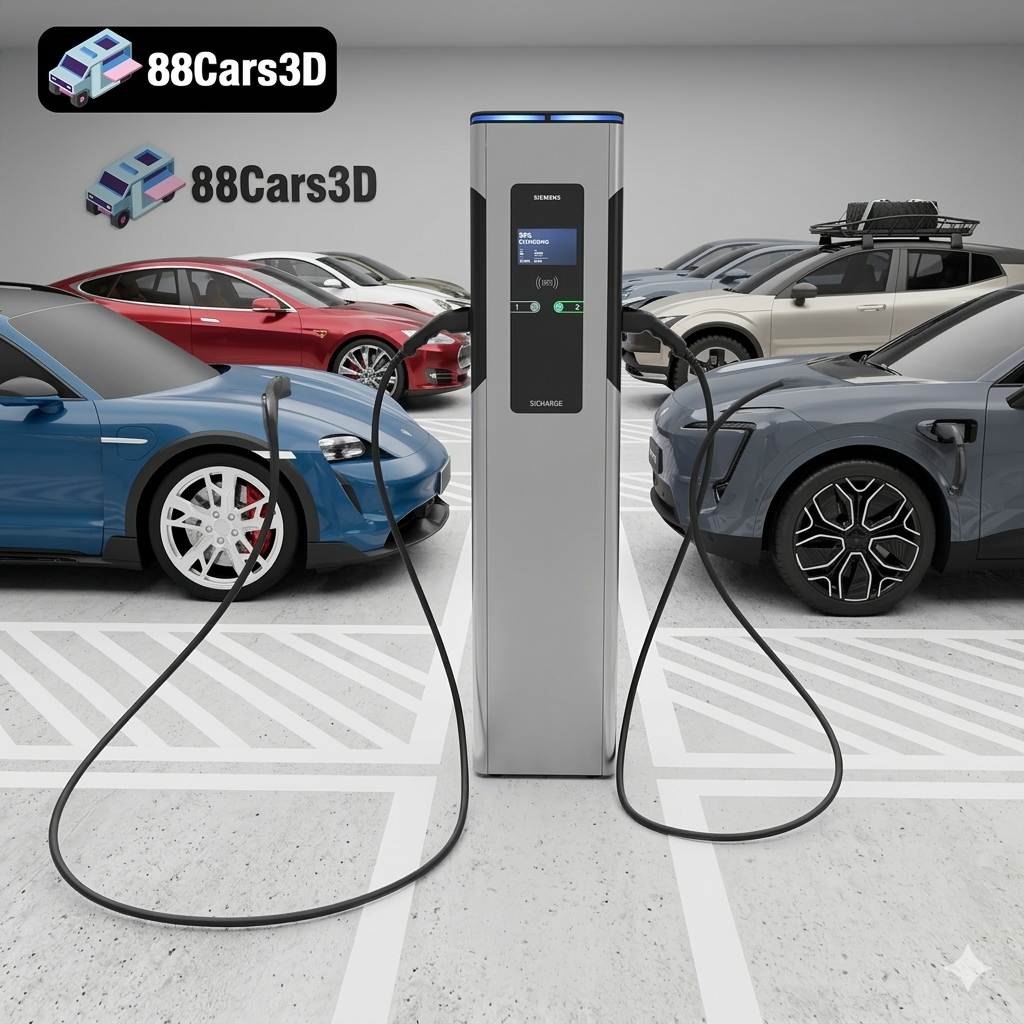
Download the Future of Mobility EV 3D Models Bundle. Includes the Volvo EX30, Tesla Model S, AVATR 11, Porsche Taycan, and a Siemens EV Charger. Save big on this highly optimized 5-in-1 pack for ArchViz and game development!
Price: $89.99

