⚡ FLASH SALE: Get 60% OFF All Premium 3D & STL Models! ⚡

“`html
The allure of bringing a detailed 3D car model to life on your 3D printer is undeniable. However, many of the most intricate and impressive automotive designs, especially those found on high-quality marketplaces like 88cars3d.com, often come as large, monolithic STL files. Attempting to print these behemoths in one piece can lead to a cascade of printing failures: warped beds, layer shifts, excessive support material, and ultimately, a frustratingly incomplete model. The solution? Strategic splitting of the model into smaller, manageable parts. This comprehensive guide will walk you through the essential techniques and considerations for successfully dissecting large 3D car models, ensuring a smoother printing workflow, better results, and the satisfaction of assembling your own automotive masterpiece. We’ll delve into file preparation, slicing strategies, software tools, and essential printing parameters to help you conquer even the most ambitious projects.
Why go through the effort of splitting a large 3D car model? The reasons are multifaceted and directly tied to the practical limitations and capabilities of most 3D printers. Large, single-piece models often exceed the build volume of common desktop printers. Even if a model fits, printing it as a whole can be a high-risk, low-reward endeavor. Consider the stresses involved: a massive print demands prolonged adhesion to the build plate. Any minor detachment or warp can ruin the entire print, wasting hours of time and valuable filament. Furthermore, complex geometries with overhangs and internal cavities necessitate extensive support structures. A single, large model can accumulate an enormous amount of support material, making removal difficult and potentially damaging the delicate details of the car. Splitting the model addresses these issues head-on.
By dividing a car model into logical components – such as the body, chassis, wheels, interior elements, and smaller accessories – you transform an insurmountable task into a series of achievable prints. This approach allows for optimized print orientation for each individual part, minimizing the need for supports and maximizing surface quality. It also enables the use of different print settings or even materials for specific components if desired. For instance, you might print the main body with a higher layer resolution for a smoother finish, while printing structural chassis components with a more robust infill for added strength. This modular approach also simplifies assembly, allowing for easier alignment and joining of parts after printing. Platforms like 88cars3d.com often provide pre-split models for this very reason, recognizing the practical benefits for hobbyists and makers.
The most immediate reason for splitting models is the physical constraint of your 3D printer’s build volume. A 1:18 scale classic supercar, for example, can easily surpass the typical 220x220x250mm build space of many FDM printers. Attempting to force a larger model can result in parts of the print being missed entirely, or the printer throwing an error. Splitting the model ensures that each component can be placed entirely within the printer’s operational area. This requires careful planning of cut lines to ensure that each piece fits comfortably, with a small margin for error, on your chosen printer.
Large, single prints are inherently more susceptible to failure. Issues like uneven cooling, bed adhesion problems, or filament run-outs become significantly more impactful when they occur during a print that could take days. Smaller, segmented prints allow for quicker iteration and testing. If a single component fails, the loss is contained, and you can quickly identify and correct the issue without sacrificing an entire complex model. This iterative approach saves time, reduces material waste, and fosters a more enjoyable printing experience.
The process of splitting a 3D model requires specialized software that can manipulate mesh geometry. Fortunately, there are several excellent options available, ranging from free, open-source tools to professional-grade applications. The choice often depends on your budget, technical skill level, and the complexity of the model you’re working with. For most hobbyists and makers looking to split car models downloaded from sources like 88cars3d.com, readily available and powerful tools can get the job done effectively. Understanding the strengths of each software will help you select the best tool for your specific needs.
Many users start with their preferred slicer software, as some advanced slicers include basic cutting tools. However, for precise and complex cuts, dedicated mesh editing software is often superior. These programs offer more control over the cutting plane, the ability to add interlocking features, and robust tools for repairing any mesh inconsistencies that may arise during the splitting process. Familiarizing yourself with at least one of these tools is crucial for advanced 3D printing projects involving large or complex models.
Blender is a free and open-source 3D creation suite that is incredibly powerful, though it does have a steeper learning curve. It offers robust tools for mesh editing, including boolean operations that can be used to cut models. You can create planes and use them to slice through your model, separating it into multiple pieces. Blender also excels at repairing meshes, which is vital after performing cuts. Its versatility makes it suitable for everything from simple cuts to more complex modifications like adding keys or registration pins for easier assembly.
Autodesk Meshmixer is a free software specifically designed for working with and editing 3D meshes. It provides an intuitive interface for tasks like cutting, hollowing, and smoothing models. The “Inspector” tool is excellent for identifying and repairing errors, and its “Slice” function allows you to easily cut models with planar cuts. Meshmixer also offers features like generating interlocking “puzzle” pieces or adding alignment pins, which are incredibly useful for assembling multi-part prints. It’s a fantastic tool for beginners and intermediate users looking for a straightforward way to split models.
For users on Windows, Microsoft’s 3D Builder is a surprisingly capable and free tool for basic mesh manipulation. It offers a straightforward “Slice” command that can split models along a chosen plane. Similarly, Tinkercad, while primarily a beginner-friendly CAD tool, can also be used for simple slicing tasks by combining shapes and using the “hole” function. These are best suited for very simple cuts or when you only need to divide a model into two or three large sections.
For those needing advanced control, particularly in professional or engineering contexts, Autodesk Netfabb or Fusion 360 offer sophisticated mesh repair and manipulation capabilities. They provide precise boolean operations, advanced slicing tools, and features for creating complex interlocking mechanisms. While these are often paid software solutions (though Fusion 360 has a free tier for hobbyists), they offer unparalleled precision and workflow integration for demanding projects.
Simply slicing a model in half isn’t always the optimal approach. Strategic planning of your cut lines and the use of interlocking features can dramatically improve the ease of printing, alignment, and the structural integrity of the assembled model. Think about how the car is constructed in reality – separating body panels, the frame, and mechanical components can inspire logical cut points. Consider the orientation of each piece on the print bed; a cut that allows a part to lie flat with minimal overhangs is often preferable, even if it creates more pieces.
The goal is to create clean breaks that are easy to reassemble. Avoid cutting through intricate details like grilles, emblems, or panel lines unless absolutely necessary. If you must cut through a feature, consider how you might reinforce or reconstruct it after printing. Furthermore, if your model is intended for painting, you might want to split it in ways that make accessing difficult-to-reach areas easier. For very large models, planning for internal supports or mounting points for electronics (like LEDs) can also influence your cutting strategy.
Examine the 3D model closely. Look for natural break points. These could be along panel gaps (doors, hood, trunk), the separation between the body and the chassis, or even between distinct mechanical assemblies like the engine bay and the rest of the car. If the original CAD data was well-structured, these natural seams will be evident. The aim is to make the assembled model look as seamless as possible, so choosing cuts that align with existing design lines is crucial.
Once you’ve decided on your cut lines, consider adding interlocking features to aid in alignment and bonding. This is where software like Meshmixer or Blender truly shines. You can add cylindrical pins to one half of the cut and corresponding holes to the other. These “keys” ensure that when you glue the parts together, they are perfectly aligned. The diameter and depth of these pins should be carefully considered – too small, and they won’t provide enough guidance; too large, and they might interfere with fitting or require excessive sanding. Adding a slight taper to the pins can also make insertion easier.
Each split part will need to be oriented optimally on the build plate. A well-chosen cut can allow a larger section of the model to be printed flat, significantly reducing the need for support material and improving the surface finish. For example, splitting a car body vertically might allow you to print the two halves lying on their sides, with the underside supported. Conversely, splitting it horizontally might allow the top to be printed with minimal supports, but the underside will require more. Evaluate the geometry of each individual piece and determine the orientation that yields the best balance of detail, support usage, and print time.
Let’s walk through a common scenario: splitting a large car body into two halves to fit a standard FDM printer. We’ll use Meshmixer for its ease of use and powerful features. Remember, the exact steps might vary slightly depending on the complexity of the model and the software you choose, but the underlying principles remain the same. This workflow prioritizes clean cuts and facilitates easier assembly. When downloading models from marketplaces such as 88cars3d.com, ensure you are using a version of the model suitable for modification, though most high-quality STL files are designed with this in mind.
Before you begin, it’s good practice to have a backup of your original STL file. Open your chosen 3D editing software and import the monolithic car model. Familiarize yourself with the model’s geometry and identify a suitable cutting plane – often, splitting along the vertical centerline is the most straightforward approach for car bodies. This plan requires careful execution to ensure symmetry.
Launch Meshmixer and import your large car model STL file. Before making any cuts, use the ‘Inspector’ tool (under ‘Analysis’) to check for and repair any errors in the mesh. This is crucial; attempting to cut a non-manifold or broken mesh can lead to unpredictable results and further errors.
Navigate to the ‘Edit’ menu and select ‘Slice’. Choose the ‘Plane Slice’ option. You’ll see a plane appear, initially oriented arbitrarily. You can rotate and move this plane to position it correctly. For a car body, you’ll likely want to align it with the vertical centerline. Meshmixer provides tools to align the plane with selected faces or the model’s bounding box. Once positioned, you can choose to ‘Keep Both Halves’ or ‘Discard Both Halves’ (which is useful if you only want one section). Critically, there’s an option to ‘Slice and Separate’. Ensure this is enabled. Click ‘Accept’ to perform the slice. You will now have two distinct objects in your scene.
After the initial slice, you may need to refine the cut edges. Use Meshmixer’s ‘Sculpt’ tools (like ‘Buldge’ or ‘Erode’ with a small brush size) to smooth out any rough areas along the cut plane. To add alignment pins, select one of the sliced halves. Go to ‘Edit’ > ‘Add’ > ‘Cylinder’. Position and scale this cylinder to act as a pin. Then, use the ‘Boolean’ operation (‘Difference’) to subtract this cylinder from the first half. On the second half, create a similar cylinder and use the ‘Boolean’ operation (‘Union’) to add it, effectively creating the hole. Repeat this process symmetrically for additional pins.
Once you are satisfied with the cuts and any added features, you need to export each part individually. In Meshmixer, you can often select individual objects and use ‘File’ > ‘Export’ to save them as separate STL files. Name them clearly, for example, “CarBody_Left.stl” and “CarBody_Right.stl”. Ensure you export them in binary STL format, which is generally more efficient.
Once your large car model has been successfully split into printable parts, the next crucial step is slicing these individual components for your 3D printer. The slicing process translates your 3D model into layer-by-layer instructions (G-code) that the printer follows. For multi-part models, especially those representing intricate details like cars, careful tuning of slicing parameters is essential to achieve high-quality results and ensure proper fit during assembly. The goal is to balance print speed, surface quality, structural integrity, and ease of post-processing for each part.
Different parts of a car model might benefit from different slicing settings. For example, the main body might require a finer layer height for smoother curves and details, while internal structural components might prioritize strength with a slightly thicker layer height and higher infill. Understanding the trade-offs between various settings is key. For instance, lowering the layer height significantly improves vertical resolution but dramatically increases print time. Similarly, increasing infill density enhances strength but uses more material and time.
The layer height setting directly impacts the vertical resolution of your print. For detailed car models, especially the exterior bodywork, a smaller layer height (e.g., 0.1mm or 0.12mm on a 0.4mm nozzle) will result in smoother curves and fewer visible layer lines. However, this comes at the cost of significantly longer print times. Conversely, a larger layer height (e.g., 0.2mm or 0.28mm) prints much faster but will produce more pronounced layer lines, which may require more post-processing to smooth out. You might choose a finer layer height for the main body parts and a coarser one for chassis components.
Infill refers to the internal support structure within a printed object. For car models, the required infill density depends on the function of the part. Main body shells often only need a low infill percentage (5-15%) for structural rigidity and to support the outer walls. However, parts like chassis components, axles, or suspension elements may benefit from higher infill (20-50% or more) for increased strength and durability. The infill pattern also matters; ‘Grid’, ‘Cubic’, or ‘Gyroid’ patterns offer good strength in multiple directions, while ‘Lines’ can be faster but less robust. Choosing an appropriate infill density and pattern ensures that your printed car parts are both visually appealing and structurally sound.
Print speed is a critical factor in print quality and time. Faster print speeds can lead to artifacts like ringing or ghosting, especially on curved surfaces common in car models. It’s often advisable to print detailed models at moderate speeds. For outer walls, a speed of 30-50 mm/s is a good starting point. Inner walls and infill can often be printed faster. Ensure your printer’s cooling fan is adequately set, especially for materials like PLA, as good cooling is essential for sharp details and preventing drooping on overhangs. For ABS or other higher-temperature materials, less aggressive cooling might be needed to prevent warping.
When slicing, you’ll need to generate support structures for any overhanging parts. For car models, this often includes wheel arches, spoilers, mirrors, and undercarriage details. The type of support (normal, tree/organic) and its density can significantly affect print success and post-processing effort. Tree supports, available in slicers like Cura, can be easier to remove and use less material. Ensure supports are generated with a suitable interface layer for cleaner removal. For build plate adhesion, options like a skirt, brim, or raft are crucial, especially for larger parts that have a smaller contact area with the bed. A brim is often recommended for car bodies to ensure they don’t detach during the prolonged print time.
The journey doesn’t end when the prints are off the build plate. Post-processing and assembly are where your split 3D car model truly transforms into a finished piece. This stage requires patience and attention to detail, but the results can be incredibly rewarding. Careful cleaning, sanding, filling, and painting can hide layer lines and imperfections, while precise assembly brings the entire vehicle together. Planning for these steps during the splitting and printing phases will make this part of the process much smoother.
Consider the materials you’ll use for assembly. Cyanoacrylate (super glue) is a popular choice for its fast bonding strength, but it can be brittle. Two-part epoxy adhesives offer a stronger, more flexible bond, ideal for structural components. For larger assemblies or when significant filling is needed, a modeling putty or Bondo can be used. Remember that the goal is to achieve clean, smooth surfaces that mimic the finish of a real car. This might involve multiple rounds of sanding and priming. Don’t underestimate the power of a good primer coat to reveal imperfections you might have missed.
Carefully remove all support structures from your printed parts. For FDM prints, this can often be done with pliers, flush cutters, or a hobby knife. Take your time to avoid damaging the underlying model details. For resin prints, supports are typically removed after the initial wash and before the final cure, using similar tools. Once supports are removed, clean any residue from the print, especially important for resin prints after washing.
This is where you refine the surface finish. Start with a coarser grit sandpaper (e.g., 150-220 grit) to remove any significant layer lines or support marks. Gradually move to finer grits (e.g., 400, 800, 1000, and even higher) to achieve a smooth surface. For any gaps or imperfections at the seams between parts, use a modeling filler or putty. Apply it generously, let it cure, and then sand it smooth. Several applications may be necessary. Once you’re satisfied with the smoothness, apply a thin, even coat of primer. This will highlight any remaining flaws and create a uniform surface for painting.
Begin assembling the car parts using your chosen adhesive. Ensure precise alignment, especially if you added alignment pins. Use clamps or masking tape to hold parts together while the adhesive cures. For painting, apply thin, even coats. Use specialized automotive paints or acrylics suitable for models. Consider techniques like airbrushing for smooth gradients and detailed work. Masking off different sections (like trim, windows, or two-tone paint jobs) is essential for clean lines. Adding smaller details like lights, grilles, and interior components will bring the model to life.
Bringing a detailed 3D car model to life is an incredibly rewarding experience, and mastering the art of splitting large models is a fundamental skill for any serious 3D printing enthusiast. By understanding the necessity of splitting, choosing the right software tools, employing strategic cutting techniques, and carefully calibrating your slicer settings, you can overcome the challenges posed by large, complex designs. The ability to segment a monolithic STL file into manageable parts not only makes printing feasible but also allows for optimized quality, reduced failure rates, and a more enjoyable overall process. Whether you’re downloading print-ready STL files from marketplaces like 88cars3d.com or working with your own designs, the techniques discussed here will empower you to tackle ambitious projects with confidence.
Remember that practice makes perfect. Don’t be discouraged if your first few attempts at splitting and printing don’t turn out flawlessly. Each print is a learning opportunity. Pay close attention to your slicing settings, experiment with different support strategies, and refine your post-processing techniques. The satisfaction of assembling a beautifully printed and finished 3D car model, built piece by painstaking piece, is a testament to your skills and patience. So, download that stunning classic, choose your software, plan your cuts, and start building your automotive dream!
“`
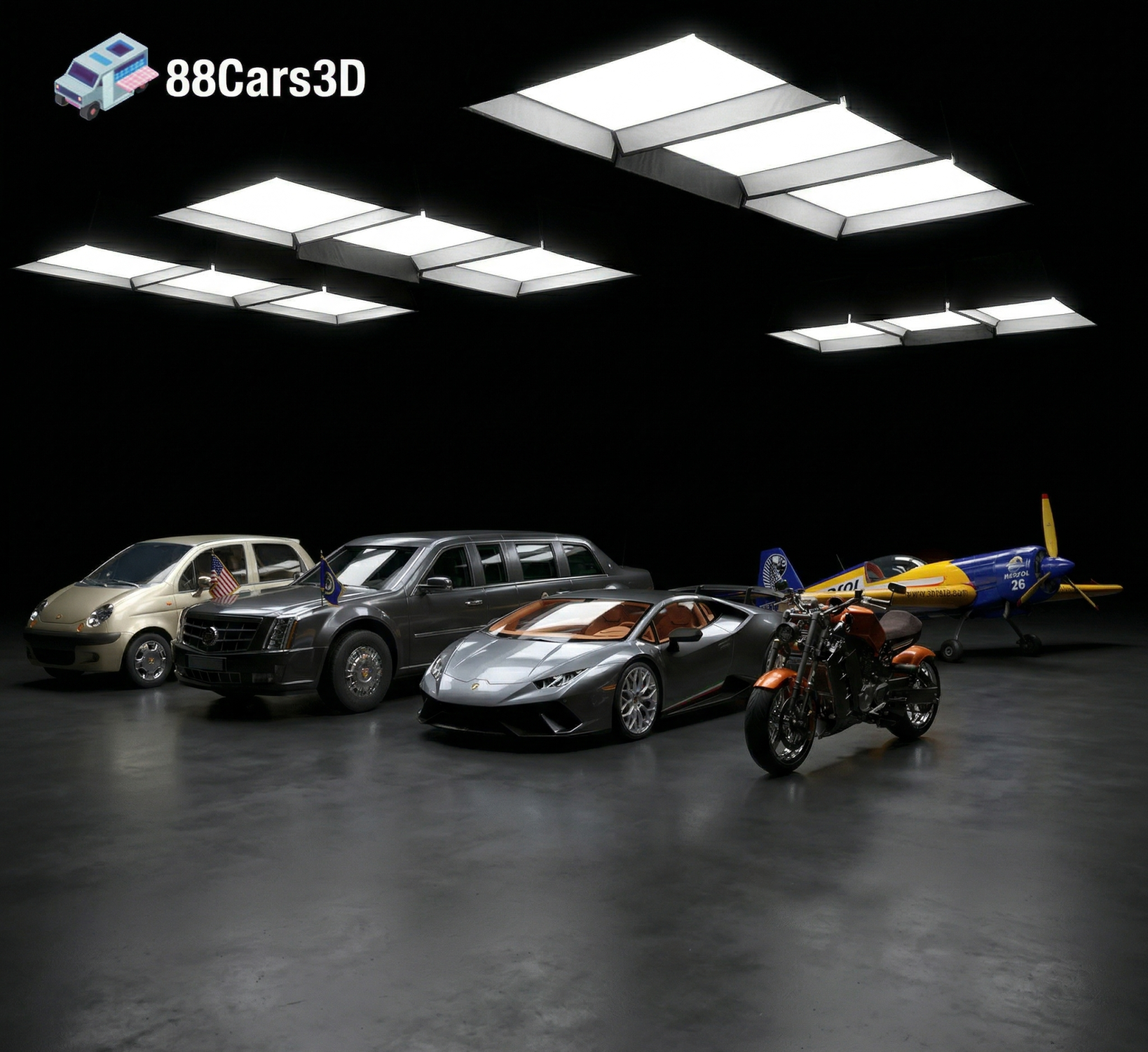
Texture: Yes | Material: Yes | 3D Printable: Yes. Download the Ultimate Creators’ Showcase featuring 5 premium 3D models: Lamborghini Huracan, ZAV Concept Motorcycle, Sukhoi SU-26, Presidential Limousine, and Daewoo Damas. Optimized for 4K CGI rendering and 3D printing. Save massive with this exclusive multi-category bundle!
Price: $99.99

Texture: Yes | Material: Yes | 3D Printable: Yes. Download the Italian Thoroughbreds Bundle featuring 5 iconic 3D models: Lamborghini Huracán Performante, Ferrari 458 Italia, Lamborghini Urus, Diablo SV, and Maserati GT. Optimized for 4K rendering and 3D printing (STL included). Save 50% with this ultimate Italian vehicle collection.
Price: $199.99

Download the Elite Future Mobility Bundle featuring 4 highly optimized 3D models: Tesla Model S, Avatr 11, Li L9, and Zoox Robotaxi. Perfect for ArchViz, Smart City renders, and game dev. Optimized for Unreal Engine and Blender. Includes .fbx, .obj, and .max formats.
Price: $99

🚗 5 Iconic German Cars (BMW M4 G82, M5 CS, X3, 1 Series & Mercedes E-Class). ✅ Optimized for ArchViz: Ready for Corona & V-Ray. 💰 Save €71 with this limited-time collection! 🚀 Instant Download after purchase.
Price: $119

Download the Extreme Off-Road & Survival 3D Models Bundle! Includes the Brabus 800 Adventure, Dodge Ram Bigfoot, Spec Truck, and a Caravan. Save over €210 on this premium 4-in-1 off-grid vehicle pack for ArchViz and game development.
Price: $149.99

Download the Heavy Duty & Commercial Logistics 3D Models Bundle! Includes the Ford Sterling, Caterpillar CT680, Mercedes Citaro Bus, and Vito Van. Save over €130 on this massive, game-ready 4-in-1 industrial vehicle pack.
Price: $109.99

Download the Ultimate Custom Motorcycles 3D Models Bundle. Includes a Custom Chopper, Ducati 916 Café Fighter, Harley XR1200X, and BMW K100. Perfect premium props for luxury ArchViz garages. Save over €250 today!
Price: $159.99

Download the ultimate JDM Street Racing 3D Models Bundle! Includes the Nissan GT-R, Toyota Supra, Mazda RX-7, Lancer Evo IX, and Honda NSX. Save big on this highly optimized, game-ready 5-in-1 Japanese legend car pack.
Price: $129.99

Download the ultimate American Muscle & Cinematic Classics 3D Models Bundle! Includes the Dodge Charger ’68, Mustang Eleanor GT500, Camaro Z28 ’79, and a custom ’69 Mustang. Save over €240 on this game-ready, premium 4-in-1 pack.
Price: $149.99

Download the Everyday City Traffic 3D Models Bundle. Includes the VW Golf, Kia Picanto, Hyundai Tucson, Toyota Yaris, and a DHL Ford Transit Van. Save big on this 5-in-1 pack, perfectly optimized for realistic ArchViz streets and game traffic.
Price: $99.99

