⚡ FLASH SALE: Get 60% OFF All Premium 3D & STL Models! ⚡

“`html
The world of 3D printing is an exciting frontier, especially for automotive enthusiasts and model makers. The ability to bring detailed car models to life on your desktop is incredibly rewarding. At 88cars3d.com, we pride ourselves on providing high-quality, print-ready STL files designed for a seamless printing experience. However, even the best files can benefit from thoughtful preparation. This guide dives deep into three crucial aspects of STL file manipulation: scaling for your needs, hollowing for material and time savings, and optimizing settings for faster print speeds without compromising quality. Whether you’re using FDM or resin printing, mastering these techniques will elevate your hobby, save you valuable printing time, and reduce material waste, leading to more successful and cost-effective prints.
Before we delve into manipulation, it’s essential to grasp what an STL file actually is. STL (Stereolithography or Standard Tessellation Language) is a de facto standard file format for 3D printing. It represents a 3D surface geometry as a collection of triangular facets. Each triangle is defined by three vertices and a normal vector, which indicates the outside direction of the surface. This tessellation is crucial because it’s how 3D printers interpret the shape of an object.
A key characteristic of a printable STL file is that it must be manifold. A manifold mesh is a watertight, continuous surface without holes, internal faces, or intersecting triangles. Think of it like a perfectly sealed balloon – there are no gaps for air (or resin/filament) to escape. Non-manifold geometry can confuse slicing software, leading to errors during slicing, incomplete prints, or objects with hollow sections that shouldn’t be there. When you download models from marketplaces such as 88cars3d.com, they are typically checked for manifold integrity. However, if you’re modifying models or working with files from less reputable sources, using mesh repair software like Meshmixer, Netfabb, or Blender’s 3D-Print Toolbox is crucial.
Each triangle in an STL file is composed of vertices (the corners) and edges (the lines connecting them). The collection of these triangles forms the faces of the object. The density of these triangles directly impacts the file size and the level of detail the mesh can represent. High-detail models will have more triangles, leading to larger files and potentially more processing time for your slicer. Conversely, low-polygon models will be smaller but may appear faceted or less smooth. Understanding this trade-off is important when considering how much detail you need for your specific application – a display model might warrant higher detail than a functional prototype.
One of the most common operations you’ll perform on an STL file is scaling. Whether you need a miniature version of a classic supercar for your desk or a larger-than-life replica for a centerpiece, scaling is straightforward but requires attention to detail. Most slicing software (like Cura, PrusaSlicer, or Simplify3D) and dedicated 3D modeling software (Blender, Meshmixer) offer easy-to-use scaling tools.
Uniform scaling adjusts the model equally along all three axes (X, Y, and Z), preserving the original proportions. If you want to make a car model 50% larger, you’d scale it by 150% uniformly. Non-uniform scaling allows you to adjust dimensions independently along each axis. This can be useful for fine-tuning fitment in specific scenarios, but for car models, it’s generally best to stick to uniform scaling to avoid distorting the vehicle’s aesthetics. Always scale based on percentages or target dimensions, ensuring your slicer is set to the correct units (millimeters are standard in 3D printing).
A critical consideration when scaling down models is maintaining adequate wall thickness. If you shrink a model too much, thin features like mirrors, spoilers, or even the car’s body panels might become thinner than your 3D printer’s nozzle diameter or resin layer thickness capabilities. This can result in prints failing or features breaking off. Before scaling down significantly, check the minimum wall thickness of the model. If it’s too thin, you might need to use modeling software to thicken specific features or accept that the model cannot be scaled down further while retaining detail. Platforms like 88cars3d.com often provide models with optimized wall thicknesses, but scaling is a variable you control.
The scaling considerations can differ slightly between FDM and resin printing. For FDM printing, the minimum printable feature size is often dictated by the nozzle diameter (typically 0.4mm). Scaling down a model below this threshold for thin walls means those features simply won’t be produced. For resin printing, the layer height and the printer’s XY resolution (pixel size for DLP/SLA printers) are the limiting factors. Resin printers can often achieve finer details than FDM, allowing for potentially smaller scale prints, but extremely thin features can still break or warp due to curing stresses and physical fragility.
Printing solid objects can be incredibly time-consuming and consume a large amount of filament or resin. For many aesthetic models, especially larger ones, printing them hollow is a practical solution. This involves creating an internal cavity within the model, leaving only a thin shell. Most modern slicers have built-in functions for hollowing, or you can achieve it manually in 3D modeling software.
Slicers like Cura and PrusaSlicer offer a “Hollow” or “Wall Thickness” setting. When you enable this, the slicer automatically creates an internal cavity and adds a specified wall thickness. You then need to ensure you add “drain holes” to allow uncured resin to escape during post-processing for resin prints, or to prevent trapped air/moisture in FDM prints. These drain holes are usually small circular openings strategically placed on the underside of the model, often in inconspicuous areas.
For more control, especially with complex models, manual hollowing in software like Blender or Meshmixer is preferred. This involves creating a slightly smaller duplicate of your original model, inverting its normals, and merging it with the original. Alternatively, you can use a “Shell” or “Offset” tool to create an inner surface. This method allows you to precisely control the internal geometry and ensure drainage points are correctly placed. When downloading models from 88cars3d.com, they are often provided as solid meshes. Hollowing these before slicing is a common optimization step.
The ideal wall thickness for a hollowed model depends on the printing technology and material. For FDM, a wall thickness of 1.2mm to 2.0mm (3-5 extrusion widths) is often sufficient. For resin printing, 0.8mm to 1.5mm is common. Ensure your drain holes are large enough for easy resin escape (e.g., 2-3mm diameter) but small enough not to detract from the model’s appearance. For FDM, consider the infill settings as well; a low infill percentage (5-15%) combined with thicker outer walls can sometimes be more efficient than a very thin shell with high infill.
Achieving faster print speeds without sacrificing the quality of intricate models like those found at 88cars3d.com is a delicate balancing act. It involves optimizing several slicing parameters. This section focuses on the most impactful settings.
Layer height is one of the most significant factors influencing print time. Thicker layers (e.g., 0.2mm or 0.3mm for FDM, 50-100 microns for resin) print much faster because fewer layers are needed to build the object. However, thicker layers result in more visible layer lines and a coarser surface finish. For highly detailed car models where aesthetics are paramount, you might opt for finer layer heights (e.g., 0.1mm for FDM, 25-50 microns for resin). However, for prototypes or less critical parts, increasing layer height can drastically reduce print time. A common strategy is to use a moderate layer height (e.g., 0.15mm for FDM) as a good balance between speed and detail for most car models.
Infill provides internal support to the outer walls and determines the object’s internal structure. For many display models, high infill density is unnecessary. Reducing infill density from 100% down to 10-20% can save considerable time and material. Furthermore, the choice of infill pattern matters. Patterns like ‘lines’ or ‘grid’ are generally faster to print than more complex patterns like ‘gyroid’ or ‘cubic’. If you hollowed your model, the infill setting primarily affects the density within the walls if you didn’t set a specific wall thickness, or it can be set to 0% if you have sufficiently thick hollow walls. For models requiring some structural integrity, consider using a higher infill percentage (around 20-40%) with a faster pattern.
Most slicers allow you to adjust print speeds for different parts of the model (e.g., outer walls, inner walls, infill, top/bottom layers). While increasing the overall print speed can seem like the obvious solution, it’s often better to selectively increase speeds. For instance, infill can often be printed much faster than outer walls, as visual quality is less critical. For outer walls, which define the visible surface, printing slower (e.g., 30-50 mm/s for FDM) ensures better surface finish and detail adherence. Acceleration and jerk settings also play a significant role. Higher acceleration allows the printer head to reach its target speed more quickly, reducing time spent accelerating and decelerating, especially on shorter print paths. Experimenting with these settings on test prints is key to finding the optimal balance.
Support structures are often necessary for overhangs and bridges in complex models. However, generating excessive or overly dense supports can significantly increase print time and make removal difficult, potentially damaging the model. When enabling supports, consider using tree supports (available in Cura and PrusaSlicer), which are often more material-efficient and easier to remove than traditional supports. You can also optimize support settings by adjusting the support density (lower density prints faster), support pattern (e.g., lines are faster), and support interface (a denser layer at the top of supports can improve surface quality but increases print time). For hollowed models, ensure drain holes are positioned where supports are not strictly necessary, or that supports can be easily removed around them.
Even with the best source files, unexpected issues can arise. Advanced users often employ techniques to repair meshes and fine-tune support generation for complex geometries, such as detailed automotive models.
If your slicer flags errors or if a print fails due to geometry issues, you’ll need to repair the mesh. Software like Netfabb (Autodesk) offers powerful automated repair tools. For more manual control, Meshmixer is excellent for identifying and fixing non-manifold edges, holes, and inverted faces. Blender, with its 3D-Print Toolbox add-on, provides a comprehensive suite of tools for mesh analysis and repair. The workflow typically involves importing the STL, using automated tools, then manually inspecting and fixing problematic areas. Key checks include ensuring all faces have consistent outward normals and that the mesh forms a closed, watertight volume.
Beyond basic support settings, advanced users consider the model’s specific geometry. For car models, areas like wheel wells, undercarriage details, and intricate spoilers often require careful support consideration. Instead of relying solely on automatic generation, manually paint supports onto critical overhangs or areas prone to failure. When planning for support removal, consider the orientation of the model on the build plate. Placing the model so that critical details are facing upwards or away from build plate supports can minimize scarring. For resin prints, ensuring supports can be easily reached with cleaning tools and alcohol is also important.
Even with perfect prints, post-processing is often required. This can include sanding to remove layer lines (especially for FDM prints), filling small gaps with putty, and priming before painting. For resin prints, thorough washing and curing are essential. The goal is to achieve a smooth, uniform surface that showcases the detail of the car model. Techniques like wet sanding, using automotive primers, and airbrushing can elevate the final result significantly. Remember to wear appropriate safety gear, including masks and gloves, especially when working with solvents or sanding materials.
By understanding and applying these techniques—from basic scaling and hollowing to advanced mesh repair and support optimization—you can transform your 3D printing experience. Whether you’re printing a sleek sports car or a rugged off-roader, these skills will ensure your models are not only faster to print but also of higher quality and more cost-effective. Explore the vast library of detailed printable car models available at 88cars3d.com and start applying these principles to bring your automotive passion to life!
“`
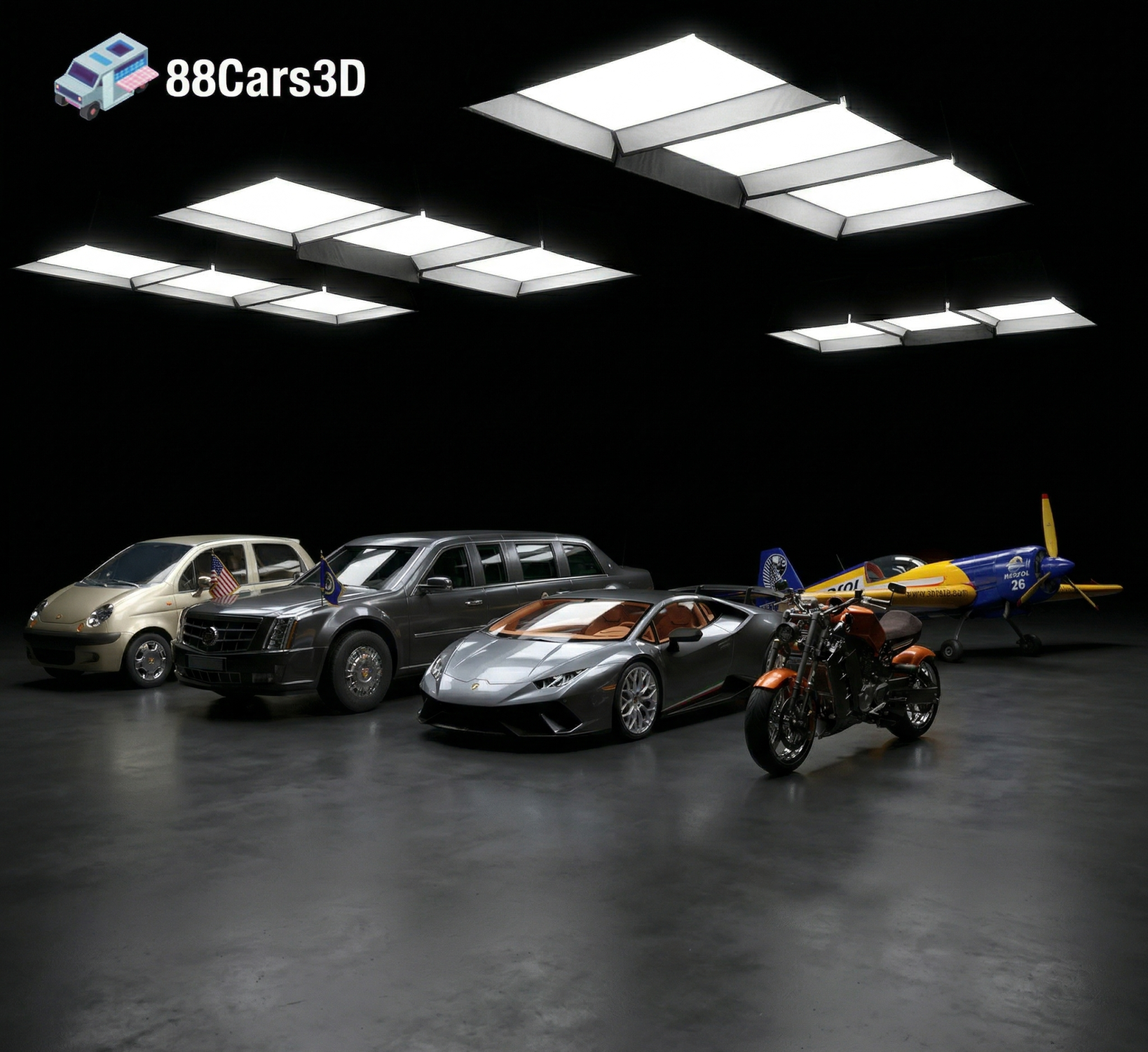
Texture: Yes | Material: Yes | 3D Printable: Yes. Download the Ultimate Creators’ Showcase featuring 5 premium 3D models: Lamborghini Huracan, ZAV Concept Motorcycle, Sukhoi SU-26, Presidential Limousine, and Daewoo Damas. Optimized for 4K CGI rendering and 3D printing. Save massive with this exclusive multi-category bundle!
Price: $99.99

Texture: Yes | Material: Yes | 3D Printable: Yes. Download the Italian Thoroughbreds Bundle featuring 5 iconic 3D models: Lamborghini Huracán Performante, Ferrari 458 Italia, Lamborghini Urus, Diablo SV, and Maserati GT. Optimized for 4K rendering and 3D printing (STL included). Save 50% with this ultimate Italian vehicle collection.
Price: $199.99

Download the Elite Future Mobility Bundle featuring 4 highly optimized 3D models: Tesla Model S, Avatr 11, Li L9, and Zoox Robotaxi. Perfect for ArchViz, Smart City renders, and game dev. Optimized for Unreal Engine and Blender. Includes .fbx, .obj, and .max formats.
Price: $99

🚗 5 Iconic German Cars (BMW M4 G82, M5 CS, X3, 1 Series & Mercedes E-Class). ✅ Optimized for ArchViz: Ready for Corona & V-Ray. 💰 Save €71 with this limited-time collection! 🚀 Instant Download after purchase.
Price: $119

Download the Extreme Off-Road & Survival 3D Models Bundle! Includes the Brabus 800 Adventure, Dodge Ram Bigfoot, Spec Truck, and a Caravan. Save over €210 on this premium 4-in-1 off-grid vehicle pack for ArchViz and game development.
Price: $149.99

Download the Heavy Duty & Commercial Logistics 3D Models Bundle! Includes the Ford Sterling, Caterpillar CT680, Mercedes Citaro Bus, and Vito Van. Save over €130 on this massive, game-ready 4-in-1 industrial vehicle pack.
Price: $109.99

Download the Ultimate Custom Motorcycles 3D Models Bundle. Includes a Custom Chopper, Ducati 916 Café Fighter, Harley XR1200X, and BMW K100. Perfect premium props for luxury ArchViz garages. Save over €250 today!
Price: $159.99

Download the ultimate JDM Street Racing 3D Models Bundle! Includes the Nissan GT-R, Toyota Supra, Mazda RX-7, Lancer Evo IX, and Honda NSX. Save big on this highly optimized, game-ready 5-in-1 Japanese legend car pack.
Price: $129.99

Download the ultimate American Muscle & Cinematic Classics 3D Models Bundle! Includes the Dodge Charger ’68, Mustang Eleanor GT500, Camaro Z28 ’79, and a custom ’69 Mustang. Save over €240 on this game-ready, premium 4-in-1 pack.
Price: $149.99

Download the Everyday City Traffic 3D Models Bundle. Includes the VW Golf, Kia Picanto, Hyundai Tucson, Toyota Yaris, and a DHL Ford Transit Van. Save big on this 5-in-1 pack, perfectly optimized for realistic ArchViz streets and game traffic.
Price: $99.99

