⚡ FLASH SALE: Get 60% OFF All Premium 3D & STL Models! ⚡

“`html
The allure of bringing intricate automotive designs to life from digital files to tangible objects is a driving force for many makers, hobbyists, and enthusiasts. Whether you’re a fan of classic cars, a builder of custom hot rods, or simply fascinated by the engineering marvels on wheels, 3D printing offers an unprecedented level of customization and detail. At 88cars3d.com, we provide high-quality, print-ready STL files of automotive models, designed with the printing process in mind. But to transform these digital blueprints into stunning physical replicas, the right 3D printer is paramount. This guide delves into the essential features that elevate a 3D printer from a general-purpose tool to a specialized powerhouse for model making, ensuring your printable car models turn out with the precision and quality they deserve.
Choosing the right 3D printer can feel overwhelming with the sheer variety of technologies and specifications available. For model makers, the focus shifts from sheer speed or industrial output to fidelity, detail, and the ability to reproduce complex geometries. We’ll explore the critical aspects like resolution, build volume, material compatibility, and user experience that directly impact the quality of your 3D printed car models. By understanding these key features, you can make an informed decision that aligns with your budget, your technical skill level, and your ambition to create the most accurate and impressive models possible.
When it comes to creating detailed automotive models, the ability of a 3D printer to reproduce fine lines, sharp edges, and smooth curves is non-negotiable. This capability is primarily governed by its resolution and the achievable layer height. For model makers, especially those working with intricate designs like those found on high-performance sports cars or classic automobiles, higher resolution and lower layer heights translate directly to a more refined and realistic final product.
3D printer resolution can be discussed in two main contexts: XY resolution and Z resolution. The XY resolution refers to the precision with which the printer can position the print head (in FDM) or the light source/laser (in resin printing) within the horizontal plane. Higher XY resolution means finer details can be printed without blurring or loss of definition. The Z resolution, often synonymous with layer height, dictates the vertical precision, determining how smooth the surface will be. Lower layer heights mean less visible “stair-stepping” on curved surfaces, resulting in a more organic and less obviously 3D printed appearance.
For detailed automotive models, especially those with delicate spoilers, intricate grilles, or smooth body panels, a printer capable of printing at layer heights of 0.1mm or even 0.05mm (50 microns) is highly desirable. While standard FDM printers often operate at 0.2mm as a default for a balance of speed and quality, pushing this lower significantly enhances detail. Resin printers, particularly SLA and DLP types, inherently offer superior XY resolution and can achieve much lower layer heights, often down to 25 microns, making them a popular choice for hyper-detailed miniatures and models.
It’s crucial to understand the tradeoff between resolution and print time. Printing at lower layer heights significantly increases the time required to complete a model, as more layers need to be deposited. For example, printing a model at 0.05mm layer height will take approximately four times longer than printing the same model at 0.2mm. This means efficient workflow planning is essential. If you are printing multiple parts or less detailed components, you might opt for a slightly higher layer height to save time. However, for key display pieces or parts requiring extreme fidelity, the longer print times are a necessary investment. Material usage is generally consistent regardless of layer height, as the volume of the object remains the same, but longer print times consume more energy.
Achieving optimal resolution also heavily relies on proper slicing software settings. When using slicers like Cura or PrusaSlicer, selecting the appropriate layer height is the primary control. Beyond that, ensuring the nozzle size (for FDM) or pixel size (for resin) is appropriate for the desired detail is important. For very fine details on FDM, consider using smaller nozzle sizes (e.g., 0.2mm or 0.3mm instead of the standard 0.4mm), though this will further increase print times and can be more prone to clogging. Ensure your model’s STL file has sufficient mesh density for the software to interpret these fine details correctly. Models from marketplaces like 88cars3d.com are often designed with optimal mesh topology to take advantage of high-resolution printing.
The build volume of a 3D printer refers to the maximum dimensions (length, width, and height) of an object that it can print. For model makers, particularly those interested in printing larger scale car models or even full-sized components, the build volume is a critical consideration. A larger build volume offers greater flexibility, allowing you to print more ambitious projects or print multiple smaller parts simultaneously.
When considering printable car models, the desired scale plays a direct role in determining the required build volume. A 1:18 scale model might fit comfortably on most desktop printers, but a 1:10 scale model, or even a larger diorama piece, will necessitate a printer with a significantly larger build area. If your goal is to print a classic muscle car with its hood open to showcase an engine, and you want to print it in one piece for maximum structural integrity, the dimensions of that vehicle at your chosen scale will dictate the minimum length and width required. Similarly, printing a detailed engine bay or a complex interior often requires sufficient height within the build volume.
Beyond single-piece prints, a larger build volume allows for more efficient printing of multi-part models. If you are printing a car model that is designed to be assembled from many components (e.g., chassis, body panels, wheels, interior), you can arrange more parts on the build plate at once. This reduces the total number of print jobs and can save considerable time and effort in managing and post-processing multiple prints. For instance, printing a set of four wheels and tires, along with smaller body details, in a single run is far more efficient than dedicating separate prints for each.
While a large build volume is attractive, it’s essential to balance this requirement with other crucial features like resolution and print quality. Some large-format printers may sacrifice resolution to achieve their expansive build areas, or they may be slower to print due to the larger distances the print head needs to travel. It’s also worth noting that printing larger objects generally requires more filament and takes considerably longer. Therefore, consider if your ambition truly requires a massive build volume or if a well-designed multi-part approach on a more standard-sized printer would suffice. If you are downloading complex car models from platforms like 88cars3d.com, check the recommended print size and if the model is designed to be printed in sections for smaller printers.
For hobbyists focused on smaller-scale models (e.g., 1:24 or 1:32 scale), a standard build volume of around 200x200x200mm is often perfectly adequate. However, if you envision printing larger, more detailed models, or if you want the flexibility to prototype custom automotive parts (like functional car emblems or interior trim pieces), investing in a printer with a build volume of 300x300x300mm or even larger might be necessary. Always measure the largest dimension of the object you intend to print at your desired scale and add a buffer for potential print orientation or support structures.
The choice of printing material significantly impacts the final look, feel, and durability of your 3D printed car models. While PLA is the most common and easiest-to-print filament for FDM printers, model makers often benefit from printers that can handle a wider range of materials. Versatility in material compatibility allows you to achieve different aesthetic qualities, mechanical properties, and post-processing capabilities, bringing your automotive replicas closer to realism.
PETG, for instance, offers improved layer adhesion and impact resistance over PLA, making it suitable for parts that might require some flexibility or durability, like suspension components or even functional parts. ABS is known for its strength, temperature resistance, and smooth surface finish after post-processing (like acetone smoothing), which can be ideal for achieving that automotive-grade sheen. However, ABS can be more challenging to print, requiring higher temperatures, an enclosed build chamber to prevent warping, and good ventilation due to fumes. For advanced users aiming for realistic paint finishes and high detail, printers capable of consistently handling these materials are essential. Some printers have specialized features like hardened steel nozzles to print abrasive materials like carbon fiber-filled filaments, which can add realism to certain car parts.
For resin printers (SLA, DLP, MSLA), the material landscape is equally diverse. Standard resins offer incredible detail but can be brittle. Engineering resins provide enhanced toughness, flexibility, or temperature resistance, suitable for more robust models or functional prototypes. Clear resins allow for realistic windows and lighting elements, while specialty resins like wood-fill or ceramic-fill can offer unique aesthetic qualities. Understanding the specific resin types and their printing requirements (e.g., exposure times, layer heights, wash and cure protocols) is key to unlocking their potential for model making.
To effectively print with a variety of materials, a 3D printer needs specific capabilities. For FDM printers, this includes:
For resin printers, material compatibility is often tied to the specific light source (wavelength) and the resin manufacturer’s recommendations. Printers designed for specific resin types are generally easier to use and yield better results.
Consider how the chosen material lends itself to post-processing. PLA can be sanded and painted but may melt under high heat. ABS is excellent for sanding, filling, and acetone smoothing for a glossy finish. Resins can be sanded, primed, and painted to achieve very realistic finishes. The printer’s ability to produce clean, well-defined prints will directly affect the ease and quality of your post-processing efforts. Models from 88cars3d.com are designed to facilitate these finishing techniques.
For any model maker, the ability to consistently produce accurate and dimensionally stable prints is paramount. This goes beyond just initial resolution and delves into the printer’s accuracy (how close the printed object is to its digital dimensions) and repeatability (how consistently it can reproduce the same object). A well-calibrated printer is the bedrock of achieving this.
When printing car models, precise dimensions are critical for parts to fit together correctly during assembly, especially for complex models with interlocking components or tight tolerances. A printer that consistently prints parts that are slightly larger or smaller than specified can lead to significant fitting issues. For example, if wheel hubs are printed slightly too large, they won’t fit onto the axles, or if body panels are printed with incorrect curves, they won’t align seamlessly. Look for printers known for their rigid frame construction and precise motion systems (e.g., high-quality stepper motors, lead screws, or linear rails) as these contribute significantly to dimensional accuracy.
Repeatability is crucial for producing multiple identical parts, such as all four wheels of a car, or for being able to reliably reprint a part if a print fails or if you want to create multiple copies of a model. A printer that exhibits good repeatability will produce parts that are virtually indistinguishable from previous prints under the same settings. This consistency saves time and reduces waste. Factors like backlash in mechanical components, inconsistent extrusion rates, and variations in heating can all affect repeatability. Well-designed printers often incorporate features like auto-bed leveling and closed-loop stepper motors to enhance consistency.
Owning a printer that is easy to calibrate and maintain is a significant advantage for any model maker. Regular calibration ensures optimal performance and helps diagnose potential issues before they lead to failed prints. Key calibration routines include:
Printers that provide user-friendly calibration wizards or accessible firmware settings make this process much less daunting. Similarly, easy access to components for routine maintenance, like cleaning nozzles, lubricating rods, or tightening belts, contributes to long-term reliable printing. Understanding your printer’s calibration needs is as important as understanding 3D printer settings and slicing parameters.
Beyond the raw technical specifications, the overall user experience and the accompanying software ecosystem play a vital role in how effectively you can utilize your 3D printer for model making. A printer that is intuitive to operate, with good software support, can significantly streamline your workflow and reduce frustration, allowing you to focus more on the creative aspects of bringing your automotive designs to life.
For hobbyists and makers, a printer that is easy to set up and get running quickly is a major plus. This includes features like pre-assembled components, clear instructions, and straightforward user interfaces on the printer itself (e.g., a responsive touchscreen). Navigating print queues, adjusting settings on the fly, and monitoring print progress should be intuitive. If the printer requires extensive assembly or complex initial configuration, it can be a barrier to entry, especially for those new to 3D printing. Similarly, reliable connectivity options (USB, SD card, Wi-Fi) and robust firmware are essential for a smooth printing experience.
The 3D printer’s compatibility with popular slicing software is critical. While most printers work with standard slicers like Cura, PrusaSlicer, or Simplify3D, some manufacturers offer their own optimized slicer software. These proprietary slicers can sometimes provide tailored profiles and advanced features that leverage the specific capabilities of the printer. It’s beneficial if the printer’s software ecosystem allows for easy import of STL files, offers pre-configured profiles for various materials, and provides tools for advanced slicing techniques, such as precise support generation and infill optimization. When downloading printable car models from 88cars3d.com, ensure your chosen slicer and printer can handle the complexity of the STL files.
A strong online community and readily available support resources can be invaluable, especially when troubleshooting common printing issues or learning advanced techniques. Manufacturers with active online forums, dedicated support channels, and a wealth of online tutorials and documentation make it easier to find solutions to problems and learn how to get the most out of your printer. This is particularly helpful when dealing with intricate models or new materials. A vibrant community often means more shared knowledge on optimizing print settings for specific models, which is a huge asset for model makers.
Consider the printer’s firmware. Is it open-source, allowing for advanced customization and community-driven enhancements? Does the manufacturer regularly release firmware updates to improve performance, fix bugs, or add new features? A well-supported printer with ongoing firmware development can be more “future-proof,” meaning it can adapt to new technologies and user demands over time. For serious model makers, having control over firmware settings can enable fine-tuning for specific projects or materials.
Ultimately, the most crucial feature of any 3D printer for model makers is its ability to produce high-quality prints. This encompasses a combination of factors: surface finish, geometric accuracy, detail reproduction, and structural integrity. While individual components like resolution and material compatibility contribute to this, the printer’s overall performance in delivering clean, precise, and aesthetically pleasing results is the benchmark.
For automotive models, a smooth surface finish is often desired to mimic real-world vehicles. While some level of layer lines is inherent to FDM printing, a good printer with precise layer deposition and correct slicing parameters will minimize their visibility. Resin printers generally excel here, offering incredibly smooth surfaces right off the build plate. However, even with FDM, printers that can achieve consistent, thin layers (e.g., 0.05mm to 0.1mm) and maintain a stable extrusion process will produce models that require less intensive post-processing to achieve a paint-ready finish. Look for printers known for their rigidity, accurate motion control, and well-tuned extrusion systems.
The ability to capture fine details is critical for automotive models. This includes sharp edges on bodywork, intricate grille patterns, small emblems, and realistic tire treads. A printer with high XY resolution and consistent extrusion will ensure these details are reproduced faithfully. For FDM, this means a precise hotend and nozzle, while for resin, it relates to the projector or laser’s resolution and the resin’s photopolymerization properties. Models from 88cars3d.com are meticulously designed to retain these fine details, so the printer must be capable of translating them into reality.
Beyond aesthetics, the structural integrity of the printed model is important, especially if it’s intended for assembly or display. Good layer adhesion, resulting from optimal print temperatures and proper material handling, ensures parts are strong and not prone to delamination. Dimensional accuracy, as discussed earlier, is crucial for ensuring that different components fit together as intended, leading to a well-assembled and sturdy final model. Test prints of critical components, like chassis elements or wheel hubs, can reveal a printer’s capability in this regard. A printer that offers reliable adhesion to the build plate also prevents the common failure of a print detaching mid-process, which would compromise its structural integrity.
The print quality directly impacts the effort required for post-processing. A printer that delivers excellent detail and a smooth surface finish will significantly reduce the time and skill needed for sanding, filling, priming, and painting. This is particularly relevant for model makers who aim for professional-looking results. If a printer consistently produces blobs, stringing, or rough surfaces, the post-processing workload can become substantial, potentially outweighing the initial cost savings. Evaluating the printer’s ability to produce clean, defect-free prints is, therefore, a direct measure of its suitability for high-quality model making.
The fundamental choice for many model makers boils down to selecting between Fused Deposition Modeling (FDM) and resin-based printing technologies (SLA, DLP, MSLA). Each has its distinct advantages and disadvantages, making one potentially more suitable than the other depending on your specific needs, budget, and desired outcomes for your 3D printable car models.
FDM printers work by extruding melted plastic filament layer by layer onto a build platform. They are generally more affordable, have larger build volumes, and can print with a wider variety of robust materials like PLA, PETG, and ABS.
FDM is an excellent choice for larger scale models, functional prototypes, or when cost-effectiveness and material versatility are primary concerns. Models downloaded from 88cars3d.com can be scaled and printed effectively on FDM machines, especially if post-processing is planned to achieve smooth finishes.
Resin printers cure liquid photopolymer resin using a UV light source (laser for SLA, projector for DLP, or an array of LEDs for MSLA). They are renowned for their exceptional detail and smooth surface finishes.
Resin printing is ideal for highly detailed display models, miniature car collectibles, or when achieving photo-realistic surface quality straight off the printer is the priority. The detailed automotive models offered on 88cars3d.com can truly shine when printed on a high-resolution resin printer.
The decision between FDM and resin often comes down to the intended use of the printed models. If you want to print large, durable, or functional parts, or if you are on a tighter budget, FDM is likely the better choice. If your primary goal is to achieve the highest possible level of detail and a flawless surface finish for display models, a resin printer will likely provide superior results. Many serious model makers find value in owning both types of printers to leverage the strengths of each technology for different projects.
“`
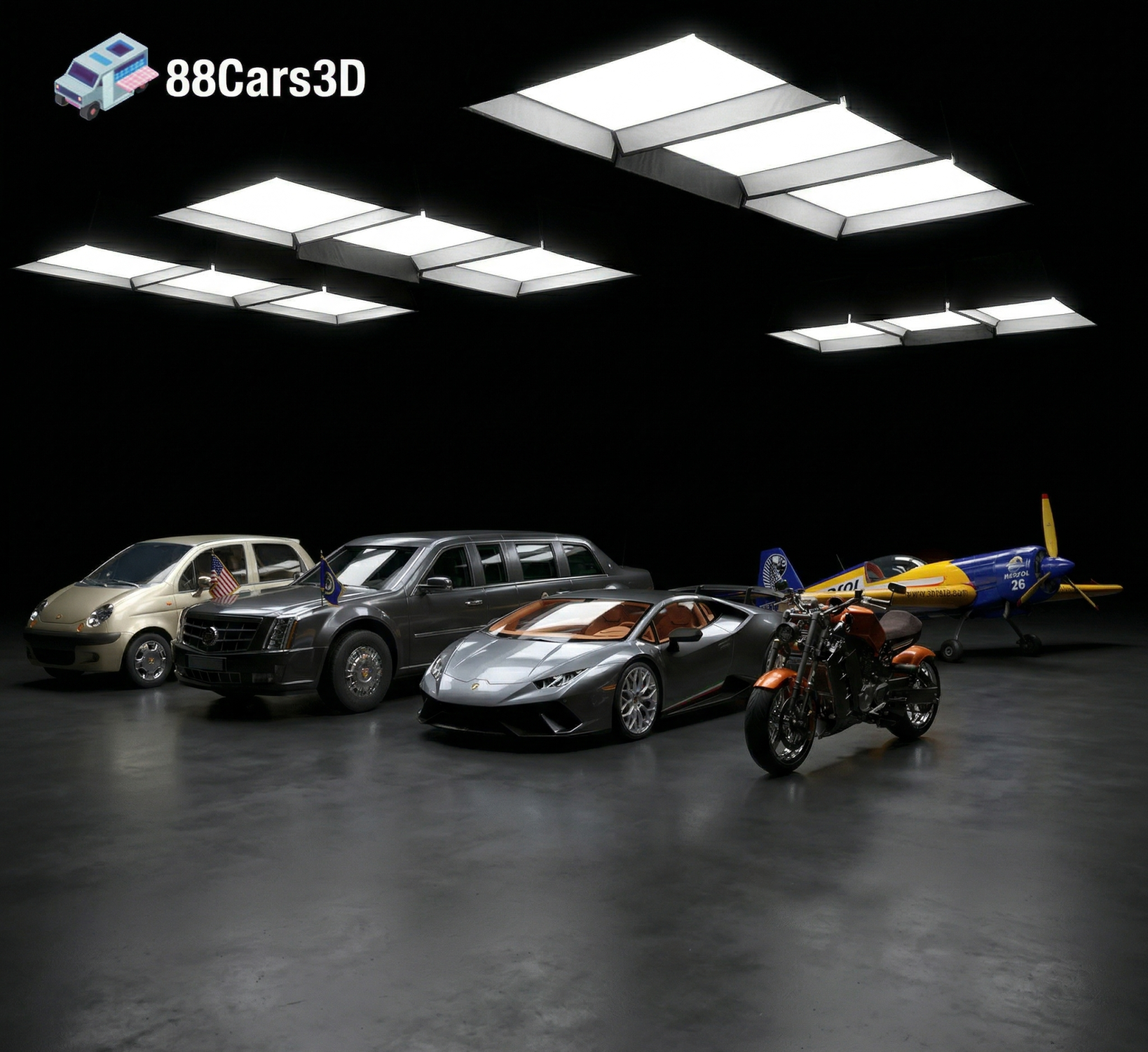
Texture: Yes | Material: Yes | 3D Printable: Yes. Download the Ultimate Creators’ Showcase featuring 5 premium 3D models: Lamborghini Huracan, ZAV Concept Motorcycle, Sukhoi SU-26, Presidential Limousine, and Daewoo Damas. Optimized for 4K CGI rendering and 3D printing. Save massive with this exclusive multi-category bundle!
Price: $99.99

Texture: Yes | Material: Yes | 3D Printable: Yes. Download the Italian Thoroughbreds Bundle featuring 5 iconic 3D models: Lamborghini Huracán Performante, Ferrari 458 Italia, Lamborghini Urus, Diablo SV, and Maserati GT. Optimized for 4K rendering and 3D printing (STL included). Save 50% with this ultimate Italian vehicle collection.
Price: $199.99

Download the Elite Future Mobility Bundle featuring 4 highly optimized 3D models: Tesla Model S, Avatr 11, Li L9, and Zoox Robotaxi. Perfect for ArchViz, Smart City renders, and game dev. Optimized for Unreal Engine and Blender. Includes .fbx, .obj, and .max formats.
Price: $99

🚗 5 Iconic German Cars (BMW M4 G82, M5 CS, X3, 1 Series & Mercedes E-Class). ✅ Optimized for ArchViz: Ready for Corona & V-Ray. 💰 Save €71 with this limited-time collection! 🚀 Instant Download after purchase.
Price: $119

Download the Extreme Off-Road & Survival 3D Models Bundle! Includes the Brabus 800 Adventure, Dodge Ram Bigfoot, Spec Truck, and a Caravan. Save over €210 on this premium 4-in-1 off-grid vehicle pack for ArchViz and game development.
Price: $149.99

Download the Heavy Duty & Commercial Logistics 3D Models Bundle! Includes the Ford Sterling, Caterpillar CT680, Mercedes Citaro Bus, and Vito Van. Save over €130 on this massive, game-ready 4-in-1 industrial vehicle pack.
Price: $109.99

Download the Ultimate Custom Motorcycles 3D Models Bundle. Includes a Custom Chopper, Ducati 916 Café Fighter, Harley XR1200X, and BMW K100. Perfect premium props for luxury ArchViz garages. Save over €250 today!
Price: $159.99

Download the ultimate JDM Street Racing 3D Models Bundle! Includes the Nissan GT-R, Toyota Supra, Mazda RX-7, Lancer Evo IX, and Honda NSX. Save big on this highly optimized, game-ready 5-in-1 Japanese legend car pack.
Price: $129.99

Download the ultimate American Muscle & Cinematic Classics 3D Models Bundle! Includes the Dodge Charger ’68, Mustang Eleanor GT500, Camaro Z28 ’79, and a custom ’69 Mustang. Save over €240 on this game-ready, premium 4-in-1 pack.
Price: $149.99

Download the Everyday City Traffic 3D Models Bundle. Includes the VW Golf, Kia Picanto, Hyundai Tucson, Toyota Yaris, and a DHL Ford Transit Van. Save big on this 5-in-1 pack, perfectly optimized for realistic ArchViz streets and game traffic.
Price: $99.99

