⚡ FLASH SALE: Get 60% OFF All Premium 3D & STL Models! ⚡

The roar of a finely tuned engine, the sleek lines of a classic coupe, the rugged stance of an off-road beast – automotive passion comes in many forms. For 3D printing enthusiasts, recreating these iconic machines in miniature is a rewarding challenge. At 88cars3d.com, we’re dedicated to providing you with high-quality, print-ready STL files of vehicles, from vintage classics to modern sports cars. But having a great model is only half the battle. Achieving that show-stopping level of detail requires understanding your 3D printer and mastering the art of slicing and printing. This guide will delve deep into the technical aspects of 3D printing detailed car models, covering everything from file preparation and slicer settings to advanced techniques for FDM and resin printing. Whether you’re a seasoned maker or just starting, you’ll gain the knowledge to transform digital designs into stunning, tangible replicas.
We’ll explore the nuances of file formats, the critical role of mesh integrity, and how to fine-tune your slicer for unparalleled accuracy. You’ll learn how to conquer tricky geometries with optimized support structures, choose the right materials, and perform essential printer calibration. By the end of this comprehensive guide, you’ll be equipped to tackle even the most intricate vehicle designs and produce prints that truly capture the essence of automotive artistry.
Before your chosen vehicle model ever touches the print bed, its digital foundation—the STL file—must be sound. STL (STereoLithography) is the de facto standard for 3D printing, representing a surface as a collection of triangular facets. While seemingly simple, the quality of this mesh directly impacts printability and final detail. For detailed car models, the complexity and accuracy of this mesh are paramount. Issues like non-manifold geometry, inverted normals, or holes can lead to slicing errors, failed prints, and lost details.
Platforms like 88cars3d.com are committed to providing meticulously prepared STL files. Our models are designed with 3D printing in mind, featuring clean topology, appropriate wall thicknesses, and watertight meshes. However, it’s always good practice to perform a quick check and, if necessary, repair your files. Software like Meshmixer (free), Blender (free), or Netfabb (commercial) are invaluable tools for this. These programs allow you to visualize the mesh, identify potential problems, and execute repairs. For instance, the “Inspector” tool in Meshmixer can automatically detect and fix common issues such as holes, self-intersecting triangles, and boundary errors, ensuring your model is manifold and ready for slicing.
A “watertight” or “manifold” mesh is one that encloses a volume without any holes or inconsistencies. Think of it like a balloon – air can be contained within it. In 3D printing, this means the slicer can accurately determine the internal volume and surface of the object. Non-manifold edges (where more than two triangles share an edge) or holes can confuse the slicer, leading to gaps in the print or even complete failure. When preparing a model, especially if you’re modifying it, always run a mesh check. In Blender, you can use the “3D-Print Toolbox” add-on. For Netfabb, the automatic repair features are robust. Ensuring your mesh is clean prevents hours of printing frustration and ensures that fine details like grilles, emblems, and panel gaps are rendered faithfully.
While STL is king for slicing, you might encounter other formats like OBJ or FBX. OBJ files can store color and texture information, which is useful for visualization but not directly used by most slicers. FBX is a more complex format often used in animation and game development, also containing richer data than a standard STL. For direct 3D printing, converting these to STL is typically necessary. However, understanding these formats can be beneficial if you plan on further customizing models in advanced modeling software before exporting them as print-ready STLs. Always ensure your final export to STL is binary, as it’s more efficient and less prone to corruption than ASCII STL.
The slicer software (e.g., Cura, PrusaSlicer, Lychee Slicer) is the crucial intermediary between your STL file and your 3D printer. It “slices” the model into hundreds or thousands of horizontal layers and generates the G-code, a set of instructions that dictates the printer’s movements, extrusion, and temperature. For highly detailed car models, slicer settings are not just about making a print; they’re about achieving fidelity, minimizing print time, and ensuring structural integrity.
The primary goal when slicing detailed models is to capture the fine features. This involves selecting an appropriate layer height. A smaller layer height (e.g., 0.08mm to 0.12mm for FDM, or even 0.025mm to 0.05mm for resin) results in smoother curves and finer details, effectively reducing the visible “stair-stepping” effect on sloped surfaces. However, this comes at the cost of significantly increased print time. Finding the right balance is key. For instance, printing a 1:24 scale model might necessitate a layer height of 0.1mm or less on an FDM printer to capture subtle body panel lines and trim details, whereas a larger, less detailed model might be perfectly acceptable at 0.2mm.
Every increase in print resolution (i.e., decrease in layer height) directly increases the number of layers and, consequently, the print time. A standard 0.2mm layer height might print a model in 5 hours, while reducing it to 0.1mm could push the time to 15-20 hours. For resin printers, the exposure time per layer is also a factor, with thinner layers requiring shorter individual layer exposures but more layers overall. Consider the scale and complexity of your model. A small, intricate part might justify a longer print time for a higher layer resolution. For larger or less detailed sections, a coarser layer height might be acceptable to save time. Experimentation is crucial. Try printing a small, critical section of a model at different layer heights to determine the best compromise for your needs.
Infill refers to the internal structure printed within the model’s shell. For display models, high infill percentages are often unnecessary and waste material and time. A density of 10-20% is typically sufficient for FDM prints, providing adequate support for the outer layers without adding excessive weight or print duration. For structural integrity, especially for parts that might be handled or assembled, increasing infill density to 25-30% can be beneficial. Different infill patterns offer varying strengths and print speeds. Patterns like Grid, Gyroid, or Cubic are excellent all-rounders. Gyroid is particularly good as it provides strength in all directions and can be printed efficiently. For resin prints, infill is less of a concern as the entire model is typically printed solid or with a hollow internal structure to save resin and reduce print times, with dedicated settings for hollowed models often available in slicers.
Detailed car models often feature overhangs, bridges, and intricate details like spoilers, mirrors, and undercarriage components that require support. Proper support generation is critical to prevent print failures and ensure clean surfaces. Slicers offer various support types: standard, tree (or organic), and custom. Tree supports are often preferred for intricate models as they touch the model at fewer points, are easier to remove, and can reduce scarring on the surface. Key settings to adjust include support density, overhang angle (the angle at which supports are generated, typically 45-60 degrees), support Z distance (the gap between the support and the model, crucial for easy removal), and support interface layers (dense layers at the top of supports to create a flatter surface for the model to print on).
Fused Deposition Modeling (FDM) printers build objects layer by layer by extruding melted filament. They are popular for their affordability, material versatility, and larger build volumes. However, achieving the fine detail required for intricate car models on an FDM printer presents unique challenges and opportunities.
The choice of nozzle size significantly impacts detail. While a standard 0.4mm nozzle is common, switching to a smaller nozzle, such as 0.2mm or even 0.15mm, can dramatically improve the ability to render fine details like grilles, emblems, and panel lines. This comes with a caveat: print times will increase substantially, and the printer will be more susceptible to clogs. If you opt for a smaller nozzle, consider increasing the flow rate slightly and ensuring your filament is dry and clean. Additionally, print speeds need to be reduced. Printing intricate parts at speeds of 30-40mm/s for outer walls and even slower for details will yield much better results than pushing the printer at 80mm/s.
A smaller nozzle (e.g., 0.2mm) allows for finer extrusion lines, enabling the printer to resolve smaller features. For example, a grille pattern that might appear as a solid surface with a 0.4mm nozzle could be discernible as individual bars with a 0.2mm nozzle. However, printing with a smaller nozzle requires careful calibration. Extrusion multiplier (flow) might need adjustment, and the printer’s maximum volumetric flow rate becomes a limiting factor. Slowing down print speeds is essential. Outer walls might be printed at 20-30mm/s, while the initial layers should be even slower for optimal bed adhesion. This meticulous approach is vital for capturing the subtle curves and sharp edges characteristic of automotive design.
PLA (Polylactic Acid) is the go-to material for many hobbyists due to its ease of printing, low warping, and wide range of available colors. It’s excellent for detailed models where high temperature resistance isn’t a primary concern. For slightly more durable prints or those requiring better heat resistance, PETG (Polyethylene Terephthalate Glycol) is a good option, though it can be stringier and require more tuning. ABS (Acrylonitrile Butadiene Styrene) offers excellent strength and temperature resistance but is prone to warping and requires an enclosed printer and heated bed (around 100-110°C) for successful printing. For painted models, PLA is generally easiest to work with due to its smooth surface finish and minimal post-processing needs. Always ensure your filament is stored correctly in a dry environment, as moisture can degrade print quality significantly.
Proper bed adhesion is non-negotiable, especially for taller, more complex models like cars. Warping—where the corners of the print lift off the bed—can ruin a print. Options include using painter’s tape, a PEI sheet, glue stick, or specialized bed surfaces. For car models, orienting the print to minimize overhangs and maximize the surface area on the build plate is crucial. Often, printing the car directly on its wheels (if modeled) or on its side offers the best balance of detail preservation and support reduction. Consider using a brim or raft in your slicer settings for added stability, especially for models with small contact points with the build plate. A clean build plate, proper bed leveling, and the right first layer height (often slightly thicker, e.g., 0.25-0.3mm) are foundational for success.
For the absolute highest fidelity in miniature automotive models, resin 3D printing (SLA/DLP/MSLA) reigns supreme. These technologies use a light source (laser, projector, or LCD screen) to cure liquid photopolymer resin layer by layer. The achievable resolution is orders of magnitude finer than most FDM printers, allowing for incredibly crisp details.
Resin printers are characterized by their XY resolution, determined by the laser spot size (SLA), pixel size (DLP), or pixel pitch of the LCD screen (MSLA). Common resolutions range from 50 microns (0.05mm) down to 20 microns (0.02mm). This means features as small as a few tenths of a millimeter can be rendered with astonishing clarity. When printing detailed car models, using a resin with good flow characteristics and a layer height of 0.03mm to 0.05mm is typical. Even finer layers (0.02mm) are possible but significantly extend print times.
The XY resolution dictates the smallest feature size that can be printed in the horizontal plane. A printer with a 50-micron XY resolution can resolve finer details than one with a 100-micron resolution. Coupled with a fine Z-axis layer height (e.g., 0.03mm), this allows for incredibly smooth curves and sharp edges. Think of printing tiny badges, intricate wheel spokes, or delicate spoilers – resin printers excel here. The choice of resin type also matters; standard resins offer good detail, while specialized “high-detail” or “modeling” resins can further enhance fine feature reproduction. Always consult the resin manufacturer’s recommendations for optimal exposure times, as these vary significantly between different resin formulations.
Supports are just as critical in resin printing, but the approach differs. Supports need to be fine and strategically placed to minimize visible marks on the final print. Light supports with minimal contact points are preferred. Tree-like supports or very fine raft-based supports that are easy to sand away are common. The orientation of the model on the build plate is vital to minimize suction forces on large, flat surfaces (like the underside of a car), which can cause print failures. Angling the model at 10-30 degrees off the build plate often helps break suction. Settings like exposure time per layer, lift speed, and bottom layer exposure time need meticulous calibration to ensure adhesion to the build plate without over-curing details.
Resin prints require post-processing. After printing, the model is removed from the build plate and needs to be washed in isopropyl alcohol (IPA) or a specialized resin cleaner to remove uncured resin. This is followed by UV curing, typically in a curing station, to fully harden the print. Safety is paramount: always wear nitrile gloves and safety glasses when handling uncured resin and IPA. Post-curing not only hardens the print but also maximizes its mechanical properties. Once cured, supports can be carefully removed with flush cutters or a hobby knife. Sanding resin can be done wet or dry, starting with coarser grits and moving to finer ones. Priming and painting are essential steps to bring out the final detail and achieve a professional finish.
Regardless of whether you choose FDM or resin, a well-calibrated and maintained printer is the bedrock of consistent, high-quality prints. Neglecting this can lead to a cascade of issues, from poor layer adhesion to dimensional inaccuracies.
For FDM printers, regular calibration of the extruder (E-steps) and bed leveling are crucial. E-step calibration ensures that the printer extrudes the correct amount of filament. Bed leveling ensures the first layer adheres evenly across the entire build surface. PID tuning for the hotend and heated bed helps maintain stable temperatures, preventing fluctuations that can affect print quality. For resin printers, ensuring the FEP film on the resin vat is clean and free of scratches, and that the build plate is clean and properly leveled, is essential. Exposure calibration tests (often found online or built into slicers) are vital to dial in the correct exposure times for your specific resin and printer combination.
An E-step calibration ensures that when your printer is instructed to extrude 100mm of filament, it actually extrudes 100mm. Incorrect E-steps lead to under-extrusion (weak, gappy prints) or over-extrusion (bloated, imprecise prints). This is typically done by marking the filament, commanding a specific extrusion amount, measuring how much was actually fed, and adjusting the E-step value in the printer’s firmware or slicer. Bed leveling is equally critical. The nozzle must be the correct distance from the build plate across the entire surface for the first layer to adhere properly. Manual leveling requires adjusting screws on the bed corners, while auto-bed leveling systems use a probe to map the bed surface and compensate for minor unevenness.
For resin printing, the FEP (Fluorinated Ethylene Propylene) film at the bottom of the resin vat is a wear item. Scratches or damage can lead to adhesion failures and poor print quality. It needs to be kept clean and inspected regularly. Build plate leveling is also critical to ensure consistent adhesion across the entire print area. Exposure calibration tests are essential for determining the optimal exposure time for each layer. These tests typically involve printing a series of small features or cones at varying exposure times. Analyzing the results helps you find the sweet spot that provides good detail adhesion without over-exposing and losing fine features or causing the print to adhere too strongly to the FEP film, leading to peeling.
3D printing detailed vehicle models is a journey that blends digital artistry with mechanical precision. From ensuring the integrity of your STL files downloaded from sources like 88cars3d.com to mastering the intricate settings within your slicer, every step plays a vital role in the final outcome. Whether you’re leveraging the accessible power of FDM printing with careful attention to nozzle size, speed, and material choice, or diving into the unparalleled detail offered by resin printing, the principles of careful preparation, calibration, and execution remain constant.
Remember that achieving truly spectacular results often involves a degree of experimentation. Don’t be afraid to adjust layer heights, tweak support settings, try different materials, or refine your printer’s calibration. The insights shared in this guide provide a robust technical framework, but your own experiences will further hone your skills. By understanding the interplay between your files, your software, your printer, and your chosen materials, you are well-equipped to overcome common challenges and consistently produce stunning, detailed automotive replicas. So, download that dream car model, prepare your slicer, and start printing your own high-octane collection – the possibilities are as limitless as the open road.
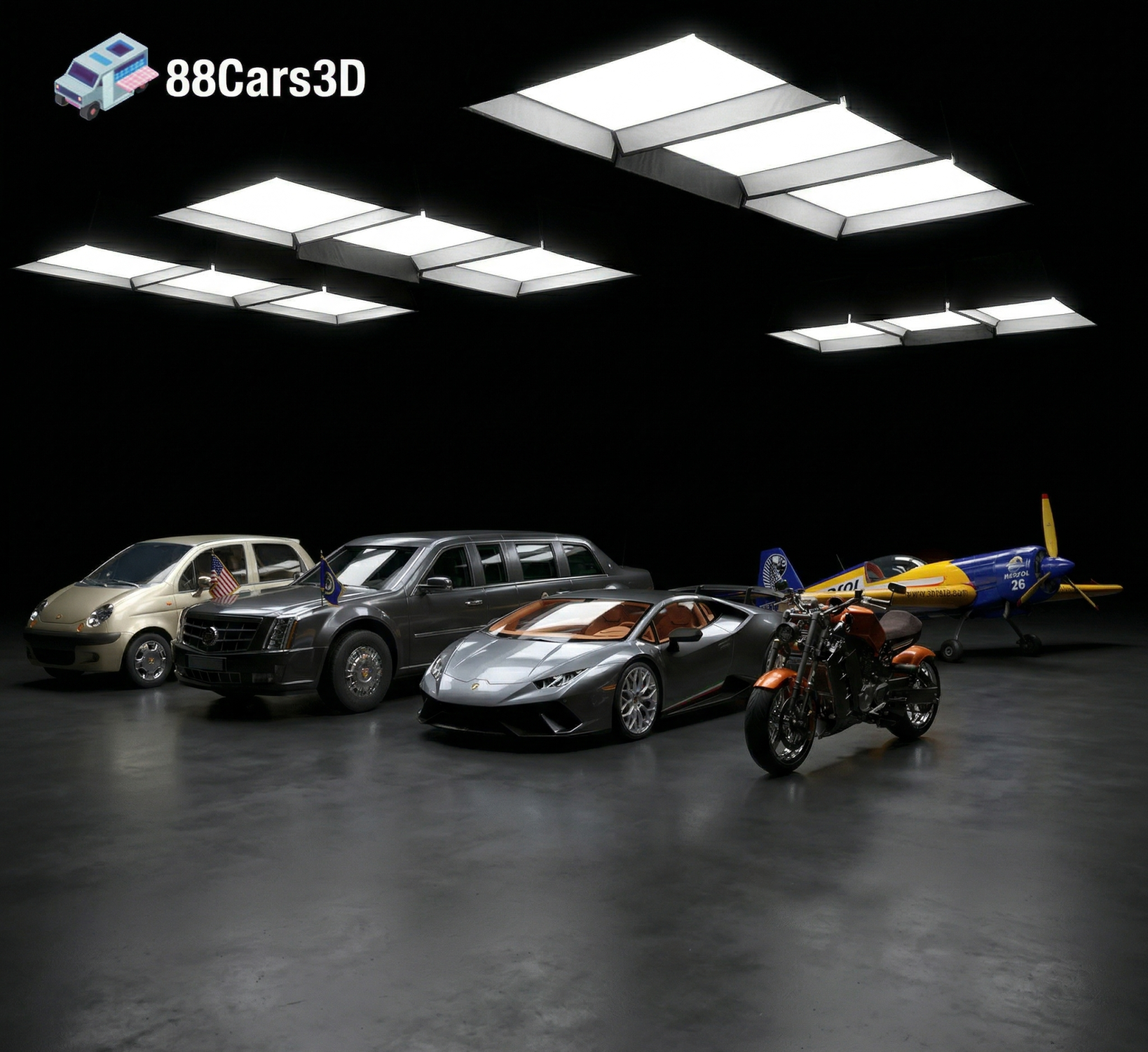
Texture: Yes | Material: Yes | 3D Printable: Yes. Download the Ultimate Creators’ Showcase featuring 5 premium 3D models: Lamborghini Huracan, ZAV Concept Motorcycle, Sukhoi SU-26, Presidential Limousine, and Daewoo Damas. Optimized for 4K CGI rendering and 3D printing. Save massive with this exclusive multi-category bundle!
Price: $99.99

Texture: Yes | Material: Yes | 3D Printable: Yes. Download the Italian Thoroughbreds Bundle featuring 5 iconic 3D models: Lamborghini Huracán Performante, Ferrari 458 Italia, Lamborghini Urus, Diablo SV, and Maserati GT. Optimized for 4K rendering and 3D printing (STL included). Save 50% with this ultimate Italian vehicle collection.
Price: $199.99

Download the Elite Future Mobility Bundle featuring 4 highly optimized 3D models: Tesla Model S, Avatr 11, Li L9, and Zoox Robotaxi. Perfect for ArchViz, Smart City renders, and game dev. Optimized for Unreal Engine and Blender. Includes .fbx, .obj, and .max formats.
Price: $99

🚗 5 Iconic German Cars (BMW M4 G82, M5 CS, X3, 1 Series & Mercedes E-Class). ✅ Optimized for ArchViz: Ready for Corona & V-Ray. 💰 Save €71 with this limited-time collection! 🚀 Instant Download after purchase.
Price: $119

Download the Extreme Off-Road & Survival 3D Models Bundle! Includes the Brabus 800 Adventure, Dodge Ram Bigfoot, Spec Truck, and a Caravan. Save over €210 on this premium 4-in-1 off-grid vehicle pack for ArchViz and game development.
Price: $149.99

Download the Heavy Duty & Commercial Logistics 3D Models Bundle! Includes the Ford Sterling, Caterpillar CT680, Mercedes Citaro Bus, and Vito Van. Save over €130 on this massive, game-ready 4-in-1 industrial vehicle pack.
Price: $109.99

Download the Ultimate Custom Motorcycles 3D Models Bundle. Includes a Custom Chopper, Ducati 916 Café Fighter, Harley XR1200X, and BMW K100. Perfect premium props for luxury ArchViz garages. Save over €250 today!
Price: $159.99

Download the ultimate JDM Street Racing 3D Models Bundle! Includes the Nissan GT-R, Toyota Supra, Mazda RX-7, Lancer Evo IX, and Honda NSX. Save big on this highly optimized, game-ready 5-in-1 Japanese legend car pack.
Price: $129.99

Download the ultimate American Muscle & Cinematic Classics 3D Models Bundle! Includes the Dodge Charger ’68, Mustang Eleanor GT500, Camaro Z28 ’79, and a custom ’69 Mustang. Save over €240 on this game-ready, premium 4-in-1 pack.
Price: $149.99

Download the Everyday City Traffic 3D Models Bundle. Includes the VW Golf, Kia Picanto, Hyundai Tucson, Toyota Yaris, and a DHL Ford Transit Van. Save big on this 5-in-1 pack, perfectly optimized for realistic ArchViz streets and game traffic.
Price: $99.99

