Get 20% OFF All Premium 3D & STL Models!

A high-quality 3D car model is a digital chameleon. In the hands of a skilled artist, the same base asset can become a hero car in a blockbuster film, a customizable vehicle in a high-octane video game, an interactive element in an augmented reality showroom, or even a physical scale model via 3D printing. However, transforming a single model for these wildly different applications is not a simple “export as” process. Each use case has its own strict technical requirements, from polygon count and texture resolution to material complexity and file format. Mastering the art of preparation and optimization is what separates amateur work from professional, production-ready results. Starting with a meticulously crafted asset, like those found on marketplaces such as 88cars3d.com, saves countless hours and provides the perfect foundation for these workflows.
This comprehensive guide will take you on a deep dive into the entire pipeline. We’ll deconstruct the process of preparing 3D car models for virtually any scenario. You will learn the industry-standard best practices for topology and edge flow, the strategic nuances of UV mapping for complex automotive surfaces, and the secrets to crafting photorealistic PBR materials. We’ll cover everything from high-fidelity rendering for marketing stills to hardcore performance optimization for game engines and AR/VR, finishing with the specific steps needed to prepare your model for the physical world of 3D printing. Let’s get started.
Topology—the structure and flow of polygons that form a 3D mesh—is the single most important aspect of a professional 3D car model. Clean topology ensures predictable deformations, smooth subdivision, and efficient texturing. The ideal polygon structure, however, varies significantly depending on the final application. A model destined for a close-up cinematic render has vastly different needs than one meant for a mobile racing game.
For cinematic and marketing renders where visual fidelity is the only priority, high-polygon models are the standard. These models often exceed 1 million polygons and are built almost exclusively with quadrilaterals (quads). The key here is creating a mesh that subdivides perfectly. Edge loops are strategically placed to define the sharp, crisp character lines of the car’s bodywork. Instead of using simple bevels, artists add multiple “support loops” or “holding edges” close to any hard edge. When a subdivision modifier (like TurboSmooth in 3ds Max or a Subdivision Surface modifier in Blender) is applied, these support loops hold the shape and create an incredibly smooth, yet sharp, transition, perfectly mimicking real-world manufacturing. This technique eliminates pinching and artifacts, which is crucial for capturing realistic reflections on the car paint.
The “mid-poly” workflow is a popular compromise, offering a great balance between detail and performance. This approach is common in high-end PC or console games for “hero” assets—the cars the player will be driving or interacting with up close. A typical mid-poly car model might range from 80,000 to 200,000 triangles. The topology is still predominantly quad-based to maintain good form, but support loops are used more sparingly. Instead of relying on subdivision, detail is “baked” from a super high-poly source mesh into a normal map. This normal map creates the illusion of fine details—like panel gaps, vents, and bolts—on a lower-polygon surface, saving huge amounts of performance. This is why professional 3D car models, a standard on platforms like 88cars3d.com, are almost exclusively built with clean, quad-based topology that can be easily adapted for either high-poly rendering or mid-poly game asset creation.
For mobile games, background traffic cars, or VR applications where every frame counts, low-polygon modeling is essential. These models are heavily optimized and can range from 5,000 to 30,000 triangles. Here, artists focus on silhouette and form, removing any edge loops that don’t contribute to the overall shape. Triangles are perfectly acceptable and often strategically used to reduce the polygon count further. The most critical technique in this domain is the creation of Levels of Detail (LODs). An LOD system uses multiple versions of the same model at decreasing levels of complexity. The game engine automatically swaps these models based on the car’s distance from the camera—showing the highest detail version (LOD0) up close, and a very simple version (LOD3) in the far distance, which might just be a few hundred polygons.
UV mapping is the process of flattening a 3D model’s surface into a 2D space so that textures can be applied correctly. For a complex object like a car, with its mix of large, smooth panels and intricate mechanical parts, a strategic approach to UV mapping is crucial for achieving professional results. Poor UVs can lead to stretched textures, visible seams, and inefficient use of texture space.
The first step is deciding where to place your “seams”—the edges where the 3D mesh will be cut to allow it to unfold flat. The golden rule is to hide seams where they are least likely to be seen. For a car, ideal places for seams are:
Try to keep large, visible surfaces like the hood, roof, and doors as single, contiguous UV shells. This prevents any seam-related artifacts in the middle of a panel where reflections and decals need to be perfect. For cylindrical parts like exhaust pipes or suspension components, place the seam along the bottom or back where it will be out of sight.
Texel density refers to the number of texture pixels (texels) per unit of 3D surface area. For a high-quality result, you need a consistent texel density across the entire model. If the doors have a high density and the bumper has a low density, the texture on the bumper will appear blurry or pixelated in comparison. Most 3D software has tools to visualize and equalize texel density. For hero assets, you’ll want to give more texture space (and thus higher texel density) to areas that will be seen up close, like the wheels, dashboard, and logos, while slightly reducing it for less important areas like the chassis.
For managing textures, you have two primary professional workflows:
Physically Based Rendering (PBR) is a methodology for shading and rendering that provides a more accurate representation of how light interacts with materials. Creating convincing PBR materials is the key to making your 3D car model look real. This workflow typically revolves around a set of texture maps that control different surface properties.
Understanding the core PBR texture maps is fundamental:
Standard PBR materials work well for most surfaces, but car paint requires a more advanced layered shader. A typical car paint material consists of three layers:
With a perfectly modeled and textured car, the final step for creating stunning marketing visuals or portfolio pieces is the rendering process. This involves setting up realistic lighting, cameras, and render settings to produce a photorealistic image. This is where automotive rendering truly shines.
The fastest and most realistic way to light a 3D car is with Image-Based Lighting (IBL) using a High Dynamic Range Image (HDRI). An HDRI is a 360-degree panoramic photo that contains a massive range of light intensity data. When used as an environment map in a 3D scene, it projects realistic light and reflections onto your model from all directions. For automotive rendering, choose high-resolution (16K+) HDRIs of studio environments, outdoor roads, or showrooms. To seamlessly integrate your car into a scene, use a matching high-resolution “backplate” image as the background and set up a “shadow catcher” plane underneath the car to catch realistic shadows.
Real-world photography principles are essential here. Avoid using wide-angle lenses (below 35mm) for hero shots, as they can distort the car’s proportions. Professional car photographers typically use longer focal lengths, between 50mm and 135mm, which compress the perspective and create a more flattering, powerful look. To add realism and draw focus, enable Depth of Field (DoF) in your camera settings. Use a wide aperture (low f-stop number) to create a shallow depth of field, blurring the background and making the car pop. This effect is subtle but makes a huge difference in perceived realism.
While the principles are similar, each render engine has its nuances.
Regardless of the engine, focus on balancing your render settings. Start with lower-quality progressive renders to quickly iterate on lighting and composition, then increase sample counts or lower noise thresholds for the final, high-resolution output. A final pass in post-production software like Photoshop or After Effects for color grading, contrast adjustments, and adding lens effects is always recommended.
Preparing 3D car models as performant game assets requires a complete shift in mindset from rendering. Here, every polygon, texture, and material is counted, as the goal is to maintain a high and stable framerate (e.g., 60 FPS). This involves a series of aggressive optimization techniques.
As mentioned earlier, LODs are non-negotiable for game performance. A robust LOD chain for a hero car might look like this:
Both Unreal Engine and Unity have built-in tools to manage LODs, automatically switching them based on screen space size.
A “draw call” is a command from the CPU to the GPU to draw an object on the screen. Too many draw calls can create a CPU bottleneck and tank your framerate. The number of draw calls is heavily influenced by the number of materials on an object. If your car has 20 different materials, it could result in 20 draw calls. By using the texture atlasing technique discussed in the UV mapping section, you can consolidate materials. For instance, all the chrome parts (grille, trim, badges) can be combined to share one material and one set of textures, reducing multiple draw calls to just one.
Game engines use specialized, compressed texture formats to reduce memory usage and improve loading times. Instead of standard PNGs or TGAs, you’ll be using formats like DXT (or BCn). These are “lossy” formats, but they offer significant memory savings. Modern engines like Unreal Engine and Unity handle this compression automatically on import. For meshes, it’s also crucial to ensure all geometry is triangulated before exporting, as the game engine will do this anyway, and doing it beforehand gives you control over how the quads are split, preventing potential shading issues.
The use cases for 3D car models extend beyond traditional screens. Augmented Reality (AR), Virtual Reality (VR), and 3D printing present their own unique sets of technical challenges that require specific preparation.
AR and VR applications are essentially ultra-performance-critical games. The primary goal is to maintain a rock-solid high framerate (typically 90 FPS for VR) to prevent motion sickness. This means optimization is even more aggressive.
Choosing the right file format is critical for these applications.
Preparing a model for 3D printing is a process of turning a digital visual asset into a blueprint for a physical object. The mesh must be:
As we’ve seen, a 3D car model is far more than just a collection of polygons. It’s a versatile asset whose potential is unlocked through careful, purpose-driven preparation. The journey from a raw digital sculpture to a final, optimized product requires a deep understanding of the end-use case. For photorealistic renders, you will focus on subdivision-ready topology, UDIM texturing, and advanced layered shaders. For game development, your priorities will shift entirely to polygon budgets, LOD chains, and draw call reduction through texture atlasing. And for the emerging worlds of AR/VR and 3D printing, you must adhere to strict performance constraints and ensure your model is a physically plausible, watertight object.
The key takeaway is that success lies in planning. By knowing your destination from the start—be it a marketing still, a game, or a physical prototype—you can apply the specific techniques outlined in this guide to achieve stunning, professional-grade results every time. The foundation of any great project is a great asset. To kickstart your next project with a model that is built to these exacting professional standards, explore the extensive library of production-ready 3D car models at 88cars3d.com, giving you the perfect starting point for any application you can imagine.

Texture: Yes
Material: Yes
Download the Mercedes-Benz SLK 350 2005 3D Model featuring clean geometry, realistic detailing, and a fully modeled interior. Includes .blend, .fbx, .obj, .glb, .stl, .ply, .unreal, and .max formats for rendering, simulation, and game development.
Price: $9.99

Texture: Yes
Material: Yes
Download the Mercedes-Benz SL 65 AMG 3D Model featuring clean geometry, realistic detailing, and a fully modeled interior. Includes .blend, .fbx, .obj, .glb, .stl, .ply, .unreal, and .max formats for rendering, simulation, and game development.
Price: $9.99

Texture: Yes
Material: Yes
Download the Mercedes-Benz S500 3D Model featuring clean geometry, realistic detailing, and a fully modeled interior. Includes .blend, .fbx, .obj, .glb, .stl, .ply, .unreal, and .max formats for rendering, simulation, and game development.
Price: $9.99

Texture: Yes
Material: Yes
Download the Mercedes-Benz S55 W220 AMG 1999 3D Model featuring clean geometry, realistic detailing, and a fully modeled interior. Includes .blend, .fbx, .obj, .glb, .stl, .ply, .unreal, and .max formats for rendering, simulation, and game development.
Price: $9.99

Texture: Yes
Material: Yes
Download the Mercedes-Benz CLA45 AMG 2017 3D Model featuring clean geometry, realistic detailing, and a fully modeled interior. Includes .blend, .fbx, .obj, .glb, .stl, .ply, .unreal, and .max formats for rendering, simulation, and game development.
Price: $29.99

Texture: Yes
Material: Yes
Download the Mercedes-Benz CL65 C215 AMG 3D Model featuring clean geometry, realistic detailing, and a fully modeled interior. Includes .blend, .fbx, .obj, .glb, .stl, .ply, .unreal, and .max formats for rendering, simulation, and game development.
Price: $9.99

Texture: Yes
Material: Yes
Download the Mercedes-Benz A45 2021 3D Model featuring clean geometry, realistic detailing, and a fully modeled interior. Includes .blend, .fbx, .obj, .glb, .stl, .ply, .unreal, and .max formats for rendering, simulation, and game development.
Price: $9.99

Texture: Yes
Material: Yes
Download the Mercedes-Benz 300SL 1955 3D Model featuring clean geometry, realistic detailing, and a fully modeled interior. Includes .blend, .fbx, .obj, .glb, .stl, .ply, .unreal, and .max formats for rendering, simulation, and game development.
Price: $9.99

Texture: Yes
Material: Yes
Download the Mercedes-Benz 190SL 1955 3D Model featuring clean geometry, realistic detailing, and a fully modeled interior. Includes .blend, .fbx, .obj, .glb, .stl, .ply, .unreal, and .max formats for rendering, simulation, and game development.
Price: $9.99
Texture: Yes
Material: Yes
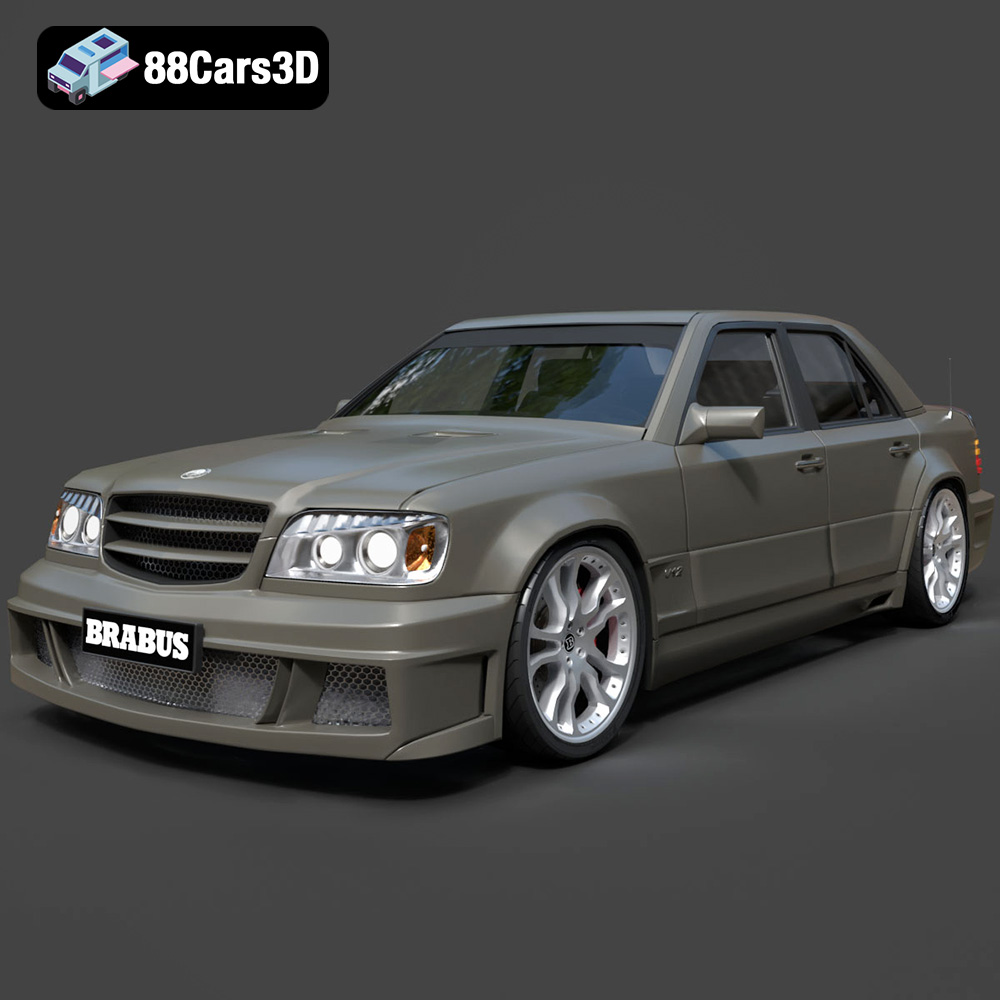
Download the Mercedes-Benz W124 Brabus V12 3D Model featuring clean geometry, realistic detailing, and a fully modeled interior. Includes .blend, .fbx, .obj, .glb, .stl, .ply, .unreal, and .max formats for rendering, simulation, and game development.
Price: $9.99

