Get 20% OFF All Premium 3D & STL Models!

“`html
There’s a unique thrill in creating a stunning automotive render. The way light dances across perfectly sculpted curves, the glint of a metallic flake paint, and the realistic contact of rubber on asphalt—it’s a blend of technical skill and artistic vision. But achieving this level of photorealism or real-time performance begins long before you touch the lighting or render settings. It starts with the core asset: the 3D car model itself. A great model can elevate your project, while a poor one can lead to endless frustration, rendering errors, and visual artifacts. This comprehensive guide is your roadmap to navigating the entire lifecycle of a professional 3D car model. We will dissect what makes a model truly high-quality, explore the intricacies of material creation, dive deep into rendering workflows for visualization, and uncover the essential optimization techniques required for game development and AR/VR applications. Whether you’re an automotive designer crafting a virtual prototype, a game developer building a racing simulator, or an archviz artist placing a vehicle in a scene, mastering these principles will empower you to transform a raw 3D mesh into a breathtaking final product.
Before diving into texturing or rendering, the first and most critical step is a thorough evaluation of your 3D model’s technical quality. A strong foundation here will prevent countless headaches down the line. A high-polygon model isn’t necessarily a high-quality one; the structure, organization, and preparation of the mesh are what truly matter. Investing time in this initial phase ensures that your model will behave predictably under different lighting conditions, deform correctly if animated, and be easily optimized for various applications. This is why professional marketplaces like 88cars3d.com invest heavily in clean, well-structured models, as they provide a reliable starting point for any project.
Topology refers to the arrangement of vertices, edges, and polygons that form the 3D mesh. For automotive models, this is paramount. Good topology is characterized by a clean, quad-based mesh (four-sided polygons) with deliberate edge flow that follows the natural contours and panel lines of the vehicle. This structure is essential for several reasons:
When you inspect a model, look for evenly spaced quads across large surfaces and increased density around areas of high curvature or detail. A typical high-quality hero car model for visualization might range from 500,000 to 2 million polygons after subdivision.
UV mapping is the process of flattening a 3D mesh into a 2D space to apply textures correctly. For complex objects like cars, a well-thought-out UV layout is crucial. Look for non-overlapping UV islands, which ensure that each part of the model has a unique texture space, preventing textures from bleeding onto unintended areas. For extreme close-ups and high-resolution renders, models may use the UDIM (U-Dimension) workflow, where the UVs are spread across multiple texture tiles. This allows for incredibly high texture resolutions (e.g., multiple 4K or 8K maps) without sacrificing performance. Check for minimal distortion in the UV shells; a checkerboard pattern applied to the model should appear as uniform squares across the entire surface. A poor UV map will stretch and distort textures, destroying realism.
Before you begin work, it’s vital to set up your scene correctly. The most important step is ensuring the model is at real-world scale. If a car is 4.5 meters long in reality, it should be 4.5 meters (or 450 cm) in your 3D software. This is non-negotiable, as lighting, physics simulations, and depth of field calculations in render engines like Corona and V-Ray are physically based and depend on accurate scale. After importing, check for flipped normals (polygons facing the wrong way), which will render black or transparent. Finally, organize the model. A professional model should have its components logically named (e.g., “wheel_FL,” “door_driver,” “brake_caliper_RR”) and grouped or layered for easy selection and management.
With a clean and prepared model, the next stage is to breathe life into it with realistic materials. The industry standard for this is the Physically Based Rendering (PBR) workflow, which simulates how light interacts with surfaces in the real world. This approach relies on a set of texture maps that define a material’s physical properties. Mastering PBR material creation is the key to achieving photorealistic metals, plastics, glass, and, most importantly, the complex car paint shader that defines a vehicle’s character.
The most common PBR workflow is Metalness/Roughness. It uses several key texture maps:
A car paint material is more than just a color; it’s a complex stack of layers. A convincing car paint shader in 3ds Max (using Corona or V-Ray) or Blender (using Cycles) typically involves three main components:
Realism lies in the details. Tires require a dark, high-roughness material, with a normal map for the sidewall lettering and tread pattern. Use a separate UV channel or decal system for branding like “Michelin” or “Pirelli.” For glass, use a dedicated glass shader with a slight tint (often a very light green or blue) and a high Index of Refraction (IOR) of around 1.52. To sell the effect, add a subtle grunge or dirt map to the roughness channel to simulate smudges, especially around the edges of the windows. Plastic trim materials for bumpers and dashboards often have a very fine procedural noise bump map to simulate a textured finish and a higher roughness value to appear matte.
A perfect model and flawless materials can still fall flat without compelling lighting. Lighting in automotive visualization serves two purposes: it illuminates the vehicle and, more importantly, it uses reflections to define the car’s shape and form. Every curve, crease, and contour is revealed by the way it reflects its environment. Whether you’re aiming for a clean studio shot or a dynamic environmental render, mastering lighting is the final artistic step in creating a stunning image.
The most efficient and realistic way to light a 3D car is with Image-Based Lighting (IBL) using a High Dynamic Range Image (HDRI). An HDRI is a 360-degree panoramic image that contains a vast range of light intensity data, from the darkest shadows to the brightest highlights of the sun. When used as an environment map in your 3D scene, it projects this light information from all directions, creating incredibly realistic and nuanced lighting and reflections.
While an HDRI provides a fantastic base, professional renders often add custom lights to further sculpt the car. This is akin to a real-world photoshoot. You can add large area lights (planes or discs) to act as a key light (the main light source), a fill light (to soften shadows), and rim lights (placed behind the car to create a bright outline that separates it from the background). By controlling the intensity, color, and position of these lights, you can draw the viewer’s eye to specific design features, like the grille, wheels, or side profile.
Balancing render quality with render time is a constant challenge. Modern render engines like Corona and V-Ray have simplified this with progressive rendering based on noise levels.
– Global Illumination (GI): For most automotive scenes, a primary GI solver of Brute Force (or Path Tracing) combined with a secondary solver like Light Cache (in V-Ray) or UHD Cache (in Corona) offers the best balance of quality and speed for calculating bounced light.
When moving from pre-rendered visualization to real-time applications like video games, AR, or VR, the priority shifts from ultimate visual fidelity to maximum performance. A two-million-polygon model that renders beautifully in Corona would bring any game engine to its knees. Real-time optimization is a process of intelligently reducing complexity while preserving visual quality as much as possible. Starting with a well-structured model from a source like 88cars3d.com, which often includes clean topology, can make this optimization process significantly more efficient.
The cornerstone of real-time mesh optimization is the Level of Detail (LOD) system. An LOD system uses multiple versions of the same model at varying polygon counts. The highest quality version, LOD0, is shown when the player is close to the car. As the car moves further away, the game engine automatically swaps it for lower-poly versions (LOD1, LOD2, etc.).
This process can be done manually by a 3D artist or with automated tools like Simplygon, but manual retopology almost always yields superior results for the critical LOD0.
In game engines, every material applied to an object can result in a separate draw call—a command from the CPU to the GPU to draw something. Too many draw calls can create a CPU bottleneck and lower the frame rate. To combat this, we use texture atlasing. This involves combining the textures for multiple different parts of the car (e.g., the body, the trim, the lights) into a single, larger texture set. For example, instead of having five separate 2K materials, you might have one 4K material that services all five parts. This drastically reduces draw calls. Additionally, textures are compressed using formats like DXT/BCn to reduce VRAM usage, which is crucial for performance, especially on consoles and mobile devices.
When importing your optimized model (typically as an FBX file) into an engine like Unreal Engine or Unity, you need to configure it properly. This involves setting up the materials using the engine’s native shader system (e.g., Unity’s HDRP Lit Shader or Unreal’s Material Editor). You will also need to set up physics colliders—simplified, invisible meshes that define the car’s physical shape for collision detection. These are usually a series of convex hull shapes that are much simpler than the visible geometry. Finally, you’ll need to configure the LOD system within the engine, specifying the screen-space size at which each LOD level should switch.
The use of 3D car models extends beyond traditional screens into the immersive worlds of Augmented and Virtual Reality, and even into the physical world through 3D printing. Each of these applications has its own unique set of technical requirements and optimization strategies that differ significantly from those for rendering or gaming. The key challenges revolve around file formats, extreme performance constraints, and ensuring a model is physically printable.
For AR/VR, models need to be delivered in highly efficient, web-friendly formats. The two dominant standards are:
To create these, you typically export from software like Blender or use conversion tools. The target file size for a high-quality AR car model is often under 50MB to ensure fast loading times on mobile devices.
Performance is absolutely critical in VR, where a stable 90 frames per second (FPS) is required to prevent motion sickness. Optimization must be aggressive. Polygon counts are often even lower than in traditional games (e.g., 50k-80k triangles for a detailed hero asset). Textures are heavily compressed, and shader complexity is kept to a minimum. Techniques like baked lighting are often used, where realistic shadows and ambient occlusion are pre-calculated and saved into a texture map, removing the need for expensive real-time lighting calculations. Transparency is computationally expensive and should be used sparingly.
Preparing a model for 3D printing is an entirely different discipline. The goal is to create a “watertight” or “manifold” mesh. This means the mesh must be a single, continuous, closed surface with no holes. Any gaps or intersecting geometry will confuse the slicing software that prepares the model for the printer.
The raw output from a render engine is rarely the final image. Just like a professional photographer edits their photos, a 3D artist uses post-processing to elevate their render from a great image to a spectacular one. This final stage is where you can fine-tune colors, add atmospheric effects, and introduce subtle camera imperfections that sell the illusion of photorealism. This process is typically done in software like Adobe Photoshop, After Effects, or Blackmagic Fusion using render elements exported from the 3D application.
Instead of just rendering a single final image (a “beauty pass”), you should export multiple Render Elements, also known as Arbitrary Output Variables (AOVs). These are separate images that isolate different components of the final render. Essential AOVs for automotive rendering include:
In your compositing software, your workflow would look something like this: Start with the beauty pass as your base layer. Layer the AO pass on top using a “Multiply” blend mode and reduce its opacity to 10-20% to subtly enhance contact shadows. Use the Specular and Reflection passes with a “Screen” or “Add” blend mode to boost highlights on the bodywork. Use the Cryptomatte pass to select the background and slightly desaturate or color-shift it to make the car stand out. This layered, non-destructive approach gives you complete creative control over the final look.
The last step is color grading. This is where you establish the final mood of the image. You can apply a Look-Up Table (LUT) for a cinematic color scheme, use Curves adjustments for precise control over contrast, and add subtle imperfections that mimic a real camera lens. These include a slight vignette (darkening the corners of the image), a touch of chromatic aberration (slight color fringing on high-contrast edges), and a soft glow or bloom effect on the brightest highlights. These final touches are what bridge the gap between a technically perfect CG image and a piece of art that evokes emotion.
A 3D car model is more than just a collection of polygons; it’s the canvas for your creative vision. We’ve journeyed through the entire pipeline, from the foundational importance of clean topology and precise UV mapping to the artistic nuances of PBR material creation and cinematic lighting. We’ve seen how a single model must be transformed and optimized for wildly different outputs, whether it’s a photorealistic marketing image, a high-performance game asset, or a tangible 3D print. The key takeaway is that success in any of these fields hinges on understanding the technical requirements of your target platform and making deliberate, informed decisions at every stage of the process.
The journey from a raw file to a stunning final product is complex, but it is also incredibly rewarding. By starting with a high-quality asset and applying the principles of meticulous preparation, realistic texturing, thoughtful lighting, and intelligent optimization, you can ensure your projects not only meet but exceed professional standards. Now it’s time to apply these techniques. Open up your software, load your model, and start creating the breathtaking automotive visuals you’ve envisioned.
“`

Texture: Yes
Material: Yes
Download the Mercedes-Benz SLK 350 2005 3D Model featuring clean geometry, realistic detailing, and a fully modeled interior. Includes .blend, .fbx, .obj, .glb, .stl, .ply, .unreal, and .max formats for rendering, simulation, and game development.
Price: $9.99

Texture: Yes
Material: Yes
Download the Mercedes-Benz SL 65 AMG 3D Model featuring clean geometry, realistic detailing, and a fully modeled interior. Includes .blend, .fbx, .obj, .glb, .stl, .ply, .unreal, and .max formats for rendering, simulation, and game development.
Price: $9.99

Texture: Yes
Material: Yes
Download the Mercedes-Benz S500 3D Model featuring clean geometry, realistic detailing, and a fully modeled interior. Includes .blend, .fbx, .obj, .glb, .stl, .ply, .unreal, and .max formats for rendering, simulation, and game development.
Price: $9.99

Texture: Yes
Material: Yes
Download the Mercedes-Benz S55 W220 AMG 1999 3D Model featuring clean geometry, realistic detailing, and a fully modeled interior. Includes .blend, .fbx, .obj, .glb, .stl, .ply, .unreal, and .max formats for rendering, simulation, and game development.
Price: $9.99

Texture: Yes
Material: Yes
Download the Mercedes-Benz CLA45 AMG 2017 3D Model featuring clean geometry, realistic detailing, and a fully modeled interior. Includes .blend, .fbx, .obj, .glb, .stl, .ply, .unreal, and .max formats for rendering, simulation, and game development.
Price: $29.99

Texture: Yes
Material: Yes
Download the Mercedes-Benz CL65 C215 AMG 3D Model featuring clean geometry, realistic detailing, and a fully modeled interior. Includes .blend, .fbx, .obj, .glb, .stl, .ply, .unreal, and .max formats for rendering, simulation, and game development.
Price: $9.99

Texture: Yes
Material: Yes
Download the Mercedes-Benz A45 2021 3D Model featuring clean geometry, realistic detailing, and a fully modeled interior. Includes .blend, .fbx, .obj, .glb, .stl, .ply, .unreal, and .max formats for rendering, simulation, and game development.
Price: $9.99

Texture: Yes
Material: Yes
Download the Mercedes-Benz 300SL 1955 3D Model featuring clean geometry, realistic detailing, and a fully modeled interior. Includes .blend, .fbx, .obj, .glb, .stl, .ply, .unreal, and .max formats for rendering, simulation, and game development.
Price: $9.99

Texture: Yes
Material: Yes
Download the Mercedes-Benz 190SL 1955 3D Model featuring clean geometry, realistic detailing, and a fully modeled interior. Includes .blend, .fbx, .obj, .glb, .stl, .ply, .unreal, and .max formats for rendering, simulation, and game development.
Price: $9.99
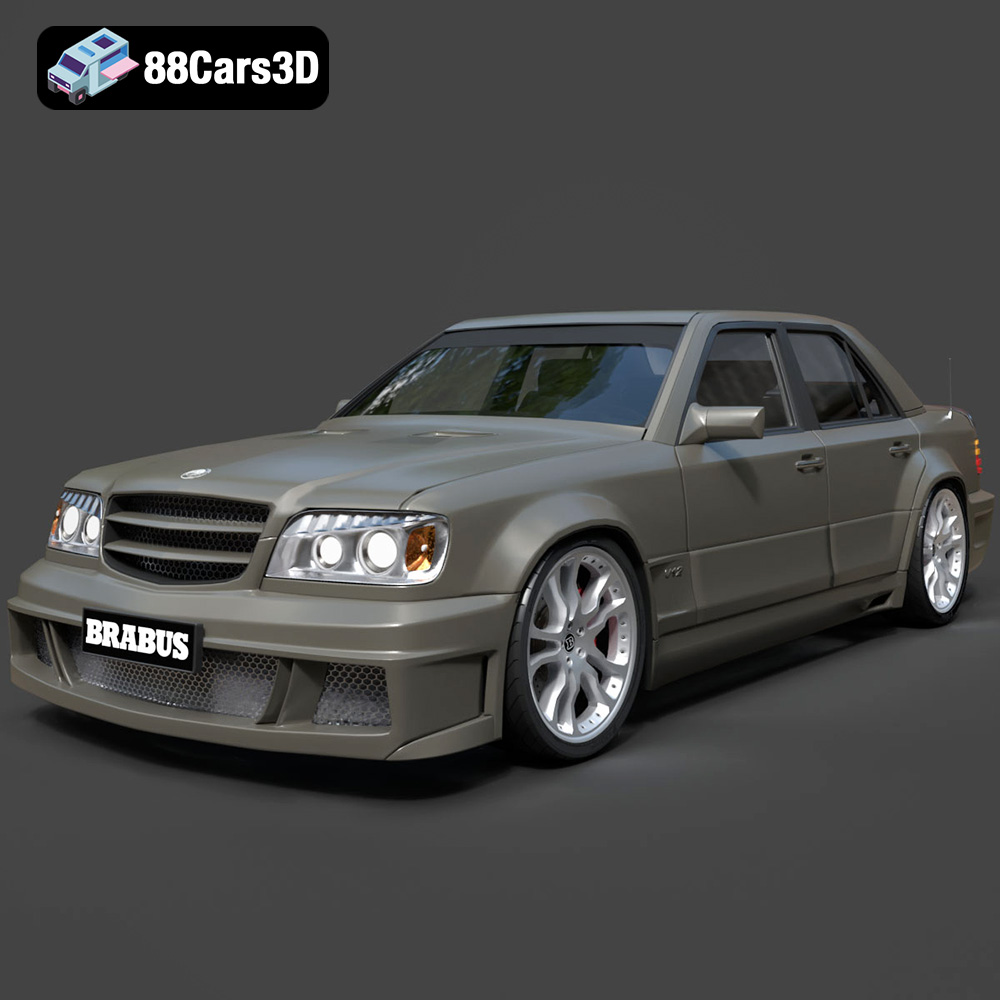
Texture: Yes
Material: Yes
Download the Mercedes-Benz W124 Brabus V12 3D Model featuring clean geometry, realistic detailing, and a fully modeled interior. Includes .blend, .fbx, .obj, .glb, .stl, .ply, .unreal, and .max formats for rendering, simulation, and game development.
Price: $9.99

