Get 50% OFF All Premium 3D & STL Models!

“`html
The world of automotive 3D modeling is a fascinating blend of art and engineering. Whether you’re crafting realistic renderings, developing immersive game assets, or preparing models for 3D printing, the process demands a deep understanding of topology, texturing, rendering, and optimization. This comprehensive guide will walk you through the essential techniques and workflows, equipping you with the knowledge to create stunning 3D car models that meet the highest industry standards. We’ll explore everything from clean topology and UV mapping to PBR material creation and game engine optimization, providing actionable insights for both beginners and experienced 3D artists. Platforms like 88cars3d.com offer a great starting point for finding high-quality base models to practice with.
Topology is the backbone of any successful 3D model, especially when dealing with the complex curves and surfaces of a car. Clean and efficient topology ensures smooth deformations, predictable shading, and optimized performance. A poorly constructed model can lead to rendering artifacts, animation problems, and difficulties in later stages of the workflow.
Edge loops are continuous chains of edges that define the shape and flow of a 3D model. In automotive modeling, prioritizing edge loops that follow the contours of the car’s body is crucial. This ensures that when you subdivide the mesh (add more polygons for smoother surfaces), the shape of the car remains accurate and the reflections behave realistically. Aim for evenly spaced edge loops in areas with curvature, such as the fenders and roof. For flat surfaces, fewer edge loops are necessary.
Finding the right balance between polygon density and subdivision is essential. Starting with a low-polygon base mesh allows for easier manipulation and refinement. As you refine the model, you can gradually increase the polygon count by adding edge loops or using subdivision modifiers (like Subdivision Surface in Blender or TurboSmooth in 3ds Max). Remember that excessive polygon density can negatively impact performance, especially in real-time applications like games or AR/VR experiences. A good starting point for a car model intended for rendering might be around 50,000 to 150,000 polygons before subdivision. The final polygon count after subdivision depends on the desired level of detail and the target rendering engine. For game assets, keeping the polygon count significantly lower is crucial, often requiring LODs (Levels of Detail) which we will discuss later.
While triangles are unavoidable in some situations, especially during game engine optimization, try to minimize their use and avoid n-gons (polygons with more than four sides) whenever possible. N-gons can cause unpredictable shading and deformation artifacts. Convert n-gons to quads (four-sided polygons) by adding edges or using tools specifically designed for this purpose. If triangles are necessary, strategically place them in areas where they are less likely to be noticeable, such as under the car or in recessed areas.
UV mapping is the process of projecting a 2D texture onto a 3D model. A well-executed UV map is critical for achieving realistic textures and avoiding stretching or distortion. Automotive models, with their complex curves and intricate details, require careful planning and execution of the UV mapping process.
The placement of UV seams (the cuts that define the boundaries of the UV islands) is crucial for minimizing distortion. Hide seams in areas that are less visible, such as along panel gaps, under the car, or inside the wheel wells. For curved surfaces like fenders and doors, consider using multiple seams to reduce stretching. Experiment with different seam placement strategies to find the optimal balance between distortion and the number of UV islands.
Once you’ve created your UV seams, you’ll need to optimize the UV islands (the individual pieces of the UV map). Maximize the UV space by scaling and rotating the islands to fit efficiently within the 0-1 UV space. Avoid overlapping UV islands, as this will cause texture conflicts. Use a UV packing tool to automatically arrange the islands for optimal space utilization. A good UV packing should aim for at least 80% UV space utilization.
For highly detailed textures, consider using UDIMs (UV Dimension). UDIMs allow you to extend the UV space beyond the 0-1 range, assigning different texture tiles to different UV quadrants. This enables you to use extremely high-resolution textures without sacrificing detail. UDIMs are particularly useful for creating realistic paint scratches, dirt, and other surface imperfections. For example, you might use a 4K texture for the main body panels and a separate 4K texture for the wheels and tires, all managed through UDIMs.
Physically Based Rendering (PBR) is a rendering technique that simulates the interaction of light with materials in a realistic way. PBR materials are defined by a set of parameters that describe the surface properties, such as color, roughness, and metallicness. Creating accurate PBR materials is essential for achieving photorealistic results in automotive rendering.
The key PBR parameters include: Base Color (or Albedo), Roughness, Metallic, Normal Map, and Ambient Occlusion (AO). Base Color defines the diffuse color of the material. Roughness controls the surface smoothness, with lower values resulting in a glossier surface. Metallic determines whether the material behaves like a metal or a non-metal. Normal Maps add surface detail without increasing the polygon count. Ambient Occlusion simulates the darkening of surfaces in crevices and corners. Understanding how these parameters interact is crucial for creating realistic materials.
Creating realistic car paint requires a layered approach. Start with a base coat color and then add a clear coat layer. The clear coat should have a high glossiness (low roughness) to simulate the reflective properties of the paint. Use a micro-scratch normal map to add subtle imperfections to the clear coat surface. Experiment with different flake patterns to create metallic paint effects. Consider using a Car Paint shader available in some render engines, which are specifically designed to simulate the complex layered structure of automotive paint.
Creating PBR materials from scratch can be time-consuming. Consider using material libraries or purchasing pre-made PBR textures. When sourcing materials, pay attention to the resolution and quality of the textures. High-resolution textures (2K or 4K) are recommended for close-up shots. When sourcing models from marketplaces such as 88cars3d.com, ensure that the included materials are high-quality and PBR-compliant.
Rendering is the final step in the 3D modeling process, where the 3D model is converted into a 2D image. Choosing the right rendering engine and settings is critical for achieving photorealistic results. Popular rendering engines for automotive visualization include Corona Renderer, V-Ray, Cycles (Blender), and Arnold.
Corona Renderer is known for its ease of use and ability to produce photorealistic results with relatively little effort. It features a progressive rendering engine that allows you to see the final image gradually converge, making it easy to fine-tune the lighting and materials. Corona Renderer is particularly well-suited for architectural and automotive visualization.
V-Ray is an industry-standard rendering engine used in a wide range of industries, including film, animation, and automotive design. V-Ray offers a wide range of features and options, allowing for precise control over the rendering process. V-Ray is known for its speed, stability, and ability to handle complex scenes.
Lighting plays a crucial role in the realism of a rendering. Use a combination of natural and artificial lights to create a balanced and visually appealing scene. High Dynamic Range Images (HDRIs) are often used to create realistic environment lighting. Experiment with different HDRI environments to find one that complements the car model and the overall scene. Consider using area lights to simulate soft, diffused lighting. Properly setting up reflections, refractions, and global illumination (GI) is crucial for achieving a realistic final image.
Creating 3D car models for games requires a different set of considerations than creating them for rendering. Game engines have strict performance requirements, so it’s essential to optimize the model to ensure smooth frame rates.
LOD meshes are simplified versions of the 3D model that are used when the object is far away from the camera. This reduces the number of polygons that need to be rendered, improving performance. Create multiple LOD levels, with each level having progressively fewer polygons. For example, a detailed LOD0 mesh might have 50,000 polygons, while a lower-resolution LOD2 mesh might have only 5,000 polygons. The game engine automatically switches between the LOD levels based on the distance to the camera.
Texture atlasing is the process of combining multiple textures into a single larger texture. This reduces the number of draw calls (the number of times the CPU instructs the GPU to draw something), which can significantly improve performance. Group materials that use similar textures together and combine their textures into a single atlas. Aim to minimize the number of materials used on the car model. For instance, all the metallic parts of the car might share the same metallic texture in an atlas.
Collision meshes are simplified versions of the 3D model that are used for collision detection. They don’t need to be as detailed as the visual meshes, so they can have a much lower polygon count. Create collision meshes that accurately represent the overall shape of the car, while minimizing the number of polygons. In many cases, simple box or capsule colliders can be used for the chassis and wheels.
Choosing the right file format is crucial for ensuring compatibility between different software packages and platforms. Popular file formats for 3D car models include FBX, OBJ, GLB, and USDZ.
FBX is a versatile file format that supports a wide range of features, including meshes, materials, textures, animations, and cameras. It is widely supported by 3D modeling software, game engines, and rendering engines. FBX is a good choice for transferring 3D models between different applications.
OBJ is a simple and widely supported file format that primarily stores mesh data. It does not support animations or complex material properties. OBJ is a good choice for exporting static 3D models for use in rendering or 3D printing.
GLB is a binary file format that is optimized for web delivery and real-time rendering. It is based on the glTF (GL Transmission Format) standard. GLB files are efficient in terms of file size and loading speed, making them ideal for use in web-based 3D viewers and AR/VR applications. GLB supports PBR materials and basic animations.
USDZ is a file format developed by Apple for augmented reality (AR) applications. It is based on the USD (Universal Scene Description) format. USDZ files are optimized for real-time rendering on iOS devices and support PBR materials and basic animations. USDZ is the preferred format for creating AR experiences on Apple devices.
Mastering automotive 3D modeling requires a combination of technical skills, artistic vision, and attention to detail. By understanding the principles of topology, UV mapping, PBR materials, rendering, and game engine optimization, you can create stunning 3D car models that meet the demands of various industries. Remember to practice regularly, experiment with different techniques, and stay up-to-date with the latest industry trends. Utilizing resources and platforms like 88cars3d.com to source high-quality models can be a great way to accelerate your learning and refine your skills. Start experimenting with the techniques discussed in this guide, and watch your automotive 3D modeling skills reach new heights. Focus on building a strong foundation in topology and UV mapping, as these are the cornerstones of any successful 3D model. Good luck, and happy modeling!
“`

Texture: Yes
Material: Yes
Download the Toyota Mark 2 2001 3D Model featuring clean geometry, realistic detailing, and a fully modeled interior. Includes .blend, .fbx, .obj, .glb, .stl, .ply, .unreal, and .max formats for rendering, simulation, and game development.
Price: $10

Texture: Yes
Material: Yes
Download the Toyota Celica 2000 3D Model featuring clean geometry, realistic detailing, and a fully modeled interior. Includes .blend, .fbx, .obj, .glb, .stl, .ply, .unreal, and .max formats for rendering, simulation, and game development.
Price: $10

Download the Toyota Camry US 2012 3D Model featuring clean geometry, realistic detailing, and a fully modeled interior. Includes .blend, .fbx, .obj, .glb, .stl, .ply, .unreal, and .max formats for rendering, simulation, and game development.
Price: $10

Texture: Yes
Material: Yes
Download the Toyota GT 86 2013 3D Model featuring clean geometry, realistic detailing, and a fully modeled interior. Includes .blend, .fbx, .obj, .glb, .stl, .ply, .unreal, and .max formats for rendering, simulation, and game development.
Price: $10

Texture: Yes
Material: Yes
Download the Toyota Mark X 2010 3D Model featuring clean geometry, realistic detailing, and a fully modeled interior. Includes .blend, .fbx, .obj, .glb, .stl, .ply, .unreal, and .max formats for rendering, simulation, and game development.
Price: $10
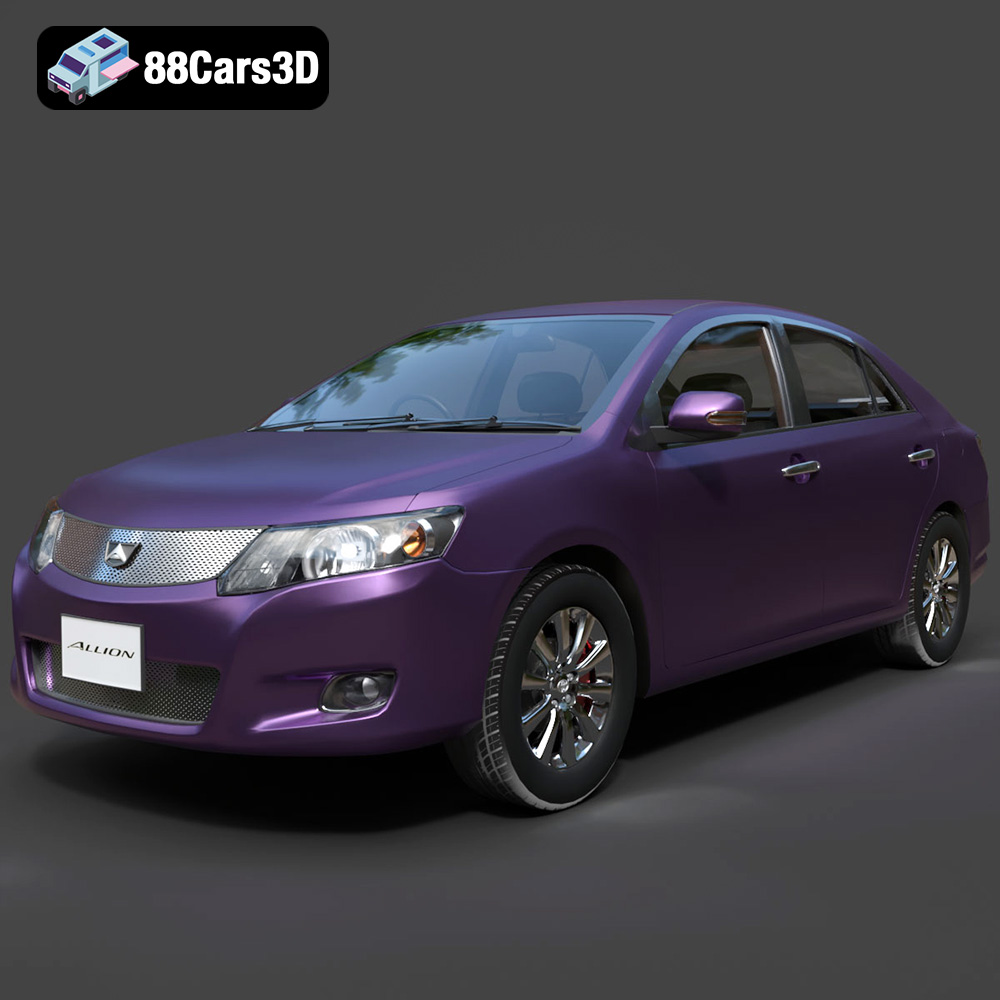
Texture: Yes
Material: Yes
Download the Toyota Allion 2008 3D Model featuring clean geometry, realistic detailing, and a fully modeled interior. Includes .blend, .fbx, .obj, .glb, .stl, .ply, .unreal, and .max formats for rendering, simulation, and game development.
Price: $10
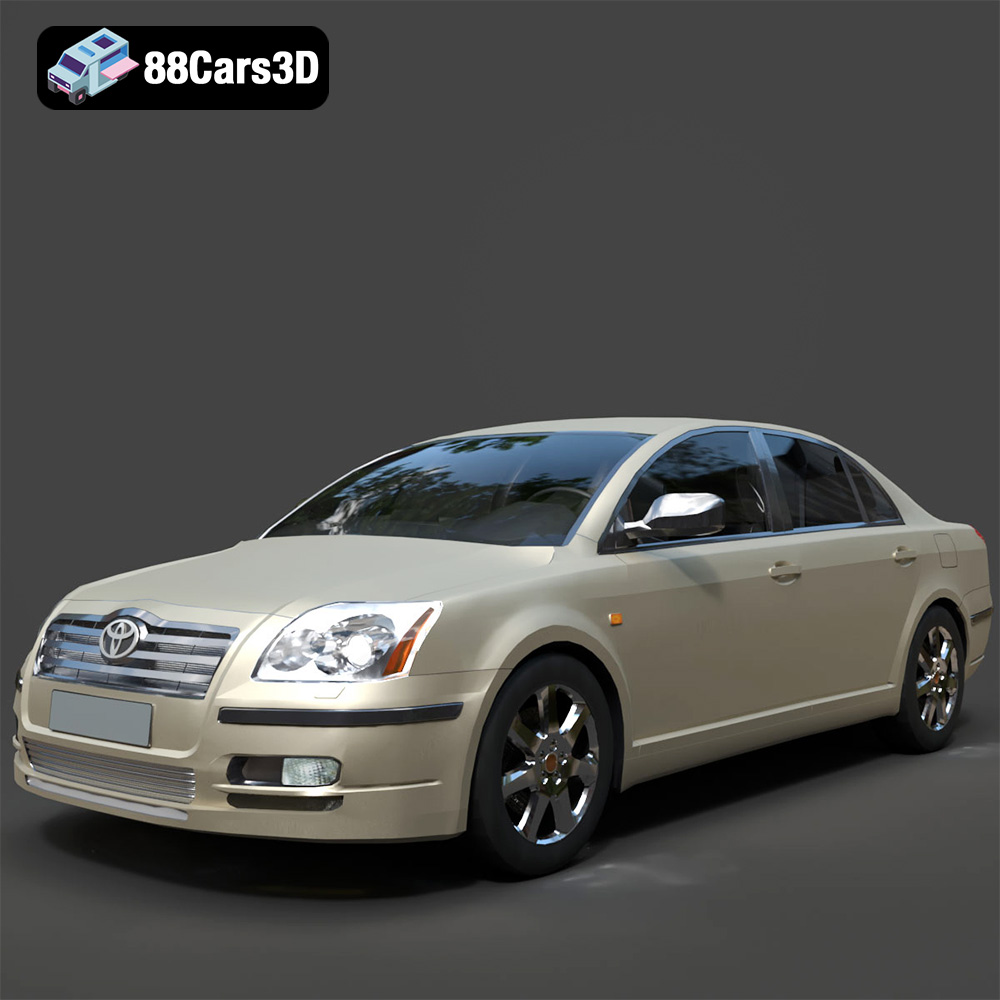
Texture: Yes
Material: Yes
Download the Toyota Avensis 2005 3D Model featuring clean geometry, realistic detailing, and a fully modeled interior. Includes .blend, .fbx, .obj, .glb, .stl, .ply, .unreal, and .max formats for rendering, simulation, and game development.
Price: $10

Texture: Yes
Material: Yes
Download the Skoda Superb 2009 3D Model featuring clean geometry, realistic detailing, and a fully modeled interior. Includes .blend, .fbx, .obj, .glb, .stl, .ply, .unreal, and .max formats for rendering, simulation, and game development.
Price: $10

Texture: Yes
Material: Yes
Download the Skoda Superb 2006 3D Model featuring clean geometry, realistic detailing, and a fully modeled interior. Includes .blend, .fbx, .obj, .glb, .stl, .ply, .unreal, and .max formats for rendering, simulation, and game development.
Price: $10

Texture: Yes
Material: Yes
Download the Ford Mustang Shelby Super Snake Concept 2018 3D Model featuring clean geometry, realistic detailing, and a fully modeled interior. Includes .blend, .fbx, .obj, .glb, .stl, .ply, .unreal, and .max formats for rendering, simulation, and game development.
Price: $18.99

