Get 50% OFF All Premium 3D & STL Models!

Unreal Engine has revolutionized the world of real-time rendering, transforming it from a tool exclusively for game development into a powerhouse for industries ranging from architecture to filmmaking. Nowhere is this transformation more apparent than in automotive visualization. The ability to create photorealistic, interactive, and dynamic experiences has empowered automakers, marketing agencies, and creative professionals to showcase vehicles with unprecedented fidelity. Gone are the days of long, costly offline renders. Today, we can build everything from stunning cinematic commercials to fully interactive car configurators that run in real-time, all within a single, unified ecosystem. This guide is your roadmap to mastering this powerful workflow.
This comprehensive article will walk you through the entire process of bringing a high-quality 3D car model into Unreal Engine 5 and transforming it into a portfolio-ready piece. We will cover the essential steps from initial asset preparation and import to crafting complex PBR materials, setting up dynamic lighting with Lumen, building interactive features with Blueprint, and optimizing your project for flawless performance. Whether you’re a 3D artist aiming for photorealism, a game developer building a racing simulator, or a visualization specialist creating a virtual showroom, the techniques detailed here will provide you with the technical foundation to elevate your automotive projects to the next level.
The foundation of any stunning real-time visualization is a high-quality, well-prepared 3D model. Garbage in, garbage out—this principle holds especially true in the demanding world of automotive rendering where every surface, curve, and reflection matters. Proper preparation ensures not only visual fidelity but also optimal performance and a smooth workflow once you’re inside the engine. Starting with a clean and intelligently constructed asset saves countless hours of troubleshooting down the line. Platforms like 88cars3d.com offer professionally crafted 3D car models that are often built with these real-time requirements in mind, providing an excellent starting point.
Before you even think about importing, inspect your model’s topology. The ideal model for Unreal Engine features clean, quad-based geometry where possible, as this subdivides predictably and works well with complex material effects. However, triangles are not the enemy—Unreal Engine’s renderer, and especially Nanite, triangulates everything under the hood. The key is to avoid common pitfalls like non-manifold geometry, overlapping faces, and excessively dense meshes in areas that don’t require detail. For automotive models, pay close attention to the main body panels, ensuring smooth, flowing edge loops that capture the vehicle’s character lines perfectly. A typical high-quality hero vehicle model for visualization might range from 500,000 to several million polygons, a range that UE5’s Nanite can handle with ease.
Equally critical are the UV maps. A professional automotive model should have multiple, well-organized UV channels:
While Unreal Engine supports several file formats, FBX remains the industry standard for individual game assets due to its robustness and compatibility. USD (Universal Scene Description) is also gaining significant traction, especially for complex scenes and collaborative workflows. For this guide, we’ll focus on the FBX workflow.
When importing your vehicle’s FBX file into Unreal Engine, the import dialog presents several crucial options:
Properly configuring these settings on import ensures your model comes into the engine structured, optimized, and ready for the next stage: material creation.
The realism of your automotive visualization hinges on the quality of your materials. Unreal Engine’s node-based Material Editor is an incredibly powerful tool that allows you to simulate virtually any real-world surface. For vehicles, this means creating convincing car paint, brushed metal, textured plastics, realistic rubber, and flawless glass. This is achieved through a Physically Based Rendering (PBR) workflow, which aims to mimic how light interacts with materials in the real world.
The core of PBR materials relies on a set of texture maps that define a surface’s properties. For most opaque materials on a car, you will primarily work with these inputs in the Material Editor:
By correctly authoring and combining these maps, you can build a library of materials that accurately represent every component of your vehicle.
Standard car paint is one of the most complex materials to replicate. It’s a multi-layered surface with a base coat, a metallic flake layer, and a top clear coat. Unreal Engine’s Material Editor has a specific shading model to handle this.
Here’s a simplified breakdown of creating a two-stage metallic paint material:
This layered approach creates a deep, rich surface where reflections on the clear coat are sharp, while the underlying metallic layer has a softer, more complex shimmer—just like real automotive paint.
Glass requires a different approach. Set the Material’s Blend Mode to Translucent. The two most important inputs are `Opacity` and `Refraction`. A low Opacity value (e.g., 0.1-0.2) makes the glass transparent. The `Refraction` input takes an Index of Refraction (IOR) value—for glass, this is typically around 1.52—which will realistically bend the light passing through it. For tinted glass, you can simply darken the Base Color.
For headlights and taillights, you’ll want to use an Emissive material. By plugging a color and a multiplier (a scalar value greater than 1) into the `Emissive Color` input, the material will appear to glow. You can even use a texture mask to control which parts of the headlight assembly are illuminated, creating intricate and realistic lighting effects.
Lighting is what breathes life into your scene. It defines form, creates mood, and is the final ingredient for achieving photorealism. Unreal Engine 5’s most significant advancement in this area is Lumen, a fully dynamic Global Illumination and Reflections system. Lumen allows for real-time, iterative lighting workflows without the need for time-consuming light baking, making it perfect for automotive visualization where immediate feedback is crucial.
Lumen works out of the box in new Unreal Engine 5 projects. It calculates indirect lighting (light bouncing off surfaces) and reflections in real-time, producing stunningly realistic results. When a bright light hits your car’s red paint, Lumen ensures that a subtle red bounce light is cast onto the ground and surrounding objects. Similarly, reflections are no longer limited to screen-space effects; Lumen can render off-screen objects and provides multi-bounce reflections for incredible accuracy, which is essential for shiny surfaces like car paint and chrome.
To ensure Lumen is working at its best, check your Project Settings and make sure `Dynamic Global Illumination Method` and `Reflection Method` are both set to `Lumen`. While it is incredibly powerful, be mindful that Lumen is resource-intensive, but for high-end automotive visualization, the quality trade-off is more than worth it.
One of the fastest ways to achieve professional studio lighting is by using an image-based lighting setup. The HDRI Backdrop actor in Unreal Engine simplifies this process immensely. Simply drag it into your scene, assign a high-dynamic-range image (HDRI) of a studio environment, and it will automatically create a sky sphere for visible background and a Skylight for ambient illumination.
You can then fine-tune the lighting by:
While an HDRI provides a great base, cinematic shots often require more deliberate, artistic lighting. This is where a traditional three-point lighting setup comes in, using Unreal’s light actors:
Finally, the Post Process Volume is where you perform your “digital color grading.” By adding one to your scene, you can control global settings like `Exposure`, `Contrast`, `Bloom` (for a soft glow on highlights), `Vignette`, and color grading through Look-Up Tables (LUTs) to achieve a specific cinematic mood or brand aesthetic.
A major advantage of real-time rendering is the ability to go beyond static images and create dynamic, interactive experiences. Unreal Engine provides two incredibly powerful tools for this: Blueprint for visual scripting and Sequencer for cinematic animation. These tools allow you to create everything from a simple turntable animation to a fully functional automotive configurator where users can change paints, wheels, and interiors on the fly.
Blueprint is Unreal Engine’s visual scripting system that enables you to create complex logic without writing a single line of code. A car configurator is a perfect use case. Here is a basic workflow to create a simple paint color switcher:
This simple script allows a user to instantly change the car’s paint in real-time. This same logic can be extended to switch wheel styles, interior trims, or even trigger animations like opening doors. This process is far simpler when using high-quality assets from sources such as 88cars3d.com, which often feature properly named and separated components ready for this kind of interactivity.
For creating pre-rendered animations, commercials, or in-game cutscenes, Sequencer is Unreal’s cinematic editing tool. It operates like a non-linear video editor, allowing you to animate objects, cameras, and properties over a timeline.
A typical automotive cinematic workflow in Sequencer involves:
Whether you’re creating a VR experience, a playable game, or a configurator for a showroom kiosk, performance is paramount. A smooth, high-frame-rate experience is essential for immersion and usability. Unreal Engine offers a suite of powerful tools and technologies designed to ensure your automotive visualization runs flawlessly, even with incredibly detailed assets.
For high-end visualization on modern hardware, Nanite virtualized geometry is the single most important optimization feature. Nanite intelligently streams and renders only the geometric detail you can perceive, effectively eliminating traditional constraints on polygon counts and draw calls. This means you can import a multi-million polygon CAD model of a car and render it in real-time without needing to manually create multiple Levels of Detail (LODs).
When you import a high-poly 3D car model, simply check the “Build Nanite” box. Nanite will process the mesh, allowing it to be rendered with incredible efficiency. This is a transformative workflow for automotive design and marketing, as it allows artists to work with source-quality assets directly in the engine, preserving every detail and nuance of the vehicle’s design.
While Nanite is revolutionary, it’s not a silver bullet for every platform, particularly mobile AR/VR or older hardware. In these cases, traditional optimization techniques are still vital.
You can’t optimize what you can’t measure. Unreal Engine provides essential built-in profiling tools to help you find performance bottlenecks:
By using these tools, you can make informed decisions to balance visual quality with real-time performance, ensuring your project runs smoothly on your target hardware.
We’ve traveled the full production pipeline, from the fundamental importance of a well-crafted 3D model to the final polish of optimization. We’ve seen how Unreal Engine 5 provides a complete, end-to-end solution for modern automotive visualization. By leveraging a clean asset foundation, mastering the PBR Material Editor, harnessing the dynamic power of Lumen lighting, and adding layers of interactivity with Blueprint and Sequencer, you have all the tools necessary to produce world-class results. The advent of technologies like Nanite has further blurred the lines between real-time and offline rendering, allowing for unprecedented detail and creative freedom.
The key takeaway is that success lies in a methodical approach that balances artistic vision with technical execution. Start with the highest quality game assets you can, pay meticulous attention to your materials and lighting, and never stop testing performance. The techniques discussed here are not just theoretical concepts; they are the practical, everyday workflows used by professionals in the automotive and entertainment industries. Now it’s your turn to apply them. Take these principles, experiment with them, and start building your own breathtaking real-time automotive experiences. For those looking to dive even deeper, the official Unreal Engine documentation is an invaluable resource, offering detailed guides on every feature mentioned here and more. Visit the Unreal Engine Learning portal to continue your educational journey.

**Meta Description:**
Texture: Yes
Material: Yes
Download the Toyota Crown Majesta 2009 3D Model with luxury detailing, clean topology, and a fully modeled interior. Available in .blend, .fbx, .obj, .glb, .stl, .ply, .unreal, and .max formats for rendering, simulation, and game development.
Price: $13.9

**Meta Description:**
Texture: Yes
Material: Yes
Download the Toyota AE86 Levin 1983 1987 3D Model featuring realistic exterior and interior detailing. Includes .blend, .fbx, .obj, .glb, .stl, .ply, .unreal, and .max formats for rendering, simulation, and game development.
Price: $29.99

Texture: Yes
Material: Yes
Download the Toyota Mark 2 2001 3D Model featuring clean geometry, realistic detailing, and a fully modeled interior. Includes .blend, .fbx, .obj, .glb, .stl, .ply, .unreal, and .max formats for rendering, simulation, and game development.
Price: $10

Texture: Yes
Material: Yes
Download the Toyota Celica 2000 3D Model featuring clean geometry, realistic detailing, and a fully modeled interior. Includes .blend, .fbx, .obj, .glb, .stl, .ply, .unreal, and .max formats for rendering, simulation, and game development.
Price: $10

Download the Toyota Camry US 2012 3D Model featuring clean geometry, realistic detailing, and a fully modeled interior. Includes .blend, .fbx, .obj, .glb, .stl, .ply, .unreal, and .max formats for rendering, simulation, and game development.
Price: $10

Texture: Yes
Material: Yes
Download the Toyota GT 86 2013 3D Model featuring clean geometry, realistic detailing, and a fully modeled interior. Includes .blend, .fbx, .obj, .glb, .stl, .ply, .unreal, and .max formats for rendering, simulation, and game development.
Price: $10

Texture: Yes
Material: Yes
Download the Toyota Mark X 2010 3D Model featuring clean geometry, realistic detailing, and a fully modeled interior. Includes .blend, .fbx, .obj, .glb, .stl, .ply, .unreal, and .max formats for rendering, simulation, and game development.
Price: $10

Texture: Yes
Material: Yes
Download the Toyota Allion 2008 3D Model featuring clean geometry, realistic detailing, and a fully modeled interior. Includes .blend, .fbx, .obj, .glb, .stl, .ply, .unreal, and .max formats for rendering, simulation, and game development.
Price: $10

Texture: Yes
Material: Yes
Download the Toyota Avensis 2005 3D Model featuring clean geometry, realistic detailing, and a fully modeled interior. Includes .blend, .fbx, .obj, .glb, .stl, .ply, .unreal, and .max formats for rendering, simulation, and game development.
Price: $10
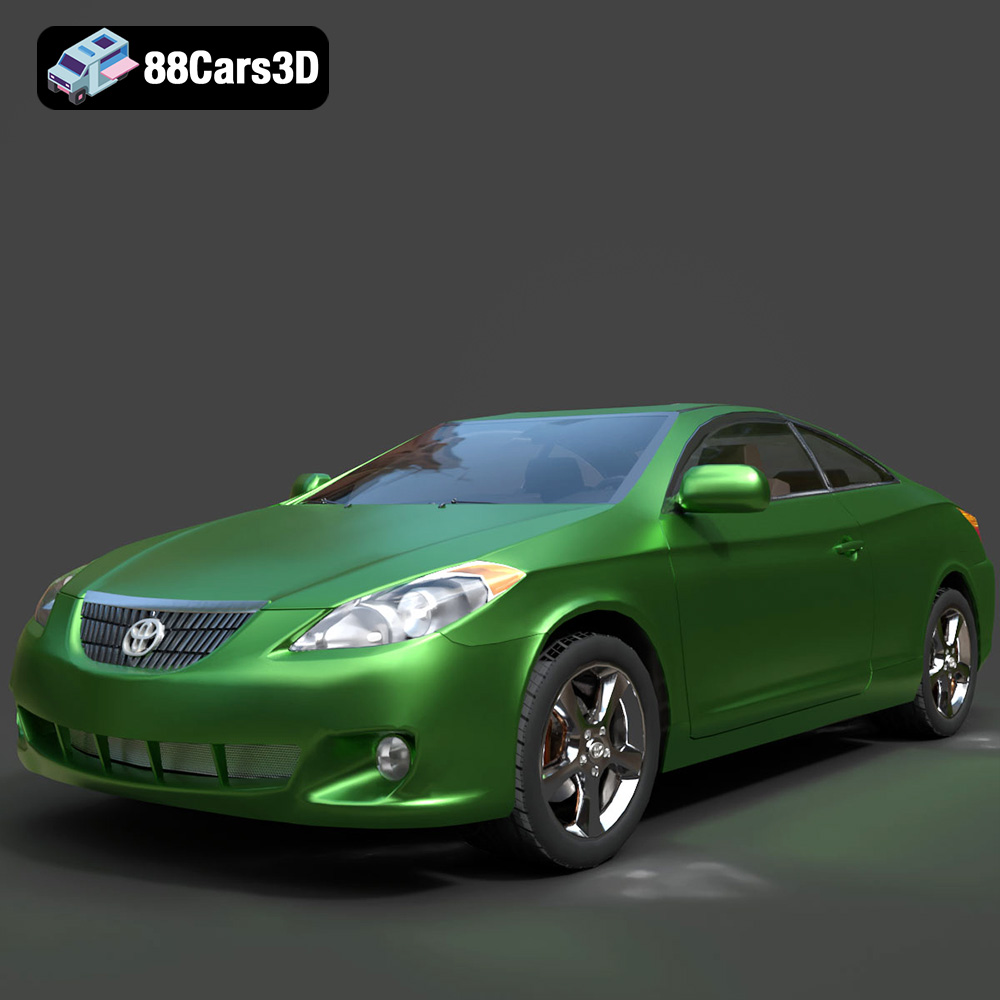
Texture: Yes
Material: Yes
Download the Toyota Camry Solara 2006 3D Model featuring clean geometry, realistic detailing, and a fully modeled interior. Includes .blend, .fbx, .obj, .glb, .stl, .ply, .unreal, and .max formats for rendering, simulation, and game development.
Price: $10

