Get 50% OFF All Premium 3D & STL Models!

“`html
The allure of automotive design, coupled with the accessibility of 3D printing, has created a thriving community of enthusiasts crafting miniature cars and intricate vehicle components. Whether you’re a seasoned 3D printing veteran or just beginning your journey, achieving flawless prints of automotive models requires a deep understanding of STL files, printer settings, slicing techniques, and post-processing methods. This comprehensive guide will equip you with the knowledge and skills to transform digital designs into tangible, high-quality 3D printed car models. We’ll explore everything from prepping your STL files to optimizing your printer settings and mastering essential post-processing techniques. Get ready to take your automotive 3D printing projects to the next level!
The foundation of any successful 3D print lies in the quality of the STL file. STL (Stereolithography) is a file format that represents the surface geometry of a 3D object using a collection of triangles. For automotive models, which often feature complex curves and intricate details, a well-structured STL file is crucial. A poorly designed or corrupted STL file can lead to printing errors, surface imperfections, and structural weaknesses in the final product. Platforms like 88cars3d.com offer print-ready STL files that are optimized for 3D printing, saving you significant time and effort in file preparation.
STL files store surface information as a series of triangles. The higher the number of triangles used to represent a curved surface, the smoother and more accurate the representation. However, increasing the triangle count also increases the file size and processing time during slicing. Finding the right balance between resolution and file size is key. For automotive models, pay close attention to areas with complex curves, such as the hood, fenders, and roofline. Aim for a resolution that captures these details without creating an excessively large file. A good starting point is a deviation tolerance of 0.01mm – 0.05mm during STL export from your CAD software.
A “manifold” mesh is a closed, watertight surface. Non-manifold geometry includes issues like holes, self-intersections, and disconnected edges. These errors can confuse the slicer and lead to failed prints. Before printing, always inspect your STL file for these issues. Software like Meshmixer, Netfabb, and even online services can automatically detect and repair many common mesh problems. Meshmixer’s “Make Solid” function is particularly useful for converting non-manifold meshes into printable solids. Ensure that your model has proper wall thickness (typically 1-2mm for FDM and resin printing) to provide adequate strength and support.
Slicing is the process of converting a 3D model into a series of 2D layers that the 3D printer can understand and execute. The slicing software takes the STL file as input and generates a G-code file, which contains instructions for the printer’s movements, temperature settings, and material extrusion. The choice of slicing parameters significantly impacts the print quality, speed, and strength of the final automotive model. Experimentation and fine-tuning are essential to achieve optimal results. Popular slicing software includes Cura, PrusaSlicer, Simplify3D, and Chitubox (for resin printing).
Layer height is the thickness of each individual layer of plastic or resin that the printer deposits. Lower layer heights (e.g., 0.1mm or 0.05mm) result in smoother surfaces and more detailed features, which is critical for automotive models with complex curves. However, lower layer heights also increase the print time significantly. Higher layer heights (e.g., 0.2mm or 0.3mm) are faster but produce less detailed surfaces. A good compromise for automotive models is a layer height of 0.1mm to 0.15mm. Consider adaptive layer height features in slicers like Cura and PrusaSlicer to automatically adjust layer height based on the model’s geometry, using thinner layers for curved surfaces and thicker layers for flat areas.
Infill is the internal structure of the 3D printed object. The infill pattern and density affect the strength, weight, and printing time of the model. For automotive models, a moderate infill density (15-25%) is typically sufficient for structural integrity. Common infill patterns include rectilinear, grid, gyroid, and honeycomb. Gyroid infill offers a good balance of strength and material usage. For areas that require extra support or strength, such as the chassis or mounting points, consider increasing the infill density locally using modifier meshes within your slicing software. When downloading models from marketplaces such as 88cars3d.com, you can often find recommendations for optimal infill settings tailored to specific car models.
Support structures are temporary structures that are printed to support overhanging features of the model during printing. Without support structures, these overhanging sections would collapse or deform. Generating and removing support structures can be one of the most challenging aspects of 3D printing, especially for complex automotive models. The goal is to create supports that are strong enough to provide adequate support but easy to remove without damaging the model’s surface. Choosing the right support type, density, and placement is crucial.
Most slicing software offers automatic support generation. While convenient, automatic supports are not always optimal. They can sometimes generate unnecessary supports in areas that don’t require them, or fail to provide adequate support in critical areas. Manual support placement allows you to fine-tune the support structures to match the specific needs of your model. This requires more time and effort but often results in cleaner prints with less post-processing. In Cura, for example, the “Custom Support” plugin allows you to add and customize supports precisely where they are needed.
The interface between the support structure and the model’s surface is critical for easy removal and minimal surface damage. A dense support interface can be difficult to remove and may leave behind unsightly marks. Using a thinner interface layer or a different material for the interface layer (e.g., PVA for PLA supports) can facilitate easier removal. After printing, carefully remove the support structures using tools like pliers, cutters, and knives. Heat can also be used to soften the support material and make it easier to remove. Be patient and work slowly to avoid damaging the model’s surface. Post-processing techniques like sanding and polishing can be used to smooth out any remaining marks.
The choice of material and printer settings significantly impacts the final quality and durability of your 3D printed automotive model. Different materials have different properties, such as strength, flexibility, and temperature resistance. Understanding these properties and how they interact with your 3D printer is crucial for achieving optimal results. Furthermore, proper printer calibration and maintenance are essential for consistent and reliable prints.
FDM (Fused Deposition Modeling) and resin printing (SLA, DLP, LCD) are the two most common 3D printing technologies. FDM printing uses thermoplastic filaments, such as PLA, PETG, and ABS. Resin printing uses liquid resins that are cured by UV light. FDM printing is generally more affordable and suitable for larger parts, while resin printing offers higher resolution and finer details, making it ideal for intricate automotive models. PLA is a good starting point for beginners due to its ease of use and low cost. PETG offers improved strength and temperature resistance. ABS is more durable but requires a heated bed and enclosure to prevent warping. Resin printing provides incredibly detailed prints but requires careful handling of the resin and proper post-processing (washing and curing).
Regular printer calibration and maintenance are essential for consistent and reliable prints. For FDM printers, this includes leveling the bed, calibrating the extruder, and adjusting the print speed and temperature settings. For resin printers, this includes calibrating the exposure time, cleaning the resin vat, and leveling the build plate. A well-calibrated printer will produce accurate and consistent results, reducing the likelihood of printing errors. Regularly clean your printer and lubricate moving parts to ensure smooth operation. Regularly check and tighten belts, screws, and other components to prevent mechanical issues.
Post-processing is the process of refining and finishing the 3D printed object after it has been removed from the printer. This can include sanding, painting, assembly, and other techniques to improve the appearance, functionality, and durability of the model. For automotive models, post-processing is often essential to achieve a realistic and professional finish. Proper post-processing can transform a raw 3D print into a stunning replica.
Sanding is used to smooth out surface imperfections and layer lines. Start with a coarse grit sandpaper (e.g., 220 grit) to remove major imperfections, and then gradually move to finer grits (e.g., 400, 600, 800 grit) to achieve a smooth surface. Wet sanding can help to reduce dust and improve the surface finish. For complex automotive models, use a variety of sanding tools, such as sanding blocks, sponges, and rotary tools, to reach difficult areas. After sanding, thoroughly clean the model to remove any dust or debris.
Painting is used to add color and detail to the model. Priming the model before painting helps to improve adhesion and create a uniform surface. Use high-quality model paints and apply thin, even coats to avoid drips and runs. Airbrushing can provide a more even and professional finish. After painting, consider adding finishing touches like clear coats, decals, and weathering effects to enhance the realism of the model. Apply several thin coats of clear coat for a durable and glossy finish.
Even with careful planning and execution, 3D printing failures can occur. Understanding the common causes of these failures and how to troubleshoot them is essential for becoming a proficient 3D printer. Early identification of issues and proactive adjustments can save time, materials, and frustration. A methodical approach to troubleshooting will help you pinpoint the problem and implement an effective solution.
Warping occurs when the corners of the print lift off the build plate. This is often caused by poor bed adhesion or temperature fluctuations. To prevent warping, ensure that the bed is properly leveled and cleaned. Use a bed adhesive, such as glue stick, hairspray, or painter’s tape, to improve adhesion. For materials like ABS, use a heated bed and enclosure to maintain a consistent temperature. Increasing the bed temperature can also help to improve adhesion. Experiment with different bed temperatures to find the optimal setting for your material.
Stringing and blobs are caused by excessive material oozing from the nozzle during non-printing moves. To prevent stringing, reduce the printing temperature, increase the retraction distance, and decrease the retraction speed. Ensure that the nozzle is properly tightened and that the filament is dry. Blobs can also be caused by inconsistent extrusion. Calibrate the extruder to ensure that it is extruding the correct amount of material. Check for clogs in the nozzle and clean it if necessary.
3D printing automotive models is a rewarding but challenging endeavor. By understanding STL files, optimizing slicing parameters, mastering support structures, selecting the right materials, and mastering post-processing techniques, you can create stunning and realistic replicas of your favorite cars. Remember to troubleshoot common printing failures and to continuously refine your skills through experimentation and learning. Don’t be afraid to try new things and to explore the vast resources available online. The journey of mastering 3D printing is a continuous learning process, and with dedication and perseverance, you can achieve impressive results. The models available on 88cars3d.com are a great starting point for practicing these techniques and improving your 3D printing skills. Happy printing!
“`
Texture: Yes
Material: Yes
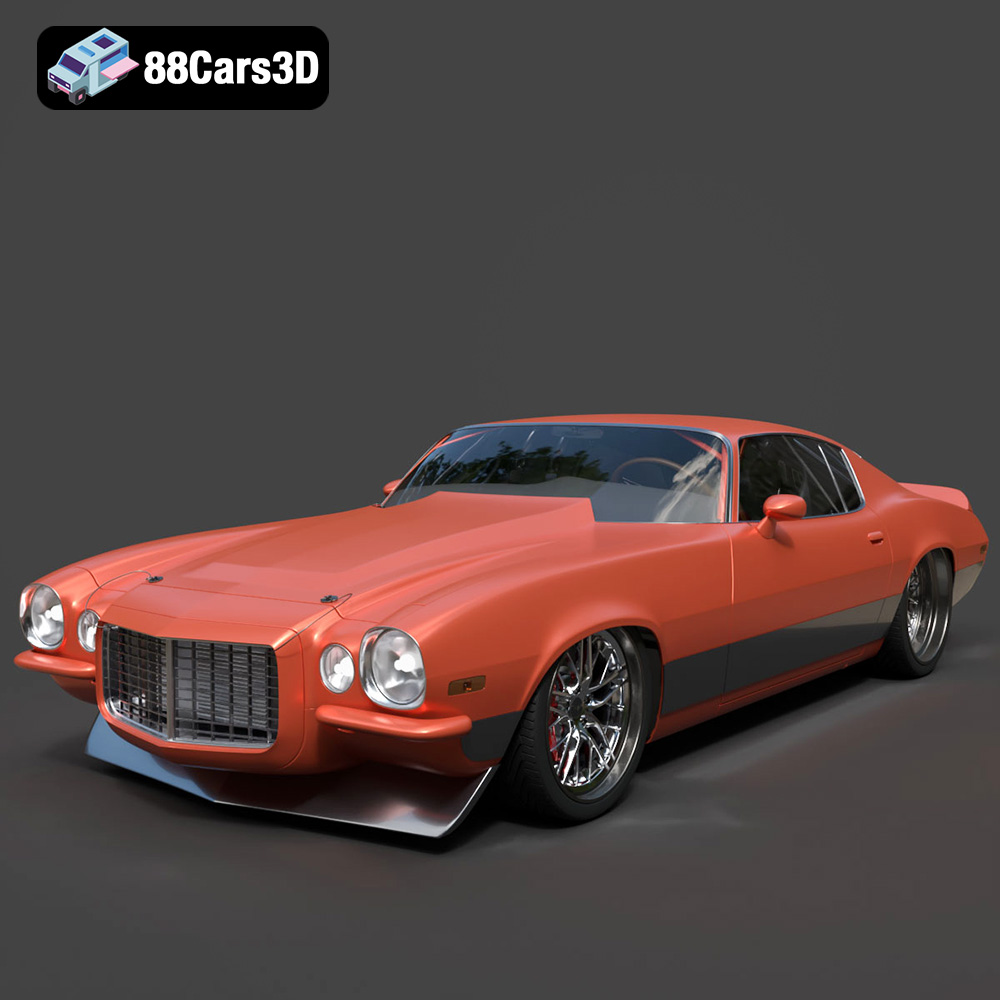
Download the Chevrolet Camaro 1970 3D Model featuring clean geometry, realistic detailing, and a fully modeled interior. Includes .blend, .fbx, .obj, .glb, .stl, .ply, .unreal, and .max formats for rendering, simulation, and game development.
Price: $10

**Meta Description:**
Texture: Yes
Material: Yes
Download the Toyota Crown Majesta 2009 3D Model with luxury detailing, clean topology, and a fully modeled interior. Available in .blend, .fbx, .obj, .glb, .stl, .ply, .unreal, and .max formats for rendering, simulation, and game development.
Price: $4.99

**Meta Description:**
Texture: Yes
Material: Yes
Download the Toyota AE86 Levin 1983 1987 3D Model featuring realistic exterior and interior detailing. Includes .blend, .fbx, .obj, .glb, .stl, .ply, .unreal, and .max formats for rendering, simulation, and game development.
Price: $9.99

Texture: Yes
Material: Yes
Download the Toyota Mark 2 2001 3D Model featuring clean geometry, realistic detailing, and a fully modeled interior. Includes .blend, .fbx, .obj, .glb, .stl, .ply, .unreal, and .max formats for rendering, simulation, and game development.
Price: $4.99

Texture: Yes
Material: Yes
Download the Toyota Celica 2000 3D Model featuring clean geometry, realistic detailing, and a fully modeled interior. Includes .blend, .fbx, .obj, .glb, .stl, .ply, .unreal, and .max formats for rendering, simulation, and game development.
Price: $4.99

Download the Toyota Camry US 2012 3D Model featuring clean geometry, realistic detailing, and a fully modeled interior. Includes .blend, .fbx, .obj, .glb, .stl, .ply, .unreal, and .max formats for rendering, simulation, and game development.
Price: $4.99

Texture: Yes
Material: Yes
Download the Toyota GT 86 2013 3D Model featuring clean geometry, realistic detailing, and a fully modeled interior. Includes .blend, .fbx, .obj, .glb, .stl, .ply, .unreal, and .max formats for rendering, simulation, and game development.
Price: $4.99

Texture: Yes
Material: Yes
Download the Toyota Mark X 2010 3D Model featuring clean geometry, realistic detailing, and a fully modeled interior. Includes .blend, .fbx, .obj, .glb, .stl, .ply, .unreal, and .max formats for rendering, simulation, and game development.
Price: $4.99

Texture: Yes
Material: Yes
Download the Toyota Allion 2008 3D Model featuring clean geometry, realistic detailing, and a fully modeled interior. Includes .blend, .fbx, .obj, .glb, .stl, .ply, .unreal, and .max formats for rendering, simulation, and game development.
Price: $4.99

Texture: Yes
Material: Yes
Download the Toyota Avensis 2005 3D Model featuring clean geometry, realistic detailing, and a fully modeled interior. Includes .blend, .fbx, .obj, .glb, .stl, .ply, .unreal, and .max formats for rendering, simulation, and game development.
Price: $4.99

