Get 50% OFF All Premium 3D & STL Models!

The world of automotive visualization has been revolutionized by real-time rendering, and at the forefront of this transformation is Unreal Engine. What was once the exclusive domain of offline, time-consuming render farms is now accessible on the desktop, offering interactive, photorealistic experiences that are changing how cars are designed, marketed, and sold. From dynamic car configurators to immersive virtual reality test drives and stunning cinematic commercials, Unreal Engine provides a complete suite of tools to bring digital vehicles to life with breathtaking fidelity. However, achieving these high-end results requires a deep understanding of the engine’s powerful features and a mastery of specific workflows.
This comprehensive guide is your roadmap to mastering automotive visualization in Unreal Engine 5. We will take you through the entire production pipeline, starting with the crucial first step: preparing and importing high-quality 3D car models. We’ll dive deep into the Material Editor to construct complex, multi-layered car paint, glass, and chrome. You’ll learn how to illuminate your vehicle with the revolutionary Lumen dynamic lighting system, bring it to life with Blueprint for interactivity, and leverage the game-changing power of Nanite for unprecedented geometric detail. Finally, we’ll cover optimization strategies and show you how to render beautiful cinematic sequences using Sequencer and the Movie Render Queue. By the end of this article, you will have the technical knowledge to transform a static 3D model into a stunning, interactive, and photorealistic automotive experience.
The foundation of any successful visualization project is meticulous preparation. A well-organized project and properly optimized assets will save countless hours down the line and ensure a smooth, efficient workflow. Before you can create stunning renders, you must first bring your automotive model into the engine correctly and establish a clean working environment. This initial phase sets the stage for everything that follows, from material creation to final rendering, and getting it right is non-negotiable for professional-quality results.
The quality of your final output is directly proportional to the quality of your input assets. For automotive visualization, this means starting with a 3D model that features clean topology (quad-based geometry where possible), proper UV mapping for seamless texture application, and a logical hierarchy of components. When sourcing assets, look for models where parts like doors, wheels, and the steering wheel are separate objects, which is essential for animation and interactivity. Marketplaces like 88cars3d.com specialize in providing production-ready 3D car models that are already optimized for these real-time workflows, featuring PBR textures and clean geometry, saving you significant prep time.
Unreal Engine supports a variety of file formats, but FBX and USD (Universal Scene Description) are the industry standards for complex assets.
A disciplined folder structure is crucial for managing project complexity. Before importing, create a logical hierarchy within your Unreal project’s Content Browser. A common and effective structure for an automotive project looks like this:
Content/
└── Cars/
    └── [Car_Name]/
        ├── Blueprints/
        ├── Materials/
        ├── Meshes/
        ├── Textures/
        └── Sequences/
This organization ensures that all assets related to a specific vehicle are easy to find, modify, and reuse. It also prevents your project from becoming a chaotic mess of unlinked files as it grows in scale.
A 3D model is just a shell; materials are what give it substance, realism, and character. Unreal Engine’s node-based Material Editor is an incredibly powerful tool for creating physically-based rendering (PBR) materials that accurately simulate how light interacts with real-world surfaces. For vehicles, mastering materials for car paint, glass, rubber, and chrome is the key to achieving photorealism.
The Material Editor works by connecting nodes that represent mathematical operations or texture maps to the inputs of a main material node. The core PBR inputs you will constantly work with are:
For an in-depth exploration of all material nodes and their functions, the official Unreal Engine documentation serves as an invaluable resource.
Standard car paint is a complex material with multiple layers. We can simulate this in Unreal Engine using the Clear Coat shading model. This gives us a primary material layer and a secondary, transparent coating on top.
Beyond the paint, other materials complete the look:
Lighting is arguably the single most important element in creating a believable and visually stunning scene. Unreal Engine 5’s Lumen is a revolutionary fully dynamic global illumination and reflections system that provides incredible realism out of the box. It eliminates the need for baking lightmaps, allowing for rapid iteration and real-time feedback as you light your automotive scenes.
Lumen works by tracing rays against a simplified representation of the scene to calculate indirect lighting and reflections. This means that changes to lights, materials, or geometry are reflected in the global illumination instantly. To enable Lumen, navigate to your Project Settings, go to Engine > Rendering, and set both Dynamic Global Illumination Method and Reflection Method to `Lumen`.
Key Lumen features for automotive visualization include:
To get the best quality, you can adjust Lumen’s settings in a Post Process Volume, increasing the Final Gather Quality for cleaner results, at the cost of performance.
While Lumen is powerful, it can be performance-intensive. For projects targeting lower-end hardware, mobile, or VR, traditional baked lighting remains a valid and highly optimized workflow. Using Static Lights and the Lightmass Global Illumination system, Unreal Engine pre-calculates (bakes) all the lighting information into texture maps called lightmaps. This results in extremely fast rendering performance, as the lighting calculations are already done. The tradeoff is flexibility; if you move a light or an object, you must re-bake the entire scene. This workflow heavily relies on well-made Lightmap UVs in the second UV channel of your meshes.
A classic studio setup is perfect for showcasing a vehicle.
Experiment with the size, intensity, and color temperature of these lights to craft the perfect mood for your shot.
Real-time rendering’s true power is unlocked through interactivity. Unreal Engine’s Blueprint visual scripting system allows artists and designers to create complex interactive experiences without writing a single line of code. For automotive visualization, this means building car configurators, animating components, and even setting up drivable vehicle physics.
A car configurator is a staple of automotive marketing. Here’s a basic workflow to create a paint color switcher using Blueprint:
This simple setup can be expanded to swap wheel styles, interior trims, and other customizable features.
To create animations like opening doors or a trunk, you need to set up the hierarchy correctly. In your 3D modeling software, ensure the door’s pivot point is correctly placed at its hinge.
Inside the `BP_Car` Blueprint, add the door as a separate Static Mesh Component and place it correctly relative to the car body. Then, in the Event Graph, you can use a Timeline node. A Timeline allows you to animate a value over a set period. You can create a float track in the Timeline that goes from 0 to 1 over a second. On the `Update` output of the Timeline, use a `Set Relative Rotation` node for the door component. Use a `Lerp (Rotator)` node to smoothly interpolate between the closed rotation and the open rotation, driven by the output of the Timeline. Triggering the `Play` and `Reverse` inputs of the Timeline will open and close the door smoothly.
For fully drivable cars, Unreal Engine provides the Chaos Vehicle system. This is a more advanced topic but involves setting up a specific Blueprint based on the `WheeledVehiclePawn` class. You then configure a Vehicle Movement Component, where you define engine characteristics, transmission settings, and wheel setups. You need to create special Physics Assets and Animation Blueprints to connect the visual wheel rotation to the underlying physics simulation. While complex, it allows for the creation of realistic, physics-driven vehicle simulations for games or interactive test drives.
Unreal Engine 5’s Nanite virtualized geometry system is a paradigm shift for real-time graphics, especially for hard-surface models like vehicles. Nanite allows you to render models composed of millions of polygons in real-time without the traditional performance costs, manual LOD (Level of Detail) creation, or normal map baking. This means you can use your cinematic-quality, high-poly source assets directly in the engine.
Traditionally, a 5-million polygon car model would be impossible to render in real-time. It would need to be manually retopologized down to 100k-200k polygons, with details baked into normal maps. Nanite intelligently streams and renders only the geometric detail you can perceive on screen. It breaks the mesh down into clusters of triangles and seamlessly scales their detail up or down on the fly. This frees artists from polygon budgets and allows for the use of incredibly detailed assets, such as those found on platforms like 88cars3d.com, without any manual optimization. To enable Nanite on a mesh, simply open the Static Mesh Editor, find the Nanite Settings, and check Enable Nanite Support.
Nanite is ideal for the static, rigid components of a vehicle: the body, chassis, wheels, and detailed interior elements like the dashboard and seats. However, it has some limitations to be aware of. As of Unreal Engine 5.3, Nanite does not support:
For this reason, a common workflow is to use Nanite for the main car body and interior, while using standard Static Meshes for components like glass windows.
Even with Nanite, performance is not infinite. It is crucial to profile your scene to find bottlenecks. Use the console command `Stat GPU` to see a detailed breakdown of what your graphics card is spending time on. Look for high costs in areas like shadows, reflections, or Lumen. `Stat Unit` will show you if you are limited by the CPU (Game/Draw thread) or GPU.
Beyond Nanite, other optimization techniques include:
Once your car is modeled, textured, lit, and placed in a scene, the final step is to capture its beauty. Unreal Engine’s Sequencer is a professional, non-linear editing tool that allows you to create cinematic sequences directly within the engine. Combined with the Movie Render Queue, it provides all the tools needed to produce final-pixel quality videos and still images.
To begin, create a Level Sequence asset. Drag this into your scene to create a Sequencer instance. You can then add actors from your level—such as your car Blueprint and any cameras—to the Sequencer timeline as “tracks.” On these tracks, you can keyframe almost any property: location, rotation, material parameters, light intensity, and more. This gives you complete control to animate your scene over time, creating everything from a simple camera pan to a complex, multi-shot commercial.
For cinematic results, use a Cine Camera Actor. This camera type offers real-world camera settings like Focal Length, Aperture (f-stop), and Focus Distance. Animating these properties can create professional camera techniques like rack focus. To control the final look of your image, add a Post Process Volume to your scene (or use the built-in track in Sequencer). Here you can adjust:
While you can export directly from Sequencer, the Movie Render Queue (MRQ) offers far superior quality and control. It’s a separate plugin you may need to enable. MRQ renders frames offline, allowing it to use higher-quality settings than are possible in real-time.
Key MRQ settings for automotive visualization include:
You have now journeyed through the entire pipeline of creating state-of-the-art automotive visualizations in Unreal Engine 5. We’ve seen that the process begins not in the engine, but with the selection of a pristine, high-quality 3D asset. From there, we meticulously built up layers of realism through PBR materials, sculpted mood and form with dynamic Lumen lighting, and introduced life with Blueprint-driven interactivity. We leveraged the raw power of Nanite to render immense detail and learned how to profile and optimize for smooth performance. Finally, we framed our creation through the cinematic lens of Sequencer, producing a polished final product with the Movie Render Queue.
The synergy between high-fidelity 3D car models and the powerful real-time toolset of Unreal Engine opens up limitless possibilities. The key takeaway is that every stage builds upon the last; a great material cannot save a poor model, and brilliant lighting is lost without a detailed subject to illuminate. By starting with professionally crafted assets, such as the game-ready models available from marketplaces like 88cars3d.com, you position yourself for success. Now it’s your turn to apply these techniques. Open the engine, import a model, and start creating the future of automotive visualization today.

Texture: Yes
Material: Yes
Download the Mercedes S-Class 2024 3D Model featuring clean geometry, realistic detailing, and a fully modeled interior. Includes .blend, .fbx, .obj, .glb, .stl, .ply, .unreal, and .max formats for rendering, simulation, and game development.
Price: $10

Texture: Yes
Material: Yes
Download the Chevrolet Camaro 1970 3D Model featuring clean geometry, realistic detailing, and a fully modeled interior. Includes .blend, .fbx, .obj, .glb, .stl, .ply, .unreal, and .max formats for rendering, simulation, and game development.
Price: $10

Texture: Yes
Material: Yes
Download the Mercedes-AMG GT 2015 3D Model featuring clean geometry, realistic detailing, and a fully modeled interior. Includes .blend, .fbx, .obj, .glb, .stl, .ply, .unreal, and .max formats for rendering, simulation, and game development.
Price: $88.99

Texture: Yes
Material: Yes
Download the Suzuki GSX-R 1000 3D Model featuring clean geometry, realistic detailing, and a fully modeled interior. Includes .blend, .fbx, .obj, .glb, .stl, .ply, .unreal, and .max formats for rendering, simulation, and game development.
Price: $10

Texture: Yes
Material: Yes
Download the Porsche Cayman S 2024 3D Model featuring clean geometry, realistic detailing, and a fully modeled interior. Includes .blend, .fbx, .obj, .glb, .stl, .ply, .unreal, and .max formats for rendering, simulation, and game development.
Price: $10

Texture: Yes
Material: Yes
Download the Holden Commodore Sportwagon 2017 3D Model featuring clean geometry, realistic detailing, and a fully modeled interior. Includes .blend, .fbx, .obj, .glb, .stl, .ply, .unreal, and .max formats for rendering, simulation, and game development.
Price: $10

Texture: Yes
Material: Yes
Download the Mitsubishi Colt 3 Door 2008 3D Model featuring clean geometry, realistic detailing, and a fully modeled interior. Includes .blend, .fbx, .obj, .glb, .stl, .ply, .unreal, and .max formats for rendering, simulation, and game development.
Price: $10

Texture: Yes
Material: Yes
Download the Mercedes-Benz S650 Pullman 3D Model featuring clean geometry, realistic detailing, and a fully modeled interior. Includes .blend, .fbx, .obj, .glb, .stl, .ply, .unreal, and .max formats for rendering, simulation, and game development.
Price: $95.99

Texture: Yes
Material: Yes
Download the Mercedes G-Class SUV 2024 3D Model featuring clean geometry, realistic detailing, and a fully modeled interior. Includes .blend, .fbx, .obj, .glb, .stl, .ply, .unreal, and .max formats for rendering, simulation, and game development.
Price: $10
Texture: Yes
Material: Yes
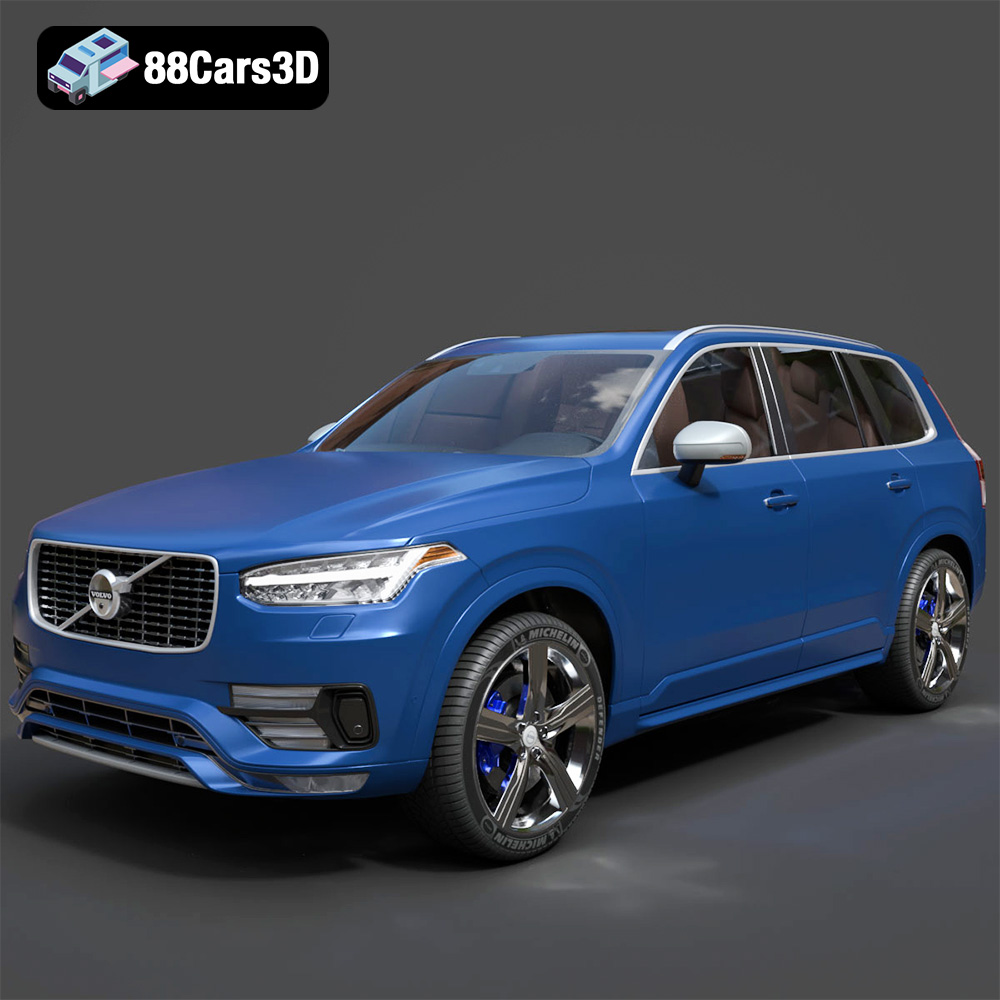
Download the Volvo XC90 R-Design 2015 3D Model featuring clean geometry, realistic detailing, and a fully modeled interior. Includes .blend, .fbx, .obj, .glb, .stl, .ply, .unreal, and .max formats for rendering, simulation, and game development.
Price: $10

